The first carton of chocolate milk struck my shoulder so hard that it burst against the wall behind me.
For half a second, nobody moved.
Brown liquid slid down the painted cinder blocks of the theater-practice room, dripping over a faded poster from last year’s production of The Crucible. A torn corner of the carton clung to my light puffer jacket. Cold milk soaked through the fabric and spread across my shirt.
Then someone laughed.
It was only one nervous sound from the back of the room, but it gave everyone else permission to breathe again. Whispers broke out. Phones lifted. A chair scraped across the floor.
And standing at the center of it all, with one hand still extended from the throw, was Isabelle Laurent.
She looked exactly like the kind of person people believed before she even spoke.
Her personalized black bomber jacket had her initials embroidered in gold across the chest. Her joggers probably cost more than everything I was wearing. White premium earbuds hung around her neck like jewelry, even though our theater director had told us repeatedly not to wear them during rehearsal.
Her face was calm.
Mine was wet, burning, and covered in chocolate milk.
“Stop pretending you’re the victim,” Isabelle said.
The room went silent again.
I tightened both hands around the clear plastic evidence sleeve pressed against my stomach.
Inside it were three pages of dialogue, a torn strip of fluorescent paper, and a black marker with a cracked silver cap.
None of it looked dramatic.
That was the problem.
A lie could enter a room screaming.
Proof usually arrived quietly.
My name is Nina Chavez. I was seventeen years old, a junior at Westbridge Arts Academy in Austin, Texas, and until that morning, the worst thing anyone had ever accused me of was returning a library book two days late.
I was not popular. I was not mysterious. I did not have a dramatic past or a powerful family.
I was the girl who stayed after rehearsals to stack chairs because no one else remembered. I carried safety pins, pain relievers, spare pencils, and cough drops in my backpack. I knew which stage door stuck during cold weather and which microphone cable had to be twisted before it worked.
The theater department did not notice me often.
That was how I liked it.
But quiet people see things.
Sometimes we see too much.
Three hours before Isabelle threw the milk, I had arrived early for improv rehearsal because Mr. Bell had asked me to collect the anonymous dialogue cards from the rehearsal box.
The exercise was supposed to be simple. Each student had written one harmless opening line on a card. Mr. Bell would shuffle them, and pairs of actors would build improvised scenes around whatever line they drew.
It was meant to help us think quickly.
It was meant to be fun.
Instead, someone had planted a series of cruel, humiliating lines aimed at specific students.
One mocked Malik Turner’s stutter.
Another joked about the scars on Emma Chen’s arm from a childhood accident.
A third accused Daniel Ruiz’s father of being undocumented.
The fourth card was about me.
It read:
“Maybe Nina cleans up after everyone because that is the only role her family knows how to play.”
I had stared at the words for a long time.
Not because I had never heard that kind of insult before.
Because I recognized the handwriting.
At least, I thought I did.
The letters leaned slightly to the right. Every lowercase “a” had an open top. The writer pressed so hard that the marker had left shallow grooves in the paper.
I had seen that handwriting on rehearsal notes, cast lists, birthday cards, and posters taped across the school.
It looked like Isabelle’s.
But handwriting alone was not proof.
And Isabelle Laurent was not just another theater student.
She was the department’s brightest star.
Her mother chaired the Westbridge Arts Foundation. Her father owned three boutique hotels downtown and had paid for the new lighting board in our main auditorium. Isabelle had played the lead in every production since freshman year. Teachers called her “driven.” Students called her “untouchable,” though never where she could hear them.
When she entered a room, people made space.
When I entered one, people handed me things to carry.
I should have put the cards back.
I should have waited for Mr. Bell.
Instead, I noticed something else.
The anonymous dialogue cards had been cut from ordinary white index stock. But beneath the planted cards were tiny curls of fluorescent yellow paper, as if someone had trimmed them on top of another sheet.
That color mattered.
The only fluorescent yellow paper in the department was used for emergency script revisions. It was kept in a locked cabinet inside the costume office.
I knew because I inventoried supplies every Friday.
I also knew the cabinet had been opened recently.
A narrow strip of yellow paper was caught beneath the bottom hinge.
My stomach tightened.
I walked into the costume office and found the cabinet door unlocked.
Inside, one package of fluorescent paper had been torn open.
Beside it lay a black marker with a cracked silver cap.
The marker was still damp.
That was when I heard footsteps.
I slipped the marker, the paper strip, and the planted dialogue into an evidence sleeve we used for prop labels. Then I stepped behind the rolling costume rack just as someone entered.
Through the narrow gap between coats, I saw Isabelle.
She closed the door behind her.
Her expensive earbuds were in.
She crossed directly to the cabinet.
When she saw it open, she froze.
Then she began searching.
Not casually.
Frantically.
She checked beneath fabric bins, behind folders, inside the trash can. Her breathing sharpened. She pulled open drawers hard enough to rattle the scissors inside.
Finally, she took out her phone and whispered, “It’s gone.”
I could not hear the response.
Isabelle turned toward the costume rack.
For one terrifying second, I thought she had seen my shoes.
Then a bell rang in the corridor, and she hurried out.
I waited until her footsteps disappeared before moving.
My hands were shaking.
I had no idea who she had called.
I had no idea whether she had written the cards herself or was covering for someone else.
But I knew one thing.
She had come looking for the evidence before anyone publicly knew it existed.
I carried the sleeve straight toward Mr. Bell’s office.
He was not there.
His door was locked, and a handwritten note said he had been called into an administrative meeting.
Behind me, someone said, “What are you holding?”
I turned.
Isabelle stood at the far end of the hall.
Her face had changed.
The panic was gone.
In its place was a wounded expression so perfect that I almost doubted what I had seen.
“Nina,” she said softly, “why were you going through my things?”
“They weren’t your things.”
Her eyes dropped to the evidence sleeve.
“Give me that.”
“No.”
She walked closer.
Students began appearing from nearby classrooms. The hallway between the theater wing and music rooms was always crowded before rehearsal.
Isabelle lowered her voice.
“You don’t understand what you found.”
“Then explain it.”
“I can’t explain it here.”
“You can explain it to Mr. Bell.”
Her jaw tightened.
“Nina, listen to me. Someone is trying to hurt people.”
“I know.”
“And you’re making it worse.”
“How?”
“By carrying that around like you solved something.”
I looked directly at her.
“You were searching the cabinet.”
Something flickered in her eyes.
Then she smiled.
Not kindly.
“Be careful,” she whispered. “You’re not as invisible as you think.”
She turned away before I could answer.
Within twenty minutes, the rumor had spread across the theater department.
Nina Chavez had written the insulting dialogue cards.
Nina Chavez had been caught stealing supplies.
Nina Chavez had planted the messages because she was jealous of Isabelle’s success.
By the time improv rehearsal began, half the room had already decided I was guilty.
That was the moment I understood Isabelle’s real talent.
It was not acting.
It was directing people without letting them know they had been given a script.
When I entered the practice room, forty students were waiting.
The rehearsal space was long and windowless, with black-painted walls, portable risers, prop tables, and mirrors covered by gray curtains. Fluorescent lights buzzed overhead.
Mr. Bell still had not returned.
Ms. Rios, the assistant director, stood near the sound console looking confused.
Isabelle sat on the front riser, surrounded by her friends.
She did not accuse me immediately.
She waited until everyone noticed me.
Then she stood.
“There she is.”
I stopped just inside the doorway.
Malik looked away from me.
Emma’s face was pale.
Daniel folded his arms.
Isabelle held up one of the cruel dialogue cards.
Not the original.
A photograph of it on her phone.
“I think Nina owes us an explanation,” she said.
“I was bringing the cards to Mr. Bell.”
“After writing them?”
“I didn’t write them.”
Isabelle gave a sad little laugh.
“You were the only person assigned to collect them.”
“Someone put them in the box before I arrived.”
“And somehow you found a marker, paper scraps, and everything else you needed to create a convincing story.”
I held up the sleeve.
“I found these in the costume office.”
“Where you were not supposed to be.”
“I inventory that office every Friday.”
“It’s Tuesday.”
A few people laughed.
I felt the heat rise in my face.
Ms. Rios stepped forward. “All right. Everyone needs to calm down.”
“I am calm,” Isabelle replied. “I just think the people she targeted deserve the truth.”
She turned toward Malik.
“Nina has always been angry that some of us get more opportunities.”
“That isn’t true.”
“She complained about the casting list last month.”
“I asked why Malik’s audition score had been entered incorrectly.”
“And she accused the department of favoritism.”
“I asked for the original score sheet.”
Isabelle faced the room.
“Do you hear that? It is always records and forms and evidence with her. She acts like everyone is dishonest except her.”
That was how she did it.
She turned facts into personality flaws.
Questions became bitterness.
Carefulness became obsession.
Silence became guilt.
“I want Ms. Rios to look at what I found,” I said.
Isabelle’s eyes sharpened.
“Of course you do. Because you prepared it.”
She crossed to the refreshment table.
For a second, I thought she was walking away.
Then she grabbed the chocolate milk.
The carton struck me before Ms. Rios could react.
Cold liquid splashed across my jacket, my cheek, and the floor.
Gasps filled the room.
Isabelle picked up a paper plate loaded with pasta salad and threw that too.
It hit my chest and slid downward in clumps.
Someone shouted her name.
Another person laughed.
Phones rose higher.
My eyes burned. My hands shook. The humiliation was so complete that my body seemed to shrink inside itself.
I wanted to run.
I wanted to disappear into the restroom, lock the door, and stay there until no one remembered my name.
Then I looked down at the evidence sleeve.
Chocolate milk covered the outside.
The documents inside were still dry.
Isabelle stepped closer.
“Give it to me,” she said.
“No.”
Her voice dropped.
“You have no idea what you’re doing.”
“No,” I whispered. “But you do.”
She reached for the sleeve.
I pulled it against my chest.
Ms. Rios finally moved between us.
“That is enough!”
Isabelle backed away at once. Her expression transformed from fury to shock.
“She threatened me,” she said.
I stared at her.
“What?”
“She said she was going to destroy my family.”
“I never said that.”
“She cornered me in the hall.”
“You approached me.”
“She has been following me for weeks.”
“That is a lie.”
Isabelle looked at the students.
“Ask anyone. She is always watching me.”
People shifted uncomfortably.
The accusation was absurd.
It was also just believable enough.
I was quiet.
I noticed things.
I knew schedules, room codes, inventory lists, and rehearsal times.
In the wrong voice, those habits could sound frightening.
Ms. Rios held out her hand. “Nina, give me the sleeve.”
I hesitated.
Isabelle saw it.
Her lips parted slightly.
She wanted me to refuse.
She wanted me to look irrational.
I placed the sleeve in Ms. Rios’s hand.
“Please don’t let anyone leave with it,” I said.
Isabelle laughed. “Listen to her.”
Ms. Rios ignored her and studied the contents.
“What exactly am I looking at?”
“The planted cards, a paper strip from the costume cabinet hinge, and the marker I found beside the opened package.”
“Did anyone see you find them?”
“No.”
“Convenient,” Isabelle said.
“But the cabinet inventory sheet will show who signed out the key.”
Isabelle’s face did not change.
That frightened me more than anger would have.
Ms. Rios walked to the office phone and called the administration building.
While she spoke, Isabelle returned to her friends.
They formed a wall around her.
No one came to stand beside me.
I remained near the doorway, covered in milk and pasta, while the room filled with whispers.
Then Malik approached.
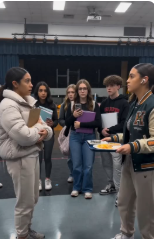
He stopped several feet away.
“Did you write the card about me?”
“No.”
“Look at me when you say it.”
I did.
“No.”
His expression tightened.
“My brother sent me a video from another school. It’s already online.”
My stomach dropped.
“What video?”
“Isabelle confronting you in the hall. Someone posted it with the cards.”
I had not seen anyone filming.
That meant someone had been waiting.
“This was planned,” I said.
Malik gave a bitter smile. “That’s what everybody says when they get caught.”
He walked away.
I looked across the room at Isabelle.
She was watching me over someone’s shoulder.
For the first time, she seemed afraid.
Not of the evidence sleeve.
Of something else.
Ten minutes later, Principal Hargrove entered with the campus security officer and Mr. Bell.
Mr. Bell took one look at me and stopped.
“Nina?”
“I’m fine.”
“You are not fine.”
Isabelle stood quickly.
“Mr. Bell, I was trying to defend everyone she attacked.”
“By throwing food at her?”
“She threatened me.”
“I did not,” I said.
Principal Hargrove raised both hands.
“No one else speaks until we review what happened.”
We were moved to the main auditorium.
The students sat in rows while the adults gathered onstage around a folding table. The evidence sleeve was placed beneath a bright work light.
I sat alone in the front row.
Isabelle sat three seats away with her mother, Celeste Laurent, who had arrived within minutes.
Mrs. Laurent wore a cream-colored suit and the expression of someone who believed every room belonged to her.
She looked at my stained clothes.
Then she looked away.
“My daughter has been subjected to months of harassment,” she told the principal.
“That is not true,” I said.
Mrs. Laurent did not acknowledge me.
“We will be contacting our attorney.”
Principal Hargrove rubbed his forehead. “Mrs. Laurent, we are still determining what occurred.”
“What occurred is obvious. A troubled student created offensive material and attempted to frame Isabelle.”
Mr. Bell turned toward her.
“Nina is not troubled.”
Mrs. Laurent’s eyes hardened. “You may want to reconsider how confidently you make that claim.”
The threat hung in the air.
Mr. Bell’s department depended on foundation funding.
Everyone knew it.
He looked at Isabelle.
“Did you enter the costume office this morning?”
“No.”
The answer came too quickly.
I leaned forward.
“I saw you.”
“You were hiding behind the costumes,” Isabelle said.
A murmur swept through the students.
I froze.
She had just confirmed she was there.
Isabelle realized it a second too late.
Mrs. Laurent gripped her arm.
“What Isabelle means,” she said, “is that Nina has been telling people she hid in the office.”
“No,” Mr. Bell said quietly. “That is not what she said.”
Principal Hargrove asked security to retrieve the costume-office access log.
The officer returned with a thin electronic tablet.
“There’s a problem,” he said. “The key cabinet system shows the costume-office key was checked out at 7:11 this morning under Nina Chavez’s student number.”
Every face turned toward me.
My heart seemed to stop.
“I didn’t check it out.”
“The system requires a student ID,” he said.
“My ID was in my backpack.”
“Where was your backpack?”
“In the practice room.”
“Unattended?”
“For maybe five minutes.”
Isabelle lowered her eyes.
Mrs. Laurent smiled without showing her teeth.
“There is your answer.”
“No,” I said.
My voice sounded too small in the auditorium.
“It isn’t.”
The security officer continued.
“The key was returned at 7:36.”
I had found the cabinet open at approximately 7:40.
Someone had used my student number, planted the physical evidence, returned the key, and left the cabinet unlocked for me to discover.
The realization was devastating.
The evidence I had protected all morning had been designed to point at me.
Even Isabelle’s frantic search could have been part of the performance.
Maybe she had known I was behind the costumes.
Maybe her whispered phone call had been staged.
I looked at her.
For the first time, she would not meet my eyes.
Mrs. Laurent stood.
“This spectacle is finished.”
“Not yet,” Mr. Bell said.
He picked up the black marker.
“The department does not buy this brand.”
Everyone looked at him.
“What?” Principal Hargrove asked.
“Our markers have blue plastic caps. This has a silver cap.”
Mrs. Laurent sighed. “Students bring their own supplies.”
“Yes,” Mr. Bell said. “And this one has a label underneath the barrel.”
He rotated the marker beneath the work light.
A small white inventory sticker appeared.
PROPERTY OF WESTBRIDGE MEDIA LAB.
Principal Hargrove looked toward the security officer.
“Who accessed the media lab this morning?”
The officer checked the tablet.
“One student at 6:48. Isabelle Laurent.”
The auditorium erupted.
Isabelle stood so fast that her chair struck the floor.
“I was recording an audition tape!”
Mrs. Laurent turned pale.
Mr. Bell held up the marker.
“Did you use this?”
“No.”
“Then how did it get from the media lab to the costume office?”
“I don’t know!”
Principal Hargrove called the media teacher.
The response came through the auditorium speakers.
“Yes, Isabelle signed out recording equipment before seven,” the teacher said. “One tripod, one camera, two microphones, and a packet of markers for labeling takes.”
“Did she return them?”
“The camera and tripod. Not the microphones. I assumed she still had them.”
“Microphones?” I repeated.
My skin prickled.
The video from the hallway.
The phone call in the costume office.
The carefully positioned students.
Someone had not merely planted dialogue cards.
Someone had been recording the entire setup.
Mr. Bell looked toward the technical booth.
“Can we access the media lab’s cloud backups?”
Mrs. Laurent stepped forward.
“You have no right to search my daughter’s private files.”
“The equipment belongs to the school,” Principal Hargrove said.
The auditorium projector flickered to life.
A login screen appeared.
The media teacher remotely opened the automatic backup folder connected to the missing microphones.
Dozens of audio files filled the screen.
Each was labeled with a date, time, and device number.
The newest file had begun recording at 6:52 that morning.
It was still running.
A technician clicked it.
At first, we heard static.
Then Isabelle’s voice filled the auditorium.
“Put Nina’s card on top. She notices patterns, so make sure the yellow scraps are visible.”
Every person in the room stopped breathing.
A second voice replied.
Male.
Older.
Familiar.
“You’re certain she’ll take the evidence?”
“She can’t help herself. Nina always thinks records will save people.”
My stomach turned.
I knew that voice.
Everyone did.
It belonged to Principal Hargrove.
He stood beside the folding table, staring at the screen.
The recording continued.
Principal Hargrove’s voice said, “Once she removes the materials, the access log and the hallway video will make it look like she created them.”
Isabelle answered, “And after she is expelled, the complaint disappears.”
“What complaint?” Mr. Bell whispered.
The principal lunged toward the laptop.
The security officer blocked him.
Mrs. Laurent stepped backward.
Her face had gone gray.
More audio played.
Principal Hargrove spoke again.
“Her father’s maintenance reports cannot reach the district board. If Nina keeps asking why the auditorium support beams failed inspection, they’ll trace the repair funds.”
My father.
For six months, my father had worked evenings as a maintenance contractor at Westbridge. Two weeks earlier, he had been fired after reporting that money allocated for auditorium repairs had vanished while the work remained unfinished.
He told me not to get involved.
I had not listened.
I had quietly copied the inspection numbers from a discarded work order and asked Mr. Bell why the dates did not match the school’s public renovation report.
I thought I was helping my father clear his name.
I had not realized the missing funds went higher than the theater department.
The audio crackled.
Isabelle’s voice became unsteady.
“You promised no one would get hurt.”
“No one is getting hurt,” Principal Hargrove replied. “A scholarship student transfers schools. That happens every day.”
Scholarship student.
That was what they called me when they wanted to avoid saying poor.
Isabelle whispered, “My mother said the foundation would lose everything if the audit opened.”
“Your mother is correct.”
Mrs. Laurent covered her mouth.
Isabelle stared at her.
“You knew?”
The question was not on the recording.
She had spoken it in the auditorium.
Mrs. Laurent did not answer.
Isabelle’s face collapsed.
Not theatrically.
Not beautifully.
The confident girl in the embroidered jacket vanished, leaving behind a frightened eighteen-year-old who had suddenly discovered that she had not been protecting her family.
She had been used by it.
The final section of the recording began.
Principal Hargrove said, “After rehearsal, destroy the original inspection file in Nina’s backpack.”
My hand flew toward the bag beneath my seat.
The principal moved first.
He rushed down the stage steps.
The security officer grabbed him, but Hargrove twisted free and reached the aisle.
Students screamed and scattered.
I pulled the backpack against my chest.
Then Isabelle stepped between us.
Hargrove stopped.
“Move,” he ordered.
“No.”
“Isabelle.”
“No.”
Her voice shook, but she did not move.
“You said this would protect my mother.”
“It still can.”
“You put those words about Malik and Emma and Daniel in the box.”
“You approved them.”
“I thought they would be removed before anyone saw them.”
“You wanted Nina blamed.”
Tears streamed down Isabelle’s face.
“Yes,” she said. “I did.”
The admission struck the room harder than the thrown food had.
She turned toward me.
“I hated that you kept finding things I was told not to notice. I hated that you could ask one calm question and make adults panic. I thought if you left, everything would go back to normal.”
She looked down at my ruined jacket.
“But none of it was normal.”
Principal Hargrove tried to push past her.
Isabelle held her ground.
The security officer seized him from behind and pulled him away.
A second later, another voice came from the rear of the auditorium.
“Do not touch the backpack.”
My father stood beneath the exit sign.
He was still wearing his maintenance uniform.
Beside him were two district investigators and an Austin police detective.
I stared at him.
“Dad?”
He walked toward me slowly.
His face was exhausted, but his eyes were clear.
“I’m sorry, mija.”
“For what?”
“For letting you think you were alone.”
He knelt beside my seat and touched the evidence sleeve on the table.
“The papers you found were not the only proof.”
From inside his jacket, he removed a small digital storage drive.
For months, my father had copied every altered inspection report, payment record, and maintenance order connected to the missing renovation funds.
He had not been fired for making an accusation.
He had been fired because Principal Hargrove discovered that he was preparing to testify.
The district investigators had been building a case quietly.
My questions had frightened Hargrove into moving sooner than expected.
But there was one final twist none of us understood.
“How did the investigators know to come today?” Mr. Bell asked.
My father looked at Isabelle.
“She called them.”
I turned toward her.
Isabelle wiped her face.
“When I went into the costume office, I really was looking for the evidence,” she said. “But not to destroy it.”
The auditorium remained silent.
“I knew Nina was behind the rack,” she continued. “I saw her reflection in the mirror. I said, ‘It’s gone,’ because I needed Principal Hargrove to believe the plan was still working.”
She reached beneath the collar of her bomber jacket and pulled out one of the missing school microphones.
“I kept this recording from the moment I entered the media lab.”
The hidden proof had been attached to her the entire time.
She had recorded Hargrove’s instructions.
She had also recorded herself agreeing to frame me.
“Why?” I asked.
Her voice broke.
“Because last night I heard my mother arguing with him. I learned the foundation money had been redirected into my father’s hotels. Hargrove told her you were close to finding the connection. I agreed to help because I thought I could get a confession.”
“You threw food at me.”
“I know.”
“You let everyone believe I wrote those things.”
“I know.”
“You could have told me.”
“I didn’t trust you.”
The honesty hurt more than an excuse.
Isabelle looked around the auditorium.
“And I was afraid that if Nina knew, she would refuse to play the victim.”
A few students lowered their heads.
She had been right.
I would never have agreed.
Isabelle had chosen to hurt me because she believed the outcome justified it.
Her recording exposed the principal.
It did not erase what she had done.
The police escorted Hargrove out of the auditorium.
Mrs. Laurent was taken aside by the district investigators. She did not look at her daughter when she left.
The students remained seated, stunned by the sudden collapse of the world they thought they understood.
Malik was the first to approach me.
“I’m sorry,” he said.
Emma came next.
Then Daniel.
Others followed.
Their apologies blurred together.
I accepted some.
I could not accept all of them yet.
Mr. Bell gave me his jacket to cover the stains. My father sat beside me while the auditorium emptied.
Isabelle remained alone on the front riser.
Her embroidered initials caught the work light.
For once, they did not look powerful.
They looked small.
Three weeks later, Principal Hargrove was formally charged with fraud, evidence tampering, retaliation, and misuse of school funds. The district reopened my father’s contract and issued him a public apology.
Mrs. Laurent resigned from the foundation. Her family’s hotels became part of a larger financial investigation.
The auditorium was closed for emergency structural repairs.
And Isabelle was suspended from performances for the rest of the school year.
Many people thought she should have been expelled.
For a while, I did too.
Then Mr. Bell showed me the complete recording.
There was one section the auditorium had not heard.
After Principal Hargrove left the costume office that morning, Isabelle had spoken into the hidden microphone.
Her voice was barely above a whisper.
“Nina, I don’t know whether you can hear me. I am going to make you hate me. I may not deserve forgiveness afterward. But keep the sleeve. Keep asking for the records. And whatever happens, do not let him take your backpack.”
She had known I was behind the costumes.
She had known the microphone would preserve the truth.
She had also known that if she warned me directly, the trap might collapse before investigators arrived.
That did not make the milk less cold.
It did not make the public humiliation painless.
But it changed the shape of what had happened.
On the final day of school, I found Isabelle sitting outside the locked auditorium doors.
She wore plain jeans and an old gray sweatshirt.
No earbuds.
No embroidered jacket.
She was holding two cups of vending-machine hot chocolate.
“I thought throwing another carton might be inappropriate,” she said.
I almost smiled.
Almost.
She handed me one cup.
We sat in silence.
“I’m not ready to forgive you,” I said.
“I know.”
“I don’t know whether I ever will.”
“I know that too.”
“But I understand why you did it.”
She stared at the floor.
“That might be worse.”
“It probably is.”
For the first time, we both laughed.
It was not a happy sound exactly.
But it was honest.
The district later created a student records committee so financial complaints and safety reports could not be buried by one administrator. Malik joined. Emma joined. Daniel joined.
So did I.
Isabelle was not permitted to hold an official position, but she attended every public meeting and sat in the back row.
She no longer spoke first.
She listened.
My father supervised the auditorium repairs, and when the building reopened that autumn, Mr. Bell chose a new production.
Not a tragedy.
Not a story about revenge.
A story about witnesses, truth, and what happens when people finally stop following the script they were given.
He asked me to audition.
I laughed because I thought he was joking.
“I work backstage,” I reminded him.
“You’ve spent your whole life making sure other people can be seen,” he said. “Maybe it’s your turn.”
On opening night, I stood behind the curtain with my heart pounding.
My father sat in the first row.
Malik, Emma, and Daniel were beside him.
Isabelle stood in the lighting booth, completing community-service hours under supervision.
Just before the curtain rose, a soft voice came through my headset.
“Ready, Nina?”
I looked toward the dark booth above the audience.
For months, I had thought the most powerful person in a room was the one who could command everyone’s attention.
I had been wrong.
Sometimes power belonged to the person holding the quiet record.
Sometimes it belonged to the person brave enough to preserve it.
And sometimes it belonged to the girl who stepped into the light after everyone had already decided she should disappear.
I took a breath.
“Ready.”
The curtain opened.
This time, the room fell silent for me.
THE END
