The slap was loud enough to silence an entire library.
For one strange second, the sound seemed to hang beneath the high arched ceiling, trapped between the shelves of challenged novels, handmade banners, and paper chains covered with student-written quotes about freedom.
My face turned sharply to the side.
A hot sting spread across my cheek.
Somebody gasped.
Somebody else whispered my name.
And then, almost all at once, dozens of phones rose into the air.
Scarlett Vale stood in front of me with one jeweled sandal planted beside the overturned book box. Her silk floral dress looked absurdly delicate for someone whose hand was still clenched at her side.
“You’re sick,” she said.
Her voice trembled just enough to sound wounded.
That was the frightening thing about Scarlett. She knew exactly how much emotion to show. Too little made you look cold. Too much made you look guilty. Scarlett always found the perfect middle.
I pressed my tongue against the inside of my cheek and tasted copper where I had bitten it.
“I asked Ms. Patel to check the barcode records,” I said.
Scarlett gave a breathless laugh and looked toward the crowd.
“Do you hear her? She’s still doing it.”
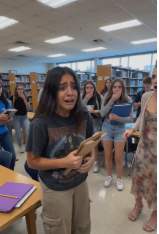
Students packed the central aisle of Hawthorne High School’s library. Banned-Books Week had transformed the room into something between a festival and a protest. Yellow caution tape had been twisted decoratively around displays. Posters announced READ DANGEROUSLY and STORIES DON’T NEED PERMISSION. Teachers had encouraged students to dress as characters from controversial books.
Now nobody was looking at the displays.
They were looking at me.
Sofia Bennett, seventeen years old, standing in an old Static Echoes band shirt, loose khakis, and faded Converse, with a red mark blooming across my cheek.
Beside the circulation desk sat the reason Scarlett had hit me.
A cardboard box labeled RESTRICTED DISPLAY — FACULTY APPROVAL REQUIRED.
Inside were twenty-four books that had been pulled from the student-curated exhibit that morning. According to the labels, they had all been selected by me.
They had not.
Someone had switched the barcode stickers.
And whoever had done it had made sure the school’s most controversial titles appeared under my student identification number.
Books containing violent extremism, explicit propaganda, and materials that were not even approved for circulation had been placed among the challenged classics assigned to our display.
By lunch, rumors had already spread that I had deliberately smuggled prohibited material into the library.
By fifth period, people were saying I wanted the school investigated.
By sixth, Scarlett had announced that she had personally tried to stop me.
She had not expected me to find the box of unused barcode labels beneath the returns cart.
She had definitely not expected me to notice the tiny crescent-shaped tear on the backing paper.
The same tear I had seen on a label Scarlett had peeled from her notebook that morning.
“Move away from the box,” Ms. Patel ordered.
The librarian hurried around the circulation desk, her silver bangles chiming against one another. She was normally the calmest adult in the school. Even students serving detention lowered their voices around her.
Now her face had gone pale.
Scarlett turned immediately.
“She attacked me first.”
A murmur moved through the crowd.
I stared at her.
“You slapped me.”
“She grabbed my wrist!”
“I stopped you from taking the barcode sheet.”
“That sheet is mine.”
“No,” I said. “It belongs to the library.”
Scarlett’s gaze flicked downward.
Only for a second.
But I saw it.
So did Ms. Patel.
On the carpet between us lay a strip of white barcode stickers. Most had been used, leaving empty rectangles behind. Three remained attached.
One of them bore the number assigned to my library account.
Ms. Patel bent to pick it up.
Scarlett moved faster.
Her jeweled sandal came down on the strip.
“Don’t touch that,” Ms. Patel said.
Scarlett froze.
The library doors opened behind the crowd.
Principal Warren entered with two security staff members and Scarlett’s mother.
That was when my stomach dropped.
Victoria Vale did not merely volunteer at Hawthorne High. She chaired the school foundation, organized donor events, and had funded half the new library renovation. Her name appeared on a brass plaque beside the main entrance.
THE VALE LITERACY INITIATIVE.
She wore a cream suit and carried herself like someone accustomed to rooms rearranging themselves around her.
“What happened?” she demanded.
Scarlett’s expression changed.
The fury vanished. Her shoulders folded inward. Tears filled her eyes so quickly that I wondered if she had practiced.
“She cornered me,” Scarlett whispered.
Victoria crossed the room and pulled her daughter close.
Then she looked at me.
Not at the red mark on my face.
Not at the barcode sheet beneath Scarlett’s shoe.
At my clothes.
My old shoes.
The library volunteer badge pinned crookedly to my shirt.
Her eyes measured me in less than a second and arrived at a conclusion.
“Sofia has been obsessed with my daughter for months,” she said.
I heard someone behind me whisper, “I knew it.”
My throat tightened.
“That isn’t true.”
Victoria ignored me.
“She copies Scarlett’s projects. She follows her into student meetings. Last semester, she accused Scarlett of stealing a speech.”
“She did steal it,” I said.
The room changed.
Not loudly.
It was more like a tightening.
Scarlett slowly lifted her head from her mother’s shoulder.
Victoria’s eyes became flat.
Principal Warren stepped forward. “That’s enough. Everybody who isn’t directly involved needs to leave.”
Nobody moved.
He raised his voice.
“Now.”
Students began drifting toward the exits, but their phones stayed raised until the last possible moment. Some looked uncomfortable. Others looked disappointed that the confrontation had not become worse.
My best friend, Jonah Kim, lingered near the reference shelves.
I shook my head at him.
Go.
He hesitated, then slipped something into his jacket pocket and followed the others out.
The library doors closed.
The silence that remained was colder than the crowd had been.
Principal Warren turned to me.
“Sofia, did you switch the labels on these books?”
“No.”
“Did you place restricted materials in the public display?”
“No.”
“Did you grab Scarlett?”
“I stopped her from taking the evidence.”
Victoria gave a disgusted sigh.
“There is no evidence.”
Ms. Patel pointed beneath Scarlett’s foot.
“There is a partial barcode sheet.”
Scarlett stepped back.
The strip on the carpet had crumpled under her sandal.
Victoria looked at it.
For the first time, something uncertain moved across her face.
Then it was gone.
“A sheet my daughter says belongs to her.”
“Library barcode labels never belong to students,” Ms. Patel replied.
Scarlett swallowed.
Principal Warren crouched, picked up the strip by its edge, and placed it on the circulation desk.
“Security footage,” I said. “The camera above the west shelves faces the returns cart. Check it.”
Nobody answered.
I looked at Ms. Patel.
She looked away.
A chill moved through me.
“What?” I asked.
Ms. Patel’s fingers closed around her bangles.
“The west camera stopped recording at nine twelve this morning.”
Scarlett exhaled.
It was almost silent, but I heard it.
Victoria rested a protective hand on her daughter’s back.
“There. So we have no proof, only Sofia’s accusations.”
“We have the barcode sheet.”
“You have a discarded strip that could have come from anywhere.”
“It has Sofia’s account number printed on it,” Ms. Patel said.
“Then perhaps Sofia printed it.”
“I don’t have access to the barcode printer,” I said.
Victoria smiled without warmth.
“Her mother cleans the administrative wing. I assume she has access to many places students do not.”
The words hit harder than the slap.
My mother, Elena Bennett, worked evening maintenance at Hawthorne. She had taken the job after my father died, stacking school shifts on top of weekend office cleaning so we could remain in our apartment.
“She does not steal keys,” I said.
“I didn’t say she did.”
“You wanted everyone to think it.”
Victoria tilted her head.
“I cannot control what people infer from the facts.”
Scarlett looked at the floor.
Something about that bothered me more than her lies.
She should have been triumphant.
Instead, she looked frightened.
Principal Warren rubbed his forehead.
“Until we sort this out, Sofia, you are suspended from library volunteer duties and student media committee activities.”
My chest tightened.
Student media was not just an extracurricular. I was using the portfolio for college applications. I had spent two years building it.
Scarlett knew that.
“What about her?” I asked.
Principal Warren looked toward the mark on my cheek.
“Scarlett will also face consequences for striking you.”
Victoria stiffened.
“My daughter reacted under extreme provocation.”
“She slapped another student.”
“She was being harassed.”
“Stop,” Scarlett whispered.
Everyone turned.
She stared at her mother.
Victoria’s expression softened immediately. “Darling?”
Scarlett shook her head.
“Just stop talking.”
Then she walked out of the library.
Victoria followed.
Principal Warren instructed security to seal the book box and collect the barcode strip. Ms. Patel began photographing everything.
I stood between the shelves and watched my life become evidence.
When I finally left the library, Jonah was waiting outside.
The hall was empty except for him.
He took one look at my cheek and swore softly.
“I recorded it,” he said.
“The slap?”
“Everything from when she came near the box.”
“That proves she hit me. It doesn’t prove she switched the labels.”
“No,” Jonah said. “But this might.”
He pulled his phone from his pocket and opened a photograph.
It showed Scarlett reaching toward the barcode strip.
Behind her, partly visible between two shelves, was a figure in a dark maintenance uniform.
My mother.
The timestamp read 9:11 a.m.
One minute before the camera had stopped recording.
My heart seemed to stop with it.
“Why was my mother there?”
Jonah lowered the phone.
“I thought you knew.”
I called her immediately.
She did not answer.
I called again.
Voicemail.
By the time I reached home, evening rain had begun tapping against the windows. Our apartment smelled faintly of cinnamon and laundry detergent, the two scents that had defined my childhood.
My mother’s work shoes were beside the door.
“Elena?”
She hated when I called her by her first name, which was why I used it when I was scared.
She appeared in the kitchen doorway wearing her navy work uniform.
Her face changed when she saw my cheek.
“What happened?”
“Scarlett slapped me.”
My mother moved toward me, anger flashing across her face.
Then I showed her Jonah’s photograph.
She stopped.
The anger disappeared.
“What were you doing in the library at nine eleven?”
She folded her arms.
“I had a work order.”
“For what?”
“A spill.”
“There was no spill.”
“You don’t know that.”
“The security camera stopped recording one minute later.”
My mother looked toward the rain-streaked window.
“Did you turn it off?”
“No.”
“But you know who did.”
She said nothing.
The quiet between us filled with things I did not understand.
I placed my backpack on the table.
“They are accusing me of switching labels. Mrs. Vale suggested you helped me access the printer.”
My mother’s face tightened.
“She said that?”
“She knew exactly what she was doing.”
“Yes,” my mother murmured. “She usually does.”
The response startled me.
“You know her.”
My mother closed her eyes.
“Not the way you think.”
“How do I think?”
“That she is just another rich parent who believes money makes her untouchable.”
“Isn’t she?”
My mother walked to the kitchen drawer and removed a ring of keys. For a moment, I thought she was preparing to leave.
Instead, she unlocked a small cabinet above the refrigerator.
I had seen that cabinet all my life. It held old tax documents, my father’s death certificate, and papers she checked whenever bills became frightening.
She removed a thin red folder.
Inside was a photograph.
Two teenage girls stood in front of Hawthorne High School’s old entrance.
One was my mother.
The other was Victoria Vale.
They looked about my age.
They were laughing with their arms around each other.
On the back, written in fading blue ink, were the words:
ELENA AND VICKY — BANNED-BOOKS PROTEST, 1998.
I stared at it.
“You went to Hawthorne?”
“For one year.”
“You were friends with her?”
“We were more than friends. We were like sisters.”
“What happened?”
My mother lowered herself into a chair.
“Twenty-eight years ago, our English teacher organized a student reading group. The school board wanted several books removed. Victoria and I created an underground lending list.”
I almost laughed from disbelief.
“You?”
“Yes, me.”
“You barely let me keep library books past the due date.”
“That is because fines are expensive.”
Despite everything, a tiny smile crossed her face.
It disappeared quickly.
“We found evidence that the removals had nothing to do with protecting students. A board member wanted certain books gone because one exposed corruption connected to his business.”
“Who was the board member?”
“Victoria’s father.”
Rain struck the window harder.
“We planned to publish the evidence in the student newspaper,” my mother continued. “The night before printing, the files vanished. The next morning, the school accused me of stealing restricted books and damaging property.”
My stomach turned.
“Barcode labels?”
“They used handwritten checkout cards then. But the method was similar. Records were changed to make it appear that everything led to me.”
“Victoria did it?”
My mother stared at the old photograph.
“She testified that she saw me enter the office.”
“Did she?”
“No.”
“Why would she lie?”
“Her father threatened to send her mother away and make sure Victoria never saw her again.”
I sat across from her.
“So she sacrificed you.”
“She was seventeen and afraid.”
“So am I.”
My mother looked at me sharply.
I regretted the cruelty of the words as soon as they left my mouth, but I did not take them back.
“You let me volunteer beneath a plaque with her name on it,” I said. “You let me work with Scarlett. You never told me.”
“I wanted your life to be yours.”
“It isn’t mine anymore. They are repeating the same thing.”
“I know.”
“Then help me.”
My mother pressed both hands against the red folder.
“I went into the library because Ms. Patel asked me to meet her.”
“Why?”
“She found a hidden compartment behind the old archive cabinets during renovation. Inside were documents from 1998.”
“The evidence you lost.”
“Yes.”
“Did Victoria know?”
“I don’t think she did until this week.”
“What was in the compartment?”
My mother’s voice became almost inaudible.
“The original newspaper plates. Board correspondence. And a recorded interview.”
“With whom?”
“Victoria.”
I stared at her.
“At seventeen, she confessed everything on tape. She said she had switched the records under her father’s orders. But the faculty adviser hid the recording before the board could destroy it.”
“Then why didn’t it clear you?”
“The teacher died in a car accident that weekend. Nobody knew where she had hidden the archive.”
A chill ran along my arms.
“And Ms. Patel found it now.”
“She planned to present it at tomorrow night’s Banned-Books Week ceremony. Quietly. She thought Victoria might finally admit what happened.”
“But Scarlett found out.”
“I saw her in the library this morning,” my mother said. “She was crying beside the returns cart. She had one of the archive letters in her hand.”
“Why didn’t you stop her?”
“I tried. Then the camera light went off, and the fire alarm panel flashed a service warning. I ran to alert security.”
“Did Scarlett switch the labels?”
My mother hesitated.
“I don’t know.”
I stood.
“You’re still protecting them.”
“I am trying not to accuse a child without proof.”
“She hit me.”
“And that was wrong.”
“She destroyed my reputation.”
“We don’t know that she acted alone.”
The words settled heavily.
“Victoria,” I said.
My mother looked toward the folder.
“She has spent twenty-eight years building a public identity around literacy and student freedom. If those records emerge, everyone will know her foundation began as an attempt to erase what her family did.”
“So she recreated the old accusation against me to discredit you.”
“That is possible.”
My phone buzzed.
A message from Jonah.
SCARLETT POSTED A VIDEO. YOU NEED TO SEE THIS.
The video had already been viewed twelve thousand times.
Scarlett sat in her bedroom, still wearing the floral dress. Her eyes were red.
“I stayed quiet because my family asked me to,” she began. “But Sofia Bennett has been threatening me for weeks. She said she would destroy my mother’s foundation unless I gave her a leadership position. Today she planted labels to frame me. When she grabbed me, I panicked.”
She paused, letting tears fall.
“I’m sorry I slapped her. Violence is never acceptable. But I’m scared of what she’ll do next.”
My hands went cold.
Comments raced beneath the post.
LIAR SOFIA.
SUSPEND HER.
HER MOM PROBABLY HELPED.
My mother reached for the phone.
Then Scarlett’s video glitched.
For half a second, another voice could be heard off camera.
A woman’s voice.
“Start again, and this time say she threatened the foundation.”
My mother and I looked at each other.
“Victoria,” I whispered.
The clip ended almost immediately after the glitch. Scarlett must not have noticed it before posting.
But Jonah had.
He downloaded the original and isolated the audio.
By midnight, the sound had spread across student group chats. Public opinion did not reverse completely, but cracks appeared.
Why was Mrs. Vale coaching her?
Why had the camera stopped recording?
Why was Sofia’s mother photographed in the library?
The next morning, Hawthorne felt less like a school than a courthouse waiting for a verdict.
Principal Warren summoned me, my mother, Scarlett, Victoria, Ms. Patel, and two district officials to the library before classes began.
The sealed book box sat on the central table.
Beside it was the recovered archive.
Victoria entered holding Scarlett’s arm.
Scarlett looked exhausted.
She would not meet my eyes.
Principal Warren began carefully.
“District technology staff examined the camera system. The west-library camera was disabled using an administrator override code.”
Everyone looked toward Ms. Patel.
She shook her head. “I did not enter it.”
“Who had the code?” I asked.
“Ms. Patel, myself, district security, and the foundation’s building liaison.”
Victoria’s face remained still.
Principal Warren looked at her.
“You are listed as the liaison.”
Victoria released Scarlett’s arm.
“My code was stored in the foundation office. Anyone could have accessed it.”
“Your daughter?”
“Possibly.”
Scarlett flinched.
I saw it.
So did my mother.
Victoria was preparing to sacrifice her.
Again.
A district official opened a laptop.
“The barcode printer log shows that twenty-four labels connected to Sofia Bennett’s student account were printed at 8:47 a.m. from the library office computer.”
“Who entered the office?” Principal Warren asked.
“The electronic lock recorded Ms. Patel’s key card.”
Ms. Patel’s mouth fell open.
“I was supervising the auditorium display at 8:47.”
“Your card was reported missing last week,” Principal Warren said.
“And returned to my desk yesterday.”
All eyes turned toward Scarlett.
She started breathing faster.
Victoria stepped away from her.
The movement was small, but brutal.
Scarlett looked at her mother.
“You said they couldn’t trace the card.”
The words came out before she could stop them.
Silence crashed through the room.
Victoria’s face emptied.
Scarlett covered her mouth.
Principal Warren leaned forward.
“Scarlett, did you use Ms. Patel’s card?”
Tears filled Scarlett’s eyes.
She looked at the archive box.
Then at me.
“Yes.”
My anger should have felt satisfying.
It did not.
Scarlett suddenly looked less like the untouchable girl in jeweled sandals and more like a terrified seventeen-year-old standing on the edge of a decision that would define her.
“Did you switch the labels?” I asked.
“Yes.”
“Why?”
She turned toward her mother.
Victoria’s expression was a warning.
Scarlett’s shoulders shook.
“Because she told me to.”
Victoria laughed.
It sounded almost convincing.
“My daughter is distressed.”
“You told me Sofia’s mother was trying to blackmail us,” Scarlett said. “You said if the archive became public, the foundation would collapse and hundreds of students would lose scholarships.”
“I said no such thing.”
“You gave me Ms. Patel’s card.”
“Scarlett—”
“You told me to make Sofia look obsessed. You told me people believe the first story they hear.”
Victoria’s face changed.
The polished public mask slipped.
“Everything I have done has been for you.”
“No,” Scarlett said. “Everything you have done has been so nobody finds out who you were.”
Victoria stared at her daughter.
My mother stepped forward.
“Vicky.”
The old nickname hit Victoria like a physical blow.
She turned.
For one second, the two women were seventeen again—one accused, one afraid, both trapped beneath the weight of a powerful family.
“You could have told the truth,” my mother said quietly. “At any point in twenty-eight years.”
Victoria’s eyes filled with something that might have been grief.
“You survived.”
My mother’s face tightened.
“That is not the same as being unharmed.”
The district official opened the archive box.
Inside were yellowed papers, photographs, newspaper layouts, and a small cassette tape sealed in plastic.
Ms. Patel placed an old player on the table.
“We recovered this with the materials.”
Victoria took one step backward.
“No.”
Principal Warren pressed play.
Static filled the library.
Then a teenage voice spoke.
Victoria’s voice.
“My father told me Elena’s family could not fight back. He said the school needed someone to blame, and she was already on financial aid. I changed the checkout cards. Elena did not steal anything.”
The recording continued.
Teenage Victoria cried as she described the threats against her mother.
Adult Victoria stood perfectly still.
Scarlett wept beside her.
The tape should have been the end.
But then another voice entered the recording.
A man’s voice.
Victoria’s father.
“You will repeat what I taught you tomorrow. And someday, when this school belongs to our family, no one will remember Elena Bennett’s name.”
My mother covered her mouth.
I reached for her hand.
The tape clicked off.
Nobody moved.
Then Scarlett whispered, “There’s more.”
Victoria turned sharply.
Scarlett removed her phone from her cardigan pocket.
“I started recording last night after the video.”
She pressed the screen.
Victoria’s voice filled the library.
“You will take responsibility for the labels. You are a minor. They will forgive you. I cannot lose the foundation.”
Scarlett’s recorded voice answered, “What about Sofia?”
“She will recover.”
“And Ms. Bennett?”
“She recovered once before.”
The recording ended.
Victoria lunged for the phone.
A security officer stepped between them.
For the first time since I had known her, Victoria Vale looked powerless.
Not poor.
Not unimportant.
Simply unable to control what happened next.
The district suspended her foundation privileges immediately. An independent investigation began into the misuse of school systems, the old archive, and the foundation’s financial records.
Scarlett received a suspension, community service, and removal from her student leadership positions.
I was cleared publicly.
But the twist no one expected came three days later.
Ms. Patel called us back to the library after school.
Only my mother, Scarlett, Jonah, and I were there.
On the table sat one final envelope from the archive.
It was addressed to Elena Bennett.
My mother opened it with shaking hands.
Inside was a letter from the teacher who had hidden the evidence.
Elena,
If you are reading this, then the truth survived longer than the people who tried to bury it. I am sorry I could not protect you openly. I placed copies of the evidence somewhere the Vale family would unknowingly preserve them: inside the sealed cornerstone of the library wing they funded.
But there is something else you deserve to know.
The original student proposal for a permanent freedom-to-read program was not written by Victoria Vale.
It was yours.
Every principle, every outreach plan, every scholarship model, and even the name Literacy Without Permission came from the notebook confiscated from you in 1998.
If the program still exists when this letter is found, it belongs morally—and perhaps legally—to you.
My mother read the final paragraph twice.
Ms. Patel slid a stack of copied documents across the table.
“The district’s attorneys confirmed it,” she said. “The foundation used Elena’s original plan, language, and program structure for decades.”
Jonah stared at the brass plaque near the entrance.
“The Vale Literacy Initiative was hers.”
“Not anymore,” Scarlett said.
We all looked at her.
She had changed since the confrontation. She wore jeans, plain sneakers, and no makeup. Not because expensive clothes were wrong, but because she no longer seemed interested in using them as armor.
“I met with the foundation board this morning,” she continued. “My mother’s voting authority has been removed. The board wants to rename the program.”
My mother shook her head.
“I don’t want my name on a building.”
“It doesn’t have to be your name,” I said.
She looked at me.
“You said your old program had a title.”
Her eyes moved toward the letter.
“Literacy Without Permission,” she whispered.
One month later, the brass Vale plaque was removed.
In its place, the school installed a simple wooden sign created by students:
THE LITERACY WITHOUT PERMISSION PROJECT
FOUNDED FROM THE RECOVERED WORK OF ELENA BENNETT AND DEDICATED TO EVERY STUDENT WHO WAS EVER SILENCED.
My suspension disappeared from my record. Student media invited me back as editor, but I accepted only after the school agreed to create clear evidence-review rules before public disciplinary announcements.
Scarlett returned after her suspension.
The first day, people stared at her the way they had stared at me.
She stopped beside my table in the library.
“I’m not asking you to forgive me,” she said.
“Good.”
She nodded.
“I deserved that.”
I studied her face.
“Why did you post the video if you knew your mother was coaching you?”
“Because I was still hoping that obeying her would make me feel safe.”
“Did it?”
“No.”
She placed a small object on the table.
The crescent-torn barcode backing.
“I kept this,” she said. “I think part of me wanted to get caught.”
I turned it over between my fingers.
“Maybe.”
She started to walk away.
“Scarlett.”
She stopped.
“Help us rebuild the display.”
Her eyes widened.
“That isn’t forgiveness,” I said. “It’s work.”
A faint, uncertain smile appeared.
“I can do work.”
Together, we rebuilt the Banned-Books Week exhibit.
This time, every label was checked by two students and one librarian.
The restricted materials were documented properly. The challenged classics returned to their shelves. Beside each book, students added cards explaining who had tried to remove it and why.
At the center of the display, Ms. Patel placed the faded photograph of my mother and Victoria from 1998.
She did not use it to honor Victoria.
She used it as a warning.
Beneath it, a card read:
SILENCE DOES NOT ALWAYS LOOK LIKE CENSORSHIP. SOMETIMES IT LOOKS LIKE FEAR, LOYALTY, MONEY, OR A STORY REPEATED SO OFTEN THAT PEOPLE STOP ASKING WHO BENEFITS FROM IT.
My mother stood beside me at the reopening ceremony.
Her hand found mine.
“You held your ground,” she said.
“So did you.”
“Eventually.”
Across the library, Scarlett was helping a nervous freshman attach a barcode label correctly. Jonah stood nearby filming the new display, though he had promised not to post anyone without permission.
The room filled with conversations, turning pages, and the soft rolling sound of carts moving between shelves.
No shouting.
No accusations.
No slap echoing beneath the ceiling.
Just books, records, and people finally willing to read what had been hidden.
I once thought truth had to arrive like thunder to defeat a lie.
I was wrong.
Sometimes truth waited in a cardboard box.
Sometimes it survived on a strip of damaged labels.
Sometimes it slept inside a wall for twenty-eight years.
And sometimes it spoke through the trembling voice of the person who had helped bury it.
Scarlett caught my eye from across the room.
She lifted one of the newly labeled books.
I checked the number from where I stood.
Correct.
I nodded.
She placed it on the shelf.
My mother smiled beside me.
The public scene had been loud enough to make the school believe a lie.
But the quiet proof had waited longer.
And in the end, it did not merely clear my name.
It returned my mother’s.
THE END
