By the time I reached the host family’s backyard pool in Palo Alto, California, the rumor had already beaten me there.
It was waiting for me in the humid shimmer above the turquoise water, in the way conversations snapped shut when I stepped through the side gate, in the way thirty students turned their heads at once like I had walked into a courtroom instead of an exchange-student welcome party.
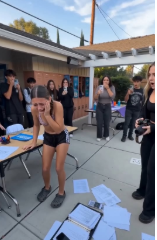
For one second, all I could hear was the soft buzz of string lights, the splash of someone’s foot dragging through the shallow end, and the click of Piper Ross’s expensive film camera.
Click.
She stood near the patio table, perfectly still, a black cardigan draped over her shoulders despite the warm evening air. Her straight-leg pants looked freshly pressed. Her hair fell in that clean, effortless way that always made adults call her “polished” and girls like me “plain.” The silver camera hung around her neck like jewelry.
And she was smiling.
Not loudly. Not obviously. Just enough for me to understand that whatever had happened, she had already decided how the story would end.
I was seventeen, an American high school student from Florida, wearing a thin sun shirt, long shorts, and old water shoes I had bought from a clearance rack before flying to California for the summer exchange program. My name was Sienna Blake, and until that afternoon, the worst thing people had called me at Westbridge Academy was “too serious.”
Now they were looking at me like I was cruel.
“Is it true?” someone whispered.
I didn’t know who said it. Maybe Lily from chemistry. Maybe one of Piper’s friends. The words floated across the backyard and landed on my chest with the weight of a stone.
I swallowed. “Is what true?”
Piper tilted her head as if she pitied me. “Don’t do that, Sienna.”
My stomach tightened.
Behind her, near the glass patio doors, stood Jun Park, the exchange student from South Korea whose arrival had been the entire reason for the party. His face was pale. He held his phone in both hands, thumbs pressed against the screen, eyes lowered as if looking up would hurt too much.
That was when I realized the rumor had reached him too.
“Jun,” I said softly.
He didn’t answer.
Piper’s smile sharpened. “You should probably apologize before this gets worse.”
“For what?”
A few students shifted. Someone near the pool laughed under their breath, not because anything was funny, but because crowds do that when they don’t know where to put their discomfort.
Piper lifted her camera and snapped another photo of me.
Click.
The sound made me flinch.
“You really want everyone to hear it?” she asked.
I looked around at the faces: curious, judgmental, excited, scared. Teenagers with plastic cups in their hands and phones half-raised, waiting for a scene to become proof of something. The host parents, Mr. and Mrs. Alvarez, were inside the kitchen, probably arranging snacks, unaware that their backyard had turned into a trap.
My voice came out smaller than I wanted. “I want the original source checked before anybody blames anyone.”
Piper’s expression changed.
Only for a second.
It was so quick most people missed it, but I saw it: the flicker in her eyes, the tiny tightening around her mouth. Panic, buried under polish.
Because she knew what I knew.
That morning, in the student media room, I had found a draft message attached to a school record update about the exchange welcome feature. It included a photo of Jun speaking during his introduction, his mouth open mid-word, with a caption mocking his pronunciation. The edited record listed my name as the person who uploaded it.
But I had never uploaded that photo.
I had never written that caption.
And the file history, if anyone bothered to check it properly, would show exactly who had.
The problem was that Piper’s family sponsored half the school’s arts funding. Her father donated to the media lab. Her mother chaired the exchange program gala. Teachers smiled differently when Piper entered a room. Students apologized when she stepped on their shoes.
I had learned, long before Palo Alto, that some people didn’t need to be innocent to be believed. They only needed to look expensive while accusing someone else.
“I’m not blaming anyone,” Piper said, her voice sweet enough to poison tea. “I’m asking you to take responsibility.”
“No,” I said. “You’re asking me to accept a lie.”
A ripple moved through the students.
Piper’s friends, Madison and Chloe, exchanged looks. Madison already had her phone out, recording. Chloe’s lips parted in delight, like she had been waiting all week for something ugly to happen.
Jun finally looked up.
His eyes met mine, and the hurt in them nearly broke me.
“I didn’t make fun of you,” I said, looking only at him. “I found the record after someone changed it. I tried to report it before—”
“Before what?” Piper interrupted. “Before you got caught?”
Heat climbed my neck. “Before you turned this into a performance.”
The backyard went silent.
Piper’s smile disappeared.
I should have stepped back. I know that now. I should have found Mrs. Alvarez, or called Ms. Donnelly, our exchange coordinator, or simply walked away until adults were present. But seventeen-year-old pride is a dangerous thing when mixed with public humiliation. I had been quiet my whole life, polite through every insult, careful through every misunderstanding, and I was tired of watching people mistake patience for guilt.
So I stood there.
And Piper crossed the patio.
Her shoes clicked against the stone. Her camera bumped lightly against her chest. For half a second, her face came close enough that I could smell expensive sunscreen and mint gum.
“Say it again,” she whispered.
I looked at the students filming us. I looked at Jun. I looked at the pool, trembling with reflected lights.
“Check the original source,” I said. “That’s all I asked.”
Piper slapped me.
It was not the hardest pain I had ever felt, but it was the most public. The sound cracked through the backyard. My face turned with the force of it, and for one frozen heartbeat, nobody breathed.
Then the whispers began.
“Oh my God.”
“She hit her.”
“Did someone get that?”
My cheek stung. My eyes watered before I could stop them, which made me angrier than the slap itself. I refused to touch my face. I refused to give Piper the satisfaction of seeing me fold.
She stood in front of me, breathing hard now, her perfect mask slipping.
“You don’t get to ruin someone and then act innocent,” she said loudly.
The strange thing was, she wasn’t talking to me anymore. She was talking to the crowd. To the cameras. To the invisible adults who would eventually hear about this and ask who sounded believable.
And because Piper Ross had spent her entire life rehearsing innocence, people listened.
Then Jun’s phone made a small sound.
A notification.
He looked down, and his expression changed.
At first, I thought he had received another cruel message. His eyebrows pulled together. His lips parted. His thumb hovered over the screen.
Then he looked toward the house.
“Mrs. Alvarez?” he called, his voice shaking.
The patio door slid open.
Mrs. Alvarez stepped outside with a tray of lemonade cups, smiling at first. “What happened? Why is everyone so—”
She saw my face.
Her smile vanished.
Mr. Alvarez appeared behind her. “Sienna?”
Piper immediately turned toward them, eyes glistening on command. “She’s been lying about me.”
I almost laughed. Not because it was funny. Because it was terrifying how quickly she became the victim again.
Mrs. Alvarez set the tray down slowly. “Everyone put your phones away.”
No one moved.
Mr. Alvarez’s voice hardened. “Now.”
Phones lowered, but not all the way.
Jun walked toward them, still holding his phone. “Please,” he said. “You need to see this.”
Piper’s head snapped toward him.
“Jun,” she said softly, warning wrapped in kindness. “You’re upset. Maybe don’t—”
“No,” Jun said.
It was the first strong word I had heard from him all day.
He stopped beside Mrs. Alvarez and turned his phone around. “This came from my backup folder. I thought it was gone.”
Piper went still.
The screen showed a video.
Not a polished video. Not one of those clean social media clips with perfect lighting and edits. It was shaky, vertical, half-obscured by the edge of a backpack, recorded from a low angle in the student media room.
For a second, I didn’t understand what I was seeing.
Then Piper’s voice came through the speaker.
“Just make it look like Sienna uploaded it.”
My whole body went cold.
A second voice answered. Madison’s. “Are you sure? That’s not just messy, that’s like… traceable.”
Piper laughed softly. “Not if we use the shared station. Sienna was logged in after lunch. She never logs out properly.”
The backyard changed.
Not loudly at first. It changed in small movements: Madison lowering her head, Chloe stepping away from Piper, two students looking at me with sudden horror instead of suspicion.
On the video, Piper leaned over a computer. Her camera sat beside the keyboard. Jun’s introduction photo filled the screen. The caption beneath it was cruel, mocking the way he had pronounced “collaboration” during his first day presentation.
Piper’s voice continued, casual and sharp.
“He thinks everyone likes him because he’s new and awkward. The exchange feature was supposed to be mine. My mom literally got the sponsors for this program.”
Madison whispered something on-screen.
Piper replied, “Relax. Sienna will make a perfect villain. She’s always acting like the school’s conscience.”
My throat closed.
The school’s conscience.
She had said it like an insult.
The video ended.
For three seconds, nobody spoke.
Then Piper said, “That’s fake.”
It was such a small, desperate sentence that it almost sounded childish.
Jun’s hand trembled around the phone. “It came from my phone.”
“You edited it,” Piper snapped.
Jun flinched.
Something in me broke open.
“Don’t,” I said.
Piper turned on me. “Don’t what?”
“Don’t do that to him again.”
Her face twisted. “You don’t know anything.”
“I know you framed me,” I said. My voice was shaking, but this time it didn’t sound weak. It sounded alive. “I know you mocked Jun and tried to make everyone think I did it. I know you slapped me because you thought fear would be louder than proof.”
Mrs. Alvarez took the phone from Jun gently and replayed the video, her mouth tightening with every second. Mr. Alvarez pulled out his own phone and called Ms. Donnelly.
Piper looked around the backyard for support and found only silence.
That was when she truly panicked.
“You all believed her?” she said, turning on the crowd. “Seriously? You’re all just going to believe some shaky video?”
Madison whispered, “Piper, stop.”
Piper stared at her. “You recorded it too.”
Madison’s face drained of color.
The words slipped out before Piper could catch them.
The backyard heard.
Mrs. Alvarez looked at Madison. “What does that mean?”
Madison’s eyes filled. “I didn’t— I mean, I had a clip because Piper asked me to record Sienna coming into the media room later. She wanted to show she was logged in. I didn’t know she was going to—”
“Madison,” Piper hissed.
But Madison was crying now, and once guilt found a crack, it poured out fast.
“She told me it was just a prank,” Madison said. “Then she said Sienna deserved it because she was always trying to expose things. She said if Sienna got blamed, nobody would question the donor list problem.”
Donor list.
The words landed differently from everything before them.
Piper’s lips parted.
Mr. Alvarez lowered his phone slowly.
I felt the air change again.
“What donor list problem?” Mrs. Alvarez asked.
Piper’s eyes moved to me.
For the first time that evening, she looked afraid of what I might say.
And I remembered the file I had seen two days earlier.
At the time, I hadn’t understood it fully. I had been helping Jun format his exchange welcome article when I noticed a hidden folder linked to the event sponsor page. Most of the names matched the official program donors, but one line had been changed. A scholarship fund meant to cover exchange-student travel fees had been rerouted under a private “media enhancement” expense.
The name attached to the authorization draft was Ross Family Cultural Sponsorship.
I had told myself I must be misunderstanding it. I was a student, not an accountant. I had taken screenshots only because my mother, a public school secretary back in Florida, had taught me one rule: if a record looks wrong, preserve it before asking questions.
At the time, Piper had walked into the media room and seen me looking at the file.
By afternoon, the cruel photo of Jun had appeared under my login.
Now I understood.
This had never only been about a mocking caption.
Piper hadn’t attacked me because I found one ugly prank.
She attacked me because I had stumbled onto something much bigger.
Ms. Donnelly arrived fifteen minutes later, breathless and stern, with the principal on speakerphone. By then, the party had collapsed into clusters of whispering students. The pool glowed behind us like a stage set after the actors had stopped pretending.
I sat at the patio table with an ice pack against my cheek. Jun sat beside me, shoulders hunched, his phone on the table between us like it was both a weapon and a wound.
“I’m sorry,” he said quietly.
I looked at him. “For what?”
“For believing maybe you did it.”
His honesty hurt, but not as much as the look on his face.
“I think I would’ve wondered too,” I said. “If everyone told me the same lie at once.”
He stared at the pool. “Back home, my father told me people here would smile even when they hated me.”
I didn’t know what to say to that.
So I said the only true thing I had. “Some will. Some won’t.”
He nodded slowly.
Across the patio, Piper sat between her parents, who had arrived in a sleek black car that looked too serious for a backyard party. Mrs. Ross wore cream silk and a calm expression. Mr. Ross wore a blue blazer and the irritated look of a man who thought problems existed only because other people failed to hide them well.
“This is being blown out of proportion,” Mrs. Ross said to Ms. Donnelly. “Teenagers make mistakes.”
“Teenagers also face consequences,” Ms. Donnelly replied.
Mr. Ross glanced at me. Not at my eyes. At my old water shoes. “And we’re taking one student’s word for all this?”
Jun lifted his phone. “It’s not one student’s word.”
Mrs. Ross smiled at him the way adults smile when they want a young person to feel small. “I understand you’re upset, sweetheart, but recordings can be misleading.”
Mrs. Alvarez stepped forward. “Not this one.”
I had met Mrs. Alvarez only a week earlier, but in that moment I wanted to hug her. She was not loud. She was not dramatic. She simply stood between Jun and the Ross family like a door that would not open.
Then Ms. Donnelly asked the question that turned the whole night upside down.
“Sienna,” she said, “do you still have the screenshots of the sponsor folder?”
Piper’s mother froze.
Not Piper.
Her mother.
It was so slight that most people might have missed it. But I saw the cream silk sleeve stop moving. I saw Mr. Ross look at his wife, not his daughter.
And I knew the center of the story had shifted again.
“Yes,” I said.
Piper whispered, “No.”
Everyone looked at her.
Her eyes were wide, not with guilt this time, but terror. Real terror. The kind that had nothing to do with detention or suspension or popularity.
“Mom,” she said, barely audible. “You said it was just temporary.”
Mrs. Ross’s face hardened. “Be quiet.”
But Piper was staring at her mother now, and something in her expression looked younger than eighteen. Younger than the polished senior everyone feared.
“You said you put it back.”
Mr. Ross stood. “Piper.”
She flinched.
The backyard went silent for the third time that evening.
And suddenly I saw it.
Piper had framed me. Piper had mocked Jun. Piper had slapped me in front of everyone. She was guilty.
But she was not the mastermind.
She was the daughter of one.
Ms. Donnelly’s voice became very careful. “What was temporary, Piper?”
Mrs. Ross rose gracefully. “This conversation is over until our attorney is present.”
Mr. Alvarez said, “Actually, this conversation is being documented.”
Mrs. Ross turned toward him. “You have no idea who you’re threatening.”
“No,” Mrs. Alvarez said. “But I know who you threatened.”
She nodded toward Jun.
Piper’s face crumpled.
For a moment, she looked at Jun, then at me. Her lips trembled like she wanted to speak and had forgotten how.
“My mom said the exchange program was wasting money,” Piper whispered. “She said the scholarship funds were being mismanaged by the school, so she moved some of it to the media lab account until the gala. She said it didn’t matter because it was still for the program.”
Mrs. Ross snapped, “Piper!”
But Piper kept going, words spilling faster now.
“Then Sienna saw the folder, and Mom said if anyone asked questions, Dad could handle it, but I panicked because Sienna always reports everything. I thought if people already believed she was mean to Jun, nobody would listen to her about the money.”
Her breath hitched.
“I didn’t think— I didn’t think it would get this big.”
The silence afterward was not shocked anymore.
It was heavy.
I looked at Piper and realized the twist hurt more than I wanted it to. I had wanted her exposed. I had wanted people to see the truth. But seeing the truth did not feel like victory at first.
It felt like discovering a rotten beam inside a beautiful house.
Piper had not invented cruelty alone. She had inherited it, polished it, worn it like a cardigan.
But inheritance did not make her innocent.
“You slapped me,” I said quietly.
She looked at me.
“You humiliated Jun.”
Her eyes filled.
“You made everyone believe I did something cruel because you were scared of what your family had done.”
Piper wiped her face quickly, angry at her own tears. “I know.”
“No,” Jun said, voice low. “You don’t.”
She turned to him.
He stood. His hands shook, but he did not lower his gaze this time.
“You made me feel like my voice was a joke,” he said. “I practiced my introduction for three nights. I recorded it ten times. I asked Mrs. Alvarez if I sounded clear. Then I saw that photo, and for one hour, I thought the whole school was laughing at me.”
Piper covered her mouth.
Jun continued, “Maybe your mother scared you. Maybe your family lied. But you chose my face. You chose my voice. You chose Sienna’s name.”
The words struck harder than shouting.
Piper nodded once, tears sliding down her cheeks. “I’m sorry.”
Jun did not accept it. Not then.
And I respected him for that.
By Monday morning, Westbridge Academy no longer felt like a school. It felt like a building holding its breath.
The video had not gone public, because Mrs. Alvarez had insisted on protecting Jun from more humiliation, but enough students had witnessed the backyard confession that silence was impossible. Rumors moved through the halls in broken pieces. Piper was absent. Madison had given a formal statement. The Ross family’s sponsorship account was under review. Ms. Donnelly asked me to meet with the principal before first period.
I expected a warning. Maybe a speech about discretion. Maybe the school’s careful way of saying, Please do not embarrass the people who fund us.
Instead, Principal Hargrove closed his office door and said, “Sienna, I owe you an apology.”
I blinked.
He was a tall man with silver hair and tired eyes, and I had never seen him look uncomfortable before.
“We should have checked the source immediately,” he said. “You asked for the correct thing. The adult response failed you.”
I gripped the strap of my backpack.
Adults rarely said that.
When they did, it made the room feel unstable.
Ms. Donnelly sat beside me. “The altered record has been restored. Your name has been cleared. Jun’s original welcome feature will be republished only with his approval.”
“And Piper?” I asked.
Principal Hargrove folded his hands. “She has been suspended pending a conduct hearing. Her parents’ sponsorship accounts are being audited by the district and an outside firm.”
The word “audit” sounded too clean for what had happened. Like calling a storm “weather.”
Then he looked at me more gently. “There is something else.”
My stomach tightened.
Ms. Donnelly slid a folder across the desk.
Inside was a printed photo.
At first, I thought it was from Piper’s camera. The image showed me standing beside Jun in the media room a week earlier, both of us leaning over a computer, laughing at something on the screen.
I remembered that moment. Jun had accidentally typed “pubic speaking club” instead of “public speaking club,” then panicked until I laughed so hard he realized the mistake was harmless.
But I had not known anyone took a photo.
“Where did this come from?” I asked.
Ms. Donnelly smiled faintly. “Piper’s film roll.”
I stared at it.
Principal Hargrove said, “Most of the photos from her camera were staged or irrelevant. But this one mattered.”
I didn’t understand.
Ms. Donnelly turned the photo over.
On the back, in Piper’s handwriting, were four words.
They look actually kind.
A strange ache moved through me.
Principal Hargrove said, “Piper documented more than she realized. Her film camera has timestamps matched to the lab entry logs. It supports your timeline.”
I thought of the click in the backyard. Click. Click. Click. Piper trying to capture my humiliation.
Instead, her own camera had helped prove I was there before the alteration, helping Jun, not harming him.
That should have been the final twist.
It wasn’t.
The real one came three days later.
Jun asked me to meet him by the courtyard after school. He looked nervous, holding his phone like he had at the party, but this time his eyes were brighter.
“I found something,” he said.
I tried to smile. “Good something or terrifying something?”
“Both.”
He opened a folder on his phone and showed me a series of automatically backed-up videos. The media room clip had not been recorded by accident from his backpack, like we first thought.
“It was from my translation app,” he said. “I use it when I’m nervous, to review conversations later. I forgot it records short video notes when the camera permission is on.”
“That’s lucky,” I said.
He shook his head. “No. This is the part.”
He played another clip.
The camera angle showed the hallway outside the media room. Piper stood there with her mother. Mrs. Ross’s voice was low but clear.
“If the Blake girl talks, make her look jealous. Make her look unstable. People believe patterns, Piper. Give them one.”
My skin prickled.
Then Piper said something I never expected.
“I don’t want to do this anymore.”
Her mother’s reply was colder than winter water.
“Then you can explain to your father why your college recommendation disappears with the sponsorship.”
The video stopped.
I stared at Jun.
He said quietly, “There’s more. Enough for the audit.”
For a long moment, I could not speak.
The ending I had imagined was simple: Piper exposed, me cleared, Jun protected, the crowd ashamed.
But real endings are rarely that clean.
When the final hearing happened, Piper walked into the conference room without her cardigan, without her camera, without her friends. She looked smaller, but not innocent. Never innocent. She sat across from me and Jun with her hands folded so tightly her knuckles were white.
Her parents did not attend.
Their attorney did.
That told everyone enough.
Piper read her statement in a shaking voice. She admitted framing me. She admitted creating the mocking caption. She admitted striking me. She also turned over emails, messages, and account notes proving her parents had misused donor funds and pressured her to protect the family’s image.
When she finished, she looked at Jun.
“I don’t expect you to forgive me,” she said. “I just wanted to say the truth without performing it.”
Then she looked at me.
“You were right,” she said. “Quiet evidence beats loud people.”
I remembered thinking those exact words in the backyard, when my cheek still burned and everyone stared.
I did not forgive her that day.
But I stopped hating her.
There is a difference.
The Ross family lost their sponsorship role. The exchange scholarship fund was restored with penalties. Mrs. Ross resigned from the gala board. Mr. Ross’s name disappeared from the school donor wall so quietly that some students did not notice until weeks later.
But I noticed.
Jun noticed too.
On the day his welcome feature was finally published, he asked me to read it before anyone else. The headline was simple: “What It Means to Be Heard.”
In the article, he did not mention Piper by name. He did not mention the slap, the party, the rumor, or the cruel photo. Instead, he wrote about language, courage, and the difference between being corrected and being mocked. He wrote that kindness was not pretending someone never struggled, but making sure struggle was never used as entertainment.
At the bottom, he added one photo.
It was the picture from Piper’s film roll: me and Jun laughing in the media room, caught in a moment neither of us had known mattered.
Under it, the caption read:
“Some people record to embarrass. Some records survive to tell the truth.”
The article went farther than any rumor ever had.
Parents shared it. Teachers printed it. Students who had stared at me in the backyard stopped me in the hall to apologize, awkwardly, imperfectly, but sincerely.
Madison apologized too. She joined the student ethics committee Ms. Donnelly created after the investigation. I didn’t trust her immediately, but I watched her try. Sometimes trying is the first honest thing a person does after cowardice.
As for Piper, she transferred before winter break.
On her last day, I found an envelope in my locker.
Inside was one photograph.
Not of me humiliated.
Not of the party.
It was a photo of the backyard pool after everyone had gone home. The string lights reflected in the water. The patio chairs stood empty. The scene looked peaceful in a way it had never felt.
On the back, Piper had written:
I used to think cameras made the truth. Now I know they only catch what people are brave enough to face. I’m sorry.
I kept the photo.
Not because it fixed anything.
Because it reminded me that proof can clear your name, but it cannot give you back the moment before people doubted you. Healing takes longer than evidence. Trust returns slowly, like light moving across the bottom of a pool after the storm has passed.
At the end of the semester, Jun invited me, Mrs. Alvarez, and Ms. Donnelly to the exchange showcase. He stood onstage in the auditorium, shoulders straight, voice steady, pronunciation careful but no longer fearful.
“My first weeks here were difficult,” he said, smiling a little. “But I learned something important. A voice does not have to be perfect to deserve respect.”
The applause began softly.
Then it grew.
I stood in the back beside my mother, who had flown in from Florida for the showcase after I finally told her everything. She squeezed my hand so tightly it hurt.
“You did good, baby,” she whispered.
For once, I believed it.
After the showcase, Jun found me near the lobby doors.
“I have something for you,” he said.
He handed me a small box.
Inside was a new pair of water shoes.
I burst out laughing. “Are you saying mine are ugly?”
“Yes,” he said solemnly. “Very.”
For the first time in months, I laughed without checking who was watching.
Outside, Palo Alto was glowing with late afternoon sun. Students streamed past us, loud and ordinary, carrying posters and leftover snacks. Life had not become perfect. People still whispered. Some apologies still felt too late. Some adults still protected money before children until someone forced them not to.
But Jun was smiling.
My name was clear.
The scholarship fund was safe.
And the next time someone in that school asked for the original source to be checked, nobody laughed.
They checked.
That was the happy ending no one had expected.
Not revenge.
Not a viral video.
Not Piper destroyed while everyone cheered.
The real victory was quieter and stronger: a school that had once believed the loudest girl in the backyard learned, painfully and publicly, that truth does not need influence, money, or perfect clothes to survive.
Sometimes it only needs one student brave enough to say, “Check the original source.”
And one camera record that kept playing after everyone thought the story was over.
THE END
