The track field at Colorado Springs High looked like a place for discipline, teamwork, and clean competition.
That was the lie the morning told before everything fell apart.
The ROTC fitness testing event had filled the field with students in athletic clothes, teachers holding clipboards, parents standing behind the fence with coffee cups, and cadet leaders calling out times like every second mattered. The air was sharp with mountain cold, and the sky above Colorado Springs looked too bright for the kind of humiliation waiting for me near the concession tent.
I knew there was trouble before anyone said my name.
Students were pretending not to stare.
That was always how it started.
Not with shouting. Not with proof. Just a silence that bent around you, making you feel guilty before you even knew the accusation.
My name was Emily Carter. I was seventeen, born in Kansas, fair-skinned, with dark-blonde hair tied into a ponytail that had already loosened from running between the kitchen prep area and the field tables all morning. I wore a navy windbreaker, school athletic pants, and practical school shoes, the kind of outfit nobody noticed unless they wanted to make fun of it.
I was not there to compete.
I was there because someone had to help with the food station.
And because someone had to say no when everybody else wanted to keep selling.
The rumor reached me before Penelope Rhodes did.
“She said Emily shut down the food tent because she was jealous.”
“No, she said Emily messed up the logs.”
“I heard Emily lied about the chicken temperature.”
“She’s trying to ruin ROTC testing.”
My fingers went cold around the clipboard.
The truth had started thirty minutes earlier in the school kitchen, when I refused to sign off on trays of breakfast wraps that had been sitting too long at the wrong temperature.
The lie had apparently traveled faster.
Penelope came walking across the grass like she had rehearsed every step.
She was eighteen, white, from one of those wealthy, influential school families whose last name appeared on plaques, donor emails, and polite conversations between adults. She had realistic teen features, but everything around her had been styled into authority: her neat hair, her expensive navy custom school-uniform skirt, her polished loafers, the crisp sweater over her blouse even though everyone else was dressed for the track field.
Penelope Rhodes looked like someone whose version of the story always won.
Behind her came two friends, Lacey and Morgan, both holding phones low enough to pretend they were not recording.
I did not move.
That was my mistake, or maybe the only brave thing I did that morning.
Penelope stopped close enough that I could smell her perfume over the grease and coffee drifting from the food tent.
“You need to fix what you started,” she said.
I held the clipboard against my chest. “I didn’t start anything.”
“You told Coach Miller we couldn’t sell the breakfast wraps.”
“Because they failed the safety check.”
Her smile turned sharp. “You mean because you decided they failed.”
“No,” I said. “Because the thermometer readings were outside the safe range, the prep checklist was incomplete, and the holding log had a gap.”
Several students nearby went quiet.
Penelope heard that quiet and used it.
She turned slightly, letting the audience see her face. “Emily, everybody knows you get anxious around responsibility. You probably misread the thermometer.”
My cheeks heated.
There it was.
Not an argument. A character attack.
I had been called anxious before. Too careful. Too serious. Too dramatic about rules. The kind of girl who checked locks twice, saved receipts, and asked teachers whether “optional” really meant optional.
I had learned that people loved responsible girls until responsibility became inconvenient.
“I read it correctly,” I said.
Penelope tilted her head. “Then why did Lacey see you changing the log?”
Lacey’s eyes flickered.
I looked at her. “You saw me add the second reading after I retested.”
Penelope laughed softly. “That’s not what she told me.”
Lacey looked away.
The cold air suddenly felt thin.
Behind us, a whistle blew on the track. Students started another timed run, sneakers striking the lane in steady rhythm. The normal sound of school life continued, which somehow made the confrontation worse. The world did not stop because someone was trying to destroy your name.
I tried to step around Penelope. “I’m taking this to Coach Miller.”
She moved with me.
“You’re not taking anything anywhere until you admit you overreacted.”
“I won’t sign off on food that could make people sick.”
Her expression cracked.
Just a little.
Enough.
Because that was what she really feared. Not my opinion. Not my clipboard. The word sick. The word safety. The possibility that the food revenue from the event, the fundraiser she had promised would impress the boosters, might turn into a reportable incident.
Penelope’s family had helped sponsor the ROTC fitness testing day. Her mother had arranged donors. Her father owned a restaurant supply company that provided discounted food for the concession tent. Penelope had spent two weeks telling everyone this event would prove she could handle “real leadership.”
And I had found the one thing leadership could not polish away.
A bad temperature log.
“Give me the clipboard,” she said.
“No.”
“Emily.”
“No.”
Her eyes went flat.
On the table beside her sat a foil-wrapped breakfast wrap, one of the ones I had pulled from service. Penelope picked it up so quickly I barely understood what she was doing.
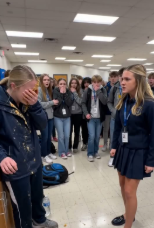
Then she threw it straight at my face.
The wrap burst against my cheek and windbreaker, warm filling smearing across my skin, tortilla pieces sliding down the front of my jacket. A few students gasped. Someone laughed once and immediately stopped. Sauce dripped from my chin onto the clipboard.
For a second, I almost let the crowd’s shock swallow me.
The sting was not from the food.
It was from the humiliation.
Being hit in public does something strange to your body. It turns you into a witness to yourself. I could see my own hands shaking. I could hear my breath catch. I could feel every student deciding what kind of story this was.
Poor Emily.
Crazy Emily.
Liar Emily.
Penelope stepped closer, voice trembling with fake outrage. “That’s what happens when you try to ruin something good for everyone.”
My eyes burned.
I wanted to scream.
I wanted to throw the clipboard at her feet and walk away.
Then I remembered the kitchen.
The thermometer.
The checklist.
The prep texts.
The blank space in the holding log where a timestamp should have been.
And I understood why she was panicking.
Penelope did not care about fairness. She cared about revenue. She cared about preserving the perfect event. She cared about burying the safety concern before it could touch her family’s name.
So I wiped sauce from my cheek with the sleeve of my windbreaker, looked straight at Coach Miller as he came jogging over, and said, “Please ask for the actual record.”
Penelope scoffed. “She’s lying.”
Coach Miller looked at me, then at the food on my jacket, then at Penelope’s empty hand.
His jaw tightened.
“What record?” he asked.
“The kitchen temperature log,” I said. “The thermometer photos. The prep texts. The food-safety checklist. All of it.”
Penelope’s friends stopped recording.
That was when I knew they had been waiting for a meltdown, not evidence.
Coach Miller’s voice got quiet. “Everyone step back.”
Nobody did at first.
Then Sergeant Lane, the retired Army instructor who ran the ROTC program, walked up with the kind of silence that made students move before he spoke.
“Back,” he said.
The circle opened.
Penelope tried one last time. “Sergeant Lane, this is ridiculous. Emily is making a scene because she doesn’t understand event operations.”
He looked at her. “Then the records will show that.”
For the first time all morning, Penelope had nothing ready.
We moved into the equipment room beside the field house because Coach Miller refused to review the file in front of the entire track field. But the damage had already spread. Students whispered outside the door. Lacey and Morgan hovered near the hallway. Two parent volunteers stood by the coffee urns, pretending not to listen.
Inside the room, the air smelled like rubber mats, old uniforms, and metal shelving.
I stood near the wall, still sticky with sauce, while Sergeant Lane opened the school laptop.
Coach Miller pulled up the shared event folder. Ms. Patel, the assistant principal, arrived halfway through with her badge swinging from her lanyard and concern already written across her face.
Penelope stood near the table with her arms crossed.
She looked less perfect under fluorescent lights.
The first file opened.
FOOD-SAFETY CHECKLIST — ROTC FITNESS TEST FUNDRAISER.
My initials appeared beside the early morning sanitation check. The refrigerator temperature check. The glove station restock. The allergen label review.
Then came the holding-temperature section.
A blank line.
Ms. Patel leaned closer. “Why is this missing?”
Penelope answered too quickly. “Because Emily didn’t fill it out.”
“I didn’t fill it out,” I said, “because I couldn’t verify the temperature when I arrived. The trays were already outside the safe holding window.”
Penelope laughed. “You’re guessing.”
I opened my phone with shaking hands. “I took photos.”
Coach Miller looked at me. “Show us.”
I pulled up the pictures.
The first showed the digital kitchen thermometer reading below the required hot-holding temperature. The second showed the same reading five minutes later. The third showed the food-safety checklist with the blank timestamp circled in pencil.
Ms. Patel’s mouth tightened.
Penelope looked at Lacey through the narrow window in the door.
Lacey looked down.
Sergeant Lane opened the prep text thread next. It included messages from the student food team.
6:14 a.m. — Food delivered.
6:28 a.m. — Wraps assembled.
6:41 a.m. — Holding trays moved to field tent.
Then a message from Penelope at 7:05.
Do NOT slow service. Keep the line moving. We need the first rush before testing starts.
Another from Morgan.
Emily says we need to recheck temp.
Penelope’s reply came one minute later.
Tell her to stop being dramatic. My dad said these hold fine.
The room went quiet.
Penelope swallowed. “That doesn’t mean anything.”
Ms. Patel looked up. “It means you were informed there was a concern.”
“It was not a real concern.”
Sergeant Lane clicked the next file.
A scanned delivery label appeared.
Vendor: RHODES RESTAURANT SUPPLY.
Coach Miller closed his eyes briefly.
That was the second crack in the story.
Penelope’s family was not just donating money.
They had supplied the food.
Ms. Patel asked, “Was this disclosed on the event safety form?”
Penelope’s voice sharpened. “My father gives discounts to the school all the time. That isn’t illegal.”
“No one said illegal,” Sergeant Lane said. “We said disclosed.”
Penelope’s face reddened.
The third file opened.
Kitchen thermometer log.
Rows of numbers appeared on the screen, each with a timestamp, initials, and a digital upload record.
At first, it looked ordinary.
Then Coach Miller scrolled down.
6:52 a.m. — Hot tray reading: PASS.
Initials: PR.
Penelope lifted her chin.
“There,” she said. “My reading passed.”
I stared at the line.
Something was wrong.
Not the number. The number looked perfect. Too perfect.
The timestamp.
I stepped closer. “That reading wasn’t there when I checked the log.”
Penelope rolled her eyes. “Because you didn’t check carefully.”
“No,” I said. “The line was blank.”
Ms. Patel clicked the revision history.
The room seemed to shrink around the laptop.
The revision panel loaded slowly, spinning in a small gray circle.
Outside, we could hear students calling times on the field. Normal life again, pressing against the walls.
Then the history appeared.
6:52 a.m. — Blank row created by system.
7:22 a.m. — Row edited.
User: prhodes@student.
Value added: PASS.
Coach Miller whispered, “Penelope.”
Penelope’s face went white.
But the final timestamp had not loaded yet.
Sergeant Lane scrolled.
7:24 a.m. — Uploaded thermometer image.
User: prhodes@student.
File name: temp_pass_final.jpg.
Ms. Patel clicked the image.
A thermometer reading appeared on screen, showing a safe temperature.
For one awful second, Penelope looked relieved.
Then I noticed the background.
“That’s not our kitchen,” I said.
Everyone leaned in.
The thermometer was held over a metal tray, but behind it was not the school kitchen’s beige tile wall. It was stainless steel shelving with red labels.
Coach Miller frowned. “That looks like Rhodes Supply.”
Sergeant Lane zoomed in.
There, blurred but visible in the corner of the photo, was a delivery crate stamped RHODES RESTAURANT SUPPLY.
Ms. Patel turned slowly toward Penelope.
“You uploaded a thermometer photo taken somewhere else?”
Penelope shook her head. “No. I didn’t— I mean, I used the wrong photo by accident.”
“After Emily raised a safety concern?” Ms. Patel asked.
“It was an accident.”
Sergeant Lane scrolled once more.
The last timestamp loaded.
7:26 a.m. — Message sent from prhodes@student to Food Team Group Chat.
Hide the first readings. If Carter keeps pushing, say she contaminated the tray during testing.
The whole room turned toward her.
Penelope gripped the edge of the table.
“No,” she whispered.
Not because the message was fake.
Because it was real.
Because everyone could see it.
Coach Miller looked like he had been punched. Ms. Patel’s face had gone still in a way that scared me more than anger. Sergeant Lane removed his glasses and set them beside the laptop.
Outside the equipment room, the whispering had stopped.
I realized then that the door was still cracked open.
Lacey, Morgan, and half the nearby hallway had heard everything.
Penelope saw them too.
Her friends suddenly looked like strangers.
Lacey backed away from the door.
Morgan covered her mouth.
Penelope’s voice broke. “I was trying to keep the event from collapsing.”
“You were trying to blame Emily,” Coach Miller said.
“She made it sound worse than it was!”
“It was food safety,” Ms. Patel said. “You do not get to decide that safety is inconvenient.”
Penelope’s eyes filled, but her anger fought the tears. “You don’t understand what was on the line.”
I laughed once.
It came out bitter and tired.
“What was on the line?” I asked. “Money?”
She looked at me then.
For the first time, she did not look powerful.
She looked trapped.
“My father said if the fundraiser failed, he would make sure everyone knew I couldn’t handle leadership,” she said. “He said I embarrassed the family last semester by losing the council election. This was supposed to fix it.”
Nobody spoke.
I had expected excuses.
I had not expected that.
It did not make her innocent. It did not remove the sauce drying on my jacket or the humiliation burning under my skin. But it revealed something ugly behind the polished Rhodes name.
Penelope had not protected the food because she thought it was safe.
She had protected the story because she was terrified of what would happen if it failed.
Then Ms. Patel clicked one more file.
A kitchen camera still.
Penelope stiffened.
“I thought the kitchen camera didn’t record audio,” she said.
Sergeant Lane looked at her. “It doesn’t.”
Ms. Patel replied, “But it records motion and time.”
The still showed Penelope entering the kitchen office at 7:20 a.m., two minutes before the log was edited. Behind her, half-visible through the doorway, stood a man in a gray coat.
Her father.
Mr. Rhodes.
The next still showed him leaning over the laptop while Penelope stood beside him.
The next showed Penelope wiping her eyes.
The twist settled over the room like snow.
Ms. Patel’s voice softened, but only slightly. “Penelope, did your father tell you to change the log?”
Penelope stared at the screen.
Her mouth trembled.
“He said it wasn’t really changing it,” she whispered. “He said it was correcting an overreaction. He said no one would get sick because the food was probably fine.”
“Probably?” Coach Miller repeated.
Penelope looked at me, then down at her hands.
“He said Emily was the kind of girl people would believe made a mistake.”
There it was.
Not just the lie.
The reason I had been chosen for it.
Not because I was guilty.
Because I was easy to frame as nervous, careful, dramatic, too serious.
Because my practical windbreaker and old shoes looked less convincing than her blazer and family name.
Ms. Patel closed the laptop.
“The food service stops now,” she said. “All remaining items are pulled. The district will be notified. Penelope, you are removed from event leadership pending investigation.”
Penelope covered her face.
But I could not feel sorry for her yet.
Not fully.
Not while sauce still clung to my collar.
The ROTC fitness testing continued, but the fundraiser did not.
By noon, every student on campus had heard some version of the truth. By the end of the day, the official announcement went out: food service had been paused due to safety verification concerns, no students had been served the questionable items after the issue was identified, and the school would conduct a full review.
My name was not in the email.
That should have relieved me.
It didn’t.
Because people already knew.
Apologies came in strange forms. A girl from my English class left napkins and a clean sweatshirt by my locker. A sophomore mumbled, “Sorry for laughing,” without looking at me. Lacey sent a message that said, I should have said something, then deleted it, then sent it again.
Penelope did not come to school the next day.
Her father did.
That was when the story became bigger than school.
Mr. Rhodes arrived in the main office wearing a suit and a smile that looked like a threat. He demanded to speak with Principal Harlan, Ms. Patel, and the district representative. He said the school had mishandled donated goods. He said students were unreliable. He said his daughter had been pressured and confused.
Then Sergeant Lane brought the camera stills.
And the prep texts.
And the revision history.
Mr. Rhodes stopped smiling.
The district investigation found that Rhodes Restaurant Supply had delivered food earlier than documented, failed to provide proper holding equipment, and encouraged student volunteers to continue service despite safety concerns. The company’s vendor agreement was suspended. The booster club froze the fundraiser account. Penelope’s mother resigned from the event committee two days later.
But the ending I expected still did not come.
I thought Penelope would disappear behind her family’s money. I thought she would transfer, deny everything, and let the adults fight it out.
Instead, on Monday morning, she was waiting outside the records office.
No blazer.
No polished confidence.
Just a gray sweater, red eyes, and a folder held in both hands.
When she saw me, she stood.
“Emily,” she said.
I stopped several feet away.
The hallway emptied around us in that obvious way students do when they want to listen while pretending not to.
Penelope noticed, swallowed, and spoke anyway.
“I’m sorry.”
The words sounded scraped out of her.
I said nothing.
She looked down at the folder. “Not just for throwing food at you. For trying to make people think you were unstable. For letting my father say you were the kind of person no one would trust. For agreeing because it was easier than standing up to him.”
My throat tightened despite myself.
“You could have made people sick,” I said.
“I know.”
“You could have ruined my record.”
“I know.”
“You humiliated me in front of everyone.”
Her eyes filled. “I know.”
The hallway was silent.
Penelope held out the folder.
“These are the original delivery messages from my dad,” she said. “The ones he told me to delete. I recovered them from my tablet backup. They prove he knew the holding equipment wasn’t working before the food arrived.”
I stared at the folder.
“Why give them to me?”
“Because you were the one telling the truth before anyone wanted it.” Her voice cracked. “And because if I give them straight to administration, my father’s lawyer will say I was pressured. But if I give them to you in front of cameras, everyone will know I chose to hand them over.”
I looked around.
Phones were out.
For once, I did not hate them.
I took the folder.
“Then we go together,” I said.
Penelope blinked.
“What?”
“To Ms. Patel,” I said. “Together.”
I did not forgive her in that hallway.
But I refused to become what she had been: someone who used a crowd to crush a person who was already scared.
So we walked side by side to the office.
Not as friends.
As two girls carrying the part of the truth each of us had been brave enough, or desperate enough, to hold.
The final hearing happened two weeks later.
Penelope admitted what she had done. She received a suspension, removal from leadership positions, mandatory service hours with the district safety office, and a note on her conduct record. Her father’s company lost its school contracts. The booster club funds were redirected to certified food-safety equipment and training.
Coach Miller apologized to me in front of the entire ROTC group.
Not privately.
Not quietly.
Publicly.
“I should have stopped the rumor before I checked the record,” he said. “Emily Carter did the right thing. She protected students.”
The field was silent after that.
Then Sergeant Lane began clapping.
One person joined.
Then another.
Then the whole group.
I hated how much I needed it.
But I did.
Sometimes being cleared is not enough. Sometimes you need the same room that doubted you to hear your name spoken correctly.
The spring event was rescheduled a month later.
This time, food was handled by certified staff. The temperature logs were displayed on a tablet at the service table. Student volunteers were trained before touching a single tray. Every checklist had two signatures.
And me?
I was asked to lead the verification station.
At first, I almost said no.
Then my mother reminded me of something she used to say back in Kansas whenever storms rolled across the fields and knocked branches into the road.
“Don’t let the thing that scared you become the place you never return to.”
So I returned.
I wore the same navy windbreaker, washed until the stain was gone but not forgotten. My ponytail still came loose. My shoes still looked practical. I still checked every reading twice.
Near the end of the day, Penelope approached the table.
People noticed.
Of course they did.
She held a thermometer in one hand and a checklist in the other.
“I need a second verification,” she said.
Her voice was steady, but her cheeks were pink.
I looked at the reading.
Safe.
I signed.
Then I handed her the clipboard.
“Your turn,” I said.
She stared at me.
Slowly, she signed beneath my name.
Not above it.
Beneath it.
A small thing.
A meaningful thing.
The event raised less money than Penelope had originally promised.
But no one got sick.
No one was blamed.
No records were changed.
And somehow, that felt like winning.
At the end of the day, as the sun dropped behind the mountains and the track turned gold, Sergeant Lane found me packing gloves into a supply box.
“You ever think about logistics?” he asked.
I laughed. “That sounds like a punishment.”
“It’s not,” he said. “It’s what keeps people alive when everyone else is busy clapping for the front of the room.”
I looked toward the field, where students were taking down banners.
For so long, I had thought being careful made me small. The kind of person people tolerated until my caution interrupted their plans.
But that day taught me something different.
Careful people are the reason plans do not become disasters.
Records matter.
Timestamps matter.
The person willing to say no matters.
Even when her voice shakes.
Even when the crowd stares.
Even when someone with a polished smile throws food in her face and calls her a liar.
My phone buzzed as I carried the last box toward the field house.
A message from Penelope.
I know this doesn’t fix it. But thank you for making me walk into the office instead of letting me hide behind another story.
I stood there for a long moment, watching the message glow on the screen.
Then I typed back:
Don’t thank me. Just don’t change another record.
Three dots appeared.
Then her reply came.
I won’t.
I believed her.
Not completely.
Not blindly.
But enough to let the story end somewhere better than where it began.
Because the happiest ending was not that Penelope fell.
It was that the truth stood.
The food was stopped.
The students were safe.
The adults learned to check the log before believing the loudest voice.
And the next time someone called a careful girl dramatic, half the room turned toward the record first.
That was enough.
More than enough.
Because sometimes the thing that proves everything is not a speech, not a rumor, not a family name, and not a perfect outfit.
Sometimes it is a kitchen temperature log with one final timestamp.
And when that timestamp loads, even the most polished lie has nowhere left to hide.
THE END
