The first thing I noticed was not Poppy Grey’s hand.
It was the complaint box.
It sat on the folding table outside the gym like it always did during club recruitment week, a cheap blue plastic container with a narrow slit cut into the top and a laminated sign taped crookedly across the front: STUDENT CLUB ACCESS FORMS — CONFIDENTIAL.
Confidential.
That word was the reason I was standing there with my stomach twisting and my hands cold.
Half of Martin Luther King High School had been pulled into the gym for the spring club showcase. Sacramento sunlight poured through the high windows, turning dust into gold above the bleachers. The air smelled like nacho cheese from the booster table, sharpie ink from poster boards, and the sugary vanilla drinks students carried in giant Stanley cups. Everywhere, people were laughing too loudly, filming too much, leaning into each other’s shoulders like the whole day was just a harmless performance.
But I knew something was wrong.
My name is Fatima Noor. I was seventeen, Afghan American, a senior who kept her hair neat because my mother always said people used messy details as excuses to dismiss serious girls. I wore casual school clothes that day—wide-leg jeans, a soft gray cardigan, white sneakers with one scuffed toe—and I had spent the morning telling myself not to shake.
I had already dropped one form into that box before first period.
A complaint form.
A real one.
A form about how club participation rights were being quietly controlled by a circle of students who believed school opportunities belonged to them first and everyone else later.
And now the box did not look right.
The tape along the side had been lifted and pressed down again. One corner of the lid sat higher than the other. The laminated sign had a wrinkle that had not been there at 7:40 that morning.
Someone had opened it.
I stood frozen beside the gym doors, clutching the strap of my backpack, while the student council table blasted music from a portable speaker. Across the gym, Poppy Grey laughed so brightly that three girls turned just to see what was funny.
Poppy always knew how to make people look.
She was eighteen, white, polished in a way that seemed effortless but never was. Her hair was styled in soft waves that fell over a varsity jacket with her last name stitched on the sleeve. She wore a tennis skirt, white sneakers, and the kind of confidence that came from generations of adults smiling at your family before you even spoke.
Her father chaired a donor committee. Her mother organized half the school fundraisers. Her older brother had been student body president, tennis captain, and the type of graduate teachers still mentioned as if he had personally built the school with his bare hands.
Poppy was not officially in charge of everything.
She just acted like she was.
“Fatima.”
My friend Leila’s voice pulled me back. She stood beside the debate club table, holding a stack of flyers against her chest. Her eyes followed mine to the complaint box.
“You see it too?” she whispered.
I swallowed. “The lid was sealed this morning.”
Leila’s face changed. “Are you sure?”
“I put my form in. I checked because I was scared someone would say I never submitted it.”
The moment I said it, my throat tightened.
For three weeks, I had been trying to report what was happening. Students from certain backgrounds, certain friend groups, certain families, kept getting “accidentally” left off club tryout lists or told events were full when they were not. The environmental club had denied two sophomores their volunteer hours because their forms had “gone missing.” The mock trial team had suddenly changed its rehearsal schedule without telling three newer members. A freshman named Mariam had been told she could not join student government committees because the list was “closed,” even though Poppy’s friends added themselves two days later.
At first, I thought it was disorganization.
Then I saw the pattern.
The same names benefited. The same names disappeared.
And behind almost every switch, every missing form, every altered sign-up sheet, stood someone from Poppy’s circle.
I had not accused Poppy directly in the form. I had been careful. Too careful, maybe. I listed dates, screenshots, witnesses, and the club participation rules printed on the district website. I asked for one official review.
One check.
One adult to open the box before the wrong students lost opportunities they had earned.
Leila lowered her voice. “You need to tell Ms. Alvarez now.”
“I tried before lunch. She said she’d check after the showcase.”
“That’s too late.”
“I know.”
The music cut suddenly. A microphone squealed.
Everyone turned toward the center of the gym, where the student leadership table had been arranged beneath blue and gold balloons. Poppy stood there with a microphone in one hand and a smile that did not reach her eyes.
My stomach dropped.
“Before we start the final club presentations,” Poppy said, voice sweet and clear, “I think we need to address something really disappointing.”
Leila grabbed my wrist.
The room shifted, not physically, but socially. Bodies angled toward the center. Conversations thinned. Phones rose. Teenagers could smell humiliation before it happened, and they moved toward it the way people moved toward smoke.
Poppy’s gaze found me.
“There’s been a complaint,” she said, “about club participation rights.”
A few heads turned.
My mouth went dry.
“And normally,” Poppy continued, “we would handle that privately. But when someone files a dishonest report that attacks student volunteers and damages the reputation of clubs that worked hard all year, I think the truth matters.”
Leila whispered, “Fatima, don’t.”
But I was already walking.
Not fast. Not dramatic. Just enough to reach the edge of the crowd and say, “That is not what the form said.”
My voice was calm. I was proud of that. My hands were trembling, but my voice held.
Poppy tilted her head as if I were a small child interrupting a grown-up conversation.
“Oh,” she said. “So you admit it was yours?”
A murmur passed through the gym.
I looked around and saw faces I knew: classmates from English, a boy from chemistry, two girls from yearbook, a freshman who had once asked me where the counseling office was. Some looked confused. Some looked hungry for drama. Some looked relieved it was not them standing there.
“I submitted a complaint because the box is supposed to protect students,” I said. “Someone opened it.”
Poppy laughed softly.
Not loudly. That would have made her look cruel.
Softly, like I was embarrassing myself.
“Fatima, the box wasn’t opened. You got caught.”
“That’s not true.”
“You accused people because you didn’t get the club position you wanted.”
“I’m already in three clubs.”
“Then maybe you wanted attention.”
The word landed exactly where she wanted it to.
Attention.
It was the easiest insult to throw at a girl who dared to say something in public. If you were quiet, you were suspicious. If you spoke, you wanted attention. If you cried, you were manipulative. If you stayed calm, you were cold.
I felt heat rising in my face.
“I asked for records to be checked,” I said. “That’s all.”
Poppy stepped down from the small platform.
The gym got quieter.
She moved toward me through the crowd with her friends behind her, phones angled low but ready. Her smile had disappeared now. Up close, I could see the tiny silver studs in her ears and the pale pink gloss on her mouth.
“You don’t get to smear people and then act innocent,” she said.
“I didn’t smear anyone.”
“You named my friends.”
“I named events. Dates. Missing forms.”
“You made it about race, didn’t you?”
The air changed.
My whole body went cold.
“I did not,” I said carefully.
Poppy’s eyes sharpened. She knew exactly what she had done. She had thrown something into the room that would make people uncomfortable enough to stop listening.
Behind me, someone whispered, “Wait, what happened?”
Another student said, “I don’t know, she filed something.”
Poppy leaned closer. “You always do this. You act quiet and sweet, and then you write these dramatic complaints so adults feel sorry for you.”
Leila pushed forward. “That’s a lie.”
Poppy did not even look at her.
“Stay out of it,” one of Poppy’s friends snapped.
I should have stepped back.
I should have waited for Ms. Alvarez.
I should have remembered that people like Poppy did not argue to find truth. They argued to build a crowd.
But then I saw Mariam near the back of the gym, small and pale, clutching her debate folder to her chest. She had been the one who cried in the library when she realized she had missed the application deadline for a committee she had never been told was open.
I thought of my mother reading district emails at midnight with the help of a translation app so she would not miss anything important for my younger brother.
I thought of every student who learned early that rules only protected you if someone powerful agreed to follow them.
So I looked Poppy in the face.
“The participation list was changed after submission,” I said. “The records will show that.”
For one second, Poppy’s expression cracked.
It was small. A twitch near her mouth. A flicker in her eyes.
Then she slapped me.
The sound cut through the gym like a book slammed shut.
My head turned from the force of it, but the humiliation arrived before the pain did. A hot sting spread across my cheek. The crowd inhaled as one body. Someone dropped a metal water bottle, and it clanged across the floor.
For half a second, I could not hear anything but my own heartbeat.
Then the room exploded.
“Oh my God!”
“She hit her!”
“Did you get that?”
“Move, move!”
Phones rose higher. Stanley cups tilted. Backpacks bumped against legs as students pushed for a better angle. Nobody moved fast enough to stop it. Nobody stepped between us before the damage became a spectacle.
Poppy stood inches away from me, breathing hard.
“Maybe now you’ll stop lying,” she said.
My eyes burned, but I refused to cry.
Not because crying would be wrong.
Because I knew she was waiting for it.
She needed me to collapse. She needed the video to show her strong and me broken. She needed the room watching my humiliation instead of asking why the complaint box looked tampered with.
I touched my cheek.
Then I said, quietly, “You opened the box.”
Poppy’s face drained of color.
Only for a moment.
Then Ms. Alvarez shoved through the crowd.
“That is enough!”
She was the activities coordinator, a compact woman with sharp glasses and the kind of voice that could silence a cafeteria. Behind her came Mr. Glenn, the vice principal, and two security staff.
“What happened?” Mr. Glenn demanded.
Everyone started talking at once.
“She slapped her!”
“Fatima filed a fake complaint!”
“No, Poppy said—”
“The box—”
“I have video!”
Poppy immediately began crying.
It was almost impressive how fast she did it. Her eyes filled, her shoulders trembled, and she pressed one hand to her mouth as if she were the one who had been hit.
“I’m sorry,” she said, voice breaking. “I shouldn’t have reacted, but she’s been harassing us for weeks. She filed this awful form saying we discriminated against people. She’s trying to ruin scholarships and club records.”
My stomach twisted.
Scholarships.
She had raised the stakes.
Ms. Alvarez looked at me. Her eyes softened when she saw my cheek, but her mouth stayed tense.
“Fatima, did you submit a form?”
“Yes.”
“Did you accuse Poppy?”
“I asked the school to review missing and altered participation records. I did not accuse anyone without evidence.”
Poppy sobbed harder. “That is not true.”
Mr. Glenn held up both hands. “Everyone back up. Phones down.”
No one put their phones down.
That was when Principal Harris arrived.
He did not shout. He did not need to. Principal Harris was tall, silver-haired, and usually calm in a way that made guilty people nervous. He walked into the circle, looked at my cheek, looked at Poppy, then looked at the complaint box.
“Ms. Alvarez,” he said, “bring me the box.”
Poppy stopped crying.
The shift was so subtle that most people missed it.
I did not.
Ms. Alvarez lifted the box from the table. The crooked lid wobbled under her hand.
Principal Harris noticed.
“Was this box sealed this morning?”
Ms. Alvarez frowned. “Yes. I sealed it myself.”
“Who had access?”
“Only I had the key to the storage cabinet, but the box was on the table during lunch.”
Poppy wiped her cheeks. “Principal Harris, I really think—”
He held up one finger.
She closed her mouth.
He turned to me. “Fatima, when did you submit your form?”
“Before first period. Around 7:40.”
“Did anyone see you?”
I hesitated.
“Yes,” Leila said loudly. “I did. And so did Coach Ramirez. He was setting up the tennis club table.”
Poppy’s friend Brielle snorted. “Of course Leila says that.”
Principal Harris turned toward her. “You will not interrupt again.”
Brielle’s mouth snapped shut.
The principal examined the box. “Ms. Alvarez, open it.”
The gym was silent now.
Not frozen like before the slap.
Waiting.
Ms. Alvarez pulled a small ring of keys from her lanyard and unlocked the plastic latch. The lid came up with a sticky sound where the tape had been lifted and pressed down again.
Inside were several forms.
She removed them carefully and spread them across the table.
My heart pounded as she sorted through them.
Then she stopped.
Her brow furrowed.
“What is it?” Mr. Glenn asked.
Ms. Alvarez held up a form.
It was mine.
But something was wrong.
The top half was filled out in my handwriting: name, grade, student ID, date. My careful letters. My black ink.
The bottom half had been altered.
A paragraph had been added beneath my complaint.
Not in my handwriting.
Not in my words.
It accused Poppy Grey and three other students of “intentionally excluding immigrant students because they were jealous and racist.” It claimed I demanded immediate removal of student leaders and cancellation of awards. It sounded angry, messy, extreme.
It sounded exactly like the kind of complaint Poppy had described.
My breath disappeared.
“I didn’t write that,” I said.
Poppy whispered, “Yes, you did.”
“I didn’t.”
“Then why is it on your form?”
Because someone wrote it there, I thought.
Because someone needed my real concern to look like a personal attack.
Because someone had opened the box.
I looked at Principal Harris, but his face was unreadable.
“Is there another copy?” he asked.
My pulse jumped.
“Yes.”
The word came out before I realized I was saying it.
Poppy’s eyes snapped to mine.
“What?” she said.
I reached into my backpack with shaking hands and pulled out a folder. It was purple, bent at the corners, stuffed with printed screenshots, district policies, and one thing my father had insisted on.
A photocopy.
Baba always made copies.
Receipts, permission slips, forms, emails, medical instructions, everything. He said paperwork had saved him more than once when people pretended promises had never happened.
“When you hand someone paper,” he had told me the night before, tapping the copy machine at his small shipping store, “keep proof that the paper existed before they touched it.”
At the time, I thought he was being overprotective.
Now I silently thanked him.
I handed the copy to Principal Harris.
“This is what I submitted.”
He placed both forms side by side.
The crowd leaned forward.
My copy was calm. Detailed. Specific. It listed club participation rights, dates, missing names, and a request for a confidential review. It did not mention Poppy. It did not use the word racist. It did not demand punishments.
The altered form did.
Principal Harris read silently.
The longer he read, the quieter the room became.
Poppy’s face turned stiff.
Then he asked the question that changed everything.
“Who knew about this form before the attack?”
Poppy took one step back.
Not enough for most people to notice.
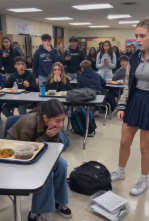
But her friends did.
Brielle lowered her phone.
Another girl, Kenzie, looked down.
Principal Harris lifted his eyes. “Ms. Grey?”
Poppy blinked. “I didn’t know about it.”
“You described its contents before the box was opened.”
“I heard rumors.”
“From whom?”
“I don’t remember.”
“Try.”
The word was calm, but it hit like a door locking.
Poppy’s lips parted.
No answer came out.
Then Coach Ramirez appeared at the edge of the crowd.
“I saw Fatima submit the form,” he said. “And I saw someone near the box during lunch.”
Every head turned.
Poppy’s friends went still.
Principal Harris looked at him. “Who?”
Coach Ramirez hesitated. His eyes moved toward the tennis club table.
“Brielle Vaughn,” he said. “She was standing close to it. I thought she was fixing the sign.”
Brielle’s face went bright red. “I was not opening anything!”
“No one said opening,” Leila muttered.
Mr. Glenn stepped closer to the table. “Brielle, did you touch the box?”
“No!”
Principal Harris looked at Ms. Alvarez. “Security cameras.”
Poppy’s voice sharpened. “There aren’t cameras inside the gym.”
Everyone knew that.
The gym cameras had been broken since winter.
For the first time, something like relief flickered across Poppy’s face.
Then a quiet voice spoke from behind the yearbook table.
“There’s one in the hallway.”
A boy named Noah lifted his hand halfway. He was part of AV club, thin, nervous, always carrying equipment cases. “It catches the gym doors. And maybe the table reflection in the trophy case.”
Poppy turned toward him so fast her hair swung.
“No, it doesn’t.”
Noah flinched.
Then he frowned.
“Yes,” he said. “It does.”
Principal Harris looked at Mr. Glenn. “Pull the footage.”
Poppy stepped forward. “This is ridiculous. I was upset because she attacked us, and now everyone’s acting like I’m the criminal?”
“No one called you a criminal,” Principal Harris said.
“You’re treating me like one.”
“I’m asking questions.”
“My parents donate to this school.”
The sentence landed ugly.
Even Poppy seemed to realize it.
Principal Harris stared at her for a long moment.
“Then your parents should want the school rules followed carefully,” he said.
Somewhere near the back, someone whispered, “Damn.”
The gym showcase ended right there.
Students were sent to sixth period, though nobody learned anything for the rest of the day. My cheek still burned. The office gave me an ice pack wrapped in a paper towel, and Leila sat beside me in the waiting area with her knee bouncing so fast the chair squeaked.
Poppy sat across from us with her arms folded, no longer crying.
Her friends were in separate rooms.
That was the first sign the story was bigger than a slap.
The second sign came when Mr. Glenn returned with a laptop and a face like someone had found a snake under a pillow.
Principal Harris called me, Poppy, and our parents into the conference room.
My mother arrived still wearing her pharmacy technician scrubs, her scarf slightly crooked from rushing. My father came straight from the shipping store, smelling faintly of cardboard and printer toner. He touched my shoulder once, gently, then looked at my cheek.
His jaw tightened.
Poppy’s mother arrived in cream-colored heels and a blazer that looked more expensive than my family’s couch. Her father came five minutes later, phone in hand, already irritated.
“This better be handled discreetly,” Mr. Grey said before sitting down.
Principal Harris closed the door.
“No,” he said. “It will be handled correctly.”
He turned the laptop around.
The footage was grainy and silent, but clear enough.
At 12:18, Brielle approached the complaint box. She looked around, then lifted the lid slightly. She did not open it fully. She slid something thin under the tape. A moment later, Poppy entered the frame.
My breath caught.
Poppy did not touch the box.
She stood beside Brielle, blocking the view from the gym while Brielle removed a paper and replaced it.
Then Poppy looked directly toward the hallway camera.
And smiled.
My mother made a small sound beside me.
Poppy’s mother went very still.
Mr. Grey leaned forward. “That could be anything.”
Principal Harris clicked again.
The next clip showed the trophy case reflection. Distorted, yes, but visible. Brielle holding my form. Poppy writing on it with a pen.
Poppy’s face changed.
Not guilt.
Calculation.
“I was correcting something,” she said.
Her mother whispered, “Poppy.”
“She wrote it badly. I was making it clearer.”
I stared at her.
Even after everything, her first instinct was not to apologize.
It was to edit reality.
Principal Harris said, “You altered a confidential student complaint, publicly misrepresented it, and then physically attacked the student who submitted it.”
“I didn’t attack her. I slapped her because she was lying.”
My father spoke for the first time.
“My daughter was telling the truth.”
His voice was quiet, but it filled the room.
Poppy looked away.
Mr. Grey stood. “We’ll involve attorneys.”
Principal Harris nodded. “That is your right. The district will also be involved.”
Poppy’s mother covered her mouth.
But then the twist began.
Mr. Glenn entered carrying another folder.
“Sorry,” he said, looking at Principal Harris. “You need to see this now.”
Principal Harris opened the folder.
His expression changed.
He looked at me.
Then at my father.
Then at Poppy.
“Fatima,” he said slowly, “you included screenshots with your complaint.”
“Yes.”
“One of them showed edits to the club participation spreadsheet.”
“Yes. The shared document history.”
“Do you know whose account made the earliest changes?”
I shook my head.
“I only saw initials.”
Principal Harris turned the folder around.
At first, I did not understand what I was seeing.
It was a printout of a document history log. Names, timestamps, edits.
The missing students had not just been removed by Poppy’s friends.
The first change—the one that made the list private, the one that allowed later names to disappear—had been made from an administrator account.
Ms. Alvarez’s account.
Leila gasped.
Poppy looked confused.
Then terrified.
Because this was no longer just about her.
Principal Harris pressed his lips together. “Ms. Alvarez says she did not make these changes.”
Mr. Grey seized on it. “So your staff mishandled the lists. My daughter is being scapegoated.”
“No,” Principal Harris said. “Because the login location matters.”
He pointed to the bottom of the page.
The administrator account had been accessed from an IP address connected to the Grey family’s donor office on campus.
A small room behind the auditorium used for fundraising calls, parent committee meetings, and storage.
The room Mr. Grey had a key to.
Poppy’s father stopped moving.
The conference room became so silent I could hear the air conditioner clicking.
Poppy whispered, “Dad?”
Mr. Grey’s face hardened. “Don’t say anything.”
But his daughter was looking at him now with something I had not expected.
Not loyalty.
Shock.
“You said it was just moving names,” she whispered.
Mrs. Grey turned sharply. “What?”
Poppy’s eyes filled for real this time.
“You said everyone does it. You said club leadership mattered for college and donors expected reliable students in visible roles. You said the new kids could join other clubs.”
Mr. Grey’s face flushed dark. “Poppy, stop.”
But she did not stop.
Maybe because she finally understood that her father would let her take the blame. Maybe because the same confidence that made her cruel also made her unable to accept being sacrificed.
“You told Brielle which forms to pull,” she said, voice shaking. “You told me Fatima’s complaint could ruin everything.”
Mrs. Grey stood slowly.
“Richard,” she said.
Mr. Grey pointed at Poppy. “You are emotional. You don’t know what you’re saying.”
My father looked at Principal Harris. “Is this recorded?”
Principal Harris nodded toward the ceiling.
The conference room camera blinked red.
Mr. Grey saw it.
And for the first time all day, the powerful man in the room looked powerless.
The district investigation moved fast after that.
Faster than anyone expected.
By Monday morning, the school had sent a formal message to families. It did not name me, but everyone knew. A donor-affiliated parent had improperly accessed student activity systems. Club participation records had been altered. Confidential student complaints had been tampered with. All affected students would be contacted. An outside review would begin immediately.
Poppy was suspended pending disciplinary action.
Brielle transferred before the week ended.
Mr. Grey resigned from every committee and, according to rumors, lost more than his school influence when the district referred the access breach to the proper authorities.
But the part no email said was this:
Poppy asked to meet me.
At first, I said no.
Then I thought about the way she had looked when she said, “You said it was just moving names.”
So I agreed, but only with Principal Harris, my parents, and a counselor present.
Poppy looked smaller without her varsity jacket.
She sat across from me in the counseling office wearing a plain sweater, her hair tied back, her eyes swollen. For a long time, she said nothing.
Then she looked at my cheek, though the mark had faded.
“I’m sorry,” she said.
I did not answer.
She swallowed. “Not because I got caught. I mean, I am sorry for that too, but…” She pressed her hands together. “I knew it was wrong before I hit you. I knew when Brielle opened the box. I knew when I wrote on your form. I told myself you were trying to ruin us because that was easier than admitting we were ruining other people.”
Her voice cracked.
“My dad always said school was a game and only stupid people didn’t use advantages. I believed him because believing him made me feel safe.”
I looked at her for a long moment.
“Do you know what you took from Mariam?” I asked.
Poppy nodded, crying silently now.
“Do you know what you took from me?”
She shook her head.
I leaned forward.
“You made me afraid that telling the truth would make everyone stare at me like I was the problem. And the worst part is, you almost succeeded.”
Poppy covered her face.
“I know,” she whispered.
I did not forgive her that day.
Forgiveness is not a vending machine. You do not insert an apology and receive peace.
But I did something I did not expect.
I said, “Then tell the truth where everyone can hear it.”
Two days later, Poppy stood in the auditorium.
Not alone. Principal Harris stood nearby. So did Ms. Alvarez, who had been cleared after the login evidence confirmed her account had been misused. Students filled the seats, restless and whispering, expecting another performance.
They got one.
Just not the kind Poppy used to give.
She walked to the microphone with trembling hands and read from a paper.
“My name is Poppy Grey. Last week, I altered a confidential complaint form submitted by Fatima Noor. I lied about what she wrote. I publicly humiliated her to stop people from checking records. I did this because I was protecting myself and people close to me, not because she had done anything wrong.”
The auditorium was silent.
Poppy continued.
“Students were excluded from clubs they had a right to join. Some of those decisions were influenced by adults who should have known better. But I also made my own choices. I hurt people. I am sorry.”
She looked up.
Her eyes found mine.
“Fatima told the truth. I tried to bury it.”
For the first time since the slap, the staring did not feel like a cage.
It felt like a window opening.
After that, the school changed.
Not magically. Not perfectly. Real change is slower than speeches. But the district created a digital participation system with automatic receipts. Complaint forms generated confirmation emails. Club rosters became reviewable by faculty advisors and student advocates. No donor parent could access activity records again.
Mariam joined the student government outreach committee.
Leila became debate captain.
And me?
I almost stepped away from everything.
For a week, I told myself I was tired of being brave in rooms where other people got to be comfortable. I wanted to finish senior year quietly, go home, help my brother with algebra, and never touch another complaint form again.
Then Principal Harris called me into his office.
“I want to nominate you for the district student equity board,” he said.
I laughed because I thought he was joking.
He was not.
“You identified a systemic problem, documented it responsibly, and continued telling the truth under pressure,” he said. “That matters.”
I looked down at my hands.
“My complaint form got me slapped.”
“No,” he said gently. “Someone chose to slap you because your complaint form was powerful.”
I thought about that for a long time.
That evening, Baba drove me to the shipping store. He needed to close up, and I sat behind the counter while he counted receipts. The copy machine hummed beside us, the same machine that had made the duplicate form.
“You know,” he said, “paper remembers.”
I smiled. “You’ve said that before.”
“Because people forget when truth is inconvenient.”
I ran my fingers over the edge of a stack of blank forms.
“Baba?”
“Yes?”
“I think I’m going to accept the nomination.”
He looked at me, and his face softened in that quiet way fathers have when pride is too big to say directly.
“Good,” he said. “Make copies.”
I laughed then.
Really laughed.
For the first time in days, the sound did not hurt.
Graduation came with Sacramento heat shimmering above the football field. My family sat in the bleachers, my mother waving too hard, my father pretending not to wipe his eyes. When my name was called, I walked across the stage with my head high.
Somewhere in the crowd, Mariam cheered.
Leila screamed loud enough for both of us.
And near the back, standing beside her mother, Poppy Grey clapped.
Not loudly. Not for attention.
Just once, then again, then again.
I did not know what kind of person she would become. I did not need to know. Her future was hers to repair.
Mine was mine to build.
At the edge of the stage, Principal Harris handed me my diploma and a sealed envelope.
I opened it later, after photos, after hugs, after my little brother complained that the sun was melting his face.
Inside was a copy of my original complaint form.
Clean. Unaltered. Stamped, reviewed, resolved.
Behind it was a letter confirming my appointment to the district student equity board.
And clipped to the front was a sticky note in Principal Harris’s handwriting.
You reached the truth before the form reached my desk. Next time, we make sure no student has to fight that hard to be heard.
I held the paper against my chest.
For months, I had thought the story began with a slap.
But I was wrong.
The slap was just the moment everyone started watching.
The real story began much earlier, with a girl standing in front of a complaint box, terrified but unwilling to let the wrong names disappear.
Poppy had wanted me humiliated before the form reached the principal.
Instead, the form reached everyone.
And once the truth got out, it did what truth does when it is finally given air.
It changed the room.
It changed the school.
And it changed me.
THE END
