The weird thing about the cheer-squad sign-up table in Nashville, Tennessee, was how normal it looked right before everything blew up.
There were blue-and-gold balloons tied to the table legs, glossy flyers stacked beside a plastic bowl of peppermints, and a hand-lettered poster that said WELCOME FUTURE WILDCATS CHEER. Somebody had drawn little stars around the word welcome, like kindness could be proven with marker ink.
Students crowded the gym lobby after lunch, laughing too loudly, checking their hair in phone screens, pretending they were not nervous about tryouts. The cheer coach was in the main gym, talking with returning team members. A few teachers stood near the doors, half-supervising, half-drinking coffee.
Everything looked harmless.
That was what scared me.
Because the record on the laptop did not match the forms in the folder.
My name was Mina Torres. I was seventeen, a Filipina American student, and I had learned early that quiet girls became invisible unless someone needed them to blame. I wore a black polo shirt, a pleated skirt, and plain shoes that squeaked a little on the polished floor. Beside Madison Vale, I looked like a shadow standing next to a spotlight.
Madison was eighteen, born in California, captain of the student media team, and the kind of person who always looked casual in a way that still felt expensive. She wore a cropped jacket, clean sneakers, and confidence like school property. People knew her because she filmed pep rallies, edited announcements, and decided which students appeared in the highlight reels. She knew how to make someone popular by including them for three seconds, and how to make someone disappear by cutting them out.
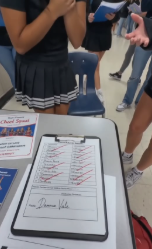
That day, she was sitting behind the cheer-squad sign-up table with the official registration laptop open in front of her.
And she had made four transfer students disappear.
I found it by accident.
Or maybe not accident exactly.
I was helping Coach Ramirez alphabetize paper tryout forms because the online sign-up portal had been lagging all morning. I did not want the job, but I was good at details, and adults loved giving detail work to girls who did not complain.
The folder had twenty-nine paper forms.
The online record had twenty-five names.
At first, I thought I had miscounted.
I counted again.
Still twenty-nine.
Then I checked the missing forms.
All four belonged to transfer students.
Leila Santos. Camila Nguyen. Brianna Cole. Yara Haddad.
Four girls who had moved into the district after winter break. Four girls who did not have older sisters on the team, parents on the booster committee, or friends in Madison’s media circle. Four girls who had turned in their forms on time.
But on the official list, they did not exist.
I looked toward the gym doors, where Leila stood beside Camila, both clutching water bottles and trying to pretend they were not terrified. I had seen them practice jumps in the courtyard for two weeks. Leila counted beats under her breath. Camila always smiled after missing a move, then tried again. They were not asking for special treatment.
They were asking for a fair tryout.
I looked back at the laptop.
Madison’s media team login was active in the corner.
The record was still open.
My stomach tightened.
“Madison,” I said.
She did not look up. “What?”
“These four forms aren’t on the official list.”
Her fingers stopped over the keyboard.
Only for a second.
Then she smiled.
“Probably late.”
“They’re timestamped before the deadline.”
“Then Coach can handle it later.”
“Tryouts start in twenty minutes.”
Madison finally looked at me. “Mina, don’t make this complicated.”
That was when I knew.
People say guilty people panic loudly, but that is not always true. Sometimes panic arrives dressed as boredom. Sometimes it sounds like a calm person telling you not to make something complicated.
I kept my voice low. “I’m going to ask Coach Ramirez to check the record before tryouts start.”
Madison’s smile disappeared.
“Mina.”
“I’m not accusing anyone.”
“You kind of are.”
“No. I’m asking one adult to verify the list.”
Her eyes flicked toward the transfer girls, then back to me.
“Do you know how annoying you sound right now?” she asked.
A couple students nearby heard that and turned.
I felt the attention hit my back.
Still, I held the folder tighter. “The forms are official. They need to be counted.”
Madison leaned forward. “You’re not in charge here.”
“Neither are you.”
The words left my mouth before I could stop them.
The lobby changed.
It was not dramatic at first. Just a few heads turning. A laugh that cut off too quickly. Phones shifting in hands. People sensing that a scene might happen and deciding, silently, to watch instead of help.
Madison stood.
She was not much taller than me, but she knew how to use a crowd like height.
“You’ve been weird about this all day,” she said loudly.
My face warmed. “About what?”
“About the sign-up list. About transfer students. About acting like there’s some conspiracy because you didn’t get asked to help with the media video.”
“That has nothing to do with this.”
“Doesn’t it?” She tilted her head, performing concern. “You’ve always been bitter when people don’t notice you.”
The words landed exactly where she aimed them.
I heard someone whisper, “Ouch.”
Madison knew my weak spot. Everyone did, maybe. I was not popular. I was not bullied every day, but I was easily overlooked. Teachers forgot to call on me. Group chats formed without me. Yearbook captions named everyone except the quiet girl holding the props.
Madison had once cut me out of a student volunteer montage even though I organized half the event. When I asked why, she said, “You were mostly in the background anyway.”
Now she was trying to make the missing names look like my jealousy.
“I’m asking for verification,” I said again.
Madison stepped around the table.
“Stop saying that like it makes you sound official.”
I turned toward the gym doors. “Coach Ramirez?”
Madison moved fast.
Her hand struck my cheek so hard my head turned.
The slap cracked across the lobby.
For a few seconds, nobody moved.
The balloons bobbed gently beside the table. The laptop screen glowed behind Madison. The peppermints sat untouched in their plastic bowl. Somewhere inside the gym, a whistle blew.
My cheek burned.
But the humiliation burned worse.
Everyone stared at me like the slap was the whole story.
Like the sound had erased the forms, the missing names, the record still open behind her.
Madison breathed hard, her hand lowered now, eyes wide as if even she had not expected herself to do it.
Then she recovered.
Because people like Madison always recovered before quieter people could speak.
“Do not try to ruin tryouts because you’re jealous,” she said, loud enough for the lobby to hear.
I tasted metal at the inside of my cheek.
Leila gasped my name.
Camila whispered, “Mina…”
I did not cry.
I wanted to. My eyes burned badly enough that the lights blurred. But crying would have completed Madison’s version of the scene. It would have made me look emotional, unstable, dramatic. The kind of girl who needed to be removed so the perfect event could continue.
So I turned my face back toward her.
“The record is still open,” I said.
Madison’s expression changed.
Just slightly.
But I saw it.
So did Leila.
So did Coach Ramirez, who had stepped out of the gym at the exact wrong moment for Madison and the exact right moment for everyone else.
“What record?” Coach Ramirez asked.
The lobby froze.
Madison turned toward her, instantly softening. “Coach, Mina is causing a scene.”
Coach Ramirez’s eyes moved to my cheek.
Then to Madison’s hand.
Then to the laptop.
“What record?” she repeated.
I lifted the folder. “The tryout registration list. Four transfer students turned in forms, but their names are missing from the official list.”
Madison laughed once. “That’s not true.”
Coach Ramirez walked to the table.
Madison stepped in front of the laptop.
The movement was small.
Too small to be innocent.
Coach Ramirez noticed.
“Move, Madison.”
Madison’s face tightened. “I was managing sign-ups for you.”
“And now I’m checking them.”
“Coach, seriously, this is just Mina trying to—”
“Move.”
Madison moved.
The laptop was still open.
The official registration spreadsheet filled the screen. Twenty-five names. Timestamps. Grade levels. Emergency contacts. Status column. Notes column.
Coach Ramirez took the folder from me and began reading names.
“Leila Santos.”
Not on the list.
“Camila Nguyen.”
Not on the list.
“Brianna Cole.”
Not on the list.
“Yara Haddad.”
Not on the list.
The lobby had gone silent enough to hear the building’s air system humming overhead.
Madison crossed her arms. “Maybe they filled out the wrong forms.”
Leila stepped forward, voice shaking. “Madison gave us those forms.”
Madison turned on her. “No, I didn’t.”
Camila said, “You said transfer students had to use paper because the portal didn’t recognize our student IDs yet.”
Madison’s mouth opened.
No sound came out.
Coach Ramirez looked at the laptop again. “Who has editing access?”
Madison answered too fast. “Coach, you do.”
“And?”
Madison’s eyes flickered.
I said, “Student media team has temporary access because they were making the tryout announcement graphic.”
Coach Ramirez’s face darkened.
The door to the main office opened behind us, and Mr. Ellison, the activities director, stepped into the lobby holding a coffee mug.
“What’s going on?”
Coach Ramirez did not look away from the screen. “I need the registration audit trail.”
Madison went pale.
Mr. Ellison set down his mug.
The word audit had a strange power. It made people stop pretending confusion was enough.
He walked behind the table and clicked into the spreadsheet settings. Madison’s media login still sat in the upper-right corner.
Active user: mvale.media.
Mr. Ellison glanced at Madison.
She swallowed. “I was just checking formatting.”
He opened the version history.
The lobby held its breath.
The first record loaded.
8:11 a.m. — Registration list imported from portal.
Twenty-nine names.
I felt Leila grab my hand.
Twenty-nine.
All four transfer students had been there.
Then the next entry loaded.
9:03 a.m. — Rows hidden.
User: mvale.media.
Rows 12, 14, 19, 22.
Mr. Ellison clicked.
Four hidden rows appeared in gray.
Leila Santos.
Camila Nguyen.
Brianna Cole.
Yara Haddad.
The proof did not shout.
It simply appeared.
And somehow that was louder than the slap.
Students who had stared at me minutes earlier began looking away. Madison’s friends near the table shifted backward. One girl who had laughed under her breath suddenly pretended to search for something in her backpack.
Madison’s face changed before Mr. Ellison even finished reading.
The polished captain of the student media team vanished.
In her place stood a girl realizing the camera was no longer pointed where she wanted.
Coach Ramirez’s voice was low. “Why were these rows hidden?”
Madison shook her head. “I didn’t hide them.”
Mr. Ellison looked at the screen. “Your login did.”
“I must have clicked something by accident.”
“Four separate rows?”
“I didn’t know what I was doing.”
I looked at her. “You knew enough to pick only transfer students.”
That landed.
Madison’s eyes snapped to mine, full of fury and fear.
Then the second part of the evidence package came out.
Camera footage.
Coach Ramirez remembered the lobby security camera before Madison did. Mr. Ellison pulled it up from the activities office while all tryouts were delayed. We were moved into a conference room beside the gym, but students still crowded the hallway outside, whispering in waves.
Inside, I sat with an ice pack against my cheek. Leila, Camila, Brianna, and Yara sat together along the wall. Madison sat opposite us, arms folded, staring at the table like she could force it to become a door.
The footage showed the sign-up table at 8:57 a.m.
Madison sat alone behind the laptop.
She checked the hallway.
Then she leaned toward the screen and clicked.
Once.
Twice.
Again.
Again.
At 9:03, the hidden rows disappeared from the visible list.
Then she picked up the four paper forms and slipped them under a stack of cheer flyers.
Coach Ramirez inhaled sharply.
Camila covered her mouth.
Madison whispered, “It wasn’t supposed to matter.”
Everyone turned toward her.
For a second, I thought she would deny saying it.
She didn’t.
Her eyes filled, but her voice came out angry. “They weren’t going to make the team anyway.”
The room went completely still.
Leila’s hand tightened around mine.
Coach Ramirez stood slowly. “Excuse me?”
Madison looked like she wanted to pull the sentence back, but it was already in the room.
“They transferred midyear,” she said. “They don’t know our routines. They don’t know our style. I was trying to keep tryouts organized.”
“No,” Yara said quietly.
Everyone looked at her.
She had barely spoken all morning. She was small, with dark hair pulled into a tight braid and a tryout number folded in her hands.
“You were trying to keep us out before we got a chance.”
Madison’s eyes flashed. “You don’t understand how competitive this is.”
Brianna laughed bitterly. “We understand perfectly.”
Coach Ramirez pressed her fingers to her forehead.
Then Mr. Ellison opened another file.
“Madison,” he said, “why did you message the returning squad group at 8:45 saying, ‘Don’t worry, I fixed the transfer problem’?”
Madison went white.
The real motive had a timestamp too.
The message thread showed Madison talking with three returning cheerleaders, including her best friend Ashley, who had been worried that transfer students might take open spots.
Ashley: Coach says transfers can try out like everyone else.
Madison: Let me handle the list.
Ashley: You can do that?
Madison: I run media and registration check-in. Don’t worry, I fixed the transfer problem.
The words sat there, ugly and plain.
Transfer problem.
Leila looked down.
I felt something twist inside my chest.
This was never just about cheer. It was about belonging. About who got welcomed by posters and who got quietly erased behind a laptop screen. About how easy it was to make new students feel like outsiders when nobody checked the list.
Madison covered her face with both hands. “I didn’t mean it like that.”
“You meant enough to hide their names,” I said.
She looked at me through her fingers, eyes wet and furious. “You don’t know what it’s like.”
I almost laughed.
“You slapped me in front of half the school because I asked an adult to check a record.”
“My whole senior year is being judged,” she snapped. “Media team, cheer coverage, scholarship applications—everything. Ashley said if transfers made the squad, the returning girls would blame me for promoting tryouts too widely. Coach wanted open registration. The boosters wanted community inclusion. Everybody wanted something, and I was stuck in the middle.”
Coach Ramirez’s expression hardened. “So you chose to erase the students with the least power.”
Madison flinched.
That was the truth, and everyone knew it.
Then came the twist none of us expected.
Mr. Ellison’s computer pinged.
He looked down at a new email.
His face changed.
“What is it?” Coach Ramirez asked.
He clicked the attachment.
A second video opened.
Not from the lobby camera.
From Madison’s own media tablet.
The angle showed the sign-up table from behind, probably recorded automatically while she was testing livestream settings for the tryout announcement. Madison’s voice came through clearly.
Ashley stood beside her at 8:50 a.m., arms crossed.
“If those transfer girls try out, Coach might actually like them,” Ashley said. “Leila has tumbling clips from her old school.”
Madison replied, “I know.”
“So hide them.”
“I can’t just hide them.”
“You can if it looks like portal error.”
Madison said nothing.
Ashley leaned closer. “You want USC media leadership, right? My mom knows the alumni interviewer. She said you need team support footage, not drama. Help us, and I’ll make sure you get the recommendation clip.”
Madison whispered, “That’s insane.”
Ashley smiled. “No. It’s high school.”
Then Madison sat at the laptop.
And hid the rows.
The video ended.
Nobody spoke.
Madison stared at the screen like it had betrayed her.
But it had not betrayed her.
It had shown all of her.
Not only the guilty part. The pressured part too. The part that knew it was wrong and chose it anyway.
Ashley, who had been waiting in the hallway, tried to leave.
Sergeant Dean, the school security officer, stopped her at the door.
Coach Ramirez looked at Madison. “You let Mina take the hit for something Ashley pushed you to do.”
Madison’s lips trembled.
“I thought if Mina looked dramatic, people would stop asking questions,” she whispered.
The words struck harder than the slap.
Because that was exactly what she had done.
She had not needed everyone to believe her forever.
She only needed them to believe me for long enough to move forward without checking the record.
Coach Ramirez canceled tryouts for the day.
Not postponed.
Canceled.
She announced that a new tryout process would be scheduled with staff-only registration, restored forms, and outside review. The transfer students would receive equal tryout slots. Student media access to registration files was revoked immediately.
Madison was removed from the media team pending disciplinary review.
Ashley was removed from the returning squad leadership group.
And I was sent to the nurse with an ice pack and a form I did not want to fill out because writing “slapped by student” made my hand shake more than I expected.
Leila came with me.
She sat in the nurse’s office while I stared at the wall clock.
“I’m sorry,” she said.
“You didn’t slap me.”
“No,” she said. “But I almost didn’t say anything when Madison denied giving us the forms. I was scared Coach would think I was causing trouble before tryouts even started.”
I looked at her.
That was how systems like Madison’s worked. They made people afraid to defend themselves because defense looked like drama, and silence looked polite.
“You said something,” I told her. “That matters.”
She nodded, but her eyes were still wet.
The new tryouts happened two weeks later.
By then, the whole school knew what Madison had done. Some people were angry for the right reasons. Some were angry because tryouts got delayed. Some were angry because the truth made their friend group look bad. That was the thing about exposure: it did not instantly make everyone fair. It only made unfairness harder to hide.
Madison was suspended for three days, removed as media captain, and assigned restorative accountability work with the activities office. Ashley lost her squad captain nomination and her mother’s booster committee role came under review after emails showed she had pressured Coach Ramirez about keeping “team culture consistent.”
The phrase team culture became a joke for a week.
But it stopped being funny when Coach Ramirez held a meeting and said, “Culture is who gets a chance when nobody important is watching.”
I wrote that down.
I don’t know why.
Maybe because I needed proof that an adult had finally said it out loud.
At the new tryouts, Leila landed her tumbling pass so cleanly the gym erupted. Camila nailed the chant section. Brianna recovered from a mistake without losing rhythm. Yara, quiet Yara, had the sharpest motions of anyone in her group.
Not all four made the final squad.
That mattered.
Because fairness was not the same as guaranteed victory.
Leila and Yara made the team.
Camila was offered a manager-training role with an option to try out again in winter.
Brianna did not make it, but Coach Ramirez gave her specific feedback and invited her to open practices.
Nobody disappeared.
Nobody had to wonder if their form had been hidden before they failed.
That was the difference.
The day results were posted, I found Madison sitting alone in the media room.
The door was open.
The record system was locked now, staff-only. Her old captain badge sat on the desk in front of her. She looked up when she saw me.
For a moment, neither of us spoke.
Then she said, “I’m not supposed to be in here without supervision.”
“Then why are you?”
She gave a weak laugh. “Because apparently I make terrible choices.”
I almost smiled.
Almost.
Madison pushed a paper across the desk.
It was an apology letter.
Not typed.
Handwritten.
“I already gave copies to Leila, Camila, Brianna, Yara, and Coach,” she said. “This one’s yours.”
I did not pick it up immediately.
“What does it say?”
“That I was wrong. That I slapped you because I wanted the room to watch your reaction instead of the record. That I knew the transfer forms were valid. That I let Ashley pressure me, but I still made the choice.”
Her eyes filled.
“And that I’m sorry for making you feel like being quiet meant you were easy to erase.”
My throat tightened.
I picked up the letter.
I did not forgive her right there.
But I believed she had written the truth.
That was a beginning.
Months later, the cheer-squad sign-up table looked normal again.
Different balloons. New flyers. Same gym lobby.
But this time, there was a staff member behind the laptop, a printed list taped beside the table, and a sign that said ALL REGISTRATION CHANGES MUST BE VISIBLE IN THE AUDIT LOG.
I stood nearby as a volunteer, handing out numbers.
Leila walked past in uniform and bumped my shoulder gently.
“Still checking the list?” she teased.
“Always.”
“Good.”
Across the lobby, Madison entered with a camera.
Not as captain.
As a student assigned to film under supervision.
She paused near the table and looked at the audit-log sign.
Then she looked at me.
For a second, the old Madison flickered in my memory: the polished captain, the slap, the humiliation, the crowd staring like my pain was entertainment.
But the girl in front of me looked different now.
Not magically transformed.
Not perfect.
Just aware.
She lifted the camera slightly. “Coach asked me to film the new process. I won’t record faces without permission.”
I nodded. “Good.”
She hesitated. “Mina?”
“What?”
“The record is open.”
I looked at the laptop, then back at her.
Madison gave a small, sad smile.
“This time, I know.”
That was the happy ending.
Not that Madison was ruined.
Not that everyone suddenly loved me.
Not that the transfer students all became stars and the cruel girls vanished.
The real victory was smaller and stronger.
The list stayed visible.
The hidden rows stayed unhidden.
The quiet students learned they could ask for verification without apologizing for it.
And the next time someone tried to turn a record problem into a personality problem, the adults did not wait for a slap before checking the screen.
They checked first.
Because sometimes the truth does not need a dramatic speech.
Sometimes it is already there, glowing on an open laptop, waiting for one person brave enough to say:
“Look again.”
THE END
