The slap landed before I could finish saying the truth, and for one frozen second, the entire science camp forgot how to breathe.
The sound cracked through the main lodge at Spokane Ridge Science Camp like a branch breaking under snow. Every conversation stopped. Every phone lifted higher. Every face turned toward me, not with concern first, but with that awful, hungry shock people get when they realize they are witnessing something they will replay later.
My cheek burned. My eyes watered before I could stop them. But I did not cry.
Not because I was brave.
Because the worst part had not been the slap.
The worst part was seeing Rory Ellis smile like she had just corrected the story in front of everyone.
“There,” she said, her voice trembling just enough to sound wounded instead of cruel. “Maybe now you’ll stop lying about me.”
Behind her, three of her friends kept filming. One of them, Elise, had her mouth open in fake horror, but her thumb never left the screen. Another whispered, “Oh my God,” like she had not been waiting for this exact moment since breakfast.
I stood in the center of the lodge with my backpack still hanging from one shoulder, my brown hair slipping loose from its messy braid, my jeans dusty from the trail outside. Around us, camp counselors, juniors, seniors, and two teachers stared from between posters of the solar system and framed photographs of past science teams standing proudly beside microscopes and telescopes.
Science camp was supposed to be the place where evidence mattered.
That was the joke of it.
My name was Cassidy Moore. I was seventeen, quiet enough for people to underestimate me, stubborn enough for it to become inconvenient, and unlucky enough to have discovered that the field-trip bus records from our school had been altered.
At first, it seemed like a boring mistake.
One schedule log. One bus roster. One missing name.
Then the rare book disappeared.
That changed everything.
The book was called Field Notes of the Cascades, a century-old naturalist journal borrowed from the Spokane Historical Archive for our camp research exhibition. It had brittle cream pages, pressed fern sketches, and handwritten observations from a woman scientist whose work had been ignored in her lifetime. Our school had been given special permission to display it for one night only.
I was the student assigned to check it in.
And according to the rumor Rory had spread, I was also the student who had stolen it.
By the time Rory stepped into my space with her polished boots and donor-family confidence, the lie had already traveled through camp faster than wildfire smoke. Students I barely knew had stared at me over lunch trays. Someone had whispered thief near the refill station. A sophomore had pulled his backpack closer when I passed.
I had heard Rory before I saw her.
“She’s pretending she found an issue with the bus logs,” Rory had said loudly near the lodge entrance. “That’s what guilty people do. They make up paperwork drama so nobody looks at them.”
I remember gripping the folder under my arm so tightly that the edge bent against my palm.
Inside it were printed copies of the schedule log, the bus seating chart, and a photograph of the rare book on the display table before it vanished. I had been trying to get an adult to compare the times since breakfast, but every time I asked, someone told me to wait.
Wait until after the keynote.
Wait until the archive representative arrived.
Wait until Principal Halden had a free minute.
Wait.
That was the word adults used when they did not want the truth to interrupt the event they had planned.
Rory did not wait.
She walked straight toward me in front of everyone, her neatly styled hair shining under the lodge lights, her cream sweater looking expensive even at a muddy science camp. Rory Ellis was eighteen, beautiful in the practiced way of girls who knew exactly how much space the world would give them, and connected in the way that made teachers lower their voices around her parents.
Her father had donated the renovated camp bus garage.
Her mother chaired the school foundation.
Her name was on banners, plaques, programs, and every adult’s nervous smile.
Mine was on a check-in sheet.
“You need to stop,” Rory told me.
“I’m asking for the original record,” I said. “That’s all.”
“No,” she snapped. Then she glanced at the phones behind her and softened her expression. “No, Cassidy. You’re trying to blame me because you got caught.”
A murmur moved through the lodge.
“I didn’t get caught,” I said. “The log shows—”
That was when she slapped me.
Hard enough to turn my face.
Hard enough to make the crowd gasp.
Not hard enough to make me forget what I had seen.
For half a second, I froze. My cheek pulsed. My heart beat so loudly I could hear it in my ears. Rory’s friends were still filming. The teachers near the coffee table looked stunned, but none of them moved fast enough.
And then something inside me went very still.
Rory had expected me to shout. To lunge. To cry. To look exactly like the desperate liar she had described.
Instead, I lifted my head and said, clearly enough for every phone in the lodge to catch it, “Pull up the original schedule log.”
The sentence changed the room.
Rory’s smile flickered.
“What?” she said.
“The original record,” I repeated. “Not the printed copy. Not the version in the student packet. The transportation office log with the update history.”
A teacher near the fireplace, Mr. Benton, shifted. He taught environmental chemistry and had the exhausted look of someone who had spent two days preventing teenagers from falling into rivers. He looked from Rory to me, then to the folder in my hand.
“Cassidy,” he said carefully, “maybe we should take this into the office.”
“Yes,” I said. “Please.”
Rory laughed, but it came out thin. “This is ridiculous. She’s doing this because everyone knows she was alone near the display table.”
“I wasn’t alone,” I said.
“You were,” she shot back.
“No,” I said. “That’s what the changed bus record makes it look like.”
Another murmur. This one sharper.
Rory’s friend Elise lowered her phone half an inch.
Principal Halden appeared at the hallway leading from the administrative office. She was a tall woman with silver glasses, a navy blazer, and the kind of controlled expression that made students stand straighter without knowing why.
“What is going on?” she asked.
Nobody answered at first.
Then Mr. Benton said, “There’s been an altercation.”
Principal Halden’s eyes moved to my cheek. Something tightened in her face.
Rory immediately folded into a wounded posture. “Cassidy accused me in front of everyone. She’s been spreading lies all day because the rare book went missing.”
“I asked for the log,” I said.
Principal Halden looked at me. “Which log?”
“The field-trip bus records,” I said. “The original transportation schedule. Someone changed the return group assignments after we arrived yesterday. My name was moved into the display-room window, and another student’s name disappeared.”
Rory’s face lost a little color.
Not enough for most people to notice.
I noticed.
Principal Halden held out her hand. “Come with me. Both of you.”
Rory stepped back. “I don’t think I should have to—”
“Nobody leaves,” Principal Halden said.
The lodge went silent again.
Behind her, the office door opened, and a man in a dark green archive jacket stepped out carrying a laptop bag.
At the time, I did not know who he was.
Rory did.
Because the second she saw him, she whispered to her friends, “Stop filming.”
But Elise’s phone was still recording.
And that, in the end, would ruin Rory more completely than anything I had printed in my folder.
The office smelled like pine cleaner, old carpet, and overheated electronics. Rain tapped against the window behind Principal Halden’s desk, turning the forest outside into a blur of gray trunks and dark green needles. Mr. Benton stood near the filing cabinet. The man in the archive jacket introduced himself as Daniel Price, collections coordinator from the Spokane Historical Archive.
He had kind eyes, but they were not soft.
“I came early because of the missing item,” he said.
Rory clasped her hands in front of her. “I’m really sorry about the book, Mr. Price. We’re all upset.”
His gaze rested on her for one second longer than politeness required. “I imagine so.”
Principal Halden sat at the desk and opened her laptop. “Cassidy, explain from the beginning.”
So I did.
I told them about the display team assignments, about how I was responsible for checking the rare book into the secure case after the afternoon research session. I explained that the book had been present at 3:40 p.m. because I had photographed the display table for our project documentation.
Rory interrupted. “Everyone knows that.”
Principal Halden lifted one finger. Rory went quiet.
I continued.
“At 4:05, I left with Group C for the watershed trail. That’s what the original schedule said yesterday morning. But this morning, the printed camp schedule says I stayed behind for indoor display prep until 4:30. That would place me near the rare book during the window when it vanished.”
Mr. Benton frowned. “Why would the printed schedule be different?”
“That’s what I asked,” I said.
Rory scoffed. “Because schedules change. It’s camp. People switch groups all the time.”
“Not this switch,” I said. “Because the student who replaced me on the trail disappeared from the printed version.”
Principal Halden turned her laptop around slightly. “Who?”
I hesitated.
This was the part that had made me afraid from the beginning.
“Lena Ortiz,” I said.
The room changed.
Lena was sixteen, a scholarship student, and one of the smartest people in our school. She could identify bird calls by ear, solve chemistry problems in her head, and make teachers smile without trying. She was also quiet, anxious in crowds, and easy for people like Rory to step over.
Rory gave a quick laugh. “Lena? Why are you dragging Lena into this?”
“I’m not dragging her into anything,” I said. “I’m trying to prove she was there.”
“At the display table?” Principal Halden asked.
“No,” I said. “On the trail with me.”
Mr. Benton looked up. “Lena was on the trail?”
“Yes. She found something near the old service road. A camp maintenance tag. She said it looked like it came from one of the archive transport boxes. She was going to tell Mr. Price, but after dinner she got scared.”
Rory’s eyes flashed. “That’s insane.”
I looked at her then. “You told everyone Lena had been sneaking around the storage room.”
Rory’s lips parted.
It was small. Barely a reaction.
But Principal Halden saw it.
Daniel Price leaned forward. “What maintenance tag?”
I reached into my folder and pulled out a photo Lena had texted me before she stopped answering messages. It showed a small laminated tag lying in wet pine needles. The printed label read: ARCHIVE TRANSPORT — CASE B.
Mr. Price took the page from me slowly.
“That tag was attached to the rare book’s protective transport case,” he said.
Rory made a sound halfway between a laugh and a cough. “Anyone could have dropped that.”
“Not anyone,” he said. “The transport case was not opened by students. It was kept in the locked prep room.”
The rain tapped harder.
Principal Halden turned back to the laptop. “I’m accessing the transportation portal.”
Rory shifted. “My parents should be here if this is going to turn into some kind of accusation.”
“This is a fact-finding conversation,” Principal Halden said. “Your parents will be contacted if necessary.”
Rory looked toward the door.
Mr. Benton moved slightly, not blocking it exactly, but reminding her that leaving was not an option.
The transportation portal loaded slowly. I watched the spinning circle on the screen like it was deciding whether my life would become believable again.
My cheek still burned. I could feel the shape of Rory’s hand in the heat under my skin. But underneath the humiliation, underneath the fear, there was something stronger.
The truth had a trail.
It always had a trail.
People like Rory forgot that because they were used to adults sweeping behind them.
Principal Halden clicked into the trip record.
A table opened. Names, groups, bus numbers, activity slots, timestamps.
She scrolled.
“There’s the current version,” she said.
Rory leaned in quickly. “See? Cassidy was assigned to indoor prep.”
“After modification,” I said.
Principal Halden clicked a small gray button marked History.
Rory stopped breathing.
The update history appeared.
Three entries.
The first was from the transportation office the day before camp.
The second was from Mr. Benton, who had moved two students after a medical accommodation.
The third was from 9:18 p.m. the previous night.
Principal Halden read the screen.
Her voice stayed calm, but her eyes did not.
“Group C assignment modified. Cassidy Moore moved from watershed trail to indoor display prep. Lena Ortiz removed from watershed trail. Modified by student admin access.”
Mr. Benton went pale. “Students don’t have admin access.”
“No,” Principal Halden said. “They don’t.”
Rory whispered, “That doesn’t prove anything.”
Principal Halden clicked the entry.
A device ID expanded beneath it.
Mr. Benton looked at the number and closed his eyes.
“What?” Rory demanded. “What is that?”
Principal Halden did not answer her. She reached for the desk phone. “I need Ms. Greer from tech services in my office now.”
Rory’s voice sharpened. “This is getting ridiculous. Cassidy probably used someone else’s login.”
I almost laughed. Not because it was funny, but because it was exactly what she had planned to say all along.
Daniel Price was still studying the photo of the transport tag. “Cassidy, did Lena say anything else when she found this?”
I swallowed. “She said she saw someone near the service road after the keynote rehearsal. Someone carrying a rectangular case under a rain jacket.”
Rory’s face went still.
“Who?” Principal Halden asked.
“She didn’t tell me,” I said softly. “She got scared after Rory started telling people Lena had been around the storage room. She thought nobody would believe her.”
Rory turned on me. “You are such a liar.”
Mr. Benton’s voice hardened. “Rory.”
“She is!” Rory’s perfect mask cracked at the edges. “She’s been jealous all year. She wanted the archive project lead, but I got it. She wanted the scholarship presentation, but Lena got it. Now she’s making this whole thing up because she can’t handle being invisible.”
The words hit harder than the slap in a way I hated.
Because part of me believed them.
Not the lie.
The invisible part.
I had spent years being the kind of student adults called reliable when they needed extra work done and forgot when they handed out credit. I checked forms. Fixed citations. Stayed late. Carried boxes. Protected people who did not always know I was protecting them.
Rory got applause.
I got responsibility.
But before I could respond, the office door opened.
Lena Ortiz stood there with Ms. Greer from tech services behind her.
Lena’s face was pale. Her dark hair was damp from the rain. She clutched her phone in both hands like it might float away if she loosened her grip.
Rory stared at her.
“Lena,” Rory said softly, almost kindly. “You don’t have to be part of this.”
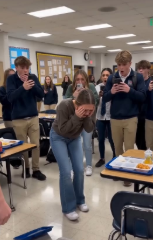
Lena flinched.
That flinch told the whole room more than any speech could have.
Principal Halden stood. “Lena, you’re safe here. We’re trying to understand what happened.”
Lena’s eyes found mine.
I gave the smallest nod.
Her voice came out barely above a whisper. “I saw Rory.”
Rory’s expression emptied.
“No, you didn’t,” she said.
Lena gripped her phone tighter. “I did.”
Ms. Greer stepped forward, holding a tablet. “Principal Halden, I matched the device ID on the schedule change. It came from a school-issued tablet checked out to the camp leadership team.”
Rory exhaled too quickly. “Lots of people used those tablets.”
Ms. Greer looked at her. “This one was checked out under your name.”
Rory’s friends were no longer outside the office door. The hallway had gone quiet in that way that meant people were listening while pretending not to.
Rory shook her head. “That tablet was in the common room. Anyone could have taken it.”
Ms. Greer tapped the screen. “The login used was not yours.”
Rory seized on that. “Exactly.”
“It was Mr. Ellis’s donor portal credentials.”
The office fell silent.
Rory’s father.
For the first time, Rory looked truly afraid.
Principal Halden’s face changed in a way I had never seen before. Not shock. Not confusion.
Recognition.
“Your father’s credentials were used to access student transportation records?” she asked.
Rory said nothing.
Daniel Price set the photo down. “Why would a donor have access to transportation records?”
Principal Halden’s mouth tightened. “He shouldn’t.”
Ms. Greer looked uncomfortable. “The donor portal was incorrectly connected to the event management system during the bus garage renovation project. It appears certain accounts retained elevated permissions.”
“That is a serious breach,” Daniel Price said.
Rory whispered, “It was just a schedule.”
“No,” Lena said.
Everyone looked at her.
Her voice shook, but she kept going. “It wasn’t just a schedule. She needed Cassidy to look like she was inside. And she needed me to disappear from the trail because I saw her near the service road.”
Rory’s eyes filled with sudden tears. “Lena, stop. Please.”
The please was not apology.
It was warning.
But Lena did not stop.
“She was carrying the archive case,” Lena said. “It was wrapped in her blue rain jacket. I thought maybe she had permission, but then she saw me. She told me if I said anything, everyone would find out my scholarship application had a false recommendation.”
My stomach dropped.
Lena looked at the floor. “She said her mom knew people on the scholarship committee. She said they could make me look dishonest.”
Principal Halden’s voice was very quiet. “Was your application false?”
“No,” Lena whispered. “But I got scared.”
Rory turned away, wiping at her face. “This is insane. I didn’t steal the book.”
“Then where is it?” I asked.
She spun back. “I don’t know!”
But she said it too fast.
Daniel Price looked toward the rain-streaked window. “The transport tag was found near the old service road. Where does that road lead?”
Mr. Benton answered. “Maintenance shed. Old observatory. North cabins.”
Rory closed her eyes.
I remembered something then.
Something so small it had not mattered until that moment.
During breakfast, Rory had complained about mud on her boots even though she claimed she had stayed inside all night. Elise had joked that rich-girl boots were not made for “crime scene trails.” Everyone laughed.
Rory had not.
“The old observatory,” I said.
Rory looked at me like she hated me.
Daniel Price stood. “Why do you say that?”
“Because Rory was assigned to give the donor presentation there tonight,” I said. “After the exhibition.”
Principal Halden turned to Rory. “Were you planning to move the book there?”
“No,” Rory said.
But it was over.
Not officially. Not yet.
But the truth had entered the room, and it was not leaving.
They found the rare book twenty minutes later.
It was not in Rory’s cabin. Not in her bag. Not in the old observatory display case.
It was beneath the loose floorboard under the observatory’s back supply cabinet, wrapped carefully in archival cloth and sealed inside a plastic weatherproof box.
That was the strangest part.
Rory had not damaged it.
She had protected it.
When Daniel Price lifted the book out, his hands were steady, but his face was grim. Principal Halden stood beside him with two camp security staff and Ms. Greer. Rory watched from the doorway, arms wrapped around herself, her polished confidence gone.
Students had gathered outside despite being told to return to the lodge. Rain glistened on their jackets. Phones hovered low now, hidden but still present.
Rory’s father arrived before dinner.
He came in a black SUV that looked absurd on the muddy camp road. Charles Ellis stepped out wearing a wool coat, expensive shoes, and an expression that suggested the weather had personally offended him. Rory ran to him like a child, and for one second, I saw something real in her face.
Not innocence.
Fear.
He did not hug her.
He put one hand on her shoulder and looked toward Principal Halden. “This has gone far enough.”
That was when I understood.
Rory had power at school because her family had power.
But Rory was not the source of it.
She was trained by it.
Principal Halden invited him into the office. Daniel Price insisted on attending. Ms. Greer brought the access records. Mr. Benton brought witness statements. Lena sat beside me, trembling but determined.
Rory sat across from us with her father standing behind her chair.
Charles Ellis never looked directly at me.
“Teenage misunderstandings,” he said. “That’s what this is. My daughter made a mistake reacting emotionally after being accused.”
“She struck another student,” Principal Halden said.
“And I’m sure she regrets that.”
Rory nodded quickly. “I do.”
It was the first apology-like thing she had offered.
It did not reach her eyes.
Charles continued. “As for the book, Rory has explained to me that she moved it because she believed the display room was unsecured.”
Daniel Price’s eyebrows lifted. “She moved a rare archive item without authorization, hid it, altered transportation records, and threatened a witness because she believed she was improving security?”
Charles smiled slightly. “Young people panic.”
Lena’s hands twisted in her lap.
I stared at Charles Ellis and suddenly saw Rory’s whole performance reflected in him. The controlled voice. The instant reframing. The calm confidence that reality could be edited if spoken firmly enough.
Principal Halden said, “Your donor credentials were used to alter school transportation records.”
“Obviously an error in your system,” he said.
Ms. Greer opened her mouth, but Principal Halden raised a hand.
Charles placed a folder on the desk. “Before this becomes more embarrassing for everyone, I suggest we handle it privately. The Ellis Foundation has supported this district for years. I would hate for a temporary lapse in judgment to jeopardize future opportunities for students.”
There it was.
The threat dressed as generosity.
My cheeks burned again, but this time not from the slap.
Lena shrank beside me.
Rory stared at the floor.
Principal Halden looked at the folder and did not touch it.
Then Daniel Price spoke.
“Mr. Ellis, why was your foundation so interested in this particular archive exhibition?”
Charles’s smile faded a fraction. “Excuse me?”
Daniel Price opened his laptop and turned it around.
On the screen was a scanned page from Field Notes of the Cascades. A page I had photographed without understanding its importance. It showed a hand-drawn map of land parcels near Spokane Ridge, marked with old survey notes and a name written in faded ink.
Moore.
My last name.
I stared at it.
“What is that?” I whispered.
Daniel Price looked at me with unexpected gentleness. “Your great-great-grandmother, Eliza Moore, was one of the naturalists whose work appears in this journal. She documented several protected wetland zones before they were commercially surveyed.”
Charles Ellis went completely still.
Principal Halden looked from the screen to him. “And?”
Daniel clicked to another document. “One of those wetland zones overlaps with the proposed expansion site for the Ellis Foundation’s new outdoor education center.”
The room turned cold.
I did not understand at first.
Then I did.
The rare book was not just a rare book.
It was evidence.
Not of Rory’s lie.
Of something much bigger.
Daniel Price continued, “If this journal is authenticated as an original environmental record, it may complicate permits for development on that land.”
Charles laughed once, sharply. “That is a dramatic interpretation.”
“Maybe,” Daniel said. “But it explains why someone would want the book missing before the archive representative completed tonight’s verification.”
Rory looked up at her father.
Her face changed.
Not fear now.
Shock.
“Dad?” she whispered.
Charles did not look at her.
And in that silence, the final piece slid into place.
Rory had not stolen the book for herself.
She had done it for him.
Or because of him.
Or because she thought she had to.
Principal Halden leaned forward. “Rory, did your father ask you to move the book?”
Charles snapped, “Do not answer that.”
Rory flinched.
Every adult in the room saw it.
“Rory,” Principal Halden said, softer now, “you need to tell the truth.”
For the first time since I had known her, Rory Ellis looked small.
Her perfect hair had loosened from the rain. Her eyes were red. Her hands shook in her lap. She looked at me then, really looked, and I saw something I had not expected.
Shame.
Not enough to erase what she had done.
But enough to crack the mask.
“I didn’t know what it was,” she said.
Charles said, “Rory.”
She started crying, but not dramatically. Quietly. Like something inside her had finally given way.
“He told me the archive made a mistake,” she said. “He said the book had private family documents tucked inside and that if people saw them, it could hurt the foundation. He said I just needed to move it until he arrived. He gave me the login. He told me which schedule to change so nobody would know I left the rehearsal.”
My whole body went numb.
Charles’s face darkened. “You are confused.”
“No,” Rory said, and her voice broke. “You told me Cassidy was nobody. You said if anyone asked questions, people would believe me before they believed her.”
The words landed like stones.
Nobody moved.
Rory looked at me, tears slipping down her face. “I’m sorry.”
I wanted to hate her apology.
Part of me did.
But another part of me saw the trap she had lived inside: a house where love sounded like orders, where mistakes were managed, where truth was whatever protected the family name.
Still, my cheek hurt.
Lena had been threatened.
The entire camp had been turned against me.
Understanding someone’s cage did not make them innocent of what they did with the keys.
Principal Halden closed the laptop. “Mr. Ellis, this conversation is over. I am contacting the district, the archive board, and legal counsel.”
Charles stood. “You are making a career-ending mistake.”
Principal Halden looked up at him. “No. I think I’m correcting one.”
The fallout came fast.
By nightfall, the camp was no longer whispering about me stealing a book. They were whispering about Rory, her father, the donor portal, the hidden archive record, and the slap that had been filmed from six different angles.
Principal Halden gathered everyone in the lodge after dinner.
The rain had stopped. The windows reflected our faces back at us, pale and tense under the warm lights. Rory was not there. Neither was her father. Lena sat beside me, her shoulder pressed against mine. For once, neither of us felt invisible.
Principal Halden stood at the front.
“Today,” she said, “a student was publicly accused without evidence. Another student was intimidated. A school record was altered. A historical item was removed without permission. These matters are being handled through official channels.”
Nobody spoke.
Then she looked directly at the students.
“I want to be very clear. Filming someone’s humiliation is not the same as seeking truth. Sharing a rumor is not the same as knowing a fact. And silence, when someone is being targeted, is not neutrality.”
A few people looked down.
Elise was crying near the back.
I should have felt satisfied.
I mostly felt tired.
After the meeting, students approached me in awkward little waves.
“I didn’t know.”
“I’m sorry I believed it.”
“I should’ve said something.”
“You were really brave.”
The apologies blurred together. Some were sincere. Some were embarrassed. Some were just afraid of being on the wrong side now that the truth had power.
Lena and I escaped to the porch.
The air smelled like wet cedar and cold earth. Across the clearing, the old observatory stood dark against the trees. Somewhere inside the lodge, adults were still talking in serious voices.
Lena leaned on the railing. “I almost didn’t come.”
“I know,” I said.
“I was scared she’d ruin everything for me.”
“She tried.”
Lena looked at me. “You still stood up for me.”
I gave a small laugh. “I was terrified.”
“Me too.”
We stood quietly for a moment.
Then she said, “Your great-great-grandmother was in the book.”
“I guess so.”
“That’s kind of amazing.”
I looked out at the dark forest. All day, I had thought the rare book could prove where I was. I had thought it was just the thing Rory needed to hide to blame me.
But it had carried my family’s name the whole time.
A woman scientist no one had listened to.
A record someone powerful wanted buried.
A truth waiting for the right person to notice.
Maybe that was why I had felt so desperate to protect it before I even knew.
Three weeks later, the story became bigger than our school.
The district launched an investigation into donor access systems. The Ellis Foundation suspended its outdoor education center project after environmental reviewers requested the archive documentation. Charles Ellis resigned from two boards before anyone could vote him out. The local paper wrote about the rediscovered field notes of Eliza Moore, calling them “a remarkable historical contribution to early conservation science.”
My mother cried when I showed her the article.
She ran her fingers over Eliza Moore’s name like it was a photograph.
“My grandmother used to say we came from stubborn women,” she whispered. “I guess she was right.”
Lena got her scholarship.
Not quietly.
At the spring assembly, Principal Halden announced her name in front of the whole school, and the applause was so loud Lena covered her face. I stood in the front row and clapped until my hands hurt.
Rory did not return to school for the rest of the semester.
I heard rumors, of course. That she transferred. That she was grounded forever. That she was cooperating with investigators. That she had turned over messages from her father. I did not know what was true.
Then, on the last day of junior year, I found an envelope in my locker.
No name on the outside.
Inside was a handwritten letter.
Cassidy,
I have rewritten this twelve times because every version sounds too small.
I am sorry I slapped you. I am sorry I lied about you. I am sorry I threatened Lena. I am sorry I used what people believed about me to make them doubt what was true about you.
My father taught me that being believed was the same as being right. It isn’t.
You asked for the original record. I keep thinking about that. I keep thinking about how you did not ask people to like you or feel sorry for you. You just asked them to look at what was real.
I don’t expect forgiveness. I just wanted you to know that I told the investigators everything.
The book is safe because you refused to be scared into silence.
Rory
I read it twice.
Then I folded it carefully and put it back in the envelope.
I did not forgive her that day.
Not fully.
But I believed her.
Sometimes that is the first honest thing two people can share.
That summer, the Spokane Historical Archive invited me and Lena to help prepare a student exhibit about Eliza Moore’s field notes. We spent three afternoons in a cool back room wearing cotton gloves and turning pages so carefully we barely breathed. Daniel Price taught us how to handle fragile paper, how to read old survey marks, how to trace a record across time.
One afternoon, he placed a small magnified scan in front of me.
“We found something else,” he said.
It was a page from the back of the journal, one that had been stuck lightly to another for decades. The handwriting was faded but readable.
If these notes are ever challenged, let the record be compared against the transport schedules and witness ledgers. Men with money often trust that paper will stay where they put it. They forget paper can wait.
My throat tightened.
Lena read it over my shoulder. “Cassidy.”
I stared at the words.
A hundred years before Rory changed a schedule log, Eliza Moore had written about men with money trusting paper to stay where they put it.
A hundred years before Charles Ellis tried to bury her record, she had predicted him.
Not by name.
By pattern.
That was the twist no one at camp had seen coming.
The rare book had not only exposed Rory’s lie.
It had been written by a woman who knew the powerful would someday try to erase the truth, and she had hidden the method to catch them inside the very kind of records they underestimated.
Bus schedules. Witness ledgers. Transport logs.
Boring papers.
Quiet papers.
The kind nobody clapped for.
The kind that saved everything.
In September, the school renamed the annual science research award after Eliza Moore. Lena won the first one. I received a special commendation for archival integrity, which sounded much fancier than “girl who got slapped and asked for a log.”
When I walked onto the auditorium stage, people stood.
For a second, the applause overwhelmed me. I saw students who had filmed, students who had whispered, students who had looked away. I saw Principal Halden smiling. I saw Mr. Benton wiping his glasses. I saw my mother crying in the second row.
And then I saw Rory.
She stood near the back doors with her hands clasped in front of her.
No expensive crowd around her. No phone lifted. No performance.
Just Rory.
She did not wave.
She only nodded once.
I nodded back.
Not because everything was fixed.
Because the truth had done what truth does when someone protects it long enough.
It had changed the room.
After the ceremony, Lena found me by the trophy case.
“You okay?” she asked.
I looked at the new plaque, at Eliza Moore’s name shining under the lights.
“I think so,” I said.
My reflection stared back from the glass: brown hair, jeans, a face that had once burned under a public slap, eyes steadier than they used to be.
For most of my life, I thought being quiet meant being easy to erase.
I was wrong.
Quiet things survive.
Logs. Letters. Field notes. Girls who notice details.
And sometimes, when the whole room is watching the wrong story, all it takes is one steady voice asking for the original record.
THE END
