The first phone rose before I even hit the edge of the supply table.
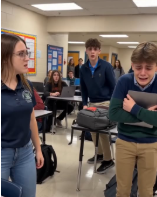
I saw it out of the corner of my eye: a black case, a cracked screen protector, a student’s hand shaking with the thrill of catching disaster before a teacher could turn it into a misunderstanding. Then another phone lifted. Then another. Within three seconds, half the school activity space in Santa Fe High looked like a courtroom where the jury had already decided someone had to be guilty.
And somehow, everyone was looking at me.
My palms stung from catching myself against the table. A stack of permission forms slid sideways, fanning out across the floor like white flags nobody planned to honor. The metal leg of a folding chair scraped the tile behind me. Someone gasped. Someone whispered, “Did she just shove her?”
Whitney Cross stood two steps away with her hands pressed to her chest, her eyes wide behind polished glasses, her mouth parted like she had just witnessed something terrible instead of causing it.
“Alina,” she said, loud enough for the room to hear, “why are you acting like this?”
My name sounded wrong in her mouth.
I was Alina Novak, seventeen, Polish American, scholarship-track student, school activities volunteer, the girl teachers trusted to alphabetize forms and refill markers and stay late without being asked. I was wearing a blue-green sweater over a plain shirt, loafers my mother had bought on sale, and my hair clipped back because I had expected to spend the afternoon organizing field-trip materials.
Not defending myself in front of a hundred students.
Whitney Cross, eighteen, daughter of the athletic-field sponsor, looked like she belonged in the glossy school brochure folded on the front office counter. Polo shirt. Neat hair. Glasses that made her look thoughtful instead of dangerous. She had the kind of calm expensive people wore when they were used to other people cleaning up after them.
She turned toward the students with a trembling breath so perfect it almost deserved applause.
“I only asked her to stop touching the official bus list,” Whitney said. “She got aggressive.”
The word aggressive landed in the room like a match.
I felt my throat close.
“No,” I said, but it came out too quiet.
Whitney’s eyes flicked to the table behind me. To the forms. To the folder beneath my hand.
That was when I understood.
This wasn’t about me moving a paper.
This was about the name crossed off the bus list.
That morning, the school activity space had smelled like coffee, dust, poster paint, and the faint winter cold that slipped in whenever someone opened the courtyard doors. We were preparing for the sophomore-junior service field trip to a historic farm and museum outside Santa Fe, the kind of event the school loved because it made good photos: students in matching shirts, teachers smiling beside buses, donor families thanked in captions.
I had volunteered because I needed service hours, but also because I liked systems. Lists made sense. Paperwork either matched or didn’t. Permissions were either signed or missing. Rules were annoying, but they were at least supposed to apply to everybody.
At least, that was what I used to believe.
I was sorting the bus packets when I noticed the first problem.
One student’s name had been crossed off Bus Two in thick black marker: Mateo Ruiz.
The line through his name was aggressive, so dark it had nearly torn the paper.
I knew Mateo. Not well, but enough. He was quiet, always carrying a sketchbook, always sitting near the back of class like he was trying to take up less space than he deserved. He was a scholarship student, like me. His mother cleaned offices at night. He had spent two weeks talking about the trip because the museum had an architecture exhibit he wanted to see.
Beside the crossed-out name, someone had written: NO PERMISSION ON FILE.
But I remembered filing his form.
I remembered because his mother had signed in blue ink and written a note at the bottom: Thank you for including him.
That sentence had stayed with me.
I checked the folder again. Then the binder. Then the digital list printed from the student activities email. Mateo had permission. Emergency contact. Medical clearance. Everything.
And yet his name had been removed.
At first, I thought it was a mistake.
Then I found the second list.
It was tucked beneath the athletic boosters packet, clipped to a note about sponsor photos. On that version, Bus Two had an added name in Mateo’s place: Parker Cross.
Whitney’s younger brother.
Parker was not supposed to be on the trip. He was a freshman, not eligible for that activity, and he had not attended the required orientation. More importantly, the bus had exactly one open seat, and somebody had created that seat by erasing Mateo.
My stomach turned cold.
I was still staring at the paper when Whitney appeared beside the table.
“Those are finalized,” she said.
I looked up.
Her smile was small and bright, like a window with the blinds closed behind it.
“I think there’s a mistake,” I said. “Mateo Ruiz has permission paperwork. His name got crossed off.”
Whitney leaned closer. Her perfume was sharp and floral, expensive enough to feel like an insult in a room full of dry-erase markers and school coffee.
“If he’s crossed off, there’s probably a reason.”
“There isn’t. His form is here.”
I held it up.
For half a second, Whitney’s face changed. Not much. Just enough. A tiny tightening around her mouth. A flicker of irritation behind the lenses.
Then she smiled again.
“Alina, you’re not in charge of final approvals.”
“No, but I’m not going to hand a false list to Ms. Bell.”
“You’re making this bigger than it needs to be.”
I looked down at Mateo’s mother’s note.
Thank you for including him.
Something inside me hardened.
“It already is bigger,” I said. “Someone removed a student who had permission.”
Whitney moved closer.
Students were beginning to arrive for the afternoon prep meeting. Laughter bounced off the high ceiling. A few athletes in Cross Field hoodies leaned against the wall. Whitney’s friends drifted in around her, smooth and watchful.
She lowered her voice.
“You should be careful.”
I met her eyes.
“About what?”
“About accusing people when you don’t understand the full story.”
That was the thing about Whitney Cross. She never had to threaten directly. Her family’s name did it for her.
Cross Field was painted on the stadium sign. Cross Family Athletic Center was printed across the gym entrance. At assemblies, the principal thanked her father with the same smile he used for district officials. Teachers didn’t say Whitney was untouchable, but they didn’t have to. Everybody already knew.
I knew, too.
But I also knew what it felt like to have adults misplace your dignity and call it a paperwork issue.
My mother worked double shifts at a medical billing office. My father drove deliveries before sunrise. They had left Kraków before I was born, chasing the kind of stability that always seemed one bill away from disappearing. They had taught me to be polite, to work twice as hard, to never give people a reason to say I didn’t belong.
But nobody had taught me what to do when being polite meant helping someone else disappear.
So I pulled the email records folder closer.
“I’m checking with Ms. Bell,” I said.
Whitney’s smile vanished.
“You don’t need to do that.”
“I do.”
“Alina.”
Her voice sharpened just enough that nearby conversations faded. The students closest to us turned.
I should have walked away right then. I should have taken the folder and gone straight to the office. But Whitney shifted, blocking the path, and one of her friends stepped behind her with a phone already in hand, not recording yet, just ready.
Whitney said, “You’ve been weird about me all semester.”
A murmur moved through the room.
I blinked. “What?”
“You keep trying to make everything about money. About sponsors. About my family.” Her voice trembled now, a careful imitation of hurt. “I know you’re upset about not getting the leadership award, but this is not okay.”
The room changed.
Just like that, the field-trip list became invisible, and I became the story.
My face burned.
“I never said anything about the award.”
“You didn’t have to.”
“Whitney, stop.”
But she had already found the angle. I saw it happen. She squared her shoulders toward the crowd, not toward me. Her expression softened into fear. She took one step closer.
“I’m asking you to step away from the official materials,” she said.
“I’m not doing anything wrong.”
“You’re making everyone uncomfortable.”
A boy by the windows whispered, “What’s going on?”
Whitney reached toward the folder.
I pulled it back.
Her eyes flashed.
Then she shoved me.
Not hard enough to injure me. Not dramatic enough to look uncontrollable. Just enough to make my hip hit the table and send the papers sliding, just enough to make me stumble, just enough to create a scene she could narrate before I caught my breath.
And the phones went up.
The worst part was how fast people believed the first complete sentence.
“She got aggressive,” Whitney said again, now with tears shining in her eyes.
I looked at the crowd. Some faces were shocked. Some hungry. Some uncertain. A few students kept recording, their screens reflecting small versions of my humiliation back at me.
Ms. Bell pushed through the crowd, cheeks flushed. “What happened?”
Whitney stepped toward her immediately.
“I tried to stop Alina from changing the bus list,” she said. “She grabbed the folder and started arguing.”
“That’s not true,” I said, stronger this time.
But Ms. Bell’s eyes were already on the scattered papers, the students filming, my hand still gripping the folder like evidence and guilt were the same thing.
“Everyone lower your phones,” she said.
Nobody did.
Whitney wiped beneath one eye.
“She’s been obsessed with this idea that Mateo was removed unfairly,” she said. “But the list was already approved.”
I turned to Ms. Bell. “Mateo’s paperwork is complete. His name was crossed off and replaced with Parker Cross. Parker isn’t eligible.”
The room went silent.
Whitney’s face paled, then recovered.
“My brother was invited to help with equipment.”
“No,” I said. “His name is on the student bus roster.”
Ms. Bell held out her hand. “Give me the folder.”
I hesitated.
Not because I didn’t trust Ms. Bell. I wanted to. She taught history like the past still had fingerprints on everything. She was one of the few adults who said my name correctly the first time.
But I had seen what happened when evidence entered adult hands too early. It became “context.” It became “handled privately.” It became a meeting with no witnesses and a decision nobody explained.
Still, refusing would make me look worse.
I gave her the folder.
Ms. Bell opened it.
Whitney stared at the pages like she could set them on fire with manners.
The first form was Mateo’s. Blue ink. Mother’s note. Complete.
The second was the printed email confirmation from two days earlier: Mateo Ruiz cleared for Bus Two.
Ms. Bell’s brows drew together.
Whitney said quickly, “There may have been an updated email.”
“There was,” I said.
I reached into the side pocket of the binder and pulled out the printed chain I had found earlier, the one I had not fully understood until that moment.
The email record showed a request sent from an account labeled Student Activities Support to update the bus roster. It claimed Mateo’s permission was missing and Parker Cross had been approved as replacement equipment assistant.
But beneath that was the forwarded metadata, printed because our school’s old system included ugly details nobody usually bothered to read.
The request had not come from Ms. Bell.
It had not come from the front office.
It had come from a student aide login assigned to Whitney Cross.
Ms. Bell’s face tightened.
“Whitney,” she said slowly, “why is your aide account attached to this change?”
Whitney’s mouth opened.
For the first time, no perfect sentence came out.
The room felt like it leaned forward.
A student near the back whispered, “Oh.”
Whitney gave a small laugh. “That doesn’t mean anything. Lots of people use those computers.”
“Your login was used,” Ms. Bell said.
“My account stays open sometimes.”
I looked at her hands. They were clenched so tightly her knuckles had gone pale.
Ms. Bell turned another page.
The room was quiet except for the low buzz of phones still recording.
“Here is another email,” Ms. Bell said. Her voice had changed. It was no longer the voice of a teacher calming a scene. It was the voice of someone realizing the floor beneath her had been fake. “This one asks that Mateo Ruiz not be contacted until after departure because he had supposedly withdrawn.”
“That wasn’t me,” Whitney said.
But it was too late.
The perfect story had cracked.
And once it cracked, everyone heard what was inside.
Ms. Bell ordered everyone to the auditorium while she called the assistant principal. Whitney tried to leave, but Mr. Harlan, the activities director, arrived at the door and asked her to stay. She looked at him like he had forgotten who her father was.
Maybe he had.
Or maybe, for once, he remembered who he was.
I sat on a plastic chair near the storage shelves while adults talked in low voices. My body had stopped shaking, but my thoughts had not. The room still smelled like paper and winter air. One of my loafers had a scuff across the toe from where I had stumbled. I stared at it because looking at anything else felt impossible.
Mateo arrived twenty minutes later.
He came in with his backpack hanging off one shoulder, cheeks red from rushing. His eyes moved from Ms. Bell to me to Whitney.
“What happened?” he asked.
No one answered right away.
His gaze dropped to the forms on the table.
He understood before anyone explained.
“Oh,” he said.
It was such a small sound.
Not anger. Not surprise.
Something worse.
Recognition.
Like part of him had expected the world to do this eventually.
I stood. “Mateo, I found your permission form. You were never missing paperwork.”
He looked at me.
“Then why did my mom get a voicemail saying I wasn’t allowed to go?”
Whitney went still.
Ms. Bell turned sharply. “A voicemail?”
Mateo nodded. “Yesterday. It said the trip was full and my approval came too late. My mom cried because she thought she had messed up the forms.”
The room changed again.
Before, it had been about a list. A bad email. A shove.
Now it had a mother’s tears attached to it.
Mr. Harlan asked gently, “Do you still have the voicemail?”
Mateo took out his phone.
Whitney whispered, “This is insane.”
No one looked at her.
Mateo played the message.
A woman’s voice came through the speaker, careful and official-sounding: “Hello, Mrs. Ruiz, this is calling from Santa Fe High Student Activities. Unfortunately, Mateo’s permission paperwork was not received before the deadline, and the bus list is now closed. We apologize for any confusion.”
The voice was not Whitney’s.
It was older.
Familiar.
Ms. Bell’s face drained.
Mr. Harlan took the phone, replayed the first few seconds, and looked at Whitney.
“Who made that call?”
Whitney’s eyes shone, but not with sadness anymore. With panic.
“I don’t know.”
But I knew that voice.
I had heard it at booster bake sales, at award nights, at the front table during football banquets.
It belonged to Evelyn Cross.
Whitney’s mother.
The room became so quiet I could hear the heater click on.
That was the first twist.
Not the biggest one.
Just the first.
The assistant principal, Mrs. Ortega, arrived with a district compliance officer because the words “student records” and “unauthorized roster change” had apparently traveled fast through the building. Whitney’s father was called. Mateo’s mother was called. My parents were called.
That last part terrified me.
Not because I had done anything wrong.
Because my parents had spent their lives trying to stay away from rooms where powerful people decided whether you were trouble.
My mother arrived first, still wearing her office cardigan, her badge clipped crookedly because she must have left work in a rush. My father came ten minutes later in his delivery jacket, hands rough and cold, eyes searching my face before anyone spoke.
“Alina,” my mother said, pulling me into her arms. “Are you hurt?”
I shook my head.
But when she touched my shoulder, something inside me loosened, and I nearly cried.
Whitney’s father arrived like a man entering a building he had paid for.
Charles Cross was tall, silver-haired, and calm in a way that made everyone else seem emotional by comparison. He wore a dark coat over a suit and nodded to the administrators as if greeting employees.
“What seems to be the misunderstanding?” he asked.
Misunderstanding.
The word made my father’s jaw tighten.
Mrs. Ortega explained carefully. She mentioned the bus roster. The crossed-out name. The email trail. The voicemail.
Mr. Cross listened without moving.
Then he looked at me.
It was not a cruel look. That almost made it worse. It was the look of someone measuring the cost of an inconvenience.
“This sounds like a student disagreement that escalated,” he said. “I’m sure Alina was trying to help, but teenagers sometimes misread administrative processes.”
My mother’s hand tightened around mine.
I said, “I didn’t misread anything.”
His gaze cooled.
Whitney stood beside him now, smaller than before but not defeated. With her father in the room, some of her confidence returned.
“My daughter would never target another student,” Mr. Cross said.
Mateo’s mother, Mrs. Ruiz, had arrived quietly and was standing near the door in a navy cleaning uniform, her hair pulled back, her face tired in a way no one should look before evening.
“She targeted my son,” Mrs. Ruiz said.
Everyone turned.
Her voice shook, but she did not lower it.
“She called me. Or someone in your family did. They made me think I failed him.”
Mr. Cross looked at her as if she had spoken out of turn.
“I understand you’re upset.”
“No,” Mrs. Ruiz said. “You don’t.”
Whitney looked at the floor.
Mrs. Ortega cleared her throat. “Mr. Cross, until we complete a review, Whitney will not participate in student aide duties, and Parker will not attend the trip.”
Mr. Cross’s expression barely changed, but the room felt colder.
“I would caution the school,” he said, “against making decisions based on incomplete information and student gossip.”
Then my father spoke.
His English was careful, accented, and steady.
“The information is complete enough when a child is removed and another child benefits.”
Mr. Cross turned to him.
For a second, nobody breathed.
My father had never liked confrontation. He apologized when grocery carts bumped into him. He smiled when people mispronounced our name. He told me that dignity was not the same as volume.
But now he stood straight, looking at Charles Cross like no amount of donated grass could make him taller.
“My daughter did what adults should have done,” he said.
My heart twisted.
Whitney’s face crumpled.
“I didn’t mean for it to get like this,” she whispered.
Her father snapped his eyes to her.
“Whitney.”
One word. Warning and command.
She closed her mouth.
And that was when I noticed something I had missed all day.
Whitney was afraid of him.
Not embarrassed. Not annoyed.
Afraid.
The realization did not excuse what she had done. It didn’t erase the shove, the lie, the way she had tried to turn the room against me.
But it changed the shape of the story.
A perfect villain would have been easier.
A scared girl with power was more dangerous.
The review moved to the conference room. Students were sent home with strict instructions not to post videos, which guaranteed that clips would spread before dinner. By five o’clock, half the school had seen Whitney shove me. By seven, someone had captioned it: WHEN THE DONOR PRINCESS GETS CAUGHT.
I hated it.
Not because Whitney didn’t deserve consequences, but because the internet flattened everything. It turned Mateo into “the scholarship kid.” It turned me into “the girl in the green sweater.” It turned a real wrong into entertainment.
That night, I sat at our kitchen table while my mother made tea nobody drank.
My phone buzzed constantly.
Some messages were kind.
You were brave.
Whitney finally got exposed.
Others were ugly.
You just wanted attention.
Hope ruining the field trip was worth it.
My father set my phone face down.
“Enough.”
“I need to know what people are saying.”
“No,” he said. “You need to know who you are.”
I looked at him, exhausted.
“What if they make this go away?”
My mother sat across from me.
“Then we do not go away.”
It sounded simple when she said it.
It was not.
The next morning, Mrs. Ortega called us into a formal meeting. The district had reviewed the email logs overnight. Whitney’s aide account had made the roster change. A call had been placed to Mrs. Ruiz from a blocked line, but security footage showed Evelyn Cross entering the activities office around the same time. Parker Cross had been added after a private booster meeting about “sponsor family involvement.”
Whitney admitted she had changed the list.
But she claimed she did it because her father told her Parker needed to attend for promotional photos.
She said she thought Mateo’s paperwork was incomplete because her mother told her so.
She said she shoved me because she panicked.
It was a confession, but not the whole truth.
I could feel it.
Something was still missing.
The district suspended Whitney from activities and opened a records investigation. Parker was removed from the trip. Mateo was reinstated. Mrs. Ruiz received a formal apology. My parents were told I would not face discipline.
A happy ending, according to adults who liked clean endings.
But the next day, an envelope appeared in my locker.
No name.
Inside was a single printed email.
The subject line read: FIELD LIST — HANDLE BEFORE REVIEW.
It was from Charles Cross to Evelyn Cross, dated three days before the shove.
Evelyn,
The Ruiz boy cannot be on that bus. Replace with Parker and keep it quiet. If Bell resists, use Whitney’s login. Student mistake is easier to explain than board interference.
C.
My hands went numb.
Student mistake is easier to explain than board interference.
Whitney had not invented the plan.
She had been chosen to take the fall.
I stared at the paper until the hallway blurred.
Then I saw Whitney at the far end near the trophy case.
She was looking at me.
Not with anger.
With pleading.
I walked toward her.
Students slowed around us, sensing another scene. Whitney’s friends were nowhere near her now. That was another thing about status: it attracted people fast, but fear scattered them faster.
“Did you put this in my locker?” I asked.
Her eyes flicked to the paper.
“No.”
“Whitney.”
Her lips trembled. “I didn’t.”
“Then who did?”
She swallowed.
“My brother.”
Parker.
I had barely thought about him except as the replacement name on the list. In my mind, he had been the spoiled freshman handed someone else’s seat.
But Whitney looked toward the freshman hallway with an expression I recognized from Mateo’s face.
The look of someone trapped inside an adult decision.
“Parker heard them talking,” she whispered. “He didn’t want to go. He told my dad it was wrong, and Dad said he was too young to understand what loyalty means.”
“Why didn’t you tell the district yesterday?”
Whitney laughed once, but it broke halfway.
“Because you don’t know my father.”
I looked at the email again.
“Then help me make sure everyone does.”
Her eyes widened.
“You’d help me?”
“No,” I said honestly. “I’m helping Mateo. And Parker. And every student after them.”
Whitney flinched, but she nodded.
That afternoon, we went to Ms. Bell together.
It was the strangest walk of my life: me in my plain sweater, Whitney in yesterday’s perfect clothes, both of us silent, both of us carrying pieces of the same ugly truth.
Ms. Bell read the email once.
Then again.
Then she closed her office door.
“Where did this come from?”
“Parker Cross,” I said.
Whitney whispered, “He can prove it.”
Parker arrived after school, small for his age, freckles across his nose, Cross Field hoodie swallowed by his backpack straps. He looked terrified, but when Ms. Bell asked if he understood what he was sharing, he nodded.
“My dad uses Mom’s tablet sometimes,” Parker said. “It syncs emails. I saw it. I printed it at the library because I didn’t want him to know.”
“Why give it to Alina?” Ms. Bell asked gently.
Parker looked at me.
“Because she didn’t stop when everyone looked at her like she was wrong.”
The words hit me harder than I expected.
Mrs. Ortega took the email to the district. This time, the investigation did not stay inside the school.
By the end of the week, everything came out.
Charles Cross had been pressuring the school for years. Not always dramatically. A roster favor here. A grade appeal there. A field priority change. A leadership award quietly redirected. Nothing big enough alone to cause a scandal. Together, it formed a map of influence that ran through the school like hidden wiring.
And the biggest revelation was not about Mateo’s bus seat.
It was about Cross Field itself.
The donor agreement required the school to report all sponsor involvement in student placement decisions. If a sponsor family used donations to influence academic or activity access, the district could suspend the naming rights and review the funding contract.
Charles Cross had known that.
That was why he wanted Whitney’s login used.
Student mistake was easier to explain.
But Parker’s email made it impossible to explain away.
At the emergency board meeting, the auditorium overflowed. Students packed the aisles. Parents stood along the back wall. Local reporters waited near the doors. I sat with my parents on one side, Mateo and his mother beside us.
Whitney sat across the aisle with Parker.
Their father sat three rows ahead of them with a lawyer.
He did not look back.
The board chair read the findings in a voice that tried to remain neutral and failed. Unauthorized roster manipulation. Improper donor pressure. Misuse of student aide access. Retaliatory conduct. Attempted concealment.
When my name was mentioned, my mother squeezed my hand.
When Mateo’s name was mentioned, Mrs. Ruiz pressed a tissue to her mouth.
Then the board invited student statements.
I had not planned to speak.
My father leaned close. “Only if you want.”
I looked at Mateo.
He gave me a small nod.
So I stood.
The auditorium blurred at the edges as I walked to the microphone. I could feel phones rising again, but this time, the sound did not scare me.
“My name is Alina Novak,” I said. “I didn’t find a scandal. I found a crossed-out name.”
The room went still.
“At first, I thought fixing it meant putting the right student back on the bus. But now I think the crossed-out name was the whole problem. Because it was supposed to look small. One student. One seat. One list. Easy to ignore.”
I looked at the board, then at the students.
“But when a school lets someone be erased quietly, it teaches everyone watching that some names matter less.”
My voice shook.
I let it.
“Mateo Ruiz had permission. He followed the rules. His mother did everything right. And still, someone decided he could be removed because they thought nobody would fight for him.”
I looked at Whitney.
Her eyes were full of tears.
“I was shoved in front of everyone. I was lied about. But I was not the first person hurt by this. And I don’t want the punishment to be just one student taking the blame for adults who taught her that influence mattered more than truth.”
A murmur moved through the room.
Charles Cross finally turned.
I looked straight at him.
“That is the real record we need to correct.”
When I sat down, my legs were shaking.
My father wiped his eyes with the back of his hand and pretended he was adjusting his glasses.
Mateo spoke next. He did not say much. Only that he had wanted to go on the trip, that he had almost told his mother not to bother fighting because “people like us don’t win these things,” and that Alina had proved him wrong.
That sentence stayed with me.
People like us.
Win.
The board voted unanimously to suspend the Cross naming agreement pending legal review. Charles Cross resigned from the booster committee before they could remove him. The district implemented new rules: no student aide could alter official rosters, all field-trip changes required two adult approvals, and any donor-connected student placement had to be disclosed.
Whitney received a suspension from extracurricular leadership and had to complete restorative accountability meetings with Mateo, Ms. Bell, and the district counselor. It wasn’t nothing. It also wasn’t the easy destruction the internet demanded.
Parker transferred out of his father’s house to live with an aunt for the rest of the semester. Whitney followed a month later.
That was the twist nobody online wanted to talk about.
The girl who had shoved me had also been shoved, just in quieter ways, for years.
Not by a table.
By a family image so polished it left no room for honesty.
Spring came slowly to Santa Fe that year. Snow melted from the shaded edges of the parking lot. The desert light turned gold again. The field-trip bus finally left on a Friday morning, two weeks late.
Mateo sat by the window of Bus Two with his sketchbook open.
I passed him on the aisle and he lifted the page.
He had drawn the school activity space, but not the way it had looked during the shove. In his drawing, the scattered papers had turned into birds. They rose above the tables, above the students, above the phones, flying toward a sky filled with sharp New Mexico sunlight.
At the bottom, in tiny letters, he had written:
The list was wrong. We fixed it.
I smiled so hard my eyes burned.
“Your mom will love that,” I said.
“She already cried once today,” he said. “I’m trying not to overdo it.”
I laughed.
Behind us, someone stepped onto the bus.
The conversations dipped.
Whitney Cross stood at the front, gripping the strap of a plain backpack. No polished smile. No circle of friends. No perfect story ready.
Ms. Bell had allowed her to come as a student, not a leader, after Mateo agreed. That part had surprised me.
When Whitney reached our row, she stopped.
“Can I sit here?” she asked.
Not beside me. Across the aisle.
As if even asking for closeness required permission now.
Mateo looked at me.
I looked at Whitney.
There were a hundred things I could have said. Some sharp. Some deserved.
Instead, I said, “Don’t touch the roster.”
Mateo snorted.
Whitney blinked, then gave the smallest real smile I had ever seen from her.
“I won’t.”
She sat across the aisle.
For a while, none of us talked. The bus pulled out of the school lot, passing the stadium where workers had already covered the Cross name with a temporary banner that read COMMUNITY FIELD.
The sight made everyone on the bus cheer.
Whitney looked out the window, and a tear slipped down her cheek. She wiped it quickly, but I saw.
I thought about Mateo’s crossed-out name. My scuffed loafer. My mother’s hand around mine. My father saying my daughter did what adults should have done. Parker printing the email in secret. Whitney standing beside me in Ms. Bell’s office, terrified and trying anyway.
Maybe happy endings were not the ones where everyone became good and all the pain disappeared.
Maybe they were the ones where the truth finally had enough witnesses.
Halfway to the museum, my phone buzzed.
A message from an unknown number.
I almost ignored it.
Then I opened it.
It was a photo of the old bus list, the version with Mateo crossed out. Beneath it was another photo: the corrected list, Mateo’s name restored in clean black type.
Under the images, someone had written:
Some names come back louder.
I looked across the aisle.
Parker was not on the bus, but I knew.
I saved the photo.
Outside, the desert stretched wide and bright, the mountains steady in the distance. The bus hummed with voices, laughter, second chances, and the strange fragile feeling of a world that had nearly gone wrong but didn’t.
Mateo began sketching again.
Whitney leaned her forehead against the glass and whispered, so quietly I almost missed it, “Thank you.”
I did not say you’re welcome.
Not yet.
But after a moment, I reached into my bag, pulled out an extra pencil, and held it across the aisle.
Whitney looked at it like it was something impossible.
Then she took it.
And for the first time since the phones had risen, since the papers had scattered, since her perfect story had cracked open in front of everyone, the silence between us did not feel like fear.
It felt like a page waiting to be rewritten.
THE END
