The first thing I felt was the cafeteria sauce sliding down my cheek.
Not the shame.
Not the anger.
Not even the sting in my eyes when the hot, sticky mess hit my face and dripped onto the collar of my shirt.
Just the sauce.
Thick, orange-red, smelling like overcooked tomatoes and garlic, spreading across my skin while the entire geology lab in Flagstaff High School went silent around me.
For one terrible second, nobody moved.
A room full of students who had spent all morning handling volcanic rock samples, recording GPS codes, and pretending we were serious young scientists suddenly became a crowd at an execution.
Phones were already up.
Of course they were.
Someone whispered, “Fatima did it.”
Not “What happened?”
Not “Why did Brielle throw food at her?”
Just my name, already attached to the crime like a label stuck onto the wrong tray.
My name is Fatima Reed. I was seventeen years old, Somali American, and by that point in my life, I had already learned that some people did not need proof to suspect me. They only needed a room, a mistake, and a girl like Brielle Kensington pointing her manicured finger in my direction.
Brielle stood three feet away from me, breathing hard, still holding the empty plastic lunch bowl she had just dumped over my head.
She looked perfect.
That was the part that made everyone believe her faster.
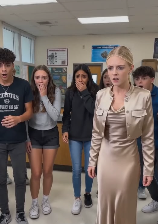
Her champagne silk dress did not belong in a geology lab, but somehow she made it seem intentional, like she had dressed for a private-school gala and accidentally wandered into public education. Her cropped jacket was pale cream with gold buttons. Tiny diamond earrings flashed each time she moved her head. Her blond hair fell in smooth waves around her shoulders, and her face wore the expression of someone who had been insulted by the existence of consequences.
“You ruined the classification record,” she said.
Her voice shook just enough to sound wounded.
That was Brielle’s talent.
She could make an accusation sound like an injury.
I wiped sauce from my jaw with the back of my hand. My fingers trembled, but I refused to lower my eyes.
“I didn’t touch that tray after the first check,” I said.
Brielle laughed once, sharp and bright.
“Then why was your station tag on the damaged record?”
Around us, the geology lab seemed to shrink.
The sorting tables were still covered with black basalt, pale pumice, red scoria, and labeled sample bags from our field activity at Sunset Crater. The posters on the walls showed cross sections of volcanoes and rock cycles. Outside the tall windows, Arizona sunlight poured over the campus like nothing serious could ever happen there.
But on the center table, one volcanic rock sample had been placed in the wrong sorting tray.
And that one mistake was enough to destroy me.
At least, that was what Brielle was counting on.
Two hours earlier, I had been excited.
That is the part no one in the hallway videos understood later.
I loved geology.
Not in the casual way students say they like a subject because the teacher is nice or the homework is easy. I loved it because rocks told the truth without asking who had money, who had connections, who belonged, who did not. A rock did not care if your lunch came from home in a reused container or from the expensive café downtown. A rock did not care if your father worked nights repairing heating systems or if someone’s family name was printed on the donor wall outside the auditorium.
A rock had a history.
Pressure. Heat. Time. Location.
Evidence.
That morning, our geology club was preparing for the Northern Arizona Student Earth Science Showcase. The winning team would present at the university, and our school had never made it past district finals. Mr. Delgado, our science teacher and club sponsor, had spent weeks telling us that accurate records mattered more than beautiful displays.
“If your sample location is wrong,” he always said, tapping the clipboard with his pen, “then your conclusion is wrong. Science is not about sounding confident. It is about being correct.”
I believed him.
Maybe too much.
The lab buzzed with activity. Students moved between trays, tablets, rock hammers, and printed field maps. Each volcanic sample had a bag with a barcode, a tray number, and GPS metadata from the field collection app. My job was quality control. I checked that every physical sample matched the digital record before the final submission.
It was not glamorous work.
Brielle hated that I had it.
She was our presentation lead because her family had donated money for the new STEM wing, and because she could speak in front of adults like she had been trained in a boardroom. She smiled beautifully, used words like “community impact,” and somehow made other people’s labor sound like her vision.
She was not stupid.
That made everything worse.
Brielle knew enough geology to be dangerous and enough social politics to be untouchable.
The sample at the center of everything was number V-17.
A dark, dense piece of basalt with tiny vesicles along one side and a thin reddish oxidation layer near the edge. It had been collected during our field trip near the lava flow boundary, and its GPS coordinates were important because it helped prove a transition zone in our project.
At 10:16 a.m., I scanned V-17.
The tablet loaded the record.
Sample V-17
Collector: Brielle Kensington
Initial classification: Vesicular basalt
Field GPS: 35.3719 N, 111.5430 W
Tray assignment: Basalt Group B
Everything matched.
I remembered that clearly because Brielle had been hovering nearby, pretending not to watch me.
“Looks correct,” I said.
She smiled.
“Of course it does.”
I did not like her tone, but I moved on.
By lunch, the lab had grown crowded. Student council volunteers were bringing food for the club because the showcase prep was supposed to last all day. Someone turned on music. Mr. Delgado stepped out to meet the district coordinator. Ms. Han from the front office came in to check the sign-out sheet for the borrowed tablets.
That was when I saw V-17 again.
Only now it was in the wrong tray.
Not Basalt Group B.
Scoria Group C.
At first, I thought someone had made a careless mistake while rearranging the display. But the sample bag had been opened, the tray card had been smudged, and the printed record sheet beside it had a crease through the QR code.
My stomach tightened.
A wrong tray could make our data look sloppy, but a damaged record could make it look dishonest.
I picked up the sample bag, careful not to touch the rock itself.
“Who moved V-17?” I asked.
Nobody answered.
I looked at the digital tablet beside the tray. The screen was asleep.
I woke it.
The record was open.
But now, under classification history, there was an edit.
Tray assignment changed: Scoria Group C
Edited by: Station 4
Station tag: F. Reed
I stared at my own name on the screen.
The air seemed to leave the room.
I had not made that edit.
Station 4 was my station, yes. My login had been active earlier, yes. But I had checked V-17 as correct. I knew I had.
Before I could call Mr. Delgado, Brielle appeared behind me.
“What did you do?”
Her voice sliced through the lab.
Everyone turned.
I looked at her, confused. “I didn’t do anything.”
“Then why is my sample in the wrong tray?”
“I just found it like this.”
Brielle stepped closer, her eyes shining with the kind of panic that attracts attention.
“That sample is the anchor point for our whole project.”
“I know.”
“Do you?” she snapped. “Because the record says you changed it.”
By then, students were gathering.
A few had phones angled low, pretending not to record. Brielle saw them. I saw her see them.
And something in her expression changed.
She was not trying to solve the problem anymore.
She was performing the discovery of a villain.
“I didn’t change the record,” I said slowly.
Brielle’s laugh came out wounded. “Fatima, your station tag is right there.”
“Station tags can stay logged in.”
“So now you’re saying someone framed you?”
“I’m saying we need to check the GPS metadata and access log before accusing anyone.”
That should have been reasonable.
It should have been the obvious next step.
But reasonable is fragile when a rich girl decides emotion will win faster.
Brielle’s eyes filled with tears.
“I trusted you with quality control,” she said loudly. “I defended you when people said you were too intense about everything.”
That hit harder than I expected.
Because I knew exactly what she meant by intense.
It was the word teachers used when I asked too many questions.
The word classmates used when I corrected them.
The word people used when they wanted to make care look like aggression.
“I’m not intense,” I said. “I’m careful.”
“Careful?” Brielle looked at the damaged record sheet. “You nearly got us disqualified.”
“I found the mistake.”
“You caused it.”
“I didn’t.”
Her face hardened.
Then she grabbed the open lunch bowl from Lacey’s hand and dumped it onto my face.
The lab gasped.
The sauce slid down my cheek.
And suddenly, the volcanic rock sample was not the story anymore.
I was.
Mr. Delgado returned less than a minute later.
By then, Ms. Han had rushed in with paper towels, and the crowd had split into clusters of whispering students. Brielle was crying into her friend’s shoulder. Lacey kept saying, “She just snapped because the project matters so much,” as if throwing food at someone was a natural stage of academic grief.
Mr. Delgado looked from Brielle to me.
His face went still.
“Phones down,” he said.
No one moved.
His voice sharpened. “Now.”
Phones lowered slowly.
He came to me first. That mattered. I did not realize how much until later.
“Fatima, are you hurt?”
I shook my head, though my throat was tight. “No.”
He handed me a towel, then turned to the room.
“Nobody leaves.”
Brielle lifted her head. “Mr. Delgado, she altered the record.”
“We will determine what happened after reviewing the evidence.”
“The evidence is on the tablet.”
“The tablet is part of the evidence,” he said. “Not all of it.”
Brielle blinked.
For the first time, a crack appeared in her confidence.
Mr. Delgado placed the tablet on the center table without touching the screen again. Then he looked at Ms. Han.
“Please call Principal Harris and ask her to come to the lab. Also contact IT. I want the device access logs preserved.”
Brielle’s mother arrived before IT did.
That should tell you everything about the kind of power the Kensington family had at our school.
Mrs. Kensington swept into the geology lab in a white pantsuit and gold heels, her sunglasses still on top of her head. She smelled like expensive perfume and cold air. Behind her came Principal Harris, looking tense but controlled.
Brielle ran to her mother.
“She ruined everything,” Brielle said.
Mrs. Kensington wrapped an arm around her daughter and looked at me with polished disappointment.
“Fatima, is it?”
I hated that she said my name like she had just found it on a complaint form.
“Yes.”
“My daughter has worked for months on this showcase.”
“So have I.”
Her eyebrows lifted slightly.
A small movement.
A big insult.
Principal Harris stepped between us. “We are reviewing the situation.”
Mrs. Kensington looked at the sauce still staining my shirt. “I can see emotions ran high.”
Mr. Delgado said, “Brielle dumped food on Fatima.”
Mrs. Kensington’s expression did not change. “After discovering sabotage, according to the students present.”
“Alleged sabotage,” Mr. Delgado said.
The principal looked relieved that someone else had said it.
Brielle sniffed. “My sample was moved. The record was changed under Fatima’s station tag.”
I said, “The GPS codes will show the original classification.”
Brielle turned toward me too quickly. “What?”
“The GPS metadata,” I said. “Every bag scan logs location history, timestamp, and the tablet ID. If the sample was correctly classified from the beginning, the record will show it.”
For a second, Brielle forgot to cry.
Her face went blank.
Then she recovered. “That doesn’t matter if you changed it later.”
“It matters if someone changed it while using my station tag.”
Mrs. Kensington laughed softly.
“Are we really entertaining conspiracy theories from the student whose login appears on the altered record?”
Mr. Delgado’s jaw tightened.
“Science requires review.”
Mrs. Kensington looked around the lab, at the student-made posters, at the trays, at the rock samples, at me.
“This is a high school club, Mr. Delgado. Not a federal investigation.”
“No,” he said. “But it is still a place where facts matter.”
That was when IT arrived.
His name was Mr. Bell, a quiet man with a gray beard and the permanent expression of someone who had seen every possible way students could misuse school technology. He connected the tablet to his laptop while everyone watched.
The room became painfully silent except for the tapping of keys.
I stood near the sink, my shirt damp from where I had tried to clean the sauce. My face felt sticky no matter how many times I wiped it. I could feel students looking at me and then looking away when I noticed.
I wondered what my father would say when he heard.
He had immigrated before I was born and worked harder than anyone I knew. He always told me, “Fatima, let your work be so precise that lies have nowhere to stand.”
But lies did not need to stand.
Sometimes they only needed to spread.
Mr. Bell frowned at the screen.
Brielle held her mother’s hand.
Principal Harris leaned closer. “What do you see?”
“The record was edited at 11:42 a.m.,” Mr. Bell said. “Station tag F. Reed.”
Mrs. Kensington exhaled as if the matter were settled.
Brielle’s lips curved slightly.
Mr. Bell kept typing.
“But the station tag was not authenticated by password at that time.”
I looked up.
“What does that mean?” Principal Harris asked.
“It means the station had an active session, but the user did not log in fresh. Someone used an already-open tablet.”
My heartbeat quickened.
“I told you,” I said.
Brielle’s mother cut her eyes toward me. “That proves carelessness, not innocence.”
Mr. Bell continued. “There is also a physical scan event from the sample bag at 11:41.”
“From which tablet?” Mr. Delgado asked.
“Tablet Seven.”
Mr. Delgado frowned. “Fatima’s station used Tablet Four.”
The room shifted.
Brielle’s fingers tightened around her mother’s hand.
Mr. Bell clicked again.
“Tablet Seven was assigned to Kensington.”
A silence fell so complete I could hear the air conditioner hum.
Brielle whispered, “That’s impossible.”
Mr. Bell looked at her over his glasses.
“Technology rarely cares what is convenient.”
A few students made sounds like they were trying not to react.
Mrs. Kensington’s voice sharpened. “Are you accusing my daughter based on device assignment? These tablets are passed around constantly.”
“Not constantly,” Mr. Delgado said. “We logged them this morning.”
Ms. Han held up the sign-out sheet.
Brielle’s name sat beside Tablet Seven in blue ink.
Still, I knew it was not enough.
A tablet assignment could be questioned. A station session could be twisted. Brielle’s family had enough influence to turn uncertainty into fog.
Then Mr. Bell said, “There’s GPS metadata.”
My breath caught.
He opened another file.
The projector screen at the front of the lab flickered as he connected his laptop.
A map appeared.
Red points. Blue points. Time stamps.
Mr. Bell zoomed in.
“Sample V-17 was scanned in the field at Sunset Crater on October 3 at 9:28 a.m. Initial collector classification entered as vesicular basalt. Collector ID: B. Kensington.”
Brielle’s face drained.
Mr. Bell clicked again.
“Second verification scan today at 10:16 a.m. by Station 4. No classification change. Quality control confirmed.”
Mr. Delgado looked at me.
For the first time all afternoon, I felt air enter my lungs.
“That was mine,” I said.
“Yes,” Mr. Bell said. “Then at 11:41 a.m., Sample V-17 was scanned by Tablet Seven. Classification changed one minute later using the open Station 4 session.”
Principal Harris stared at the screen.
“So someone scanned it with Brielle’s tablet, then changed the record at Fatima’s station?”
“That is what the system logs show.”
Brielle spoke too loudly. “Anyone could have picked up my tablet.”
Mr. Bell nodded slowly.
“That is why the GPS proximity ping matters.”
Mrs. Kensington went still.
I had never heard of that feature.
Neither had Brielle, apparently.
Mr. Bell explained, “The newer sample bags include a passive location ping when scanned. It logs approximate indoor proximity to the nearest lab beacon. At 11:41, Tablet Seven scanned V-17 at Beacon C.”
Mr. Delgado looked toward the back table.
“Beacon C is Brielle’s prep area.”
Mr. Bell clicked once more.
“At 11:42, the classification edit was made from Station 4. The system registered Tablet Seven still within two meters of the station during the edit.”
The room erupted.
Students whispered. Someone said, “No way.” Someone else said, “She framed Fatima.”
Brielle stepped backward.
“No,” she said. “No, that’s wrong.”
But it was too late.
The proof had loaded.
And her name had appeared where mine had been.
Principal Harris turned to her.
“Brielle, did you move Sample V-17?”
Brielle looked at her mother.
That was the moment everything became clear.
She was not looking for comfort.
She was looking for instructions.
Mrs. Kensington’s face was frozen, but her eyes were sharp.
“Brielle,” she said carefully, “do not answer without me.”
Mr. Delgado’s expression darkened.
Principal Harris said, “This is a school disciplinary matter, not a courtroom.”
Mrs. Kensington smiled without warmth. “Then stop treating my daughter like a criminal.”
I wiped the last of the sauce from my chin.
“She treated me like one.”
Everyone turned toward me.
My voice shook, but I kept going.
“She accused me in front of everyone. She let people record me. She dumped food on my face. And she knew the record would point back to her tablet.”
Brielle’s eyes filled again, but this time the tears did not look useful.
They looked real.
“I didn’t mean for it to go that far,” she whispered.
Her mother snapped, “Brielle.”
But Brielle was staring at the map on the screen like it had become a mirror.
“I just needed the sample out of Basalt Group B.”
Mr. Delgado stepped forward. “Why?”
Brielle pressed her lips together.
Mrs. Kensington said, “Enough.”
But Principal Harris raised a hand.
“No. I want to hear the answer.”
Brielle’s shoulders trembled.
“Because Basalt Group B proved the original field route was wrong.”
Mr. Delgado frowned. “The route?”
My mind raced.
Our project was based on mapping the transition between lava flow zones. If V-17’s GPS coordinates stayed in Basalt Group B, it confirmed a boundary that contradicted the revised route map Brielle had presented last week.
The revised map.
The beautiful one printed on glossy board.
The one with Kensington Foundation sponsorship at the bottom.
Mr. Delgado turned slowly toward the display table.
“Who made the revised route map?”
Brielle said nothing.
Mrs. Kensington answered for her.
“My office helped print presentation materials.”
“That is not what I asked.”
The room became tense again.
Mr. Bell opened the route-map file history.
I watched Brielle’s confidence collapse piece by piece.
The map had been altered three days earlier.
Not by a student.
By a Kensington Foundation staff account.
The revised route shifted the collection boundary nearly half a mile east, making it appear that our team had discovered a cleaner, more dramatic volcanic transition than we actually had.
It made the project look better.
It made Brielle’s presentation look brilliant.
And V-17 was the one sample that exposed the alteration.
If V-17 stayed correctly classified with its real GPS code, the glossy map was false.
If V-17 moved to the wrong sorting tray and its record looked damaged by my station, then Brielle could blame the inconsistency on me.
A careless student.
An intense girl.
A convenient mistake.
Principal Harris looked sick.
Mr. Delgado looked furious.
Mrs. Kensington’s face went pale beneath her makeup, but her voice stayed controlled.
“This is a misunderstanding involving draft materials.”
“No,” I said.
The word surprised even me.
Everyone looked at me again.
I stepped closer to the center table, sauce-stained shirt and all.
“This is not a misunderstanding. Brielle knew the sample was correct from the beginning. The GPS codes prove she classified the rock correctly in the field. Then someone changed the presentation map. Then she moved the sample so the real data would look like my mistake.”
Brielle covered her face.
For one second, I felt almost sorry for her.
Almost.
Then I remembered the sauce.
The phones.
The whisper of my name becoming guilt.
Principal Harris ordered all showcase materials secured.
Mrs. Kensington demanded a private conversation.
Mr. Delgado refused to let the sample bags leave the lab.
And me?
I went to the bathroom and finally cried.
Not because I was weak.
Because staying calm had cost me everything I had.
I stood at the sink under fluorescent lights, scrubbing sauce from my hairline with school paper towels that dissolved in my hands. My reflection looked unfamiliar. Red eyes. Damp shirt. Tight jaw.
The bathroom door opened.
For one wild moment, I thought Brielle had come to finish the performance.
But it was Lacey.
She stood near the entrance holding her phone against her chest.
“I’m sorry,” she said.
I laughed once, bitterly. “For recording or for believing her?”
Lacey flinched.
“Both.”
I turned off the faucet.
She looked smaller without Brielle beside her.
“I didn’t post the video,” she said. “Brielle told Brielle’s group chat to send clips around, but I didn’t. I have something else.”
I stared at her.
“What?”
She unlocked her phone and played a video.
The angle was bad, half-blocked by a stack of food trays, but the audio was clear.
Brielle’s voice: “Move it before Delgado comes back.”
Another voice, older, female, speaking through the phone on speaker.
Mrs. Kensington.
“Then make sure the record points to someone else.”
My skin went cold.
Brielle whispered, “Fatima’s station is still open.”
Mrs. Kensington replied, “Then use it. The board presentation cannot have errors.”
The video ended.
For a moment, the bathroom seemed to tilt.
Lacey’s eyes filled with tears.
“I thought they were just fixing the display. I didn’t understand until she accused you.”
“Why didn’t you say something?”
“Because I was scared of her.”
I wanted to shout.
But I knew fear.
Not her kind exactly, but enough to recognize it.
“Send it to Principal Harris,” I said.
Lacey nodded quickly.
“And to me.”
She hesitated.
I held out my hand.
“No more private proof,” I said.
This time, she obeyed.
The district hearing happened the next morning in the library.
By then, the school had already changed.
Students who had whispered my name now avoided my eyes. Some apologized in rushed little bursts between classes. Others acted like nothing had happened because admitting they were wrong would require remembering how quickly they had enjoyed my humiliation.
The geology lab was locked.
The showcase was postponed.
The Kensington Foundation’s logo had been removed from the school website pending investigation.
My father came with me to the hearing wearing his cleanest work shirt. He smelled faintly of metal tools and winter air. When he saw the stain still faintly visible on my backpack strap, his face tightened, but he did not tell me to stay home. He did not tell me to let adults handle it.
He only said, “Stand straight. You are not the one who should shrink.”
So I stood straight.
Across the table sat Brielle and her mother. Brielle looked exhausted, stripped of shine. Mrs. Kensington looked furious in a way she was trying to disguise as concern.
Principal Harris presented the evidence.
Tablet logs.
GPS metadata.
Beacon proximity.
Route-map file history.
Lacey’s video.
With every item, Mrs. Kensington’s polished explanations grew thinner.
Draft confusion.
Student stress.
Miscommunication.
Technical uncertainty.
But facts kept arriving like stones stacked into a wall.
Finally, Brielle broke.
“I did it,” she said.
Her mother turned on her. “Brielle.”
“No.” Brielle’s voice cracked. “I did. I moved the sample. I used Fatima’s station. I accused her because I thought if everyone was looking at her, they wouldn’t look at the map.”
The room went silent.
Principal Harris asked, “Why was the map changed?”
Brielle stared at the table.
“My mother said the original project was too ordinary.”
Mrs. Kensington inhaled sharply.
Brielle kept going.
“She said if the school was going to present under Kensington sponsorship, it needed to look award-winning. She said a cleaner transition zone would impress the university judges. I told her Mr. Delgado would notice, but she said teachers notice what donors allow them to notice.”
My father’s hand closed over mine under the table.
Mrs. Kensington stood.
“This is outrageous. My daughter is under extreme emotional pressure.”
Principal Harris’s voice was cold.
“Sit down, Mrs. Kensington.”
Mrs. Kensington did not sit.
So the district representative, who had been quiet until then, spoke.
“Mrs. Kensington, the board will be reviewing your foundation’s involvement with student academic materials. If you continue interfering with this hearing, we will conclude it without your statement.”
For the first time, Mrs. Kensington sat.
Brielle was suspended.
Her leadership role was removed.
The showcase entry was disqualified.
Mrs. Kensington’s foundation was barred from sponsoring student research events until the district audit was complete.
But the ending I remember most did not happen in the hearing.
It happened later, in the geology lab.
Mr. Delgado reopened the room after school so we could repair the project board with the correct data. Only six students came back. Lacey was one of them. So was I.
The room still smelled faintly like cafeteria sauce and dust.
Sample V-17 sat in its proper tray.
Basalt Group B.
I picked it up inside its bag and looked at the GPS label.
A small, dark rock.
Nothing flashy.
Nothing polished.
But it had held the truth better than half the people in the room.
Mr. Delgado came to stand beside me.
“You were right to insist on checking the metadata,” he said.
I swallowed.
“I was scared I sounded paranoid.”
“You sounded like a scientist.”
That made me smile for the first time in two days.
A week later, we presented at the showcase.
Not with the glossy fake map.
With the messy real one.
Our transition zone was less dramatic than the Kensington version. The boundaries were uneven. The sample distribution raised more questions than it answered. Our conclusion admitted uncertainty.
And the judges loved it.
They said real science did not pretend nature arranged itself for a prettier poster.
We won second place.
Not first.
Second.
And somehow that felt perfect.
Because it was honest.
After the awards, Brielle found me outside the auditorium.
She was alone.
No champagne dress. No diamonds. No crowd.
Just a girl in jeans, holding herself together with both arms.
“I’m sorry,” she said.
I looked at her for a long time.
The apology stood between us like a fragile bridge.
“I don’t forgive you yet,” I said.
She nodded, tears shining in her eyes. “I know.”
“But you told the truth.”
“I should have told it before I hurt you.”
“Yes,” I said. “You should have.”
She wiped her cheek.
“My mom is stepping down from the foundation.”
“Good.”
Brielle almost smiled, but it broke before it formed.
“I’m transferring schools.”
I did not know what to say to that.
She looked toward the auditorium doors.
“You deserved better from everyone.”
I thought about the phones, the whispers, the sauce, the way proof had to work twice as hard as accusation.
“Yes,” I said. “I did.”
Brielle nodded like that answer mattered more than comfort.
Then she walked away.
Months later, the district created a new data-integrity policy for student competitions. Every sample scan required individual login authentication. Every outside sponsor had to sign a boundary agreement. Every student accused of misconduct had the right to a full evidence review before disciplinary action.
Mr. Delgado framed a copy of the new policy and hung it in the geology lab.
Beneath it, he placed a small photo of Sample V-17.
The caption read:
TRUTH HAS COORDINATES.
On the last day of senior year, I stood in front of that photo with my acceptance letter from Northern Arizona University folded in my pocket. I had been awarded a small research scholarship in earth sciences. Not huge. Not glamorous.
Mine.
My father cried when I showed him.
I cried too.
Not because the world had suddenly become fair.
It had not.
But because that day in the lab had taught me something I would carry for the rest of my life.
Some people will put your name in the wrong tray.
They will mislabel your intentions.
They will damage the record and call your defense suspicious.
They will throw humiliation at your face and expect you to wipe it away quietly.
But evidence remembers.
The rock remembers where it came from.
The data remembers who touched it.
And if you stand long enough beside the truth, even when your voice shakes, even when everyone is watching, even when the lie looks cleaner and richer and easier to believe, the proof can still load.
And when it does, the whole room has to look again.
THE END
