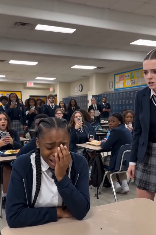
The slap came so fast that for one breath I forgot my own name.
A sharp crack split the hallway outside the fashion-design studio, louder than the lockers slamming, louder than the laughter dying in everyone’s throats, louder than the little voice inside me that had been begging me all morning to stay quiet.
My cheek burned. My eyes watered. My fingers tightened around the edge of the garment bag hanging from my shoulder, and for a second, all I could see was Odette Fallon standing in front of me with her perfectly glossed mouth parted in anger, her cream blazer smooth, her pleated skirt neat, her golden hair pinned back like she had stepped out of a donor brochure instead of a Richmond public high school.
Around us, students froze.
Phones lifted.
Someone whispered, “Ruth Carter just got slapped.”
Not “Odette slapped Ruth.”
Not “What happened?”
Just my name, like I had become the headline before anyone bothered to read the story.
Odette’s blue eyes flashed toward the garment bag.
“Don’t touch that sample again,” she said, low enough that only the closest students heard the fear underneath her voice.
I should have stepped back.
That was what girls like me were trained to do around girls like her.
Girls like Odette Fallon had families whose names appeared on plaques outside renovated auditoriums and scholarship luncheons. Girls like me had mothers who worked double shifts altering other people’s clothes in the back room of a dry cleaner, hands rough from steam and needles, dreams folded away between unpaid bills.
But my cheek was still stinging, and behind that sting was something stronger than embarrassment.
Memory.
My mother at our kitchen table three years earlier, her tired eyes bright as she unfolded a sketch she had kept hidden inside a cookbook.
“One day,” she had told me, touching the drawing like it was alive, “you’ll know when something belongs to you, Ruth. Don’t let anyone make you apologize for protecting it.”
Now I was standing in a hallway full of witnesses, staring at the dress sample Odette did not want anyone to examine.
And I knew.
Something was wrong.
Something had been wrong from the moment I saw the ownership tag stitched beneath the inner lining.
The annual Richmond Youth Design Showcase was supposed to be the biggest event of our senior year. Every school in the district submitted original fashion pieces, and the winning student received a scholarship, a paid summer internship, and a feature in a local magazine. For most students, it was exciting. For me, it was oxygen.
I did not have Odette’s money. I did not have her family connections. I did not have a mother who could attend every parent event smiling beside school board members.
I had thread.
I had thrift-store fabric.
I had a black binder full of sketches I carried like a second heart.
And I had my mother’s voice.
That morning, I had come early to the fashion studio to help Ms. Alvarez inventory the final samples. I liked arriving before the hallway filled. In the quiet, the sewing machines looked almost holy, lined up beneath the windows with spools of color catching the pale Virginia light.
Ms. Alvarez trusted me because I noticed things.
Loose seams. Missing labels. Wrong measurements. Incorrect sign-out times.
That was how I found the mistake.
Or what I first thought was a mistake.
Odette’s showcase piece, a midnight-blue evening dress with silver vine embroidery crawling up the bodice, hung inside a clear garment bag near the front rack. Everyone had been talking about it for weeks. Odette had called it “Fallon Heritage,” a tribute to her grandmother’s old Southern garden parties. She had described the inspiration in interviews for the school website. She had posed beside it while student photographers captured her looking thoughtful and elegant.
I remembered thinking it was beautiful.
Too beautiful.
Not because Odette was incapable of talent, but because the stitch language felt familiar.
The crescent-shaped leaves. The angled shoulder seam. The hidden paneling that let the fabric move without wrinkling.
Those were not just techniques.
They were fingerprints.
My mother had used them.
I had grown up watching her hands build shapes like that from nothing. She never called herself a designer. She called herself a seamstress because the world made that word feel smaller, safer, more acceptable for a Honduran woman with accented English and no fashion degree. But at night, when she thought I was asleep, she sketched gowns on paper grocery bags.
The dress in Odette’s garment bag carried one of my mother’s secret signatures.
A tiny silver moth hidden inside the vine embroidery near the waist.
Most people would have thought it was decoration.
I knew better.
My mother used to sew moths instead of butterflies because she said moths survived by finding light in the dark.
I reached for the sample record clipped to the hanger.
That was when my stomach dropped.
Owner: Odette Fallon.
Original concept submitted: Fallon Heritage.
Supporting design archive: Fallon Family Collection.
But underneath the typed label, pressed into the corner in faint blue ink, was an older inventory code.
CARTER-LUCIA-09.
I stopped breathing.
Lucia Carter was my mother.
My mother, who had died two years earlier after a winter of coughing she kept pretending was just exhaustion. My mother, whose old design trunk had disappeared from our apartment during the chaos after her funeral. My mother, whose sketches I had searched for in every closet, under every bed, behind every box of fabric scraps, crying because losing them felt like losing her twice.
I touched the code with my thumb.
“Ruth?”
Ms. Alvarez’s voice came from the supply closet.
I turned too quickly, nearly knocking the hanger against the rack.
Her eyes narrowed. “What is it?”
I tried to speak, but my throat had closed.
She came closer. Ms. Alvarez was not the kind of teacher who panicked. She wore her gray curls pinned with colored pencils and kept a measuring tape around her neck like a judge’s sash. She looked at the label, then at me.
“Where did you see that code before?”
“My mom,” I whispered.
The classroom went very still.
Ms. Alvarez knew about my mother. Not everything, but enough. She knew I had learned sewing before multiplication. She knew I stayed after school because our apartment felt too quiet. She knew I never entered the showcase because I could not afford the materials.
Her face changed.
Not pity.
Recognition.
“Don’t move that sample,” she said.
But before she could say anything else, the bell rang, and the hallway outside exploded with students arriving for the final showcase review.
Odette appeared five minutes later surrounded by her usual orbit.
Brielle with her phone already recording.
Lacey carrying iced coffee.
Two boys from student council dragging a rolling mirror.
Odette walked in laughing at something, but the laugh ended the second she saw me beside her garment bag.
Her eyes flicked to the sample record.
Then to Ms. Alvarez.
Then back to me.
“What are you doing with my dress?” she asked.
Her voice was light. Sweet. Dangerous.
“I’m checking a record,” I said carefully.
“You’re checking my record?”
Ms. Alvarez stepped in. “Ruth is assisting me with inventory.”
Odette smiled, but it did not reach her eyes. “That’s funny. Because from here, it looks like she’s touching my showcase piece.”
I let go of the clipboard.
“I noticed an ownership code that needs to be verified.”
Odette’s expression hardened so quickly that even Brielle lowered her phone.
“What code?”
“The archive code under the current label.”
Odette laughed once. “That’s probably from storage. My family donated fabric and vintage pieces. Half the archive has Fallon codes.”
“This one doesn’t say Fallon,” I said.
The room shifted.
I felt everyone listening.
Odette stepped closer. Her perfume smelled expensive and floral, like something designed to cover smoke.
“Ruth, I know you want to feel involved, but this is not your project.”
Something hot moved through my chest.
“I didn’t say it was.”
“You implied it.”
“I said the record needs to be checked.”
“And I said don’t touch my dress.”
There it was.
My dress.
Not the dress.
Not the sample.
My dress.
Ms. Alvarez reached for the clipboard. “That’s enough. We’ll take this to administration.”
Odette’s smile vanished.
“No.”
Everyone heard it.
A single word, too sharp to hide.
Ms. Alvarez paused. “Excuse me?”
Odette blinked and recovered. “I mean, the showcase starts tonight. My parents are coming. The donors are coming. We can’t delay everything because Ruth thinks she found some mysterious clue.”
I wanted to disappear. I wanted to shove the clipboard into Ms. Alvarez’s hands and run.
But then I saw the moth again through the garment bag.
A tiny silver thing stitched where nobody would notice unless they knew where to look.
My mother had not stitched moths to be hidden forever.
“I’m not accusing anyone,” I said, though my voice trembled. “I just want the actual record checked.”
Odette turned toward the doorway where more students had gathered.
“Do you hear that?” she said loudly. “She’s not accusing anyone. She’s just trying to ruin my scholarship submission five hours before judging.”
“That’s not true.”
“Then why are your hands on my sample?”
I looked down.
My fingers were still gripping the hanger.
I let go.
Too late.
Odette moved before Ms. Alvarez could stop her.
She crossed the space between us and slapped me.
Not a shove. Not a brush of the hand.
A full, hard slap that turned my face sideways and sent a gasp through the room.
For one second, nobody moved.
Then whispers spread like spilled ink.
Odette looked shocked at herself, but only for an instant. Then she lifted her chin.
“She was trying to sabotage me,” she said.
And just like that, she handed the crowd a story.
I stood there with my cheek burning, and I understood something that made my knees feel weak.
Odette was not losing control.
She was creating a scene big enough to bury the question.
Ms. Alvarez snapped, “Office. Now.”
Odette’s eyes flashed. “Gladly. But that dress stays here.”
“No,” Ms. Alvarez said. “The dress and the record come with us.”
Odette reached for the garment bag.
I moved without thinking, stepping between her and the rack.
Her gaze turned icy.
“Get out of my way, Ruth.”
“No.”
The word came out small.
But it stayed standing.
Principal Whitmore’s office smelled like lemon polish and old decisions.
By the time we arrived, the hallway video had already spread. Someone had clipped the slap so it began with my hand on Odette’s garment bag and ended with her saying I was sabotaging her. No one saw the code. No one heard the fear in her first warning.
Principal Whitmore sat behind his desk with his hands folded. He was a broad man with silver hair and a practiced expression of concern. Beside him stood Mrs. Fallon, Odette’s mother, wearing pearls and the kind of calm that made other people feel rude for being upset.
Odette sat in the chair nearest her mother, dabbing at invisible tears.
I sat across from them with Ms. Alvarez standing behind me.
My cheek had cooled, but something inside me had not.
Mrs. Fallon looked at me like I was a stain on silk.
“Ruth,” she said softly, “I’m sure this has been emotional for you. Senior year can make students act out.”
I almost laughed.
Act out.
A rich girl hit me in front of half the fashion department, and somehow I was the storm.
Principal Whitmore cleared his throat. “We need to determine whether there was any misconduct regarding the showcase entry.”
“Misconduct?” Mrs. Fallon repeated. “My daughter was assaulted academically. Her work was handled without permission.”
“She slapped Ruth,” Ms. Alvarez said.
Mrs. Fallon did not even blink. “Odette reacted under extreme distress.”
“By hitting another student.”
Odette whispered, “I was scared.”
I looked at her.
For the first time, I realized she was not lying about that part.
She had been scared.
Just not of me.
Principal Whitmore turned to Ms. Alvarez. “You mentioned a record issue.”
Ms. Alvarez placed the clipboard on his desk. “The current label lists Odette as owner, but there is an older archive code beneath it. CARTER-LUCIA-09.”
The room changed.
Mrs. Fallon’s hand tightened around her purse clasp.
It was tiny. Almost nothing.
But I saw it.
Principal Whitmore frowned. “Carter?”
“My mother,” I said. “Lucia Carter.”
Odette looked away.
My heart beat once, hard.
She knew.
Mrs. Fallon smiled gently. “How unfortunate. But Carter is not exactly rare. This could be any number of things.”
“My mother was a seamstress,” I said. “She worked alterations for private clients in Richmond.”
Mrs. Fallon’s smile thinned. “Many people work alterations.”
“She used a silver moth.”
Odette’s head jerked back toward me.
There.
There it was again.
Recognition.
Principal Whitmore looked from me to Odette. “What silver moth?”
Ms. Alvarez unzipped the garment bag halfway, careful not to touch the fabric more than necessary. She turned the dress enough for the hidden embroidery to catch the light.
The silver moth gleamed.
Small. Delicate. Defiant.
My eyes stung.
For two years, I had not seen that mark except in memory.
Mrs. Fallon leaned forward. “That is part of the garden motif.”
“No,” I said. “It’s my mother’s signature.”
Odette’s voice cracked. “Anyone can sew a moth.”
“Then why did you panic when I said the code?”
Silence.
Principal Whitmore’s expression tightened. “Odette?”
Mrs. Fallon stood. “This is becoming inappropriate. My daughter submitted her design through proper channels. If Ruth has personal grief attached to a similar image, I sympathize, but grief is not evidence.”
The words hit me harder than the slap.
Grief is not evidence.
Maybe she was right.
Maybe memory was not enough.
Maybe a moth stitched into fabric could be dismissed by anyone powerful enough to rename it.
Then Ms. Alvarez said, “There’s more.”
She reached into her tote bag and pulled out a sealed plastic sleeve.
Inside was a faded paper form.
“I found this in the old department archive last semester,” she said. “I didn’t know what it belonged to until today. It was misfiled under community partnership donations.”
Principal Whitmore took the sleeve.
Mrs. Fallon went very still.
Ms. Alvarez continued, “In 2009, a local seamstress named Lucia Carter submitted original sketches and three sample pieces to the Richmond Young Designers Mentorship Program. The program was sponsored by Fallon Textiles.”
My mouth went dry.
Fallon Textiles.
Odette’s family company.
Principal Whitmore read the form silently.
His face lost color.
“What does it say?” I asked.
He did not answer quickly enough.
So Ms. Alvarez did.
“It says Lucia Carter’s submissions were accepted for review, but the ownership transfer section was left unsigned.”
Mrs. Fallon snapped, “That document is seventeen years old.”
“It is still a record,” Ms. Alvarez said.
Odette stood abruptly. “This is insane. You’re all acting like I stole something. I designed that dress.”
“Then show the original sketches,” I said.
Her mouth opened.
No words came.
Mrs. Fallon touched her daughter’s arm. “Odette, sit down.”
But Odette did not sit.
She stared at me with a look I did not understand until later.
Not hatred.
Desperation.
“You don’t know what you’re doing,” she whispered.
I almost missed it.
“What?”
Her mother’s voice sliced through the room. “Odette.”
Odette closed her mouth.
Principal Whitmore exhaled. “Until this is resolved, the showcase submission will be paused.”
“No,” Mrs. Fallon said.
It was the same word Odette had used earlier.
“No?” Ms. Alvarez repeated.
Mrs. Fallon’s face hardened. “Do you understand who funds this showcase?”
The room went cold.
Principal Whitmore looked down.
And in that second, I saw the whole machine.
The renovated studio. The scholarship dinner. The donors smiling in photographs. The teachers choosing careful words because money had ears.
Odette had slapped me, but the hand behind it was bigger.
Mrs. Fallon leaned toward the principal. “My daughter’s future will not be derailed by an unverified accusation from a student with an emotional attachment to a dead woman’s hobby.”
Dead woman’s hobby.
I stood before I knew I was moving.
“My mother was not a hobby.”
Principal Whitmore said my name, but I barely heard him.
“She was not your charity case. She was not your storage code. She was not some woman whose work could be folded into a family collection because no one thought her daughter would ever find it.”
Mrs. Fallon’s eyes sharpened.
For the first time, she looked at me not like a nuisance.
Like a threat.
“You should be very careful,” she said.
I smiled, though my hands were shaking.
“My mother told me that too.”
The showcase was not canceled.
That was the first betrayal.
It was “postponed for internal review,” which meant Odette’s dress stayed locked in the administration conference room while rumors ran wild through the school.
By lunch, half the student body believed I had tried to steal Odette’s design because I was jealous. The other half believed Odette had stolen from my dead mother. The truth was somewhere locked behind adult doors, and everyone treated it like entertainment.
I hid in the back stairwell with my knees pulled to my chest.
My phone buzzed nonstop.
Some messages were cruel.
Some were curious.
One was from an unknown number.
Check what your mother left in the blue tin.
I stared at the screen.
The blue tin?
At home, in the top cabinet above the stove, my mother had kept an old Danish butter cookie tin filled with buttons, broken zippers, and needle packets. I had not opened it since she died because the smell of metal and thread made me miss her too much.
My hands went cold.
Who sent this?
No reply.
I skipped seventh period and went home.
Our apartment was smaller in daylight, every crack and corner exposed. The kitchen still had the yellow curtains my mother had sewn from clearance fabric. For a moment, I stood under the cabinet and felt like a little girl again, waiting for her to come home from work.
Then I climbed onto a chair and pulled down the blue tin.
It was heavier than I remembered.
Buttons rattled inside.
I opened it.
At first, there was nothing unusual. Black buttons. Pearl buttons. A rusted thimble. A measuring tape curled like a sleeping snake.
Then I saw the false bottom.
My breath caught.
I pried it up with a butter knife.
Underneath was a stack of folded papers tied with blue thread.
On top was my name.
For Ruth, when the moth finds light.
I sat down on the kitchen floor.
The first page was a letter.
My dearest Ruth,
If you are reading this, it means the world has finally brought back something I was too tired to chase.
My hands began to tremble so badly the paper shook.
I read until the words blurred.
My mother wrote that in 2009, before I was born, she had submitted original designs to a mentorship program sponsored by Fallon Textiles. She had been promised guidance, exposure, maybe even a small collection. Instead, after months of meetings, the program shut down quietly. Her samples were never returned.
When she asked questions, she was told she had signed a release.
She had not.
She had kept copies.
Sketches.
Photos.
Letters.
And one more thing.
A hospital bracelet.
I frowned through my tears.
At the bottom of the stack was a tiny plastic bracelet, yellowed with age.
Baby Girl Carter.
Date of birth: April 18.
My birthday.
Behind it was a photograph.
My mother, younger and exhausted, sitting in a hospital bed holding a newborn wrapped in a pink blanket.
Beside her stood a woman I recognized instantly.
Mrs. Fallon.
Younger. Smiling. One hand resting on my mother’s shoulder.
On the back, in my mother’s handwriting:
She said she would help us. I wanted to believe her.
I could not breathe.
The apartment tilted.
Why would Mrs. Fallon have been there when I was born?
Another paper slipped from the stack.
It was not a design record.
It was a legal document.
Temporary guardianship agreement.
Unsigned.
My mother’s letter continued on the next page.
Ruth, there are things I could not explain when you were little. Fallon Textiles did not only take my designs. They tried to take control of me when I was young, pregnant, and alone. Mrs. Fallon offered money, doctors, housing, protection. But everything had strings. She wanted my work, my silence, and eventually, she wanted access to you.
I pressed a hand over my mouth.
The words became knives.
She believed a child connected to my story would someday complicate ownership. She wanted me grateful, dependent, afraid. I ran before the agreement was finalized. I kept you. I kept the copies. But I never had the money to fight them.
A knock sounded at the door.
I jumped so hard the papers scattered.
For a second, I thought it was Mrs. Fallon.
But when I looked through the peephole, Odette stood in the hallway.
Alone.
No blazer now. No perfect orbit of friends. Just a girl with red eyes and her arms wrapped around herself.
I opened the door only because I wanted answers more than I wanted pride.
“What are you doing here?”
Odette looked past me at the papers on the floor.
Her face crumpled.
“You found it.”
My blood turned cold. “You sent the text.”
She nodded.
Anger rose so fast I could barely speak. “You slapped me. You called me a saboteur. You let everyone think I was trying to steal from you.”
“I know.”
“That’s all you have to say?”
“No.” Her voice broke. “I have a lot to say. I just don’t know if you’ll believe any of it.”
I almost shut the door.
Then she said, “My mother didn’t design that dress either.”
I froze.
Odette swallowed. “She made me enter it.”
The hallway seemed to narrow around us.
“What?”
“She said it was from our family archive. She said it was my legacy. But I knew something was wrong because the construction notes were too detailed, too personal. And there were old initials on the muslin pattern pieces. L.C.”
Lucia Carter.
I stepped back from the door.
Odette entered slowly, like she expected the room to reject her.
She saw the photograph on the floor and covered her mouth.
“She knew your mom,” I said.
Odette’s eyes filled. “Yes.”
“How?”
“My mother used her.” The words came out like they hurt. “And I think my father helped cover it up.”
For the first time since the slap, I saw Odette without the Fallon armor.
She was eighteen, scared, and trapped inside a name that had been handed to her like a crown and a cage.
“Why hit me?” I asked.
She wiped her cheek. “Because my mother was standing in the doorway.”
I stared at her.
“She came to school early. I saw her outside the studio before I walked in. When you mentioned the code, I panicked. She told me if anyone questioned the dress, I had to make it look like jealousy. She said people believe emotion before evidence.” Odette’s voice cracked. “I thought if I created a scene, she’d stop. I thought I could get the dress pulled privately later. I didn’t think—”
“You didn’t think slapping me would matter?”
She flinched.
Good.
“It mattered,” I said.
“I know.”
“No, you don’t. You turned me into a target.”
“I know,” she whispered.
Something in her voice stopped me from shouting.
Not because she deserved forgiveness.
Because she sounded like someone already drowning.
Odette reached into her bag and pulled out a flash drive shaped like a silver key.
“My mother keeps digital scans of the archive. Contracts, donor files, old submissions. I copied what I could.”
I did not take it.
“Why?”
“Because I’m tired of being her proof that lies work.”
The flash drive lay in her palm.
Small. Impossible.
“What’s on it?”
Her gaze met mine.
“The original scans of your mother’s designs. Emails between my parents. A file labeled Carter Acquisition. And a video from 2009.”
My stomach twisted. “Video of what?”
Odette looked at the photograph again.
“Your mother refusing to sign.”
The auditorium was packed by six o’clock.
The showcase went forward because money hated empty seats. Parents filled rows. Students whispered over programs. Local reporters stood near the aisle adjusting cameras. The stage glowed under white lights, and behind the curtain, garments waited like silent witnesses.
Principal Whitmore had tried to keep the review private.
Mrs. Fallon had tried to have me removed from campus.
Ms. Alvarez did something neither of them expected.
She called the district arts director.
Then she called the local magazine judge.
Then, quietly, she called my mother’s old coworker from the dry cleaner, Mrs. Patel, who arrived wearing her best purple sari and carrying a folder full of receipts proving Lucia Carter had bought the original fabric years before Fallon Textiles claimed ownership.
By the time Mrs. Fallon realized the room had shifted, there were too many witnesses.
Odette stood beside me backstage, pale but steady.
“Are you sure?” I asked her.
She looked toward the front row where her mother sat smiling like a queen.
“No,” she said. “But I’m doing it anyway.”
The showcase began with speeches.
Principal Whitmore talked about creativity and community partnership. Mrs. Fallon gave a polished introduction about legacy, opportunity, and young talent. Every word sounded beautiful. Every word felt stolen.
Then came Odette’s category.
The midnight-blue dress was rolled onto the stage on a mannequin.
Gasps filled the auditorium.
Even knowing what it was, I could not deny its beauty.
My mother’s beauty.
The silver vines shimmered under the lights. The hidden moth caught one bright beam and flashed like a secret finally tired of hiding.
Mrs. Fallon smiled.
Odette walked to the microphone.
For one awful second, I thought she would choose herself.
Her fingers gripped the stand.
“My name is Odette Fallon,” she began. “And this morning, I slapped Ruth Carter.”
The auditorium went silent.
Principal Whitmore half rose.
Odette continued quickly. “I did it because I was afraid. Not of Ruth. Of the truth she found.”
Mrs. Fallon’s smile disappeared.
Odette lifted the flash drive.
“This dress was submitted under my name. But I did not create it. The original designer was Lucia Carter, Ruth’s mother.”
Noise erupted.
Mrs. Fallon stood. “Odette, stop.”
Odette looked at her mother.
For the first time all day, she did not obey.
“No.”
The word rang through the auditorium, the same word she and her mother had used to block the truth.
Now it opened the door.
Ms. Alvarez stepped onto the stage and connected the flash drive to the projector. The screen flickered.
A scanned sketch appeared.
The auditorium gasped again.
There was the dress.
Not similar.
The same.
Lucia Carter’s signature sat in the bottom corner, dated 2009.
Then came emails.
Fallon Textiles internal archive.
Discussion of “unclaimed ethnic artisan submissions.”
A message from Mrs. Fallon’s account: Secure the Carter pieces before she requests return. No signed transfer located. Handle through donation classification.
My hands curled into fists.
Donation.
They had turned theft into generosity.
Mrs. Fallon’s voice rose. “This is privileged family property!”
The district arts director stood from the second row. “Mrs. Fallon, I suggest you sit down.”
But the final file was already loading.
The video.
The screen showed a small office seventeen years earlier. My mother sat across from Mrs. Fallon, younger, thinner, visibly pregnant. A contract lay on the table.
Mrs. Fallon’s voice came through the speakers, smooth and cold.
“Lucia, be reasonable. You need medical support. We need clean ownership. Sign the transfer.”
My mother’s voice shook, but it did not break.
“My designs are for my daughter.”
Mrs. Fallon laughed softly. “Your daughter is not even born.”
My mother placed both hands over her stomach.
“She is already someone.”
My knees almost gave out.
Odette grabbed my hand.
Onscreen, Mrs. Fallon leaned forward.
“You’ll regret making an enemy of people who could have saved you.”
My mother stood.
“No,” she said. “I’ll regret teaching my daughter to bow.”
The video ended.
For a long moment, nobody moved.
Then Mrs. Patel began to clap.
One pair of hands.
Small. Fierce.
Ms. Alvarez joined.
Then students.
Then parents.
Then the whole auditorium rose into a sound so powerful it felt like the walls were breathing.
I cried before I could stop myself.
Not pretty tears. Not quiet ones.
The kind that come from a place grief has been locked inside for too long.
Mrs. Fallon tried to leave, but reporters were already at the aisle. The district director intercepted Principal Whitmore. Odette’s father, who had been sitting stiffly near the back, lowered his head like a man watching a house he built from stolen wood catch fire.
And then Odette did the last thing anyone expected.
She walked to me in front of everyone and took the microphone again.
“I don’t deserve Ruth’s forgiveness,” she said. “But I owe her the truth. The scholarship submission under my name should be withdrawn. Any award attached to this design belongs to Lucia Carter’s estate and to Ruth Carter, if she chooses to accept it.”
I looked at her, stunned.
Her voice trembled.
“And I formally request disciplinary action against myself for hitting another student.”
The applause faded into shocked silence.
Odette stepped away from the microphone and faced me.
“I’m sorry,” she said.
This time, she did not say it like a girl trying to escape consequences.
She said it like a girl finally accepting them.
Weeks later, the story was everywhere.
Not the edited hallway clip.
The real story.
Fallon Textiles lost sponsors. The district opened an investigation into years of donated archive materials. Mrs. Fallon resigned from three boards in one afternoon. Principal Whitmore announced new ownership protections for student work with the expression of a man discovering ethics under pressure.
Odette was suspended for the slap and removed from the showcase committee. She did not fight it. She also gave a public statement naming every file she had copied, every lie she had helped protect, and every student artist who deserved better than a system that confused wealth with talent.
People asked me if I forgave her.
I never gave them the answer they wanted.
Forgiveness, I learned, was not a ribbon you tied around harm to make it beautiful.
It was slower than that.
Messier.
Some days, I hated her.
Some days, I remembered her hand around mine while my mother’s video played, and I understood that courage could arrive late and still matter.
The scholarship committee renamed the top award the Lucia Carter Original Design Grant.
They gave the first one to me.
But the real ending came one rainy afternoon in April, on what would have been my mother’s birthday.
I stood in the newly renovated fashion studio, now officially called the Carter Design Room. My mother’s sketches hung framed along one wall. Beneath them, a plaque read:
LUCIA CARTER
DESIGNER, MOTHER, MOTH SEEKING LIGHT
HER WORK WAS NEVER LOST. ONLY WAITING.
Ms. Alvarez handed me a small velvet box.
“What is this?”
“Something your mother left in the archive,” she said. “It was sealed with the design samples.”
Inside was a silver thimble engraved with one word.
Ruth.
I pressed it to my palm and felt the strangest thing.
Not loss.
Not anger.
Light.
Across the room, Odette stood near the doorway, uncertain whether she was welcome. She wore jeans and a plain sweater, her hair loose, no orbit around her, no crown.
I looked at her for a long moment.
Then I nodded.
She entered quietly.
Together, we watched younger students gather around the sewing tables, cutting fabric, arguing over colors, dreaming loudly.
One freshman held up a crooked sleeve and groaned. “This is impossible.”
I smiled.
“No,” I said, hearing my mother in my own voice. “It’s just not finished yet.”
Outside, rain tapped the windows.
Inside, the moths on my mother’s sketches gleamed under the studio lights.
And for the first time since the day Odette slapped me, I understood the truth completely.
She had not broken me open.
She had broken open the lie.
And everything my mother had hidden in the dark finally found its way home.
THE END
