Part 2: The Signature Behind The Uniform Records
Evelyn’s mother stopped blinking.
That was what I noticed first.
Not Evelyn’s hand still hanging halfway in the air after slapping me. Not the guests whispering around the pool. Not the sting spreading across my cheek while the stage lights burned too bright over my face.
I noticed Mrs. Harrington staring at the backstage records like the paper had reached up and grabbed her throat.
The event director, Mr. Vale, held the clipboard in both hands.
“These design records show that the affordable uniform proposal was submitted six weeks ago,” he said. “With fitting notes, fabric cost reductions, and size-accessibility changes.”
Evelyn laughed, but it came out thin.
“So? She probably copied someone.”
A woman near the front table whispered, “After slapping her, that’s what she says?”
My face burned harder.
I wanted to disappear behind the stage curtain. I wanted my mom’s hand on my shoulder. I wanted one adult to look at me like I was not the problem.
Then Mr. Vale turned the record around.
At the bottom of the approval page was a signature.
Not mine.
Not Evelyn’s.
Marianne Harrington.
Evelyn’s mother.
Mrs. Harrington’s lips parted.
The poolside lights reflected in the water behind her, throwing little trembling pieces of gold across her white dress. She looked elegant, rich, untouchable.
And terrified.
Evelyn turned toward her. “Mom?”
Mr. Vale’s voice hardened. “Mrs. Harrington, you signed off on this pilot proposal.”
Mrs. Harrington swallowed. “I sign many documents.”
“You signed this one after rejecting the public version of the uniform budget,” he said. “The one that would have priced out almost every scholarship student.”
The guests shifted.
Sponsors stopped sipping their drinks. A photographer slowly lowered her camera.
Evelyn shook her head. “No. That doesn’t mean anything.”
But her mother was still staring at the signature.
I finally spoke, my voice shaking but clear.
“I didn’t design those uniforms to embarrass sponsor kids. I designed them because students were skipping events when the required clothes didn’t fit them or cost too much.”
Evelyn snapped, “You don’t get to make yourself the hero.”
I touched my cheek.
“No,” I said. “You tried to make me the warning.”
The room went silent.
Then one of the backstage assistants ran toward Mr. Vale, holding a tablet.
“Sir,” she said breathlessly. “You need to see the security clip.”
Evelyn’s face changed before anyone pressed play.
Part 3: The Video From The Catering Hallway
The clip opened on the tablet with no sound at first.
Just a narrow catering hallway behind the pool deck, lit by harsh service lights instead of chandeliers. Staff moved in and out with trays, careful and quick, invisible to the guests who were busy calling the evening beautiful.
Then Evelyn appeared.
She was not alone.
Her mother stood beside her, holding a garment bag.
My stomach tightened.
The time stamp in the corner read 6:18 p.m.
One hour before Evelyn slapped me.
Mrs. Harrington looked over her shoulder, then unzipped the garment bag. Inside was the ceremonial blazer I was supposed to wear on stage, the one made from the affordable uniform prototype.
The one I had designed.
Evelyn wrinkled her nose.
“She’s actually wearing that?”
Mrs. Harrington said something the camera could not catch, but her face was sharp with irritation.
Then Evelyn reached into the garment bag and pulled at the inside seam.
The video was silent, but everybody saw the motion.
She was tearing the size label.
Someone behind me whispered, “Oh my God.”
Evelyn’s voice rose in the present. “That is not what it looks like.”
Mr. Vale did not look away from the screen.
The video continued.
Evelyn took something small from her pocket. A replacement label. She pressed it inside the blazer, then handed the garment bag back to a staff member with a smile.
I could barely breathe.
That explained the confusion backstage. The blazer had been marked as a sponsor-family sample, not the scholarship student prototype. That was why the coordinator almost pulled me from the ceremony.
That was why Evelyn kept saying I had no right to stand at the center mark.
She had tried to make my own work look stolen.
Mrs. Harrington reached for the tablet.
Mr. Vale moved it away.
“Don’t,” he said.
That single word made the entire pool deck freeze.
Evelyn’s mother lifted her chin. “This is being misinterpreted.”
The staff assistant spoke before anyone else could.
“I was the one who pulled the clip,” she said. “Because Mrs. Harrington asked me to delete camera footage from the catering hall.”
A sharp gasp moved through the party.
Evelyn whispered, “Mom, stop.”
Mrs. Harrington looked at her daughter with sudden fury, like Evelyn had failed by being caught.
That look told me something worse than the video.
Evelyn had not invented this cruelty.
She had learned it.
Then Mr. Vale turned the tablet toward the crowd again, rewound the clip, and paused on one clear frame.
Mrs. Harrington’s hand was holding the torn label.
And printed on it, in small black letters, was my name.
Prototype Design: Amara Bell.
Part 4: The Name They Tried To Remove
My name looked strange on the screen.
Not because it was wrong.
Because for once, it was undeniable.
Amara Bell.
I had written that name on sketches late at night at our kitchen table while my mom folded laundry beside me. I had written it on measurement sheets, fabric notes, and cost breakdowns. I had written it small at first because I did not want to seem full of myself.
Now it filled the poolside screen.
Evelyn stared at it like she hated every letter.
“You were never supposed to be announced as designer,” she said.
The sentence slipped out before she could stop it.
Her mother closed her eyes.
Mr. Vale turned slowly. “What did you say?”
Evelyn’s face went pale.
“I meant—”
“No,” I said.
My voice surprised me.
Everyone looked at me.
For most of my life, when rich girls like Evelyn spoke over me, I let them. Not because I agreed. Because I was tired. Because I knew how fast people called girls like me angry when we did not smile through humiliation.
But my cheek still hurt.
And my name was on that label.
“You meant I was supposed to do the work quietly,” I said. “You meant someone else was supposed to wear it, stand on stage, take the photo, and thank the donors.”
Evelyn’s jaw tightened.
“You don’t understand how events work.”
“I understand how clothes work,” I said. “I understand what happens when uniforms are made for only one kind of body, one kind of budget, one kind of student.”
The guests were silent now.
Not bored silent.
Listening silent.
I looked at the tables near the pool, at the sponsor kids in polished outfits, at the scholarship students standing near the back like they were waiting for permission to exist.
“My mom works double shifts,” I said. “When my school blazer didn’t fit right last year, she stayed up fixing it by hand because buying a new one meant skipping something else. I designed these so nobody had to feel ashamed before they even walked into the room.”
A woman at table five wiped her eyes.
Evelyn looked furious. “You’re making it emotional.”
I looked straight at her.
“You made it public.”
That landed.
Mr. Vale opened the backstage record again. “The central ceremonial role was assigned to Amara because the committee believed the designer of the accessible uniform should present it.”
Mrs. Harrington said, “That was not the sponsor agreement.”
A new voice answered from behind the stage.
“No. It was mine.”
Everyone turned.
A man in a dark suit stepped out from the side entrance, holding a sealed envelope.
Mr. Vale went still.
“Mr. Whitcombe.”
The older man looked at Evelyn, then at her mother.
“I funded this event,” he said. “And I know exactly why I chose Amara Bell.”
Part 5: The Donor Who Had Been Watching
Oliver Whitcombe was not the loudest person at the party, but the moment he spoke, the air changed.
He did not look like the other donors. No bright smile for cameras. No glass of champagne. No need to prove he belonged there. He carried himself like someone who had already seen every performance rich people knew how to give.
Evelyn’s mother recovered quickly.
“Oliver,” she said, softening her voice. “This has become an unfortunate misunderstanding.”
He looked at the paused security footage.
“Unfortunate, yes. Misunderstanding, no.”
Evelyn folded her arms, but her hands were shaking.
Mr. Whitcombe stepped toward me. “Amara, are you all right?”
The question almost undid me.
Not “What happened?”
Not “Did you provoke her?”
Are you all right?
I nodded because if I opened my mouth, I might cry.
He turned back to the crowd.
“When this charity first asked me to sponsor its youth uniform program, I requested one thing: show me the students who solve problems no one photographs.”
Mrs. Harrington’s expression tightened.
“Amara’s proposal was the only submission that lowered cost without lowering dignity,” he said. “She added adjustable seams, breathable lining, and size-flexible cuts. She calculated how to produce them affordably without making scholarship students look like an afterthought.”
A murmur moved through the tables.
My eyes stung.
I had not known he had read all that.
Evelyn said, “Anyone could write a proposal.”
Mr. Whitcombe looked at her. “Could they?”
She shut her mouth.
He opened the sealed envelope.
“This was supposed to be announced tonight after Amara presented the prototype. But since the Harrington family has forced the truth into the center of the event, we may as well keep it there.”
Mrs. Harrington stepped forward. “Oliver, I would advise—”
“No,” he said.
That one word was quiet, but final.
He pulled out a document.
“The Whitcombe Foundation is funding a three-year student design fellowship based on Amara Bell’s uniform model.”
The pool deck erupted in whispers.
My hand flew to my mouth.
Mr. Whitcombe looked at me.
“The first fellowship seat is yours.”
For one second, everything blurred: the lights, the water, the guests, the screen with my name, the slap mark on my cheek.
Then Evelyn laughed.
Not because it was funny.
Because she could not survive the silence.
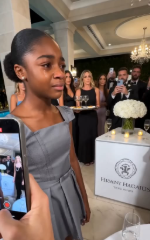
“You’re giving her a fellowship because she cried in public?”
Mr. Whitcombe’s face hardened.
“No,” he said. “I’m giving it to her because your family tried to steal her work and she still stood beside it.”
Mrs. Harrington whispered, “Evelyn, stop.”
But Evelyn’s eyes were wet now, and rage was spilling through the cracks.
“She only got picked because she’s poor.”
The words hit the room like broken glass.
Then, from the back of the pool deck, someone answered.
“No,” my mother said. “She got picked because she is brilliant.”
Part 6: My Mother Walked Through The Silence
My mom still wore her grocery store uniform.
That was what made the room hurt.
Everyone else had pearls, linen, silk, sponsor pins, polished sandals, perfect hair. My mother had tired eyes, a name tag, and the same black work shoes she wore when she stood eight hours at the register.
She must have come straight from her shift.
For one strange second, I felt embarrassed.
Then I hated myself for it.
Because my mother walked through that luxury poolside party like she had every right to be there.
And she did.
“Mom,” I whispered.
She reached me and touched my cheek carefully.
Her face changed.
“Who did that?”
No one answered.
My eyes moved to Evelyn.
My mother followed my gaze.
Evelyn looked away.
Mrs. Harrington lifted her chin. “Your daughter is fine. This event is already being handled.”
My mother turned toward her.
“Do not speak to me like my child is a spilled drink.”
A few people gasped.
Mrs. Harrington went rigid.
My mother looked at the screen, at the label with my name, at the footage of Evelyn tearing it out.
Then she looked at Mr. Whitcombe.
“Sir, my daughter did not tell me about a fellowship. She only told me she hoped the uniforms would help students stop hiding in bathrooms before ceremonies.”
The words went straight through me.
Because it was true.
I had told her that one night while cutting fabric on the living room floor.
I had seen girls miss award photos because their uniforms pulled wrong, boys tugging sleeves over stains, students pretending not to care because caring cost too much.
Mr. Whitcombe nodded slowly. “That is why her work matters.”
My mother turned to the guests.
“I cannot write checks big enough to get my child respect in rooms like this,” she said. “But I taught her not to steal, not to lie, and not to make another child feel small to look taller.”
Evelyn started crying then.
Quietly at first.
Mrs. Harrington grabbed her arm. “Stop it.”
Evelyn pulled away.
That shocked the room almost as much as the footage.
“You told me sponsor kids had to stay visible,” Evelyn said to her mother. “You said if Amara stood in the center, people would ask why I wasn’t there.”
Mrs. Harrington’s face froze.
Evelyn wiped her face angrily. “You said the foundation needed a better face.”
The phrase made something cold move through the crowd.
A better face.
My mother stepped closer to me.
Mr. Whitcombe’s voice turned icy.
“Mrs. Harrington, your family’s sponsorship is revoked effective immediately.”
Mrs. Harrington looked stunned. “You cannot embarrass us like this.”
He looked at the screen again.
“You did that yourself.”
Then Mr. Vale received another message on his phone.
He read it once.
Then again.
His voice lowered.
“There is one more clip.”
Part 7: The Second Clip Showed The Real Plan
Nobody wanted to watch the second clip.
That was the strange thing.
The truth had already done enough damage, but the tablet in Mr. Vale’s hand felt heavier than before, like it carried the part no one could explain away as panic or pride.
The video opened in the same catering hallway.
This time, the timestamp was earlier.
5:42 p.m.
Mrs. Harrington stood with two event coordinators near a rack of garment bags. Evelyn hovered behind her, arms crossed.
Mrs. Harrington’s voice was clear in this clip.
“The scholarship girl can stand near the display table,” she said. “But my daughter should be on stage when the foundation photo is taken.”
One coordinator said, “The program says Amara Bell presents the prototype.”
Mrs. Harrington smiled.
“Programs change.”
The second coordinator looked uncomfortable. “Mr. Whitcombe personally approved that.”
Mrs. Harrington stepped closer.
“Mr. Whitcombe is sentimental. Sponsors are practical.”
Evelyn looked bored until her mother turned to her.
“If anyone asks, say Amara altered the garment label herself to get attention.”
My breath stopped.
The coordinator whispered, “That could get her removed from the fellowship review.”
Mrs. Harrington’s answer was calm.
“That is the idea.”
The pool deck went silent in a way I had never heard before.
Even the water seemed still.
My mother’s hand found mine.
Evelyn was sobbing now, one hand pressed to her mouth.
“I didn’t know about removing her from the fellowship,” she said. “I swear.”
I looked at her.
I wanted to hate her simply. It would have been easier.
But her face was crumbling under the weight of discovering that her mother had used her too.
Mrs. Harrington looked around the party, searching for allies among people who had smiled at her for years.
No one stepped forward.
Mr. Whitcombe folded the fellowship document and placed it back in the envelope.
“This will be reviewed by the full foundation board,” he said.
My stomach dropped.
For one horrible second, I thought I was losing it after all.
Then he turned to me.
“Not your seat, Amara. The program. We clearly need stronger protections around student work.”
I breathed again.
Mr. Vale stepped to the microphone on the stage.
“Ladies and gentlemen,” he said, voice unsteady, “we will be pausing the ceremony briefly.”
“No,” I said.
Everyone turned.
My mother squeezed my hand.
My heart was racing so hard I could feel it in my throat.
I looked at the prototype blazer hanging backstage, the one Evelyn had tried to relabel, the one I had built from late nights and measured hope.
Then I looked at Mr. Vale.
“Don’t pause it,” I said. “Let me present the uniform.”
Mrs. Harrington gave a bitter laugh.
“You cannot be serious.”
I stepped toward the stage.
“I am.”
Part 8: The Girl They Tried To Move Stood Center Stage
The walk to the stage felt longer than any hallway I had ever crossed.
My cheek still hurt. My hands were cold. The guests were watching me with a new kind of attention, and I did not trust it yet. Attention could turn. Attention could pity. Attention could disappear when the next pretty scandal arrived.
But my mother stood at the front of the crowd, still in her work shoes, eyes shining.
So I kept walking.
Mr. Vale handed me the prototype blazer.
The torn label had been pinned carefully to the front, not hidden inside.
Amara Bell.
Prototype Design.
I put the blazer on over my simple dress. It fit exactly the way I had designed it to fit: not tight, not stiff, not pretending one body shape was the rule. The fabric moved when I moved. The seams gave where they needed to give. The sleeves could be adjusted without looking cheap.
For the first time all night, I felt like the clothes were not covering me.
They were backing me up.
I stepped to the center mark.
The same mark Evelyn thought belonged to her.
The microphone waited.
My voice shook on the first word.
Then steadied on the second.
“This uniform was designed for students who have ever stood outside a ceremony wondering if they looked wrong before they even walked in.”
The pool deck stayed silent.
I looked at the scholarship students near the back.
“It was designed for students who borrow, alter, hide, repeat outfits, and smile like it doesn’t hurt.”
My mother pressed a hand to her mouth.
“It was designed to be affordable, adjustable, and dignified. Because dignity should not be a luxury item.”
Someone clapped once.
Then another.
Then the sound spread across the poolside party until it became something too large to control.
I did not smile yet.
Not because I was ungrateful.
Because I wanted to finish.
“And I want the first production run donated to every student who needs one before next semester’s ceremonies.”
Mr. Whitcombe stood.
“Approved.”
The applause broke open.
Evelyn stood near the side exit with her face wet and her arms wrapped around herself. Mrs. Harrington was gone by then, escorted out by event security after refusing to surrender her sponsor badge.
I expected Evelyn to leave too.
Instead, she walked toward the stage.
The crowd quieted.
My mother stepped forward, but I shook my head once.
Evelyn stopped below me.
“I’m sorry,” she said.
The words were small.
They did not fix the slap.
They did not fix the label.
They did not fix what she had tried to become at her mother’s command.
But for once, she said them without looking at anyone else for approval.
“I was cruel,” she said. “And I knew enough to stop.”
I looked at her for a long moment.
Then I said, “Tell the board that.”
She nodded, crying harder. “I will.”
Months later, the Harrington sponsorship plaque came down from the school lobby. In its place, the foundation hung the first finished uniform jacket in a glass case. Not because it was expensive. Because it was proof.
Under it was the torn label Evelyn had tried to remove.
And beside that, a sentence from my presentation:
DIGNITY SHOULD NOT BE A LUXURY ITEM.
The fellowship changed everything. Not overnight. Not magically. But steadily. I learned pattern software, production planning, textile ethics, and how to speak in rooms where my voice used to shrink.
My mother kept the first thank-you letter from a freshman who said she finally went to an awards night without crying in the bathroom.
She framed it above our kitchen table.
Sometimes I still remember the slap.
The sound. The heat. The way the rich guests stared like I had become a problem in their perfect evening.
But I remember something else louder.
The moment I stood on the center mark wearing my own name where everyone could see it.
They tried to tear the label out, but all they did was teach the whole room how to read it.
