My phone was still zipped inside my backpack when half the school decided I had written the sentence that could destroy Audrey Beaumont’s perfect reputation.
That was the strangest part later, the detail I kept returning to whenever people asked me how everything fell apart so fast. I could not have posted the photo. I could not have edited the pledge board image. I could not even have seen the rumor spreading in real time because my phone was buried under a granola bar, two notebooks, and a folded Earth Day volunteer schedule in the bottom of my bag.
But truth is slow when people want drama.
A rumor can run across a school before the person being blamed even knows the race has started.
I was standing behind the Earth Day environmental booth in the gym lobby at Westbridge High in Madison, Wisconsin, sorting recycling pledge cards into neat little stacks when the first wave of silence hit me. Not full silence. Schools never go fully silent. There was still the squeak of sneakers, the buzz of fluorescent lights, the crinkle of paper cups, the laughter from the gardening club table, the thump of a poster board falling somewhere near the cafeteria doors.
But around me, the sound changed.
People looked at me, then looked away.
Then looked again.
I was used to being overlooked. I was Skye Miller, seventeen years old, originally from Montana, the quiet helper with a messy ponytail, faded jeans, an old green flannel over a white T-shirt, and sneakers that had seen more school events than most teachers. I stayed after class for clubs, carried boxes, cleaned up glitter, taped signs, counted donations, and made sure adults got the credit they forgot to share.
I did not belong to the wealthy popular circle.
I did not have a parent on the booster board.
I did not have a group of girls who moved through the halls like a security detail.
Audrey Beaumont had all of that.
Audrey was eighteen, polished, connected, and practiced in the art of looking innocent before anyone accused her of anything. She wore a cream sweater, a pleated skirt, spotless white sneakers, and a delicate gold necklace that caught the light every time she turned her head. Her hair looked expensive. Her backpack looked expensive. Even her reusable water bottle looked like something chosen by a consultant.
She was president of the Green Futures Club, the face of the Earth Day event, and the person whose family had promised funding for the winning environmental initiative.
So when a photo started spreading of the recycling pledge board with Audrey’s name signed beside a controversial sentence, everyone immediately needed someone else to blame.
The sentence was written in thick green marker under the pledge line:
“I support recycling only when it protects people who actually belong in this community.”
Audrey Beaumont’s name was signed beneath it.
The handwriting looked like hers.
The photo looked real.
The sentence was cruel enough to ignite the whole school in minutes.
And somehow, before I even saw it, people were whispering that I had done it.
At first, I did not understand why students were staring. Then Liam Ortega from the chess club rushed up to me, his face pale.
“Skye,” he said, lowering his voice. “You need to check your phone.”
“My phone’s in my backpack.”
“Then get it.”
“Why?”
He glanced over his shoulder. “They’re saying you wrote something on the pledge board and signed Audrey’s name.”
My fingers froze around a stack of pledge cards.
“What?”
He swallowed. “There’s a photo.”
“I didn’t write anything.”
“I know.”
That should have helped.
It didn’t.
Because when one person says “I know” and fifty people look at you like they don’t, the fifty people feel louder.
I reached for my backpack, but before I could unzip it, the crowd near the main entrance shifted.
Audrey Beaumont was coming toward me.
She did not walk fast. She never had to. Her friends moved with her, three girls from student council and two boys from the debate team, all wearing matching Earth Day volunteer lanyards. Behind them came Mrs. Calder, the Green Futures adviser, and Mr. Nolan from administration, both looking tense in a way that made my stomach drop.
Audrey’s eyes were bright.
Not confused.
Not hurt.
Performing.
That was the first thing I noticed, though I did not have the words for it yet. She did not look like someone discovering a betrayal. She looked like someone arriving at a scene she had already rehearsed.
“Skye,” she said, loud enough for the entire booth area to hear. “How could you?”
Every conversation around us thinned out.
“I didn’t do anything,” I said.
Audrey laughed once, broken and sharp. “You signed my name to that disgusting pledge.”
“No, I didn’t.”
“You’ve always been jealous of Green Futures.”
That one almost made me laugh, which would have been the worst possible thing to do.
Jealous?
I had spent three weeks helping her club prepare because Mrs. Calder asked for volunteers. I had stapled flyers, sorted plastic bottles, labeled compost bins, and built the pledge board frame with Liam after the first one collapsed. I had never wanted Audrey’s position. I had wanted the event to run properly.
“I helped build that board,” I said. “That’s why I’m asking you to check the original file.”
Audrey’s face hardened. “What original file?”
“The booth records,” I said, turning toward Mrs. Calder. “The pledge board was photographed every hour for the club archive. And the gym lobby camera faces this table. If somebody signed it while the booth was unattended, there should be footage.”
For one second, Audrey’s expression slipped.
It was tiny. A blink too long. A tightening near her mouth. But I saw it.
Then she stepped closer.
“Listen to yourself,” she said. “You got caught, and now you’re trying to drag school security into your lie?”
“I’m trying to prove the truth.”
“You’re trying to humiliate me.”
“No,” I said. “Somebody already did that when they signed your name.”
Her eyes flashed.
Mrs. Calder lifted a hand. “Girls, let’s calm down.”
Girls.
As if we were arguing over a lunch table seat.
Mr. Nolan cleared his throat. “Skye, this is a serious accusation.”
“I know,” I said. “That’s why I want you to open the original file.”
Audrey turned to the crowd, her voice trembling beautifully. “She keeps saying that because she knows it will take time. By then everyone will forget what she did.”
Students murmured.
Someone whispered, “That’s true.”
My face warmed.
My backpack sat against the table leg, still zipped. My phone was inside. The marker used on the pledge board was lying in a cup near Audrey’s elbow. The original board stood behind us like a silent witness, the sentence dark and ugly under the gym lobby lights.
“I didn’t touch it,” I said.
Audrey looked directly at me.
Then she slapped me.
The sound was shocking.
Not because it was loud, but because it made everything else disappear.
My head turned with the force. My cheek burned. My breath caught somewhere high in my chest, and for one humiliating second I could not make myself inhale.
Around me, students gasped.
Phones lifted.
Mrs. Calder said Audrey’s name in a horrified voice, but she did not step between us until after it happened.
Audrey’s hand shook at her side.
For a moment, she looked surprised by herself.
Then she recovered.
“Don’t you ever try to ruin my life and act like you’re the victim,” she said.
And there it was.
The lie trying to become official.
I could feel the crowd choosing. Not all at once. Not fairly. But instinctively. Audrey was crying now, and I was standing there with a red cheek and dry eyes, because shock had frozen my tears somewhere deeper.
Crying looked innocent.
Standing looked guilty.
My hands curled around the edge of the booth table.
I wanted to run.
I wanted to grab my backpack, push through the crowd, hide in a bathroom stall, call my mother, and let the adults do whatever adults did when they had already decided the quiet girl was convenient.
But then I saw the pledge board camera.
It was not a big camera. Just a small black device clipped near the top of the booth frame, installed by the media club to create a time-lapse of the Earth Day event. I had helped position it that morning. Every fifteen minutes, it saved a still image to the club archive. The gym security camera recorded continuous video from the opposite corner.
Two witnesses.
Two quiet, mechanical witnesses.
Audrey had remembered the crowd.
She had remembered her tears.
She had remembered her status.
But she had missed the one thing school records never forget.
Time.
I lifted my head.
“Open the file,” I said.
My voice was hoarse, but it carried.
Audrey stared at me.
Mr. Nolan said, “Skye, this may need to be handled in the office.”
“No,” I said. “It started here. She hit me here. Everyone is filming here. Open the file here.”
Audrey’s friends began speaking at once.
“That’s dramatic.”
“She’s trying to distract.”
“Why is she so obsessed with files?”
Mrs. Calder looked overwhelmed. She had gone pale, one hand pressed against her lanyard.
Then a new voice cut through the noise.
“I can open it.”
Everyone turned.
It was Ms. Voss, the media studies teacher, standing near the photography table with a laptop tucked under her arm. She had short gray hair, sharp glasses, and the particular calm of a person who had spent years teaching teenagers how to use expensive equipment without breaking it.
“The Earth Day booth archive is on the media drive,” she said. “The pledge-board camera uploads there.”
Audrey shook her head. “That camera only takes random pictures. It won’t prove anything.”
“How would you know what it captured?” I asked.
Audrey’s eyes snapped to mine.
The crowd heard it too.
That tiny question changed the temperature.
Ms. Voss walked to the projector cart near the environmental display area. The school had set it up to show climate documentaries between presentations. She connected her laptop while Mr. Nolan stood beside her, suddenly much more serious.
Audrey folded her arms.
“This is ridiculous,” she said, but her voice had lost its polish.
My cheek throbbed. I kept one hand pressed to it, not because it helped the pain, but because it reminded me that what happened had happened. I had not imagined it. I had not caused it. I had been struck because I asked for proof.
Ms. Voss logged into the media archive.
The projector screen lit up.
Folders appeared.
EARTH_DAY_EVENT.
BOOTH_TIME_LAPSE.
PLEDGE_BOARD_STILLS.
GYM_LOBBY_B_CAMERA.
The gym lobby went quiet.
Not silent. Never silent. But the kind of quiet that means people have stopped enjoying the scandal and started fearing the answer.
Ms. Voss opened the still images first.
The pledge board appeared on screen at 10:00 a.m.
Clean.
At 10:15.
Clean.
At 10:30.
Still clean.
Audrey stood rigid beside me.
At 10:45, the board was unattended. The booth table was empty except for pledge cards, markers, and a stack of stickers.
At 11:00, the controversial sentence appeared.
A murmur rippled through the crowd.
“That doesn’t show who wrote it,” Audrey said quickly.
“No,” Ms. Voss said. “It shows when it appeared.”
She opened the gym lobby camera folder.
Mr. Nolan stepped closer. “Ms. Voss, we should be careful with student privacy.”
“We can review the relevant time window,” Ms. Voss said. “You’re standing right here as an administrator.”
He nodded reluctantly.
She loaded the footage from 10:45 to 11:00.
The video began.
Students moved through the gym lobby in fast, ordinary patterns. A teacher carried a box of reusable cups. Two freshmen chased a rolling tape dispenser. Liam and I crossed the far background at 10:47, carrying compost signs toward the cafeteria hallway.
Then the booth was empty.
At 10:52, Audrey Beaumont entered the frame.
Not with her friends.
Alone.
The entire crowd seemed to inhale at once.
On screen, Audrey looked around, checking both directions. She stepped behind the booth table, picked up the green marker, and wrote on the pledge board.
Nobody spoke.
She signed her own name.
She capped the marker.
Then, before leaving, she pulled out her phone and took a photo.
The video continued for a few seconds after she walked away, showing the board exactly as the viral image had shown it.
Ms. Voss paused the footage.
The gym lobby went dead quiet.
The proof did not just clear me.
It made every person in that room turn toward her.
Audrey stood frozen, her face drained of color.
Someone near the back whispered, “She wrote it herself.”
Another student stepped away from her.
Then another.
The movement was small but brutal. Audrey had arrived surrounded by people. Now space opened around her like the floor itself no longer wanted to hold her.
Mrs. Calder covered her mouth.
Mr. Nolan looked at Audrey. “Is that you?”
Audrey did not answer.
The projector still held her image on the screen: hand raised, marker touching the board, her own signature half-formed beneath the sentence she had blamed on me.
I waited for satisfaction to come.
It didn’t.
All I felt was tired.
Then Audrey said, very softly, “You don’t understand.”
I almost laughed.
Not because it was funny.
Because guilty people always said that when proof finally made them simple.
Mr. Nolan said, “Audrey, come with me.”
“No.” She backed away. “No, you don’t understand.”
Her eyes darted toward Mrs. Calder, then toward the Green Futures display table, where a glossy poster announced the school’s environmental initiative competition.
BEAUMONT FOUNDATION STUDENT IMPACT GRANT — WINNER ANNOUNCED TODAY.
The foundation name hit me like a second slap.
Beaumont.
Audrey’s family.
The winning club would receive a large grant for its environmental project. Green Futures was expected to win. Audrey was expected to stand onstage that afternoon and accept recognition for leading the event.
But the controversial sentence would make her look cruel, exclusionary, and completely unfit to represent the school’s environmental campaign.
Unless someone else was blamed.
Someone quiet.
Someone outside her circle.
Someone like me.
Mrs. Calder whispered, “Audrey, what did you do?”
Audrey’s face twisted.
“I had to,” she said.
The words cracked open the room.
“You had to frame me?” I asked.
She looked at me then, and for the first time all day, she was not performing. She was furious, terrified, and strangely young.
“You were going to ruin everything anyway,” she said.
“I was sorting pledge cards.”
“You were asking questions about the bottle drive.”
My stomach tightened.
The bottle drive.
Three days earlier, I had noticed that several bags of returned bottles from the Earth Day collection were missing from the storage room. The club had announced a huge recycling total, enough to strengthen its grant application, but the physical count did not match. When I asked Mrs. Calder about it, she said Audrey’s team had handled the final numbers.
I had not accused anyone.
Not yet.
But Audrey had seen me checking.
“You made the pledge board scandal to distract from the recycling numbers,” I said.
Audrey’s mouth shut.
Mrs. Calder slowly lowered her hand.
Mr. Nolan turned to her. “What recycling numbers?”
The gym lobby erupted.
Audrey tried to walk away, but Principal Danvers arrived before she reached the doors. Someone must have called her during the footage review. She came in with two assistant principals and a security officer, her face set in a hard, calm line.
“Everyone not directly involved, return to your booths or classrooms,” she said.
Nobody wanted to move.
She raised her voice once.
“Now.”
The crowd broke reluctantly, but not before the damage had reversed completely. People who had filmed my humiliation were now whispering Audrey’s name. People who had believed her tears were checking their phones with pale faces. Her friends stood together near the water fountain, looking like they wanted to disappear.
I was led into the conference room beside the main office, where an ice pack was placed against my cheek and my mother was called.
While we waited, Principal Danvers, Mr. Nolan, Ms. Voss, and Mrs. Calder reviewed the footage again. Then they checked the original event files. Then the bottle drive records.
That was where the hidden school file appeared.
It had been saved under an ordinary folder name:
EARTH_DAY_SUPPLY_BACKUP.
Inside was a spreadsheet connected to the recycling pledge booth, the bottle drive, and the grant application totals. I recognized it because I had made the first version.
But this one had hidden columns.
Ms. Voss expanded them.
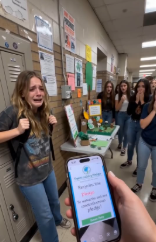
The room changed.
The public recycling total was nearly double the verified count.
Several donation entries were marked “pending confirmation,” but had been included anyway.
And beside three questionable entries was a note:
A.B. APPROVED — DO NOT FLAG BEFORE GRANT REVIEW.
A.B.
Audrey Beaumont.
Mrs. Calder sank into a chair.
“I didn’t see this version,” she whispered.
Principal Danvers looked at her sharply. “You are the club adviser.”
“I know.” Mrs. Calder’s eyes filled with tears. “Audrey said her father’s office helped format the final grant packet. I thought they were just making it professional.”
“Professional,” my mother said from the doorway.
Everyone turned.
She stood there in her postal service uniform, still holding her keys, her face tight with fear she was trying to turn into control.
Her eyes found me.
Then my cheek.
“Oh, Skye.”
“I’m okay,” I said automatically.
She walked straight to me and took the ice pack from my hand, adjusting it gently. “You do not have to say that when you are not.”
That almost made me cry.
Not the slap. Not the rumor. Not the footage.
That.
Principal Danvers explained what they had found. My mother listened without interrupting, which was how I knew she was angrier than I had ever seen her.
When the principal finished, my mother looked at Mrs. Calder.
“My daughter asked for a file,” she said. “Your student hit her for it. Then the file showed my daughter was telling the truth. I want every part of this recorded.”
“It will be,” Principal Danvers said.
“No,” my mother replied. “Not just handled. Recorded.”
I looked at her.
She squeezed my shoulder once.
My mother had spent years delivering mail through Montana winters before we moved to Wisconsin. She believed in routes, signatures, tracking numbers, receipts. She always said people respected what could be documented.
That day, I understood her better than ever.
Audrey’s parents arrived an hour later.
Her father wore a dark suit and the expression of a man offended by consequences. Her mother looked first at Audrey, then at the administrators, then at me, and seemed to decide instantly that I was the easiest person in the room to blame.
“This has gone too far,” Mrs. Beaumont said.
My mother stood up.
“Your daughter slapped mine,” she said.
Mrs. Beaumont barely glanced at me. “Teenagers get emotional.”
“Your daughter framed mine.”
Mr. Beaumont said, “That is an extreme accusation.”
Principal Danvers turned the laptop toward them and played the footage.
They watched Audrey sign the board.
They watched her photograph it.
They watched her leave.
Neither parent spoke.
Then Ms. Voss opened the hidden spreadsheet.
Mr. Beaumont’s face changed.
Not when he saw the false totals.
When he saw the note.
A.B. APPROVED.
Because he understood records too.
The Beaumont Foundation suspended the grant announcement by the end of the day. Audrey was removed from the Green Futures leadership position pending investigation. The school issued a statement saying the pledge board incident had been falsely attributed to another student, though they did not name me publicly because my mother refused to let them turn my trauma into their public relations cleanup.
But school statements do not erase school memory.
By Monday, everyone knew the truth.
The apology wave began before first period.
“I’m sorry I believed it.”
“I didn’t know.”
“I thought the photo was real.”
“I should have waited.”
“I should have said something.”
I nodded until my neck felt stiff.
The hardest apologies came from people I liked. Liam apologized even though he had warned me. Mrs. Calder apologized with shaking hands and red eyes. She admitted she had trusted Audrey’s confidence because it was easier than checking my concern.
That one hurt.
Because she did not hate me.
She simply had not valued me enough to verify the truth before the lie grew teeth.
A week later, the environmental initiative competition was held again, but everything had changed. The Beaumont Foundation was no longer allowed to sponsor or judge. The grant money was frozen. Green Futures had to submit corrected recycling numbers, and the pledge board was replaced with a new one titled:
WHAT WE OWE EACH OTHER.
Students signed it all day.
Some wrote simple things.
Recycle honestly.
Protect the planet.
Don’t blame people without proof.
Believe records before rumors.
Near the bottom, in Liam’s messy handwriting, one sentence made my throat tighten:
Quiet people are not easy targets.
The biggest surprise came during the final assembly.
Principal Danvers walked onto the auditorium stage with Ms. Voss, Mrs. Calder, and the district environmental coordinator. I sat near the back with my mother because I had begged not to be publicly named.
At first, the assembly was exactly what I expected: corrected totals, new oversight rules, a lecture about digital responsibility, and a reminder that filming someone’s humiliation was not the same as helping them.
Then Principal Danvers paused.
“Sometimes,” she said, “a school learns the most from the student who asked one simple question when everyone else wanted an easy answer.”
My stomach dropped.
Mom took my hand.
“We will not name that student without permission,” Principal Danvers continued. “But we will honor what that student protected.”
The screen behind her changed.
A new project appeared.
THE OPEN LEDGER ENVIRONMENTAL INITIATIVE.
It was based on the system I had quietly suggested weeks earlier: public recycling totals connected to verified logs, camera-confirmed booth collections, and student-accessible records so no club could inflate numbers for awards again.
My idea.
Not Audrey’s.
Not the Beaumont Foundation’s.
Mine.
Mrs. Calder stepped to the microphone, her voice unsteady.
“This initiative began as a concern raised by a student volunteer,” she said. “I failed to listen quickly enough. I will not make that mistake again.”
The auditorium was silent.
Then she said, “The district has approved it as the new standard for all environmental club reporting.”
My mother squeezed my hand so hard it hurt.
A laugh escaped me. A small, stunned laugh.
For once, nobody had stolen the work.
For once, the record did not just prove what happened after harm.
It changed what would happen next.
Audrey Beaumont transferred to online school for the rest of the semester. People said different things about her. Some said she was ruined. Some said she would be fine because girls like Audrey always landed somewhere soft. I did not spend much time wondering which version was true.
I had my own life to return to.
But I did see her once more.
It happened three weeks after the assembly, late in the afternoon, when I went back to the gym lobby to take down old Earth Day posters. The building was quiet. Rain tapped against the windows. The pledge board still stood near the wall, covered with signatures and promises.
Audrey was there.
She wore a plain sweatshirt and jeans, her hair pulled back without its usual shine. She looked at me like she expected me to call for a teacher.
I didn’t.
For a long moment, neither of us spoke.
Then she said, “My dad knew about the numbers.”
I stared at her.
Audrey looked at the floor. “Not the pledge board. That was me. But the inflated recycling total… he said grant committees expect big impact. He said everyone rounds up. He said if Green Futures won, the school would benefit and nobody would care how we got there.”
The room felt suddenly colder.
“Why tell me?” I asked.
She swallowed.
“Because there’s another file.”
My heart began to pound.
Audrey reached into her backpack and pulled out a folded printout.
Not a flash drive. Not a dramatic confession.
A printed email chain.
“My father’s assistant sent this to the school board liaison by mistake,” she said. “Then recalled it. I printed it before he deleted my access.”
I did not take it right away.
“What’s in it?”
“Proof that the grant was never really open,” she said. “The Beaumont Foundation had already decided Green Futures would win before the competition. The other clubs were just decoration.”
I looked at her, trying to find the performance.
There was none.
Only exhaustion.
“You framed me,” I said.
“I know.”
“You hit me.”
Her eyes filled. “I know.”
“You let everyone think I was hateful.”
A tear slipped down her face. “I know.”
I wanted to hate her cleanly. It would have been easier if she stayed a villain in perfect clothes. But there she stood, holding the next piece of truth with shaking hands, and I understood something I did not want to understand.
Audrey had harmed me because she was cruel.
But she had also been raised inside a machine that rewarded cruelty as long as it came with donations.
Understanding that did not forgive her.
It only made the truth bigger.
I took the printout.
“I’m giving this to Principal Danvers,” I said.
Audrey nodded. “That’s why I brought it.”
“You don’t get credit for fixing what you helped break.”
“I know,” she whispered.
I turned to leave.
“Skye?”
I stopped.
“I’m sorry,” she said.
I looked back at her.
The apology was too small for what she had done. Most apologies are. But it was the first thing I had heard from her that did not seem designed for an audience.
“I hope someday you become someone who would have stopped yourself,” I said.
Then I walked away with the file.
The investigation that followed reached far beyond the Earth Day booth. The district found improper communication between the Beaumont Foundation and several school officials. The environmental grant program was rebuilt with independent review. Clubs that had lost previous competitions were invited to resubmit projects. Mrs. Calder remained adviser only after completing ethics training and publicly correcting the club records.
The Open Ledger Initiative launched that fall.
Every bottle count, pledge board entry, compost weight, and donation total became traceable. Not because students could not be trusted, but because trust deserved protection.
And me?
I went back to being quiet.
Mostly.
But it was different now.
When I stayed after school, people remembered to write down my name. When I asked to check a file, adults opened it. When rumors started, students were slower to believe them and faster to ask what proof existed.
On the last day of school, I found the pledge board one final time.
Most of the signatures had faded slightly. The green marker had softened to the color of old leaves. Near the corner, someone had added a sentence I had not noticed before:
The truth was here before the rumor arrived.
I stood there for a while, my backpack heavy on one shoulder, my phone safely inside it.
Then Liam appeared beside me with two paper cups of lemonade from the cafeteria fundraiser.
“You ready to go?” he asked.
I looked at the board.
At the place where Audrey had tried to turn her own sentence into my shame.
At the spot where the camera had seen what everyone else refused to believe.
At the signatures that came after.
“Yeah,” I said.
Outside, the spring air smelled like rain and cut grass. My mother’s car waited near the curb, and beyond the parking lot, trees moved in the wind like they were shaking off the last of a storm.
For a long time, I had thought being quiet meant being easy to erase.
I was wrong.
Quiet things leave records too.
A camera frame.
A hidden file.
A timestamp.
A name finally written where it belongs.
And sometimes, when the lie gets loud enough to fill a whole school, the truth does not need to shout back.
It only needs someone brave enough to press play.
THE END
