The moment Evelyn Harrington shoved me in front of three hundred guests, I learned how loud a rich room could become without anyone truly speaking.
There were gasps, yes.
A few chairs scraped backward.
Someone whispered my name like it was a fragile glass they had just dropped.
But mostly, the room filled with the sharp, expensive silence of people deciding whether I was worth helping.
I hit the polished floor near the stage steps, one hand scraping against the edge of the black platform. For a second, all I saw were shoes. Satin heels. Italian leather. Glittering sandals. Men’s polished dress shoes shining under the chandelier light. Everything around me looked expensive enough to make my thrifted dress feel like an apology.
My name is Nora Castillo.
I was seventeen, Mexican American, and a scholarship student at Ashbourne Preparatory Academy in Seattle, a school where even the hallway air felt privately funded.
The gala was supposed to be my proudest night.
Instead, I was on the floor with my palm burning, my knees shaking, and Evelyn Harrington standing above me like I had stolen something from her simply by being chosen.
The gala was called the Ashbourne Legacy Benefit, held every spring at the Fairmont ballroom downtown. The invitations were thick cream paper with gold lettering. The flower arrangements were taller than some students. Every table had crystal glasses, silver chargers, folded linen napkins, and centerpieces made of white orchids and candlelight.
Parents arrived in black cars and gowns that looked like they belonged in museums. Students posed near the entry wall under a sign that said BUILDING FUTURES TOGETHER, smiling like the event was their private runway.
I stood near the stage because I had been chosen for the central ceremonial role.
Not because I was rich.
Not because I had a famous last name.
Because I had done the work.
For three weeks, I had stayed after school in the events office, fixing donor lists, correcting name cards, updating the seating chart, printing backups when the printer jammed, matching auction items to donor records, and rewriting the stage cues after the original student committee somehow forgot to include the scholarship speakers.
The irony was almost funny.
A scholarship gala almost forgot the scholarship students.
I noticed because I was the one checking the final binder.
Ms. Chen, the development coordinator, had found me sitting cross-legged on the carpet outside the copy room with papers spread around me like a paper storm.
“Nora,” she had said, blinking at the mess, “why are you still here?”
“Because the program has Mr. Lawson speaking before the scholarship video,” I said, holding up two pages, “but the stage cue says the video plays before him. Also, the donor recognition slide is missing the Alvarez family, and Table Twelve has two guests with shellfish allergies but the menu says shrimp appetizer.”
Ms. Chen had gone very still.
Then she said the words that changed everything.
“Do you want to help me save this event?”
I had laughed because I thought she was joking.
She was not.
So I helped.
Quietly.
No announcement. No title. No special badge. I just did the work.
I knew how to do quiet work. My mother cleaned hotel rooms before sunrise and ironed uniforms at night. My father had left when I was eight, taking most of his promises with him. I had spent my life watching my mother make impossible days function without applause.
So when Ashbourne gave me a full scholarship, I treated it like something fragile and sacred. I arrived early. I did not complain. I worked harder than anyone could accuse me of not belonging.
But belonging is complicated when people keep reminding you the door was opened for you, not by you.
Evelyn Harrington never let me forget it.
She was eighteen, the daughter of one of Ashbourne’s biggest donor families, and she moved through school with the calm certainty of someone who had never wondered whether a bill could be paid. Her mother, Vivienne Harrington, chaired the gala committee and spoke in a voice that made teachers stand straighter.
Evelyn had expected the central role that night.
Everyone had.
The central role was simple but symbolic. At the height of the gala, one student would walk to the center mark onstage, receive the ceremonial lantern, and introduce the scholarship film. The lantern represented “the light of opportunity,” which sounded dramatic, but donors loved symbols, and Ashbourne loved donors.
Evelyn wanted that mark.
She had practiced for it.
She had already told people she was doing it.
Then Ms. Chen chose me.
“You understand what this night is supposed to mean,” she told me. “You caught every mistake nobody else wanted to see. You should be the one standing there.”
I asked if she was sure three times.
She said yes all three.
By the time we arrived at the gala, Evelyn’s smile had become dangerous.
She found me backstage twenty minutes before the program began, dressed in a pale blue designer gown that looked like water under moonlight. Her hair was pinned with tiny pearls. Her earrings shimmered every time she turned her head. Beside her, I felt like a pencil sketch next to a finished painting.
“You’re standing center?” she asked.
I held the stage binder against my chest.
“Ms. Chen assigned me.”
Evelyn’s mouth curved.
“Of course she did. Ashbourne loves a scholarship story.”
I looked down at the binder.
“I’m just introducing the film.”
“No,” she said. “You’re being displayed.”
The word hit harder than I expected.
Displayed.
Like I was part of the auction items.
Like the school had polished me just enough to make donors feel generous.
I wanted to say something sharp. I wanted to ask whether she understood that the scholarship program was not decoration, that students like me were not props for her family’s philanthropy.
But my mother was in the audience.
She had borrowed a navy dress from my aunt and taken two buses from work to get there on time. She had texted me a blurry selfie from the lobby with the message: MI NIÑA, I AM SO PROUD.
I would not let Evelyn ruin that.
So I said, “I need to check the stage cues.”
Evelyn stepped into my path.
“You know what’s embarrassing?” she said softly. “Everyone is going to think you earned this because you’re special.”
My fingers tightened around the binder.
“I did earn it.”
Her eyes flashed.
“No. You were chosen because people like feeling good about helping girls like you.”
I looked at her then.
Really looked.
Under the pearls, the perfect makeup, and the cold voice, Evelyn was furious in a way that looked almost desperate.
“You’re angry because I’m standing where you wanted to stand,” I said.
Her face hardened.
“I’m angry because you don’t know your place.”
Behind us, someone dropped a tray. The sharp clatter broke the moment. Evelyn stepped back, smoothing her expression before anyone important could see it.
“Good luck, Nora,” she said.
She made my name sound like something she was wiping off her shoe.
The program began at seven thirty.
From backstage, I watched the ballroom glow. The chandeliers cast warm light over the tables. Waiters moved like shadows. Donors laughed softly, lifting glasses. The stage curtains smelled faintly of dust and expensive perfume.
Ms. Chen handed me the ceremonial lantern.
It was heavier than I expected, brass and glass, with a battery candle glowing inside.
“You ready?” she whispered.
“No.”
She smiled. “Good. That means you care.”
I peeked through the curtain.
My mother sat near the back at Table Nineteen, the scholarship family table. She was not near the donors or board members. Her chair was angled slightly behind a pillar, but she sat upright like she belonged anywhere she chose to sit.
When she saw me, she lifted one hand.
That almost broke me.
I wanted her so badly in that moment.
Not because I was afraid of the speech.
Because I could still feel Evelyn’s words under my skin.
Girls like you.
Don’t know your place.
Then the emcee said my name.
“Nora Castillo, Ashbourne senior and Legacy Scholarship recipient, will now lead us into tonight’s scholarship presentation.”
Applause rose.
I stepped forward.
The center mark was a small piece of tape on the stage floor, invisible to the audience but huge to me. I walked toward it holding the lantern with both hands. The light inside trembled slightly because my hands trembled too.
I had almost reached the mark when Evelyn appeared from the side.
At first, I thought she was confused. Maybe she had missed her cue. Maybe there had been a change.
Then I saw her face.
Furious.
White with it.
She moved fast.
Her shoulder struck mine, then her hand shoved hard against my arm.
The lantern slipped.
I stumbled sideways.
My foot missed the stage step.
The room tilted.
I fell.
The lantern hit the carpet and rolled, its little fake flame still glowing absurdly inside the glass.
For one frozen second, nobody moved.
Then someone gasped, “Nora!”
It was my mother.
I knew her voice anywhere.
That was what hurt worst.
Not the floor.
Not my scraped palm.
My mother’s voice cracking across a ballroom full of people who had already made her sit near a pillar.
Evelyn stood at the edge of the stage, breathing hard.
“She stepped into my cue,” she said.
The lie came out instantly.
Cleanly.
Like she had practiced.
“I was supposed to take the lantern.”
I pushed myself up on one elbow.
“That’s not true.”
Evelyn looked toward the audience, eyes shining.
“She panicked and blocked me.”
A few heads turned.
Some people looked confused. Some looked embarrassed. Some looked at me as if I might confirm the least uncomfortable version.
My mother was already standing.
“Nora!” she called.
A staff member tried to stop her from coming forward. My mother moved around him like he was furniture.
Ms. Chen rushed onto the stage.
“What happened?”
Evelyn’s voice shook perfectly.
“She shoved into my cue. I tried to keep the lantern from falling.”
I stared at her.
Even from the floor, with my palm bleeding and my heart hammering, I could see how quickly the room wanted her version to make sense.
Evelyn Harrington belonged in the center.
Nora Castillo was a scholarship girl.
Maybe she got nervous.
Maybe she stepped wrong.
Maybe she misunderstood.
Maybe.
Maybe.
Maybe.
That word has protected so many lies.
Ms. Chen looked at me.
“Nora?”
“She pushed me,” I said.
Evelyn made a small wounded sound.
“Oh my God.”
Her mother rose from the front table.
Vivienne Harrington did not rush. She glided. Tall, elegant, silver-blond hair swept into a perfect twist, diamonds at her throat, expression controlled enough to frighten anyone who depended on her donations.
“This is deeply unfortunate,” she said, reaching the stage area. “Clearly there was a cue confusion.”
Ms. Chen’s face tightened.
“There was no cue confusion.”
Vivienne’s gaze flicked to her.
“Let’s not escalate this publicly.”
My mother reached me then.
She knelt beside me, gathering my face in her hands.
“Mija, are you hurt?”
“I’m okay,” I whispered, though I was not.
She saw my palm and inhaled sharply.
Vivienne looked at us as if we were making the floor untidy.
“We can discuss this privately,” she said.
That was when Ms. Chen turned toward the backstage technician.
“Pull the security clip.”
Vivienne’s expression changed so quickly I might have missed it if I had not been looking.
It was not fear yet.
It was recognition.
“Security clip?” she asked.
Ms. Chen’s voice was steady.
“The ballroom has a stage camera for insurance and livestream backup. It records the stage wings and front steps.”
Evelyn looked toward her mother.
For help.
For instruction.
For rescue.
Vivienne stared at the stage monitor like she had just remembered a locked door she had forgotten to close.
The technician, a college student named Aaron, hurried to the media table. His fingers flew over the laptop. The ballroom murmured behind us. Nobody was eating now. Nobody was smiling for photos. Even the waiters had paused near the walls.
Principal Whitaker came up from Table One, face pale with controlled panic.
“Ms. Chen,” he said quietly, “perhaps we should handle this after the program.”
Ms. Chen did not move.
“A student was just shoved in front of the entire gala.”
Vivienne’s voice sharpened.
“Allegedly.”
My mother rose slowly.
She was shorter than Vivienne, wearing a borrowed dress and shoes that hurt her feet. But when she stood, something in her face made even Principal Whitaker step back.
“My daughter is bleeding,” she said. “Do not make her injury sound imaginary.”
The word daughter landed in me like warmth.
I blinked hard.
The ballroom screen flickered.
Aaron had connected the security feed to the side monitor first, but someone had left the main projector on. Before anyone stopped it, the clip appeared on the giant screen behind the stage.
The room fell silent.
The video showed the stage from a high angle.
There I was, walking toward the center mark, lantern in hand.
There was Evelyn, waiting in the wing.
For a moment, she watched me.
Then she stepped out.
Her arm extended.
Her hand hit my shoulder and shoved.
No confusion.
No accident.
No shared cue.
The ballroom saw me fall.
They saw the lantern roll.
They saw Evelyn turn toward the audience and begin speaking before I had even lifted my head.
Aaron froze the clip without being asked.
Evelyn’s face went white.
But her mother’s face went whiter.
Because in the corner of the video, visible for only a second before the shove, there was another detail.
Vivienne Harrington standing near the backstage entrance.
Holding a clipboard.
Pointing toward the stage.
Evelyn had looked at her just before moving.
Ms. Chen saw it too.
“Rewind five seconds,” she said.
Principal Whitaker whispered, “Lydia—”
“My name is Ms. Chen right now,” she said.
Aaron rewound.
The clip played again.
This time, everyone watched the corner.
Vivienne Harrington leaned toward Evelyn.
She raised one hand.
Then she pointed directly toward the center mark.
Evelyn stepped out.
Shoved me.
The video stopped.
Nobody breathed.
Evelyn looked at her mother again.
But Vivienne was no longer looking at her daughter.
She was staring at the evidence like she had just recognized her own signature.
Ms. Chen turned slowly.
“Mrs. Harrington,” she said, “why were you backstage giving stage directions?”
Vivienne’s mouth opened.
Nothing came out.
For the first time that night, the woman who could command entire committees with a raised eyebrow had no sentence ready.
Then Aaron, still at the laptop, said something that changed everything.
“Ms. Chen?”
Everyone looked at him.
He swallowed.
“There’s another file attached to the stage record.”
Vivienne’s head snapped toward him.
“Do not open that.”
The room heard her.
Every table.
Every donor.
Every scholarship parent.
Every student.
Do not open that.
No sentence in the world makes people want something opened more.
Ms. Chen stepped closer to the media table.
“What file?”
Aaron looked at Principal Whitaker.
The principal looked like he wanted the floor to swallow him.
Ms. Chen repeated, “What file?”
Aaron clicked.
A backstage record appeared on the screen.
It was not video.
It was the final gala operations binder.
The one I had helped rebuild.
A digital approval page filled the screen.
STAGE CEREMONIAL ROLE — FINAL CONFIRMATION
Selected student: Nora Castillo
Reason: Emergency event support, donor record correction, scholarship program restoration, stage cue reconstruction
Approved by: Lydia Chen
Reviewed by: Vivienne Harrington
My heart stopped.
Vivienne had reviewed it.
She had known.
She had known I was officially selected.
She had known why.
She had known I had saved the event.
Aaron scrolled.
Below the approval was a comment box.
Vivienne Harrington had left a note at 4:18 p.m.
This selection is unacceptable. The center role should represent Ashbourne’s legacy families, not need-based admissions. Replace Castillo with Evelyn before the program goes live.
A sound rose from the ballroom.
Not a gasp.
A wave.
My mother’s hand found mine.
I could feel her trembling.
Ms. Chen’s voice shook now, but not with fear.
“With respect, Mrs. Harrington, Nora corrected donor records, fixed the seating errors, caught allergy issues in the dinner service, restored the scholarship video cue, and prevented tonight’s program from failing.”
She clicked to another page.
A list appeared.
Backstage corrections completed by Nora Castillo:
— Corrected 42 donor name cards
— Restored missing scholarship speaker segment
— Identified allergy conflicts at Tables 12 and 26
— Rebuilt stage cue order after file corruption
— Verified auction item donor credits
— Recovered final scholarship video from backup drive
— Printed emergency program inserts
— Confirmed ceremonial lantern cue
The ballroom stared.
I stared too.
I had not known Ms. Chen documented all of it.
I had thought it was just work.
Quiet work.
Necessary work.
The kind people used and forgot.
But there it was.
My name beside every saved piece of the night.
Evidence that I had not been placed at the center because of pity.
I had earned the center by holding the entire event together from behind the curtain.
Evelyn whispered, “Mom.”
Vivienne finally turned to her.
Not with concern.
With anger.
“Quiet.”
Evelyn flinched.
That tiny movement hit me unexpectedly.
For a moment, I saw beyond the shove. Beyond the cruelty. Beyond the rich girl furious at a scholarship kid.
I saw a daughter trained to win because losing meant becoming small in her mother’s eyes.
But sympathy did not erase what she had done.
Principal Whitaker stepped forward, voice tight.
“Mrs. Harrington, we need to continue this discussion privately.”
My mother’s grip tightened.
“No,” she said.
Everyone turned toward her.
She swallowed, then lifted her chin.
“My daughter was humiliated publicly. The truth can be spoken publicly too.”
The room went silent again.
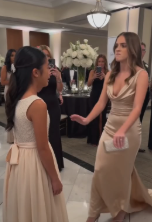
My mother’s accent was stronger when she was emotional. I had once wished people would not notice it. That night, I wanted everyone to hear every syllable.
Vivienne looked at her like she was a stain on the carpet.
“This is not your place.”
My mother smiled then.
Not kindly.
“My daughter was told the same thing. You were wrong both times.”
A few people clapped.
Then more.
Then half the ballroom.
Not everyone. Some donors looked uncomfortable. Some board members stared at their plates like the salad had become legally complicated.
But enough people clapped that Vivienne’s face tightened with the realization that control was slipping.
Evelyn began to cry.
Real tears now. Not the kind meant for an audience.
“I didn’t want to push her,” she said.
Vivienne snapped, “Evelyn.”
“No,” Evelyn said, voice cracking. “You told me if I let her stand there, everyone would think she mattered more than me.”
My chest hurt.
Evelyn looked at me.
“I’m sorry.”
I did not answer.
She deserved the silence.
Ms. Chen walked to the fallen lantern, picked it up, and checked the glass. Somehow, it had not broken. The little battery flame still glowed.
She brought it to me.
“Nora,” she said softly, “can you stand?”
My mother helped me up.
My palm throbbed. My legs felt weak. Every eye in the ballroom was on me now, but the stare had changed. It was no longer accusation. It was recognition, and somehow that felt almost as frightening.
Ms. Chen placed the lantern in my hands.
“You do not have to continue.”
I looked at my mother.
Her eyes were wet.
Then I looked at the screen behind me, still showing the list of everything I had done.
My work.
My name.
My proof.
I stepped onto the stage.
The applause began before I reached the center mark.
This time, I stood exactly where I was supposed to stand.
My voice shook when I began.
“My name is Nora Castillo,” I said, “and I am a Legacy Scholarship student.”
The ballroom quieted.
“I used to think saying that meant I had to prove I deserved to be here every day.”
My mother covered her mouth.
“But tonight, I learned something. A scholarship is not proof that someone gave me a place I did not earn. It is proof that someone opened a door, and I walked through it carrying every lesson my family taught me.”
I held up the lantern.
“My mother taught me that work done in silence still has value. Ms. Chen taught me that records matter because truth needs somewhere to stand. And this school—”
I paused.
Principal Whitaker looked like he might faint.
“This school has a choice. It can treat students like me as stories to display, or it can treat us as people who already belong.”
The room was absolutely still.
Then I said, “The scholarship film can play now.”
I stepped back.
Aaron started the video.
The screen filled with faces of students who had received aid from Ashbourne. Students studying late. Students playing instruments. Students building robots. Students painting, debating, running, writing, dreaming.
And for the first time that night, the gala became what it had pretended to be.
Not a runway.
Not a donor performance.
A room full of futures.
The fallout came quickly.
Vivienne Harrington resigned from the gala committee before the weekend ended, though everyone knew resignation was just the polite word for removal. The board opened a conduct review. Evelyn was suspended from student leadership activities and required to complete a restorative discipline process before graduation.
The Harrington family tried to control the story, but the security clip had already become the story.
Not because students posted it.
Ms. Chen made sure no one uploaded the footage publicly.
The story spread because everyone important had seen it live.
Every donor.
Every administrator.
Every parent.
Every student.
Nobody could say they did not know.
But the twist that changed my life came two weeks later.
Ms. Chen asked me to come to the development office after school. I thought she wanted help sorting the final donation records, and honestly, I would have done it. Part of me still found comfort in fixing messy things.
Instead, I found my mother sitting there.
And Principal Whitaker.
And three board members.
My stomach dropped.
“Am I in trouble?”
Ms. Chen smiled.
“No, Nora. Sit down.”
I sat beside my mother.
She squeezed my knee under the table.
Principal Whitaker cleared his throat.
“Nora, on behalf of Ashbourne, I owe you a direct apology.”
I did not know what to do with that, so I stayed quiet.
He continued.
“You were harmed at an event where you should have been honored. You were doubted in a moment when the evidence supported you. And your work was undervalued until it became necessary to defend you.”
That last sentence found the bruise exactly.
Ms. Chen placed a folder in front of me.
“After the gala, several donors asked to review the scholarship program. Not the public version. The real one. Funding, student support, emergency needs, mentorship, all of it.”
I opened the folder.
Inside was a letter.
THE CASTILLO STUDENT EQUITY FUND.
I blinked.
“What is this?”
Ms. Chen’s eyes shone.
“A new fund. Created by donors who saw what happened and wanted to do more than clap. It will cover emergency costs for scholarship students: transportation, formalwear, testing fees, laptops, application fees, meals during school events.”
My throat tightened.
Formalwear.
Transportation.
Meals.
All the little costs that made opportunity expensive even after tuition was covered.
My mother whispered, “Dios mío.”
I kept reading.
The fund’s first student advisory fellow would receive a paid summer position helping design the support program.
My name was printed on the next line.
Nora Castillo.
I looked up, stunned.
Ms. Chen smiled.
“You saved one night because you noticed what others ignored. We think you can help us build something that saves students from having to be invisible.”
For a second, I could not speak.
Then I thought of myself in that ballroom, on the floor, wanting my mother. I thought of all the students who had learned to carry extra shoes in plastic bags, skip paid events, borrow calculators, hide hunger, smile through shame, and still say thank you for the chance to stand near people who treated them like guests in their own lives.
“Yes,” I said.
My voice broke.
“Yes, I’ll do it.”
My mother cried openly.
This time, I did not feel embarrassed.
At graduation, two months later, the school announced the first recipients of the Castillo Student Equity Fund. Five younger students stood onstage, nervous and proud, each holding a certificate that meant fewer hidden struggles next year.
I stood backstage with Ms. Chen, watching them.
Evelyn appeared beside me quietly.
She looked different. Less polished. More human. She wore a simple white dress under her gown and no pearls.
“I’m transferring after graduation,” she said.
I looked at her.
“To a public university out of state. My mother wanted Eastbridge. I didn’t.”
“That’s good,” I said.
She nodded.
“I’m not asking you to forgive me.”
“Good.”
A sad smile crossed her face.
“You always say exactly what you mean.”
“I learned late.”
“I think I learned later.”
We stood in silence.
Then Evelyn reached into her graduation gown pocket and pulled out a folded paper.
“This is a copy of my statement from the review,” she said. “I admitted what I did. What my mother told me. All of it. I thought maybe you should have it.”
I took it.
“Why?”
“Because you deserved records before anyone believed you. I want you to have this one without needing to fight for it.”
For the first time, I saw something in her face that looked like change.
Not redemption.
Not yet.
But the beginning of accountability.
“Thank you,” I said.
Her eyes filled.
“I really am sorry, Nora.”
I looked toward the stage, where the younger scholarship students were walking into applause.
“I know.”
That was all I could give her.
It was enough.
After the ceremony, my mother and I stood outside under the pale Seattle sun. She adjusted my graduation cap three times even though it was fine.
“You looked beautiful,” she said.
“You always say that.”
“Because you always are.”
I rolled my eyes, but I smiled.
Ms. Chen found us near the steps and handed me the ceremonial lantern from the gala.
I stared at it.
“I can’t take this.”
“Yes, you can,” she said. “The board approved it. We ordered a new one for next year.”
My fingers closed around the brass handle.
The glass had a tiny scratch from the fall.
The little battery candle still worked.
“It survived,” Ms. Chen said.
I looked at my mother.
She touched the scratch gently.
“So did you.”
That night, I placed the lantern on my desk beside my college acceptance letter, my fellowship folder, and a photo of my mother and me at graduation.
For weeks, I had thought the shove would be the thing I remembered most.
The shock.
The floor.
The silence.
The way Evelyn’s lie rose before I could stand.
But memory is strange.
What stayed with me was not the fall.
It was the moment after.
The security clip loading.
The ballroom seeing.
My mother speaking.
My name appearing in the records.
The lantern being placed back into my hands.
The center mark waiting for me.
Evelyn Harrington thought she could shove me out of the light.
Her mother thought a signature in the wrong place could erase a scholarship girl from the stage.
But the proof did what proof always does when someone finally lets it speak.
It made the room look again.
And once they looked, they could not unsee me.
Not as a charity case.
Not as a mistake.
Not as a girl who should know her place.
As Nora Castillo.
The student who saved the gala.
The daughter of a woman who taught her that quiet work still mattered.
The girl who fell in front of Seattle’s richest guests and stood back up holding the light.
THE END
