Part 2: The Coach Opened The Copy First
The coach did not raise his voice, and somehow that made the silence worse.
He placed his phone flat on the folding table, screen glowing beneath the white glare of the courtyard lamps, and said, “Nobody touches another paper until I finish this.”
Lila’s hand froze above the scanned design file.
For the first time all afternoon, she looked less like the girl everyone followed and more like someone who had walked into a room and found the floor missing. Her rhinestone bag trembled against her wrist. The same girls who had laughed when she called me bitter were suddenly studying their shoes, their paint-stained sneakers, the cracks between the paving stones.
Coach Alden tapped the screen once.
A photo opened.
It showed the first primer layer of the mural wall, back when the surface was still ghost-white and waiting for color. Across the center panel, under faint pencil outlines, were small signatures written in waterproof marker. Not huge. Not attention-seeking. Just names from the original design crew.
Mine was there.
So was Elsie Ward’s. And Tomas Vale’s. And below the largest sunburst sketch, in my handwriting, was the note I remembered writing three weeks earlier: center motif approved after final color test.
Lila swallowed.
“That could be anyone’s writing,” she said, but her voice had lost its shine.
Coach Alden looked at her. “Then you won’t mind if we compare it to the design packet you submitted yesterday.”
The crowd shifted like one nervous animal.
Lila’s mother, Helena Ashford, appeared at the courtyard gate then, wearing cream trousers and a silk scarf that looked too expensive for wet paint and school folding chairs. She did not ask if anyone was hurt. She did not look at the red mark on my cheek.
She looked at Lila.
Then she looked at the papers.
“What is going on?” she asked, sharp enough to cut through the air.
Lila rushed to her. “They’re twisting it. She’s trying to humiliate me.”
I expected Mrs. Ashford to defend her daughter immediately. Everyone did. That was how things worked at Saint Marcellin Academy. The Ashfords donated new lighting for the theater, paid for the art wing plaques, smiled in newsletters as if generosity were a family trait.
But Coach Alden slid one document toward her.
“Your daughter submitted this as her original mural plan,” he said. “The file metadata shows it was created after the primer signatures were photographed.”
Helena’s face hardened.
Lila whispered, “Mum, don’t.”
That tiny plea changed everything.
Because it was not embarrassment in her voice.
It was fear.
Coach Alden heard it too. His expression tightened. “Lila,” he said slowly, “what else is in this file?”
A gust of evening wind lifted the corner of the paper.
Underneath it, another page slipped free.
It was not a mural sketch.
It was a donation invoice stamped with the Ashford Foundation seal.
And beside the amount, written in red pen, was one sentence that made Coach Alden go pale:
Replace student artist credit before public unveiling.
Part 3: The Invoice With My Name Crossed Out
Nobody moved until Elsie bent down and picked up the invoice with two fingers, like it might burn her.
“Why does it say replace student artist credit?” she asked.
Lila snapped, “Give that back.”
But Elsie stepped behind Coach Alden instead. Small, quiet Elsie, who usually apologized before asking to borrow a brush, looked Lila straight in the face and said, “No.”
That single word cracked something open.
The students around us leaned closer. Even the parents who had been pretending to check messages began watching. Paint rollers dripped blue onto plastic sheets. Somewhere near the fountain, a little boy asked his father why everyone had stopped talking.
Helena Ashford reached for the invoice, but Coach Alden folded it into his clipboard.
“This is now school property,” he said.
Her eyes flashed. “Careful, Mr. Alden.”
He did not blink. “I am being careful. That is why I’m not letting it disappear.”
Lila stared at him as if he had betrayed some secret contract. Then she turned on me.
“This is what you wanted?” she hissed. “To make everyone hate me?”
My throat felt tight, but the sting on my cheek kept me standing straight.
“No,” I said. “I wanted my name left where I wrote it.”
That landed harder than I expected.
A few people looked away.
Lila’s lips parted, but no answer came. Behind her, Helena’s fingers closed around her daughter’s wrist with polished, controlled force.
“We are leaving,” she said.
Coach Alden stepped in front of them.
“Not yet.”
The courtyard went still again.
He lifted another paper from the table, this one slightly wrinkled from being handled too many times. “The scanned design file has revision notes attached. One note says the final version was copied from an earlier student submission. That earlier submission belongs to Clara Bellamy.”
My breath stopped.
Clara Bellamy.
The name hit the older teachers first. I saw it pass across their faces like a shadow. Ms. Renard from history put a hand over her mouth. The head of school, Director Moreau, who had just arrived from the main building, froze halfway down the steps.
I had heard Clara’s name only once, whispered by Elsie during cleanup.
A girl who had left Saint Marcellin the year before.
A girl whose mural proposal had “not met standards.”
A girl who had transferred suddenly after a scholarship review.
Lila shook her head too quickly. “I don’t know her.”
But Helena did.
Her expression did not change much, only around the eyes. Yet that was enough.
Director Moreau descended the final step.
“Helena,” she said quietly, “why is Clara Bellamy’s name in a current project file?”
Helena smiled without warmth. “I suggest we discuss this privately.”
Coach Alden looked at the crowd, then at me, then at the invoice in his hand.
“No,” he said. “We started this publicly because a student was publicly attacked. We finish it with witnesses.”
Then Director Moreau opened the folder herself.
Inside was a page with my name crossed out.
Under it was Clara Bellamy’s.
And under Clara’s name was Lila Ashford’s, written in fresh black ink.
Part 4: Clara Bellamy Was Watching From The Gate
The sound that escaped Lila was not quite a sob.
It was smaller than that. Angrier. Like a door inside her had slammed shut.
“This wasn’t supposed to be in there,” she said.
Everyone heard her.
Helena’s grip tightened. “Lila.”
But the damage had already happened.
Director Moreau held up the page, her face drained of color. “Who prepared this?”
Nobody answered.
Then a voice came from the courtyard gate.
“I did.”
We all turned.
A girl stood beneath the iron arch, half-hidden by the climbing ivy and the gold spill of the streetlamp outside. She wore a dark wool coat over a paint-speckled skirt, and her hair had been chopped short unevenly, as if she had cut it herself and decided not to care what anyone thought.
Clara Bellamy.
I knew before anyone said her name.
There was something in the way the adults reacted—too much guilt, too much recognition, too much sudden caution.
Clara walked in slowly, carrying a brown envelope against her chest.
Lila’s face went white. “You can’t be here.”
Clara gave her a tired smile. “That’s funny. Your mother said the same thing last year.”
Helena moved first. “This is trespassing.”
Director Moreau did not look at her. “Clara, why are you here?”
Clara’s eyes flicked to me, then to the red mark on my cheek. Her expression changed. Not pity. Recognition.
“I saw the livestream,” she said. “Someone posted the slap.”
A murmur rippled through the courtyard.
My stomach dropped. I had been so focused on the papers that I had forgotten the phones, the filming, the hungry little screens waiting to turn my humiliation into entertainment.
Clara placed the envelope on the table.
“I kept copies,” she said. “Every sketch. Every email. Every scholarship message. Every threat disguised as advice.”
Helena laughed once, cold and sharp. “This is absurd.”
Clara opened the envelope.
The first page was a printed email from the Ashford Foundation. I could not read every line from where I stood, but I saw enough.
Conditional scholarship renewal.
Public conduct expectations.
Foundation image.
Then Clara pulled out a photograph of a mural mock-up almost identical to ours, except the center design was rougher, wilder, full of fierce gold shapes and twisting blue vines.
Coach Alden whispered, “This is the original.”
Clara nodded. “I designed it for the community wall last spring. Lila wanted it for the academy showcase. I said no.”
Lila’s voice cracked. “You were leaving anyway.”
“No,” Clara said. “I was pushed out.”
Helena stepped toward her. “Enough.”
Clara did not move.
“You told my mother I would lose my scholarship if I made a complaint,” she said. “You told Director Moreau I had become unstable. You told Lila not to worry because girls like me always disappear quietly.”
Director Moreau closed her eyes.
That was the first moment I understood the truth.
This was not just about my name.
I was not the first.
Clara turned to me and slid one final page across the table.
It was a copy of a message from Lila to someone named Marta.
Find another scholarship girl for the center panel. If she complains, we’ll say she copied Clara too.
Part 5: The Girl Who Refused To Disappear
My hands went numb.
For a moment the courtyard blurred around the edges: the half-painted wall, the folding tables, the wet brushes, Lila’s stunned face, Clara standing so still she looked carved from grief.
I read the message twice.
Then a third time.
There it was, plain as spilled ink.
Not a misunderstanding. Not jealousy. Not rich-girl drama exaggerated by a crowd.
A plan.
I looked up at Lila. “You chose me.”
Her eyes shone, but she lifted her chin. “You were always acting like you were better than everyone.”
A strange laugh broke out of me. It sounded nothing like happiness.
“Because I stayed after school to paint?”
“Because people felt sorry for you,” Lila snapped. “Because teachers praised every tiny thing you did like you were brave for breathing.”
Clara flinched.
I saw then that Lila was not only cruel. She was starving for something no applause could feed. She had lived inside attention so long that another girl’s name on a wall felt like theft.
But knowing that did not soften what she had done.
Director Moreau turned to Helena. “The board will need to review every Ashford Foundation scholarship tied to student work.”
Helena’s smile vanished. “You will do no such thing.”
“I already have to,” Director Moreau said. “There are witnesses.”
Helena’s gaze swept over us—students, parents, teachers, phones still raised at awkward angles. She seemed to calculate how many people could be frightened, persuaded, or bought before morning.
Then she settled on Clara.
“You came back for revenge,” she said.
Clara’s eyes watered, but her voice stayed steady. “I came back because she hit someone.”
The words struck me harder than I expected.
Not because of the slap.
Because Clara had seen herself in it and returned to the place that had broken her.
Lila suddenly grabbed the scanned design file.
She moved so fast that Coach Alden barely caught her sleeve. The papers scattered across the table, sliding into wet paint and dust. Lila twisted free, clutching one page against her chest.
“Stop looking at me like that!” she screamed. “You don’t know what she did to me!”
Everyone stared.
Helena whispered, “Lila, be quiet.”
But Lila was past obeying.
“She told me if I didn’t win the showcase, we’d lose the foundation chair,” Lila said, pointing at her mother. “She said Clara’s design was wasted on Clara. She said Riley—” She stopped herself, shaking. “She said the new girl would be easy.”
The new girl.
That was what I had been to them.
Not a person. A space to overwrite.
Helena’s face turned icy. “You are confused.”
Lila looked at her mother as if seeing her clearly for the first time.
“No,” she whispered. “I’m finally not.”
Then she unfolded the page she had tried to steal.
It was not a design sheet.
It was a signed agreement between the academy and the Ashford Foundation.
At the bottom, beneath the legal text, one sentence was highlighted in yellow:
Student ownership of original artwork remains legally protected regardless of donor sponsorship.
Part 6: The Wall Was No Longer Silent
Director Moreau read the highlighted sentence aloud.
For the first time all day, Helena Ashford had nothing ready.
The courtyard seemed to breathe around us. Somewhere overhead, the lamps buzzed. A drop of blue paint fell from a roller into a tray with a soft, ridiculous plop.
Coach Alden took the agreement from Lila gently, like he did not want to frighten her into becoming her mother again.
“Where did you get this?” he asked.
Lila wiped her face with the back of her hand, smearing mascara under one eye. “Dad kept copies. Before he left.”
Helena snapped, “Your father had no right.”
Lila laughed bitterly. “He had every right. He signed it.”
The name at the bottom was not Helena’s.
It was Adrian Ashford.
A father no one at school talked about anymore, except in polished sentences: abroad, private matters, family transition. Lila had always acted like his absence was another accessory she could afford to ignore.
Now his signature sat on the table like a ghost.
Director Moreau straightened. “This means the foundation cannot claim or reassign any student artwork. Not Clara’s. Not Riley’s. Not anyone’s.”
Helena’s voice dropped. “You are making a mistake that will cost this school dearly.”
“No,” Clara said. “The mistake was thinking money made the wall yours.”
That was when the first phone rang.
Then another.
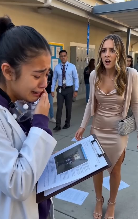
Then a parent near the fountain gasped and turned her screen toward her husband. Within seconds, whispers moved through the courtyard.
“It’s online.”
“The video?”
“Not just the video.”
Elsie lifted her phone, eyes wide. “Someone posted the invoice.”
Tomas looked over her shoulder. “And Clara’s email.”
Lila stared at the phones like they were flames spreading from hand to hand.
I should have felt victorious.
Instead, I felt sick.
Because once the crowd decided the Ashfords were guilty, the same hunger that had made them laugh at me turned toward Lila. People who had stayed silent during the slap now muttered about consequences, disgrace, lawsuits, scandal. They wanted a new villain before the paint had even dried.
Clara noticed too.
She stepped between Lila and the nearest camera.
“Put them down,” she said.
A boy from the senior class scoffed. “Why? She didn’t care when Riley got slapped.”
Clara’s voice sharpened. “That doesn’t mean we become her.”
The sentence cut through me.
I looked at Lila. She was crying now, silently, shoulders shaking under that thin cardigan. She had hurt me. She had helped erase Clara. She had tried to bury my name.
But I could see the trap around her too.
Built by money. Tightened by expectation. Painted over until it looked beautiful.
I picked up my safety goggles from the table and put them back around my neck.
Then I walked to the wall.
My center design was still half-covered by primer. The original pencil lines showed faintly under the new color, like a memory refusing to vanish.
I dipped a brush into gold paint.
Coach Alden said softly, “What are you doing?”
I looked at Clara.
Then at Lila.
Then at the empty space where my credit had been erased.
“I’m signing it again.”
Part 7: Lila Chose The Wrong Truth To Tell
The brush felt heavier than it should have.
I wrote my name slowly in the lower corner of the center panel, not large enough to dominate the mural, not small enough to be hidden again. The gold paint caught the courtyard light and shivered against the white primer.
Then I stepped back.
Clara came forward next.
Nobody asked her to. Nobody had to.
She took the brush from my hand, dipped it into blue, and signed beside mine. Clara Bellamy. The letters were firm until the last one, where her hand trembled.
Elsie signed after her. Then Tomas. Then two younger students who had mixed colors all morning and had never expected their names to matter.
One by one, the real crew approached the wall.
The crowd watched in a silence that felt different now. Not stunned. Ashamed.
Lila stood alone beside the table.
Her mother whispered something to her, urgent and low. Lila shook her head. Helena grabbed her wrist again.
This time Lila pulled away.
“I need to say it,” she said.
“No, you need to come home.”
Lila looked at her mother. “Home is where you taught me how to lie.”
The courtyard seemed to tilt.
Helena’s face changed so quickly it frightened me. For one second the polished woman disappeared, and something furious and cornered looked out.
“You ungrateful child,” she said.
Lila flinched, and that flinch told a story longer than any document.
Director Moreau stepped closer. “Lila, you don’t have to speak here.”
“Yes,” Lila said, voice breaking. “I do.”
She faced us, arms wrapped around herself.
“I knew Clara made the original design,” she said. “I knew Riley’s center panel was hers. I knew my mother had the credit list changed.” She drew a shaky breath. “And I let it happen because I wanted everyone to clap for me.”
No one interrupted.
Not even Helena.
Lila wiped her cheeks, leaving dark streaks under both eyes. “But there’s more.”
Coach Alden lowered his clipboard.
“The Ashford Foundation didn’t just replace names,” Lila said. “They used student work in donor campaigns. Posters. brochures. grant applications. My mother told people the foundation created programs it never paid for.”
Helena lunged toward her. “That is enough.”
Coach Alden blocked her path.
Lila reached into her rhinestone bag with shaking fingers and pulled out a small silver flash drive.
“My father sent me this last month,” she said. “I was scared to open it.”
Helena whispered, “Lila, think carefully.”
Lila looked at me then.
There was no apology big enough in her face. Only wreckage. But also a choice.
She placed the drive in Director Moreau’s hand.
“I’m thinking clearly for the first time.”
Director Moreau took it.
Before anyone could speak, the school’s old projector screen flickered above the courtyard stage. Tomas, who had connected the display for the mural reveal earlier, held up the cable.
“Director,” he said, voice unsteady, “it’s already plugged in.”
Helena Ashford stared at the screen.
And when the first file opened, we saw a folder labeled:
SCHOLARSHIP IMAGE CONTROL — CONFIDENTIAL.
Part 8: The Names Painted Back Into Light
The folder contained more than stolen mural files.
It contained years.
Photos of student projects with names cropped out. Draft essays rewritten under foundation branding. Sculpture sketches used in fundraising brochures. Scholarship review notes marked with cruel little comments: cooperative, difficult, grateful, replaceable.
Replaceable.
That word appeared again and again until it no longer looked like a word. It looked like a system.
Director Moreau stood very still as each file opened. Parents stopped whispering. Teachers who had once smiled beside Ashford donation plaques looked as if they wanted to disappear into the courtyard stones.
Clara covered her mouth.
I reached for her hand without thinking. She gripped mine so tightly our fingers hurt.
Then one video file loaded.
The date was from the previous year.
Adrian Ashford appeared on screen in what looked like a private office. He seemed exhausted, older than the man in the academy brochures, his shirt collar open and his eyes red.
“If this reaches the school,” he said, “then Helena has not stopped.”
Lila made a small sound.
Adrian continued, voice rough. “The foundation was meant to protect students whose work deserved a chance. Helena turned it into a mirror for our family name. I signed the ownership clause because I knew she would try this one day.”
He looked directly into the camera.
“To any student whose name was removed,” he said, “I am sorry. I helped build the room where it happened.”
Lila broke.
Not dramatically. Not beautifully. She folded forward with one hand over her mouth, like the grief had knocked the breath out of her.
Helena stood frozen beneath the projected light, her face pale and flat.
Director Moreau closed the laptop.
“The academy will suspend all Ashford Foundation activity immediately,” she said. “Every affected student will be contacted. Every project will be reviewed. Every public credit will be corrected.”
Helena laughed softly. “You think you can survive without us?”
Clara looked at the mural.
Then she picked up a brush.
“Yes,” she said.
That one word moved through the courtyard like a spark.
By morning, the video had spread across the city. By afternoon, three former students came forward. By the end of the week, the academy board removed every donor plaque linked to stolen student work.
But the surprising part was Lila.
She did not vanish.
She came back the next Monday in plain jeans, no rhinestones, no crowd orbiting her. She stood outside the art room for twenty minutes before I opened the door.
“I don’t expect forgiveness,” she said.
“Good,” I replied.
She nodded, eyes wet.
Then she handed me a list of names.
Students whose credits had been changed.
Students whose work had been photographed.
Students Clara and I had never heard of.
“I can help find the originals,” Lila said. “My mother kept everything.”
Clara stepped beside me. “Why would you do that?”
Lila looked toward the courtyard wall.
“Because I know what it feels like to have your name belong to someone else.”
So we let her help.
Not as a friend. Not at first.
As a witness.
Weeks later, the mural was unveiled without donors, without champagne speeches, without Helena Ashford smiling beside stolen color. The whole wall glowed with names. Not hidden in the corner. Not erased under paint. Written into the design itself, winding through vines, stars, windows, birds, and gold sunbursts.
Clara’s name stood at the center beside mine.
Lila’s was there too, but not where she once wanted it.
She signed beneath a small repaired crack in the plaster, next to the words she painted herself:
I helped erase this. Then I helped restore it.
When the crowd applauded, I did not look at them first.
I looked at the wall.
For once, it did not ask us to prove we had been there.
It remembered us on its own.
