Part 2: The Adult Serena Never Expected
The woman walking toward us did not hurry, and somehow that made her arrival worse.
Her heels clicked across the auditorium floor with a clean, final sound that cut through the whispers. Students stepped aside before they even knew why. Teachers turned, then straightened. Serena’s face changed so quickly I almost missed it—the hard little smile vanished, and underneath it was something pale and frightened.
It was Dr. Elena Voss, the visiting engineering director from Berlin, the speaker everyone had been waiting for.
And she was looking straight at Serena.
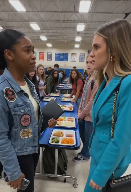
Food still clung to the sleeve of my denim jacket. Something cold slid down my wrist. I wanted to wipe it away, but my hands were trapped around the signup board like it was the only thing keeping me standing.
Dr. Voss stopped beside the staff member, Mr. Adler, and looked at the open board.
“Why,” she asked quietly, “is my technical-student panel missing from the printed schedule?”
Nobody laughed then.
Serena lifted her chin. “There was a correction.”
Dr. Voss turned her eyes to her. “By whom?”
Serena’s mouth opened, but no sound came out.
Mr. Adler swallowed and pointed to the handwritten row on the original board. “This says the vocational robotics group was confirmed first. Two weeks before the executive panel.”
“That is correct,” Dr. Voss said. Then she looked at me, and her expression softened only a little. “Were you the one holding this record?”
I nodded because my throat had locked.
Serena stepped forward. “She was making it about herself. She always does this. I was trying to protect Career Day from becoming messy.”
A murmur spread through the students.
Dr. Voss did not blink. “Throwing food at a student is your version of protecting a school event?”
Serena flushed red.
Then a man near the side doors cleared his throat. He wore a grey suit and a council badge clipped crookedly to his pocket. I knew him from the posters: Councillor Markus Legrand, chair of the school partnership board.
He was also Serena’s uncle.
He walked toward us slowly, looking not at Serena but at the board in Mr. Adler’s hands.
“Perhaps,” he said, “we should discuss this privately.”
Something about that sentence made my stomach drop.
Dr. Voss smiled without warmth. “No. This became public when she humiliated a student in front of witnesses.”
The auditorium went so quiet I could hear the projector fan humming overhead.
Serena’s uncle lowered his voice. “Elena, be reasonable.”
“I am being reasonable,” Dr. Voss said. “I am asking why a confirmed student speaker group disappeared from a schedule sponsored by my institute.”
My fingers tightened around the edge of my jacket.
Because now I understood.
This was not only about Serena.
This was about adults too.
Serena looked at her uncle, just once, but it was enough. A tiny glance. A desperate warning.
Mr. Adler saw it too.
He looked back at the board, then at the printed schedule on the podium, and his face went grey.
“There are initials beside the change,” he whispered.
Dr. Voss leaned closer.
Mr. Adler turned the board toward the room.
Under the crossed-out speaker slot, written in blue marker, were three letters.
M.L.
Councillor Markus Legrand stopped moving.
And Serena, for the first time since throwing food at me, looked like she wanted to disappear.
Part 3: The Initials Beneath The Crossed-Out Name
Mr. Adler did not accuse anyone at first.
That was almost worse.
He only held the board up under the auditorium lights, and everyone stared at the initials like they were a match dropped beside spilled petrol. My heart was beating so hard I felt it behind my eyes.
Councillor Legrand gave a short laugh. “Those could mean anything.”
Dr. Voss turned to him. “Then explain them.”
His smile tightened. “There are hundreds of people involved in Career Day.”
“At this school?” she asked. “On this board?”
Serena snapped, “This is ridiculous.”
Her voice cracked on the last word.
A few students near the front exchanged looks. Someone whispered, “She’s scared.”
Serena heard it. Her eyes flashed toward the row, and the whisper died.
I should have felt relieved. I should have felt stronger because the proof was finally speaking. Instead, I felt smaller than ever, standing there with stains on my jacket while important adults circled the truth like they were deciding whether it deserved to live.
Then a girl from the media club raised her phone.
“I filmed the schedule table this morning,” she said. Her name was Sofia Ritter, quiet, always behind a camera. “Before assembly started.”
Serena turned on her. “Don’t.”
One word.
Not loud.
But sharp enough that Sofia flinched.
Dr. Voss looked at Sofia. “Please show it.”
Sofia stepped forward, hands trembling, and connected her phone to the projector. The screen flickered. The auditorium filled with a paused video of the signup table outside the hall.
There it was: the same board, propped against the wall.
The technical-student speaker group was still listed.
The time stamp in the corner read 08:12.
Then Sofia pressed play.
The video showed Serena entering the frame with Councillor Legrand beside her. His face was half-turned, but his voice came through clearly.
“We cannot have workshop students before the corporate donors,” he said.
Serena replied, “I’ll handle it.”
A rustle moved through the room.
My breath caught.
The video continued. Serena reached for the board. Councillor Legrand uncapped a blue marker.
Then the screen froze as Sofia paused it.
His hand hovered beside the speaker slot.
The same blue marker.
The same initials.
Serena whispered, “Sofia, please.”
That “please” changed everything.
It was not sorry.
It was panic.
Dr. Voss looked at Councillor Legrand. “You removed them.”
He straightened. “I adjusted a program order.”
“You erased students,” she said.
“They were not erased,” he snapped. “They were moved to a less visible room.”
A sound went through me, quiet and painful.
Because that was the whole truth, said out loud like it was nothing.
Less visible.
That was where people like me were always supposed to go.
Serena’s eyes filled, but she was not looking at me. She was looking at her uncle, furious that he had admitted too much.
Then the auditorium doors opened again.
A group of students in navy workshop jackets stood there, carrying a small robotics crate between them.
Their teacher, Frau Keller, looked at the screen.
Then she looked at me.
“So that is why our badges stopped working.”
Part 4: The Locked Badges And Missing Room
For a moment, nobody understood what Frau Keller had said.
Then the robotics crate shifted in one student’s hands, and the metal inside gave a small, hollow clatter. The sound ran across the auditorium like a warning bell.
Dr. Voss turned slowly. “Your badges stopped working?”
Frau Keller came down the aisle with four students behind her. Their workshop jackets were clean but worn at the cuffs. One boy had grease beneath one fingernail. A girl with cropped blonde hair held a folder against her chest like she had been carrying it too long.
“We arrived at the side entrance at nine,” Frau Keller said. “Our speaker room was locked. Security said our names were no longer on the access list.”
Mr. Adler stared at Councillor Legrand. “I never removed them.”
The blonde student opened her folder. “We have the confirmation email.”
Serena muttered, “This is being exaggerated.”
The girl’s eyes shot to her. “We sat outside for forty minutes.”
Her voice shook, but she did not look away.
I recognized that kind of shaking. It was not weakness. It was what happened when anger had to fight its way through fear.
Dr. Voss held out her hand for the folder.
The girl gave it to her.
On the first page was the confirmation, printed with the school crest and Dr. Voss’s institute logo. The technical-student panel had been assigned the main auditorium at 10:30. Not a side room. Not a workshop corner. The main stage.
Frau Keller’s jaw tightened. “Our students prepared for six weeks.”
The boy holding the crate spoke next. “Our project was about low-cost prosthetic tools. We built the prototype because my brother needed one.”
The auditorium shifted. Not loudly. Just enough that shame seemed to move through the seats.
Serena looked at the floor.
For the first time, I wanted her to look at me. I wanted her to see what she had thrown food over. Not a schedule. Not a mistake.
People.
Mr. Adler rubbed a hand over his mouth. “Who changed the access list?”
Nobody answered.
Then Sofia, still by the projector, said, “There’s another file.”
Serena spun toward her. “You promised.”
Sofia went still.
The room went colder.
Dr. Voss noticed. “Promised what?”
Sofia’s lips parted, but Serena spoke first. “She’s confused.”
Sofia looked at me then, and I saw something raw in her face. Guilt. Fear. Maybe both.
“I’m not confused,” Sofia whispered.
She tapped her phone again. The screen changed to a screenshot of a message thread.
At the top was Serena’s name.
Below it, a message glowed under the projector light.
Delete the hallway clip and I’ll make sure your media internship stays approved.
A thousand tiny sounds exploded at once—gasps, chairs scraping, someone saying, “No way.”
Serena’s hand flew to her satchel.
Councillor Legrand stepped toward the stage. “Turn that off.”
Dr. Voss did not move. “Leave it on.”
But Serena was already backing away, eyes locked on the side door.
And I realized with a sick jolt that she was not running from the room.
She was running toward the records office.
Part 5: The Door Serena Reached First
I moved before I thought.
My old sneakers slipped on the polished floor, and for one terrifying second I almost fell. Then Sofia grabbed my elbow and steadied me.
“She’s going to destroy something,” Sofia breathed.
I did not ask how she knew.
We both knew.
Serena pushed through the side door into the corridor, her cobalt blazer flashing like a warning. Councillor Legrand shouted her name, but he did not sound angry. He sounded afraid she would fail.
Dr. Voss followed at a fast walk. Frau Keller and Mr. Adler came behind her. Students spilled from the auditorium despite teachers trying to keep order.
The corridor smelled like floor wax, coffee, and the sweet sauce drying on my sleeve.
Serena reached the records office first.
The door was locked.
She slapped her palm against the keypad, typed quickly, and the light turned green.
Mr. Adler froze. “She has access?”
Nobody answered.
That answer was enough.
Serena disappeared inside.
By the time we reached the office, drawers were already open. Folders lay scattered across the desk. Serena stood by the copier, breathing hard, one hand inside her satchel.
“Step away from the cabinet,” Dr. Voss said.
Serena laughed. It sounded broken. “You don’t understand. None of you understand what this day means.”
Frau Keller stepped forward. “It meant something to my students too.”
Serena’s face twisted. “Your students? They would have bored everyone.”
The blonde student behind Frau Keller flinched as if slapped.
Something hot rose in my chest.
I heard myself speak before I had permission from my fear.
“You threw food at me because I protected their place.”
Serena looked at me then. Really looked.
Her eyes were wet, but cruel. “You think this is about you?”
“No,” I said. My voice shook. “That’s what makes it worse.”
For a second, she had no answer.
Then her hand came out of the satchel holding a torn strip of paper.
Mr. Adler gasped. “That’s the access-change form.”
Serena backed toward the shredder.
Dr. Voss said sharply, “Do not.”
Serena’s fingers tightened.
Councillor Legrand appeared in the doorway, pale and sweating. “Serena. Give it to me.”
She looked at him with pure hatred. “You said it would be clean.”
The room stopped breathing.
He whispered, “Not here.”
But it was too late.
Sofia’s phone was still recording.
Serena saw it.
Her face collapsed.
Then she did something none of us expected.
She did not shred the form.
She threw it at me.
Paper hit my stained jacket and fluttered to the floor.
“Fine,” she said. “Read what he made me sign.”
Part 6: The Form With A Second Signature
The paper landed faceup.
I stared at it like it might burn through the floor.
Mr. Adler reached for it first, but Dr. Voss stopped him with one lifted hand. She crouched herself, picked it up carefully by the corner, and placed it flat on the records desk.
Everyone leaned in.
At the top, printed in official school format, were the words:
Career Day Speaker Access Amendment.
The technical-student panel had been crossed out.
The replacement speaker line read: Blackwell Future Leadership Foundation.
Serena’s family foundation.
A cold heaviness settled over the room.
But the worst part was at the bottom.
Two signatures.
One belonged to Councillor Markus Legrand.
The other belonged to someone whose name I did not recognize at first.
Then Mr. Adler whispered, “No.”
Dr. Voss looked at him. “Who is that?”
He swallowed. “The deputy headteacher. Martin Havel.”
A door opened somewhere behind us.
Everyone turned.
A tall man in a dark green tie stood in the corridor, holding a paper cup of coffee. His expression did not change quickly enough. For one second, his face showed the truth before he covered it with authority.
“What is happening here?” Deputy Havel asked.
Serena wiped her cheeks angrily. “Don’t pretend.”
Councillor Legrand closed his eyes.
Deputy Havel’s gaze moved from Serena to the form on the desk. Then to me. Then to Sofia’s phone.
“Recording school administrative documents is not permitted,” he said.
Dr. Voss stepped between him and Sofia. “Threatening students is also not permitted.”
His jaw flexed. “This is an internal matter.”
“No,” Frau Keller said. “My students were locked out of a public event.”
“And a student was assaulted,” Mr. Adler added.
Deputy Havel’s eyes sharpened. “Assaulted?”
For a strange second, I almost laughed. Not because anything was funny, but because adults always found softer words until proof made them uncomfortable.
I lifted my stained sleeve.
No one spoke.
Deputy Havel looked at Serena. “You threw food?”
Serena’s mouth trembled. “You told me to make sure the schedule stayed changed.”
His face hardened. “Careful.”
That one word told me everything.
Serena heard it too.
Her fear turned into something uglier and stronger.
“No,” she said. “I was careful for you. I lied for you. I smiled for photos while you moved the students out and promised my foundation the stage.”
Deputy Havel stepped into the office. “You are emotional.”
Serena laughed through tears. “And you are finished.”
Then she reached into her satchel again.
This time, she pulled out a small silver flash drive.
Councillor Legrand whispered, “Serena, don’t.”
She looked at him, then at me.
For the first time, her voice was not sharp.
It was empty.
“He made a second schedule before Career Day even opened.”
Part 7: The Schedule Hidden Before Sunrise
Dr. Voss took the flash drive, but she did not plug it in right away.
She looked at me first.
It startled me. Adults usually looked past me when decisions mattered.
“Imani,” she said softly, though in that moment my name sounded different in her European accent, steadier somehow. “Do you want to be in the room when this is opened?”
Every instinct told me to leave.
My jacket was ruined. My face felt hot. My hands were sticky. Students were crowded in the hallway, craning to see whether the invisible girl would finally become useful enough to matter.
But then I looked at the robotics students.
The blonde girl still held her folder like a shield.
The boy still held the crate.
They had waited outside a locked door for forty minutes while powerful people smiled under banners about opportunity.
I nodded.
“I’ll stay.”
Dr. Voss plugged in the drive.
The records office computer took forever to recognize it. The spinning icon turned and turned while nobody moved. Even Serena stayed silent, arms wrapped around herself now, no longer polished, no longer untouchable.
A folder opened.
Inside were three files.
Final_CareerDay_Public.pdf
Final_CareerDay_Donors.pdf
Original_Student_Panel_Order.pdf
Mr. Adler whispered, “There were two finals.”
Dr. Voss opened the donor version.
The projector in the office displayed the schedule.
At 10:30, where the technical-student panel should have been, was Serena’s family foundation presentation.
At the bottom, in small print, was a note:
Student workshop panel to be relocated if necessary to maintain sponsor flow.
Sponsor flow.
That was what they called stealing a stage from students who had earned it.
Then Dr. Voss opened the original file.
The technical-student group was listed first.
Not because of pity.
Because their project had won the regional innovation award.
A sound escaped Frau Keller, half relief and half grief.
The blonde student covered her mouth.
Dr. Voss clicked the file properties.
Created: 05:41.
Modified: 06:03.
Modified by: Martin Havel.
Deputy Havel said nothing.
Serena looked at the screen, then at me. “I didn’t know they had won an award.”
I wanted to hate her cleanly. It would have been easier.
But her voice was small in a way that made the room more complicated.
“You knew enough,” I said.
She flinched.
Deputy Havel suddenly moved toward the computer.
Dr. Voss blocked him. “Do not touch it.”
He snapped, “This is my school system.”
“No,” she said. “These are children.”
That landed harder than any shout.
Then the blonde robotics student stepped forward, lifted the small prototype from the crate, and set it on the desk.
It was a hand brace made from printed parts and soft straps.
“My brother was supposed to see this from the front row,” she said. “He thought people like us were finally allowed on the main stage.”
Deputy Havel looked away.
Councillor Legrand sank into a chair.
Serena began to cry silently.
And then, from the hallway, a younger boy’s voice said, “I’m here.”
The blonde student turned so fast the folder fell from her hands.
A boy with a visible wrist brace stood at the doorway, breathing hard, one hand gripping the frame.
“I saw the livestream,” he said.
His eyes moved to the prototype.
Then to the adults.
“Please don’t move them again.”
Part 8: The Stage They Tried To Steal
No one spoke after the boy said that.
Even the students in the hallway went quiet, as if the whole building had leaned closer to hear what would happen next.
Dr. Voss looked at the boy, then at the prototype, then at the ruined schedule on the screen.
“The technical-student panel goes on now,” she said.
Deputy Havel recovered enough to say, “That is not possible. The auditorium program—”
“Is already broken,” Dr. Voss cut in. “We are repairing it.”
Mr. Adler moved first. He took the original board from under his arm and walked out of the records office. Frau Keller followed with her students. Sofia kept filming, not like a gossip now, but like someone protecting history from being rewritten.
I stayed behind for one second.
Serena stood by the desk, makeup streaked, blazer stained where she had wiped her own hands against it. She looked smaller without the crowd obeying her.
“Why did you give me the form?” I asked.
She stared at the floor. “Because he was going to blame you.”
My breath caught.
She looked up. “Deputy Havel said if anyone questioned the change, we should say you mixed up the boards while volunteering.”
The room tilted.
Invisible work.
Invisible blame.
It had already been prepared for me before I ever opened my mouth.
Councillor Legrand whispered, “Serena.”
She ignored him.
“I thought if I scared you, you would drop it,” she said. Her voice cracked. “I didn’t think you would stand there holding the truth after everyone laughed.”
I swallowed hard.
“I wasn’t brave,” I said.
Serena wiped her face with the back of her hand. “You were.”
I did not forgive her.
Not then.
Maybe not soon.
But I believed that she knew, finally, what she had done.
In the auditorium, the main lights came up. The donor banners were still hanging, but they looked different now, smaller somehow. Mr. Adler walked onstage and adjusted the microphone with trembling hands.
“Career Day will continue,” he said, “with the students who were originally scheduled and rightfully confirmed.”
A wave of applause started in the back.
Then it grew.
Not polite applause.
Not donor applause.
Real applause, messy and loud and alive.
The robotics students climbed onto the stage. The blonde girl helped her younger brother into the front row. The boy with the crate set the prototype on the table, hands shaking, eyes bright.
Dr. Voss stepped beside me. “You should sit in front.”
I looked down at my stained jacket. “I look awful.”
She smiled faintly. “You look like someone who refused to let a record disappear.”
So I sat in the front row.
Serena did not.
Deputy Havel was removed from the auditorium by two council officers before the presentation ended. Councillor Legrand resigned from the partnership board before sunset. The Blackwell foundation lost its speaking slot, but the money it had pledged was redirected into a student innovation fund—with legal oversight, public records, and student voting power.
That was Dr. Voss’s surprise.
But it was not the biggest one.
Three weeks later, the school announced the first winner of the new fund.
Not Serena.
Not me.
The robotics group won it, of course.
But they named the award themselves.
They called it the Visible Work Grant.
At the ceremony in Lyon, Frau Keller asked me to step onto the stage with them. I almost refused, until the blonde student took my hand and whispered, “You held the board when nobody else would.”
Across the room, Serena stood with her parents, no blazer, no perfect smile. When our eyes met, she did not wave.
She only nodded once.
Small.
Public.
Real.
And for the first time in my life, when people looked at the work nobody used to clap for, they saw all of us standing behind it.
