Part 2: The Screen Showed Her Name Too Clearly
The teacher’s question did not sound loud.
That made it worse.
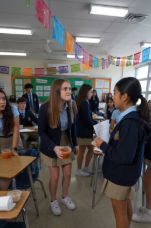
Ms. Clara Whitfield stood beside the projector with one hand still on the mouse, her face washed pale by the blue-white glow of the classroom screen. Around her, tissue-paper flowers hung from the ceiling tiles, half-finished cultural fair posters curled on desks, and the smell of taco sauce clung to my hoodie like evidence nobody could politely ignore.
Brielle Beaumont had reached the door.
Not run. Not yet.
She had backed away with that practiced look rich girls used when they wanted witnesses to believe they were leaving because they were above the mess, not because the mess had finally named them.
Then Ms. Whitfield asked, “Who changed the record after hours?”
Every phone in the room stopped moving.
Not lowered.
Stopped.
On the screen was the original description sheet for the Spanish cultural booth assignments. The file history sat open on the right side, showing edits, timestamps, and user initials.
My name was beside the first upload.
Inaya Murphy — Description Writer: Dominican Carnival Display, Folk Mask History, Student Credits Attached.
Below that was a later edit.
11:48 p.m.
B. Beaumont.
The new description removed my name, changed the source credits, and added a sentence claiming the booth concept came from Brielle’s cultural presentation committee.
My throat tightened, but I did not speak.
Brielle did.
“That’s not what it looks like.”
Someone near the window laughed once, then immediately went quiet.
Ms. Whitfield turned from the screen. “Then explain what it is.”
Brielle’s eyes flicked toward her friends. The same girls who had laughed when taco sauce hit my sleeve now stared at their shoes, their phones, the papel picado, anywhere except her.
“I fixed it,” Brielle said. “The sheet was messy.”
“You removed Inaya’s name,” Ms. Whitfield said.
“I reorganized it.”
“You changed the ownership line.”
“That wasn’t ownership. It was formatting.”
My fingers curled around the stained paper copy I had carried in. The sauce had splashed one corner orange, but the original words were still visible.
I raised it slowly.
“This is the printout from yesterday,” I said. “The one you told everyone I forged.”
Brielle’s jaw tightened.
Ms. Whitfield crossed the room and took it from me carefully, as if my paper had become more fragile than glass.
She placed it under the document camera.
The printed sheet appeared beside the digital version.
Original.
Edited.
My name.
Her name.
The room did the math before any adult had to.
A boy in the back whispered, “She stole the whole booth.”
Brielle snapped, “I didn’t steal anything.”
But her voice had lost its sharpness. It shook at the edges.
Ms. Whitfield looked at the class. “Everyone put your phones down.”
No one did.
Then a new voice came from the doorway.
“I think they should keep recording.”
Everyone turned.
Standing there was Mr. Adrian Keller, the assistant principal, holding a folder with the school seal on the front and an expression that made Brielle’s face go completely still.
He looked straight at her and said, “Because this is not the first description sheet that has been changed.”
Part 3: The Folder From Last Year Opened
Brielle’s face did something strange.
It did not crumble.
It closed.
One second she was a girl caught in a classroom lie. The next, she became polished again, chin lifted, shoulders set, eyes cold enough to make people question what they had just seen.
“My parents need to be called,” she said.
Mr. Keller stepped into the room. “They already have been.”
That made her blink.
He turned to Ms. Whitfield. “Please send the students to the library. Inaya stays. Brielle stays.”
A low wave of protest moved through the classroom.
“Now,” he said.
Chairs dragged against the floor. Backpacks zipped. Someone whispered my name like it had become a headline. I stood beside the document camera, sauce drying stiff against my sleeve, trying to pretend the whole room had not just watched my humiliation replay into proof.
As the class filed out, Brielle leaned close enough for only me to hear.
“You think this makes you important?”
I looked at her.
Her perfume smelled expensive and sweet, completely wrong against the taco sauce and poster glue.
“No,” I said. “I think it makes you visible.”
Her eyes flashed.
Then the door shut, and the room became too quiet.
Mr. Keller set the folder on Ms. Whitfield’s desk. “Before anyone speaks, I want both of you to understand something. This was already under review.”
My stomach dropped.
Brielle crossed her arms. “What was?”
He opened the folder.
Inside were three printed description sheets from previous school events.
Italian Heritage Night.
European Languages Week.
International Food Expo.
Each one had handwriting in red pen, edit logs attached, and student names highlighted.
A name crossed out.
A richer student added.
A contribution moved.
A credit rewritten.
Ms. Whitfield covered her mouth.
I stared at the pages, feeling the room tilt slowly around me.
Mr. Keller tapped the first sheet. “Last year, Lucia Greco filed a complaint after her research was removed from a regional display. It was dismissed as a misunderstanding.” He tapped the second. “Then Sofia Marin said her translation work was credited to someone else. That was dismissed too.” His finger stopped on the third. “This semester, Inaya brought us an original sheet before the digital file could be fully overwritten.”
Brielle’s voice sharpened. “You’re trying to connect things that aren’t connected.”
Mr. Keller looked tired suddenly. Not weak. Tired in the way adults look when they finally realize they ignored something because the truth was inconvenient.
“All three edits came from student accounts connected to your committee permissions.”
Brielle laughed. “Committee permissions are shared.”
“Yes,” he said. “That is what made this hard to prove.”
For one heartbeat, she looked relieved.
Then Mr. Keller slid out one final page.
It was not a description sheet.
It was an access request.
Approved by Brielle Beaumont.
Temporary editor access: Cultural Fair Master Folder.
Assigned to: Edith Calder.
Brielle went pale.
I had heard that name before. Everyone had.
Edith Calder was not a student.
She was Brielle’s family assistant.
Ms. Whitfield whispered, “Why would your family assistant have access to a school folder?”
Brielle did not answer.
Outside the classroom window, students stood in the hall pretending not to listen.
Mr. Keller closed the folder with one hand.
“Brielle,” he said, “you may want your parents here quickly.”
And for the first time, she looked less afraid of being punished than of being found out by the wrong person.
Part 4: Her Mother Arrived Like A Verdict
Victoria Beaumont arrived in heels that clicked like warnings.
She did not knock before entering the Spanish classroom. She swept in wearing a cream coat, pearl earrings, and the kind of controlled smile that could make adults sit straighter without knowing why.
Behind her came a man I guessed was Brielle’s father, Edward Beaumont, tall and quiet with tired eyes. He did not look at the posters, the sauce stain on my sleeve, or the folder on the desk.
He looked only at Brielle.
“Are you hurt?” he asked.
Brielle shook her head.
Victoria’s gaze landed on me.
It was quick, but I felt it.
A measurement.
Not of injury.
Of inconvenience.
“My daughter called me in tears,” Victoria said. “I hope there is a serious reason she is being held here like a criminal.”
Mr. Keller’s voice stayed even. “No one is being held. We are discussing altered school records.”
Victoria’s smile thinned. “Then discuss it with the technology office.”
“We are.”
The door opened again.
A woman in a navy blazer stepped inside carrying a tablet. “Marta Leone, district digital records compliance.”
Brielle looked at her mother.
Victoria’s expression did not change, but one hand tightened around her handbag.
Marta connected her tablet to the projector. “We pulled the file logs from the cultural fair folder and the associated permission changes.”
“Without parental consent?” Victoria snapped.
“With district authorization,” Marta said.
On the screen appeared a chain of edits.
Not just Brielle’s name.
Not just Edith Calder’s.
There were admin-level requests routed through a parent volunteer account.
Victoria Beaumont — Cultural Fair Sponsorship Liaison.
The room seemed to shrink.
Ms. Whitfield sat down slowly.
Edward Beaumont finally looked at his wife.
“Victoria,” he said.
She gave him one cold glance. “Not now.”
Marta enlarged the log. “At 11:52 p.m., a parent liaison account restored an edited document after the classroom teacher had locked the folder.”
Mr. Keller turned to Victoria. “Why did you access a student description sheet after hours?”
Victoria laughed softly. “I help with the fair every year. I clean up documents. Teachers are overwhelmed. Children make mistakes.”
My chest burned.
Children make mistakes.
That was what she called it when my name disappeared.
Ms. Whitfield stood. “I did not ask you to clean up my documents.”
Victoria ignored her and looked at Mr. Keller. “This school should be careful before accusing families who fund its programs.”
There it was.
Not hidden.
Not subtle.
The sentence that explained why Lucia Greco and Sofia Marin had been dismissed before me.
Edward stepped closer to the desk. “Fund its programs?”
Victoria turned sharply. “Edward.”
“No,” he said. His voice was quiet, but the room shifted toward it. “What did you do?”
Brielle’s eyes filled. “Dad, I didn’t—”
But Edward was not looking at Brielle anymore.
He was looking at Victoria.
Marta tapped the screen again. “There is also a message attached to the parent liaison account.”
Victoria’s face changed.
Marta read aloud.
“Replace Murphy credit before morning. Brielle needs clean leadership optics for the council application.”
Nobody moved.
The words hung above us like smoke.
Then Edward Beaumont took one step back from his wife and whispered, “You used our daughter for this.”
Victoria’s perfect smile vanished.
Part 5: The Application That Needed A Lie
Brielle sat down as if her legs had given up.
She stared at the projected message, her hands pressed flat on her skirt, fingers trembling so fast I could see it from across the room.
“I didn’t know about that message,” she said.
Victoria snapped, “Brielle.”
But something had opened in her daughter’s face.
Not innocence. Not exactly.
More like a girl realizing the cage she thought was a throne still had bars.
Mr. Keller asked, “What council application?”
Edward answered before his wife could. “The North Star Student Leadership Council. Brielle applied last month.”
Marta looked through her tablet. “The application requires proof of original project leadership.”
I understood then.
The cultural fair booth was not just a booth. It was a credential. A pretty paragraph for a selection committee. A polished story about initiative, diversity, leadership, and community.
And my work had been useful because it sounded good in someone else’s mouth.
Brielle’s eyes met mine.
For the first time all day, she looked ashamed.
Then Victoria ruined even that.
“Inaya’s description was unpolished,” she said. “The booth needed a stronger presentation. Brielle elevated it.”
Ms. Whitfield’s voice shook. “She threw taco sauce at Inaya.”
Victoria glanced at my sleeve. “An emotional reaction. Teenagers are dramatic.”
I almost laughed.
Not because it was funny.
Because if I did not laugh, I might shake apart.
“So when I’m upset, I’m unstable,” I said. “When she throws food, she’s emotional.”
The room went silent.
Edward looked at me then, really looked.
His face changed when he saw the stain. Not in a performative way. In a sickened way, like some part of him had finally caught up with the morning.
“Inaya,” he said carefully, “I’m sorry.”
Victoria scoffed. “Edward, do not apologize before legal counsel—”
“I am not legal counsel,” he said. “I am her father.”
Brielle flinched.
Edward saw it.
That small movement did something to him. His shoulders lowered, not with defeat, but with recognition.
He turned to Brielle. “How long has this been happening?”
Victoria’s voice became steel. “Do not answer that.”
Brielle’s mouth opened.
Nothing came out.
Then she looked at her mother and whispered, “Since the Milan exchange essay.”
Victoria closed her eyes for half a second.
Mr. Keller took a pen from his pocket. “What happened with the Milan exchange essay?”
Brielle wiped one tear quickly, angrily. “Mum said my draft wasn’t strong enough. She said Helena Novak’s essay had a better community angle. She made Edith get a copy from the shared review folder.”
Ms. Whitfield whispered, “Helena lost that exchange place.”
Brielle nodded once.
My stomach turned.
Brielle covered her face. “I told myself it wasn’t stealing because Mum rewrote it. I told myself everyone got help.”
Victoria’s voice cut across the room. “You were given opportunities. That is not a crime.”
Brielle dropped her hands.
“No,” she said, voice breaking. “But taking them from someone else is.”
Victoria stared at her daughter as if she had become a stranger.
Then Marta’s tablet chimed.
She looked down at the alert, frowned, and turned the screen toward Mr. Keller.
“There has been a new deletion attempt,” she said.
Mr. Keller went still. “From where?”
Marta looked directly at Victoria.
“From the Beaumont home network.”
Part 6: The Assistant With The Second Password
Victoria Beaumont did not deny it.
That was the most frightening part.
She simply reached into her handbag, took out her phone, and began typing.
Edward grabbed her wrist. “Stop.”
The room froze.
Victoria looked down at his hand like it disgusted her.
“Let go of me.”
“No,” Edward said.
His voice was still quiet. But this time, it did not bend.
Marta stepped toward the projector. “The deletion attempt failed. The district archive copied the folder automatically once the investigation opened.”
Victoria’s jaw tightened.
Brielle started crying without sound.
Mr. Keller asked, “Is Edith Calder at your home right now?”
No one answered.
Edward released Victoria’s wrist and pulled out his own phone. “I’ll call her.”
Victoria laughed. “You think Edith will answer you?”
That was when Brielle stood.
“Dad,” she said, barely audible. “Edith has the second password.”
Edward turned slowly. “What second password?”
Brielle swallowed. “To Mum’s volunteer account. And mine.”
Ms. Whitfield whispered, “Brielle…”
“She uses them when Mum says things need to be fixed,” Brielle continued, words spilling faster now. “Not just school. Applications. Recommendations. Service hours. Anything.”
Victoria stepped toward her. “You selfish little girl.”
The sentence struck Brielle harder than any shout.
Edward moved between them.
“Do not speak to her like that.”
Victoria’s face flushed. “I built everything she has.”
“No,” he said. “You built a version of her that cannot stand without fraud.”
Brielle made a small wounded sound.
I should have felt outside of it.
But I did not.
Because I knew what it was like to have adults decide your story before you could speak. I knew what it was like to become useful only when you fit someone else’s version.
Marta’s phone rang.
She answered, listened, and her expression sharpened.
“Put it through.”
A moment later, the classroom speaker crackled. The school receptionist’s voice filled the room.
“Mr. Keller, there’s a woman here named Edith Calder. She says Mrs. Beaumont sent her to collect Brielle’s cultural fair materials.”
Victoria’s face went white.
Mr. Keller looked at Marta.
Marta said, “Ask her to wait.”
The speaker clicked off.
Edward stared at his wife. “You sent Edith here?”
Victoria lifted her chin. “To prevent a misunderstanding from becoming permanent.”
Marta gathered the printed logs. “No. To remove physical evidence.”
Brielle looked at me.
There was terror in her eyes now, but not for herself.
“Inaya,” she said, “the binder.”
My heart kicked.
“What binder?”
“The one with the original description sheets. The cultural fair binder. Edith knows where Ms. Whitfield keeps it.”
Ms. Whitfield turned toward the supply cabinet.
The bottom drawer was open.
Empty.
Her face drained.
“That binder had the signed originals,” she whispered.
My paper copy suddenly felt very small in my hand.
Then from the hallway came the sound of fast footsteps, a shout, and something heavy hitting the floor.
Mr. Keller opened the door.
A younger student stood there shaking, pointing toward the stairwell.
“The woman with the binder,” he gasped. “She ran.”
Part 7: The Stairwell Turned Into A Witness
Mr. Keller ran first.
Marta followed, already calling security. Edward went after them. Brielle hesitated at the classroom door, then looked back at me.
For one strange second, it felt like the whole story was asking me what kind of person I wanted to be.
The girl who stayed stained and silent.
Or the girl who followed the proof.
I ran.
The hallway outside the Spanish classroom had turned into chaos. Students pressed against lockers. Teachers shouted for everyone to move back. Somewhere near the stairwell, a binder had burst open, spilling pages across the floor like a paper storm.
Edith Calder stood halfway down the stairs with one hand gripping the railing and the other clutching a torn stack of documents to her chest.
She was not what I expected. Not glamorous. Not villainous. She looked exhausted, with gray-blonde hair pulled into a tight bun, a beige coat hanging open, and fear moving across her face faster than she could hide it.
Marta stood at the top of the stairs. “Ms. Calder, put the documents down.”
Edith shook her head. “I was told to collect family materials.”
“They are school records,” Marta said.
Victoria appeared behind us, breathless but still trying to look untouched. “Edith, don’t say anything.”
Edith looked at her.
Something passed between them.
Years of orders, maybe. Years of being paid to clean messes that were not hers.
Then Edward spoke from the lower landing.
“Edith, please. Put them down.”
Edith’s eyes filled.
“I can’t lose my job,” she whispered.
Brielle stepped forward. “You won’t.”
Victoria snapped, “You cannot promise that.”
Brielle turned on her. “No. But I can tell the truth.”
She walked down three steps, slow and careful.
“Edith,” she said, voice shaking, “I know Mum told you to do it. I know she told you it was just fixing documents. But it wasn’t. It hurt people.”
Edith’s grip loosened.
A page slipped from the stack and fluttered onto the stairs.
It landed face-up.
My name was on it.
So was Brielle’s.
And beneath both was a teacher signature confirming the original booth assignment.
Victoria lunged.
Not at me.
At the page.
Everything happened too fast.
Edward shouted. Marta reached out. Brielle stepped between her mother and the paper.
Victoria’s hand struck Brielle’s shoulder, hard enough to knock her sideways against the railing.
Gasps exploded around us.
Brielle caught herself, eyes wide, one hand pressed to her shoulder.
For a moment, no one moved.
Then Edith Calder lowered the documents to the floor.
“I kept copies,” she said.
Victoria froze.
Edith looked at Marta, trembling. “Of everything. I kept copies because I knew one day she would blame me.”
Victoria whispered, “You wouldn’t.”
Edith reached into her coat and pulled out a small black flash drive.
“I already did.”
The stairwell went silent.
Edith placed the drive in Marta’s hand.
Then she looked at me and said, “Your description sheet was not the first thing they stole, Inaya. But it can be the last.”
Part 8: The Fair Finally Said The Right Name
The cultural fair did not open on Friday.
For once, the school chose truth over decorations.
The papel picado stayed half-taped. The display tables remained empty. The Spanish classroom door was locked with a printed notice that said the event had been postponed due to a records review, which was the kind of sentence adults use when the real words are too ugly for a hallway.
But ugly words have a way of leaking out anyway.
By Monday, everyone knew Edith Calder had turned over copies of altered applications, rewritten essays, stolen service logs, and parent volunteer messages dating back almost three years.
By Tuesday, Lucia Greco and Sofia Marin were called back to campus.
By Wednesday, Helena Novak’s Milan exchange case was reopened.
By Thursday, Victoria Beaumont resigned from every school committee before the district could remove her publicly.
She still tried to walk away.
Of course she did.
People like Victoria did not run. They exited with statements. Her statement said she had only wanted the best for her daughter and regretted any administrative confusion.
Then Marta released the verified timeline to the affected families.
There was no confusion left to hide inside.
Brielle did not return to class for a week.
When she did, nobody knew what to do with her. Her friends hovered near her like scared birds. Some students glared. Others whispered. A few looked disappointed that she had not become a simple monster they could hate without thinking.
I did not speak to her until the rescheduled cultural fair.
The Spanish classroom had been transformed again, but this time every display had a clear credit card at the bottom. Research by. Translation by. Design by. Sources verified by.
No invisible work.
No stolen names.
My booth stood near the windows. The Dominican Carnival masks were bright against the morning light, their colors bold enough to make the room feel alive again. My original description sheet sat under glass beside the final display, sauce stain and all.
Ms. Whitfield had insisted.
“History should show what almost happened,” she said.
I was adjusting one of the source cards when Brielle approached.
She wore no blazer today. Just a simple navy dress, sneakers, and a white bandage peeking from under one sleeve where her shoulder had hit the railing.
For a moment, neither of us spoke.
Then she handed me an envelope.
“I wrote statements,” she said. “For Lucia, Sofia, Helena, and you. I don’t expect that to fix anything.”
“It doesn’t,” I said.
She nodded.
Her eyes were red, but she did not cry. Maybe she had finally learned tears were not a receipt for change.
“I know.”
I opened the envelope later, not then. Inside was not an apology first.
It was a list.
Every project Brielle knew had been altered. Every student name she remembered. Every committee folder Edith might have touched. At the bottom, in Brielle’s handwriting, was one sentence.
I was rewarded for being silent, and I am done accepting rewards that belong to someone else.
The shock came during the fair awards.
Mr. Keller stepped onto the small stage in the auditorium and announced that the leadership council had withdrawn Brielle’s application. That part everyone expected.
Then he announced the school was creating a new student records board, with elected student reviewers and public credit logs for every major project.
That part made people clap.
Then he looked toward the Spanish classroom section.
“And the first student chair of that board,” he said, “will be chosen not by donor committees, not by parent liaisons, and not by private recommendation, but by the students whose work was affected.”
My heart started pounding before I understood why.
Lucia Greco stood first.
Then Sofia Marin.
Then Helena Novak.
Then Ms. Whitfield.
They walked toward me carrying a small badge on a blue ribbon.
My mouth went dry.
I shook my head once. “I’m not—”
Lucia smiled. “You kept the paper.”
Sofia said, “You made them look.”
Helena added, “That is leadership.”
Across the room, Brielle watched silently.
No resentment.
No performance.
Just the hard, painful face of someone witnessing a door close because it was never hers to enter.
I took the badge with both hands.
The applause rose slowly, then filled the auditorium, not like noise, but like repair.
After the fair, I went back to the Spanish classroom alone. The sun was setting through the windows, turning the glass over my stained description sheet gold.
For weeks, I had hated that stain.
Now I touched the corner of the glass and smiled.
Because Brielle Beaumont had thrown sauce to make everyone look away from the truth.
Instead, it marked the exact place where the truth refused to disappear.
