By the time Blair Pemberton slapped me in the school library, the lie had already become louder than the truth.
The sound cracked across the quiet reading area like a book dropped from the top floor. For one second, nobody breathed. Nobody turned a page. Nobody whispered. Even the old clock above the circulation desk seemed to hesitate before ticking again.
My cheek burned.
My glasses had slipped halfway down my nose, and my cloth book bag had fallen open at my feet, spilling library return slips, a pencil case, a half-finished essay, and the laminated QR code card I had carried all morning like it was something fragile enough to break.
It was not fragile.
That was the problem.
The QR code was printed on plain white school paper, sealed under plastic by the library aide, and clipped to a stack of campaign flyers for the senior service scholarship showcase. To anyone else, it looked boring. Just a square of black patterns, a tiny label underneath, and a blue school logo in the corner.
To Blair Pemberton, it looked like a threat.
“Pick it up,” Blair said.
Her voice was low enough that the teachers by the media counter might not have heard, but every student near the computer stations did. She stood in front of me in her milk-white cashmere sweater, new plaid skirt, polished loafers, and rhinestone hair clip sparkling under the library lights like she had dressed for a private-school brochure instead of a Wednesday afternoon in Dearborn.
She looked perfect.
That was how Blair survived most things. She looked like someone adults wanted to believe.
I looked like me.
Layla Haddad, seventeen, Lebanese American, brown cardigan, corduroy pants, old loafers, thick black hair twisted up with a plastic clip that never held properly by last period. Olive skin, tired eyes, too many honors classes, too many after-school volunteer hours, too much faith in paperwork.
I had grown up believing that records mattered because records did not care how rich your family was. A timestamp did not smile at donors. A metadata field did not get nervous around a school board member. A QR code, if connected to the right archive, could not be bullied into changing its story.
That belief was the only reason I stayed standing.
“Layla,” Ms. Nguyen called from the media counter, her voice sharp with shock. “Are you okay?”
I nodded, but my throat would not open.
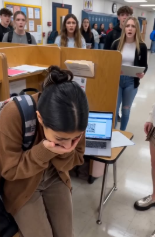
Around us, students watched in that terrible way crowds watch humiliation. Some looked horrified. Some looked thrilled. Some looked down, pretending they had not seen enough to be responsible.
Blair stepped closer.
“You always do this,” she said, louder now. “You make everyone uncomfortable and then act like you’re the victim.”
My cheek pulsed. My hands trembled, but I bent down anyway and picked up the laminated QR card. My fingers curled around its edge so tightly the plastic cut into my skin.
“I’m not the one who changed the file,” I said.
A sound moved through the room.
Not quite a gasp. Not quite a whisper. More like the building itself had shifted.
Blair’s face changed for less than a second. Her eyes flicked from my face to the QR card, then toward the projector screen at the front of the library, where the scholarship showcase files were waiting to be displayed for the review committee.
Then her expression hardened into something smooth and practiced.
“You’re desperate,” she said. “Everyone knows you wanted credit for my project.”
That was the lie.
That was the quiet lie I had been trying to stop before it became official.
Two months earlier, the school had announced the Civic Futures Service Scholarship, a district award for students who created community-impact projects. Blair submitted a project called “Reading Bridges,” a multilingual literacy drive that collected books for immigrant families and paired students with younger kids for weekend reading circles.
It was beautiful.
It was also mine.
Not the final glossy version with Blair’s name across the front. Not the expensive printed flyers or the staged photos of Blair holding picture books beside smiling children. But the original idea, the volunteer map, the family sign-up system, the translation sheets, the QR archive linking donated books to reading-level guides—I had built those.
I had done it because my little brother Sami cried in third grade when a teacher gave him a book he could decode but not understand. I had done it because my mother still kept a dictionary beside the kitchen table even after twenty-two years in Michigan. I had done it because I knew what it felt like to love stories in one language and be tested in another.
Blair had joined late.
She had joined after her aunt, who sat on the district review committee, mentioned that projects with “community diversity” had strong scholarship potential.
At first, I welcomed her. I welcomed everyone. I thought help was help.
Then the shared folder changed.
My name moved from “Project Lead” to “Volunteer Coordinator.” Blair’s name appeared at the top of the final proposal. The original planning photos were replaced by edited images. The document history was hidden from student view. The club adviser, Mr. Halden, began avoiding my questions with nervous smiles.
And then, that morning, I saw the printed showcase program.
READING BRIDGES — CREATED BY BLAIR PEMBERTON.
My name was not in it at all.
I had stood in the hallway outside the library holding that program, feeling something inside me go cold.
For a moment, I thought about letting it happen.
That was the part nobody understood later. They thought courage meant I marched in ready to fight. I did not. I stood beside the trophy case for seven full minutes, staring at Blair’s name, imagining the look on my mother’s face if I told her I had been erased and did nothing.
My father’s voice came back to me then, soft from years ago, from the back office of his small print shop where machines hummed and paper dust floated in the air.
“Layla,” he used to say, tapping a receipt with his finger, “never argue with a person who lies loudly. Bring the record. Let the record speak.”
So I brought the record.
Not a screenshot. Screenshots could be dismissed.
Not a rumor. Rumors could be buried.
I brought the QR code that linked to the original school archive, the one generated automatically when the first project submission was uploaded through the library media system. Every official submission got one. Most students ignored it. I knew about it because I helped Ms. Nguyen organize digital records every Thursday after school.
The QR code did not just open the final file.
It opened the file history.
The original upload date. The creator account. The device ID. The edits. The replacement images. The name of the person who requested administrative access after hours.
The truth had been sitting in the school system the whole time, waiting for someone to scan it.
Unfortunately, Blair knew enough to be afraid.
“Layla,” Ms. Nguyen said again, coming around the desk now. “Come here, please.”
Before I could move, Blair reached for the QR card.
I pulled it back.
That was when she slapped me.
Now the whole library knew something was wrong.
Mr. Halden appeared near the projector cart, pale and sweating, with his tie crooked and his laptop open in his hands.
“What happened?” he asked, though his eyes went first to Blair.
Blair saw that. So did I.
“She attacked my reputation,” Blair said immediately, pressing one hand dramatically to her chest. “She’s been harassing me all week because she can’t accept that my project was chosen.”
“I asked to show the archive,” I said.
“You accused me in front of everyone.”
“You slapped me in front of everyone.”
A few students shifted. Someone whispered, “She did.”
Blair turned toward the sound, and the whisper died.
That was her power. Not just money. Not just family connections. Blair knew how to make people regret being honest.
Then Ms. Nguyen stepped between us.
“She is showing the archive,” she said.
Blair blinked. “Excuse me?”
Ms. Nguyen held out her hand to me. “The QR card, Layla.”
For one second, fear stabbed through me. Not fear that the record was wrong. Fear that adults would still find a way not to see it.
But Ms. Nguyen’s face was steady.
I gave her the card.
The library projector hummed. The white screen at the front lowered with a mechanical rattle. Every sound in the room felt too loud now: the click of the scanner, the soft beep, the projector fan, the distant squeak of sneakers in the hallway.
The QR code opened.
A district login page flashed, then the media archive loaded.
READING BRIDGES — INITIAL SUBMISSION.
The room went silent.
My name appeared under “Created by.”
LAYLA HADDAD.
A sound left me before I could stop it. Not a sob. Not relief. Something smaller, something that had been trapped behind my ribs for weeks.
Blair’s face did not move.
Mr. Halden stepped forward quickly. “That may be an earlier draft. Collaborative projects often—”
Ms. Nguyen clicked “File History.”
The timeline opened.
October 3, 7:42 p.m. — Created by Layla Haddad.
October 3, 8:16 p.m. — Reading-level database uploaded by Layla Haddad.
October 5, 4:03 p.m. — Translation guide uploaded by Layla Haddad.
October 9, 5:28 p.m. — Blair Pemberton added as contributor.
October 21, 9:51 p.m. — Administrative access requested.
October 21, 10:04 p.m. — Project lead field changed from Layla Haddad to Blair Pemberton.
October 21, 10:06 p.m. — Volunteer coordinator field assigned to Layla Haddad.
October 21, 10:09 p.m. — Original creator credit hidden from public display.
The teacher froze the room.
Ms. Nguyen did not speak at first. She stared at the screen, and her expression changed from concern to something colder.
Then she turned.
“Blair,” she said, “explain the missing step everyone just saw.”
Blair’s mouth opened, but nothing came out.
For the first time since I had known her, she looked eighteen. Not untouchable. Not polished. Just scared.
Mr. Halden closed his laptop slowly.
“Maybe we should discuss this privately,” he said.
“No,” Ms. Nguyen replied.
One word.
It cut through the library like a door slamming shut.
“No?” Mr. Halden repeated.
“This became public when a student was struck in my library,” Ms. Nguyen said. “It became academic misconduct when a school record was altered. And it became my responsibility the moment that QR archive opened on my system.”
Blair’s eyes shone suddenly. “My aunt said the committee needed clean submissions. She said group credits weaken applications. She said—”
She stopped.
Too late.
Everyone heard.
Mr. Halden whispered, “Blair.”
But Ms. Nguyen had already clicked the next line in the archive.
Administrative access approved by: E. Halden.
The library erupted.
Not loudly at first. It began with a dozen tiny sounds: sharp breaths, chairs scraping, someone saying “No way,” another student muttering, “I knew it,” and then the wave rose.
Mr. Halden’s face drained.
“It was a formatting issue,” he said. “The final showcase only allows one lead name, and Blair’s family had agreed to fund—”
“To fund what?” Ms. Nguyen asked.
Mr. Halden looked toward Blair.
Blair did not look back.
That was when I knew there was more.
The QR code had proved the theft, but it had not yet explained the panic.
Ms. Nguyen must have sensed it too, because instead of closing the archive, she clicked the attached record folder.
Inside were files I recognized: the proposal draft, book inventory, volunteer schedule, family sign-ups, translation templates.
And one file I did not.
DONOR MEMO — PEMBERTON FOUNDATION MATCHING GRANT.
My stomach tightened.
Ms. Nguyen opened it.
The memo appeared on the projector. It was a formal letter on Pemberton Foundation stationery, promising a district literacy donation if Reading Bridges was selected as the showcase winner. Twenty-five thousand dollars for the school library. New media equipment. Updated shelves. A family reading room.
For one dizzy second, the room seemed to tilt.
Then I saw the condition line.
Award recognition and public project ownership must name Blair Pemberton as sole student creator.
I forgot about my cheek.
I forgot about the students staring.
I forgot about Blair.
I looked at Mr. Halden.
“You sold my name,” I said.
His face folded, not with guilt exactly, but with the exhausted irritation of a man upset he had been caught in a situation he had convinced himself was practical.
“The library needed the funding,” he said quietly.
Ms. Nguyen went still.
He turned to her. “You know what the budget looks like. You know how many requests get ignored. One name on a program in exchange for twenty-five thousand dollars—”
“One student’s work,” Ms. Nguyen said.
Mr. Halden swallowed. “I thought Layla would still have volunteer credit.”
I laughed then.
It sounded wrong. Too sharp. Too broken.
“Volunteer credit?” I repeated. “For my own project?”
Blair suddenly snapped back to life. “You don’t understand what my family can do for this school.”
“No,” a voice said from the back of the library. “I think we understand exactly.”
Everyone turned.
Principal Morales stood near the entrance with two security officers and a woman in a navy blazer I recognized from district office newsletters: Dr. Celeste Warren, assistant superintendent for student programs.
Behind them was my mother.
I stopped breathing.
She wore her work coat from the clinic, her hair still tucked under a patterned scarf, her ID badge hanging from her pocket. Her eyes found mine immediately, then moved to my cheek.
Something in her face changed.
Not panic. Not helplessness.
Fire.
“Layla,” she said softly.
I had texted her earlier. Not the whole story. Just: I may need you after school. Something is wrong with the project record.
I had not told her to come.
Of course she came.
Principal Morales walked forward slowly, eyes fixed on the projector screen.
“Ms. Nguyen,” he said, “do not close that file.”
Dr. Warren removed her glasses and looked at Mr. Halden.
“Is this the official district archive?”
Ms. Nguyen answered, “Yes.”
“Has anyone modified it since display?”
“No.”
Dr. Warren nodded once. “Then we have enough to pause the showcase immediately.”
Blair made a small wounded sound. “You can’t do that.”
Dr. Warren looked at her. “I can.”
“But my aunt—”
“Your aunt is already being contacted.”
The room changed again.
Blair’s confidence cracked down the middle.
And yet, as satisfying as it should have felt, I did not feel victorious. I felt exposed. My cheek throbbed. My chest hurt. The project that had started with my brother and picture books had become a battlefield of adults, money, and reputation.
I wanted to go home.
Then my mother reached me.
She did not hug me right away. She looked at my face carefully, asking permission without words, and when I nodded, she touched my uninjured cheek.
“You stood?” she whispered in Arabic.
I nodded again.
Her eyes filled, but she smiled. “Good.”
Blair heard the exchange and made a bitter noise.
“Oh, please,” she said. “Everyone is acting like she’s some hero. She was never going to get that scholarship anyway.”
The room fell cold.
Principal Morales said, “Blair.”
But she kept going, because panic makes people honest in the ugliest ways.
“You think the committee wants a project led by someone whose parents run a tiny print shop and work night shifts? My aunt said applications need polish. Presentation matters. People donate to confidence, not sad immigrant stories.”
My mother’s hand went still against my face.
I felt every eye turn toward us.
For one second, shame tried to rise in me. Old, familiar shame. The kind that came from lunchroom jokes about my mother’s accent, from teachers mispronouncing my last name and laughing, from students asking whether my father’s shop smelled like “foreign newspapers.”
Then I looked at the screen again.
Created by Layla Haddad.
The record was still there.
“My story is not sad,” I said.
My voice shook, but it carried.
“My parents built everything they have from work nobody applauded. My brother learned to read in two languages because people helped him. I made Reading Bridges because kids deserve books that don’t make them feel stupid. You stole it because you thought a name like mine was easier to erase.”
Blair’s face twisted.
“I didn’t steal—”
“You did,” said another voice.
It came from Malik Reyes, a senior who almost never spoke in class unless called on. He stood by the graphic novels shelf, holding his phone.
“I helped Layla test the QR book labels in October,” he said. “Blair wasn’t there.”
Then Jenna Park raised her hand, looking terrified. “I was at the first volunteer meeting. Layla trained us.”
Another student spoke. Then another.
One by one, witnesses appeared from the crowd that had stayed silent after the slap.
Not heroes. Just students who had seen enough and finally realized silence had a cost.
Blair looked around the library as if the room had betrayed her.
But the room had not betrayed her.
It had simply stopped belonging to her.
Dr. Warren asked everyone who had direct knowledge to remain. Security escorted Blair to the office, though not in handcuffs, not dramatically. She walked out stiff-backed, rhinestone clip still shining, but her steps had lost their certainty.
Mr. Halden followed separately, speaking quickly to Principal Morales in a low voice. The principal did not answer him.
When they were gone, the library felt enormous.
I sank into a chair.
My mother sat beside me, holding my hand under the table where nobody else could see.
“I’m sorry,” Ms. Nguyen said.
I looked up.
She stood in front of me with tears in her eyes.
“I should have noticed the access request,” she said. “I should have questioned the public display change.”
“You helped me today,” I said.
“Today was late.”
Maybe it was. But I knew what it cost an adult to say that out loud in a school building.
The investigation moved fast after that because the evidence was too clean to bury. By Friday, the showcase was postponed. Mr. Halden was placed on administrative leave. Blair’s aunt resigned from the review committee before the district could formally remove her. The Pemberton Foundation withdrew the grant offer, releasing a statement about “miscommunication,” which fooled absolutely no one.
Blair was suspended.
People expected me to celebrate.
I didn’t.
For days, I moved through school like everyone was watching a version of me I had not agreed to become. Some students apologized. Some avoided me. Some suddenly wanted to be my friend because public sympathy had shifted and they wanted to stand near the new version of truth.
My cheek healed before my trust did.
The worst moment came the following Monday, when I found a folded note inside my locker.
For one wild second, I thought it was from Blair.
It was not.
It was from Mr. Halden.
Layla,
I told myself I was helping the library. That was easier than admitting I was using your work because I believed you would be the student least able to fight back. I am sorry. You deserved better from me and from this school.
I read it three times.
Then I gave it to Principal Morales.
Not because I was cruel.
Because records mattered.
Two weeks later, the district held a new scholarship showcase in the auditorium. This time, every project file had a visible QR archive beside it. Every contributor was listed. Every judge signed a conflict-of-interest disclosure before entering the room.
My project table stood near the front.
READING BRIDGES — CREATED BY LAYLA HADDAD.
Underneath, in smaller letters, were the names of every student who had actually helped: Malik, Jenna, Sofia, Devon, Priya, Noor, Chris, Elena.
Not Blair.
I thought seeing my name would feel like triumph.
Instead, it felt like responsibility.
Families came through the auditorium scanning book labels, testing reading guides, asking how to sign up. A little girl in a pink coat listened as my brother Sami demonstrated how a QR code on a donated book could open a page with vocabulary help, pronunciation audio, and discussion questions in English and Arabic.
Sami looked proud enough to burst.
My father stood near the back wearing his good jacket, pretending not to cry.
My mother did not pretend at all.
Near the end of the evening, Dr. Warren stepped onto the stage.
The auditorium quieted.
“We planned tonight to recognize student service,” she said. “But sometimes service reveals something larger than a project. It reveals whether an institution is brave enough to correct itself.”
My hands went cold.
She continued, “The Civic Futures Service Scholarship this year is awarded to Layla Haddad for Reading Bridges.”
For a moment, I did not move.
Then Sami screamed.
Not clapped. Screamed.
The whole auditorium laughed, and the sound broke whatever spell had frozen me.
I walked to the stage with my heart pounding so hard I could barely feel my feet. Dr. Warren handed me the certificate, then leaned close.
“There is one more thing,” she whispered.
I blinked.
She turned back to the microphone.
“After reviewing the original project archive, the district has decided not only to award the student scholarship but to adopt Reading Bridges as a pilot program in five schools next semester.”
The applause hit like weather.
I saw my father cover his face.
I saw Ms. Nguyen crying openly.
I saw students who had once stared after the slap now standing.
And then Dr. Warren said the part I never expected.
“The funding for this pilot will come from a new community literacy donation, given anonymously in honor of the student whose record could not be erased.”
Anonymous.
But I knew.
I knew before I saw the small blue logo printed on the bottom of the pilot folder.
Haddad Print & Copy.
My father’s shop.
I found him after the ceremony in the hallway near the vending machines, where he was trying to hide behind a cup of terrible coffee.
“Baba,” I said.
He looked guilty immediately.
“How much?” I asked.
He sighed. “Not twenty-five thousand.”
“How much?”
“Enough to print the first year’s materials.”
“Baba.”
He smiled sadly. “When I came to this country, people helped me read forms I was too embarrassed to admit I did not understand. Your mother translated letters after twelve-hour shifts. You built something that would have helped us. How could I not help it stand?”
I hugged him so hard his coffee spilled on the floor.
For the first time in weeks, I cried.
Not because I had been slapped. Not because I had been erased. Not because Blair had tried to turn my life into a footnote.
I cried because the truth had not saved me alone.
People had.
The twist came three days later.
Blair Pemberton asked to see me.
Principal Morales said I did not have to agree. My mother said the same. Ms. Nguyen looked like she would personally block the door if I said no.
But I went.
Not alone. Ms. Nguyen sat beside me in the conference room, and Principal Morales stayed near the door.
Blair entered without the cashmere armor. No rhinestone clip. No perfect skirt. Just a gray hoodie, jeans, and a face that looked younger than I had ever seen it.
She sat across from me.
For a long time, she said nothing.
Then she placed a flash drive on the table.
“My aunt didn’t just change your project,” she said.
Principal Morales straightened.
Blair stared at the table. “She’s done it before. Not always like this. Sometimes recommendation letters. Sometimes award rankings. Sometimes donor kids getting credit for things they barely touched.” Her voice broke. “My sister lost a friendship over it two years ago. I knew. I knew enough.”
I did not speak.
Blair pushed the flash drive toward me, but I did not touch it.
“Why give this to me?” I asked.
“Because if I give it to the district, my family will say I’m lying to save myself.” She swallowed. “If you give it to them with the QR archive case, they’ll have to look.”
There it was.
The ending no one had expected.
Blair had not come to ask forgiveness.
She had come to hand me the rest of the match.
For a second, anger rose so fiercely I almost stood up.
“You want me to clean up your family’s mess?”
“No,” Blair whispered. “I want you to finish what you started.”
I looked at her then, really looked. I still saw the girl who slapped me. The girl who insulted my family. The girl who stole my work because she thought the world would let her.
But I also saw fear.
And maybe, buried under it, the first painful shape of honesty.
“I don’t forgive you,” I said.
She flinched.
“I know.”
“But I’ll give them the drive.”
Her eyes filled with tears she did not deserve me to comfort.
“Thank you,” she said.
I stood, picking up the flash drive with a tissue from the table.
“And Blair?”
She looked up.
“You don’t get to be the hero of this part.”
Her mouth trembled. “I know.”
The investigation widened.
Three past awards were reopened. Two committee members resigned. Mr. Halden’s case became part of a larger ethics review. Students who had been quietly pushed aside were contacted. Some received corrected records. Some received apologies that came too late but still mattered.
Blair transferred before graduation.
People asked if I was happy about that.
I wasn’t happy.
I was free.
That spring, Reading Bridges launched in five schools. At the first family reading night, I watched a mother scan a QR code on a children’s book, hear the pronunciation guide play aloud, and laugh in surprise as her son leaned against her shoulder.
Sami ran the sign-in table like a tiny principal.
My parents served coffee from silver thermoses.
Ms. Nguyen organized the books by language and reading level, and above the entrance hung a banner my father had printed himself.
YOUR STORY BELONGS TO YOU.
Near the end of the night, I stepped into the hallway for air.
The school was quiet except for the soft sounds of families reading together behind me.
I touched my cheek.
There was no pain anymore.
Only memory.
For weeks after the slap, I had wondered whether refusing to back down had been worth it. Whether one name on one project could justify all that fear, all those whispers, all that attention.
Now I knew.
It had never been just one name.
It was every student who had ever been told to be grateful for leftovers from their own work.
Every family whose accent made people underestimate their intelligence.
Every quiet helper who stayed late, did the job, fixed the mistake, and watched someone louder step into the spotlight.
The QR code had proved the file history.
But standing there in that hallway, listening to children read in voices that grew braver with every sentence, I understood the deeper truth.
Records matter.
But people make them matter.
And when the world tries to erase you, sometimes the smallest square of black-and-white proof can open a door big enough for everyone to walk through.
THE END
