By the time I reached the fundraiser bake table, my name had already become a crime.
I could feel it before anyone said anything.
It was in the way conversations snapped shut when I walked into the cafeteria. It was in the way students turned their phones halfway down, pretending they had not been replaying the same blurry clip over and over. It was in the way teachers suddenly became very interested in the posters on the walls, as if the words SPRING FUNDRAISER BAKE SALE were more urgent than a girl standing alone while the whole school quietly decided she was guilty.
My name is Rosa Benitez. I was seventeen, Dominican American, a public school senior who had spent more afternoons than I could count folding programs, taping flyers, cleaning after clubs I was not even officially part of, and doing the invisible work that made other people look organized.
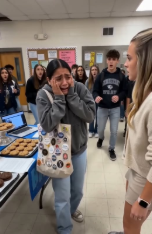
That morning, I was wearing my old gray hoodie, the one with a tiny bleach mark near the sleeve, light blue jeans, old Converse sneakers, and a canvas tote covered in club pins. Debate Club. Environmental Club. Library Volunteers. A little metal pin shaped like a strawberry from the culinary program, even though I was not in culinary. Ms. Adebayo had given it to me after I stayed late one Friday to alphabetize allergy forms.
I did not look like someone anyone would rush to defend.
I looked like the girl people asked for help when they needed things done quietly.
Across the cafeteria, at the center bake table, Kenzie Whitmore looked like the opposite of quiet. She stood beneath the hanging paper streamers in a cream cashmere cardigan, a new tennis skirt, designer sneakers so white they looked untouched by real sidewalks, and an expensive smartwatch that flashed every few seconds as if even her wrist had notifications more important than everyone else’s life.
Kenzie was eighteen, Irish American, bright-eyed in the polished way yearbook photographers loved. She had the kind of confidence money gave people before truth caught up to them. Her name appeared on posters, announcements, club newsletters, fundraisers, donation pages, and student leadership boards whether or not she had done the work behind them.
Everyone knew it.
Nobody said it loudly.
That was the way things worked at Dearborn West High. Some students got warnings. Some students got consequences. Some students got believed because their parents donated banners, sponsored athletic equipment, and smiled at school board events like they owned the building’s future.
Kenzie Whitmore was one of those students.
I was not.
The rumor had started before third period. By lunch, it had legs. By the time the fundraiser opened after school, it had claws.
Someone had posted that I had changed the ingredient list for the bake sale cupcakes.
Not just changed it.
Tampered with it.
Removed an allergen warning.
The words moved through the school with horrible speed: Rosa messed with the list. Rosa tried to sabotage Kenzie. Rosa almost got someone hurt. Rosa was jealous because Kenzie got fundraiser chair.
Jealous.
That word made me want to laugh and cry at the same time.
I was not jealous of Kenzie. I was tired of her. There was a difference.
The bake sale was supposed to raise money for the senior community scholarship fund. I had joined the planning committee because Ms. Adebayo asked for help, and because I knew what scholarship money could mean. My mother cleaned offices at night. My older brother drove delivery routes when he was not at community college. I had no room in my life to treat school activities like a stage.
I handled spreadsheets. Ingredient forms. Vendor receipts. Digital uploads. Boring things. Important things.
Kenzie handled photos.
At least, that was what she was supposed to handle.
She had insisted on being the public face of the fundraiser. She wanted the posters to say “Organized by Kenzie Whitmore and the Senior Service Board.” She wanted the school Instagram story to tag her personal account. She wanted the display table arranged so her cupcakes sat in the center under the sign that said HOMEMADE WITH LOVE.
The first time I noticed something wrong, it was not dramatic.
It was a tiny detail.
The cupcake ingredient sheet uploaded to the school fundraiser page did not match the one Ms. Adebayo had approved.
The approved version listed almond extract.
The uploaded version did not.
I stared at my laptop in the library, the screen reflecting my face back at me, my brows pulled tight. Almond extract. Missing. The kind of missing that could hurt someone.
I checked the folder again. Then the shared drive. Then the upload history.
That was when I saw the original photo data.
The image file of the ingredient sheet had been created on Kenzie’s phone at 7:42 p.m. the night before. The edited version had been uploaded at 8:03 p.m. from her school account. Someone had cropped the bottom corner where the allergen note appeared. Someone had brightened the photo and renamed it FINAL_APPROVED_LIST.
Someone had made it look official.
I took screenshots. Then I did what adults always told us to do.
I told an adult.
Ms. Adebayo was in the faculty workroom when I found her, stacking paper plates beside a box of napkins. She was one of the only teachers who treated quiet students like they still existed when there was no emergency.
“Rosa?” she said, looking up. “You okay?”
“No,” I said, and my voice came out smaller than I wanted. “There’s something wrong with the ingredient list.”
Her face changed immediately.
She took me into the office beside the workroom, closed the door halfway, and listened while I explained. She did not interrupt. She did not ask whether I was sure in that tone adults used when they had already decided a student was exaggerating. She looked at the screenshots, then at the upload history, then at me.
“Do not discuss this with anyone yet,” she said. “I’m going to pull the original records from the school system.”
“I already checked the folder.”
“I know,” she said carefully. “But we need the official audit trail. If there’s an allergen issue, this becomes bigger than a student disagreement.”
Bigger than a student disagreement.
Those words stuck to me all day.
By the time school ended, the cafeteria had transformed into fundraiser mode. Folding tables lined the wall, covered with plastic tablecloths in blue and silver. Cupcakes sat beside brownies, cookies beside banana bread, brownies beside donation jars. The air smelled like sugar, vanilla, and something burnt at the edges. Students crowded around, laughing too loudly, pretending they were not watching the drama unfold in real time.
I had not planned to go to the table.
Ms. Adebayo had told me to wait until she brought in the assistant principal.
But then my phone buzzed.
A message from my friend Elena appeared.
ROSA, DON’T COME TO THE CAFETERIA. KENZIE IS TELLING EVERYONE YOU FAKED THE SCREENSHOTS.
A second later:
SHE SAYS YOU CHANGED THE LIST BECAUSE YOU WANTED HER DISQUALIFIED.
Then:
PEOPLE ARE RECORDING.
Something hot and cold moved through my body at the same time.
I should have stayed away. I know that now. But when you are seventeen and everyone is turning your name into something dirty, staying away feels too much like admitting it.
So I walked in.
The cafeteria noise bent around me.
Kenzie saw me immediately.
Her smile was ready before I reached the table. That was the thing about Kenzie. Her face always arrived before her feelings did. Perfect surprise. Perfect hurt. Perfect outrage.
“Rosa,” she said, loud enough for the first two rows of students to hear. “I was hoping you’d come explain.”
A few phones tilted toward us.
I stopped at the edge of the table.
“I already spoke to Ms. Adebayo,” I said.
Kenzie’s eyes sharpened, but her mouth stayed soft.
“Oh, I know,” she said. “That’s the problem. You went behind my back and accused me of something disgusting.”
“I reported a missing allergen warning.”
“You reported me,” she snapped, then caught herself and gave the crowd a small, wounded laugh. “Sorry. I’m just shocked. I worked so hard on this fundraiser.”
The students around her murmured.
Worked so hard.
I thought of myself hunched over my laptop at midnight, cross-checking donation forms while my mother slept before her cleaning shift. I thought of Elena helping tape labels onto containers. I thought of Malik carrying boxes from the storage room while Kenzie posed with a clipboard for pictures.
But I said nothing.
Kenzie leaned forward, placing both hands on the table.
“You couldn’t stand that I was chair,” she said. “That’s what this is really about, right?”
“No,” I said. “This is about the ingredient receipt and the uploaded photo.”
A flicker crossed her face.
It vanished fast.
“What receipt?”
“The one for the cupcake ingredients.”
Kenzie laughed.
Not because anything was funny. Because she wanted everyone else to know how to react.
“There is no secret receipt, Rosa.”
“I never said secret.”
The laughter around us softened.
Kenzie noticed.
Her smartwatch lit up. She glanced down. For the first time, she looked less like a queen at court and more like a girl doing math in her head.
Then she stepped around the table.
“Don’t do this,” she said, lower now.
I held my tote strap tighter.
“I’m not doing anything. I’m waiting for Ms. Adebayo.”
Her eyes moved past me, toward the cafeteria doors. Teachers were approaching. Ms. Adebayo was there, and beside her was Assistant Principal Coleman, a tall man with a tired face and a radio clipped to his belt.
Kenzie saw them too.
Panic is not always loud. Sometimes it is a tiny decision made too quickly.
She moved before any teacher could step between us.
Her palm struck my cheek with a crack that split the cafeteria into silence.
For one impossible second, I did not understand what had happened. My face turned sideways. My tote slipped from my shoulder. A few pins clicked against the floor. Somewhere, someone gasped. Someone else whispered, “Oh my God.”
My cheek burned.
My eyes watered instantly, not just from pain, but from the shock of being touched like that in front of everyone.
Kenzie pulled her hand back as if she were the one injured.
“Stop lying about me,” she said, her voice trembling perfectly.
And that was the worst part.
Not the slap.
The way the room looked at me afterward.
Like my humiliation was evidence against me.
Like I must have pushed her to it.
Like girls like Kenzie did not lose control unless girls like me gave them a reason.
Ms. Adebayo reached me first.
“Rosa,” she said, her voice tight. “Come here.”
“I’m okay,” I lied.
“You are not required to be okay.”
Assistant Principal Coleman stepped between us.
“Kenzie,” he said, “step back.”
“She’s been spreading lies,” Kenzie said quickly. “She forged screenshots. She’s trying to ruin the fundraiser.”
“I said step back.”
Kenzie’s friends gathered behind her. Brielle and Madison and two girls from student council whose names I knew because I had typed them into volunteer schedules they never showed up for.
Brielle lifted her phone.
“Everyone saw Rosa come at her,” she said.
“I didn’t touch her,” I said.
My voice shook.
I hated that.
Kenzie looked at me with wet eyes.
Wet eyes. No tears falling. Just enough shine.
“You were going to destroy everything I worked for.”
Something inside me almost broke then.
Not because I believed her.
Because I understood that most people wanted to.
Ms. Adebayo bent down and picked up my tote. One pin had snapped off. The little strawberry lay on the floor near Kenzie’s designer sneaker. Ms. Adebayo picked it up too and closed it in her palm.
“Mr. Coleman,” she said, “we need the projector.”
The assistant principal looked at her.
“Now?”
“Now.”
The cafeteria stirred.
Kenzie’s face hardened.
“What projector?”
Ms. Adebayo did not answer her. She walked to the rolling cart near the stage, where the school kept a laptop connected to the cafeteria screen for announcements. Mr. Coleman spoke quietly into his radio. Another teacher moved toward the doors, not blocking them exactly, but making it harder for the crowd to scatter.
I stood beside the bake table, cheek burning, hands shaking. Elena pushed through the students and grabbed my hand.
“Rosa,” she whispered. “I’m so sorry.”
I could not answer.
Across the room, the projector flickered on. The school crest appeared on the screen, huge and blue and official.
Kenzie laughed again, but this time it came out wrong.
“This is insane,” she said. “You’re going to put my personal information on a screen because Rosa is jealous?”
Ms. Adebayo turned from the laptop.
“No personal information,” she said. “Only school records related to a fundraiser that involved food served to students.”
Mr. Coleman’s face had become unreadable. That was how I knew he had already seen enough to be worried.
Kenzie’s fingers moved over her smartwatch. Tap. Swipe. Tap.
Brielle whispered, “Kenzie, stop.”
Kenzie ignored her.
The first file appeared on the screen.
It was the approved ingredient form.
Plain white background. Typed list. Cupcakes: flour, sugar, eggs, butter, vanilla, almond extract. Contains: eggs, dairy, tree nuts.
A murmur moved through the room.
Ms. Adebayo clicked to the next image.
The uploaded fundraiser photo appeared.
Same paper. Same table. Same handwriting in the margin.
But the bottom right corner was cropped.
The allergen warning was gone.
“This,” Ms. Adebayo said, “is the version uploaded to the public fundraiser page last night.”
Kenzie folded her arms.
“Anyone could have cropped it.”
Ms. Adebayo nodded once.
“Yes. That’s why we checked the metadata and the school upload log.”
The next screen showed a file information panel.
Created: 7:42 p.m.
Device: iPhone registered to Kenzie Whitmore.
Location: Whitmore residence Wi-Fi.
Edited: 8:01 p.m.
Uploaded: 8:03 p.m.
Uploader account: kwhitmore.student@dearbornwest.edu.
The cafeteria went silent again, but this silence was different.
It was not waiting to accuse me.
It was waiting to see whether Kenzie could survive the truth.
Kenzie’s face flushed.
“That doesn’t prove I removed anything on purpose,” she said. “I was cleaning up the photo. It looked messy.”
“You removed the allergen warning,” I said.
Her head snapped toward me.
“You are obsessed with making me look bad.”
“No,” I said, and my voice was still shaking, but it was louder now. “I’m obsessed with people knowing what they’re eating.”
Mr. Coleman looked at Ms. Adebayo.
“You mentioned a receipt.”
She clicked again.
The ingredient receipt filled the screen.
At first, it looked ordinary. Store logo. Date. Items listed in small black text. Flour. Sugar. Butter. Eggs. Vanilla. Almond extract. Decorative sprinkles.
Then Ms. Adebayo zoomed in.
Purchased by: K. Whitmore.
Loyalty account ending: 4418.
Time: 6:16 p.m.
Underneath, in the notes section, the store had printed something I had not noticed when I first saw the receipt in the shared folder.
TREE NUT INGREDIENT CONFIRMED AT CHECKOUT.
A sound went through the cafeteria like everyone inhaled at once.
Kenzie’s lips parted.
“That’s fake,” she said.
Ms. Adebayo’s face did not move.
“It came directly from the scanned reimbursement packet you submitted this morning.”
Kenzie blinked.
For half a second, she looked genuinely confused.
Then I saw it.
Not guilt.
Fear.
The kind of fear that does not come from being caught in a lie.
The kind that comes from realizing someone else’s lie is about to collapse on top of you.
“Kenzie,” Mr. Coleman said slowly, “did you submit this receipt?”
She swallowed.
“My mom handled the reimbursement.”
That sentence changed the temperature in the room.
Her friends looked at one another.
Ms. Adebayo clicked to the next document.
A school reimbursement request.
Parent volunteer signature: Maureen Whitmore.
Kenzie’s mother.
Everyone knew Maureen Whitmore. She had bright blond hair, sharp perfume, and a way of speaking to school staff like she was giving instructions to employees at a hotel. She chaired the Parent Leadership Circle. She had donated money for the new auditorium curtains. She had once complained that student volunteers “lowered the polish” of school events if they were allowed to dress too casually.
I had been standing three feet away when she said it.
She had looked at my hoodie.
Mr. Coleman’s jaw tightened.
Before he could speak, the cafeteria doors opened.
Maureen Whitmore walked in.
And she was smiling.
Not a nervous smile. Not a mother worried about her daughter.
A practiced smile.
The kind adults wore when they expected rooms to rearrange around them.
“Mr. Coleman,” she said brightly. “I came as soon as Kenzie texted. I understand there’s been a misunderstanding.”
Kenzie went pale.
“Mom,” she said softly.
Maureen did not look at her.
She looked at the screen.
Then at me.
Her smile thinned.
“Oh,” she said. “This again.”
This.
Again.
My stomach tightened.
Ms. Adebayo straightened.
“Mrs. Whitmore, we’re reviewing official fundraiser records.”
“In front of students?” Maureen asked. “How unprofessional.”
“We are addressing a public accusation that already resulted in one student being assaulted in front of those same students,” Ms. Adebayo said.
The word assaulted landed hard.
Kenzie flinched.
Maureen’s eyes flicked to her daughter, then away.
“Teenage girls get emotional,” she said. “Let’s not dramatize.”
My cheek still burned.
Elena squeezed my hand so hard it hurt.
Mr. Coleman said, “Mrs. Whitmore, did you submit the reimbursement packet?”
“I helped Kenzie organize it.”
“Did you alter the ingredient documentation?”
Maureen laughed softly.
“Of course not.”
The screen behind her still showed her signature.
She turned slightly, as if noticing it for the first time.
“That only proves I signed a form.”
Ms. Adebayo moved to the laptop again.
“There’s more.”
Maureen’s expression sharpened.
“Excuse me?”
Ms. Adebayo clicked.
A new page opened.
Not a receipt.
Not a photo.
An email.
My breath caught when I saw the subject line.
RE: FINAL FUNDRAISER DISPLAY — REMOVE LOW-QUALITY ELEMENTS
The sender was Maureen Whitmore.
The recipient was Kenzie.
The timestamp was 7:55 p.m.
Ms. Adebayo did not read the entire email aloud. She did not need to. The highlighted line on the screen was enough.
Do not leave the nut warning visible on the front-facing display photo. It makes the cupcakes look unsafe, and we cannot have Rosa’s committee notes making your table appear second-class.
For a moment, nobody moved.
I heard the hum of the projector. The buzz of fluorescent lights. My own pulse in my ears.
Rosa’s committee notes.
My name.
Not because I had lied.
Because I had done the work.
Kenzie made a sound like a breath breaking.
“Mom,” she whispered.
Maureen’s face hardened fully now.
“You had no right to access my private email.”
Mr. Coleman stepped forward.
“This was forwarded through the school fundraiser account, Mrs. Whitmore. It is part of the event records.”
“That is absurd.”
“It is official documentation.”
Maureen turned to Kenzie.
“Don’t say anything.”
Kenzie’s eyes filled with actual tears now. Not polished. Not performed. Real.
And that was the first twist I did not expect.
Kenzie Whitmore, who had slapped me in front of half the school, looked terrified of her mother.
Not embarrassed.
Terrified.
“Kenzie,” Mr. Coleman said, softer than before, “did your mother tell you to crop the warning?”
Kenzie pressed her lips together.
Maureen snapped, “She’s a child.”
“She is eighteen,” Ms. Adebayo said.
“She is my daughter.”
“And Rosa is someone’s daughter too,” Ms. Adebayo replied.
The cafeteria went still.
I had never heard a teacher say something like that in a room full of students and power.
Maureen’s eyes cut toward me.
For the first time, she spoke directly to me.
“You have caused enough trouble.”
My old self would have looked down.
My old self would have apologized for standing in the path of someone else’s anger.
But my cheek hurt. My strawberry pin was broken. My name had been dragged through the school because I had tried to keep someone safe.
So I looked back at her.
“No,” I said. “I found the trouble.”
A few students shifted. Someone whispered, “Dang.”
Maureen’s nostrils flared.
“You think this makes you brave?”
“No,” I said. “I think it makes me tired.”
Kenzie looked at me then.
Really looked.
Not like I was a rival. Not like I was a problem. Like she was seeing a person she had stepped on because that was how she had been taught to move through the world.
Mr. Coleman asked everyone who was not directly involved to move back. Teachers began separating students from the table, but nobody truly left. They drifted toward the walls, pretending to examine brownies and flyers, unwilling to miss the ending.
But the ending had not arrived yet.
Not even close.
Because Ms. Adebayo clicked one final file.
“This,” she said, “came from the school’s content management system. It shows the edit history for the fundraiser page.”
The screen displayed a timeline.
7:42 p.m. — photo created.
7:55 p.m. — email from Maureen Whitmore to Kenzie Whitmore.
8:01 p.m. — image edited.
8:03 p.m. — edited image uploaded.
8:06 p.m. — description changed.
8:07 p.m. — allergen line deleted.
8:08 p.m. — fundraiser chair credit changed.
8:09 p.m. — Rosa Benitez removed from document editor list.
My heart stopped.
Removed from editor list.
That had not been in the screenshots I took.
I stared at the screen, suddenly cold.
Ms. Adebayo looked at me, and I saw apology in her face. She had discovered something worse after I left her office.
The timeline continued.
8:10 p.m. — Kenzie Whitmore added as sole student organizer.
8:11 p.m. — donation page headline changed to: Kenzie Whitmore’s Senior Scholarship Bake Sale.
The room was very quiet.
I had spent three weeks building that fundraiser.
Three weeks calling local bakeries, sorting forms, checking allergy lists, staying late to clean the library meeting table, writing captions for posts that Kenzie later reposted with her own face beside them.
I had told myself credit did not matter.
I had told myself the money mattered.
The scholarship mattered.
The work mattered.
But seeing my name removed like an inconvenient smudge made something inside me ache deeper than the slap.
Kenzie stared at the screen too.
“I didn’t remove Rosa,” she said.
Maureen’s voice came sharp.
“Kenzie.”
Kenzie turned on her.
“I didn’t.”
Maureen’s expression froze.
Kenzie took a small step away from her mother.
“I cropped the photo,” she said, voice shaking. “I did. I shouldn’t have. I knew it was wrong. But I didn’t delete Rosa’s name. I didn’t change the donation page title.”
“Kenzie,” Maureen warned.
“No,” Kenzie said, louder. “No, because you told me it was just presentation. You said allergen warnings scare donors. You said Rosa’s name made the project look like a charity case instead of a leadership event.”
A gasp rose from somewhere near the cookie table.
Maureen’s face went white with fury.
“Stop talking.”
Kenzie’s tears spilled over.
“You said if I didn’t fix it, you’d call Coach Merritt and tell him I was too overwhelmed to captain next season.”
Her voice cracked.
“And you said if people found out, we’d say Rosa did it because she had access before.”
The cafeteria erupted.
Mr. Coleman raised his voice.
“Quiet. Everyone quiet.”
But there was no quiet anymore, not really. There are some truths that make silence impossible.
I stood there, numb, as the story changed shape in front of me.
Kenzie had lied.
She had slapped me.
She had helped remove the warning.
But she had not built the whole machine.
Her mother had.
Maureen Whitmore had not just protected her daughter’s reputation. She had chosen me as the person easiest to sacrifice.
Because I wore old Converse.
Because my mother cleaned offices.
Because I did invisible work.
Because people like her believed girls like me could be erased and nobody important would object.
Mr. Coleman told Maureen they needed to continue the conversation in the office. Maureen refused. Then he told her again, this time with the school resource officer standing near the door. She left with her chin high, but her hands were trembling.
Kenzie did not follow at first.
She stood near the bake table, crying in front of everyone she had spent years impressing.
I wanted to hate her cleanly.
It would have been easier.
But nothing about that day stayed simple.
She turned toward me.
“I’m sorry,” she whispered.
I said nothing.
Her face crumpled.
“I know that’s not enough.”
“It’s not,” I said.
She nodded, like the words hurt but she deserved them.
Then she looked at the floor.
My broken strawberry pin still lay in Ms. Adebayo’s hand.
Kenzie saw it and covered her mouth.
“I’m sorry,” she said again, but this time it sounded smaller. Not for the crowd. Not for teachers. For me.
Mr. Coleman escorted her toward the office.
As she passed me, she stopped.
“I didn’t know she deleted your name until now,” she said.
I believed her.
I did not forgive her.
Those are different things.
The investigation lasted two weeks.
In high school time, two weeks is long enough for three new dramas to rise and die, but this one did not disappear. The slap video spread first, but then someone posted the cafeteria screen recording. Then the school sent an official email to families about fundraiser documentation, allergen safety, and student conduct. They did not name us, but everyone knew.
Kenzie was suspended for the slap and removed from student council leadership. She had to write formal apologies to me, Ms. Adebayo, the fundraiser committee, and every student who had purchased from the bake sale before the warning was corrected.
Maureen Whitmore resigned from the Parent Leadership Circle after the district opened a review into parent access to student-run fundraising accounts. Her name disappeared from the school website so fast it felt like watching a magic trick in reverse.
But the biggest surprise came from the ingredient receipt.
Because when the district reviewed the reimbursement packet, they found something else.
The total did not match the cupcakes.
There were extra items on the receipt. Expensive ones. Imported vanilla. Decorative boxes. Specialty ribbon. Things never used for the fundraiser.
At first, everyone assumed Maureen had padded the reimbursement for herself.
That would have been ugly, but believable.
Then Ms. Adebayo called me into her classroom after school, closed the door, and asked me to sit.
My stomach dropped.
“Am I in trouble?”
“No,” she said quickly. “No, Rosa. You’re not.”
She looked tired. More tired than I had ever seen her.
“There’s another layer to this.”
I sat slowly.
She slid a printed document across the desk.
It was a district vendor report. I did not understand most of it at first. Numbers. Dates. Approval codes. Parent volunteer reimbursements.
Then I saw a familiar name.
Whitmore Community Foundation.
I looked up.
“Isn’t that Kenzie’s family charity?”
Ms. Adebayo nodded.
“The scholarship fund donations from the bake sale were supposed to go into the senior community scholarship account. But the donation page title change redirected online donations to a temporary processing account connected to the Whitmore Foundation.”
My mouth went dry.
“What does that mean?”
“It means the fundraiser wasn’t just about credit.”
I looked down again.
The numbers blurred.
“How much?”
“Nearly six thousand dollars before the page was frozen.”
Six thousand dollars.
Money students had raised selling cupcakes and brownies and cookies. Money families had donated because they believed it would help seniors who needed support. Money that could have bought textbooks, application fees, bus passes, laptop repairs.
My hands curled into fists.
“She was stealing scholarship money?”
Ms. Adebayo’s voice was careful.
“The district is investigating. We don’t know all the details yet.”
But I understood.
The allergen warning had been the loose thread.
The receipt had pulled the whole seam open.
And then came the twist nobody expected.
Kenzie asked to speak to me.
I said no the first time.
And the second.
The third time, Ms. Adebayo said, “You don’t owe her a conversation. But she says she has something that belongs to you.”
That was the only reason I agreed.
We met in the library after school, at the same table where I had first found the missing allergen warning. Ms. Adebayo sat nearby, close enough to intervene, far enough to let us speak.
Kenzie looked different without her audience.
No cream cardigan. No perfect tennis skirt. She wore a plain navy sweatshirt and leggings, her hair pulled back badly, her face pale and bare. She looked younger than eighteen. Not innocent. Just young.
She placed an envelope on the table.
“I should have given this to Mr. Coleman,” she said. “But I wanted you to see it first.”
I did not touch it.
“What is it?”
“My college essay.”
I blinked.
“What?”
She pushed it closer.
“I wrote it in September. Before everything.”
I opened the envelope slowly.
The essay title was printed at the top.
THE GIRL WHO TAUGHT ME LEADERSHIP.
My name appeared in the first sentence.
Not Kenzie’s.
Mine.
I looked up sharply.
Kenzie’s eyes filled.
“I didn’t write about myself,” she said. “I wrote about you.”
I stared at her.
The essay described sophomore year, when the winter coat drive had almost failed because the inventory list was a disaster. It described a girl who stayed after everyone left, sorted sizes, called shelters, fixed donation labels, and never asked to be thanked. It described how leadership was not standing in front of a camera but staying until the lights shut off because someone needed to make sure every child got a coat that fit.
I remembered that coat drive.
I did not remember Kenzie being there.
Then I did.
She had been sitting on the stage steps, crying quietly because her mother had screamed at her over the phone about not making varsity captain. I had pretended not to notice because sometimes kindness is giving someone privacy.
I had handed her a roll of tape and said, “You can help with the labels if you want.”
She had stayed for twenty minutes.
Apparently, she had remembered.
“I used to admire you,” Kenzie whispered.
I did not know what to do with that.
“Then why did you treat me like that?”
She wiped her cheek.
“Because admiring you didn’t get me anything at home.”
The answer was ugly.
It was also honest.
She took a breath.
“My mom read the essay before I submitted it. She said it made me sound weak. She said no college wanted to hear that I learned leadership from a scholarship girl in a hoodie.”
My throat tightened.
“She made me rewrite it,” Kenzie said. “The final version was about founding the fundraiser committee.”
“You didn’t found it.”
“I know.”
We sat in silence.
Then she said, “The original essay is timestamped. It proves she knew you did the work months before she deleted your name. It proves she targeted you on purpose.”
The envelope felt heavier in my hands.
“This is why you wanted me to see it?”
Kenzie nodded.
“And because you deserved to know that before I became awful, some part of me knew exactly who you were.”
I wanted to tell her that did not fix anything.
I wanted to tell her admiration did not undo humiliation.
I wanted to tell her she had used her hand against my face and her voice against my name.
Instead, I said, “You still chose to lie.”
“I know.”
“You still slapped me.”
“I know.”
“And people believed you because you let them.”
Her face twisted.
“I know.”
There was no defense in her voice.
That mattered more than any apology speech would have.
I folded the essay carefully.
“I’ll give this to Ms. Adebayo.”
Kenzie nodded.
As I stood, she said, “Rosa?”
I looked back.
“I’m going to tell the district everything.”
“Good.”
“My mom will destroy me.”
I looked at her for a long second.
Then I said, “Maybe she already has. Maybe telling the truth is how you start taking yourself back.”
Kenzie broke then, silently, shoulders shaking.
I did not hug her.
But I left a tissue on the table before I walked away.
The district hearing happened on a rainy Thursday evening in April.
My mother came straight from work, still in her black cleaning uniform, smelling faintly like lemon disinfectant and cold air. She sat beside me in the front row and held my hand in both of hers.
“You don’t have to be strong every second,” she whispered in Spanish.
“I know,” I whispered back, though I did not really.
Kenzie testified.
Her voice shook, but she did not stop.
She admitted cropping the allergen warning after pressure from her mother. She admitted blaming me. She admitted slapping me. She admitted she knew I had done most of the fundraiser work and let people believe otherwise because she wanted the recognition and feared what would happen if she disappointed her mother.
Then she submitted the original college essay.
Maureen Whitmore tried to interrupt three times.
The board chair warned her twice.
The third time, he asked her to leave.
That was the moment everyone in the room understood the world had shifted.
People like Maureen Whitmore were not usually asked to leave rooms.
They usually decided who else had to.
The financial review found that the donation redirect had been set up through a parent administrator account. Maureen claimed it was an accident. The audit logs said otherwise. The district recovered the money before it disappeared fully into the foundation account, and the scholarship fund received every dollar, plus an additional penalty donation the Whitmore Foundation made after legal counsel got involved.
But the happiest ending was not Maureen losing her position.
It was not Kenzie losing her crown.
It was a letter.
Three weeks before graduation, I was called to the auditorium for what I thought was a senior awards rehearsal. I almost did not go. Awards assemblies were usually for students whose names adults already knew how to pronounce correctly.
But Ms. Adebayo found me in the hallway.
“You’ll want to be there,” she said.
The auditorium smelled like dust, stage curtains, and floor polish. Seniors filled the seats, restless and loud. I sat near the back with Elena, trying not to feel out of place.
Then Principal Harris walked onstage.
“We have one special recognition today,” she said, “for a student whose integrity protected this school community in a moment when silence would have been easier.”
My body went still.
Elena grabbed my arm.
“No way,” she whispered.
Principal Harris continued.
“This student identified a serious safety issue, preserved documentation, reported it responsibly, and showed courage under public pressure. Because of her actions, our district is implementing new student fundraiser safeguards.”
My mother appeared from the side of the stage.
I stopped breathing.
She was wearing her best blue dress and crying before my name was even spoken.
“Rosa Benitez,” Principal Harris said, “please come forward.”
The auditorium erupted.
Not polite clapping.
Not forced clapping.
Real applause.
Loud enough to shake something loose in my chest.
I walked down the aisle with my face hot, my hands trembling, and my old Converse squeaking against the floor. Students stood. Teachers stood. Malik whooped so loudly Ms. Adebayo laughed. Elena was crying. My mother covered her mouth with both hands.
Onstage, Principal Harris handed me a certificate.
Then Ms. Adebayo stepped to the microphone.
“The Senior Community Scholarship Committee has voted to rename this year’s award,” she said. “Beginning today, it will be called the Benitez Integrity Scholarship.”
I turned toward her, stunned.
She smiled through tears.
“And Rosa is its first recipient.”
The applause came again, but this time I barely heard it.
Because my mother had reached me.
She wrapped me in her arms onstage, in front of everyone, and whispered, “Te dije, mija. Lo que se hace con verdad siempre vuelve con luz.”
What is done with truth always returns with light.
I cried then.
Not delicately.
Not in a way that would look nice in photos.
I cried like a girl who had held herself together too long.
From the corner of the stage, I saw Kenzie standing near the side door.
She had not come forward. She had not tried to make the moment about her. She just stood there, clapping with red eyes.
When our eyes met, she mouthed two words.
I’m sorry.
I nodded once.
Not forgiveness.
Not yet.
But maybe the first inch of something better than hatred.
After graduation, the bake sale table was packed away. The posters came down. The cafeteria returned to smelling like fries, bleach, and teenage noise. People moved on, because schools always do.
But some things stayed changed.
The fundraiser accounts required two faculty approvals. Ingredient lists had QR codes linked to locked forms. Parent volunteers lost admin access. Student credit had to be verified by committee logs.
And me?
I stopped apologizing before I spoke.
That was the strangest change.
I had spent so much of my life making myself smaller to seem less threatening, less demanding, less easy to dislike. I had learned to say “sorry” before asking a question. Sorry, can I check that? Sorry, I think there’s a mistake. Sorry, I just wanted to help.
After everything, I began removing the sorry.
Can I check that?
There’s a mistake.
I can help.
At graduation, I wore a white dress under my gown and my old Converse on purpose. My mother said I should wear nicer shoes. I told her these had survived the worst day of senior year with me, so they deserved to walk across the stage.
She laughed and let me.
Kenzie graduated too.
Her applause was quieter than it would have been before. Her circle was smaller. But when her name was called, she walked straight, not like a queen, not like a victim, just like a girl trying to learn how to stand without someone else’s shadow telling her where to place her feet.
I did not know what would happen to her.
That was not my responsibility.
My responsibility was the life opening in front of me.
At the end of the ceremony, when caps flew into the air and families rushed the field, Ms. Adebayo found me and pressed something into my hand.
It was my strawberry pin.
Fixed.
The metal backing had been replaced. The tiny red enamel fruit shone under the sun.
“I know someone who repairs jewelry,” she said.
I turned it over in my palm.
Such a small thing.
Such a ridiculous thing to almost make me cry again.
“Thank you,” I said.
“You earned more than a pin, Rosa.”
I looked across the field at my mother, who was waving both arms like I might not see her from ten feet away. My brother stood beside her holding flowers from a grocery store bouquet, grinning like he had personally won graduation.
For the first time in months, my chest felt light.
Then Principal Harris approached with an older woman I did not recognize. She had silver hair, a navy suit, and kind eyes that noticed everything.
“Rosa,” Principal Harris said, “this is Dr. Evelyn Marsh from the state youth leadership program.”
Dr. Marsh shook my hand.
“I heard about what happened,” she said.
I braced myself.
People had said that sentence to me too many times.
But she smiled.
“I also read your fundraiser records. Your documentation was exceptional.”
I blinked.
“Thank you.”
“We offer a summer fellowship for students interested in public service, nonprofit accountability, and community leadership. It usually goes to college sophomores.” Her smile widened. “But I think we can make an exception.”
My mother had gone completely still behind her.
I stared at Dr. Marsh.
“A fellowship?”
“Paid,” she said. “With mentorship. And if you’re interested, a recommendation pathway for state scholarship programs.”
For a second, I saw the whole year differently.
Not as a wound.
As a door.
A terrible door, yes. One I never would have chosen. One that had opened because someone tried to shove me through shame and blame and silence.
But on the other side was proof.
My proof.
My work.
My name, no longer removable from the record.
I looked down at the strawberry pin in my palm, then at my mother, then at the field full of students laughing beneath the late spring sky.
“Yes,” I said. “I’m interested.”
Dr. Marsh laughed softly.
“I thought you might be.”
That night, after the celebration dinner my family could barely afford but insisted on anyway, I sat at our small kitchen table with my scholarship letter, my fixed pin, and the printed ingredient receipt that Ms. Adebayo had given me after the hearing.
I kept staring at the receipt.
Not because of the almond extract.
Not because of Kenzie.
Because of what it had become.
A receipt is supposed to prove what was bought.
This one proved what people thought they could sell.
A lie.
A reputation.
A girl’s name.
A scholarship fund.
The safety of anyone who trusted the sign on a table.
But it had also bought something else, something nobody intended.
It bought the truth enough time to stand up.
My mother placed a mug of tea beside me.
“You’re thinking too hard,” she said.
“I’m thinking just enough.”
She touched my hair.
“Are you happy?”
I looked at the scholarship letter again.
I thought about the cafeteria. The slap. The silence. The screen. The way my voice had shaken but still worked. The way Ms. Adebayo had said Rosa is someone’s daughter too. The way Kenzie had finally told the truth. The way my mother had held me onstage like I was not invisible, had never been invisible, would never be invisible again.
“Yes,” I said.
And I meant it.
The school saw me get blamed.
Then the ingredient receipt showed who really lied.
But the part nobody expected was this: the receipt did not just expose Kenzie Whitmore or her mother.
It exposed me too.
Not as guilty.
Not as jealous.
Not as the girl people could erase.
It exposed me as the person I had been all along.
Careful.
Honest.
Unwilling to let a quiet lie become official.
And finally, everyone else had to see it.
THE END
