The nacho cheese hit my cheek before I understood that Brielle Ashford had chosen humiliation over silence.
For one second, the mini-golf fundraiser stopped being a school event and became a courtroom with no judge, no rules, and a hundred students waiting to see whether I would break.
The paper tray slipped from Brielle’s hand after she threw it. Orange cheese slid down my jaw, warm and sticky. Crushed chips clung to the front of my volunteer shirt. Somewhere behind me, a golf ball tapped gently into a plastic windmill, making a cheerful little clack that sounded cruel in the silence.
Someone whispered my name.
“Maya.”
That was me.
Maya Bennett, seventeen years old, scholarship kid, volunteer coordinator, the girl who usually stayed behind the check-in table because tables had rules and people did not.
I had come to the Naples Family Mini-Golf Center that Saturday to help run Silver Coast High’s spring fundraiser. It was supposed to be simple: collect entry tickets, manage prize envelopes, keep track of raffle donations, and make sure all evidence for the school’s fundraising contest stayed clean. Each club was competing for a service grant, and the winning team would get money for its senior project.
I was there because I cared about the grant.
Brielle Ashford was there because she cared about being seen winning it.
She stood in front of me in an expensive white linen set, gold sandals, and sunglasses pushed into her glossy hair like she had stepped out of a summer magazine instead of a school fundraiser. Her family name was printed on one of the sponsor banners near Hole 4. ASHFORD DEVELOPMENT GROUP. BUILDING FUTURES TOGETHER.
Brielle always stood near that banner like it belonged to her.
Maybe it did.
“You’re pathetic,” she said, loud enough for everyone by the snack counter to hear. “You really thought you could accuse me and get away with it?”
I wiped cheese from my chin with the back of my hand. My fingers trembled, but I made myself look at the staff member beside me.
“Please open the timestamp file,” I said.
Brielle laughed, sharp and fake. “Listen to her. She sounds insane.”
The staff member, Mr. Nolan, held the printed report I had given him. He was the activities assistant, not a teacher exactly, but close enough that students behaved when he walked into a room. Usually.
Now even he looked uncertain.
That was the thing about Brielle. She made adults hesitate.
Not because she was right.
Because her parents donated.
Because her mother knew the principal by first name.
Because her father’s company paid for half the new athletic field.
Because people like Brielle did not need to threaten anyone directly. Their last name did it for them.
I looked around the room.
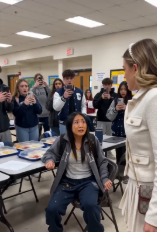
Students in fundraiser shirts clustered near the snack bar. Parents stood frozen beside scorecards. A few kids from the freshman class still held plastic golf clubs, unsure if they should keep playing or watch the disaster unfold. Phones were already out.
Of course they were.
I had tried to avoid this.
That was the worst part.
I could have posted the proof as soon as I found it. I could have dropped screenshots into the school group chat, tagged every club officer, and let the whole place explode online. But I had not wanted a spectacle. I had handed the evidence to Mr. Nolan quietly because I believed adults were supposed to handle things before students got hurt.
Then Brielle saw the paper in my hand.
And now everyone was watching cheese drip from my face.
The problem had started with the donation envelopes.
Each club had a locked envelope where cash raffle entries were collected. At the end of the fundraiser, the envelopes would be counted, scanned, and logged. The club with the highest verified total would receive an additional bonus toward its senior project.
Our club, Community Outreach, had raised money for free tutoring supplies.
Brielle’s club, Student Ambassadors, had raised money for a glossy campus beautification campaign with professional posters, matching shirts, and a video featuring Brielle walking across campus talking about leadership.
At 1:22 p.m., I noticed something wrong.
The evidence scan for our donation envelope showed a tamper flag.
Not physical damage.
Digital tampering.
Someone had accessed the school evidence folder before the donation count began and changed the upload label attached to our envelope scan. It made our entry look incomplete. If the mistake stayed, our club’s fundraising total could be disqualified.
I checked the timeline.
The edit had happened at 12:47 p.m.
I had arrived at 1:05.
That meant one thing clearly: the evidence had been tampered with before I ever touched it.
So I printed the access log and walked it straight to Mr. Nolan.
I had barely finished saying, “I think someone changed this before I arrived,” when Brielle appeared.
She came over like she owned the room.
Not rushed.
Not messy.
Fake calm.
Her eyes flicked from my face to the paper, and something cold passed over her expression.
“What are you doing?” she asked.
“Giving Mr. Nolan a log,” I said.
“What log?”
Mr. Nolan said, “Brielle, give us a minute.”
But Brielle smiled at him like he had made a cute mistake. “This concerns my club too, doesn’t it?”
“It concerns the evidence folder,” I said.
Her smile vanished.
Then came the performance.
She accused me of being jealous. She said I was trying to discredit the Student Ambassadors because I knew Community Outreach would lose. She said I had always acted bitter because I was not chosen for the promotional video. She called me messy, desperate, attention-hungry.
Every word was designed for the crowd.
I stood there, clutching the edge of the table.
“I didn’t accuse you,” I said. “I asked him to check the timestamp.”
Brielle’s face sharpened.
That was when she grabbed the nacho tray from the snack counter.
And threw it at me.
Now Mr. Nolan stared at her with the printed log in his hand.
“Brielle,” he said slowly, “why did you do that?”
“She was lying,” Brielle snapped.
“Throwing food does not prove that.”
“It proves she pushed me too far.”
Something in me hardened.
Maybe it was the cheese drying on my skin.
Maybe it was the phones recording.
Maybe it was the fact that Brielle had counted on my embarrassment more than her own fear.
I looked straight at Mr. Nolan.
“Open the file.”
This time, he did.
He set his laptop on the snack counter. The screen reflected in Brielle’s sunglasses. A little crowd pressed closer until Mrs. Alvarez, the event manager, stepped in and told everyone to back up.
Mr. Nolan logged into the school evidence portal.
The loading icon spun.
Brielle folded her arms, but her fingers tapped against her elbow. Fast. Too fast.
“Envelope ID?” Mr. Nolan asked.
“CO-19,” I said.
He typed it in.
The record opened.
COMMUNITY OUTREACH DONATION ENVELOPE — STATUS: FLAGGED INCOMPLETE.
Brielle let out a tiny breath, almost a laugh.
“See?” she said. “Flagged.”
“Click access history,” I said.
Mr. Nolan did.
The timeline appeared.
12:14 P.M. — ENVELOPE SCAN CREATED.
12:18 P.M. — UPLOAD VERIFIED.
12:47 P.M. — LABEL CHANGED TO INCOMPLETE.
1:05 P.M. — MAYA BENNETT CHECKED IN AT EVENT.
1:22 P.M. — MAYA BENNETT VIEWED RECORD.
1:24 P.M. — MAYA BENNETT PRINTED ACCESS LOG.
The room went quiet again.
This silence was different.
It had edges.
Mr. Nolan looked at the screen, then at me. “You weren’t here when the label changed.”
“No,” I said. “I wasn’t.”
Brielle’s face changed before she said a word.
It was quick, but everyone saw it.
The perfect calm cracked.
Mr. Nolan scrolled right.
There was one more column.
USER DEVICE: BA-IPHONE-14.
Mrs. Alvarez leaned forward. “BA?”
A student whispered, “Brielle Ashford.”
Brielle’s head snapped toward the voice. “That is not proof.”
Mr. Nolan’s expression turned serious. “Brielle, is your phone connected to the school volunteer portal?”
“I’m an officer,” she said. “Lots of officers have access.”
“Is your phone BA-iPhone-14?”
She hesitated.
Only half a second.
Enough.
“Yes,” she said. “But that doesn’t mean anything. Somebody could have used my phone.”
Mr. Nolan held out his hand. “Unlock it.”
Brielle stared at him.
“What?”
“Unlock your phone.”
Her bracelets jingled as she reached toward her small designer bag. Her hand shook.
The room noticed.
So did I.
She pulled out the phone, but did not unlock it.
“My dad will not be okay with this,” she said.
Mrs. Alvarez stepped closer. “A school evidence record was altered during a student event. You threw food at another student after she reported it. Unlock the phone, or we call the principal and your parents right now.”
Brielle’s eyes flashed. “Call them.”
Mr. Nolan reached for his radio.
“Wait,” Brielle said.
Her voice came out thin.
She looked at me then.
Not angry.
Afraid.
For one strange second, I almost felt sorry for her.
Then I remembered the cheese on my face.
She unlocked the phone.
Mr. Nolan did not take it immediately. He asked her to open the volunteer portal. She did. Her thumb hovered over the screen like the phone might burn her.
The recent activity page loaded.
There it was.
12:47 P.M. — LABEL CHANGE: CO-19 INCOMPLETE.
The device matched.
The account matched.
The timestamp matched.
Someone in the crowd whispered, “She did it.”
Brielle snapped, “No, I didn’t!”
But her voice broke.
Mr. Nolan said quietly, “Then explain.”
Brielle looked toward the sponsor banner.
ASHFORD DEVELOPMENT GROUP.
Her face twisted in a way I had never seen. Not spoiled. Not smug.
Trapped.
“I can’t,” she whispered.
Before anyone could ask what that meant, a man’s voice cut through the room.
“She doesn’t have to explain anything without me.”
Everyone turned.
Mr. Ashford walked in wearing a pale blue dress shirt, expensive watch, and the kind of confidence that made adults straighten automatically. He looked like a man used to doors opening before he touched them. Beside him was Brielle’s mother, elegant and silent, her lips pressed together.
Brielle looked relieved for half a second.
Then terrified.
That told me everything.
Mr. Ashford crossed the room. “What is going on?”
Mr. Nolan lifted his chin. “Your daughter’s phone appears to have been used to alter a school evidence file.”
“My daughter has been volunteering all day.”
“The timestamp says otherwise.”
“My daughter’s phone is not public property.”
“No one said it was,” Mrs. Alvarez replied. “But she opened the activity log herself.”
Mr. Ashford’s eyes moved to me.
The look he gave me was calm, dismissive, and cold.
“You are the girl accusing her?”
My mouth felt dry, but I answered. “I’m the girl who found the timestamp.”
His jaw tightened.
Then Brielle said, “Dad, please.”
Not loudly.
Not dramatically.
Just two words, full of panic.
Mr. Ashford turned to her slowly.
“Be quiet.”
The whole room heard it.
Brielle shrank back.
And suddenly, the story changed again.
This was not just about a rich girl protecting her club.
This was bigger.
Mr. Nolan looked at the laptop. “There may be additional access logs.”
Mr. Ashford stepped forward. “Close that computer.”
Nobody moved.
He smiled, but it was not a kind smile. “I said close it.”
Mrs. Alvarez crossed her arms. “No.”
That one word seemed to surprise him.
Then my own phone buzzed.
I looked down.
Unknown number.
One message.
CHECK THE SPONSOR FOLDER. SEARCH “PROJECT PINEGLASS.”
My pulse stumbled.
Project Pineglass.
I had seen that name before.
Not at school.
At home.
My mother worked part-time doing bookkeeping for small local businesses. A week earlier, she had been upset at the kitchen table, sorting invoices, muttering about a developer trying to push through a private sponsorship contract with the district. I remembered the name because it sounded pretty, and because Mom had said pretty names often hid ugly paperwork.
Pineglass.
I looked at Mr. Nolan. “Search Project Pineglass.”
Mr. Ashford’s head turned sharply toward me.
“What did you say?”
I swallowed. “Project Pineglass.”
For the first time, Mr. Ashford lost color.
Mrs. Ashford touched his arm. “Richard.”
“Quiet,” he snapped.
Brielle flinched again.
Mr. Nolan typed Project Pineglass into the evidence portal search bar.
Mr. Ashford moved like he might grab the laptop, but Mrs. Alvarez stepped directly in front of him.
The search results appeared.
SPONSOR FOLDER — ASHFORD DEVELOPMENT GROUP.
GRANT REALLOCATION PROPOSAL.
STUDENT AMBASSADOR WIN CONDITION.
COMMUNITY OUTREACH DISQUALIFICATION PATHWAY.
A sound moved through the room.
Not a gasp.
A wave.
Mr. Nolan opened the file.
Inside was a proposal explaining that if Brielle’s club won the fundraiser bonus, the school could publicly credit Ashford Development Group for “strengthening leadership visibility.” If Community Outreach won, the money would go toward free tutoring supplies for low-income students, which gave the sponsor “limited branding potential.”
My stomach turned.
Then Mr. Nolan scrolled down.
One line had been highlighted.
If competing club CO-19 is disqualified due to evidence irregularity, Student Ambassadors are projected winners.
Mrs. Alvarez put a hand over her mouth.
Brielle stared at the screen like she had never seen the words before.
“Dad,” she whispered. “You said it was just a label.”
Mr. Ashford did not look at her.
I did.
“You knew?” I asked.
Brielle’s face crumpled. “I knew he wanted me to change the status. I thought it would delay your count, not disqualify your whole club.”
“You threw food at me.”
“I panicked.”
“That doesn’t make it better.”
“I know,” she said, and this time her voice was barely audible.
Mr. Ashford pointed at Mr. Nolan. “You are making a serious mistake.”
Mr. Nolan looked nervous now, but he did not close the laptop. “This needs to go to Principal Warren.”
“It needs to go to the district,” Mrs. Alvarez said.
“And maybe the police,” someone added.
That someone was my mother.
I turned so fast my heart jumped.
Mom stood near the entrance in her grocery-store polo, her hair pulled back, her face pale with fury. She must have arrived to pick me up early and walked straight into the nightmare.
“Mom,” I whispered.
She crossed the room, saw the food on my shirt, and her expression broke before it hardened again.
“Maya,” she said softly. “Are you hurt?”
I shook my head.
She turned to Mr. Ashford.
“I warned the district accountant about Pineglass,” she said. “I wondered why the paperwork disappeared.”
Mr. Ashford stared at her. “You.”
Mom lifted her chin. “Me.”
The twist landed like thunder.
The anonymous message had not been random.
Someone had known my mother had seen the name.
Someone had known I would recognize it.
Brielle’s phone buzzed in her hand.
She looked down and froze.
Then she slowly turned the screen outward.
A scheduled message had just appeared.
From her father.
CHANGE CO-19 STATUS BEFORE 1 P.M. DO NOT ARGUE. THIS IS BIGGER THAN YOUR CLUB.
The room exploded.
Mr. Ashford reached for the phone.
Brielle stepped back.
“No,” she said.
He stopped.
She looked terrified, but she did not lower the phone.
“I’m done,” Brielle whispered. “I’m done being your perfect daughter in public and your employee in private.”
Mr. Ashford’s face darkened. “Brielle.”
“No,” she said louder. “You told me Maya was nobody. You told me nobody would believe her. You told me people like us survive because people like her get tired.”
My chest tightened.
People like her.
People like us.
The room heard it all.
For once, Brielle did not perform. She shook, cried, and looked completely human.
Then she turned to me.
“I’m sorry,” she said. “I know it’s not enough.”
“It isn’t,” I said.
She nodded like she deserved that.
Security arrived ten minutes later. Then Principal Warren. Then district officials. Mr. Ashford tried to make calls, but everyone had already seen too much. Too many students had recorded. Too many adults had read the file. Too many timestamps had opened in the wrong order for him to bury them cleanly.
By evening, the story was everywhere.
But not the version Brielle had wanted.
Not the video of food hitting my face.
The real story.
The timestamp.
The phone.
The sponsor folder.
Project Pineglass.
The next week, Ashford Development Group’s district contract was suspended. The fundraiser results were audited. Community Outreach won the grant and the bonus. My mother’s warning to the accountant became part of the investigation, and for the first time in years, people at school said her name with respect instead of acting like she was just someone’s mom in a grocery-store polo.
Brielle was suspended from Student Ambassadors.
I did not see her for three weeks.
When she came back, she found me near the tutoring supply closet, stacking boxes of notebooks bought with the grant money her father had tried to steal.
She looked different.
No designer sunglasses. No perfect calm. Just jeans, a plain shirt, and eyes that had clearly not slept well.
“I’m not asking you to forgive me,” she said.
“Good.”
She nodded.
Then she placed a sealed envelope on the table.
“What’s that?”
“A statement,” she said. “For the district. Everything I know. Every time my dad asked me to use my access. Every file. Every message.”
I stared at it.
“Why give it to me?”
“Because I don’t trust myself to get scared and take it back.”
For a long moment, neither of us spoke.
Then I took the envelope.
“You still threw food at me,” I said.
“I know.”
“You still lied.”
“I know.”
“You still made everyone look at me like I was guilty.”
Her eyes filled. “I know.”
I held the envelope tighter.
“But this is a start,” I said.
She nodded once and walked away.
At the end of the semester, Community Outreach opened its free tutoring room. We painted the walls yellow, filled shelves with notebooks and pencils, and hung a small sign near the door.
RECORDS MATTER. SO DO PEOPLE.
Mom cried when she saw it.
I almost did too.
On opening day, students came in quietly at first. Freshmen who needed algebra help. Sophomores writing essays. Seniors applying for scholarships. Nobody cared about sponsor banners or promotional videos. They cared about sharpened pencils, working calculators, and someone sitting beside them saying, “Try again. You’re closer than you think.”
That was the happy ending I had not expected.
Not Brielle being punished.
Not Mr. Ashford being exposed.
Not even the school finally believing me.
The real happy ending was this: the money went where it was always supposed to go.
To students who needed it.
To proof that could not be bought.
To futures that did not belong only to people with names printed on banners.
Months later, someone asked me if I regretted not posting the proof first.
I thought about the nacho cheese. The silence. The phones. Brielle’s shaking hand. My mother standing in the doorway saying the name Pineglass like a match striking in the dark.
Then I shook my head.
“No,” I said. “I wanted the truth handled the right way.”
“And was it?”
I smiled a little.
“Eventually.”
Because Brielle Ashford had thrown food at me in public to make me look guilty.
Her father had tried to bury evidence under money, pressure, and a sponsor folder with a pretty name.
The school had frozen because power always makes people hesitate.
But timestamps do not care about rich families.
Receipts do not care about perfect reputations.
And once her phone unlocked, the truth stopped whispering.
It spoke loud enough for the whole school to hear.
THE END
