The first thing I heard was the plastic lid striking the tile.
Then cold pasta salad slid down my forehead, across my cheek, and into the collar of my school shirt.
For one long second, nobody on the pool deck moved.
The indoor pool continued humming around us. Water filters rattled beneath the concrete. Lane ropes tapped softly against the surface. Somewhere inside the locker room, a shower kept running as though nothing had happened.
Then someone laughed.
It was not a cruel laugh at first. It sounded nervous, almost accidental.
But once it escaped, three other students joined in.
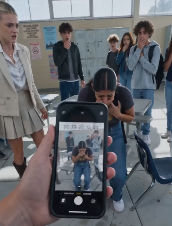
Phones came up.
Blair Whitmore stood in front of me holding the empty container.
Her cream tweed blazer remained perfect. Her white silk blouse was untouched. Even her new leather boots looked too expensive for the wet pool deck.
She tilted her head as if I had forced her to humiliate me.
“You should have stopped lying,” she said.
Pasta clung to my hair.
A piece of cucumber slid down my sleeve.
I wanted to wipe everything away, run into the locker room, and stay there until every student had gone home.
Instead, I tightened my grip on the printed lifeguard schedule in my hand.
That paper mattered more than the laughter.
“My name was removed,” I said.
Blair’s expression hardened.
“Because you were never assigned.”
“I covered the shift.”
“No, you didn’t.”
“The camera will show it.”
The students nearest us stopped laughing.
Blair looked toward the black security dome above the pool entrance.
Only for a fraction of a second.
But I saw it.
Fear.
My name is Mina Haddad. I was seventeen years old, Lebanese American, and a senior at Crestview High School in San Diego.
I was not popular.
I was not invisible either.
I belonged to the group of students adults described as dependable when they wanted extra work completed without offering extra credit.
I organized first-aid supplies for the aquatic club. I checked emergency radios before swim meets. I stayed after practice to stack kickboards and test lane alarms.
My mother managed a small bakery with my aunt. My father drove city buses. Neither of them had ever attended a donor dinner or sat on a school board.
Blair’s father, Gregory Whitmore, ran the Crestview Advancement Fund.
His name appeared on the aquatic center wall beneath a silver plaque thanking the Whitmore family for “transformative leadership.”
That plaque hung directly across from the emergency equipment cabinet whose broken alarm I had reported three times.
The trouble began with a safety certification test.
Every student lifeguard had to complete one before helping at school swim events. The assessment included water rescue, emergency response, and deck supervision.
It was supposed to be noncompetitive.
But passing it made students eligible for paid weekend shifts at district pools.
Blair wanted the lead student coordinator position.
So did I.
The coordinator did not receive much money, but the position came with a recommendation from the athletic department and a scholarship interview through a local recreation foundation.
Two days before the test, Coach Dana Ruiz posted the lifeguard schedule.
My assigned shift was Thursday from 3:30 to 5:30.
Blair’s was Friday morning.
Then, late Wednesday night, the online schedule changed.
My name disappeared from Thursday.
Blair’s appeared in its place.
I did not see the change until Thursday afternoon, when I arrived at the pool and found no adult lifeguard on deck.
The junior swim club was already practicing.
Coach Ruiz had been called into an emergency staff meeting. The assistant coach believed another certified guard had been assigned. The front-office substitute had opened the pool without checking.
Twenty-two middle school swimmers were in the water.
No qualified adult was watching them.
I knew I should have closed the pool immediately.
I also knew getting twenty-two excited swimmers out of the water without causing panic would take time.
So I took the lifeguard chair, radioed the office, and began clearing lanes one group at a time.
That was when twelve-year-old Noah Kim slipped beneath the surface.
He had been practicing underwater turns near the deep end. Another swimmer accidentally kicked him near the temple.
From the chair, I saw his body stop moving.
I blew the whistle, dove in, and pulled him up.
He was conscious by the time I reached the wall, but disoriented and coughing.
The nurse examined him. His parents took him to urgent care. He suffered a mild concussion, but he recovered fully.
Everyone called it a close call.
What nobody seemed willing to ask was why the pool had opened without the correct lifeguard.
The official incident summary stated that Blair Whitmore had been assigned to the shift and had arrived “moments after the emergency.”
That was false.
Blair arrived forty-three minutes later.
She came through the side entrance carrying an iced coffee and wearing dry clothes.
By then, Noah had already left with his mother.
I had completed the incident report.
Coach Ruiz thanked me for preventing a far worse outcome.
Then Gregory Whitmore arrived.
He spoke privately with Principal Martin and the athletics director.
The next morning, the online schedule showed Blair assigned to Thursday’s shift.
My name was gone.
The incident report was revised.
Under “responding guard,” it listed:
BLAIR WHITMORE — STUDENT AQUATICS COORDINATOR.
My name appeared only as “student witness.”
I printed the original notification email showing my assignment.
Then I checked the schedule history.
The change had been made Thursday at 4:58 p.m.
That was after Noah’s accident.
Someone had altered the schedule retroactively.
I took the printout to Coach Ruiz.
She stared at it for a long time.
“This is not the version I posted.”
“Can you restore it?”
“I need to speak with administration.”
“Why?”
“Because the schedule system is connected to district records.”
“Someone changed it.”
“I understand.”
“Then why does this need a meeting?”
Her eyes moved toward the donor plaque.
“Mina, please give me one hour.”
I waited three.
At lunchtime, Blair found me near the science hallway.
She was surrounded by three friends from student leadership.
“You’re telling people I skipped a shift,” she said.
“I told Coach Ruiz the schedule was changed.”
“You accused my father.”
“I never mentioned your father.”
“You didn’t have to.”
She stepped closer.
“Delete the screenshot.”
“No.”
“It is a school record.”
“It was sent to my account.”
“You were never supposed to be assigned.”
“Coach Ruiz made the schedule.”
“She corrected a mistake.”
“After the accident?”
Her friends stopped smiling.
Blair lowered her voice.
“You have no idea what happened.”
“I know you were not there.”
“You want people to think you saved some child.”
“I did what I was trained to do.”
“You love making yourself look noble.”
“I didn’t change the incident report.”
Her jaw tightened.
“The report is accurate.”
“It says you responded.”
“I coordinated afterward.”
“You arrived after Noah left.”
One of her friends whispered, “Blair, let’s go.”
But Blair did not move.
“You think because your family works hard, you own every story about hard work.”
The sentence stunned me.
“What does my family have to do with this?”
“You are always wearing responsibility like it makes you better than everyone.”
“I just want the original record restored.”
“No,” she said. “You want attention.”
Then the bell rang.
Students flooded the hallway.
Blair stepped back and smiled as though we had been having an ordinary conversation.
“Be careful, Mina. People don’t like liars.”
By the afternoon, the story had spread.
According to the rumor, I had entered the pool without authorization, disrupted practice, and exaggerated Noah’s accident to make myself look heroic.
Some students said I wanted Blair’s coordinator position.
Others said my family planned to sue the school.
One post claimed I had shoved another swimmer aside while attempting an unnecessary rescue.
The truth became less interesting with every retelling.
The following Monday, the school held a mandatory aquatic safety meeting on the pool deck.
Principal Martin said it would address “misinformation and student conduct.”
I knew the phrase meant me.
Parents sat in folding chairs beside the shallow end. Student lifeguards lined the wall. Athletic staff stood near the emergency cabinet.
Blair arrived with her father.
Gregory Whitmore wore a navy suit and a calm expression. He greeted teachers by name and shook hands with Principal Martin before taking a seat at the front.
His daughter sat beside him like someone attending an award ceremony.
Coach Ruiz looked exhausted.
Principal Martin began.
“Recent events have created confusion regarding supervision procedures and student responsibilities.”
Confusion.
Not a changed record.
Not an absent lifeguard.
Confusion.
He continued.
“No student should act beyond the authority assigned to them.”
Every face turned toward me.
My stomach tightened.
I raised my hand.
Principal Martin ignored it.
“The administration has reviewed the official schedule and incident report. Those records identify Blair Whitmore as the assigned student coordinator.”
Blair’s father folded his hands.
A few students nodded as if the matter were settled.
I stood.
“The record was changed after the accident.”
Principal Martin stopped.
“Mina, you will have an opportunity to speak privately.”
“The accusation was made publicly.”
“This is not an accusation.”
“You just said I acted without authority.”
“You entered an active pool.”
“Because nobody else was supervising it.”
Gregory Whitmore spoke for the first time.
“Principal Martin, perhaps the student is emotionally overwhelmed.”
His voice was gentle.
Concerned.
That made it worse.
“I’m not overwhelmed,” I said.
He looked at me as though I had interrupted an adult discussion.
“My daughter has endured several days of hostile rumors.”
“Your daughter was not at the pool.”
Blair stood.
“I was covering the shift.”
“No, you weren’t.”
“I stepped away to retrieve emergency supplies.”
“For forty-three minutes?”
“I don’t have to explain every movement to you.”
“You arrived with coffee.”
The crowd reacted.
Her face reddened.
Gregory placed a hand on her arm.
“Mina,” he said, “publicly attacking another student will not change official records.”
“I’m not attacking her.”
“You are accusing her of dishonesty.”
“The timestamp does that.”
I held up the printed schedule.
Principal Martin’s expression changed.
“Where did you obtain that?”
“It was emailed to me before the shift.”
“That document may not reflect the final schedule.”
“The final schedule was changed at 4:58, after the accident.”
Coach Ruiz closed her eyes.
Gregory Whitmore looked toward Principal Martin.
Blair moved before either man could speak.
She grabbed a catering container from the refreshment table, tore off the lid, and dumped pasta salad onto my face.
The pool deck erupted.
Someone shouted.
A chair scraped backward.
Cold dressing ran into my eyes.
Blair pointed at me.
“She has been harassing me for a week!”
Phones rose everywhere.
Gregory pulled his daughter toward him but did not look shocked.
That was the detail I remembered later.
He did not look like a father surprised by his daughter’s behavior.
He looked like a man whose plan had moved too soon.
Coach Ruiz rushed to me with towels.
“Are you hurt?”
“I’m fine.”
I was not fine.
My face burned from embarrassment.
My hands shook so badly that the printed schedule rattled.
Principal Martin ordered students to put their phones away.
Nobody did.
Gregory Whitmore stood.
“This meeting is over.”
“No,” I said.
The word came out louder than I expected.
Everyone looked at me.
I wiped dressing from my cheek.
“The camera will show who was there.”
Blair’s face changed.
Principal Martin responded too quickly.
“The pool footage is subject to student privacy restrictions.”
“Then review it privately.”
“The administration already reviewed the relevant records.”
“Did you review the camera?”
Silence.
Coach Ruiz looked at him.
“Martin?”
He adjusted his tie.
“The security system experienced a temporary storage failure.”
A murmur moved through the room.
I stared at him.
“The camera failed during the accident?”
“The footage was unavailable.”
“Then why did Blair look at it when I mentioned it?”
Blair snapped, “Because you keep making things up!”
The side door opened.
A woman entered carrying a black district tablet and a sealed evidence bag.
I recognized her as Dr. Sofia Alvarez, the district’s director of risk management. Behind her came the school resource officer and an information-technology specialist.
Principal Martin went pale.
“Dr. Alvarez, we were not expecting you.”
“I know.”
She looked at me, then at the food covering my clothes.
“What happened?”
Coach Ruiz answered.
“Blair dumped food on Mina.”
Gregory Whitmore stepped forward.
“My daughter reacted after sustained provocation.”
Dr. Alvarez looked at him.
“She reacted by throwing food at another student?”
“She felt threatened.”
“Did Mina touch her?”
“No,” Coach Ruiz said.
Blair glared at her.
Dr. Alvarez turned to me.
“Are you willing to make a statement?”
“Yes.”
“First, the nurse will examine you.”
“I want the record opened.”
“It will be.”
Principal Martin interrupted.
“The pool footage was lost.”
Dr. Alvarez held up the evidence bag.
Inside was a small black memory unit.
“No. The main server copy was deleted.”
The entire deck became silent.
She continued.
“The camera maintains an internal emergency backup for seventy-two hours. The district retrieved it Friday morning.”
Blair stopped breathing for a second.
Gregory Whitmore’s calm expression vanished.
“Why was the donor fund not informed of an investigation involving its facility?”
“Because the donor fund does not supervise student safety records.”
“My organization paid for that camera system.”
“That does not give you ownership of its footage.”
Dr. Alvarez connected the tablet to the pool display screen.
Principal Martin stepped toward her.
“There are minors visible in the recording.”
“The public portion will show only the entryway and lifeguard chair. Any protected footage will remain restricted.”
The video opened.
Thursday.
3:27 p.m.
I entered through the main pool doors wearing my red student-lifeguard shirt.
3:31.
I checked the empty guard chair.
3:33.
I used the wall radio.
3:36.
I climbed into the chair and began clearing lanes.
Blair was nowhere in sight.
At 3:48, Noah disappeared beneath the water.
The camera angle did not show him clearly, but it showed me blowing the whistle, leaving the chair, and diving into the deep end.
Students on the deck leaned toward the screen.
At 3:50, I pulled Noah toward the wall.
At 3:53, Coach Ruiz and the nurse entered.
At 4:31, Noah left with his mother.
At 4:34, Blair arrived carrying an iced coffee.
No one spoke.
The truth had no music behind it.
No dramatic explanation.
Only timestamps.
Blair stared at the screen as though it had betrayed her.
Dr. Alvarez paused the video.
“Mina was present for the entire shift.”
Coach Ruiz nodded.
“She covered the pool until I arrived.”
Dr. Alvarez looked at Principal Martin.
“Why does the official incident report identify Blair as the responding coordinator?”
He swallowed.
“I relied on the schedule record.”
“The schedule was changed at 4:58.”
Gregory Whitmore stepped forward.
“Then someone corrected an administrative error.”
Dr. Alvarez opened another file.
“The original schedule was created by Coach Ruiz on Monday at 6:14 p.m. Mina Haddad was assigned to Thursday. Blair Whitmore was assigned to Friday.”
Blair shook her head.
“That is wrong.”
“The system history confirms it.”
“My father told me I had Thursday.”
Every eye turned toward Gregory.
His face tightened.
“You misunderstood.”
“No, I didn’t.”
“Blair,” he warned.
She looked frightened now.
Not because of me.
Because of him.
Dr. Alvarez opened the account history.
“At 4:58 p.m., Mina’s name was removed and Blair’s was inserted.”
“By whom?” Coach Ruiz asked.
Dr. Alvarez enlarged the username.
BWHITMORE_STUDENTLEAD.
Blair stared at it.
“That’s my account.”
The crowd reacted.
She looked at her father.
“I didn’t change it.”
Gregory stood.
“This proves her account may have been compromised.”
Dr. Alvarez nodded.
“That possibility was investigated.”
She opened the login details.
“The change was made from the advancement office.”
That office belonged to Gregory Whitmore.
Principal Martin took a step backward.
Gregory’s expression became cold.
“Many people enter that office.”
“The computer requires a physical security card.”
He said nothing.
“Your card opened the room at 4:51,” Dr. Alvarez continued. “Blair’s student account was used seven minutes later.”
Blair stared at him.
“Dad?”
He turned toward her.
“Do not say anything.”
“You used my account?”
“Be quiet.”
“You told me the schedule already had my name.”
“Blair.”
“You said the school made a mistake.”
His voice sharpened.
“I said stop talking.”
The command echoed across the pool deck.
For the first time, everyone saw what Blair normally hid beneath confidence.
She was afraid of her father.
Dr. Alvarez looked at Gregory.
“Why did you alter the schedule after a student was injured?”
“I did not.”
“The access trail says otherwise.”
“Digital trails can be manipulated.”
“So can students,” I said.
He looked at me with sudden hatred.
That was when I understood the schedule was only part of it.
He had not changed one name simply to protect Blair from embarrassment.
Something larger was hidden inside the incident.
Dr. Alvarez opened the original emergency report.
I recognized my own typing.
At the bottom was a note I had entered after Noah left.
POOL DECK EMERGENCY ALARM FAILED TO ACTIVATE. WALL RADIO CONNECTION INTERMITTENT. PRIOR MAINTENANCE REQUESTS RECOMMENDED FOR REVIEW.
Dr. Alvarez looked toward the emergency cabinet.
“Who was responsible for the recent aquatic safety upgrades?”
Nobody answered.
Then Coach Ruiz looked at Gregory Whitmore.
“The donor fund.”
Gregory’s jaw tightened.
The Whitmore Advancement Fund had paid for the new alarm system six months earlier. A ceremony had been held beside the pool. Photographs showed Blair cutting a blue ribbon while her father described the system as state-of-the-art.
But during Noah’s emergency, the alarm had failed.
I had pressed it twice.
Nothing happened.
I used the wall radio instead.
Dr. Alvarez opened the maintenance history.
Three reports had warned that the alarm disconnected randomly when the pool humidity increased.
All three were submitted by Coach Ruiz.
All three were marked resolved.
“Who closed these requests?” Dr. Alvarez asked.
The screen showed an administrative code.
GMWHITMORE_ADV.
Gregory’s face remained still.
“You did not inspect the alarm,” Coach Ruiz said.
“Our vendor confirmed it was functioning.”
“Which vendor?”
He said nothing.
Dr. Alvarez opened an invoice.
WHITMORE FACILITIES GROUP.
The company belonged to Gregory’s brother.
The donor fund had awarded the installation contract to a family business.
Repair requests were closed without repairs because acknowledging the failure would expose the conflict.
The schedule was changed to make Blair appear responsible for the rescue.
If the donor’s daughter had saved Noah, the failed alarm would become a minor detail inside a heroic family story.
If I remained the responding guard, my incident note would require a formal safety investigation.
I looked at Blair.
“Did you know about the alarm?”
She shook her head.
Her face had gone pale.
“My father said you were trying to take credit for something I organized.”
“You organized the safety campaign photographs.”
“I thought the system worked.”
“You knew you were not at the pool.”
She began crying.
“I knew that.”
Gregory grabbed her arm.
“We are leaving.”
The resource officer stepped between him and the exit.
“Sir, remain here.”
“You cannot detain me.”
“The district has requested that you remain available while administrators determine whether student records were falsified.”
Gregory looked toward Principal Martin.
“Do something.”
Principal Martin did not move.
Dr. Alvarez turned to him.
“Did you authorize the revised incident report?”
His face collapsed.
“I was told Blair had coordinated remotely.”
“By whom?”
He looked at Gregory.
No one needed more explanation.
But Dr. Alvarez asked again.
“By whom?”
“Mr. Whitmore.”
Gregory laughed bitterly.
“You approved the report.”
“Because you said the donor board would suspend aquatic funding if the school publicly blamed the new system.”
Coach Ruiz stared at the principal.
“You traded a safety investigation for funding?”
“I was protecting the program.”
“No,” she said. “You were protecting a donor.”
Gregory turned toward the crowd.
“This school would not have a pool without my family.”
Dr. Alvarez replied, “A building does not become safe because your name is on it.”
The words struck the room harder than any accusation I could have made.
Blair sat down on a folding chair.
She looked at the empty pasta container near my feet.
“What happens now?” she whispered.
Dr. Alvarez did not answer immediately.
The district suspended Principal Martin that afternoon.
Gregory Whitmore was removed from the advancement board pending investigation.
The school shut down the pool until the alarm, communication system, and supervision procedures could be independently inspected.
Blair received a suspension for assaulting me, making false statements, and allowing an inaccurate incident account to remain uncorrected.
But the investigation uncovered one more thing.
The original schedule had not been changed only after Noah’s accident.
Someone had attempted to alter it Wednesday night.
The attempt failed because the system required Coach Ruiz’s approval.
That login also came from Blair’s account.
When Dr. Alvarez questioned her again, Blair admitted the truth.
Her father had asked for her password two days before the safety test.
He told her he wanted to “correct a staffing imbalance.”
He wanted Blair assigned to Thursday because local reporters were expected to photograph the new safety system that afternoon.
Blair was supposed to appear in the lifeguard chair for publicity.
But she arrived late because she had gone shopping with friends.
Her father did not learn she had missed the shift until after Noah’s accident.
Then he rewrote the schedule.
Blair had not planned the altered record.
But she had agreed to the lie afterward.
She knew I saved Noah.
She knew she arrived late.
She watched adults credit her anyway.
And when I refused to disappear, she dumped food on my face.
Two weeks after her suspension, she asked to speak with me.
We met in the counselor’s office.
Blair did not wear her tweed blazer.
She wore a plain sweatshirt, jeans, and old sneakers.
Without the polished clothes and crowd around her, she looked younger than eighteen.
“I’m not asking you to forgive me,” she said.
“Good.”
She nodded slowly.
“I told the district everything.”
“I heard.”
“My father says I destroyed our family.”
“You told the truth.”
“He says those are the same thing.”
“They aren’t.”
She looked toward the window.
“My whole life, he told me our name created opportunities for everyone. I thought people criticized us because they were jealous.”
“And now?”
“Now I think he created opportunities where people had to stay quiet to keep them.”
The answer was more honest than I expected.
“Why did you throw the food?” I asked.
Her eyes filled.
“Because when you mentioned the camera, I knew you were right.”
“You already knew I was right.”
“I knew you were there. But I kept telling myself the record mattered more than memory. If the schedule said I was assigned, maybe people would believe I had some role.”
“So you wanted me humiliated before they checked.”
“Yes.”
She wiped her face.
“I thought if everyone laughed at you, adults would treat your evidence like revenge.”
That had nearly worked.
The crowd had watched the food first.
The administrators had called the record official.
Her father had counted on shame becoming stronger than timestamps.
“What are you going to do now?” I asked.
“My mother and I are moving in with my aunt.”
“Your mother left him?”
“She says she should have left years ago.”
Blair looked at me.
“I’m applying to a different school for the spring term.”
I did not feel sorry for her.
Not completely.
But I no longer saw her as untouchable.
She had been protected by power and controlled by it at the same time.
That did not excuse her choices.
It explained why making a different one now mattered.
“You should learn lifeguarding again,” I said.
She looked startled.
“What?”
“You passed the physical test, but you don’t understand what the job is.”
Her cheeks reddened.
“I know it means watching the water.”
“No. It means taking responsibility before you know who will praise you.”
She lowered her eyes.
“You’re right.”
The district completed its investigation in March.
The final report found that Gregory Whitmore had manipulated student records, pressured administrators, concealed safety defects, and used donor funding to direct school decisions.
His brother’s company lost the aquatic contract.
The district referred the financial records to state investigators.
Principal Martin resigned.
The school removed the Whitmore plaque from the pool wall.
Coach Ruiz became interim athletics safety director.
The repaired alarm was tested every morning, and no pool could open unless two authorized adults confirmed coverage through a public schedule system that preserved every change.
Noah returned to the water.
His first day back, he stood at the edge of the shallow end for nearly five minutes.
I waited beside him.
“You don’t have to jump,” I said.
“I know.”
“You can sit.”
“I know.”
He looked at the deep end.
“Did you get scared after pulling me out?”
“Yes.”
He seemed surprised.
“I thought lifeguards weren’t supposed to be scared.”
“We’re supposed to notice danger while we’re scared.”
He nodded.
Then he stepped into the pool.
Slowly.
One foot at a time.
By the end of practice, he swam an entire lap.
His mother cried from the bleachers.
At the spring awards ceremony, the district offered me the student aquatics coordinator position.
I accepted only after Coach Ruiz agreed to change the role.
The coordinator would no longer be selected through donors or popularity-based recommendations. Candidates would be evaluated through attendance, safety decisions, training, and verified service hours.
The local recreation foundation also awarded me its public-safety scholarship.
When my name was announced, my parents stood so quickly that my father knocked over his chair.
My mother laughed while crying.
The ceremony took place in the same aquatic center where Blair had dumped food on me.
The refreshment table stood in the same corner.
The camera still faced the entrance.
But the donor plaque was gone.
In its place hung a simple sign:
SAFETY RECORDS EXIST TO PROTECT PEOPLE, NOT REPUTATIONS.
After the ceremony, Coach Ruiz handed me a framed copy of the original lifeguard schedule.
My name appeared beside Thursday’s shift.
“You kept this?” I asked.
“I printed it before the system was altered.”
“Why didn’t you show it sooner?”
Shame moved across her face.
“I was afraid the donor fund would cut the program.”
“You knew?”
“I knew you were assigned. I did not know Gregory had changed the record until after the accident.”
“But you stayed quiet.”
“Yes.”
I waited for an excuse.
She did not offer one.
“I failed you,” she said. “I told myself I needed time to protect the entire team. But every hour I waited made it easier for them to isolate you.”
I looked at the framed schedule.
“Why tell me this now?”
“Because apologies without accuracy become another kind of cover-up.”
That sentence stayed with me.
The camera footage proved I was there.
The schedule history proved Gregory changed the record.
The maintenance reports proved the alarm had failed.
But the hardest truth was not stored in any file.
Good people had hesitated.
Coach Ruiz hesitated because she feared losing the program.
Principal Martin surrendered because he feared losing donor money.
Students laughed because they feared standing apart from the crowd.
Each silence gave the lie another minute to grow.
Months later, Blair sent me a photograph.
She was wearing a red lifeguard shirt at a community recreation center near her aunt’s home.
Her message said:
I started over. No cameras, no donor events, and nobody here knows my father. Yesterday a little boy slipped near the shallow end. I caught him before he fell. Nobody applauded. I think I finally understood what you meant.
I stared at the message for a long time.
Then I replied:
That is the job.
She responded with two words.
I know.
I never became her friend.
Forgiveness did not require pretending the harm had been small.
But I believed she was changing.
That was enough.
On the last day of senior year, I entered the pool before sunrise.
The building was empty except for Coach Ruiz completing equipment checks.
Morning light moved through the high windows and painted pale blue lines across the water.
I climbed into the lifeguard chair.
From there, I could see the repaired alarm, the public schedule monitor, and the camera whose backup had preserved the truth.
The screen displayed that morning’s assignments.
Every name appeared beside a timestamp and approval record.
No hidden changes.
No donor access.
No rewritten history.
My name was listed first.
MINA HADDAD — OPENING SAFETY CHECK.
I thought about the moment pasta salad struck my face.
Blair believed humiliation would end the conversation.
Her father believed an official-looking record could replace what actually happened.
The school believed donor money was strong enough to make danger negotiable.
They were all wrong.
Records are not powerful simply because they exist.
They become powerful when someone refuses to let the wrong person rewrite them.
The camera had shown me entering the pool.
It had shown me taking the chair.
It had shown me diving when Noah disappeared.
But it had also shown something no schedule could manufacture.
I had been there before anyone knew there would be praise.
That was the detail Gregory Whitmore could never reproduce.
He could move names.
He could pressure administrators.
He could attach his family to a heroic report.
But he could not go backward and place Blair beside the water when a child needed help.
I climbed down from the chair and walked toward the control room.
Coach Ruiz looked up.
“Ready to open?”
I checked the alarm.
Tested the radio.
Confirmed the rescue equipment.
Then I looked at the schedule one final time.
“Ready.”
She unlocked the doors.
A few minutes later, the first swimmers entered, laughing and complaining about the early hour.
None of them knew how close the pool had come to remaining under the control of a false record.
That was fine.
Safety was not supposed to feel dramatic.
It was supposed to work quietly before anything went wrong.
I took my place beside the water.
No crowd watched.
No phones rose.
No donor waited to claim the moment.
And for the first time, that felt like the greatest recognition I could receive.
I was there.
The record was correct.
And nobody would ever again be allowed to turn my silence into their story.
THE END
