The slap sounded louder than the camera shutter that captured it.
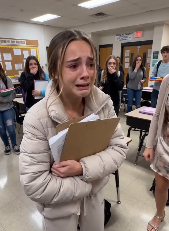
Isabelle Vaughn’s jeweled bracelet flashed beneath the fluorescent lights as her hand struck the left side of my face. My head turned sharply, and the envelope I was holding slipped from my fingers.
Printed photographs scattered across the yearbook-room floor.
For one suspended second, nobody moved.
Then the room filled with gasps, chair legs scraping against tile, and the electronic chirps of students unlocking their phones.
Isabelle stood in front of me in a silk floral dress, a pale cardigan, and jeweled sandals that looked absurdly delicate for a rainy school day in Richmond. Her dark hair fell in perfect waves around her shoulders. She looked ready for a spring luncheon rather than an after-school yearbook meeting.
I wore a light puffer jacket, track pants, and gray sneakers stained with rainwater.
The contrast was exactly what she wanted.
She looked polished.
I looked defensive.
She pointed at me before I had even raised a hand to my burning cheek.
“She stole private photographs from my account!”
The accusation moved through the room faster than the truth could catch it.
“What photos?”
“Did Iris hack the yearbook drive?”
“She’s been trying to ruin theme week.”
“I heard she was angry because Isabelle rejected her layout.”
Phones rose higher.
The students who had seen Isabelle slap me did not step forward.
They watched.
That was the power of a public scene. It did not matter what happened first if the loudest person explained it quickly enough.
My name is Iris Lewis. I was seventeen years old, a junior at Richmond Heights High School, and one of the yearbook’s archive assistants.
Archive assistant sounded important.
It was not.
It meant I labeled digital folders, matched student names with photo-release forms, backed up event images, and checked whether anyone had been accidentally excluded before pages went to print.
It was quiet work.
I liked that.
Photographs did not interrupt, flatter donors, or change their stories because the room became uncomfortable. They preserved small things people forgot: who stood at the edge of the stage, who carried chairs after an assembly, who attended an event even when the final caption ignored them.
That week, the yearbook staff was voting on the senior-edition theme.
Isabelle wanted “LEGACY IN BLOOM,” a glossy design filled with garden imagery, formal portraits, and profiles of prominent student families.
Her mother had already offered to fund embossed covers if the staff approved it.
Another group supported “EVERY FRAME COUNTS,” a theme built around candid photographs and overlooked moments from the school year.
I preferred the second theme, but I had not campaigned publicly for either one.
I was too busy checking the archive after three students complained that their photographs had disappeared from draft pages.
The first missing student was Darius Bennett, a wheelchair user who managed the basketball team. His photograph had been removed from the winter sports spread, though he appeared in the original team image.
The second was Linh Tran, who had designed the robotics club’s competition machine. Her image was missing from the engineering page, while a donor’s son who attended only one meeting appeared twice.
The third was Mateo Ruiz, a cafeteria employee’s son who had performed the lead role in the fall play. In the draft, he had been replaced by a rehearsal photograph centered on Isabelle’s friend, who played a smaller part.
Three removals could have been mistakes.
But all three shared one detail.
They had been marked with the same internal code:
AESTHETIC HOLD.
That code was not supposed to exist.
Our official photo statuses were simple: approved, pending release, duplicate, low resolution, or unidentified.
“Aesthetic hold” was not a technical category.
It was a judgment.
I first noticed it on Tuesday afternoon while checking the theater folder.
I asked Isabelle because she was yearbook editor in chief.
She did not look away from her laptop.
“Some photos do not fit the visual direction.”
“Mateo’s photograph is clear.”
“It is badly framed.”
“He is centered.”
“The background is cluttered.”
“It shows the set he helped build.”
She sighed.
“Iris, design requires editing.”
“Why is the replacement photo from rehearsal?”
“Because it looks better.”
“It centers Caroline Price.”
“Caroline photographs well.”
“Mateo was the lead.”
“The page is about the production, not one actor.”
I looked at the winter sports spread.
“Then why was Darius removed from the basketball photo?”
“He was partially blocked.”
“No, he wasn’t.”
“His chair disrupted the crop.”
The sentence sat between us.
She realized how it sounded and closed the laptop.
“You are trying to make routine decisions offensive.”
“I’m trying to understand the standard.”
“The standard is that the pages must look professional.”
“Professional for whom?”
Her jaw tightened.
“You are an archive assistant. Your responsibility is organizing files, not challenging editorial decisions.”
“My responsibility includes checking omissions.”
“These are not omissions.”
“They are students who disappeared.”
Isabelle leaned closer.
“Do not turn layout work into a moral performance.”
I did not argue.
Instead, I checked the original image archive.
Every photograph imported into the yearbook system kept a hidden record: creation time, camera model, photographer, upload account, crop history, deletion attempts, and export destination.
Most students never opened that information.
I did.
The metadata showed that Darius’s team photograph had been uploaded correctly and approved by the sports editor. Two days later, someone duplicated it, cropped him out, and replaced the approved version.
Linh’s robotics photograph had not been low resolution, as the layout notes claimed. It had been exported at full quality before being moved into the hidden “hold” folder.
Mateo’s image had been manually removed after the theater adviser approved it.
All three changes came from Isabelle’s editor account.
That alone did not prove a scheme.
As editor in chief, she had authority to modify layouts.
Then I noticed the timing.
Each removal occurred minutes after a private review folder had been accessed by an external account labeled:
RVANESSE_FOUNDATION.
The Vanesse Foundation was chaired by Isabelle’s mother, Lydia Vaughn.
It was also the largest private donor to the yearbook program.
I printed the relevant metadata pages and placed them in an envelope.
I planned to give them quietly to Ms. Evelyn Carter, our yearbook adviser, before theme voting began.
I did not want drama.
I wanted an adult to check the record.
But when I entered the yearbook room, Isabelle was already there with half the staff gathered around her.
She smiled when she saw the envelope.
Then she looked at my face and knew.
“What are you carrying?” she asked.
“Archive records.”
“For what?”
“I need to speak with Ms. Carter.”
“She is meeting with the principal.”
“I can wait.”
Isabelle stepped in front of the adviser’s desk.
“You have been accessing restricted files.”
“I have archive permission.”
“Not for editor review folders.”
“The removal history appears in the main archive.”
She looked toward the students around us.
“Iris has been digging through private accounts because she is angry about the theme vote.”
“That is not true.”
“She has been collecting screenshots of my work.”
“I printed the image histories.”
“Without authorization.”
“The photographs belong to the school.”
“My editorial notes do not.”
“I did not print your notes.”
She extended her hand.
“Give me the envelope.”
“No.”
The room grew quiet.
Isabelle was accustomed to people obeying before she had to explain why.
Her smile vanished.
“You do not understand what those records mean.”
“Then Ms. Carter can explain them.”
“You are going to create a scandal over ordinary cropping decisions.”
“Three students were removed after their photos were approved.”
“Because the pages changed.”
“All three removals came after your mother’s foundation account opened the review folder.”
That was when she slapped me.
Now the evidence lay across the floor.
Isabelle pointed at the photographs as though their existence proved I had committed a crime.
“She stole those from my account.”
I crouched to gather them.
My hands shook so badly that the pages rattled.
Isabelle reached down at the same time.
Her fingers closed around the sheet showing the access history.
I grabbed the opposite edge.
“Let go,” she whispered.
“No.”
She pulled harder.
The paper tore down the middle.
Several students gasped.
A boy from the photography team named Jordan Hale stepped between us.
“Stop touching the evidence.”
Isabelle stared at him.
“Evidence?”
“That is what she called it.”
“She fabricated it.”
Jordan picked up one of the fallen pages.
“This has system headers.”
“Anyone can fake headers.”
I looked at him.
“Check the file codes.”
Jordan read the page more closely.
He was one of the few students besides me who understood the archive software.
His expression changed.
“These are real.”
Isabelle’s voice sharpened.
“You do not know that.”
“The image identification numbers match the contact sheets.”
Her face tightened.
The crowd’s energy shifted.
Not completely.
But enough.
The public scene was still hers.
The quiet details were beginning to belong to the record.
The yearbook-room door opened.
Ms. Carter entered with Principal Elaine Foster and Lydia Vaughn.
Lydia looked like an older, more controlled version of Isabelle. She wore a cream suit, a gold brooch, and the expression of someone used to entering problems after others had prepared the room for her.
She saw the scattered pages.
Then she saw the red mark on my cheek.
“What happened?”
Isabelle rushed to her.
“Iris stole private files and threatened me.”
I stood slowly.
“She slapped me.”
Lydia looked at her daughter.
“Did you?”
“She grabbed me.”
“I did not touch her.”
Jordan spoke.
“I saw it. Isabelle slapped Iris.”
Several students looked at him in surprise.
He kept his eyes on Ms. Carter.
“She also tried to take the archive pages.”
Lydia’s expression hardened.
“This appears to be an emotionally charged disagreement among students.”
“An assault is not a disagreement,” Ms. Carter said.
Lydia turned toward her.
“Of course not. But accusations should be investigated carefully before anyone damages a young person’s future.”
I almost laughed.
She meant Isabelle’s future.
Not mine.
Principal Foster stepped forward.
“Everyone put away your phones.”
No one moved quickly.
She repeated the instruction.
This time, several students lowered them.
Ms. Carter looked at me.
“Are you hurt?”
“My cheek hurts.”
“Go to the nurse.”
“I want the files preserved first.”
Lydia sighed.
“Iris, no one is going to destroy your papers.”
“One was already torn.”
Isabelle folded her arms.
“She tore it while grabbing me.”
Jordan shook his head.
“That is not what happened.”
Principal Foster looked at the printed pages.
“What are these?”
I explained the missing photographs, the unauthorized status code, and the external foundation access.
Lydia interrupted.
“The foundation reviews materials connected to sponsored pages.”
“These were not sponsored pages,” I said.
“The yearbook as a whole is sponsored.”
“That does not give you authority to remove students.”
“No one was removed. Images were adjusted.”
“Darius disappeared from the team photo.”
“The crop improved composition.”
“Linh was removed from the robotics spread.”
“There were too many students in the frame.”
“Mateo was replaced on the theater page.”
“Editorial balance required a different photograph.”
Every answer came too quickly.
She knew each removal.
Ms. Carter looked at her.
“You reviewed those specific pages?”
Lydia’s expression remained calm.
“I provide general visual guidance.”
“You are not an editor.”
“I am the foundation liaison.”
“You are a donor.”
The room became silent.
Lydia smiled faintly.
“Without donors, there would be no embossed cover, expanded color section, or professional printing.”
Ms. Carter replied, “Donors do not choose which students deserve to appear.”
“Of course not.”
“Then why did your account access the review folder before every disputed photo was removed?”
Lydia looked toward Isabelle.
That glance lasted less than a second.
But I saw it.
So did Principal Foster.
“Open the archive,” the principal said.
Isabelle stepped toward the main computer.
“There is no need.”
Principal Foster looked at her.
“Do not touch it.”
Jordan sat at the workstation instead.
He logged in under his photography account and opened the central archive.
The original team photo appeared first.
Darius sat near the front, holding the team clipboard and smiling while players crowded behind him.
The approved crop included him.
The later version cut him out at the shoulder.
Someone in the room whispered, “That wasn’t accidental.”
Next came the robotics photograph.
Linh stood beside the machine with a soldering tool in one hand. The replacement image showed three students posing around the robot after the competition. None of them had built its navigation system.
Then came Mateo’s theater image.
He stood at center stage during the final bow.
The audience behind the camera was already standing.
The replacement showed Caroline Price beneath a cleaner spotlight.
Lydia spoke calmly.
“The alternate images are visually stronger.”
I turned toward her.
“Stronger for the students your foundation knows.”
“That is an offensive accusation.”
“The file history is not an accusation.”
Jordan opened the metadata panel.
The removal records appeared exactly as I had printed them.
User: IVAUGHN_EDITOR.
Before each edit, the external foundation account accessed the page.
Lydia folded her arms.
“Isabelle is editor in chief. She made lawful editorial decisions.”
Isabelle looked at her mother.
The words should have defended her.
Instead, she seemed alarmed.
“You told me the changes were required.”
Lydia’s eyes warned her.
“Do not mischaracterize our conversations.”
“You sent me the replacement photos.”
“I sent options.”
“You said the donor committee would withdraw the cover funding.”
The room went quiet.
Lydia’s expression became cold.
“Isabelle.”
“You said the yearbook needed families who represented the school well.”
“Stop talking.”
Ms. Carter looked at Lydia.
“What does that mean?”
Lydia turned toward her.
“It means prominent student programs require polished presentation.”
“Were the removed students considered unpolished?”
“I did not say that.”
“You said some families represent the school better,” I replied.
“That is not what I said.”
Jordan opened the folder’s message history.
A series of comments appeared beside the disputed pages.
The first was attached to Darius’s team photo.
CHAIR DISTRACTS FROM ATHLETIC ENERGY. USE CLEANER CROP.
The second was attached to Linh’s robotics image.
TOO TECHNICAL AND VISUALLY CROWDED. FEATURE DONOR-FACING STUDENTS.
The third was attached to Mateo’s theater photo.
LEAD IMAGE SHOULD REFLECT FAMILY SUPPORT AND PRESENTATION VALUE.
The comments came from RVANESSE_FOUNDATION.
Nobody spoke.
Lydia looked toward the screen as though she could force it dark through anger alone.
Principal Foster turned to her.
“Did you write these?”
“Those are incomplete excerpts.”
“Did you write them?”
“I reviewed dozens of pages.”
“That is not an answer.”
Lydia’s voice sharpened.
“The foundation has invested eighty thousand dollars in this publication over six years. We are entitled to ensure it does not become visually inconsistent.”
“You are not entitled to remove disabled students, scholarship students, or children of staff members because they do not match your preferred image.”
“I did not categorize them that way.”
“You did not need to write the categories. You selected the same pattern.”
Isabelle stood frozen beside her mother.
I had expected her to defend Lydia.
Instead, she looked betrayed.
“You said the adviser approved it.”
Ms. Carter stared at her.
“I approved none of these removals.”
Isabelle looked at Lydia.
“You told me she had.”
“I told you the pages had undergone review.”
“You said I was following school policy.”
“You are editor in chief. You are responsible for your decisions.”
The sentence landed heavily.
Lydia had directed the changes.
Now she was placing them entirely on her daughter.
Isabelle’s face went pale.
“You said you would explain if anyone questioned them.”
“I am explaining.”
“No. You are blaming me.”
Lydia’s voice dropped.
“You altered the files under your account.”
“Because you told me to!”
“You are eighteen years old.”
The cruelty in her tone stripped away every trace of protection.
Isabelle stared at her mother.
Then she looked at me.
For the first time since I had known her, she did not look polished, superior, or untouchable.
She looked frightened.
Principal Foster asked Jordan to preserve the entire folder.
He began copying the archive to a locked school drive.
A warning appeared.
EXTERNAL DELETION REQUEST PENDING.
Jordan leaned closer.
“Someone scheduled the disputed images for permanent removal at five o’clock.”
Ms. Carter looked at the clock.
It was 4:47.
“Cancel it.”
Jordan clicked the request.
The deletion order listed Isabelle’s account.
Lydia immediately spoke.
“There is your answer.”
Isabelle shook her head.
“I didn’t schedule that.”
“It is your username,” Lydia said.
“I didn’t.”
Principal Foster turned to Jordan.
“Check the device.”
He opened the security details.
The deletion request had been created at 8:14 that morning from a computer in the foundation office.
Lydia’s expression changed.
Principal Foster saw it.
“Your office?”
“Many volunteers use that room.”
Jordan examined the login.
“Isabelle’s password was used.”
Lydia regained control.
“Then Isabelle may have accessed the computer.”
“I was in first-period calculus,” Isabelle said.
“Attendance records can confirm that,” Ms. Carter replied.
Jordan opened the authentication history.
The login required a secondary approval code.
That code had been sent to a phone number ending in 4421.
Isabelle took out her phone.
“My number ends in 9086.”
Every eye turned toward Lydia.
She did not move.
Principal Foster asked, “What does your number end in?”
Lydia’s silence answered first.
Then she said, “That proves nothing. My phone may be listed as a parental recovery contact.”
Jordan checked.
“It is.”
Isabelle looked at her mother.
“You reset my password.”
“I manage several foundation-linked accounts.”
“You used mine to schedule the deletion.”
“Do not accuse me based on a technical record you do not understand.”
But Jordan understood it.
So did I.
The quiet photo evidence had already shown who removed the students.
Now the access history showed who intended to erase the original images permanently.
Still, something did not fit.
Lydia wanted the polished pages.
Isabelle followed her instructions.
But why schedule deletion during theme-voting week?
The hidden images had already been removed from the drafts.
Deleting the originals created unnecessary risk.
Unless the photographs contained something else.
I looked at the theater image again.
Mateo stood at center stage.
Behind him, near the curtain, two adults were speaking.
One was Lydia Vaughn.
The other was Assistant Principal Thomas Reed.
I enlarged the background.
Lydia appeared to be handing him an envelope.
“That photo,” I said.
Everyone looked at me.
“The deletion is not only about Mateo.”
Jordan zoomed in.
The envelope bore the logo of the Vanesse Foundation.
Assistant Principal Reed’s face was visible.
Principal Foster frowned.
“What was happening that night?”
Ms. Carter thought for a moment.
“The auditorium renovation bids were being reviewed.”
The Vanesse Foundation had funded part of the renovation.
Assistant Principal Reed chaired the vendor-selection committee.
Lydia’s husband owned a design and construction firm.
The room changed.
What began as unfair yearbook cropping suddenly pointed toward something much larger.
Principal Foster reached for her phone.
“Do not call anyone yet,” Lydia said.
The principal looked at her.
“Why?”
“Because you are about to create a baseless allegation from a background image.”
“I am calling district compliance.”
“This can be handled privately.”
“That is exactly how we arrived here.”
Jordan checked the creation date of the theater photograph.
It had been taken at 8:42 p.m. on the night before the auditorium contract was awarded.
The envelope exchange occurred in the background.
A second photo from the burst sequence showed Assistant Principal Reed placing the envelope inside his jacket.
A third showed Lydia pointing toward a set of bid documents on a nearby table.
The room was silent.
Isabelle sank into a chair.
“You knew those were in the photo?”
Lydia did not answer.
“You made me remove Mateo because the background showed you.”
“I told you the photograph was unsuitable.”
“You used me.”
Lydia’s face hardened.
“I protected this family.”
“You used my account.”
“I protected your position.”
“You made me slap Iris because I thought she was trying to destroy me.”
“No one made you strike her.”
The sentence was true.
That made it worse.
Lydia had manipulated Isabelle, but Isabelle had chosen the slap.
Both things could exist at once.
District compliance officers arrived less than thirty minutes later.
Assistant Principal Reed was removed from a basketball game and brought to the administrative office.
The envelope exchange became the center of an investigation into the auditorium contract.
The original bid records showed that Lydia Vaughn’s husband’s company had not submitted the lowest or safest proposal.
Yet it had won.
A payment ledger later revealed that the Vanesse Foundation had transferred money into a consulting account connected to Reed’s brother.
The background photograph was not enough by itself to prove bribery.
But it gave investigators the date, location, and people needed to open the correct financial records.
The photos Lydia wanted erased were preserved in three separate backups.
She had been so focused on removing the visible students that she forgot photographs also preserved what happened behind them.
The yearbook scandal spread through the school the next morning.
Students demanded that every removed photograph be restored.
Darius returned to the basketball page.
Linh appeared beside the robot she had built.
Mateo’s final-bow image became the center of the theater spread.
The fake “aesthetic hold” code was removed from the system.
Principal Foster suspended all foundation access to student publications.
Lydia resigned from the donor board before she could be formally removed.
Assistant Principal Reed was placed on leave and later charged after investigators uncovered financial misconduct connected to the auditorium contract.
Isabelle received a ten-day suspension for slapping me, attempting to seize records, and participating in unauthorized removals.
She was also removed as editor in chief.
Many students wanted her expelled from yearbook entirely.
I did not argue for her.
I did not argue against her.
That decision belonged to the adviser and disciplinary board.
For a while, I wanted nothing to do with her.
My cheek healed within days.
The memory of the room turning against me did not.
Students who had recorded the slap approached me with guilty expressions.
Some apologized.
Others said they had always suspected Isabelle.
That was a lie.
They had suspected whoever the room told them to suspect.
The most painful conversation came from Ms. Carter.
She asked me to meet in the yearbook office after school.
The room looked different without Isabelle’s floral planning boards and gold sample covers.
“I should have seen the pattern sooner,” she said.
“You approved the pages.”
“I approved earlier versions.”
“You let Isabelle’s foundation access continue.”
“Yes.”
“Why?”
Ms. Carter looked down at her hands.
“Because the program was underfunded. Lydia offered software, cameras, and printing support.”
“So you stopped checking what the money controlled.”
“I convinced myself donors were only giving suggestions.”
“The comments were not suggestions.”
“No.”
I waited for her to explain that she had been protecting the yearbook.
Instead, she said, “I failed the students whose photographs disappeared.”
That honesty mattered.
It did not erase the failure.
But it gave us somewhere to begin.
The staff held a new theme vote.
“LEGACY IN BLOOM” received four votes.
“EVERY FRAME COUNTS” received twenty-three.
The new cover showed a mosaic of small candid images rather than one polished portrait.
A custodian unlocking the gym.
Darius holding the basketball clipboard.
Linh soldering a wire.
Mateo standing beneath the final spotlight.
A cafeteria worker arranging breakfast trays.
Students painting scenery.
Teachers carrying boxes.
No image was larger than the others.
The point was not that everyone performed equal work.
The point was that no one became invisible simply because a donor preferred a cleaner frame.
Three weeks after her suspension ended, Isabelle asked to speak with me.
We met in the library conference room.
She wore jeans, a plain sweater, and simple shoes.
Without the silk dress and crowd around her, she looked like someone returning from a long illness.
“I know you don’t owe me a conversation,” she said.
“That’s true.”
She nodded.
“I am sorry I slapped you.”
I said nothing.
“I am sorry I accused you of stealing photographs. I knew the images were real.”
“You also removed them.”
“Yes.”
“Darius told you he wanted the team picture included.”
Her eyes filled.
“I remember.”
“Linh gave you the correct caption three times.”
“Yes.”
“Mateo thanked you for choosing his final-bow photograph.”
Her voice dropped.
“Yes.”
“And then you removed all of them.”
“My mother told me the donor committee had rejected the pages.”
“You knew donors were not supposed to decide.”
“I did.”
“Then why did you do it?”
She looked toward the window.
“Because every time I followed her instructions, people called me talented.”
The answer surprised me.
“She chose my clothes for events, selected my activities, rewrote my speeches, and told me which students looked right beside me in photographs. I thought that was what success felt like.”
“And when I brought the records?”
“I thought you were about to prove none of the decisions were mine.”
“So you slapped me.”
“Yes.”
“You wanted the room to see me as unstable before they looked at the files.”
“Yes.”
The apology did not make her innocent.
But she was no longer hiding inside vague language.
“What did you know about the envelope in Mateo’s photo?” I asked.
“Nothing. My mother only said the background contained confidential foundation material.”
“Did you ask what?”
“No.”
“Why?”
She gave a broken laugh.
“Because asking questions in my family was treated like betrayal.”
I thought about Lydia telling her she was responsible for her own account after directing every change.
“Are you testifying in the investigation?”
“Yes.”
“Even against your mother?”
“She used my login to schedule deletion. If I stay quiet, she will say I did it.”
There it was.
The second betrayal.
Lydia had not merely used Isabelle to remove students.
She had prepared to leave her daughter’s name on the final destruction order.
“If the files disappeared,” I said, “the record would blame you.”
“I know.”
“Does that change how you see what you did?”
“It makes me understand the structure. It does not excuse me.”
That was the most mature thing Isabelle had ever said to me.
I did not forgive her that day.
Forgiveness was not a prize awarded for one honest conversation.
But I believed she had finally stopped protecting the lie.
Isabelle testified before the school board and district investigators.
She admitted that she removed photographs after receiving instructions from her mother.
She also admitted that she knew the choices were unfair.
Her testimony helped prove that Lydia had used foundation influence to pressure student publications and disguise conflicts of interest.
Afterward, Isabelle did not return to yearbook.
She joined the school newspaper as a beginning fact-checker.
The adviser assigned her to verify names, dates, and quotes—quiet work with no glamorous title.
She accepted it.
Months later, she sent me a message.
I corrected a photo caption today. A freshman’s name had been left out. Nobody applauded, but it felt more honest than anything I did as editor.
I replied:
That is how records should work.
The final yearbook arrived two weeks before summer break.
Students gathered in the courtyard to open the boxes.
The embossed cover Lydia promised was gone.
The new cover was matte, simple, and crowded with hundreds of small images.
It was better.
I turned first to the winter sports section.
Darius was there.
He ran his fingers over the photograph and smiled.
“They almost made it look like I was never on the team.”
“You were always on the team.”
“I know. But sometimes people believe the book.”
That was why the work mattered.
Linh found her robotics page and laughed because the caption included the exact technical description she had submitted.
Mateo stared silently at the theater photograph.
The envelope exchange remained visible in the background.
District attorneys had asked whether we wanted to crop it after the investigation.
Mateo refused.
“It happened inside the frame,” he said. “Leave it.”
So we did.
The page caption did not accuse anyone.
It simply described the final bow and listed every cast and crew member.
The evidence remained quiet.
Anyone who knew the story could see it.
Anyone who did not still saw Mateo receiving the recognition he had earned.
At the yearbook signing party, I sat near the archive table.
Students wrote messages across one another’s pages.
Some were funny.
Some were sentimental.
Most would be forgotten.
Darius handed me his copy.
“Sign the team page.”
I wrote beneath his photograph:
YOU WERE NEVER OUT OF FRAME.
He read it and nodded.
Then Linh and Mateo brought theirs.
Soon a line formed.
Not because I had become popular.
Because the scandal made students realize the archive office was where their names were protected.
Ms. Carter announced that the following year, every photo removal would require a written reason and approval from two staff members. Students could appeal omissions before printing. External donors would have no access to editorial folders.
The school also created a student records committee.
I became its first chair.
I almost refused because the title sounded too visible.
Then my father reminded me that quiet work did not have to mean invisible work.
“People like you protect details,” he said. “But details also need someone willing to stand beside them.”
On the final day of school, I returned alone to the yearbook room.
The tables were clean.
The planning boards were empty.
Rain tapped against the windows, just as it had the afternoon Isabelle slapped me.
I opened the archive one last time.
The original images remained untouched.
Darius.
Linh.
Mateo.
The metadata preserved every attempt to remove them.
The old hidden status code still appeared in the audit history, though no one could use it again.
AESTHETIC HOLD.
I stared at the words.
They sounded harmless.
That was how exclusion often entered a system.
Not through a command that said erase this person.
Through softer language.
Cleaner crop.
Better balance.
Stronger image.
More representative family.
Professional appearance.
Each phrase made disappearance sound like design.
But the photographs told a different story.
Darius was part of the team.
Linh built the machine.
Mateo led the cast.
No donor comment could change what the camera had captured.
I closed the audit log and opened the photograph taken during the slap.
Jordan had submitted it as part of the disciplinary record.
In the image, my head was turned from the impact. Papers floated between Isabelle and me. Students stared from behind their phones.
It was not flattering.
For a moment, I understood the temptation to delete it.
Then I looked closer.
One page hung in the air with its printed metadata visible.
Behind Isabelle, Lydia was entering the room.
Her eyes were not fixed on her daughter.
They were fixed on the evidence.
The photograph preserved the entire structure of the moment.
The public attack.
The falling record.
The person behind the setup.
I did not add it to the yearbook.
Not every painful image belonged in a public book.
But I preserved it in the protected archive.
Evidence and humiliation were not the same thing.
The difference was purpose.
Isabelle wanted phones raised so the crowd would remember me as the girl who caused a scene.
The archive preserved the image so nobody could later claim the scene never happened.
I shut down the computer.
Before leaving, I looked at the yearbook cover displayed beside the door.
Hundreds of small photographs formed one larger image of the school.
No single family dominated it.
No donor decided who belonged.
Every frame counted because someone had checked.
Someone had noticed.
Someone had refused to let the quiet removal become permanent.
Isabelle’s slap had been loud.
Her accusation had been louder.
The crowd’s whispers nearly swallowed everything.
But the photo evidence did not need to shout.
It only needed to remain where the truth could find it.
I turned off the lights and stepped into the hallway.
For the first time all year, I was not carrying an envelope of proof.
I did not need to.
The correct photographs were already printed.
The names were restored.
And the lie that began with one hidden folder had ended inside the very frame Lydia Vaughn had tried hardest to erase.
THE END
