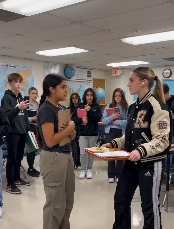
The cup of red fruit punch struck my chest before Scarlett Whitmore finished accusing me.
Cold liquid splashed across my band T-shirt, soaked into the waistband of my loose khakis, and dripped from the laces of my old Converse onto the geography-room floor.
The room erupted exactly the way she wanted.
Students gasped.
Chairs scraped.
Phones rose.
Someone near the windows laughed before realizing nobody else was laughing.
Scarlett stood beside the Model United Nations podium in her personalized embroidered bomber jacket, expensive joggers, and spotless designer sneakers. One premium wireless earbud remained in her left ear, as though even this public humiliation was not important enough to deserve her full attention.
She lowered the empty cup slowly.
“There,” she said. “Now maybe Hazel will stop pretending she’s the victim.”
My name was Hazel Ortiz. I was seventeen, Dominican American, and one of the student logistics assistants for Washington International Academy’s annual Model U.N. simulation.
I had entered the geography room carrying a plastic evidence sleeve.
Inside it was a small metal symbol shaped like an olive branch wrapped around a globe.
That symbol was supposed to identify the Security Council delegation authorized to submit emergency resolutions.
The symbol currently hanging from Scarlett’s delegate placard was not the original.
It was a copy.
And the original was in my hand.
My eyes burned from embarrassment. My fingers shook hard enough to make the plastic sleeve rustle.
But I did not wipe the punch from my shirt.
I held the evidence where everyone could see it.
“Ask Mr. Brennan to check the camera footage,” I said.
Scarlett laughed.
The sound was sharp, bright, and practiced.
“This is what she does,” she told the room. “She finds one tiny mistake and turns it into a conspiracy because she cannot stand that other people earned something.”
I looked toward the teacher’s desk.
Mr. Brennan, our geography teacher and Model U.N. adviser, had gone completely still.
That worried me more than Scarlett’s laughter.
He knew the symbol mattered.
Three months earlier, he had handed it to me personally and explained the protocol.
The school’s simulation involved six committees, more than one hundred students, and visiting judges from a national youth diplomacy organization. The winning delegation would receive invitations to a summer program in Geneva.
Scarlett represented the United Kingdom on the Security Council.
She was also student council president, captain of the debate team, and the daughter of Lydia Whitmore, chairwoman of the school’s private foundation.
People described Scarlett as confident.
Confidence was what adults called cruelty when it wore an expensive jacket and knew how to smile for photographs.
I served on the logistics team because I liked systems more than speeches.
Placards.
Seating charts.
Country assignments.
Voting cards.
Emergency symbols.
Quiet objects that prevented loud people from rewriting rules halfway through an event.
That morning, I had noticed the Security Council symbol attached to Scarlett’s placard looked wrong.
The edge was too smooth.
The original had a small scratch across the lower globe where a previous delegate had dropped it.
I checked the storage case.
Empty.
Then I found the original symbol beneath a stack of unused position papers in the faculty copying room.
Someone had hidden it.
When I asked Scarlett why her placard carried a duplicate, she smiled and said I was imagining things.
When I showed her the original, she stopped smiling.
Now half the school was watching her turn a record check into a personality problem.
“She stole that symbol from my table,” Scarlett announced.
“I found it in the copying room.”
“You planted it there.”
“I photographed it before touching it.”
Her expression flickered.
Only once.
But I saw it.
I always saw the moment people realized a record existed.
Mr. Brennan finally stood.
“That is enough.”
Scarlett turned toward him with tears gathering instantly in her eyes.
“Hazel has been following me all morning. She keeps saying I cheated. Then she walked into our committee and interrupted the simulation.”
“I asked why the symbol had been swapped.”
“You accused me in front of the visiting judges.”
“I asked one question.”
“You wanted to embarrass me.”
I looked down at my soaked shirt.
“That seems to matter a lot to you.”
Several students murmured.
Scarlett’s face hardened.
Mr. Brennan held out his hand.
“Hazel, give me the symbol.”
I did not move.
“I want it checked in front of Ms. Cho.”
Dana Cho was the visiting director from the National Student Diplomacy Association.
She had spent the morning observing committee procedure and evaluating students for the Geneva program.
Scarlett’s mother had also spent the morning following her from room to room with a professional photographer.
Mr. Brennan’s voice lowered.
“This is a school matter.”
“The symbol controls who can submit an emergency resolution,” I said. “That affects the results Ms. Cho is judging.”
Scarlett folded her arms.
“She is trying to destroy the simulation because she was not selected as a delegate.”
“I applied for logistics.”
“Because you knew you would lose if you competed.”
A few students looked at me, waiting to see whether the insult landed.
It did.
Not because I wanted Scarlett’s position.
Because she knew how easily people confused quietness with failure.
I swallowed.
“Check the cameras.”
Vice Principal Owen Price entered through the back door before Mr. Brennan could answer.
He wore a dark suit despite the heat and carried the permanent expression of a man who believed students were interruptions to administrative work.
“What is happening?” he asked.
Scarlett began crying.
“She attacked me over a Model U.N. prop.”
“I did not touch her.”
“She threatened to have me disqualified.”
“I asked for the original symbol to be checked.”
Vice Principal Price looked at my wet clothes.
“Why are you covered in punch?”
Nobody answered immediately.
A student named Malik raised his phone.
“Scarlett threw it at her.”
Price glanced toward the phones.
“Everyone stop recording.”
No one obeyed.
Scarlett wiped beneath one eye carefully enough not to smudge her makeup.
“She was waving that thing in my face.”
“I held it in a plastic sleeve.”
“She came too close.”
“You crossed the room to take it from me.”
“That is not true.”
“Then let us watch the footage,” I said.
Vice Principal Price’s eyes shifted toward the small camera above the classroom door.
It was not a security camera in the traditional sense. The school had installed committee-recording cameras for students to review debate performance. Each room recorded continuously during the simulation.
The geography-room camera had watched everything.
Scarlett throwing the punch.
Me holding the evidence.
And, if I was right, whoever had attached the duplicate symbol to her placard before the room opened.
Price’s reaction was subtle.
His jaw tightened.
Then he said, “Those recordings are for instructional use, not disciplinary investigations.”
Ms. Cho entered behind him.
“Today they are also part of the official simulation record.”
Scarlett’s crying stopped.
Ms. Cho was small, composed, and almost impossible to intimidate. She wore a navy suit and carried a tablet covered with committee notes.
She looked at my shirt, then at Scarlett’s empty cup.
“I would like to see the recording.”
Price smiled stiffly.
“There has been a misunderstanding.”
“Then the recording should clarify it.”
“The files may contain private student discussions.”
“This room is hosting a public educational simulation with written parental consent for recording.”
Price looked toward Mr. Brennan.
The teacher avoided his eyes.
That was when I understood this was larger than Scarlett.
She was afraid.
But so were the adults.
Ms. Cho approached me.
“What exactly was swapped?”
I showed her both symbols.
The original rested in the evidence sleeve. The duplicate hung from Scarlett’s placard.
At first glance, they looked identical.
Ms. Cho turned them beneath the fluorescent lights.
“The duplicate has a magnetic strip.”
I nodded.
The original symbol was purely ceremonial. The duplicate contained a thin magnetic insert.
“Why would that matter?” Malik asked.
I pointed toward the voting console on the Security Council table.
The school used an electronic simulation system. Delegates submitted resolutions digitally, but only the authorized emergency delegation could activate the crisis-priority function.
The original symbol was supposed to be scanned manually by the committee chair.
The duplicate’s magnetic strip could trigger the scanner without being removed from the placard.
Scarlett could submit an emergency resolution before other delegates knew a crisis session had opened.
She would gain several minutes to shape the debate.
In Model U.N., several minutes could determine the entire outcome.
“That’s ridiculous,” Scarlett said. “I didn’t even know it had a magnet.”
“Then someone gave you an altered symbol without telling you,” I replied.
Her gaze moved toward Vice Principal Price.
Ms. Cho noticed.
“Open the recording,” she said.
Mr. Brennan walked to the classroom computer.
Price blocked him.
“I need authorization from the district technology office.”
“The files are stored locally,” Mr. Brennan said.
Price stared at him.
For a moment, the teacher looked ready to retreat.
Then his eyes moved to my soaked shirt.
He sat down.
The computer monitor came alive.
He opened the recording folder.
The geography-room file was missing.
Scarlett exhaled.
Price spread his hands.
“It appears the camera malfunctioned.”
“It was working when I arrived,” I said.
“How would you know?”
“The red recording light was on.”
“Lights can remain active during an error.”
Ms. Cho examined the folder.
“Other committee rooms have files.”
“An isolated failure,” Price replied.
Malik raised his phone again.
“The camera feed was mirrored to the student media room.”
Everyone turned toward him.
He lowered the phone slightly.
“My media club was assigned to prepare highlight clips. The committee cameras sent backup streams to our editing server.”
Price’s face changed.
“Those students were told not to access footage without approval.”
“We did not access it,” Malik said. “The server records automatically.”
Ms. Cho looked at Mr. Brennan.
“Where is the media room?”
Before he could answer, the classroom lights went out.
The electronic voting console shut down.
The projector vanished into darkness.
Students shouted.
Emergency lights flickered on near the floor.
Price moved first.
“Everyone remain calm.”
A second later, the fire alarm began ringing.
The entire building filled with a violent electronic pulse.
“Evacuate,” Mr. Brennan ordered.
Students poured toward the doors.
Ms. Cho grabbed my wrist before the crowd separated us.
“Keep the original symbol with you.”
Scarlett heard her.
She pushed between us and reached for the sleeve.
I pulled it against my chest.
“Give it to me,” she hissed.
“Why?”
“You don’t understand what this will do.”
“To whom?”
Her face crumpled.
“To everyone.”
Vice Principal Price appeared beside her.
“Scarlett, go outside.”
“But—”
“Now.”
His tone contained something stronger than authority.
It contained familiarity.
Scarlett obeyed immediately.
Outside, students gathered on the athletic field beneath a gray Washington sky.
Teachers checked attendance.
Fire engines arrived, but there was no smoke.
No fire.
The alarm had been activated manually from the corridor beside the media room.
By the time Malik, Ms. Cho, and a security officer reached the server, its main storage drive had been removed.
The recording was gone.
At least, that was what Vice Principal Price announced.
He stood before the faculty and students with a megaphone.
“The fire alarm appears to have been triggered accidentally during an electrical interruption. Today’s Model U.N. simulation is suspended. All students should return to advisory rooms.”
Ms. Cho took the megaphone from his hand.
“The simulation is not merely suspended,” she said. “It is under formal review.”
Scarlett’s mother crossed the field toward us.
Lydia Whitmore wore a cream coat, dark sunglasses, and the expression of someone approaching an employee who had made an expensive mistake.
Her photographer followed until she raised one hand.
“Stop filming.”
He stopped.
She looked at Scarlett first.
Then at me.
“What have you done?” she asked.
The question was directed at me.
“I found the original symbol.”
“You disrupted an academic event over a prop.”
“It was altered to trigger the voting system.”
Lydia looked toward Price.
He gave the smallest shake of his head.
She turned back to me.
“You are making claims that could damage students’ futures.”
“One student’s future?”
“Many students depend on this program.”
“Then the rules should be real.”
Her smile was cold.
“Young people often mistake rigidity for integrity.”
“My father says people usually criticize rules when the rules stop favoring them.”
Her sunglasses hid her eyes, but her mouth tightened.
Scarlett whispered, “Mom, please.”
Lydia ignored her.
“Hazel, your mother works for the district transportation office, correct?”
The question sent a cold wave through me.
“Yes.”
“Positions like hers are affected by foundation funding.”
Ms. Cho stepped between us.
“Are you threatening a student’s parent?”
“I am explaining that reckless accusations have consequences.”
“No,” I said. “You are explaining why Scarlett thought everyone would protect her.”
Lydia removed her sunglasses.
Her eyes were almost identical to her daughter’s.
Scarlett looked frightened.
Lydia looked offended that fear existed.
She walked away without another word.
My mother arrived at school twenty minutes later.
Marisol Ortiz was five feet two inches tall, wore a city transportation jacket, and could silence a room without raising her voice.
She saw my stained clothes and touched my cheek.
“Who did this?”
“Scarlett threw punch.”
My mother looked across the field.
Scarlett stood beside Lydia and Vice Principal Price.
“Which one is Scarlett?”
“The teenager.”
“That was not obvious from their behavior.”
Despite everything, I laughed.
Then I told her about Lydia’s threat.
My mother’s expression became still.
“She mentioned my job?”
“Yes.”
“Good.”
“Good?”
“She made the mistake of threatening someone whose union representative enjoys paperwork.”
We went home, but I did not stop thinking about the missing recording.
The geography-room camera had been quiet.
It did not argue.
It did not cry.
It did not care whose mother funded the school.
That was why someone had removed the server drive.
But Malik called me at 9:14 that night.
“You need to come online,” he said.
I opened a video meeting.
Malik and another media-club student, Priya Desai, appeared on-screen.
Priya shared her desktop.
“The editing server creates low-resolution preview files,” she explained. “They are cached separately before the main recording uploads.”
“Did the preview survive?”
“Most of it.”
A grainy image of the geography room appeared.
The time stamp read 7:03 a.m., nearly an hour before students arrived.
Vice Principal Price entered carrying Scarlett’s placard.
He set it on the Security Council table.
Then Mr. Brennan entered.
The teacher looked upset.
There was no audio, but his gestures were clear. He pointed toward the symbol and shook his head.
Price moved close to him.
Mr. Brennan backed away.
Then Lydia Whitmore entered.
She handed Price a small velvet box.
He removed the duplicate symbol and attached it to Scarlett’s placard.
My heart pounded.
The setup had not been Scarlett’s idea.
At least, not originally.
Priya advanced the footage.
At 7:11, Lydia left.
Price remained.
He opened the voting console and inserted a flash drive.
At 7:14, Mr. Brennan returned alone.
He removed the original symbol from the placard and carried it toward the door.
Then he stopped.
Price reentered.
They argued.
Price took the symbol from him, left the room, and returned without it.
That explained why I found it hidden in the copying room.
Price had placed it there.
But why not destroy it?
Malik enlarged the final frames.
A figure appeared in the narrow glass panel beside the classroom door.
Scarlett.
She had watched everything.
“She knew,” I whispered.
The preview jumped forward to 7:29.
Scarlett entered after the adults left.
She removed the duplicate symbol.
For several seconds, she held it.
Then she reattached it.
Not innocent.
Not fully responsible.
She had been given a chance to stop the setup and chose to continue.
Priya advanced to the confrontation.
We watched Scarlett throw the punch.
Then we watched Price enter much earlier than he later claimed.
He had been standing in the hallway during our entire argument.
He waited until Ms. Cho approached before intervening.
“He wanted the public scene,” I said.
Malik nodded.
“While everyone watched Scarlett, someone entered the media room.”
A second hallway camera preview showed Mr. Brennan using his key card to enter the media room during the evacuation.
My stomach dropped.
The teacher had helped arrange the footage review.
Then he removed the drive.
“Why would he do both?” Priya asked.
Because fear did not always make people choose one side.
Sometimes it made them move back and forth until everyone was hurt.
The next morning, we brought the preview files to Ms. Cho and a district investigator named Angela Reed.
She was not related to Vice Principal Price and made that clear before sitting down.
Mr. Brennan was questioned first.
He admitted removing the server drive.
Vice Principal Price had threatened to reveal that Brennan had accepted unauthorized payments from the Whitmore Foundation.
The money was supposedly a stipend for curriculum development.
In reality, it rewarded him for providing competition schedules, judge preferences, and advance crisis topics to selected students.
Scarlett had benefited for three years.
So had six other students whose families donated heavily to the school.
The swapped symbol was only the newest advantage.
Lydia wanted Scarlett to activate the final crisis resolution early, dominate the emergency debate, and secure the Geneva invitation before Ms. Cho could compare other delegates fairly.
Mr. Brennan had objected.
But instead of exposing the scheme, he tried to protect himself.
He hid the original symbol rather than reporting the duplicate.
He helped destroy the main recording after the scandal began.
When investigators searched Price’s office, they found payment records, altered competition scores, private student evaluations, and lists ranking families by donation amount.
The lists determined which students received leadership roles.
Who represented powerful countries.
Who spoke first at assemblies.
Who received private coaching.
Who was quietly removed from competitive opportunities.
My name appeared near the bottom of one page.
ORTIZ, HAZEL — STRONG RECORDKEEPING SKILLS. LIMITED DONOR VALUE. KEEP IN SUPPORT ROLE.
I read the line three times.
For years, I thought my quiet personality explained why teachers placed me behind tables instead of at podiums.
The school had not overlooked me accidentally.
Someone had measured my family’s financial usefulness and decided what I was allowed to become.
My mother read the document beside me.
Then she said, “They were right about one thing.”
“What?”
“You are very good at keeping records.”
Scarlett was suspended immediately.
Price was removed from campus.
Lydia resigned from the foundation board before the school could vote her out.
But the most shocking discovery came from the magnetic symbol itself.
The insert did more than activate the crisis-priority function.
It carried a small data chip.
When investigators scanned it, they found archived voting records from the previous four Model U.N. simulations.
Someone had used similar devices before.
Each year, selected delegations received early access, hidden vote weighting, or altered speaking priority.
The winners were not always the best delegates.
They were the students chosen by the foundation.
The chip contained one encrypted folder named GENEVA AGREEMENT.
Investigators expected financial records.
Instead, they found correspondence between Lydia Whitmore and a senior official at the National Student Diplomacy Association.
For four years, Lydia had promised donations in exchange for guaranteed summer-program invitations.
Ms. Cho was horrified.
The official was her own father, Thomas Cho, the organization’s executive director.
She read the messages in silence.
Everyone in the room watched her discover that the program she represented had been corrupted by the person who taught her to believe in it.
“I did not know,” she said.
No one accused her.
But I understood the terror in her face.
Records did not protect people from pain.
They protected truth from comfort.
Ms. Cho contacted the organization’s independent board herself.
Her father was suspended.
A national investigation began.
Dozens of competition results were reviewed.
Students who had been denied opportunities received new evaluations.
The Geneva program was canceled for that summer and rebuilt under independent oversight.
The school’s Model U.N. event was rescheduled six weeks later.
Before that happened, Scarlett requested a meeting with me.
My mother came.
So did a counselor.
Scarlett entered wearing plain jeans and a dark sweater. Without the embroidered jacket and crowd around her, she looked younger.
She sat across from me but did not ask me to forgive her.
That helped.
“I knew my mother arranged advantages,” she said. “I told myself they were only introductions.”
“You saw the symbol being swapped.”
“Yes.”
“You could have removed it.”
“Yes.”
“You could have told Ms. Cho.”
“Yes.”
“Instead, you threw punch at me.”
Scarlett looked down.
“I thought if everyone focused on how strange and obsessive you were, nobody would believe the evidence.”
The honesty hurt.
“Did you think I was strange?”
“I thought you were dangerous.”
“Because I kept records?”
“Because you did not seem impressed by the things that protected me.”
My mother leaned forward.
“What protected you did not protect Hazel.”
“I know.”
Scarlett’s eyes filled.
“My mother told me my whole life that public confidence becomes truth if you never let anyone interrupt it.”
“So you became louder whenever you were wrong,” I said.
“Yes.”
She took a folded document from her bag.
It was a written statement identifying every competition advantage she remembered receiving.
Private prompts.
Preferred seating.
Judge information.
Altered speaking orders.
She had also named other students, but she separated those who knew about the manipulation from those who did not.
“I gave this to investigators,” she said. “This copy is for you.”
“Why?”
“Because your name was on their list.”
I opened the final page.
Scarlett had written a sentence by hand.
HAZEL ORTIZ WAS NEVER PLACED IN SUPPORT ROLES BECAUSE SHE LACKED LEADERSHIP. SHE WAS KEPT THERE BECAUSE THE ADULTS RUNNING THE PROGRAM COULD NOT CONTROL HER HONESTY.
I folded the paper.
“That does not erase what you did.”
“I know.”
“You humiliated me because you thought my reputation was disposable.”
“I know.”
“You do not get to become the hero because you confessed after getting caught.”
“I know.”
She nodded, tears moving down her face.
“I am trying to become someone who can tell the truth before it saves me.”
Scarlett completed a long suspension, community service, and restorative counseling. She lost her student council position, her debate captaincy, and all competition awards connected to manipulated events.
Mr. Brennan lost his teaching job but cooperated with investigators.
Vice Principal Price faced fraud and evidence-tampering charges.
Lydia Whitmore was charged with bribery, conspiracy, and interference with public educational programs.
Ms. Cho testified against her father and later helped create a new independent student-diplomacy organization.
When the Model U.N. simulation returned, every country assignment was selected through a public draw.
All crisis prompts were encrypted until the scheduled release time.
Voting logs were visible to every delegation.
No private foundation controlled leadership positions.
Ms. Cho invited me to participate as a delegate.
I almost refused.
Logistics felt safer.
Records could not laugh at me.
Podiums could.
Then my mother placed the old band T-shirt on my bed.
The punch stain had faded but never completely disappeared.
“You can keep hiding behind evidence,” she said, “or you can carry it with you when you speak.”
I represented the Dominican Republic.
Scarlett did not compete.
She attended as part of her community-service requirement and worked at the registration table, checking names without controlling assignments.
No personalized jacket.
No photographer.
No priority.
During the final crisis session, a hurricane displaced thousands of people across the Caribbean. Delegations argued over funding, borders, and emergency responsibility.
I raised my placard.
My hands shook.
Ms. Cho called my country.
I stood.
For a moment, I remembered the fruit punch striking my shirt and the room turning toward me with judgment already prepared.
Then I spoke.
I did not shout.
I explained how disaster policy failed when wealthy states controlled whose emergencies deserved attention. I cited the evidence packet, proposed a transparent relief fund, and required that every distribution decision remain publicly auditable.
The room listened.
Not because my family donated money.
Not because someone weighted the vote.
Because the proposal made sense.
The resolution passed.
At the closing ceremony, Ms. Cho announced that the Geneva program had been replaced with a new summer institute hosted in Washington under independent supervision.
She offered invitations to three students.
Malik received one for media transparency work.
Priya received one for digital evidence preservation.
Then Ms. Cho called my name.
I froze.
My mother rose in the audience before I did.
When I walked onto the stage, Scarlett stood near the back wall.
She applauded quietly.
Afterward, she approached me carrying a small box.
Inside was the original olive-branch symbol.
Investigators had released it back to the school.
“The program wants you to place it in the new records display,” she said.
“Why me?”
“Because you were the person who knew the copy mattered.”
We walked to the glass display case outside the geography room.
The original symbol was mounted beside a still image from the recovered camera preview.
The image showed Price attaching the duplicate to Scarlett’s placard.
Another image showed Scarlett witnessing it.
A third showed me holding the evidence while punch soaked my clothes.
Nothing had been removed to make anyone look better.
Beneath the photographs, a plaque read:
PUBLIC PERFORMANCE CAN CONTROL A ROOM FOR A MOMENT. A PRESERVED RECORD CAN CORRECT IT FOREVER.
Scarlett read the words.
“I hated that camera,” she said.
“The camera did not do anything to you.”
“I know.”
“It only remembered.”
She looked through the glass at her own image.
“I think that was what scared me.”
A year later, I returned from the summer diplomacy institute with a scholarship offer and an internship helping public schools design transparent academic competitions.
My mother framed the offer beside my grandfather’s old accounting certificate.
Malik produced a documentary about the scandal, but he refused every request to make the fruit-punch scene the opening shot.
He began instead with the quiet geography-room footage.
An empty room.
A placard.
A man attaching a false symbol while believing no one important was watching.
Scarlett agreed to be interviewed.
She did not blame her mother, the school, or the pressure she felt.
She explained those things.
Then she said, “I still chose to humiliate Hazel. Fear may explain why I reached for the evidence, but it did not move my hand for me.”
That sentence changed how many students saw her.
Not into an innocent person.
Into an accountable one.
We never became close friends.
But during senior year, she joined the committee that reviewed competition-access records. She worked quietly, often after everyone else left.
One afternoon, I passed the geography room and found her comparing the public speaking-order log to the digital system.
“You found something?” I asked.
“A time stamp is off by forty seconds.”
“Probably nothing.”
She looked at me.
I smiled.
“But check the original.”
She smiled back.
The error was harmless.
A clock synchronization issue.
Still, she documented it.
The following spring, the school held another Model U.N. simulation.
No food was thrown.
No symbols were swapped.
No donor list determined who deserved to speak.
Before the first committee opened, I stood alone in the geography room.
The recording light glowed red above the door.
Years earlier, I might have seen it as surveillance.
Now I saw something else.
A witness without ambition.
A memory without fear.
A quiet promise that the loudest person in the room would never again be the only one allowed to tell the story.
THE END
