Part 2: The Page Her Father’s Representative Wanted Hidden
The professor did not lower his voice when he read the ranking.
“Selam Johnson’s prototype outperformed Beaumont Medical’s sample in grip adaptation, flexion recovery, cable response, and low-weight endurance.”
The words moved through the ballroom like a power outage.
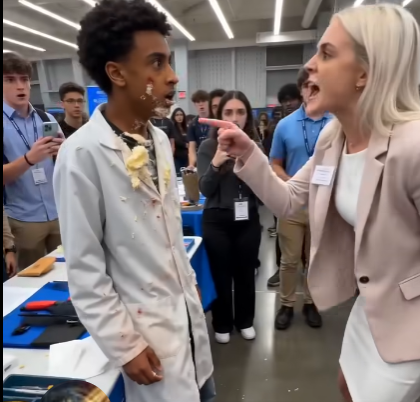
Madison Beaumont stood under the sponsor lights with banana cream sliding down the sleeve of my old lab jacket, and for the first time since she had thrown the cake, nobody was looking at the stain. They were looking at her.
Her family representative, a sharp-faced man named Richard Vale, extended his hand toward the folder again.
“Professor Alden,” he said, smiling without warmth, “that report includes proprietary comparison data. We should review it privately.”
The coordinator, Ms. Keller, held the folder tighter.
“No.”
One word. Clean. Hard.
Richard’s smile cracked.
Madison’s cheeks flushed pink beneath her perfect makeup. “This is ridiculous. That thing is a school club toy.”
I wiped cream from my wrist with a paper napkin someone had finally handed me. My hand shook, but I kept my eyes on the report.
Professor Alden turned the next page.
“There’s also a false credit submission attached to the finalist packet.”
The judges leaned in.
Madison stopped blinking.
Ms. Keller looked at me. “Selam, did you submit your design under Beaumont Medical’s student mentorship program?”
“No,” I said. “I built it in the assistive engineering club. With our school printer. With donated filament.”
Richard gave a soft laugh. “Teenagers often misunderstand sponsorship language.”
“Then explain this,” Ms. Keller said.
She lifted the page for everyone to see.
A project title. My prototype ID. My test data.
And beside it, a name that was not mine.
Madison Beaumont, Lead Student Designer.
The cameras clicked so fast it sounded like rain hitting glass.
Madison whispered, “I didn’t submit that.”
Richard’s eyes snapped toward her.
That tiny look told the room more than any confession could have.
Professor Alden closed the folder halfway, then opened it again like he had made a decision.
“There is one more attachment,” he said. “A lab access record.”
Madison’s face changed.
Not guilt.
Fear.
And when Professor Alden read the timestamp aloud, Madison’s designer heel slid back one inch, like she was already searching for the nearest exit.
Part 3: The Lab Door Opened After Midnight
“Two nights ago,” Professor Alden said, “the prototype storage cabinet was opened at 12:43 a.m.”
A gasp passed through the front row.
The engineering fair had been loud minutes earlier, full of polished speeches, sponsor banners, and parents pretending they understood torque ratios. Now every sound felt too sharp: the buzz of the lights, the scrape of a chair, Madison’s breathing.
Ms. Keller’s eyes found mine. “Selam, were you in the lab that night?”
“No.”
“Were you given access?”
“No.”
Madison crossed her arms. “Neither was I.”
Professor Alden glanced down. “The access badge used belonged to Dr. Julian Beaumont.”
Madison’s father.
The name hit the room like a dropped tool.
Richard Vale stepped forward. “Dr. Beaumont is not here to answer careless implications.”
“Then why is his badge in the record?” a judge asked.
Richard’s jaw tightened. “Medical device testing requires oversight. Beaumont Medical sponsors this fair.”
“Sponsorship is not ownership,” Ms. Keller said.
Madison looked smaller now, even in the expensive blazer, even beneath the lights built for people like her. Her mouth opened once, then closed.
I wanted to feel victorious.
I didn’t.
My prototype sat on the demonstration table, fingers curled slightly, palm printed in matte gray plastic, the thumb joint sanded by my own hands until it moved smoothly. I knew every scratch on it. Every failed cable. Every night I had stayed after school while janitors stacked chairs outside the lab.
And someone had touched it after midnight.
Professor Alden turned another page.
“The cabinet log shows removal for seventeen minutes.”
My breath caught.
Seventeen minutes was long enough to photograph, copy, swap, or damage anything.
Madison suddenly said, “I told him not to.”
The room froze.
Richard turned to her slowly. “Madison.”
She pressed her lips together, eyes shining now. “I said it was stupid. I said people would notice.”
My pulse roared in my ears.
Ms. Keller asked, “Notice what?”
Madison looked at me, and her hatred had changed into something uglier: resentment mixed with panic.
“My father said her design made ours look outdated,” she said. “He said if the university lab picked hers, investors would ask why a high school girl did what Beaumont Medical couldn’t.”
Richard grabbed her arm.
She ripped free.
Then Professor Alden lifted one final sheet.
“The physical inspection shows tampering.”
My knees nearly gave out.
Because suddenly the cake was not the attack anymore.
It was the distraction.
Part 4: The Cut Cable No One Was Supposed To See
Professor Alden placed the inspection photo on the table.
I saw it before anyone explained it.
A thin internal flexion cable near the palm joint had been sliced halfway through. Not enough to break during setup. Enough to fail during the demonstration.
My mouth went dry.
Ms. Keller whispered, “Selam…”
I stepped closer. The room blurred around the edges.
That cable had been perfect yesterday. I knew because I had tested every finger three times before sealing the palm plate. I had written the numbers in my own notebook, smudging graphite down the side of my hand.
Madison stared at the photo.
“I didn’t cut it,” she said.
Her voice sounded different now. Bare. Almost young.
Richard snapped, “Stop talking.”
But she kept looking at the photo like it had opened a trap beneath her.
“My father said the model just needed to malfunction,” she said. “He said nobody would blame her if it failed. They’d just call it ambitious and unfinished.”
Something inside me went cold.
Not because they wanted to beat me.
Because they had planned to make me doubt myself.
I pictured standing at the demonstration table, pressing the activation switch, watching the prosthetic hand jerk and collapse in front of sponsors, judges, cameras, and university faculty. I pictured Madison smiling sympathetically while her family product took the applause.
My chest tightened so hard I could barely breathe.
Ms. Keller touched my shoulder. “Selam, sit down.”
I shook my head.
“No.”
My voice cracked, but I stayed standing.
“No, I want them to hear this.”
I turned toward the crowd, toward the phones, toward every sponsor who had noticed my worn sneakers before they noticed my work.
“This hand is not perfect,” I said. “It took me four months to make the thumb stop locking. I burned through filament we barely had. I cried over the first socket design because it pinched too hard on the test form. But it passed because we kept fixing what failed.”
I pointed at the inspection photo.
“That cut was not failure. That was sabotage.”
The word detonated.
Students started talking at once. A judge stood. Richard Vale pulled out his phone and began typing furiously.
Then the ballroom doors opened.
A tall man in a navy suit entered with two security staff behind him.
Madison went white.
“Dad,” she whispered.
Dr. Julian Beaumont looked at the cake on my jacket, the report in the professor’s hands, and his daughter’s ruined expression.
Then he smiled.
“Everyone,” he said, “there has clearly been a misunderstanding.”
Part 5: The Man Who Smiled At Ruins
Dr. Beaumont’s smile was worse than Madison’s cruelty.
Madison’s anger had been messy and obvious. Her father’s was polished smooth, wrapped in authority, built to survive microphones.
He walked to the front as if the ballroom belonged to him.
“Selam,” he said warmly, like he had not just heard his own name inside a sabotage report. “I’m sorry you’ve had an upsetting afternoon.”
Upsetting.
Not public humiliation. Not stolen credit. Not a damaged prototype.
Upsetting.
I felt Ms. Keller stiffen beside me.
Dr. Beaumont turned to the judges. “Our company encourages student innovation. Sometimes, in collaborative environments, boundaries between mentorship and authorship become unclear.”
Professor Alden held up the false submission. “This says Madison was lead designer.”
“A clerical error,” Dr. Beaumont said.
“It includes Selam’s test values.”
“Shared data can migrate between systems.”
“It was submitted after your badge opened the cabinet at 12:43 a.m.”
His eyes cooled. “My badge is used by senior staff.”
“And the cut cable?”
Dr. Beaumont’s smile faded by one degree. “Plastic prototypes are fragile.”
I reached into the pocket of my lab jacket.
My fingers closed around my small black flash drive.
Madison saw it.
Her eyes widened.
I had almost forgotten it was there. Almost. But after years of being the girl people overlooked, I had learned to keep copies. Photos of test sheets. Exported data. Build logs. Videos of each trial. Not because I expected sabotage from a medical device dynasty, but because when people like me lost proof, nobody replaced it.
I lifted the flash drive.
Dr. Beaumont looked at it.
For the first time, his smile disappeared completely.
I said, “I have the full test archive.”
Richard Vale moved fast. Too fast.
He stepped toward me, hand out, saying, “That drive may contain confidential material.”
Madison grabbed his sleeve.
“Don’t,” she whispered.
But he shook her off.
The security guard stepped between us.
Ms. Keller took the drive from my hand and passed it directly to Professor Alden.
Dr. Beaumont’s face hardened.
“Professor, I strongly advise you not to open student files in a public venue.”
Professor Alden plugged the drive into the demonstration laptop.
The projector screen flickered.
Folder names appeared.
Build logs. Stress trials. Grip tests. Cable repair notes.
Then one video file sat at the bottom with a name I did not recognize.
MIDNIGHT_CAMERA_BACKUP.
I stared at it.
“I didn’t put that there,” I whispered.
Ms. Keller looked at me.
Professor Alden clicked it.
And the screen filled with the dark outline of the lab after midnight.
Part 6: The Camera Hidden Behind The Printer
At first, the video showed only shadows.
The lab was dim except for the emergency lights near the door and the blue glow of the printer status panel. My prototype sat in the storage cabinet with the door open.
Then two figures entered the frame.
Dr. Beaumont.
And Richard Vale.
The ballroom went so quiet I could hear the projector fan.
In the video, Richard held a small tool case. Dr. Beaumont stood behind him, checking his watch. There was no sound, but the image was enough.
Richard removed my prosthetic hand from the cabinet.
Dr. Beaumont pointed to the palm.
Richard opened the plate.
My fingers dug into my own palms.
The video angle came from behind the second 3D printer, low and slightly tilted. I knew that printer. It was the old one nobody used because the bed never leveled properly.
I remembered our club president, Nora, joking that she had taped an old motion camera behind it to catch whoever kept stealing filament spools.
Nora.
I looked around wildly.
She stood near the side doors, glasses crooked, face pale but determined.
She raised one hand.
“I set the camera,” she said. “After supplies went missing.”
Dr. Beaumont turned toward her with a look so vicious it made her step back.
“You recorded a private laboratory?”
Nora swallowed. “A school lab.”
Professor Alden kept the video running.
On screen, Richard touched the cable with a small blade.
Madison made a sound like she had been struck.
“Dad…”
Dr. Beaumont did not look at her.
The video showed him photographing my prototype from three angles. Then Richard closed the palm plate, placed the hand back, and shut the cabinet.
Time stamp: 12:51 a.m.
Eight minutes.
Eight minutes to steal months from me.
A judge stood and said, “This fair is suspended pending formal review.”
Dr. Beaumont finally lost the room.
Sponsors pulled away from the Beaumont banner like it had caught fire. Cameras swung toward him. Students whispered, then spoke louder, then louder still.
Richard rushed toward the laptop.
Security stopped him.
Then Madison did something no one expected.
She walked to the microphone.
Her hands trembled as she turned it on.
“My father told me Selam cheated,” she said, voice breaking across the speakers. “He told me she copied us.”
Dr. Beaumont said sharply, “Madison, step away.”
She looked at me.
Then at the screen.
Then back at the room.
“He lied.”
Part 7: The Apology That Could Not Save Her
Madison’s confession did not make her innocent.
Everyone knew it.
Even she knew it.
She stood at the microphone with tears sliding silently over her makeup, but nobody rushed to comfort her. Her friends near the sponsor table looked at their phones. Her father stared at her like she had become defective equipment.
“I believed him,” she said. “Because it was easier than admitting Selam was better.”
The words hurt more than I expected.
Better.
Not lucky. Not dramatic. Not a charity case.
Better.
Madison turned toward me, but I did not move closer.
“I threw the cake because I wanted everyone laughing before they listened to you,” she said. “I wanted you messy. Small. Embarrassed.”
My throat tightened.
The cream had dried sticky on my sleeve. My jeans were stained. My sneakers looked even older under the ballroom lights.
But I was still standing.
Ms. Keller stepped to the microphone beside Madison.
“Selam’s prototype will be evaluated on the submitted test record and live demonstration after inspection.”
Dr. Beaumont snapped, “That demonstration cannot proceed. Evidence has been contaminated.”
Professor Alden replied, “The backup prototype was sealed this morning.”
I blinked.
Backup prototype?
Ms. Keller looked at me, and a small smile broke through the tension.
“You didn’t think I ignored your paranoia, did you?”
From beneath the judges’ table, she lifted a second gray prosthetic hand in a clear protective box.
My knees weakened.
I had printed that backup over three exhausting nights, convinced I was being silly, convinced nobody would ever care enough to interfere.
Ms. Keller had sealed it. Logged it. Protected it.
The judges reset the demonstration table.
My hands shook as I connected the cable harness. The room watched every movement. Madison stepped back from the microphone, crying silently now. Her father stood trapped between cameras and security, unable to leave without looking guilty and unable to stay without being exposed.
I pressed the activation switch.
The prosthetic hand opened.
Smoothly.
The fingers closed around a foam cup without crushing it.
Then a marker.
Then a soft rubber ball.
Then the final object: a child-sized spoon.
The thumb adjusted perfectly.
A sound rose from the crowd, not applause yet, but amazement.
Professor Alden whispered, “Beautiful.”
Then the hand lifted the spoon and held it steady for ten full seconds.
The room exploded.
Part 8: The Spotlight She Could Not Take Back
The applause did not feel like victory at first.
It felt unreal.
Like I had stepped outside my body and was watching some other girl in an old lab jacket stand beside a machine she had built while rich people tried to decide whether her work was allowed to matter.
Then my mother pushed through the crowd.
She must have left work the second someone texted her. Her nursing shoes squeaked on the polished floor, and her badge was still clipped crookedly to her sweater.
She saw the cake on me first.
Then the cameras.
Then Dr. Beaumont.
“Selam,” she said, breathless. “Are you all right?”
For the first time all day, my voice broke.
“I think so.”
She hugged me anyway, careful and fierce, like she was holding together all the parts nobody else had protected.
Across the room, police officers arrived. Dr. Beaumont stopped smiling altogether. Richard Vale kept saying he was company counsel, but nobody seemed impressed anymore.
Madison stood alone beneath the sponsor banner with her arms wrapped around herself.
I thought she would leave.
Instead, she walked to the demonstration table and placed something beside my prototype.
Her Beaumont Medical finalist pin.
“I don’t deserve this,” she said.
I looked at the pin, then at her.
“No,” I said. “You don’t.”
She flinched, but she nodded.
That was the closest thing to honesty I had ever seen from her.
Two weeks later, the university lab announced its decision.
They did not just select my prototype.
They opened a low-cost assistive design fellowship in my name, funded by sponsors who dropped Beaumont Medical overnight.
But the real shock came in the letter attached to the award.
Professor Alden had included a note.
The test report had been sent to the university before the fair by an anonymous recommender. Someone had written: This student does not know how rare she is. Watch her carefully.
I asked Ms. Keller if she had sent it.
She shook her head.
Nora denied it too.
Then my mother cried when she saw the signature code at the bottom.
It belonged to my father, who had died when I was ten.
He had once worked as a hospital maintenance technician and had saved an old university contact in a notebook my mother thought was useless. Months before he passed, he had mailed sketches of my first cardboard prosthetic hand to that same professor.
Professor Alden had been watching my work for years.
Not because of Madison.
Not because of Beaumont Medical.
Because my father had believed the world would need to see what his daughter could build.
And when I placed the repaired prosthetic hand into the university lab case, I finally understood the truth Madison could never steal:
the spotlight had never made my work valuable — it had only arrived late.
