Part 2: The Folder She Suddenly Wanted Closed
The official’s request made Brianna Ellis stop moving.
“Empty your folder,” Mr. Calder said again.
The swap meet noise seemed to fold in on itself. Plastic hangers stopped clacking. Parents stopped bargaining over skirts and polos. A little boy holding a stack of khaki pants looked up at his mother like he knew the adults had crossed into something bigger than shopping.
Brianna’s cheekbones tightened.
“My business documents are private,” she said.
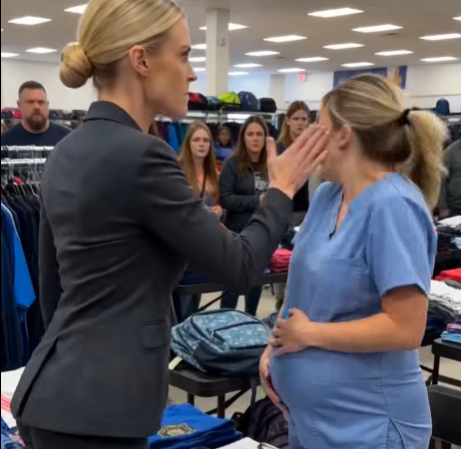
A minute ago, she had slapped me in front of everyone and called me a fraud. Now she wanted privacy.
The side of my face still burned. My six-month belly felt tight under my loose gray cardigan, and the humiliation sat heavy in my throat, but I kept one hand on the table and the other over my baby.
Mr. Calder, the district supply coordinator, held the opened proof sheet.
“The labels on Mrs. Moreno’s uniforms match the former district supplier’s batch code,” he said. “That means her items are not fake.”
A woman in the crowd whispered, “Then why did Brianna say they were?”
Brianna’s eyes snapped toward her.
“Because people bring counterfeit garbage to these events all the time,” she said.
I looked at the sewn-in label Mr. Calder had placed on the table. It was small, white, and ordinary. A blue stitch line. A supplier number. A district code from two years ago.
That tiny label had saved my name.
But Brianna kept glancing at her folder like it might start talking.
Mr. Calder stepped closer. “Your booth filed the counterfeit complaint. You claimed Mrs. Moreno was selling copied uniforms under a district supplier tag. If you have documentation, show it.”
Brianna clutched the folder to her chest.
Her assistant, a younger woman named Tessa, stood behind the booth table with her mouth slightly open.
“Brianna,” she whispered, “just show him the invoice.”
Brianna turned on her so fast Tessa flinched.
“Don’t touch my records.”
That was when everyone knew.
There was something inside that folder she feared more than the crowd.
Mr. Calder’s voice hardened. “Either you open it here, or I suspend your vendor table until a formal review.”
Brianna swallowed.
Then, with shaking fingers, she opened the folder.
The first page slid out.
An invoice.
The second page followed.
A vendor complaint form.
The third page made Tessa cover her mouth.
At the top, in bold print, was my name.
Target seller before price comparison begins.
Part 3: The Complaint Written Before I Arrived
The words stayed on the table like they had weight.
Target seller before price comparison begins.
For a second, I did not understand them. Not fully. My mind kept trying to turn them into something softer. A mistake. A note taken out of context. A bad phrase from someone careless.
Then I looked at Brianna’s face.
She understood exactly what it meant.
Mr. Calder picked up the page. “Who wrote this?”
Brianna’s lips parted.
No answer.
Tessa stared at the page, then at me. “I thought that was a reminder about booth placement.”
My voice came out thin. “My booth placement?”
Tessa looked at Brianna, terrified now. “She said you undercut us last year. She said if people saw your prices first, no one would buy new uniforms.”
The crowd shifted around us.
My table was small compared to Brianna’s polished booth. I had two folding racks, one plastic bin of sweaters, and a handwritten sign that said affordable uniforms, washed and checked. Half my stock had come from families whose kids outgrew them. I mended hems at night after work. I sold them cheap because I knew what it felt like to choose between shoes and school shirts.
Brianna had called that fake.
Because honesty was bad for her margins.
Mr. Calder turned to the complaint form.
“This was filed at 8:07 a.m.”
I blinked. “I checked in at 8:42.”
A parent near the front said, “She accused you before you even got here.”
Brianna snapped, “Because I knew what she was going to do.”
“Sell uniforms?” I asked.
Her eyes flashed. “Take customers from legitimate vendors.”
Mr. Calder looked at her booth sign.
Ellis Premier Schoolwear — Official Quality Guaranteed.
“Your exclusivity expired when the district changed suppliers,” he said.
Brianna’s face went white.
That detail landed hard.
Parents started murmuring. Some had been told her booth was the only approved one. Some had paid three times what I was charging because they thought they had no choice.
Then Tessa reached into the folder with trembling hands.
Brianna grabbed her wrist.
“Don’t.”
Tessa pulled free.
A sealed plastic bag slid onto the table.
Inside were several sewn-in labels.
Not attached to uniforms.
Loose.
Cut from something else.
Mr. Calder stared at them.
I felt my stomach drop.
Because they matched the former supplier too.
Part 4: The Loose Labels In The Plastic Bag
Nobody spoke when Mr. Calder opened the plastic bag.
The little white labels fluttered onto the table like scraps of a much larger lie.
One landed beside my proof sheet.
Same blue stitch line.
Same supplier code.
Same district mark.
The difference was simple.
Mine were sewn into old uniforms.
Brianna’s were loose.
Mr. Calder lifted one carefully. “Why do you have former supplier labels removed from garments?”
Brianna’s voice rose. “They’re samples.”
“Samples of what?”
“Quality references.”
A man in the crowd laughed bitterly. “You keep district labels in a bag for reference?”
Brianna ignored him.
Tessa began crying. “She told me to sort them by size code.”
Brianna whirled. “Tessa, stop.”
But Tessa had already crossed some invisible line between fear and relief.
“She said parents trust labels more than fabric,” Tessa whispered. “She said if older stock looked district-approved, it would move faster.”
My hand tightened over my belly.
“You were sewing them into other uniforms?”
Brianna said, “No.”
Too fast.
Mr. Calder asked, “Where is your alteration kit?”
Brianna did not answer.
Tessa pointed under the table.
A black sewing case sat behind three boxes of folded skirts.
Mr. Calder crouched, pulled it out, and opened it.
Inside were thread spools, seam scissors, tags, adhesive backing strips, and a small handheld stitch gun.
The crowd exploded.
Brianna started talking over everyone. “This is normal vendor equipment! We do repairs! We adjust hems!”
Mr. Calder held up a half-finished shirt from the case.
A former supplier label had been pinned inside the collar.
The fabric did not match district stock.
Even I could tell from six feet away.
My knees nearly weakened.
She had accused me of selling fakes while preparing fakes at her own booth.
A mother stepped forward holding a polo shirt she had just bought from Brianna.
“Check this one.”
Then another parent lifted a pair of pants.
“And this.”
Then another.
Within seconds, the table filled with uniforms bought from Ellis Premier Schoolwear.
Mr. Calder examined the first shirt.
Then the second.
Then the third.
His expression grew darker each time.
“These labels were reattached,” he said.
Brianna backed away.
“No. Those came from my distributor.”
Mr. Calder looked up.
“Then we need your distributor invoice.”
Brianna’s mouth closed.
And Tessa, shaking so hard she could barely stand, pointed to the last envelope in the folder.
“That invoice is fake too.”
Part 5: The Invoice That Named A Dead Supplier
Mr. Calder opened the envelope slowly.
By then, people were not just filming. They were sending messages, calling spouses, checking bags, pulling uniforms off hangers and turning collars inside out.
My booth stood strangely untouched now, my small price tags hanging quietly while Brianna’s polished display collapsed one seam at a time.
The invoice inside the envelope had a gold header and a neat company name.
Desert Valley School Supply.
A former district vendor.
Mr. Calder stared at it for several seconds.
Then his face changed.
“This company closed eighteen months ago.”
Brianna whispered, “That’s not true.”
“It is true,” he said. “I handled the transition.”
The crowd went cold.
He turned the invoice toward the parents.
The date was from last month.
A dead supplier could not have sold her anything last month.
A woman in scrubs stepped forward, holding two jumpers against her chest. “I bought these because she told me cheaper booths were unsafe.”
Another parent said, “She said used uniforms violated district rules.”
“They don’t,” Mr. Calder said.
The words moved like a correction everyone should have received long ago.
I felt tears pushing behind my eyes, but I refused to let them fall yet. Not while Brianna was still standing there pretending the truth was an inconvenience.
Brianna’s phone rang.
She looked at the screen and rejected the call.
It rang again.
Her hand trembled.
The name was visible from where Tessa stood.
MARCUS ELLIS.
Her husband.
Tessa said, “He knows.”
Brianna looked at her with pure panic.
Tessa stepped back. “He printed the invoices.”
Mr. Calder’s eyes sharpened. “Your husband created these?”
Brianna said nothing.
Then a deep voice came from behind the crowd.
“Don’t answer that.”
A man in a navy polo pushed through the parents, his face red, his jaw clenched. Marcus Ellis looked at the uniforms on the table, the loose labels, the open folder, and finally at me.
Not at my face.
At my belly.
Then he smiled like he had found the easiest target in the room.
“This woman has been harassing our business for months,” he said.
My whole body went cold.
Brianna looked relieved for half a second.
Until Mr. Calder lifted the fake invoice.
“Mr. Ellis,” he said, “why is your home printer code embedded in a supplier document?”
Marcus stopped smiling.
Part 6: The Printer Code He Forgot To Remove
The printer code was tiny.
A dotted tracking line along the bottom edge of the invoice, so faint most people would never notice it. Mr. Calder noticed because district contracts lived and died by paper trails.
He held the invoice close to the light.
“Serial pattern matches the complaint packet,” he said. “Same device.”
Marcus’s confidence slipped.
“That proves nothing.”
Tessa wiped her face. “It proves you printed both.”
Brianna grabbed the back of a chair like she needed it to stay upright.
Marcus turned on Tessa. “You’re an employee. Be careful.”
That threat landed badly.
Several parents stepped closer to her.
I did not know Tessa. Before today, she had helped Brianna glare at me across the swap meet. But in that moment, she looked young and trapped, and I recognized the fear of someone who had been told too many times that truth was dangerous.
Mr. Calder asked, “Who submitted the counterfeit accusation?”
Marcus pointed at me. “She brought questionable inventory.”
“I brought district-labeled former supplier uniforms from parents whose kids outgrew them,” I said. “I logged every donor.”
Brianna gave a harsh laugh. “You logged them?”
I reached into the plastic crate under my table and pulled out my binder.
The binder was ugly. Bent corners. Tape on the spine. Color-coded tabs made from sticky notes.
But inside were names, dates, item counts, donor initials, washing notes, and photos of each sewn-in label before the uniform went on the rack.
Mr. Calder took it.
His expression softened as he flipped through the pages.
“You documented all of this?”
“I didn’t want anyone saying poor families deserved poor records.”
A few people went silent at that.
Marcus rolled his eyes. “This is theater.”
My baby kicked hard, as if even she objected.
Mr. Calder turned one more page in my binder and stopped.
“What is this?”
I leaned closer.
It was a receipt from a retired school secretary who had donated twenty-three uniforms from storage.
Attached was a handwritten note.
These came from the old district warehouse after the supplier change. Legal to resell or donate. Do not let anyone call them fake.
Mr. Calder read the signature.
Then he looked toward the entrance.
“Is Mrs. Duvall here?”
An older woman near the coffee table raised her cane.
“I am.”
Marcus’s face drained.
Mrs. Duvall stepped forward.
“And I kept the warehouse release form.”
Part 7: The Warehouse Release That Ruined Them
Mrs. Duvall moved slowly, but the crowd parted for her like she carried a verdict.
She wore a purple cardigan, orthopedic shoes, and the expression of a woman who had spent thirty years in school offices watching liars underestimate paper.
From her tote bag, she pulled a blue folder.
“I thought this might be needed,” she said.
Marcus whispered something to Brianna.
Brianna shook her head, eyes wet now.
Mrs. Duvall handed the folder to Mr. Calder.
Inside was the official warehouse release form. District letterhead. Former supplier inventory list. Authorized disposal note. Donation approval.
And there was my name.
Grace Moreno.
Approved community reseller.
My throat tightened.
I had asked Mrs. Duvall for permission months ago because I was scared. Scared of rules I did not understand. Scared of being accused. Scared of exactly this.
She had told me, “Get it in writing, honey. People respect paper when they refuse to respect you.”
Now that paper sat between me and the Ellises.
Mr. Calder read the form aloud.
Parents began turning toward my booth with something like shame in their eyes.
Marcus exploded.
“This is ridiculous. She’s selling used clothes from a warehouse and pretending she’s helping people.”
Mrs. Duvall lifted her chin. “She is helping people.”
Brianna started crying. “We had expenses. We had inventory. The district dropped our vendor status and everyone went looking for cheaper options.”
“So you framed me?” I asked.
She covered her mouth.
Marcus answered for her. “We protected our business.”
“No,” Mr. Calder said. “You filed a false complaint, sold mislabeled goods, and physically assaulted a pregnant community volunteer.”
The word assaulted made Brianna flinch.
Police were called after that.
So was the district superintendent.
Parents lined up to have Brianna’s uniforms checked. More altered labels appeared. More fake invoices. More receipts with impossible supplier dates.
Then Mrs. Duvall placed one final paper on the table.
A letter from last year.
Ellis Premier Schoolwear had been warned for misrepresenting exclusivity after the district contract expired.
Brianna stared at it.
“You knew,” I whispered.
She cried harder.
But crying did not un-slap me.
And it did not un-sell a single fake.
Part 8: The Label They Could Not Cut Out
The swap meet did not close.
That was the part Brianna never expected.
She thought if she made enough noise, enough shame, enough fear, the day would collapse around me.
Instead, the district shut down her booth and moved two folding tables beside mine.
Parents brought hangers. Students sorted sizes. Mrs. Duvall sat like a queen beside the binder, checking labels with a magnifying glass she had apparently carried for emergencies.
Tessa stayed too.
She gave a statement to Mr. Calder, then helped families identify which Ellis uniforms needed refunds or replacement.
When she came to me, her eyes were swollen.
“I’m sorry,” she said. “I should have said something sooner.”
I looked at her for a long second.
“Yes,” I said. “You should have.”
She nodded, accepting it.
That mattered.
Three weeks later, Ellis Premier Schoolwear lost its district vendor approval permanently. Marcus faced fraud charges related to the fake invoices. Brianna was barred from school marketplace events and ordered to repay families for mislabeled uniforms.
But the bigger change came from the parents.
They voted to create a district-run uniform exchange with public records, verified labels, and capped prices.
Mrs. Duvall insisted the binder stay part of the process.
They called it the Moreno Ledger.
I cried when I saw the first printed copy.
Not because my name was on it.
Because every family who walked in after that could see the rules before anyone could twist them.
No whispers.
No fake exclusivity.
No rich booth owner deciding shame was a business strategy.
The last surprise came two months later, after my daughter was born.
A package arrived at my apartment with no return address.
Inside was a tiny navy cardigan, hand-sewn from leftover uniform fabric.
The label inside was not a supplier tag.
It was embroidered.
For the child of the woman who proved affordable never meant fake.
Mrs. Duvall had sewn it herself.
I held that cardigan against my sleeping daughter and finally cried the way I had refused to cry at the swap meet.
Brianna had thought pregnancy made me easy to shame.
But she forgot something important.
A mother carrying a child is also carrying a future.
And that day, every label she tried to cut away only stitched my name deeper into the truth.
