Part 2: The Timestamp Made Her Smile Disappear
The timestamp sat in the corner of the screen like a small white blade.
10:14 a.m.
Before judging.
Before the hallway.
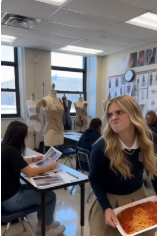
Before Sabrina Bancroft had thrown spaghetti with tomato sauce at me and turned my denim jacket into something everyone could point at instead of listen to.
Ms. Elise Weber, the art and media teacher, did not move for several seconds. Her hand rested on the laptop mouse, frozen. Behind her, the projector hummed against the silence, showing the photo Sabrina had claimed was hers: a dramatic image of light falling across handmade textile panels for the school visual culture competition.
Only now, everyone could see the original file name.
Tessa_Ward_Process_Photo_03.
The hallway outside the media room was packed with students pretending not to stare. Inside, the judges’ table had gone still. Three adults sat behind clipboards. Two students held phones halfway up, unsure whether recording had just become wrong or important.
Sabrina stood near the doorway, her long blonde hair still perfect, her white sneakers spotless, her expression locked in a smile that had forgotten how to be believable.
“That doesn’t prove anything,” she said.
Her voice sounded too bright.
Ms. Weber slowly turned. “It proves the photo existed before judging.”
Sabrina lifted one shoulder. “Lots of people take photos during setup.”
“With Tessa’s camera account?” Ms. Weber asked.
My throat tightened.
The tomato sauce was cooling against my sleeve. I could feel it through the denim, sticky and humiliating. A few minutes earlier, people had gasped when I fell. Someone had laughed before realizing teachers were watching. Sabrina had looked down at me like I was exactly where she wanted me.
Now she would not look at me at all.
Mr. Henrik Strauss, one of the competition judges, leaned toward the laptop. “Open the metadata.”
Sabrina’s head snapped toward him. “Why?”
He looked at her over his glasses. “Because you submitted this same image as your final process proof.”
A murmur moved through the room.
Ms. Weber clicked.
A panel opened with the image details.
Device: Tessa Ward’s school-issued media camera.
Original capture time: 09:37 a.m.
Uploaded to class folder: 10:14 a.m.
Edited version submitted by: Sabrina Bancroft.
Submission time: 11:52 a.m.
The room did not explode.
It sank.
That was worse.
Everyone had just watched the lie become too heavy to carry.
Sabrina laughed, but it cracked halfway through. “Maybe she shared it with me.”
“I didn’t,” I said.
My voice was quieter than I wanted, but it did not shake.
Sabrina finally looked at me. Her eyes were sharp and furious, but beneath it, there was fear.
“You were helping with setup,” she said. “You were taking photos for everyone.”
“I took documentation photos for the judging archive,” I said. “Not for you to submit.”
Mr. Strauss turned to Ms. Weber. “Was the archive folder open access?”
Ms. Weber’s face changed.
Not guilt.
Realization.
She clicked again, faster now, opening the shared folder permissions.
The screen loaded slowly.
Then the list appeared.
Students. Judges. Teachers.
And one after-hours access entry.
S. Bancroft — permission changed manually.
Ms. Weber whispered, “I never gave you editing access.”
Sabrina backed up one step.
The door behind her was blocked by students.
No one moved for her.
Ms. Weber clicked the access log.
Another timestamp appeared.
07:42 a.m.
Changed by: assistant account.
The judges looked at one another.
I saw Sabrina’s face lose its color.
Mr. Strauss spoke softly. “What assistant account?”
Before anyone answered, the classroom door opened from the other side.
A woman in a dark green coat entered, carrying a leather tablet case and wearing an expression so controlled it made the entire room straighten.
Behind her was the school principal, Mr. Lukas Moreau.
The woman looked at the projector.
Then at Sabrina.
Then at me, standing there in stained denim.
“I’m Ingrid Falk,” she said. “Regional academic integrity review.”
Sabrina’s lips parted.
Ms. Falk placed her tablet on the desk and said, “The before-judging photos are only the first proof.”
Part 3: The Archive Folder Had Other Names
Ms. Falk did not raise her voice.
That was how I knew she was dangerous.
She asked the students in the doorway to step back, asked Ms. Weber to lock the laptop screen, and asked Mr. Moreau to keep everyone inside the media room until she had copied the visible logs. Every sentence sounded calm, but every adult obeyed her like she had entered with a warrant made of silence.
Sabrina tried to call someone.
Mr. Moreau stopped her.
“Not yet,” he said.
“My parents have a right to know,” Sabrina snapped.
“They have already been contacted.”
That landed hard.
Her confidence flickered.
I stood near the supply cabinet, sauce drying on my jacket, my palms cold. I wanted to leave. I wanted to wash my sleeve. I wanted to stop being the center of a room that had only cared about me once I became evidence.
Ms. Falk connected her tablet to the projector.
A folder appeared.
Competition Archive Review — Previous Irregularities.
Mr. Strauss leaned back slowly. “Ingrid…”
She did not look at him. “You asked me last month whether this year’s scoring complaints were connected. I said we needed a pattern.”
She opened the folder.
There were names.
Not mine.
Amara Mensah.
Elena Krüger.
Marta Silva.
Lina Dubois.
Each name was attached to a school project, an image file, and a judging score that had changed after preliminary review.
My stomach twisted.
Sabrina looked at the screen and whispered, “No.”
Ms. Falk clicked on Amara Mensah’s file.
A textile photograph appeared. The style was different from mine, but the structure was familiar: process image, original timestamp, altered submission, missing credit line.
Then Elena’s.
Then Marta’s.
Then Lina’s.
Four quiet thefts.
Four students whose complaints had probably been called confusion, jealousy, stress, overreaction.
Ms. Weber pressed one hand to her mouth.
“I remember Elena,” she said. “She cried in my office. She said someone used her lighting test.”
Mr. Moreau’s face tightened. “And we told her the folder settings made it impossible.”
Ms. Falk looked at him then.
“Folder settings do not protect students when someone keeps changing them.”
No one spoke.
Sabrina’s voice came out low. “You’re trying to blame me for everything.”
Ms. Falk turned a page on the screen. “No. I am trying to find out why the same assistant account appears before each altered submission.”
The screen zoomed in.
Assistant account: Bancroft_Family_Office_Temp.
The words looked unreal.
A family office.
At school.
For student art files.
Mr. Strauss removed his glasses and rubbed his face.
Sabrina’s cheeks flushed pink. “That’s not what it sounds like.”
Ms. Weber’s voice trembled. “What does it sound like, Sabrina?”
Sabrina looked at the floor.
For the first time, she had no polished answer ready.
Ms. Falk opened another log.
This one showed a message attached to a permission request.
Need clean portfolio proof before judging. Sabrina cannot lose to another process-heavy project.
The room went so quiet I heard the projector fan click.
Another.
Replace weak source images with stronger student archive options.
Another.
Ward’s photos show better composition. Use only if attribution can be removed.
My knees almost bent.
Ward’s photos.
My photos.
My work had not been borrowed by accident. It had been selected.
Like a useful object.
Sabrina shook her head quickly. “I didn’t write those.”
Ms. Falk looked at her. “Who did?”
Sabrina’s eyes filled, but she swallowed the tears down.
Then Mr. Moreau’s phone buzzed.
He looked at the screen, and his expression changed.
“Her mother is here.”
Sabrina closed her eyes.
Not in relief.
In dread.
Part 4: Her Mother Knew The Password
Anneliese Bancroft entered the media room like she had already decided who owed her an apology.
She wore a navy wool coat, gold earrings, and a silk scarf tied with such precision it seemed impossible she had driven there in a hurry. Her eyes swept over the judges, the projector, the phones, the stain on my jacket, and finally her daughter.
“Sabrina,” she said.
Just her name.
But Sabrina flinched.
I saw it.
So did Ms. Falk.
Anneliese turned to Mr. Moreau. “I expect this to be handled privately.”
Mr. Moreau’s jaw tightened. “A student was assaulted in front of witnesses.”
Anneliese glanced at me. “Food was thrown. Let’s not dramatize.”
My face burned.
Ms. Weber stepped forward. “Tessa fell.”
“Then I’m sure Sabrina regrets the accident.”
“It wasn’t an accident,” I said.
Anneliese looked at me fully then.
Her expression did not change, but something colder entered the room.
“And you are?”
The question was designed to make me smaller.
I answered anyway.
“Tessa Ward.”
Her eyes flicked once to the screen, where my name still appeared beside the original photo.
“Ah,” she said. “The photographer.”
Not student.
Not victim.
Not person.
The photographer.
Ms. Falk spoke before I could. “Mrs. Bancroft, your family office assistant account appears in multiple unauthorized changes to student competition submissions.”
Anneliese smiled faintly. “Our office helps Sabrina organize school materials. She has a heavy workload.”
“Your office had editing access to restricted judging archives.”
“That sounds like a school security problem.”
“It is,” Ms. Falk said. “But it may also be misconduct.”
Anneliese’s smile thinned. “Be careful.”
Mr. Strauss looked up sharply.
Ms. Falk did not blink. “I am.”
She clicked open the password recovery log.
The projector showed an email address.
anneliese.bancroft@—
Sabrina whispered, “Mum, don’t.”
Anneliese’s head turned slightly.
“Sabrina.”
That one word carried warning, command, and disappointment.
Sabrina pressed her lips together.
Ms. Falk enlarged the log. “At 7:39 this morning, your email authorized a password reset for the assistant account. Three minutes later, Sabrina gained manual editing permission.”
Anneliese set her handbag on a desk.
Very slowly.
“I help my daughter succeed,” she said.
The sentence landed like a confession wearing perfume.
Mr. Moreau asked, “By changing judging files?”
“By correcting unfairness,” Anneliese replied. “Some students get praise for sentimental narratives. Some students are rewarded because their work looks humble, raw, authentic. Sabrina is judged harder because excellence is expected from her.”
I stared at her.
I had heard versions of that my whole life.
When I worked hard, it was inspiring. When girls like Sabrina worked hard, it was excellence. When I won, it was a story. When she lost, it was unfair.
Sabrina’s voice cracked. “Mum, stop.”
Anneliese ignored her. “The competition claims to value process. Tessa’s photos were process documentation. Sabrina’s final concept was stronger.”
“She used my image,” I said.
Anneliese looked at me. “Images can be interpreted.”
Ms. Weber’s face went red. “Not stolen.”
Then Sabrina suddenly stepped away from her mother.
Everyone noticed.
Anneliese did too.
“Sabrina,” she said again.
But this time Sabrina did not obey.
“She didn’t only change Tessa’s file,” Sabrina whispered.
Anneliese’s eyes hardened.
Sabrina looked at Ms. Falk. “There’s a portfolio drive.”
Ms. Falk stepped closer. “Where?”
Sabrina swallowed.
“My locker.”
Anneliese reached for her handbag.
Mr. Moreau blocked the door.
Ms. Falk’s voice sharpened for the first time.
“Mrs. Bancroft, do not touch your phone.”
But Anneliese was already dialing.
And across the screen, a new alert appeared.
Remote deletion requested.
Part 5: The Locker Held More Than Photos
The school moved faster than I expected.
Mr. Moreau called security. Ms. Falk called the district records office. Ms. Weber stood near me, not touching my shoulder, but close enough that I did not feel completely alone.
Anneliese Bancroft finally lost her perfect calm.
“You have no right to search my daughter’s belongings,” she said.
Sabrina laughed once.
It was a broken sound.
“They’re my belongings when you need privacy,” she said. “They’re your achievements when you need applause.”
Anneliese stared at her as if she had spoken a language she despised.
The locker hallway filled with adults.
Students had been moved back, but they watched from both ends of the corridor, whispering behind hands. My stained jacket had become a rumor walking beside me. I kept my chin down until I saw Amara Mensah standing near the stairwell.
She was older now, maybe graduated or visiting. Tall, serious, with her arms folded tight.
Her eyes met mine.
And in them, I saw recognition.
Not pity.
Recognition.
Sabrina stopped in front of locker 214.
Her fingers trembled on the combination.
Anneliese said, “You do not have to do this.”
Sabrina looked at her mother. “That’s what you said the first time.”
The first time.
Ms. Falk heard it too.
“What first time?” she asked.
Sabrina opened the locker.
Inside were textbooks, a gym bag, sketchbooks, and a black portfolio case wedged behind a folded cardigan. She pulled it out like it weighed more than it should.
Anneliese stepped forward.
Security stopped her.
Sabrina unzipped the case.
At first, it looked like ordinary student work: printed photos, color tests, notes, mock-up boards.
Then Ms. Falk lifted the top sheet.
Beneath it were labels.
Not Sabrina’s labels.
Original student names, cut from archive printouts and taped onto matching images.
Amara Mensah — light study.
Elena Krüger — fabric shadow test.
Marta Silva — market stall composition.
Lina Dubois — reflection series.
Tessa Ward — before-judging booth photos.
My mouth went dry.
Sabrina had kept them.
Not hidden in a cloud folder.
Not buried in a deleted history.
Kept.
Ms. Falk asked, “Why do you have these?”
Sabrina wiped her cheek with the back of her hand. “Because I thought if I kept the originals, I could give them back one day.”
Anneliese laughed coldly. “Do you hear how absurd that sounds?”
Sabrina turned on her.
“No,” she said. “What’s absurd is you calling theft strategy until I believed you.”
The corridor went still.
Sabrina opened a smaller pocket in the portfolio case and took out a flash drive.
Anneliese lunged.
This time, everyone saw it.
She grabbed Sabrina’s wrist hard enough that Sabrina cried out.
Mr. Moreau stepped forward. “Let go.”
Anneliese did not.
For one second, mother and daughter stood frozen in a silent fight over a piece of plastic smaller than a thumb.
Then Sabrina looked at me.
“Tessa,” she said, breath shaking. “Catch.”
She threw the flash drive.
It arced through the hallway.
I caught it against my chest with both hands.
Anneliese’s face twisted.
For the first time all day, she looked at me not like an inconvenience.
Like a threat.
Ms. Falk held out her palm.
I placed the drive in it.
She closed her fingers around it and said, “Now the evidence is no longer inside your family’s reach.”
Part 6: The Students She Erased Returned
By the next morning, the school had become a building full of whispers and locked folders.
The art competition was suspended. The judging room was sealed. Every student submission from the last three years was copied into a district archive. Teachers moved through hallways with strained faces, and students who had once laughed at rumors now checked their own project histories like they were looking for fingerprints.
I wore a clean jacket, but I could still feel the sauce.
That was the part nobody understood.
Humiliation does not wash out just because the stain does.
During third period, Ms. Weber came to find me.
“Tessa,” she said softly, “there are people here who asked to speak with you.”
I followed her to the library.
Amara Mensah stood by the windows. Elena Krüger sat at a table with a folder in front of her. Marta Silva leaned against a bookshelf, jaw tight. Lina Dubois stared at the floor until I entered.
Four names from the screen.
Four girls who had been turned into missing credits.
Amara spoke first.
“So it was real,” she said.
Not a question.
I nodded.
Her mouth pressed into a thin line.
“I thought I was going crazy,” Elena said. “I kept telling them the lighting photo was mine. They said I must have uploaded it wrong.”
Marta gave a bitter laugh. “They told me maybe I was too attached to process work.”
Lina looked up, eyes shining. “They told me Sabrina’s family had no reason to steal from me.”
The room tightened around that sentence.
No reason.
As if stealing only counted when the thief needed something.
Ms. Falk entered carrying the flash drive in an evidence sleeve.
Behind her came Sabrina.
The room changed instantly.
Amara straightened.
Marta stepped away from the shelf.
Elena’s hand curled around her folder.
Sabrina stopped just inside the door.
She looked smaller without her mother beside her. Not innocent. Smaller.
“I asked to be here,” she said.
Nobody answered.
She swallowed. “I know you don’t owe me anything.”
“You’re right,” Amara said.
Sabrina nodded once. “The drive has copies of your original files. My mother made an assistant organize them by usefulness. Composition. Lighting. Emotional angle. Cultural value.”
Marta’s face hardened. “Usefulness?”
Sabrina flinched. “That was the word.”
Lina whispered, “We were categories.”
I looked down at the table.
The truth was worse when spoken plainly.
Sabrina took a folded paper from her pocket. “I wrote everything I remember. Which files were changed. Which judges received altered packets. Which comments my mother wrote under my name.”
Elena’s voice was flat. “Why now?”
Sabrina looked at her for a long moment.
“Because Tessa fell,” she said.
My head lifted.
She turned to me. “I saw everyone watching you, and for one second, I was relieved. Because I thought the room would look at the mess instead of the timestamp.”
The silence hurt.
Sabrina’s voice broke. “And then I realized that was exactly what my mother taught me to do. Make the other girl look messy so nobody checks what was stolen.”
Nobody comforted her.
But nobody interrupted.
Ms. Falk placed five printed packets on the table.
“These are the restored records,” she said. “The district will reopen scoring where possible. It will also notify external programs that received altered portfolios.”
Amara closed her eyes.
Lina began to cry quietly.
Elena whispered, “So they’ll know?”
Ms. Falk nodded. “They’ll know.”
Then the library door opened.
Mr. Moreau stepped inside, pale and tense.
“Tessa,” he said, “there’s another issue.”
My stomach dropped.
He looked at Ms. Falk.
“The before-judging photos were uploaded to an outside portfolio site last night,” he said. “Under your name.”
Part 7: The Fake Portfolio Almost Ruined Everything
For a moment, I did not understand.
“My name?” I said.
Mr. Moreau nodded grimly. “A portfolio page was created using your school email identity. It includes the disputed images and a statement claiming you submitted them to multiple competitions.”
The room blurred.
“That’s not mine.”
“I know,” he said quickly. “But it is public.”
Public.
The word struck harder than the sauce had.
Sabrina went white. “Mum.”
Ms. Falk had already opened her tablet. “Show me.”
Mr. Moreau connected the page to the library screen.
There it was.
Tessa Ward Portfolio Archive.
My name at the top.
My photo from the student ID system cropped badly beside it.
Underneath were images from the stolen file set, arranged to make it look like I had gathered everyone else’s work and claimed it as mine.
Amara inhaled sharply.
Marta cursed under her breath.
Elena whispered, “She’s trying to make Tessa the thief.”
My hands went numb.
Sabrina stepped toward the screen. “She did this because I gave you the drive.”
Ms. Falk’s fingers moved quickly across her tablet. “The site was created at 1:16 a.m. Hosting registration through a private service. Upload source masked.”
Anneliese Bancroft was not in the room, but I felt her everywhere.
In the fake page.
In the stolen photos.
In the way my name had been turned into a weapon again.
Ms. Weber put both hands on the table. “We need that taken down now.”
Ms. Falk shook her head. “Not before we preserve it.”
I stared at the screen.
There was even a fake artist statement.
I believe cultural images belong to anyone brave enough to reinterpret them.
My stomach turned.
“That doesn’t even sound like me,” I whispered.
Sabrina’s voice came from behind me.
“No,” she said. “It sounds like my mother.”
Everyone turned.
Sabrina was looking at the artist statement with an expression I could not read.
“She used that sentence before,” she said. “In a speech draft. For the donors’ dinner.”
Ms. Falk’s eyes sharpened. “Can you prove that?”
Sabrina nodded slowly. “The draft is in my email.”
Mr. Moreau looked at her. “Can you access it?”
“My mother may have changed the password.”
“Try.”
Sabrina sat at the library computer. Her hands shook so badly she mistyped twice. The first password failed. The second failed.
Then she closed her eyes.
And typed something slower.
The account opened.
She gave a small, stunned laugh. “She never thought I’d use the old one.”
“What old one?” I asked.
Sabrina looked at me.
“The password from before she started managing everything.”
She searched her email.
Speech draft donors cultural reinterpretation.
A message appeared.
From Anneliese.
To Sabrina.
Attached: Donor_Dinner_Remarks_Final.docx.
Ms. Falk opened it.
Halfway down the page was the same sentence.
Exactly.
I believe cultural images belong to anyone brave enough to reinterpret them.
Ms. Falk copied the header, timestamp, and sender details.
Then another email appeared in the search results.
Subject: Emergency Portfolio Cleanup.
Sent at 1:03 a.m.
Sabrina’s hand flew to her mouth.
Ms. Falk opened it.
Anneliese had sent instructions to the family office assistant.
Build public page under Ward identity. Make her look like source problem. Remove by noon if pressure drops.
The library fell silent.
Ms. Falk spoke into her phone.
“Preserve the page. Notify legal. Contact platform abuse response. We have attribution.”
Then she looked at me.
“Tessa, this is retaliation.”
The word should have frightened me.
Instead, it steadied something inside me.
Because retaliation meant she was not confident.
It meant the proof had scared her.
I stepped closer to the screen and looked at the fake version of myself.
Then I said, “Leave it up until the hearing.”
Everyone stared at me.
My voice came stronger this time.
“If she wanted the school to see a lie with my name on it, then let them see who built it.”
Part 8: The Final Photo Named Everyone Correctly
The hearing was held in the auditorium because the conference room was too small for all the people Anneliese Bancroft had tried to erase.
Students came with folders. Parents came with printed emails. Teachers came with apologies they should have spoken years earlier. The judges sat in the front row, stiff-backed and ashamed, while Ms. Falk stood beside the projector with the calm face of someone who had brought every receipt.
I sat with Amara, Elena, Marta, and Lina.
Sabrina sat across the aisle.
Not with her mother.
That mattered.
Anneliese arrived ten minutes late with a lawyer and no apology. She wore black, as if this was a performance of dignity instead of an investigation into what she had done. She did not look at the students whose work had filled her daughter’s portfolio.
She looked at me.
A small smile touched her mouth.
For one second, my body remembered the hallway floor.
Then Ms. Falk began.
She showed the before-judging photos. She showed the timestamp. She showed the assistant account. She showed the password reset, the portfolio drive, the restored student names, and the fake website made under my identity.
Anneliese’s lawyer tried to interrupt.
Ms. Falk let him.
Then she put the emergency email on the screen.
Build public page under Ward identity.
The auditorium went so quiet it felt empty.
Anneliese’s smile disappeared.
Sabrina stood.
Her lawyer whispered something sharply, but she ignored him.
“I want to make a statement,” she said.
Anneliese turned. “Sit down.”
Sabrina did not.
Her voice shook at first. Then it steadied.
“I stole credit because I was rewarded for it. I stayed silent because silence kept me winning. But my mother did not make me throw food at Tessa. I did that. I did it to humiliate her before anyone could check the photo history.”
She turned toward me.
“I am sorry,” she said. “Not because I got caught. Because you fell, and I wanted that to be enough to make people stop looking.”
The words hurt.
But they were true.
And somehow truth hurt cleaner than lies.
Then she faced the room.
“Every award I received using altered images should be removed. Every student whose work was used should have their record corrected.”
Anneliese rose so fast her chair scraped. “You have no idea what you’re throwing away.”
Sabrina looked at her mother.
“Yes, I do,” she said. “Something that was never mine.”
That was the moment Anneliese Bancroft lost the room.
The consequences came in layers. Sabrina’s awards were suspended. The regional competition reopened three years of scoring. The school removed the Bancroft family from all volunteer access. The judges issued formal corrections to outside programs. Anneliese’s donor committee statement leaked anyway, but this time, nobody confused polish with truth.
The surprise came two weeks later.
The visual culture competition did not crown one winner.
It created a restored exhibition.
Every stolen or altered image was printed with its original creator’s name, process notes, timestamps, and the story of how the credit had been changed. The display filled the main hall from the entrance to the library.
Amara’s light study glowed beside Elena’s fabric shadows.
Marta’s market stall composition stood beside Lina’s reflection series.
My before-judging photos were placed at the center, not because they were the best images, but because they had forced everyone to look twice.
Under them, Ms. Weber placed the spaghetti-stained denim patch from my jacket in a small frame.
I almost hated it.
Then I read the caption.
Evidence is not always clean.
On opening night, Sabrina came alone.
She stopped in front of the central display for a long time. Then she took a small envelope from her coat and handed it to Ms. Falk.
Inside were five scholarship certificates funded from prize money Sabrina had returned.
Not in her name.
Not in her mother’s.
In the names of the students whose work had been stolen.
Mine was the last.
I did not forgive her that night.
But I accepted the certificate.
That was enough.
Near closing, I stood alone in front of my photos. The hallway was quiet now, not the cruel silence from the moment I fell, but a softer one, the kind that lets truth breathe.
Ms. Weber came to stand beside me.
“You kept taking pictures,” she said.
I looked at the images: the unfinished displays, the crooked tape, the raw fabric, the timestamp in the corner.
“I thought nobody noticed.”
She smiled sadly. “They do now.”
At the bottom of the final photo, the school had printed every corrected name in a long clean line.
No missing credits.
No borrowed work.
No polished lie standing where a real student should have been.
And for the first time since Sabrina threw sauce at me, I did not remember the fall first.
I remembered the moment everyone looked again.
Because the photo she misused had not captured my weakness—it had captured the truth waiting to be believed.
