Part 2: The Clip No One Was Ready To Hear
The principal did not press play immediately.
That was what made Avery Lancaster panic.
She had been ready for a quick accusation, a rushed explanation, a few adults telling everyone to calm down before sending me to the nurse and letting her walk away with that polished little smile still untouched. But Principal Marlowe stood beside the rolling screen with his hand on the laptop, waiting.
The cafeteria air felt thick with sugar, frosting, and fear.
Avery crossed her arms. “This is ridiculous,” she said, but her voice came out too sharp. “She was messing with our bake sale table. I only moved her because she was making a scene.”
I swallowed hard, still standing beside the fallen allergy binder. One corner of the laminated page had bent under a tray of cupcakes. My hands wanted to fix it. My whole body wanted to disappear.
Then Ms. Fletcher, the teacher supervising the sale, bent down and picked up the binder herself.
Her face changed before she even spoke.
“This page was removed,” she said quietly.
Avery’s bracelet slipped down her wrist as her fingers tightened around her own elbow.
“What page?” someone whispered.
Ms. Fletcher held it up. “The ingredient disclosure sheet for the peanut-free table.”
The cafeteria went still.
A boy from the soccer team muttered, “Wait, weren’t those brownies labeled safe?”
My stomach dropped all over again.
Principal Marlowe finally pressed play.
The video was not dramatic at first. It showed the bake sale table earlier that morning, before the crowd came in. Students walked in and out of frame. Trays were being arranged. Avery stood with two girls from her clique, laughing near the donation box.
Then the camera caught her hand.
Avery slid one laminated sheet out of the binder and tucked it behind the cash box.
Nobody breathed.
Avery’s face lost color.
“That proves nothing,” she snapped. “I was organizing.”
The clip continued.
One of her friends leaned close and whispered something, but the camera microphone caught enough.
“Just don’t let Rhea see it. She checks everything.”
Avery laughed softly on the recording.
Then she said the words that made Ms. Fletcher put one hand over her mouth.
“If the charity total drops because of allergy drama, my mother will kill me.”
Every head turned.
Avery looked at the screen like she wanted to tear it down with her eyes.
I felt my throat burn. Not because I was vindicated. Because for the first time, everyone understood what I had been holding in my hands.
It was not gossip. It was not attention.
It was safety.
And Avery had shoved me for protecting it.
Principal Marlowe closed the laptop slowly. “Avery,” he said, “come with me.”
But before he could move, the cafeteria doors opened.
A woman in a cream coat stepped in, holding a phone against her ear.
Avery whispered, “Mom.”
And her mother looked straight at me like I was the problem.
Part 3: Her Mother Walked In Like A Verdict
Mrs. Lancaster did not ask if I was hurt.
She did not ask what happened.
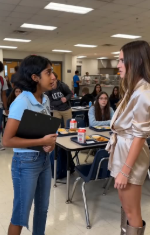
She walked across the cafeteria with the confidence of someone who had donated enough money to believe hallways opened for her. Her heels clicked against the tile, each step clean and cold.
“Avery,” she said, lowering her phone. “Why is everyone staring at you?”
Avery’s eyes filled instantly, but the tears looked practiced. “Mom, she set me up.”
My mouth opened, but no sound came out.
Mrs. Lancaster turned toward me. “You must be Rhea.”
The way she said my name made it sound like a stain.
Principal Marlowe stepped between us. “Mrs. Lancaster, this is a school matter. We need to speak privately.”
“No,” she said. “If my daughter is being humiliated publicly, then I want to know publicly what accusation is being made.”
Avery sniffed. “She’s obsessed with making us look bad.”
Something inside me twisted.
I had spent all morning writing labels in clean block letters. I had double-checked donated ingredients because one freshman had told me her little brother might come by after school and he had a severe allergy. I had asked questions nobody else wanted to ask because safety made people impatient.
Now Avery was crying, and everyone was watching to see whether her tears weighed more than my proof.
Ms. Fletcher held the binder tighter. “The allergy disclosure sheet was removed.”
Mrs. Lancaster’s expression did not change. “By whom?”
Principal Marlowe said, “The cafeteria camera appears to show Avery moving it.”
“A camera appears?” Mrs. Lancaster repeated. “That is not an answer.”
Avery looked down, but I saw her mouth move.
“Mom, please.”
That was when I understood.
Avery was not scared of being caught by the school.
She was scared of being caught by her mother for failing.
Mrs. Lancaster faced the principal. “My daughter has organized this event for weeks. Do you know how much money her committee raised last year?”
“With respect,” Ms. Fletcher said, “that does not matter if food was mislabeled.”
Mrs. Lancaster’s smile sharpened. “Everything matters when a student’s reputation is being damaged.”
Then she turned back to me.
“What exactly did you think you were doing?”
My voice shook, but I answered. “I was putting the missing allergy sheet back where families could see it.”
“And instead,” she said, “you caused a spectacle.”
Avery’s friends nodded too quickly.
For one awful second, I felt the room shift again. Not all the way back to Avery’s side, but enough. Enough to remind me that proof did not always win quickly when power knew how to dress itself.
Then a small voice came from behind the cupcake table.
“She didn’t cause it.”
Everyone turned.
It was Clara Bennett, a quiet sophomore from the baking club. Her apron was dusted with flour, and her hands were clenched around a folded receipt.
Clara looked terrified.
But she stepped forward.
“Avery told us to switch the labels.”
Avery’s head snapped up.
Mrs. Lancaster’s face finally changed.
Part 4: The Receipt Hidden Under The Cupcake Tray
Clara held out the receipt like it might burn her fingers.
“I didn’t know what it meant at first,” she said. “I thought Avery just wanted the display to look cleaner.”
Avery’s voice cut across the room. “Clara, stop.”
Clara flinched, but she did not step back.
Principal Marlowe took the receipt. Ms. Fletcher leaned beside him, scanning the small printed lines. Her lips pressed together.
“What is it?” I asked before I could stop myself.
Ms. Fletcher looked at me, then at the principal. “It’s a store receipt for peanut butter chips, chopped nuts, and brownie mix. Purchased yesterday evening.”
A student near the vending machines whispered, “For the peanut-free table?”
Clara nodded, eyes wet now. “Avery said the nut-free ingredients were too expensive and the brownies looked dry. She said nobody would know if we used regular mix because the signs were already printed.”
The cafeteria erupted.
“That’s insane.”
“My little sister bought one.”
“Did anybody eat them?”
Avery stepped backward. “She’s lying. Clara’s lying because Rhea scared her.”
I stared at Avery.
Scared her?
I was the one still feeling the echo of her hands on my shoulders. I was the one with my palms scraped from catching myself against the table edge. I was the one who had watched her reach for the proof like the truth belonged to whoever could grab it fastest.
Mrs. Lancaster moved toward Clara. “You need to be very careful before you accuse my daughter.”
Clara’s chin trembled.
Then I stepped beside her.
I did not feel brave. My knees felt loose, and my voice was barely there, but I moved anyway.
“She’s telling the truth,” I said. “The batch numbers on the boxes match the receipt. I wrote them down when I checked the trash.”
Avery stared at me with pure hatred.
“You went through trash?” she said loudly. “That’s disgusting.”
“No,” I said. “What’s disgusting is hiding allergy information.”
The words landed harder than I expected.
Ms. Fletcher’s eyes softened, but Principal Marlowe looked grim. “Nobody eats anything else from this table. Cafeteria staff, please secure all baked goods. Now.”
For the first time, the bake sale stopped being school drama.
It became an emergency.
A secretary appeared at the cafeteria entrance, breathless. She whispered something to the principal.
His face went pale.
“What?” Ms. Fletcher asked.
The secretary looked at the trays, then at the students.
“One parent just called the front office,” she said. “A child from the elementary visit is having an allergic reaction. They’re on the way to urgent care.”
The cafeteria went silent.
Avery whispered, “No.”
And this time, nobody thought she sounded innocent.
Part 5: The Phone Call That Broke The Cafeteria
Principal Marlowe cleared the room in sections.
Freshmen were sent to the auditorium. Juniors to the gym. Seniors were told to leave their bags and follow staff. Nobody argued. The usual cafeteria noise had disappeared, replaced by the squeak of shoes and the low, frightened buzz of students texting parents.
I stayed because Ms. Fletcher told me to.
Avery stayed because the principal told her to.
Clara stayed because she was shaking too hard to walk.
Mrs. Lancaster stood near the windows, calling someone in a voice so controlled it sounded more frightening than yelling. “No statements. Do you understand? Not one word until I speak to the board.”
Avery sat at a lunch table with her hands folded in her lap. She looked smaller now, but not sorry. Not yet.
She looked trapped.
The principal returned with the school nurse, who carried a clipboard and a sealed plastic bag containing one of the brownies.
“The child is stable,” the nurse said.
I closed my eyes.
The breath I let out felt like it had been trapped in my chest for an hour.
Stable.
That one word kept me standing.
Clara started crying silently.
Ms. Fletcher put an arm around her shoulders.
Avery looked at her mother. “See? It’s fine.”
Mrs. Lancaster’s eyes flashed.
“Do not speak,” she said.
The sharpness of it made even me look away.
Principal Marlowe placed the receipt, the binder page, and printed stills from the video on the table. “Avery, this is your opportunity to explain.”
Avery stared at the evidence. “I didn’t think anyone would actually get hurt.”
No one moved.
It was almost worse than a denial.
Mrs. Lancaster inhaled slowly. “Avery.”
Avery’s lips trembled. “It was supposed to be perfect. The table, the photos, the donation total. Mom said the board luncheon mattered. She said this event needed to show leadership.”
Every adult in the room looked at Mrs. Lancaster.
Her face hardened. “Do not blame me for your choices.”
Avery laughed once, broken and bitter. “You told me not to let anything messy ruin it.”
Mrs. Lancaster stepped closer. “That did not mean endanger someone.”
“No,” Avery whispered. “It meant don’t embarrass you.”
For the first time, I saw something behind Avery’s cruelty that did not excuse it, but explained its shape.
She had built herself out of polish because she lived with someone who treated imperfection like failure.
Then her eyes found mine.
And whatever softness I might have felt disappeared.
Because she said, “This still only happened because Rhea wouldn’t mind her business.”
The nurse looked up.
Ms. Fletcher’s face went cold.
I felt something in me settle.
I picked up the allergy binder and placed it between us.
“It was my business,” I said. “It was everyone’s.”
Part 6: The Boardroom Door Avery Could Not Open
By the end of the day, the story had changed three times.
First, people said Avery had shoved me over a misunderstanding.
Then they said she had hidden a label.
By last period, everyone knew the truth: she had changed the food, removed the allergy sheet, and tried to blame me when I caught it.
But what nobody knew was why I had been checking so carefully in the first place.
That part came out the next morning.
Principal Marlowe called me to the front office before homeroom. My stomach folded in on itself when I saw the boardroom door open and Mrs. Lancaster seated inside with two school board members, a lawyer, Ms. Fletcher, Clara, and my mother.
My mother stood the second she saw me.
“Rhea.”
I had not told her everything. I had only said there was a problem at school and I was okay. But the second she hugged me, I realized she already knew enough to be scared.
Mrs. Lancaster watched us with a look I could not read.
The board chair, Mr. Whitcombe, adjusted his glasses. “Rhea, thank you for coming. We need to ask about your notes from yesterday.”
“My notes?”
Ms. Fletcher nodded gently. “The batch numbers. The missing sheet. The time you first noticed the label problem.”
I took the folded paper from my backpack. It was wrinkled now, the edges soft from my nervous fingers.
“I wrote it down because my cousin has allergies,” I said. “My aunt taught me that labels matter because people trust them.”
My mother squeezed my hand.
Mr. Whitcombe read the notes. His eyebrows lifted. “These are very detailed.”
Mrs. Lancaster leaned back. “Almost too detailed for a student who claims she wasn’t looking for trouble.”
My mother’s head turned slowly. “Excuse me?”
The room chilled.
Mrs. Lancaster smiled without warmth. “I am only saying this entire matter seems unusually organized.”
Before I could answer, Clara spoke.
“She always does that,” Clara said.
Everyone looked at her.
Clara’s voice shook, but she kept going. “Rhea writes things down because people ignore her when she just says them.”
The words hit me harder than I expected.
Because they were true.
I wrote things down because being calm was not always enough. Being careful was not always enough. Sometimes, people needed paper before they believed a girl like me.
Mr. Whitcombe turned another page.
Then he frowned.
“What is this?” he asked.
I leaned forward.
It was not my handwriting.
A second sheet had been tucked behind my notes.
A printed volunteer schedule.
One name was circled in red.
Avery Lancaster.
Beside it was a handwritten instruction:
“Keep Kapoor away from ingredient station.”
My mother went still.
Mrs. Lancaster’s face drained.
And Avery, standing in the doorway behind us, whispered, “I didn’t write that.”
Part 7: The Name Behind The Red Circle
Avery had not been invited into the boardroom, but there she stood, pale and shaking, one hand gripping the doorframe.
Principal Marlowe rose. “Avery, wait outside.”
“No,” Avery said. “I didn’t write that note.”
Mrs. Lancaster stood too quickly. “Avery, this is not the time.”
Avery stared at the paper in Mr. Whitcombe’s hand like it had become a living thing. “Mom.”
The room changed.
That one word carried too much.
Mrs. Lancaster’s mouth tightened. “Do not start.”
Avery’s eyes filled, but this time the tears did not look useful. They looked young. Frightened. Real.
“You wrote it,” Avery whispered.
My skin prickled.
Mrs. Lancaster said nothing.
Mr. Whitcombe turned the paper toward her. “Mrs. Lancaster?”
She lifted her chin. “I may have made a note about volunteer assignments. That is hardly relevant.”
My mother’s voice was quiet. “You told them to keep my daughter away from allergy safety.”
“I told them to keep an overinvolved student from disrupting a major fundraiser.”
I felt my mother’s hand tighten around mine.
Avery shook her head. “You said she would make us look careless. You said if she started checking everything, people would ask why the committee hadn’t done it already.”
Mrs. Lancaster’s eyes flashed with warning.
But Avery kept talking.
“You told me the board cared about optics more than details. You said the elementary guests made the event look good. You said the allergy table had to stay full because empty trays looked bad in photos.”
The board chair slowly removed his glasses.
Ms. Fletcher whispered, “Oh my God.”
Mrs. Lancaster’s polished mask cracked.
“I told you to manage a student event,” she hissed at Avery. “Not to poison anyone.”
Avery flinched like she had been slapped by the words.
Nobody spoke for several seconds.
Then Avery looked at me.
For once, there was no smirk, no performance, no rich-girl shine.
Just shame.
“I shoved you because I was scared,” she said. “Not of you. Of her.”
The apology was not enough. It could never erase what happened.
But the truth had shifted.
Avery had done something dangerous and cruel.
And her mother had built the pressure system that made cruelty look like leadership.
Mr. Whitcombe stood. “Mrs. Lancaster, you are removed from all school fundraising committees pending formal review.”
Mrs. Lancaster’s mouth opened.
He continued, “Avery will face disciplinary action. But this board will also investigate adult interference in student safety procedures.”
For the first time since I had met her, Mrs. Lancaster had no room to command.
Then my mother asked the question that made everyone freeze.
“How many other events had labels changed before this one?”
Part 8: The Scholarship Hidden Inside The Scandal
The investigation lasted three weeks.
During that time, Avery disappeared from the cafeteria, her clique broke apart into nervous little groups, and Mrs. Lancaster stopped entering the school like she owned the bricks.
I expected people to avoid me.
Some did.
But others came quietly.
A freshman thanked me because her brother was the child who had been taken to urgent care. A junior from student council admitted that labels had been “simplified” at two previous events to make tables look cleaner. Clara sat with me at lunch one day and said, “I should have spoken sooner.”
I told her, “You spoke when it mattered.”
But the biggest surprise came on a rainy Thursday afternoon, when Principal Marlowe called an assembly.
I hated walking into the auditorium with everyone looking at me. My sneakers squeaked on the floor. My hands were cold. I sat beside my mother and tried not to stare at the empty seat where Avery usually sat with her friends.
Then the principal stepped to the microphone.
“This school failed to protect a student who was protecting others,” he said.
A murmur moved through the room.
He continued, “We treated attention to safety as inconvenience. We treated quiet labor as invisible. That changes today.”
Ms. Fletcher came forward holding a blue folder.
“The board has created a student safety leadership program,” she said. “It will be named by the first student selected to lead it.”
My heart began to pound.
She looked at me.
“Rhea, if you accept, the program comes with a full annual scholarship for college preparatory expenses, funded not by donors seeking recognition, but by a restricted safety grant.”
I could not move.
My mother covered her mouth.
Then the auditorium doors opened.
Avery walked in.
Everyone turned.
She looked different. No silk. No bracelet. Just a plain navy sweater, jeans, and eyes red from crying. She walked down the aisle holding a sealed envelope.
For one terrifying second, I thought she was going to ruin everything again.
Instead, she stopped in front of the stage and faced the room.
“My mother tried to donate money to stop the investigation,” Avery said.
The auditorium exploded in whispers.
Principal Marlowe stiffened.
Avery held up the envelope. “I brought the emails.”
Mrs. Lancaster was not there to silence her.
Avery turned to me. “You don’t have to forgive me. I wouldn’t. But you were right. Records matter.”
She placed the envelope on the stage.
That was the shocking part.
Not that Avery had been punished.
Not that her mother had been exposed.
But that the girl who had shoved me to bury the truth became the one who handed over the final proof.
The board removed Mrs. Lancaster from every school position. The safety grant doubled after local businesses joined quietly, not for publicity, but because parents demanded real change. Clara became the baking club’s safety officer. Ms. Fletcher made ingredient checks mandatory for every event.
And I named the new program The Clear Label Project.
Months later, when the first training session began, I stood at the cafeteria table where everything had happened. The binder was new. The labels were clean. The room smelled like cinnamon and warm bread.
Avery arrived last and stood near the door, unsure if she was allowed to come closer.
I looked at her, then at the empty chair beside Clara.
“You can help tape the labels,” I said.
Her eyes filled.
This time, nobody mistook tears for truth.
The truth was on the table, written clearly for everyone to see, and for the first time in that school, the girl nobody clapped for became the reason everyone was safe.
