Part 2: The Girl Addison Wanted Everyone To Blame
Clara Wexler stepped in wearing a volunteer vest that still had rain spots on the shoulders.
For one strange second, nobody moved. The charity-walk banners snapped lightly in the evening wind, the sponsor table lights buzzed overhead, and Addison Vale’s face emptied like someone had opened a drawer and stolen everything inside.
Clara’s eyes went straight to the paper in the counselor’s hand.
“Please tell me,” Clara said, her voice thin but steady, “that is the QR-code history.”
Addison recovered too fast. She laughed once, sharp and polished.
“Why are you even here?” she said. “You were told to stay home until the school reviewed your behavior.”
Clara flinched, but she did not step back.
I saw it then. The exhaustion under her eyes. The way her fingers curled around the strap of her canvas bag like she had spent days holding herself together with one hand.
The counselor, Mr. Henley, looked from Clara to Addison. “Clara, were you accused of creating the donation link?”
Clara swallowed. “Yes.”
Addison snapped, “Because she did.”
But Mr. Henley unfolded the printout. His thumb stopped near the bottom of the page.
His expression changed.
Not angry. Not shocked.
Worse.
Careful.
“Addison,” he said, “why does this show the first version of the QR code was created from your school tablet?”
The crowd did not gasp all at once. It rippled backward, person by person, like the truth had physical weight.
Addison’s mouth opened.
Her friends, Elodie March and Saskia Trent, looked at each other too quickly.
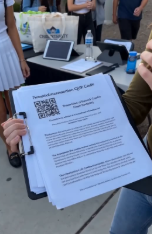
I bent to gather the pages that had scattered when she shoved me. My palm stung from scraping the pavement, but I kept collecting them because the papers suddenly felt hotter than my own fear.
Then Clara whispered, “It was never just the link.”
Mr. Henley turned to her.
Clara reached into her bag and pulled out a folded charity-walk brochure. It had been creased so many times the corners were soft.
“My family got an email saying I had been removed from the volunteer list for fraud,” she said. “But I never received the original complaint.”
Addison’s face hardened.
“Stop lying.”
Clara looked at her, and something quiet broke open in her voice.
“You used my login because I left the tablet charging in the media room. Then you told everyone I made the fake donation page because my mum needed scholarship help.”
My breath caught.
That was the part Addison had counted on. Not just proof. Shame.
She had chosen someone people could judge easily.
Someone whose money situation could be turned into motive.
Mr. Henley folded the creation history once, very slowly. “All students involved are coming with me.”
Addison tilted her chin. “My father is on the donor board.”
“I know,” he said.
For the first time, that did not sound like protection.
It sounded like a warning.
Addison’s eyes cut to me. “You don’t understand what you just started.”
I stood with the last page in my hand. My knees were still trembling from the shove, but my voice came out clear.
“No. I think I finally do.”
Then Clara stepped beside me, and the crowd parted like we were carrying something dangerous between us.
Because we were.
We were carrying the first piece of the truth.
Part 3: The Office Door Addison Could Not Charm Open
The administration office smelled like copier toner, wet coats, and the peppermint tea Mrs. Lorne drank whenever parents were about to shout.
Addison sat opposite me with her legs crossed, her ribbon still perfectly tied. Her mother had arrived first, wrapped in a camel coat, her diamonds small enough to be tasteful and bright enough to be noticed. Her father came in ten minutes later, speaking into his phone until the principal herself asked him to stop.
Clara sat beside me. She kept both hands flat on her knees.
I wanted to tell her she did not have to look so brave.
But I was afraid that if either of us stopped pretending, we would fall apart.
Principal Elise Marceau placed the QR-code history, Clara’s removal email, and my screenshots on the table.
“Let’s begin with facts,” she said.
Mr. Vale smiled without warmth. “Let’s begin with liability.”
The room went still.
Mrs. Marceau did not blink. “A student was physically shoved during a district event.”
“It was a misunderstanding,” Addison said.
I looked at her.
She had shoved me in front of half the school, but in that office she spoke as if she had bumped into me while reaching for a napkin.
Mrs. Marceau tapped the printout. “The donation QR code linked to an outside payment account. Not the registered charity account.”
Mrs. Vale leaned forward. “Children make technical mistakes.”
Clara’s voice trembled. “Then why was my name put on the complaint?”
Addison’s mother looked at Clara for the first time. Not at her face. At her shoes.
That tiny glance told me everything.
Mrs. Marceau opened another folder. “The complaint was filed anonymously from the school network.”
Mr. Vale’s phone buzzed. He ignored it. “Anonymous means you cannot attach it to my daughter.”
“No,” Mrs. Marceau said. “But the device log can.”
Addison’s smile flickered.
Mr. Henley placed a tablet on the table and turned it around. On the screen was a device record from the media room, listing the tablet checkout times.
Clara’s tablet. Addison’s login. The QR-code generator page. The payment account creation.
All stacked together like stones in a wall.
Elodie March’s name appeared too.
Then Saskia’s.
Addison whispered, “That’s private data.”
Mrs. Marceau replied, “So is a charity donor’s payment information.”
Mr. Vale stood. “This meeting is over.”
But before he could reach the door, a woman in a navy blazer entered without knocking.
She carried a laptop under one arm and wore an event badge from the district finance office.
“I’m sorry,” she said, not sounding sorry at all. “It is not over.”
Mrs. Marceau’s shoulders tightened. “Ms. Novak.”
The woman placed her laptop on the table and opened it.
“I was auditing the charity-walk payment portal after a donor reported a duplicate receipt,” she said. “The false QR code did not just redirect donations.”
She looked at Addison.
“It captured donor names, emails, and partial card details before forwarding them to the real charity page.”
Mrs. Vale went pale.
Addison stopped breathing for half a second.
I felt Clara’s hand brush mine under the table, cold and shaking.
Ms. Novak clicked once.
A spreadsheet filled the screen.
Rows and rows of donors.
Parents. Teachers. Students.
And beside several entries, a note in a hidden column:
“VIP follow-up.”
Mr. Vale’s face changed so fast it frightened me.
Not because he looked guilty.
Because he looked surprised.
Like Addison had not merely embarrassed him.
She had uncovered something he thought belonged only to adults.
Part 4: The Donor List With My Mother’s Name
My mother’s name was on line forty-seven.
Catherine Carter.
Donation amount: €25.
VIP follow-up: No.
I stared at it until the letters blurred.
It was such a small donation compared to the others. Twenty-five euros from a woman who checked grocery prices twice and pretended not to notice when I skipped new shoes. Twenty-five euros because I had told her the charity walk helped local families with medical transport.
Now her name sat inside a hidden file, copied by people who smiled at bake-sale tables.
My throat tightened.
“That is my mother,” I said.
No one answered.
Ms. Novak scrolled down. More names appeared. Some had tags beside them.
“Potential sponsor.”
“Business owner.”
“Divorce pending.”
“High-value contact.”
“Scholarship family.”
Clara made a small sound.
Her family’s name was there too.
Not VIP.
Not sponsor.
“Pressure point.”
Clara pushed her chair back so hard it scraped the floor.
“What does that mean?” she asked.
Addison stared at the screen as if she had never seen those words before. For the first time, she looked young. Not innocent. Just young enough to be afraid of the machinery she had touched.
Mr. Vale snapped, “This file is not relevant to school discipline.”
Ms. Novak turned the laptop toward him. “It is relevant to a district charity event.”
He reached for it.
Mrs. Marceau stepped between them.
That was when Addison whispered, “I only used the template.”
Everyone looked at her.
Her father said, “Be quiet.”
But she had already cracked.
“I only changed the QR code,” Addison said, words speeding up as panic burned through the polish. “Elodie said it would prove Clara was stealing attention from the walk committee. Saskia said we could send the money back before anyone noticed. I didn’t make that spreadsheet.”
Clara’s voice was barely audible. “You were going to ruin me for attention?”
Addison’s eyes flashed. “You don’t get it. Everyone was praising you for designing the route signs, and you kept acting like you didn’t care.”
Clara stared at her.
“I cared,” Clara said. “I just didn’t think kindness was supposed to be a competition.”
Something in the room shifted.
Addison looked away.
Then Ms. Novak clicked into the file properties.
Created by: Vale Civic Partnerships.
Modified by: A. Vale.
Shared with: E. March, S. Trent, R. Bellamy, T. Havers.
And one more name.
Damien Vale.
Addison’s father.
His silence became louder than shouting.
Mrs. Vale whispered, “Damien?”
He looked at his daughter as if she were a broken lock.
“You stupid girl,” he said.
Addison recoiled.
Not because he insulted her.
Because he had said it in front of us.
Mrs. Marceau picked up the office phone. “I am contacting district legal and the police liaison.”
Mr. Vale’s hand slammed onto the table.
“No one calls anyone.”
The sound made Clara jump. It made my pulse spike hard enough that I felt it in my scraped palm.
But Mrs. Marceau did not lower the phone.
Mr. Vale looked directly at me.
“You found the QR code,” he said softly. “You can also say you were mistaken.”
My whole body went cold.
He reached into his coat and took out a business card.
On the back, he wrote a number.
Not a phone number.
An amount.
€50,000.
He slid it across the table toward my injured hand.
“For your mother,” he said.
The room became so silent I heard Clara crying.
I looked at the card.
Then I looked at Addison.
For the first time that night, she looked ashamed.
But shame was not enough.
I pushed the card back with two fingers.
“My mother’s name is not for sale.”
Part 5: The Video Addison Forgot Was Still Recording
The police liaison arrived with two district safeguarding officers and a woman from financial crimes who carried no expression at all.
Her name was Inspector Livia Hartmann.
She asked for the laptop first.
Then the tablet.
Then every phone used by the charity-walk committee during the event.
Addison clutched hers so tightly her knuckles turned white.
“My daughter is a minor,” Mrs. Vale said.
Inspector Hartmann nodded. “Then she should be especially eager to show whether adults directed her.”
That sentence changed Addison.
Her eyes darted to her father.
Mr. Vale gave the smallest shake of his head.
It lasted less than a second.
But Addison saw it.
So did I.
And so did Inspector Hartmann.
“Miss Vale,” the inspector said, “did anyone instruct you to redirect the QR code?”
“No,” Addison said.
Too quickly.
Elodie and Saskia had been brought into a side room. Through the frosted glass, I could see Saskia crying into her sleeve while Elodie’s mother paced with a phone pressed to her ear.
Clara sat beside me in the hallway. My scraped palm had been cleaned and wrapped by the school nurse, but my hand still throbbed.
“You should go home,” Clara whispered.
“So should you.”
She gave a tiny, broken smile. “I tried that. They still blamed me.”
The office door opened again.
Inspector Hartmann stepped out.
“Naomi,” she said, “you mentioned your phone was recording?”
My stomach twisted. “Not on purpose. I was trying to scan the code again when Addison came over. I think it kept recording after she shoved me.”
Addison’s face appeared behind the inspector, pale and furious.
“You recorded me without consent?”
I almost laughed because the alternative was shaking.
“You attacked me in front of two hundred people.”
Inspector Hartmann held out her hand. “May I review it?”
I unlocked my phone and opened the video.
The first seconds were chaos. Lights. Shoes. Addison’s voice calling me jealous. My own breath too loud near the microphone.
Then Addison’s hand hit my shoulder.
The image spun.
The pavement filled the screen.
The papers scattered.
But the audio kept going.
Elodie’s voice: “Grab the history sheet.”
Saskia: “No, not now.”
Addison, sharp and terrified: “If she gives that to staff, Clara’s story falls apart.”
Then another voice.
Male.
Older.
Not Mr. Vale.
A voice I recognized from school assemblies.
Robert Bellamy, the charity foundation director.
“Keep your father out of this,” the voice said. “If the district sees the full donor file, we lose the transport grant.”
Inspector Hartmann replayed that part.
Once.
Twice.
Mr. Vale went rigid.
Mrs. Marceau whispered, “Robert?”
Robert Bellamy had handed out medals every year. He had hugged scholarship students on stage. He had cried during speeches about community service.
And his voice was on my phone, talking about keeping the donor file hidden.
Addison sank into the nearest chair.
“I didn’t know he was there,” she said.
Inspector Hartmann looked at her. “But you knew there was a donor file.”
Addison covered her mouth.
Her father said nothing.
That silence was the most honest thing he had given us all night.
Then Clara stood.
Her face was wet, but her voice did not shake anymore.
“My brother missed hospital transport twice last term,” she said. “The charity said there were no funds left.”
Ms. Novak looked up sharply.
Clara continued, “But tonight you collected thousands.”
The hallway seemed to tilt.
Inspector Hartmann closed my phone case carefully.
“This is no longer school discipline,” she said.
Then a police officer entered from the front doors with Robert Bellamy beside him.
Bellamy’s smile was gone.
And in his hand was a shredded strip of sponsor badges he had been trying to throw away.
Part 6: The Girl Who Lied Finally Told The Truth
Robert Bellamy did not look like a villain.
That made it worse.
He looked tired, respectable, and annoyed, like the real problem was that everyone had failed to stay polite.
“This is a misunderstanding,” he said.
Addison laughed.
It was not pretty. It came out cracked and bitter.
“That’s what I said.”
Her father turned on her. “Addison.”
But she stood before he could finish.
“No,” she said. “You don’t get to use that voice now.”
Mrs. Vale reached for her daughter, but Addison stepped away.
The silk ribbon had slipped loose from her hair. Without it, she looked less like a poster for success and more like a girl who had been trained to smile until her face hurt.
Inspector Hartmann said, “Miss Vale, speak carefully.”
Addison wiped under one eye with the back of her hand. “Mr. Bellamy told us the charity board needed better donor data. He said the official portal was outdated. He said my father had approved a temporary capture page.”
Mr. Vale said, “That is false.”
Addison looked at him with a pain so sharp I almost looked away.
“You told me not to embarrass you,” she said. “You told me Bellamy knew how these events worked. You said if I wanted to prove I was ready for the youth board, I should stop acting like a child.”
Her voice broke on the last word.
Bellamy sighed. “Teenagers exaggerate.”
Clara moved beside me. “Teenagers also get blamed.”
That landed.
Even Inspector Hartmann glanced at her.
Addison turned toward Clara.
For a moment, all the cruelty between them stood there with nowhere to hide. The insults. The fake complaint. The way Addison had chosen Clara because people might believe a poor girl would steal.
“I wrote the anonymous complaint,” Addison said.
Clara’s face tightened.
Addison forced herself to continue. “Elodie helped. Saskia knew. We used your name because Bellamy said the committee needed a distraction if anyone questioned the QR code.”
Bellamy’s jaw clenched.
Addison looked at me next.
“And I shoved Naomi because she had the creation history.”
My wrapped hand pulsed.
“I know,” I said.
“No,” Addison whispered. “You don’t.”
She pulled her own phone from her pocket and unlocked it with shaking fingers.
Her father stepped forward. “Do not.”
Addison looked at him.
And then she pressed play.
A voice memo filled the hallway.
Bellamy’s voice again, smoother this time: “If the Carter girl keeps digging, make it emotional. Rich girl versus jealous nobody always distracts a crowd.”
My heart slammed once.
Addison’s voice on the recording answered, smaller and eager: “What about Clara?”
Bellamy replied, “Clara Wexler is already useful. Her family profile makes the accusation believable.”
Clara turned away like she had been struck.
Addison stopped the recording.
No one spoke.
Then she did the one thing I never expected.
She walked to Clara and held out her phone.
“Take it,” Addison said. “Please. Before I lose my nerve.”
Clara stared at the phone.
Her fingers hovered.
Then she took it.
Bellamy lunged.
Not far. Not dramatically. Just one desperate step toward the evidence.
The officer caught his arm before he reached her.
But in that single movement, several sponsor badges fell from his coat pocket.
One of them was my mother’s.
Part 7: The Charity That Was Never Meant To Help Us
By midnight, the charity walk had turned into a cordoned-off investigation site.
The bright path lights were still on, but the laughter had drained from the place. Parents stood in tight groups. Students whispered behind their phones. Teachers moved like people trying to hold a roof up with their hands.
My mother arrived after Mrs. Marceau called her.
She came in her old navy coat, hair pinned badly because she must have done it in a hurry, eyes scanning faces until she found me.
Then she saw the bandage.
“Naomi.”
One word.
That was all it took.
I crossed the hallway and folded into her arms. She smelled like laundry soap and cold air. For the first time all night, my knees actually gave way a little.
“I’m okay,” I said.
She held my face between her hands. “You are allowed to not be okay.”
Behind her, Clara’s mother arrived with Clara’s younger brother, Milo, asleep in a wheelchair. He had a blanket over his legs and a sticker from some hospital visit on the side of his chair.
Clara saw him and broke.
Not loudly. Not theatrically.
She just bent over him and pressed her forehead to his blanket.
Ms. Novak came out of the office with a printout.
Her face looked older than it had an hour ago.
“The transport grant was not empty,” she said to Mrs. Marceau. “It was redirected through consulting invoices.”
Bellamy, seated under police supervision, looked away.
“Consulting invoices?” my mother asked.
Ms. Novak hesitated, then nodded. “Companies connected to donor board members.”
Mrs. Vale put a hand over her mouth.
Mr. Vale’s name was on one of them.
But not as the biggest payment.
The biggest payment went to Bellamy’s private consultancy.
The second went to March Strategic Events.
Elodie’s family.
The third went to Vale Civic Partnerships.
Addison’s father.
Clara stared at the paper. “So the charity had money.”
“Yes,” Ms. Novak said softly.
“My brother missed appointments because you wanted consulting fees.”
Nobody corrected her.
Because there was no softer version.
Milo stirred in his chair and opened his eyes. “Clara?”
She wiped her face fast. “I’m here.”
He looked around at all the adults, all the police, all the bright lights.
“Did we win the walk?”
The question went through the hallway like a blade.
Clara laughed once, and it turned into a sob.
Then Addison, standing apart from everyone, whispered, “No.”
Milo looked at her.
Addison’s face crumpled.
“No,” she said again. “But I think you helped us find where the road went.”
For a second, I thought Clara would hate her for speaking.
Instead, Clara looked exhausted.
“Don’t make my brother part of your apology,” she said.
Addison nodded, tears sliding down her cheeks. “You’re right.”
Inspector Hartmann returned with another officer.
“Robert Bellamy is being taken in for questioning,” she said. “Damien Vale and the other board members will be formally interviewed.”
Mr. Vale’s polished calm finally cracked. “You cannot prove intent.”
Inspector Hartmann lifted my phone in an evidence sleeve.
“Not from one file,” she said. “But from seven years of donor exports, hidden invoices, and a recording in which a child was instructed to frame another child?”
She looked at him.
“I can begin.”
Mr. Vale said nothing after that.
Addison watched her father being led to a separate room.
She did not call after him.
She only reached up and untied the silk ribbon from her hair.
Then she dropped it into the trash.
Part 8: The Name They Could Not Erase Again
Three weeks later, the district held the charity walk again.
Not at night.
Not under sponsor lights.
Not with donor-board speeches and velvet ropes around the registration table.
This time, it began on a gray Saturday morning beside the river in Porto, with fog lifting off the water and volunteers stamping their feet to stay warm. The banners were plain. The payment page was public. The QR code was printed beside a second line that read: Verified by District Finance.
Clara designed the signs.
I checked the links.
Neither of us joked about it.
Some things stop being funny once you understand what they nearly cost.
Bellamy had resigned before he was formally charged. Mr. Vale’s company lost its district contract. Elodie transferred schools. Saskia wrote an apology letter that Clara read once and never answered.
Addison stayed.
That surprised everyone.
She came back without ribbons, without her polished circle, without the easy cruelty that used to enter a room before she did. People watched her in hallways with the hungry curiosity they once turned on Clara.
She did not ask for sympathy.
That was the only reason Clara tolerated her at the second walk.
Mrs. Marceau asked Clara and me to cut the starting ribbon. Clara refused at first.
Then Milo said, “Do it so we can go home sooner.”
So she did.
My mother stood near the front, holding a paper cup of coffee. When our eyes met, she raised it like a toast.
I smiled.
Then Ms. Novak hurried toward us with a tablet pressed to her chest.
“Before we start,” she said, “there is something you need to see.”
I froze. “Is the code wrong?”
“No.” Her eyes were bright. “It is right.”
She turned the tablet around.
The total donations had already passed the original goal.
Then doubled it.
Then tripled it.
But that was not the shocking part.
The donor note attached to the largest contribution read:
For every family marked as a pressure point.
The donation came from an anonymous account.
Clara frowned. “Who sent it?”
Ms. Novak shook her head. “Legally anonymous.”
But Addison, standing behind us, went very still.
Clara saw it.
“What do you know?” she asked.
Addison looked down at her hands.
“My mother sold her jewelry,” she said. “Not all of it. Enough.”
Mrs. Vale stood at the edge of the crowd in a simple black coat, her face bare and tired. She did not come forward. She did not wave.
She only nodded once toward Clara.
Clara’s eyes filled, but her voice stayed guarded. “That doesn’t fix it.”
“No,” Addison said. “It doesn’t.”
Milo rolled closer in his chair. “Will it pay for rides?”
Ms. Novak smiled through tears. “For a long time.”
The starting whistle blew, but nobody moved yet.
Clara turned to me.
I thought she would ask what to do.
Instead, she reached for the microphone.
Her hand shook, but only a little.
“My name is Clara Wexler,” she said, her voice carrying over the river path, “and three weeks ago, someone tried to erase my name by putting it on a lie.”
The crowd fell silent.
She looked at Addison.
Then at me.
Then at her brother.
“But today, my name is on the route signs, the verified page, and the transport fund that will help families get where they need to go.”
She swallowed.
“So let the record show this: we were not pressure points. We were the reason the truth survived.”
People started clapping slowly, then louder, until the sound rolled across the water.
Addison cried quietly.
Clara did not forgive her that day.
She did something harder.
She walked past her and began the route.
Milo rolled beside her. My mother walked with mine. And I carried the verified QR code at the front, not because I had saved anyone alone, but because a strange link, a shoved girl, and a history sheet had opened a door powerful people forgot to lock.
By the end of the walk, the fog had lifted completely, and every erased name had become a direction home.
