Part 2: The Clip That Froze The Room
The principal did not press play right away.
That was the worst part.
He just stood there with his hand near the laptop trackpad, letting Madison Beaumont stare at the paused video like silence itself had turned into a witness.
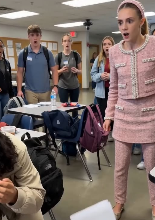
The shelter classroom smelled like wet dog towels, disinfectant, and the orange juice Madison had thrown across my face. It dripped from my chin onto my bomber jacket in slow, sticky drops. Nobody laughed anymore. Even the students who had started raising their phones had lowered them like the room had become too serious to record.
Madison’s pink headband sat perfectly in place.
Mine was the face burning in front of everyone.
But her eyes were the ones moving too fast.
“Dr. Keller,” she said, aiming her voice at the principal instead of at me, “this is obviously being taken out of context.”
Mr. Lawson, the animal shelter coordinator, crossed his arms. “Then the context should help you.”
Madison shot him a look. “I was talking to the principal.”
He did not blink. “And I’m responsible for the shelter animals.”
The final clip stayed frozen on the screen.
It showed the storage hallway behind the pet-care program room. The camera angle was narrow, taken from a shelter security camera near the supply closet. In the image, Madison stood beside the cage-card printer, her tweed sleeve lifted as she leaned over the desk.
Beside her was the school tablet.
Beside the tablet was the printed photo proof I had tried to protect.
My hands tightened around the paper towel Ms. Rivera had given me. It was already soaked through.
Madison gave a brittle laugh. “So I stood near a printer. Is that illegal now?”
I wanted to say something, but my throat felt raw. I was scared one shake in my voice would give her exactly what she wanted.
So I stayed quiet.
Dr. Keller finally pressed play.
On the screen, Madison reached for a stack of printed animal intake cards. She flipped through them quickly, then pulled one photo from the pile. A small gray terrier’s image appeared for half a second before she slid it behind a folder.
Then she took another paper from her bag.
A replacement photo.
My stomach dropped.
Someone whispered, “No way.”
The clip kept going.
Madison scanned the replacement photo into the tablet, typed something, and printed a new cage card. Then she looked over her shoulder, smiled like she had heard someone coming, and tucked the original photo into the pocket of her pearl-detailed jacket.
The photo I had picked up from the floor was not random. It was the original animal record.
Madison’s lips parted.
“That isn’t what it looks like,” she said.
Mr. Lawson’s jaw tightened. “You changed an intake photo.”
“No,” Madison snapped. “I corrected it.”
Dr. Keller turned slowly. “Corrected it from what?”
Madison lifted her chin. “The first photo was ugly and blurry. We’re supposed to make the adoption profiles look good.”
Mr. Lawson stepped toward the laptop. “That dog was under medical observation. Intake photos are identification records, not decorations.”
The room shifted again.
Not just gossip now.
Not just humiliation.
Something had been changed that could affect an animal’s care.
I looked down at the school item I had been protecting, still on the floor near the leg of a folding table. The laminated entry log had landed face-down when Madison threw the drink. Orange juice had soaked one corner, but the printed names were still visible beneath the plastic.
Mr. Lawson picked it up carefully.
Madison saw it in his hand and went pale.
“Wait,” she said. “That’s not necessary.”
He looked at her. “Then why are you afraid of it?”
Her friends near the doorway stopped pretending they were confused.
Dr. Keller turned the laptop toward Madison’s side of the room.
The next file opened automatically.
A spreadsheet.
Volunteer entry log.
Shelter records access.
Student sign-ins.
And next to the timestamp for the changed intake photo was one name.
Madison Beaumont.
Part 3: The Dog Nobody Wanted Identified
The gray terrier barked once from the back kennel, and the sound cut through the room like it knew it had become part of the story.
His name on the old card had been Milo.
On the replacement card, Madison had changed it to “Misty.”
Not just the photo.
Not just the description.
The sex, age estimate, intake time, and observation note had been altered too.
Mr. Lawson read the entries aloud, each word pulling Madison’s confidence apart.
“Original record: male, older juvenile, limp on rear left leg, keep separate until vet check. Replacement record: female, young, ready for public adoption walk-through.”
A girl beside the supply shelf covered her mouth.
Ms. Rivera looked at Madison like she could not understand how a student had managed to turn a school volunteer program into something so dangerous.
Madison crossed her arms. “It was one profile. You’re acting like I hurt something.”
Mr. Lawson’s voice went low. “You could have.”
I wiped my cheek again, but the juice had dried sticky along my jaw. My skin felt tight. I hated that everyone could see me like that. I hated that Madison had made my humiliation the opening act to her lie.
But I hated more that Milo had almost disappeared under a prettier card.
“I saw the first photo by the printer,” I said.
My voice shook, but I kept going.
“It had a red medical flag on the corner. The new one didn’t. That’s why I asked to compare the entry log.”
Madison whipped toward me. “You were snooping.”
“I was checking why a medical flag vanished.”
“You always make everything about being noble,” she said, her voice turning cruel. “You think carrying boxes and feeding dogs makes you better than everyone.”
My face burned hotter, but not from the drink this time.
Ms. Rivera stepped between us. “Madison, stop.”
“No, she needs to stop,” Madison said. “She embarrassed me in front of my team.”
Mr. Lawson lifted the laminated log. “Your team?”
Madison hesitated.
That one tiny pause opened a door.
Dr. Keller noticed it too. “What team?”
Nobody answered.
Then a boy named Ethan, who had been standing by the leash hooks, looked down at the floor.
Madison saw him.
“Ethan,” she warned.
He swallowed. “The adoption showcase team.”
Ms. Rivera frowned. “That team was supposed to photograph animals, not edit medical records.”
Ethan’s eyes flicked to Madison, then to Dr. Keller. “Madison said her group needed the most adoptable animals for the sponsor video.”
Sponsor video.
The words landed ugly.
Mr. Lawson closed his eyes for one second, like he was holding back anger for the sake of the animals around us.
Dr. Keller asked, “What sponsor video?”
Madison’s friend Claire suddenly said, “It was just for the Beaumont Foundation page.”
Madison snapped, “Claire, shut up.”
And there it was again.
The room heard the order behind the glamour.
Claire’s cheeks went red.
She whispered, “Her mom wanted the shelter segment to look more successful. Like Madison’s leadership brought in the best adoption results.”
The terrier barked again.
Milo.
His real name.
His real limp.
His real record.
Not a prop for Madison’s leadership reel.
I looked at Madison, and for a second, underneath all the polish, I saw something frightened and furious. She was not just protecting a lie. She was protecting the image her family had built around her.
Mr. Lawson clicked into the entry log archive.
“Three animal records were opened from Madison’s tablet login,” he said. “All within sixteen minutes.”
Dr. Keller turned to her. “Did you change three records?”
Madison’s mouth trembled before she pressed it flat.
“No,” she said.
Then the shelter office printer started humming.
A page slid out.
Mr. Lawson picked it up, read it, and his expression changed.
“Actually,” he said quietly, “it was not three.”
He turned the page toward Dr. Keller.
It was nine.
Part 4: The Nine Changed Records
Nine names appeared on the printed report.
Milo. Daisy. Bruno. Patches. Luna. Oscar. Tilly. Bean. Ruby.
Nine animals.
Nine records opened under Madison’s student credentials.
Nine little lives turned into polished content.
The room seemed smaller with their names in it.
Mr. Lawson laid the paper on the folding table and flattened it with both hands. “These were animals with restrictions. Medical hold, behavioral note, owner-contact pending, privacy flag, or foster-only approval.”
Ms. Rivera’s eyes snapped up. “Privacy flag?”
That was when I remembered the photo proof.
The paper Madison had tried to grab from me before she threw the drink.
My heart started beating harder.
I bent down and picked it up from the floor.
It was wrinkled now, one corner damp, but the image was still clear enough. A young student from another school stood beside a brown-and-white spaniel, face partly visible in the background of the intake photo.
I had recognized the problem immediately when I found it.
That student had come to the shelter quietly with her family to surrender a pet after losing housing. The shelter staff had told us during training that surrender records were private, especially when families were minors or in crisis.
Madison’s new version had cropped the student out.
But she had not done it to protect her.
She had used the cropped dog photo in the sponsor folder.
“Ruby’s original intake photo had a privacy issue,” I said.
Madison let out an impatient breath. “Exactly. I fixed it.”
I looked at her. “No. You hid that you used it.”
Mr. Lawson took the paper from me carefully.
He looked at the original photo, then at the sponsor folder on the laptop.
His face darkened.
“She was never cleared for the showcase,” he said. “Ruby had an owner-contact hold.”
Claire whispered, “Madison said holds made the program look messy.”
Dr. Keller closed the laptop halfway, as if he needed to stop looking at the screen before speaking.
“Madison,” he said, “did you knowingly present restricted animals as available for adoption?”
She stared back at him. “I was improving the event.”
“No,” Mr. Lawson said. “You were falsifying shelter information.”
Madison’s eyes flashed. “That’s dramatic.”
But her voice had lost its power.
The expensive confidence was cracking into something sharp and desperate.
A small volunteer named Hannah raised her hand halfway, then lowered it.
Ms. Rivera saw her. “Hannah?”
Hannah’s voice was barely audible. “Madison told me to switch Ruby’s kennel card after lunch.”
Madison turned so fast her headband slipped.
Hannah stepped back, but kept talking.
“She said if anyone asked, Ines had misplaced the original. She said people would believe it because Ines was always carrying extra papers.”
The room blurred around the edges.
So that had been the plan.
Not just to hide the proof.
To make me the reason it went missing.
The drink in my face had not been a loss of control.
It had been a distraction.
I felt Ms. Rivera’s hand gently touch my shoulder.
Dr. Keller looked sick. “Madison, is that true?”
Madison’s mouth opened.
Then her phone rang.
Not a text.
A call.
The screen lit up on the table where she had dropped it earlier.
MOM.
No one reached for it.
The room watched it vibrate against the metal surface.
Once.
Twice.
Three times.
Madison stared at the name like it was more dangerous than any record on the laptop.
Then Mr. Lawson said, “Answer it on speaker.”
Part 5: The Call Madison Could Not Control
Madison shook her head immediately.
“No.”
Dr. Keller’s eyebrows lifted. “No?”
“My phone is private.”
“And shelter records are protected,” Mr. Lawson said. “But that did not seem to matter to you.”
The call stopped.
For one second, Madison looked relieved.
Then it started again.
MOM.
The vibration rattled against the table, louder than it should have been. Everyone’s eyes kept flicking between Madison and the glowing screen.
Ms. Rivera said softly, “Madison, if your parent is involved in this event planning, we need to understand what happened.”
“My mother is not involved,” Madison said too quickly.
Claire looked down.
Ethan looked away.
Hannah started crying.
That was enough.
Dr. Keller picked up the phone but did not answer it. “I’m going to call her from the school office.”
Madison reached for the phone, but security stepped between them.
Her face twisted. “You can’t just take my things.”
Dr. Keller’s voice sharpened. “And you cannot alter records in a shelter program, throw a drink at another student, and expect us to treat this as normal drama.”
Normal drama.
Those words made my chest ache.
Because that was what Madison had counted on. Everyone calling it drama. Everyone focusing on the orange juice in my face instead of the entry log on the floor.
Dr. Keller walked into the shelter office with Ms. Rivera and Mr. Lawson. The glass window between the office and the classroom showed their shapes but blurred their faces.
We could not hear every word.
But we heard enough.
“Mrs. Beaumont… school matter… animal shelter records… yes, your daughter…”
Madison stood rigid near the doorway.
Then Dr. Keller’s voice rose.
“No, this is not about optics.”
Madison closed her eyes.
Optics.
Her mother had said optics.
A few minutes later, Dr. Keller returned, holding the phone away from his ear like it had become contaminated.
“She’s coming here,” he said.
Madison whispered, “Great.”
But it did not sound great.
It sounded like a door closing.
While we waited, Mr. Lawson opened the full shelter audit system. One by one, he compared original records with edited versions.
The damage spread wider than anyone expected.
One dog’s medication note had been hidden.
One cat’s bite-history warning had been softened into “nervous around hands.”
One senior dog’s age had been changed from nine years old to four.
A rabbit marked “not for handling by young children” had been added to the photo booth schedule.
Ms. Rivera pressed her fingers to her forehead.
“This could have gotten someone hurt,” she whispered.
Madison stared at the floor.
I thought she might finally apologize.
Instead, she said, “I didn’t know people actually depended on every little note.”
Mr. Lawson looked at her like she had just confessed more than she realized.
“That is exactly why you should never have touched them.”
The shelter front door opened hard enough to rattle the wall.
Mrs. Beaumont entered in a cream coat, carrying a designer purse and a smile meant for donors, not emergencies.
She looked first at Madison.
Then at me.
Her eyes paused on the stain across my jacket.
“Oh,” she said coldly. “So this is the girl.”
Part 6: Her Mother’s Smile Made Everything Worse
Mrs. Beaumont did not ask if I was okay.
She did not ask why Madison’s hands were shaking.
She looked at the stained paper towel in my hand, the damp collar of my bomber jacket, the students lined along the wall, and somehow decided the problem was me.
“I assume,” she said, “there has been a misunderstanding.”
Mr. Lawson stepped forward. “Nine shelter records were altered.”
Her smile did not move. “By children in a school program.”
“By your daughter’s login.”
“Then perhaps the school should supervise better.”
Madison’s face flickered.
It was quick, but I saw it.
A flash of pain.
Not because her mother denied it.
Because her mother was willing to throw everyone else under the blame before admitting Madison had done anything wrong.
Dr. Keller said, “Mrs. Beaumont, Madison also threw a drink at Ines Alvarez in front of witnesses.”
Mrs. Beaumont looked at me again, like I was a spill someone had failed to clean.
“Teenagers get emotional.”
My hands curled around the paper towel.
Ms. Rivera’s voice turned icy. “Ines was protecting a privacy-flagged record.”
Mrs. Beaumont laughed softly. “Protecting? Or overstepping?”
Madison whispered, “Mom.”
But Mrs. Beaumont kept going.
“My daughter has raised more visibility for this shelter in one week than your little student volunteers have in months. If a few profile cards needed improvement, that sounds like initiative.”
Mr. Lawson’s expression hardened. “Medical notes are not profile decorations.”
Mrs. Beaumont finally stopped smiling.
“Do you know how many donations our foundation brings into this shelter?”
There it was.
The real leash.
Not around the animals.
Around the adults.
The room felt colder.
Mrs. Beaumont placed her purse on the table, opened it, and removed a checkbook. “Let’s be reasonable. Replace whatever records need replacing. Clean the girl’s jacket. I will cover it.”
I heard someone inhale sharply.
Clean the girl’s jacket.
Not apologize.
Not accept responsibility.
Just pay for the stain and erase the truth with the same hand.
Madison stared at the checkbook. Her lips trembled.
I realized then that Madison had learned from an expert.
Dr. Keller said, “This is not a payment issue.”
Mrs. Beaumont’s voice dropped. “Everything becomes a payment issue when institutions remember how they survive.”
For the first time, Mr. Lawson looked truly furious.
But before he could answer, the shelter office door opened.
An older woman stepped out.
I had seen her once before, walking a frightened beagle through the back hall. She was Mrs. Donnelly, the shelter director, and everyone said she never came to student program days because she trusted Mr. Lawson completely.
Apparently, not today.
She held a tablet in one hand.
“I wondered,” Mrs. Donnelly said, “why a foundation donor was so interested in changing animal availability records.”
Mrs. Beaumont stiffened. “Excuse me?”
Mrs. Donnelly tapped the tablet.
A new screen appeared on the classroom monitor.
It was not a student log.
It was a donor request form.
At the top was Beaumont Foundation.
At the bottom was a note that made Madison’s face go white.
“Prioritize camera-ready animals for Beaumont campaign. Avoid medical-hold visuals.”
Mrs. Donnelly looked directly at Mrs. Beaumont.
“Your foundation requested the lie before your daughter carried it out.”
Part 7: The Director Opened The Second Log
Mrs. Beaumont did not speak for several seconds.
That scared me more than her smiling.
Because now she was calculating.
Madison looked at her mother like she was waiting to be rescued, but Mrs. Beaumont’s eyes stayed on Mrs. Donnelly. Not warm. Not worried. Just measuring the damage.
“That language,” Mrs. Beaumont said finally, “was written by a communications assistant.”
Mrs. Donnelly tilted her head. “Signed by you.”
The monitor stayed bright behind her.
Mrs. Beaumont’s signature sat below the request, clean and elegant, as if cruelty looked better in cursive.
Dr. Keller exhaled slowly.
Ms. Rivera whispered, “So Madison wasn’t acting alone.”
Mrs. Beaumont turned on her. “My daughter was volunteering for a program your school mishandled.”
Madison flinched at mishandled.
Mrs. Donnelly tapped the tablet again. “There is also a second log.”
Madison looked up.
So did Mrs. Beaumont.
Mr. Lawson’s face changed, as if he had not known this part either.
“The public-facing animal records were altered,” Mrs. Donnelly said. “But our system keeps an internal welfare log that student volunteers cannot edit.”
She pressed play.
Another camera clip appeared.
Not the storage hallway this time.
The kennel corridor.
Madison and Claire walked past the cages with a basket of colored tags. Madison stopped in front of Milo’s kennel, removed a red medical tag, and replaced it with a green showcase tag.
Claire stood behind her, nervous.
On the video, Claire said something.
The audio was faint, but clear enough.
“What if Ines notices?”
Madison answered without hesitation.
“Then we say she mixed up the tags. Everyone already thinks she takes on too much.”
The room went silent in a different way.
Not shocked.
Heavy.
Like everyone had just been forced to watch the exact moment I became her planned excuse.
My eyes burned.
I looked away from the screen, but that only made me see the real faces in the room.
Claire crying.
Ethan staring at his shoes.
Hannah covering her mouth.
Madison trembling.
Mrs. Beaumont stone-faced.
Dr. Keller looked at me, and for the first time all day, his voice was gentle.
“Ines,” he said, “I am sorry.”
Those words nearly broke me.
Because I had not realized how badly I needed an adult to say them.
Madison suddenly whispered, “I didn’t think they’d play audio.”
Mrs. Beaumont snapped, “Madison.”
But Madison did not stop.
Her breath came shallow, fast.
“You said it was just presentation,” she said to her mother. “You said shelters do it all the time.”
Mrs. Beaumont’s face hardened. “This is not the time.”
“No,” Madison said, louder now. “You told me if the ugly details stayed visible, donors would think the program was failing.”
Mrs. Beaumont stepped toward her. “Enough.”
Madison backed away.
And for the first time since the drink hit my face, I saw Madison Beaumont look completely alone.
She turned toward me, eyes wet, voice shaking with shame and anger and something that sounded almost like grief.
“I hated that you noticed,” she said. “Because I knew you were right.”
Mrs. Beaumont grabbed her purse. “We are leaving.”
Mrs. Donnelly blocked the door.
“No,” she said. “Not before animal control, the district, and the shelter board receive the full export.”
The printer started again.
Page after page slid into the tray.
And Mrs. Beaumont’s perfect smile finally disappeared.
Part 8: The Animal Who Remembered The Truth
The investigation did not end that afternoon.
It spread.
Not loudly at first. Not like gossip. More like a careful cleaning of a room nobody wanted to admit had been dirty.
The shelter board suspended the Beaumont Foundation partnership within forty-eight hours. The school paused the pet-care program for one week, then reopened it with new rules: no student could edit records, no sponsor could request animal selection, and every welfare note had to stay attached to every public-facing profile.
Mrs. Beaumont tried to call it a misunderstanding.
But misunderstandings do not come with signatures, edited logs, camera clips, and audio.
Madison was removed from leadership of the program.
For three days, she did not come to school.
When she returned, she looked smaller without her clique arranged around her. No pink headband. No tweed set. Just jeans, a plain sweater, and eyes that dropped whenever someone whispered.
I thought I would feel satisfied.
I did not.
The stain had washed out of my jacket, but the memory had not. I still felt the orange juice hit my face when someone laughed too suddenly behind me. I still checked twice before picking up any record, afraid someone would say I was overstepping.
Then Mr. Lawson asked me to come back to the shelter.
“I understand if you don’t want to,” he said. “But there’s someone who does.”
I thought he meant Madison.
He meant Milo.
The gray terrier sat in the quiet room near the back, his left rear leg bandaged, his ears uneven, his eyes bright and cautious. His real card was clipped to the kennel again. His real name. His real note. His real needs.
When I knelt, he limped forward and pressed his nose through the gap in the gate.
Something in my chest loosened.
Mr. Lawson smiled. “He wouldn’t walk for the camera team. But he walks when he hears your voice.”
I laughed once, softly, because if I spoke any louder I might cry.
A week later, the shelter held a small meeting for student volunteers.
Madison came.
She stood near the back, hands folded so tightly her knuckles turned pale. When Mrs. Donnelly asked if anyone wanted to speak, nobody expected her to move.
But she did.
Madison walked to the front with a folded paper in her hands.
“I changed records,” she said. “I removed welfare notes. I blamed Ines before she could prove what happened. And I threw a drink at her because I wanted everyone looking at her face instead of the log.”
The room did not forgive her instantly.
That made it more honest.
She looked at me.
“I’m sorry,” she said. “Not because I got caught. Because Milo could have been adopted into the wrong home. Ruby’s family could have been exposed. Someone could have been bitten or hurt. And you tried to stop that while I tried to humiliate you.”
My throat tightened.
I did not say it was okay.
Because it was not.
I said, “Then help fix it.”
Madison nodded.
So she did.
Not as a leader. Not in front of cameras. She cleaned crates, washed bowls, copied paper logs, and stood beside Claire while they restored every animal profile by hand.
The surprising part came one month later.
Ruby’s former family returned—not to reclaim her, but to thank the shelter for protecting their privacy until Ruby found the right foster home. They brought a small envelope for the volunteer who had caught the mistake.
Inside was a photo.
Ruby asleep on a blue blanket in her foster home, safe and calm.
On the back, someone had written:
Thank you for noticing what everyone else wanted to crop out.
I kept it in my backpack beside the repaired entry log copy.
At the next adoption day, there were no glamour booths, no sponsor scripts, no fake “camera-ready” animals. Each card showed the truth: medical needs, fears, habits, histories, and hopes.
Milo wore a little blue harness.
When a quiet older man knelt in front of him and waited patiently instead of reaching too fast, Milo limped forward and rested his chin on the man’s knee.
Mr. Lawson looked at me.
“That’s the one,” he whispered.
Madison stood across the room holding a stack of clean towels. She watched Milo leave with his new owner, and tears slipped down her face without performance or polish.
For once, nobody filmed her.
And when Milo turned at the door, looking back at the room where his truth had almost been erased, I realized the proof had never just been about a log.
It was about whether the smallest, quietest lives still mattered when nobody important was watching.
