Part 2: The Binder Madison Never Expected
The emcee did not say my name loudly at first.
He whispered it like he was afraid the room itself might punish him for telling the truth.
“Paloma Vale.”
My dress clung cold and heavy to my knees. Cream soup slid down the fabric in slow lines, dripping onto the polished floor in front of donors who had paid more for one seat than my mother made in a week. My hands curled at my sides because I did not know what else to do with them. If I wiped the soup away, everyone would see me shaking. If I stood still, I looked like a statue someone had decided to humiliate.
Madison Ashford was still smiling.
That was the worst part.
Not the soup. Not the shock. Not even the sharp little laugh from someone near the champagne table before they realized cameras had turned.
It was Madison’s smile, small and bright, as if she had only spilled something by accident and I had somehow behaved rudely by being in the way.
The event director, Mr. Calder, stepped onto the stage holding the marked binder against his chest. The red tabs sticking out of it looked like warning flags.
Madison’s father, Richard Ashford, moved before anyone else.
“Daniel,” he said, his voice smooth and low. “This is not the moment.”
Mr. Calder did not look at him.
He looked at the front row of donors, then at the photographers, then at me.
“I think,” he said into the microphone, “this is exactly the moment.”
Madison’s smile twitched.
Her mother, seated under the gold chandelier with diamonds at her throat, stiffened like someone had pulled a thread through her spine.
Mr. Calder opened the binder.
The sound of the rings clicking apart carried through the ballroom.
“This ceremony’s centerpiece concept,” he said, “was submitted four months ago during the youth design review.”
Madison laughed lightly. “That’s sweet, but my family foundation funded the gala installation.”
“Yes,” Mr. Calder said. “Your family funded the installation.”
He turned one page.
“They did not create the design.”
The room shifted.
A quiet, expensive kind of panic moved across the tables. People did not gasp all at once. They leaned toward one another. They whispered behind manicured hands. They checked the screens, the programs, the stage, the floral towers shaped like desert blooms rising behind us.
Those blooms were mine.
The copper wire branches. The mirrored petals. The tiny handwritten tags tucked beneath each glass flower, each one naming a family helped by the charity.
I had drawn them on notebook paper at my kitchen table after midnight.
Madison stepped forward. “This is ridiculous.”
Mr. Calder lifted a printed design file from the binder.
On the large screen behind him, the document appeared.
Original Concept Submission: Paloma Vale.
My name filled the screen.
For one second, the cold soup on my dress disappeared from my mind.
All I could see was that name.
My name.
Not crossed out. Not taped over. Not whispered like a mistake.
Visible.
Madison’s voice cut through the silence. “Anyone could type a name on a file.”
Mr. Calder clicked again.
The screen changed to a scanned sketch.
My sketch.
The one with the bent corner. The one with the coffee stain from the night my mother came home exhausted and set her mug down too close. The one where I had written, in messy pencil, “centerpiece must look like something fragile surviving heat.”
A woman near the stage covered her mouth.
Madison’s father stood. “Enough.”
But Mr. Calder turned another page.
“No,” he said. “Not enough.”
His voice changed then. It lost the polite gala warmth. It became something harder.
“The binder also contains the revision history showing the Ashford Foundation requested that Paloma Vale’s name be removed from the ceremony notes and replaced with Madison Ashford as creative lead.”
Madison’s face went blank.
And suddenly, the soup on my dress was not the scandal anymore.
The record was.
Part 3: The Name Taped Over Mine
The seating chart was brought to the stage like evidence from a crime scene.
A volunteer carried it with both hands, her face pale beneath the ballroom lights. The chart was printed on thick ivory board, bordered in gold, elegant enough to make a lie look official.
But at the center of the ceremony line, someone had taped over my name.
Not cleanly.
Not professionally.
A strip of cream paper had been pressed across the original text, and Madison Ashford had been written over it in black pen.
The room stared at that ugly little strip like it had started breathing.
Mr. Calder held it up.
“This was found at the registration table thirty minutes before the ceremony.”
Madison crossed her arms. “A volunteer made a mistake.”
The volunteer holding the chart flinched.
Mr. Calder looked toward her. “Nina, did you alter this chart?”
The young woman shook her head quickly. “No. I was told it had already been approved.”
“By whom?”
Nina’s eyes darted to Madison.
Madison’s mother stood so sharply her chair scraped the floor. “This is turning into a public attack on a young woman.”
My throat tightened.
A young woman.
Not me, apparently.
Madison could throw cold soup across my dress in front of the stage, call me unstable, tell donors I did not belong, and still be protected as a young woman.
I was just the mess she had made.
Mr. Calder’s jaw worked. “Mrs. Ashford, Paloma is also a young woman.”
For the first time, Madison’s mother looked at me.
Really looked.
Her gaze traveled over my wet dress, my cheap shoes, my trembling hands, and then quickly away, as if my humiliation was too inconvenient to witness.
Richard Ashford stepped into the aisle.
“Daniel, you are risking the largest donor relationship this charity has.”
A silence followed.
There it was.
The real title of the evening.
Not compassion. Not student work. Not community.
Donor relationship.
Mr. Calder closed the binder slowly. “Then maybe we should discuss what that relationship has cost.”
Madison’s eyes narrowed. “You wouldn’t dare.”
The microphone caught it.
The whole ballroom heard.
A reporter near the back raised his camera.
Mr. Calder turned toward the sound booth. “Play the registration footage.”
Madison’s face changed so fast it was almost frightening.
“No.”
Mr. Calder did not stop.
The screen flickered.
There was the registration table from earlier that evening. Volunteers moving place cards. Staff arranging programs. Then Madison entered the frame, her silver dress glittering beneath the lobby lights. She leaned over the chart. She peeled up a strip of tape. She pressed it over my name.
My skin prickled.
I watched her take out a pen.
Watched her write her own name.
Watched her step back and smile.
The ballroom went completely still.
Madison whispered, “That video was private.”
Mr. Calder looked at her. “It was security footage.”
Her father turned toward her with a look that was not anger exactly.
It was calculation.
As if he were trying to decide whether she had become too expensive to defend.
That look hurt me in a way I did not expect. Not for myself. For her. For one split second, I saw Madison not as a queen of polished cruelty, but as a girl trained by people who measured love in usefulness.
Then she ruined even that.
She pointed at me again.
“She wanted this,” Madison said. “She wanted everyone to feel sorry for her. Look at her. She came dressed like that to make us look bad.”
The words hit the room differently now.
Before, maybe some people would have believed her.
Now, they looked at my soup-stained dress and saw what she had done.
I looked down at the fabric.
It had been my best dress.
Not expensive. Not designer. But clean, pressed, chosen carefully because I knew rooms like this judged before they listened.
My voice came out small but clear.
“I didn’t come here to make anyone look bad.”
Madison scoffed.
I lifted my head.
“I came because I built the centerpiece.”
The screen behind me still showed her hand covering my name.
“And you knew it.”
Part 4: The Donor Table Went Silent
The charity board called an emergency pause, but no one left.
That was how I knew the truth had become more interesting than the gala.
Servers stood frozen along the walls with trays of untouched appetizers. Donors remained at their tables, whispering through tight smiles. The band had stopped playing, leaving the ballroom full of tiny sounds: ice shifting in glasses, camera shutters clicking, Madison breathing too loudly into the silence.
A staff member brought me a clean wrap from the coatroom.
I held it around my shoulders while the soup cooled unpleasantly against my skin.
Nina, the volunteer, approached with a stack of napkins.
“I’m sorry,” she whispered.
I wanted to say it was not her fault.
But I was tired of making everyone else comfortable.
So I only nodded.
Across the room, Madison stood between her parents near the donor table. Her mother kept touching her arm. Her father kept looking at his phone. Madison kept looking at me as if the night had betrayed her by continuing after she humiliated me.
Mr. Calder returned with two board members and a woman in a dark green suit.
“This is Helena Ortiz,” he told me gently. “She oversees compliance for the charity partnership.”
Helena’s eyes were sharp, but her voice was careful. “Paloma, I know this is overwhelming. We need to preserve your account while details are fresh. Did anyone from the Ashford Foundation contact you before tonight about the design credit?”
My fingers tightened around the wrap.
“Yes.”
Madison’s head snapped up.
Helena waited.
I swallowed. “Three weeks ago, I got an email from an assistant. It said the foundation had decided to present the centerpiece as a ‘family-led creative contribution’ because the donor story would be stronger.”
Helena’s expression darkened. “Do you still have the email?”
I nodded. “I saved it.”
Madison’s father spoke from across the room. “Teenagers misunderstand professional language all the time.”
Helena turned to him. “Then you won’t mind us reading it.”
He smiled without warmth. “I mind very much.”
That answer told the room everything.
Mr. Calder asked if I could open the email.
My hands shook so badly that Nina helped hold my phone steady while I searched. I hated that everyone could see the crack across the corner of my screen. I hated that Madison’s friends stared at it, probably noticing that my phone was old, that my case was peeling, that even my evidence looked poor.
But the email opened.
And poverty did not make it less true.
Helena read aloud.
“Given the visibility of the Ashford family’s contribution, we believe the evening will benefit from a simplified authorship narrative.”
A murmur spread.
She continued.
“Please understand that your participation will still be appreciated internally.”
Internally.
I almost laughed.
Internally meant invisible.
Internally meant thank you for the work, now stand aside while someone shinier receives the applause.
Helena looked up. “Was there compensation offered?”
“No,” I said.
“Credit?”
“No.”
“Did you agree to this?”
“No.”
Madison suddenly stepped away from her mother.
“She should be grateful,” she said, voice shaking. “Do you know how many students would kill to have their work even near an Ashford event?”
The room recoiled.
She heard herself too late.
Her father closed his eyes.
Mr. Calder said quietly, “Madison.”
“No,” she snapped. “Everyone here is pretending they don’t know how this works. My family brings the money. We bring the cameras. We bring the people who matter. Without us, her little wire flowers would be sitting in some classroom closet.”
A strange calm came over me.
Maybe there is a point where humiliation burns so hot it turns clean.
I stepped toward the centerpiece display.
The copper branches caught the light. Each mirrored petal reflected pieces of the room: chandeliers, cameras, donors, my stained dress, Madison’s furious face.
I touched one glass flower.
“This tag,” I said, “has the name of a family who got housing support last winter. This one is for a woman who received medical transportation. This one is for a child whose school supplies were covered.”
My voice grew stronger.
“You thought the centerpiece was decoration. That’s why you could steal it.”
Madison stared at me.
I looked straight back.
“I built it as a record of who the charity helped.”
Helena walked to the display and bent closer to the tags.
Then her face changed.
“Daniel,” she said slowly. “These names match the missing impact list.”
Mr. Calder went still.
“What missing impact list?”
Helena looked at Madison’s father.
“The one your foundation claimed was never completed.”
Part 5: The Centerpiece Held More Than Flowers
For the first time all night, Richard Ashford looked afraid.
It was quick. Almost invisible. A tightening around his mouth. A pause before he adjusted his cufflinks. But I saw it.
So did Helena.
She moved closer to the centerpiece, reading the tiny tags I had tied beneath the mirrored petals. I had written each one by hand using the original charity notes given to student designers. Names, dates, support categories, neighborhoods, small facts that made each family more than a number.
I thought I was honoring them.
I had not known I was preserving evidence.
Mr. Calder joined Helena at the display. “These records were removed from the final donor packet.”
Helena nodded. “The Ashford Foundation said the impact list was incomplete and unusable.”
Richard Ashford’s voice dropped. “Careful.”
Helena looked at him. “I am being careful.”
Madison glanced between them. “Dad?”
He did not answer her.
That scared her more than anything else had.
A board member asked to see the charity database. Someone called the office manager. Another staff member ran to retrieve a laptop from the admin suite. The gala had fully stopped pretending to be a gala.
People were standing now.
Not leaving.
Watching.
The large screen displayed the database beside my centerpiece notes. One by one, Helena compared the tags.
Family ID 014 — rent assistance.
Family ID 027 — emergency groceries.
Family ID 031 — transportation vouchers.
Every name matched an entry marked “unverified” in the donor packet.
Helena’s voice hardened. “Why were verified aid recipients removed from the public report?”
Richard Ashford smiled again, but sweat shone near his temple. “Privacy concerns.”
Mr. Calder shook his head. “They signed release forms.”
Helena clicked into another file.
The room waited.
A spreadsheet opened.
At first, I did not understand what I was seeing. Columns of numbers. Allocation codes. Donation categories. Sponsor-directed expenses.
Then Mr. Calder whispered, “No.”
Helena’s face went pale with anger.
“What?” I asked.
She looked at me, then at the centerpiece.
“Paloma, your tags don’t just prove you created the design,” she said. “They prove the charity had a complete list of aid recipients before the Ashford Foundation submitted its revised financial report.”
Madison’s mother sat down slowly.
Richard Ashford said, “This is not a student matter.”
Helena replied, “It became one when your daughter assaulted the student who preserved the missing record.”
Assaulted.
The word struck Madison like a thrown glass.
“I didn’t assault her,” she said, but her voice had lost its force.
A photographer near the front spoke up. “I have photos.”
Everyone turned.
He lowered his camera slightly. “I was shooting the stage when the soup was thrown. The sequence is clear.”
Madison stared at him. “Delete them.”
He almost laughed. “No.”
The old rhythm of the room had broken. People were no longer obeying the richest voice.
Helena requested the foundation’s expense folder. Richard refused. The board chair demanded it. Richard threatened legal action. The city representative, silent until then, stepped forward and said the charity’s public funding required immediate cooperation.
That changed everything.
The laptop was turned toward the screen.
A folder opened.
Then another.
Then a file labeled Gala Narrative Assets.
Inside were three images of my centerpiece sketch.
My original sketch.
But the signature area had been cropped out.
Another file appeared.
Madison Centerpiece Talking Points.
The first bullet read:
“Emphasize Madison’s hands-on compassion and artistic leadership.”
Madison covered her mouth.
Whether from shame or fear, I could not tell.
Then Helena clicked the next document.
A draft speech opened under Richard Ashford’s name.
One line was highlighted.
“By guiding young people quietly in the background, our family continues to shape the next generation of service.”
Quietly in the background.
That was where they wanted me.
Not absent.
Worse.
Useful, but unseen.
Something inside me broke open.
I stepped to the microphone.
Mr. Calder looked like he might stop me, then moved aside.
My dress was ruined. My hair had loosened. My shoes stuck faintly to the floor where soup had splashed.
But my voice did not shake this time.
“My name is Paloma Vale,” I said. “I created the centerpiece idea. I wrote the tags. I stayed after school to build the model. And I never gave anyone permission to erase me.”
I looked at Madison.
“You called me poor because you thought that meant I was easy to steal from.”
Her eyes filled with tears.
I did not soften.
“But poor does not mean empty. Poor does not mean silent. And poor does not mean yours.”
Part 6: The Girl Behind The Glass Flowers
The applause did not come immediately.
I was grateful for that.
Immediate applause would have felt cheap, like the room wanted to congratulate itself for finally noticing me. Instead, there was a heavy silence, the kind people sit inside when they are being forced to see themselves clearly.
Then someone stood.
Not a donor.
Not a board member.
A woman from the catering staff, still wearing black gloves and holding an empty tray.
She clapped once.
Then again.
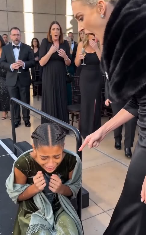
Another server joined her.
Then Nina.
Then a teacher from my design program.
Then the applause rose, uneven and human, nothing like the polished clapping from the beginning of the night.
Madison cried harder.
This time, I looked away.
Her tears were not my responsibility.
Helena stepped back to the microphone after the applause faded. “The charity board will suspend all Ashford Foundation branding pending investigation. The centerpiece will remain credited to Paloma Vale. The missing impact records will be reviewed tonight.”
Richard Ashford laughed coldly. “You are destroying years of partnership over a teenage misunderstanding.”
Mr. Calder answered before Helena could.
“No. We are ending years of misunderstanding what partnership means.”
A few donors exchanged looks. Some uncomfortable. Some relieved. Some already calculating how far away they could stand from the Ashford name.
Madison’s mother rose, her face tight. “Madison, we’re leaving.”
But Madison did not move.
She was staring at the centerpiece.
At the tags.
At the tiny mirrored petals catching fragments of her face.
“I didn’t know about the reports,” she whispered.
Her father grabbed her arm. “Not another word.”
She pulled back. “Dad, what reports?”
The room chilled.
Richard’s grip tightened. “Madison.”
And suddenly I understood something important.
Madison had known about stealing my credit. She had known about the seating chart. She had known about the soup, the lie, the performance.
But the missing charity records?
That fear in her face was real.
Helena saw it too.
“Madison,” she said carefully, “did you participate in altering financial or impact reports?”
“No,” Richard snapped.
Helena did not look at him. “I asked Madison.”
Madison’s lips trembled.
Her mother whispered, “Think about this family before you answer.”
That sentence seemed to pass through Madison like ice water.
Think about this family.
Not think about the truth.
Not think about the people helped.
Not think about the girl standing in a ruined dress because of you.
Family first.
Image first.
Power first.
Madison looked at me.
For once, there was no smile.
“I knew they changed the credit,” she said. “I wanted the ceremony spot. I wanted the cameras.”
Her voice cracked.
“But I didn’t know they used her tags to cover missing records. I thought the centerpiece was just… pretty.”
The word pretty sounded small and ugly in the room.
Richard Ashford exploded. “Enough.”
Security moved closer.
Helena asked Madison if she had any documents related to the centerpiece credit.
Madison hesitated.
Her father said, “You have nothing.”
Madison reached into her silver clutch.
Her mother made a sound like a warning.
Madison pulled out her phone.
“I have messages,” she whispered.
Richard’s face turned gray.
Madison unlocked the screen with shaking fingers. “From my father’s assistant. They told me what to say if anyone asked why Paloma wasn’t credited.”
She looked at me again.
“I’m not doing this for you.”
“I know,” I said.
And strangely, that made her flinch more than if I had accused her.
Madison handed the phone to Helena.
The ballroom watched her choose herself over the family script for the first time, and it was not graceful. It was messy, terrified, late, and nowhere near enough.
But it was real.
Then Helena read the first message aloud.
“Do not mention Paloma Vale by name. If pressed, refer to her as a student helper.”
The room hissed with whispers.
Madison squeezed her eyes shut.
Helena scrolled.
Her expression changed again.
“There’s an attachment.”
Richard Ashford stepped forward. “That phone is private property.”
Helena opened the file.
The screen behind her filled with a draft donor report.
And in the margin, beside the removed aid-recipient list, someone had written:
“Keep these names offstage. The centerpiece can carry the emotional weight without complicating the numbers.”
Mr. Calder gripped the podium.
I stared at my glass flowers.
They had not just stolen my work.
They had used my work to make erased people look remembered.
Part 7: The Speech That Was Never Given
The gala was supposed to end with Richard Ashford giving a speech.
It was printed in the program under the title Legacy of Compassion.
By then, the title looked obscene.
The city representative requested a formal hold on all foundation materials. Helena secured Madison’s phone. Mr. Calder asked staff to preserve the centerpiece exactly as installed. The board chair, who had barely spoken all evening, finally found her voice and announced that an independent audit would begin immediately.
Richard Ashford stood in the middle of the ballroom like a man watching his own portrait catch fire.
“You have no idea what you are doing,” he said.
Helena closed Madison’s phone into an evidence sleeve. “I think we do.”
Madison’s mother held her daughter by the shoulders. “Look what you’ve done.”
Madison stared at her. “Me?”
The single word split something open.
Her mother’s face hardened.
“Yes, you. If you had controlled yourself, none of this would have happened.”
There it was again.
Not if you had told the truth.
Not if you had not stolen.
If you had controlled yourself.
Madison looked at me, at my stained dress, then back at her mother.
“I threw soup on her,” she said quietly.
Her mother lowered her voice. “Madison.”
“No,” Madison said, louder. “I did. In front of everyone. And you’re angry because I got caught badly, not because I did it.”
The room went silent again, but this silence was different.
This one belonged to Madison.
For the first time all night, she was not performing for cameras or donors or her father. She was watching her own family and seeing the machinery behind the mirror.
Richard pointed toward the exit. “We are leaving now.”
Madison did not move.
Helena stepped forward. “Madison, you may leave with your parents, or you may remain with counsel present and provide a voluntary statement.”
Her mother laughed bitterly. “She is eighteen. She does not understand what she’s doing.”
Madison wiped her face with the back of her hand, smearing mascara across her cheek.
“I understand that I was raised to think people like Paloma were props.”
The words hurt even though they were true.
She turned toward me.
“I’m sorry,” she said.
The ballroom leaned in.
I did not.
Madison swallowed. “Not because you got hurt. Because I hurt you. Because I lied. Because I wanted your place even after I knew it was yours.”
Her voice broke.
“And because when I called you poor, I knew exactly what I was trying to do. I wanted the room to look at your dress, not your work.”
The apology landed heavily between us.
It did not fix anything.
But it did not insult me by pretending the wound was smaller than it was.
I held the wrap tighter around my shoulders.
“Thank you for saying it correctly,” I said.
Her mouth trembled.
“I don’t forgive you tonight.”
She nodded, crying silently now.
“I know.”
That mattered.
More than the tears.
More than the apology.
The fact that she did not demand forgiveness like another stolen thing.
Mr. Calder asked me if I still wanted to stand at the center of the ceremony.
I looked at the stage.
At the centerpiece.
At the donors, the staff, the cameras.
Part of me wanted to run to the restroom, lock the door, and scrub soup from my dress until my skin hurt. Part of me wanted my mother. Part of me wanted to vanish so badly my bones ached.
But then I saw the tags.
All those names.
All those families who had almost been turned into decoration without truth.
“No,” I said.
Mr. Calder’s face fell. “I understand.”
I shook my head.
“I don’t want to stand at the center alone.”
I looked toward the catering staff, the volunteers, the program students, Nina, the office manager, the people who had done the work while others took the photographs.
“If this ceremony is about impact,” I said, “then everyone whose work was pushed into the background should stand there.”
For the first time that night, Mr. Calder smiled.
Not polished.
Relieved.
Then the staff began moving.
Servers came from the walls. Volunteers stepped away from registration tables. Student designers emerged from the back rows. Nina stood beside me, still holding napkins. Even the photographer lowered his camera and helped clear a path.
The center of the ceremony filled with people who had been treated like scenery.
And the room finally looked honest.
Part 8: The Centerpiece Finally Named Its Creator
My mother arrived twenty minutes later wearing her grocery-store uniform.
She had come straight from work.
Someone must have called her, though I never found out who. She entered through the side doors with her hair pinned messily under a visor, her name tag still clipped to her shirt, her face tight with fear.
The moment she saw my dress, she stopped walking.
Then she saw my face.
“Paloma.”
I tried to be strong.
I failed instantly.
She crossed the ballroom faster than I had ever seen her move and wrapped me in her arms, not caring about the soup, the cameras, the donors, or the expensive people watching us like they had never understood what love looked like when it arrived without diamonds.
“I’m okay,” I whispered.
She pulled back and touched my cheek. “No, you’re not.”
That broke me more than anything else.
Because she was right.
I was not okay.
But I was still standing.
Mr. Calder explained quietly. Helena added what she could. My mother listened without interrupting, but her hand never left mine.
When she heard that Madison had called me poor, her face changed.
Not with shame.
With fury.
She looked across the room at Madison, who stood alone now near a security officer, her parents separated from her by three board members and a city representative.
My mother did not yell.
She only said, “Poor is when you have money and still steal from a child.”
No one knew what to do with that sentence.
So they remembered it.
The ceremony resumed, but not as planned.
The Ashford speech was removed. Their logo disappeared from the screen. The donor slideshow was replaced with the original aid-recipient list, verified against my handwritten tags. Each name was read with permission. Each category of help was stated plainly. Rent. Food. Transportation. School supplies. Medical appointments. Emergency shelter.
The centerpiece stood behind us, no longer a decoration.
A witness.
When my turn came, I did not give the speech they had printed.
I held my mother’s hand and spoke from where I stood, still wrapped in the borrowed coatroom shawl.
“I used mirrored petals because I wanted every person who looked at the centerpiece to see themselves inside the work,” I said. “I thought that was the point of charity. Not to make powerful people look generous, but to make invisible people impossible to ignore.”
My mother squeezed my hand.
I looked at the volunteers and staff standing with me.
“I was wrong about one thing. I thought I made this alone. I didn’t. Every name on those tags came from someone answering a call, carrying a box, driving across town, staying late, cleaning up, checking lists, and doing work nobody clapped for.”
My voice caught.
“So tonight, I don’t want the centerpiece credited only to me.”
Mr. Calder looked surprised.
Madison looked up.
I took a breath.
“I want the official title changed.”
Helena lifted her pen.
I looked at the glass flowers glowing under the chandelier.
“Call it The Record of Hands.”
The room held still.
Then Mr. Calder repeated it into the microphone.
“The Record of Hands.”
The applause came slowly again, then stronger, filling the ballroom until the chandeliers seemed to tremble.
Weeks later, the audit became public. The Ashford Foundation had redirected restricted funds into gala branding, donor experiences, and private consulting fees. The missing impact list had been buried because it proved how little of the money had gone where the speeches claimed.
Richard Ashford resigned from the foundation before charges were announced.
Madison gave a formal statement to investigators. She also sent me a letter. I read it once. It did not ask for forgiveness. I kept it for the record, not my heart.
The charity changed its rules.
Student creators had to be credited publicly. Volunteer labor had to be documented. Donor reports had to include original impact records. No family name could replace the name of the person who made the work.
And my centerpiece?
It did not get stored away.
The city moved it to the public library atrium, where school kids, tired parents, bus drivers, nurses, janitors, students, and strangers could see the mirrored petals turning slowly in the desert light.
Under it, a small plaque read:
The Record of Hands
Original Concept by Paloma Vale
Built to honor every person whose work was almost erased
On the day it was installed, my mother stood beside me in the library and pointed to my name.
“Look,” she whispered.
“I see it,” I said.
But she shook her head.
“No. Look again.”
So I did.
Not at the plaque.
At the reflection.
My old shoes. My mother’s tired smile. The children pressing close to the glass. The names beneath every petal. The proof that something fragile could survive heat, theft, shame, and still shine without asking permission.
For the first time, my name did not feel like something the world could tape over.
It felt carved into the light.
