Part 2: The Signature That Silenced The Stage
Charlotte stopped breathing.
I saw it from where I stood beside the microphone, one hand pressed against my aching scalp, the other curled around the edge of the podium so I would not collapse.
The applause was still rising around us, but Charlotte no longer seemed to hear it. Her eyes were fixed on the final signed donation form projected behind her, her fingers locked around the folder so tightly the pages bent under her grip.
The festival director, Mr. Whitaker, did not move to help her.
He only said, “Please read the signature aloud.”
Charlotte’s lips parted.
No sound came out.
The giant screen made the truth impossible to hide. At the bottom of the certification, beneath the official donation total, beneath the stamp from the festival committee, was a name written in smooth blue ink.
Margaret Sinclair.
Charlotte’s mother.
A wave of whispers passed through the auditorium.
The largest bookstore chain in the state had been expected to sponsor the festival’s opening speech. Everyone had assumed Charlotte would be chosen because her family had donated money, banners, and polished publicity.
But the signature proved something else.
Her own mother had secretly nominated me.
Charlotte looked toward the front row.
Mrs. Sinclair sat perfectly still in a cream suit, her hands folded in her lap, her face pale but steady. She did not look embarrassed. She looked tired.
Charlotte’s voice cracked. “Mom?”
Mrs. Sinclair rose slowly.
The cameras turned.
Charlotte took one step back as if her mother had struck her instead of simply standing.
Mr. Whitaker turned the microphone toward Mrs. Sinclair. “Mrs. Sinclair, would you like to explain the nomination?”
Charlotte shook her head quickly. “No. No, don’t.”
But her mother walked toward the stage.
Each step felt louder than the applause had been.
When she reached the microphone, she looked first at me. Not at the crowd. Not at her daughter. At me.
“Emily,” she said softly, “I am sorry this happened to you.”
My throat tightened.
Charlotte snapped, “You nominated her?”
Mrs. Sinclair closed her eyes for one second.
Then she opened them and said, “Yes.”
The auditorium went completely silent.
Charlotte laughed, but it sounded broken. “Why would you do that?”
Mrs. Sinclair turned toward the screen, where my name appeared again and again beside repair logs and donation forms.
“Because she did the work,” she said.
Charlotte’s face twisted. “We donated thousands of books.”
“No,” her mother said. “We donated damaged surplus inventory that the stores planned to discard.”
The words landed like a dropped glass.
Reporters leaned forward.
Teachers stared.
Authors exchanged shocked looks near the curtain.
Mrs. Sinclair continued, voice steady but heavy. “Those books were not ready for children. Many had missing pages, broken bindings, torn covers, water damage, and loose spines. Emily repaired them before they could be donated.”
My eyes burned.
I remembered those books.
The towers of them in the back room. The smell of dust and old paper. The late afternoons when my fingers stuck together from glue and my wrists hurt from pressing covers flat under heavy boards.
Charlotte stared at her mother like she was seeing a stranger.
“You made me look stupid,” she whispered.
Mrs. Sinclair’s expression trembled. “No, Charlotte. You did that when you hurt her.”
Charlotte looked at the phones, the cameras, the crowd. Her hand went to her throat.
For the first time, she looked afraid.
Not sorry.
Afraid.
Then Mr. Whitaker stepped closer to me.
“Emily,” he said gently, “you were chosen because this festival is supposed to honor literacy, service, and community access. Your work made that real.”
I could barely stand under the weight of everyone watching.
My papers still lay scattered across the stage floor.
My scalp throbbed where Charlotte had grabbed my hair.
But the screen behind me still carried the truth.
My name.
My work.
My record.
Charlotte suddenly shoved the folder back into Mr. Whitaker’s hands. “This is a setup.”
Mrs. Sinclair whispered, “Charlotte.”
But Charlotte pointed at me again.
“She’s not the face of anything,” she said. “She’s just some girl who fixed trash.”
The room froze.
Then a small voice rose from the front of the student section.
“She fixed my book.”
A little boy stood up holding a faded blue novel against his chest.
And everything changed again.
Part 3: The Boy With The Blue Book
The boy could not have been more than ten.
He stood between two teachers, gripping the blue book so tightly the worn cover bent beneath his fingers. His face was round, nervous, and determined in a way that made the entire auditorium lean toward him.
One teacher tried to guide him back into his seat, but he shook his head.
“She fixed my book,” he said again, louder this time.
Charlotte stared at him as if children from the audience were not supposed to speak unless they were clapping for her.
Mr. Whitaker crouched near the edge of the stage. “What’s your name?”
“Leo,” the boy said. “Leo Martin.”
A woman in the second row covered her mouth.
The name appeared on the screen a moment later when Mr. Whitaker turned to the restoration reports.
Leo Martin — children’s shelter reading program — restored adventure novel, blue cloth cover, repaired spine, missing chapter pages replaced from archive copy.
My chest tightened.
I remembered that book.
The cover had been almost detached. Someone had drawn a tiny rocket on the inside flap. I had spent two evenings repairing it because I could not bear the thought of a child opening it and having the pages fall out in his hands.
Leo lifted the book higher.
“The library lady said it was too broken,” he said. “But then it came back fixed. I read the whole thing.”
The silence cracked.
A few teachers started crying openly now.
Charlotte looked furious, but also trapped. She had called the books trash in front of children who had received them like treasure.
Leo’s teacher stood beside him and said, “That book was the first one he finished this year.”
The auditorium began murmuring.
Not gossip now.
Recognition.
Other students looked down at the books in their laps. A girl near the middle stood next. She held up a picture book with a repaired corner.
“My sister got one too,” she said.
Then another student lifted a textbook.
Then another.
Books rose throughout the auditorium like quiet proof.
Not new books.
Not perfect books.
Restored books.
Books with reinforced spines, patched covers, cleaned pages, careful labels.
Books I had touched.
My knees nearly gave out.
For months, I had repaired them alone in the back room, never seeing where most of them went. I imagined shelves. Maybe boxes. Maybe a few children reading them if I was lucky.
I had not imagined this.
Mrs. Sinclair turned toward Charlotte. “Do you see now?”
Charlotte’s eyes filled with tears, but her voice stayed sharp. “Everyone is acting like glue makes her a hero.”
“No,” Mrs. Sinclair said. “Consistency does.”
That word hit me harder than praise.
Consistency.
Showing up when nobody watched.
Doing careful work when no one promised a stage.
Saving things other people had already decided were worthless.
Mr. Whitaker picked up my scattered speech papers from the floor. One sheet had a shoe print across it. Another was bent where it had slid under the podium.
He handed them to me.
“You can still give your speech,” he said.
I looked at the pages.
The words I had written last night seemed too small now. Too neat. Too prepared for a ceremony that no longer existed.
Charlotte was still onstage, breathing hard, her face wet with angry tears. A security guard had moved closer but had not touched her yet.
Mrs. Sinclair said, “Charlotte, step down.”
Charlotte turned on her. “You picked her over me.”
Her mother flinched.
Then she answered, “No. I picked the truth over your performance.”
Charlotte went still.
The sentence seemed to break something inside her.
She looked at me, then at Leo, then at the books raised across the auditorium.
For one second, her expression changed.
Not into regret.
Into realization.
She had not just humiliated me.
She had humiliated every child holding one of those books.
Then the side doors opened, and a man in a dark suit hurried in carrying another sealed envelope.
He leaned toward Mr. Whitaker and whispered something.
Mr. Whitaker’s face changed.
He looked at Mrs. Sinclair.
“Margaret,” he said quietly, “the bookstore audit file just arrived.”
Charlotte’s tears stopped.
Her mother went pale.
Part 4: The Audit File Behind The Applause
The sealed envelope looked ordinary.
White paper. Red stamp. A thin line of tape across the flap.
But the moment Mr. Whitaker held it, the stage felt colder.
Mrs. Sinclair whispered, “Daniel, not here.”
Charlotte looked between them. “What audit file?”
Her mother did not answer.
That frightened Charlotte more than any accusation could have.
Mr. Whitaker stepped away from the microphone, but the room had already sensed something new. Hundreds of people sat forward. Reporters stopped photographing the children’s books and focused on the envelope.
I stood there with my damaged speech in my hands, soup-thick fear twisting in my stomach even though no soup had been thrown this time. My scalp still ached. My eyes still burned. I wanted the nightmare to end.
But truth, once opened, does not close because someone is tired.
Mr. Whitaker turned to Mrs. Sinclair. “This concerns the donated inventory.”
She closed her eyes.
Charlotte’s voice sharpened. “Mom, what is going on?”
Mrs. Sinclair looked at her daughter, and for the first time, I saw something deeper than disappointment in her face.
Shame.
“The company reported thousands of books as community donations,” Mrs. Sinclair said slowly. “But some regional stores were sending damaged inventory to charity partners before verifying whether the books were usable.”
Charlotte frowned. “So?”
“So,” Mr. Whitaker said, “the public reports counted them as full-value literacy donations even when they were incomplete, unsafe for circulation, or unusable.”
The auditorium stirred.
I thought of the torn picture books with missing pages. The textbooks with mold spots I had to reject. The novels with cracked glue and loose signatures. The books no child should have received until someone repaired them properly.
My hands felt sticky with remembered glue.
Charlotte shook her head. “That’s not my fault.”
“No,” Mrs. Sinclair said quietly. “But what happened to Emily tonight is connected.”
I looked up.
Mrs. Sinclair faced the audience.
“When I learned what Emily had been doing, I reviewed the donation pipeline. Her repair logs revealed a problem our company reports did not.”
The giant screen changed again.
A spreadsheet appeared.
Rows of donated books. Condition categories. Repair status. Recipient programs. Estimated value.
My restoration notes had been added in a separate column.
Repaired by Emily Dawson.
Rejected by Emily Dawson.
Pages replaced by Emily Dawson.
Safe for circulation after repair.
Mr. Whitaker said, “Emily’s records show that the actual community value came not from the original corporate donation, but from the restoration labor that made the books usable.”
A reporter near the aisle whispered, “That’s huge.”
Charlotte’s father was not there, but I suddenly understood his absence. The Sinclair family had expected this event to be a clean publicity moment. Charlotte smiling. Cameras flashing. The family name shining over the festival.
Instead, my repair logs had exposed the gap between donated goods and real impact.
Mrs. Sinclair took a breath. “That is why I nominated Emily. Not to embarrass my family. To correct the record.”
Charlotte laughed bitterly. “You used her to fix your guilt.”
Mrs. Sinclair flinched because it was partly true.
The room felt the truth of it too.
And so did I.
My gratitude tangled with anger until I could barely tell them apart.
I looked at Mrs. Sinclair. “Did you nominate me because I deserved it, or because you needed the company to look honest?”
Her eyes filled with tears.
The question landed harder than anything Charlotte had said.
Mrs. Sinclair walked closer to me, stopping far enough away that I could choose whether to step back.
“At first,” she said, “I wanted to fix the report.”
My chest tightened.
She swallowed.
“Then I read your notes.”
She pointed to the screen. “You wrote which books needed quieter reading corners. Which ones should go to shelters. Which picture books had no words and could help children still learning English. Which repaired textbooks needed teacher guides.”
Her voice broke.
“I nominated you because by then I understood the company had donated inventory. You had donated care.”
I looked down at my speech papers.
The shoe print across the top page suddenly felt less important than the question rising in me.
If care was the real donation, why did people with money keep getting the microphone?
Before I could speak, Charlotte stepped toward me again.
Security moved.
She stopped, shaking.
“I didn’t know about the audit,” she said.
I believed her.
Then she added, “But I still should have been chosen.”
And just like that, the little mercy I had started to feel disappeared.
Part 5: The Letter Hidden In The Folder
Mr. Whitaker asked Charlotte to leave the stage.
She refused.
Not loudly this time. Not with another attack. She simply stood there in her expensive dress, tears shining on her face, and shook her head like the stage belonged to her by birth.
“I’m not leaving while everyone rewrites my life,” she said.
Mrs. Sinclair said, “Charlotte, this is not only about you.”
Charlotte’s laugh cracked. “That’s the problem, isn’t it?”
The words were ugly, but they were also honest.
For years, I guessed, every event had bent around her. Every ribbon cutting, every bookstore photo, every children’s literacy campaign. Charlotte with a book in her hands. Charlotte smiling beside a donation box. Charlotte reading to children while someone else sorted the books afterward.
She had confused being photographed near service with serving.
Mr. Whitaker opened the thick folder again. “There is one more document.”
Mrs. Sinclair turned sharply. “Daniel.”
He looked at her. “Emily has a right to know.”
My pulse quickened.
He pulled out a cream envelope.
Unlike the audit file, this one was not sealed. My name was written on the front in careful handwriting.
Emily Dawson.
I stared at it.
“I’ve never seen that before,” I said.
“I know,” Mr. Whitaker answered. “It was submitted with your nomination.”
He handed it to me.
My fingers trembled as I opened it.
Inside was a letter.
Not from Mrs. Sinclair.
From Mrs. Alvarez, the elderly librarian who supervised the community repair room.
The first line made my throat close.
To the committee, please do not tell Emily I wrote this unless she is selected.
I blinked hard.
Mrs. Alvarez had never praised me much. She corrected my glue measurements. Reminded me to label boxes. Told me not to skip dinner when I stayed late. Her kindness was practical, never dramatic.
But her letter filled the screen as Mr. Whitaker projected it with my permission.
She described the first afternoon I had come to the library after school, quiet and nervous, asking if there was any volunteer work that did not require speaking to crowds.
She described how I stayed.
How I learned.
How I repaired books slowly at first, then carefully, then beautifully.
How I began reading donation notes and matching books to children’s programs by need, age, and condition.
Then the final paragraph appeared.
Emily does not repair books because she wants recognition. That is why she must receive it. Children have opened books because her hands refused to let damaged stories be thrown away. If this festival needs a face, choose the girl who understands that a book is not donated when it leaves a store. It is donated when it reaches a child whole enough to be loved.
I could not see the screen anymore.
Tears blurred everything.
The auditorium was silent except for scattered crying.
Leo hugged his blue book to his chest.
Mrs. Sinclair wiped her eyes.
Charlotte stared at the letter with an expression I could not read.
For once, she did not interrupt.
Mr. Whitaker spoke gently. “Emily, would you still like to give the opening speech?”
I looked at the papers in my hand.
The speech I had written was about community literacy. About access. About the power of stories. It was careful and polite.
But my hair still hurt from Charlotte’s hand.
My clothes still felt cheap under the stage lights.
And now I knew my work had been used in ways I had never understood.
I folded the speech papers once.
Then again.
I set them on the podium.
“No,” I said.
Charlotte looked up quickly, almost triumphant.
But I stepped closer to the microphone.
“I want to say something else.”
Mr. Whitaker nodded.
My voice shook at first.
“I used to think repaired books were embarrassing.”
The room went still.
“I thought children deserved new books. Perfect books. Books that didn’t show where they had been damaged.”
I looked at Leo’s blue cover.
“But I learned that a repaired book can still carry a whole story.”
My fingers tightened around Mrs. Alvarez’s letter.
“And maybe people can too.”
Charlotte’s face changed.
I looked at her.
“But repair is not the same as pretending nothing was broken.”
Part 6: The Apology That Did Not Erase The Damage
Charlotte’s shoulders dropped.
It was such a small movement, but everyone saw it because the room had become painfully alert to every breath she took.
For the first time since she had rushed onto the stage, she looked her age.
Seventeen.
Frightened.
Cornered by truth she could not buy, charm, or shout away.
But the ache in my scalp reminded me that being young did not undo what she had done.
I continued speaking.
“When Charlotte grabbed my hair, she wanted everyone to see me as less than her. When she called me poor, she wanted the room to believe my clothes mattered more than my work.”
Charlotte looked down.
I turned toward the audience.
“But if this festival is about books, then it should know better than anyone that covers never tell the whole story.”
A soft sound moved through the crowd.
Not applause.
Something quieter.
Understanding.
I looked at Mrs. Sinclair.
“And if companies donate books, they need to tell the truth about what they donate. A damaged book is not a gift until someone makes it safe to read. A report is not honest if it counts care it did not provide.”
Mrs. Sinclair bowed her head.
Then I looked at Mr. Whitaker.
“And no student’s labor should be hidden inside a folder until someone rich makes a scene.”
His face tightened with shame.
Good.
I wanted him to feel it.
Not because he was cruel, but because he had known enough to bring the folder. Which meant someone had known the truth before Charlotte hurt me.
“When did you plan to show the records?” I asked.
The microphone carried the question.
Mr. Whitaker exhaled slowly.
“After your speech,” he said. “During the award introduction.”
“And if Charlotte hadn’t attacked me?”
He looked down.
The silence answered before he did.
“We would have credited you,” he said quietly. “But not with the full record.”
The crowd shifted uncomfortably.
I nodded.
At least he told the truth.
“That has to change,” I said.
Mrs. Alvarez’s letter trembled in my hand.
“If you want me to open this festival, then open the records too. All of them. Every student restorer. Every volunteer. Every librarian. Every driver who delivered boxes. Every community worker who matched books to children. Put those names where people can see them.”
Mr. Whitaker did not hesitate.
“Yes,” he said. “We will.”
Mrs. Sinclair stepped forward. “And Sinclair Books will fund a transparent restoration program under library supervision, not corporate branding.”
Charlotte looked at her mother.
Mrs. Sinclair’s voice grew stronger. “The first funding line will pay student restorers, including back pay where records exist.”
That caused an actual gasp.
My eyes widened.
I had never been paid.
None of us had.
Charlotte whispered, “Mom, the board will hate that.”
Mrs. Sinclair looked at her daughter. “Then the board can learn what donation means.”
Something in the room loosened.
Then Charlotte turned toward me.
“I’m sorry,” she said.
The words came out raw.
I did not move.
She swallowed. “I’m sorry I grabbed your hair. I’m sorry I called you poor. I’m sorry I tried to take the stage from you.”
Her voice broke.
“And I’m sorry I thought being seen mattered more than being useful.”
The apology did not heal my scalp.
It did not erase the videos.
It did not make us friends.
But it was the first thing she had said all day that sounded like it cost her something.
I looked at her for a long moment.
“I hear you,” I said.
Hope flickered across her face.
I did not give her what she wanted.
“I’m not ready to forgive you.”
The hope dimmed.
Then she nodded.
“Okay.”
That single word mattered.
Because she did not argue.
Security escorted her offstage, not like a criminal, but like someone who had finally run out of borrowed power.
As she passed Leo, he held his blue book closer.
Charlotte saw him.
Her face crumpled.
And this time, she did not look away.
Part 7: The Names The Festival Forgot
The festival did not continue as planned.
It became something better and much more uncomfortable.
Mr. Whitaker removed the sponsor slideshow from the opening program. The giant screen no longer displayed smiling executives standing beside cardboard donation boxes. Instead, a new document appeared, built quickly from the records in the folder.
Restoration Contributors.
The first name was mine.
Emily Dawson.
But then came others.
Mrs. Alvarez.
Nora Bennett.
Grace Miller.
Thomas Reed.
Ava Clarke.
Marcus Bell.
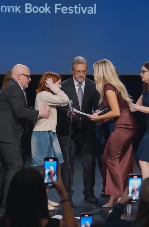
Students I knew from the repair room. Volunteers who came on weekends. Retired teachers who sorted books by reading level. Drivers who brought boxes to rural schools. Librarians who wrote notes in pencil because the official forms never had space for what children actually needed.
One by one, the names filled the screen.
Some people in the auditorium clapped when they recognized someone.
Others grew quiet because they realized how many hands had been hidden behind one sponsor logo.
Mrs. Alvarez arrived halfway through the list.
She came through the side door with her gray coat buttoned wrong and reading glasses hanging from a chain around her neck. Someone must have called her from the library.
When she saw me onstage, her face folded with worry.
Then she saw the letter on the screen.
“Oh, Emily,” she whispered.
I left the microphone and ran to her.
For one second, I forgot the cameras.
I forgot Charlotte.
I forgot the entire auditorium.
Mrs. Alvarez wrapped her arms around me carefully, like she knew exactly where I hurt without asking.
“You wrote that?” I whispered.
“Of course I did,” she said. “You think I spend all day watching you save books and have nothing to say about it?”
I laughed and cried at the same time.
She pulled back and looked at my scalp, my face, my wrinkled cardigan.
Then her eyes sharpened.
“Where is the girl who touched you?”
“Gone,” I said.
“For her sake,” Mrs. Alvarez muttered.
A few people nearby heard and laughed softly through tears.
Mr. Whitaker invited her onto the stage.
She refused at first.
“I don’t do stages,” she said.
Then she looked at the screen full of names.
Her face changed.
She took my hand.
“All right,” she said. “But only because they finally learned how to spell volunteer.”
The audience laughed again, warmer this time.
Mrs. Alvarez stood at the microphone and adjusted it down.
“I have worked in community libraries for thirty-eight years,” she said. “I have watched people donate broken things and call it generosity. I have watched children receive leftovers and still say thank you because they are kinder than the systems serving them.”
The auditorium went still.
She pointed toward the repaired books held by students.
“These books are not leftovers anymore. They are repaired stories. And repaired stories deserve honest records.”
Mrs. Sinclair stood in the front row, listening with tears in her eyes.
Mrs. Alvarez looked directly at her.
“Money is useful. But money without humility makes a very loud mess.”
Mrs. Sinclair nodded.
Then Mrs. Alvarez turned to me.
“This girl did not need a stage to matter. The stage needed her to become honest.”
My breath caught.
The audience stood.
Not all at once. First Leo. Then his teacher. Then the authors. Then the students. Then the sponsors, slower, some ashamed, some sincere.
The standing applause felt different from the first one.
The first applause had surprised me.
This one steadied me.
But just as Mr. Whitaker prepared to officially open the festival, Mrs. Sinclair returned to the microphone.
“There is one final record,” she said.
Charlotte, who had been watching from the side doorway with security beside her, looked up.
Mrs. Sinclair reached into her handbag and removed a folded document.
“My daughter does not know this exists,” she said.
The auditorium held its breath.
“And neither does Emily.”
Part 8: The Shelf With My Name On It
Mrs. Sinclair unfolded the document with shaking hands.
For a terrible second, I thought it would be another scandal. Another hidden report. Another proof that my work had been used without my permission.
But her face had changed.
This was not fear.
This was grief.
“Years ago,” she said, “before Sinclair Books became a chain, my father opened our first store beside a public library. He believed bookstores and libraries were not rivals. He believed they were two doors into the same room.”
Her voice softened.
“When he died, he left a private fund for library access projects. It has been sitting under corporate control for too long.”
Charlotte stood frozen near the side door.
Mrs. Sinclair looked at me.
“I intended to announce this quietly next month. But after today, quiet is the wrong choice.”
She lifted the paper.
“The fund will be transferred to an independent board led by librarians, teachers, and student representatives. It will support book repair, rural reading access, and paid youth restoration training.”
Mr. Whitaker stared at her.
Mrs. Alvarez whispered, “Well.”
Then Mrs. Sinclair said the part that made my knees weaken.
“The first training room will be named after the person whose records forced us to tell the truth.”
I shook my head instinctively.
“No.”
A few people turned.
I stepped toward the microphone.
“No,” I said again, stronger. “Not just me.”
Mrs. Sinclair watched me carefully.
My heart pounded.
I thought of the books. The glue. The drivers. The volunteers. The children holding repaired stories to their chests. The way Charlotte had pointed at my clothes and tried to make poverty louder than evidence.
Then I thought of the back room at the library, where all the real work happened without lights.
“Name it The Whole Story Room,” I said.
Mrs. Alvarez smiled slowly.
Mrs. Sinclair’s eyes filled again.
“The Whole Story Room,” she repeated.
Charlotte covered her mouth.
I looked toward her.
She had hurt me. Publicly. Cruelly. On purpose.
But she was watching something break open that her family had kept locked for years. And maybe, for the first time, she understood that attention was not the same as honor.
The opening ceremony finally began nearly an hour late.
I gave no polished speech.
Instead, Leo came onstage with his blue book. Mrs. Alvarez read the first page aloud. Then students across the auditorium opened their restored books and read one sentence each.
Different voices.
Different stories.
Different lives.
The sound filled the room like a library becoming a storm.
Reporters filmed, but nobody performed for them.
Charlotte did not return to the stage. She stayed near the side doors, crying quietly, then left with her mother before the first panel began. Days later, a public apology appeared from her. It admitted what she had done without blaming pressure, jealousy, or confusion. I read it once. I did not reply.
The videos spread.
So did the records.
By the end of the month, bookstores across the state had to audit their donation reports. Damaged inventory could no longer be counted as full charity impact unless it was repaired and verified. Libraries received funding for restoration tools. Student volunteers became paid trainees. Mrs. Alvarez pretended she hated the attention and secretly saved every newspaper clipping.
And me?
I went back to the library.
Not because nothing had changed.
Because everything had.
The back room had new shelves, better lights, proper tools, and a sign over the door:
The Whole Story Room.
Underneath it, in smaller letters, was a line Mrs. Alvarez insisted on adding:
Founded from the records kept by Emily Dawson and every hand that repaired what others discarded.
The first day the room opened, Leo visited with three other children from the shelter. He placed the blue book on the table carefully.
“It got loose again,” he said, embarrassed.
I smiled and opened my repair kit.
“Good,” I told him.
He frowned. “Good?”
“It means somebody loved it enough to wear it out.”
He grinned.
I repaired the spine while he watched, and for once, I did not feel hidden in the back room.
Through the glass wall, people could see the work now.
Not as pity.
Not as charity decoration.
As proof.
My cardigan was still old. My shoes were still worn thin. My hands still smelled faintly of paper, glue, and dust.
But when I pressed the repaired cover flat and wrote the final note in the restoration log, my name did not look small anymore.
It looked like the beginning of a shelf no one could throw away.
