By the time Mckenna Sharp’s hand cracked across my face in front of the whole school, I had already learned that rich people did not always need to lie loudly.
Sometimes, they only needed everyone else to be afraid of checking the truth.
The slap came so fast that I did not even raise my hands. One second I was standing on the edge of the soccer field at Queensbridge High, holding my ink-stained tote bag against my hip and asking for one teacher to verify the tournament roster. The next second, my cheek burned, the world tilted, and two hundred students went silent as if someone had unplugged the entire afternoon.
Even the wind seemed to stop.
The immigrant-student soccer tournament had been noisy all morning. Flags were pinned along the fence. Parents stood near folding tables with coffee and foil trays of food. Students from Mexico, Colombia, Ecuador, Spain, Haiti, Korea, Pakistan, Ukraine, the Dominican Republic, and everywhere in between warmed up on the field in jerseys that did not all match but somehow looked perfect together.
It was supposed to be the one day nobody had to explain where they came from.
It was supposed to be the one day the school celebrated us without making us feel like we had to apologize for existing.
And I, Carmen Ruiz, had ruined the mood by noticing a timestamp.
I was seventeen, Spanish American, and used to being described as quiet by people who confused quiet with weak. That day I wore a brick-red shirt, black culottes, and the tote bag my art teacher kept begging me to replace because the bottom corner had been stained with fountain pen ink since sophomore year.
The ink stain mattered more than anyone knew.
Across from me stood Mckenna Sharp, an American senior with perfect blond hair, perfect posture, and the kind of pale blue shirt that looked expensive because it was made to look effortless. Her pencil skirt was pressed so sharply it could have cut paper. A gold-plated pen rested in her hand like a family crest.
Her family owned Sharp & Sons Fountain Pens, a company old enough to have photographs in glass cases downtown and rich enough to sponsor half the school’s “leadership initiatives.” They had donated uniforms, laptops, scholarship plaques, and, most recently, a full set of “premium athletic footwear” for the immigrant-student tournament.
That was what the fight was supposed to be about.
Shoes.
At least, that was the word Mckenna kept using because it sounded harmless.
“This is embarrassing, Carmen,” she said, loud enough for the nearest students to hear. “You’re accusing people of something over sneakers?”
“I’m asking Ms. Bell to check the original roster,” I said.
Her smile stayed in place, but her eyes sharpened. “You already checked the roster.”
“I checked the version printed this morning.”
“That is the roster.”
“No,” I said, my voice trembling despite my effort to keep it steady. “It’s not.”
The crowd shifted.
I could feel phones rising around us. Not everyone wanted drama, but nobody wanted to miss it once it arrived.
Mckenna turned slightly, letting the field, the students, the staff table, and the parents become her audience. She was good at that. She never simply spoke to one person. She performed for a room even when there was no room.
“Carmen,” she said sweetly, “you have been acting strange all morning.”
My stomach tightened.
There it was.
Not wrong. Strange.
Not mistaken. Unstable.
That was how people like Mckenna moved a conversation away from facts and toward reputation.
I looked past her toward the check-in table. Ms. Bell, one of the tournament organizers, was sorting clipboards with Mr. Alvarez, the assistant principal. Coach Keene stood beside them, already frowning. The team from Jackson Heights was waiting by the cones, whispering among themselves.
And at the center of everything stood Luis Ortega, a sophomore transfer student from Ecuador, wearing borrowed cleats with one lace replaced by a strip of blue ribbon.
Luis had been accused of stealing tournament shoes.
Not officially, not yet. But the rumor had started like a match dropped into dry grass.
A pair of brand-new sponsor shoes in size 9 had gone missing from the equipment tent. The printed roster claimed Luis had signed for them at 8:42 a.m. Mckenna said she saw him near the tent. A volunteer said the shoes were gone afterward. Luis insisted he had never received them.
Most students had already chosen what to believe.
Luis was new. Luis was poor. Luis’s English sometimes disappeared when adults spoke too quickly. Luis wore the wrong cleats to a tournament sponsored by one of the richest families in Queens.
That was enough for some people.
But I had seen the original record.
At 8:37 a.m., before the printed rosters were placed on the staff table, I had been asked to help label the backup shoe boxes because Ms. Bell knew I had neat handwriting. I had used my own fountain pen because I always carried it, a dark green antique pen my father had restored for me.
That pen had leaked inside my tote bag two weeks earlier, leaving the permanent ink stain everyone teased me about.
While labeling boxes, I had opened the organizer email on Ms. Bell’s laptop to confirm player sizes. There had been a spreadsheet attached, timestamped from the night before.
Luis Ortega: size 8.5.
Not size 9.
And the shoes supposedly missing in his name?
Those had never been assigned to him.
At first I thought it was a small mistake. A typo. A misprint. Something easy to fix.
Then I saw the printed roster Mckenna was carrying, and Luis’s size had changed.
8.5 had become 9.
The sign-out time had become 8:42.
And beside his name, in a clean blue stroke, was a signature that was not his.
That was when the air changed.
I went to Ms. Bell quietly. I asked her to check the original email before confronting Luis. She looked confused but nodded.
Then Mckenna appeared.
Now, standing in the middle of the field with students closing in around us, Mckenna lifted her gold pen and tapped it once against her palm.
“You always do this,” she said.
“I always do what?”
“Act like you’re the only honest person in the room.”
Somebody near the bleachers murmured, “Damn.”
My cheek had not been hit yet, but I already felt the sting of where this was going.
“I’m not trying to embarrass anyone,” I said. “I just don’t want Luis blamed if the record was changed.”
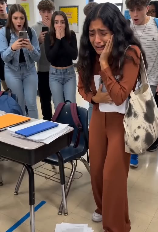
Mckenna’s smile vanished.
For one second, her real face showed through.
Cold. Furious. Afraid.
Then she stepped close enough that I could smell her expensive perfume, something floral and sharp, like roses pressed between legal papers.
“You need to stop saying that,” she whispered.
“Why?”
“Because you don’t know who you’re talking about.”
I looked at the gold pen in her hand.
A Sharp & Sons Heritage Signature Edition. Twenty-four-karat gold plated. The same model displayed in the school lobby in a case honoring her family’s donation.
For weeks, Mckenna had carried it around like proof she belonged everywhere.
But there was ink on her thumb.
Dark green ink.
The same shade as mine.
My heart started pounding.
“Mckenna,” I said slowly, “why is there green ink on your hand?”
Her eyes flicked down.
It lasted less than a second, but I saw it.
Panic.
Then her palm flew.
The slap echoed across the field.
My head turned with the force of it. My tote slipped from my shoulder and hit the turf. The students gasped all at once. Somewhere behind me, Luis said my name.
I did not cry.
That surprised me more than the slap.
My cheek burned. My eyes watered. My body wanted to shake. But somewhere beneath the humiliation, something stronger locked into place.
Mckenna had hit me because she was losing.
And everyone had seen it.
She stepped back as if she had shocked herself, then instantly rearranged her face into outrage.
“She grabbed my pen,” she said.
I stared at her.
“What?”
“She grabbed my pen and got in my face,” Mckenna said louder. “Everyone saw her being aggressive.”
Nobody answered.
Because everyone had seen the opposite.
But silence can still be useful to someone powerful. If nobody speaks, the liar gets to keep talking.
Mr. Alvarez rushed toward us, his tie swinging. “What happened?”
Mckenna pointed at me. “She accused me of changing school records and then tried to take my pen.”
“I didn’t touch her,” I said.
My voice sounded far away.
Ms. Bell arrived behind him, eyes wide. “Carmen?”
“Please check the email,” I said.
Mckenna laughed, but it cracked in the middle. “This is ridiculous.”
Coach Keene folded his arms. “Mckenna, did you strike her?”
“She was threatening me.”
“I asked if you struck her.”
Mckenna looked at the watching students.
Her kingdom.
Her audience.
Her witnesses.
Then she lifted her chin. “I defended myself.”
Luis stepped forward. “She didn’t touch you.”
Mckenna snapped toward him. “Of course you’d say that.”
The words landed uglier than the slap.
Luis froze.
The crowd reacted this time—not with gasps, but with a low, angry sound that moved through the students like thunder under pavement.
Mr. Alvarez’s face hardened. “Enough. Everyone step back.”
But Mckenna was not finished.
“You people always make everything about discrimination when you get caught,” she said.
The field went completely still.
My cheek burned hotter.
You people.
There it was, stripped clean of school-rule language, sponsor language, leadership language. The real accusation beneath the accusation.
Ms. Bell’s mouth fell open. Coach Keene looked as if someone had punched him in the chest. A parent near the refreshment table said, “Excuse me?”
Mckenna realized too late that she had said it out loud.
“I didn’t mean—”
“Yes,” I said softly. “You did.”
She turned on me again. “You don’t get to twist my words.”
“I didn’t twist anything.”
“You’re jealous.” Her voice rose. “You’re jealous because my family built something, because we sponsor things, because we actually help this school—”
“Then help it,” I said. “Check the original email.”
For the first time, she looked toward the staff table.
And that was when I knew.
The proof was still there.
Not on the printed roster.
Not on Mckenna’s copy.
On Ms. Bell’s laptop, inside the organizer email, in the attachment she had not thought anyone would reopen.
Mr. Alvarez turned to Ms. Bell. “Pull it up.”
Mckenna went pale.
“Mr. Alvarez,” she said quickly, “we don’t need to turn this into a spectacle.”
“You slapped a student in front of half the school,” he said. “It is already a spectacle.”
Someone snorted. Someone else whispered, “Finally.”
Ms. Bell opened the laptop on the folding table. The screen was connected to the portable projector they had planned to use later for the awards slideshow. Behind her, a white screen stood near the fence, fluttering slightly in the wind.
Nobody had meant for evidence to be shown there.
That made it perfect.
Mckenna stepped toward the table. “Ms. Bell, I really think—”
Coach Keene blocked her path. “Stay where you are.”
She looked betrayed, as if adults enforcing rules against her personally offended her.
Ms. Bell’s fingers trembled as she clicked through the inbox.
I stood with my hands clenched at my sides, feeling the pulse in my cheek. Luis stood a few feet away from me. His face was tight, but his eyes were fixed on the screen.
Behind us, students gathered in a widening half circle.
The email opened.
Tournament Final Roster — Submitted 10:16 p.m.
Ms. Bell clicked the attachment.
The spreadsheet appeared on the projector screen.
Rows of names. Teams. Sizes. Shoe assignments. Pickup notes.
Mr. Alvarez leaned forward.
“Luis Ortega,” Ms. Bell murmured.
She scrolled.
There it was.
Luis Ortega — Team C — Size 8.5 — Backup Pair Ready — No pickup before match.
No size 9.
No 8:42 sign-out.
No signature.
The crowd erupted.
“Quiet!” Mr. Alvarez shouted, but even he looked shaken.
Luis covered his mouth with one hand.
I exhaled for the first time in what felt like ten minutes.
Mckenna’s face hardened. “That doesn’t prove anything. Maybe that was an earlier version.”
Ms. Bell swallowed. “It says final.”
“Maybe Carmen changed it.”
The words came fast.
Too fast.
Everyone turned toward me.
My stomach dropped, but only for a second.
Because I knew something Mckenna did not know.
Ms. Bell frowned. “Carmen didn’t have access to my email.”
“She was helping at the table,” Mckenna said. “She touched your laptop.”
“I labeled boxes,” I said. “I didn’t edit anything.”
Mckenna pointed at my tote bag on the ground. “She carries fountain pens. She’s obsessed with records and handwriting. She probably forged it to frame me.”
That was the moment the story could have gone either way.
Not because she sounded convincing.
Because people love a twist when it makes the victim look complicated.
Mr. Alvarez looked at me. “Carmen, did you use Ms. Bell’s laptop?”
“To read the shoe sizes from the email,” I said. “Ms. Bell asked me to.”
Ms. Bell nodded quickly. “I did.”
“But I didn’t log in. I didn’t change anything. And I didn’t sign Luis’s name.”
Mckenna seized on that. “How would you know his signature?”
Luis looked down.
Quietly, he said, “Because I signed the international club poster yesterday. Carmen helped translate it.”
My throat tightened.
I had almost forgotten.
The poster.
Yesterday after school, Luis had stayed behind in the art room to help finish a banner for the tournament: WE PLAY AS ONE. He had signed his name in careful blocky letters, embarrassed by his handwriting. I had told him my father said every signature was a small declaration that you existed.
Now that memory stood between him and a lie.
Mr. Alvarez rubbed his forehead. “We need the printed roster.”
Mckenna stiffened.
“It’s right there,” I said.
Everyone looked down.
My tote bag had fallen open when the slap knocked it from my shoulder. Papers had spilled onto the turf. The printed roster lay half under the strap, its corner marked with a smear of dark green ink.
Ms. Bell picked it up carefully.
Mckenna’s mouth tightened. “That’s Carmen’s copy.”
“No,” I said. “That’s the one you handed me when you told me Luis had signed.”
Ms. Bell scanned the page.
Her face changed.
“What?” Mr. Alvarez asked.
She turned the page toward him. “The signature is in green ink.”
Mckenna’s eyes flew to her thumb.
Too late.
The green ink stain sat there, small and damning, just below her nail.
But the twist had not arrived yet.
Not the real one.
Mr. Alvarez said, “Mckenna, give me the pen.”
Her hand closed around the gold-plated pen.
“It’s mine.”
“I know whose it is. Give it to me.”
“My father donated—”
“Give me the pen.”
For a long second, she did not move.
Then, slowly, she placed it on the table.
Ms. Bell uncapped it.
The nib was stained dark green.
A murmur spread through the crowd.
Mckenna’s face went white, then red. “Lots of ink is green.”
I stared at the pen.
Something about it bothered me.
It was a Sharp & Sons pen, yes. Gold-plated, heavy, engraved. But the ink flow looked wrong. The stain on the roster was too thick, too wet. Heritage pens did not leak that way unless they had been refilled badly.
My father had taught me that.
My father, Rafael Ruiz, repaired fountain pens in a narrow shop under the 7 train. He had never had a glass display in a school lobby. He had never sponsored a tournament. But he could identify an ink by how it feathered on cheap paper.
And he had warned me two weeks ago, when my tote bag got stained.
“That is not your ink, Carmencita,” he had said, holding the fabric under his magnifying lamp.
I laughed then. “Papi, it came from my pen.”
“No,” he said. “Your pen uses iron gall. This is emerald dye. Brighter. Cheaper. Someone’s cartridge leaked into your bag.”
I had shrugged it off.
Now, staring at the roster, I remembered.
Someone’s cartridge had leaked into my bag.
Not mine.
Mckenna’s.
The day of the student council meeting two weeks earlier, Mckenna had borrowed my tote without asking to carry sponsor flyers from the main office to the auditorium. When she returned it, the corner was wet.
She had apologized with a smile and said, “Good thing it was already old.”
I had been angry, but I had let it go.
Because I was used to letting small insults pass so I could survive the larger ones.
Now that old stain was speaking.
“Ms. Bell,” I said, my voice suddenly steadier. “Can you zoom in on the printed roster?”
She looked confused but did it.
The projector enlarged Luis’s forged signature.
The green ink had spread into the paper fibers in a feathered pattern, uneven at the start of the L. It looked identical to the stain on my tote bag.
I picked up the bag and held the corner outward.
“My father repairs pens,” I said. “This ink matches the stain Mckenna’s cartridge left on my bag two weeks ago.”
Mckenna gave a sharp laugh. “That is insane.”
“Maybe,” I said. “But the timestamp isn’t.”
Mr. Alvarez looked at me. “What timestamp?”
I pointed to the laptop. “The organizer email proves the final roster at 10:16 p.m. had Luis as size 8.5. But the printed roster says he signed for size 9 at 8:42 a.m. So someone changed it after the email, before printing.”
Mckenna said, “Exactly. Carmen could have—”
“No,” I said. “Because the printer log can show who printed the altered version.”
Silence.
That was the first time Mckenna truly looked scared.
Not angry.
Scared.
Mr. Alvarez turned slowly toward Ms. Bell. “Can we access that?”
Ms. Bell nodded. “The office printer keeps job history.”
Mckenna took one step back.
Coach Keene noticed.
“Mckenna,” he said quietly, “don’t leave.”
“I’m calling my father.”
“You can call him after we finish.”
“You have no right to keep me here.”
“You are on school grounds after striking another student,” Mr. Alvarez said. “I have every right to ask you to remain while staff review what happened.”
The word striking made the crowd shift again.
My cheek still burned. I touched it lightly and felt the heat beneath my fingers.
Luis whispered, “I’m sorry.”
I looked at him. “You didn’t do this.”
“They did it because of me.”
“No,” I said. “They did it because they thought nobody would check.”
Ms. Bell logged into the office printer system through the staff portal. The projector still showed her screen. For a moment, all we saw were boring lines of job history—flyers, permission slips, attendance sheets.
Then the roster appeared.
Tournament_Roster_FINAL_EDITED.pdf
Printed: 8:31 a.m.
User: msharp.studentleadership
The crowd exploded.
Mckenna shouted, “That’s not proof! Someone could have used my login!”
Mr. Alvarez’s face had gone very still. “Were you in the office at 8:31?”
“I don’t remember.”
Coach Keene said, “I saw you there.”
She spun toward him. “No, you didn’t.”
“Yes,” he said. “You were by the printer. You told me you were printing sponsor certificates.”
Mckenna’s mouth opened, but nothing came out.
For a second, I thought it was over.
I thought the truth had finally landed.
But then a man’s voice cut through the crowd.
“What exactly is happening here?”
Everyone turned.
Charles Sharp stood near the gate in a navy suit, silver hair, and polished shoes that had no business touching school turf. He looked like he had stepped out of a framed donor photograph. Beside him stood Principal Mallory, tense and pale.
Mckenna ran to him immediately.
“Dad, they’re accusing me of something insane.”
Charles Sharp put one arm around his daughter and looked toward Mr. Alvarez as if the assistant principal were an employee who had misplaced a receipt.
“I think we should move this discussion inside,” he said.
There it was again.
Control the room.
Control the story.
Move it away from witnesses.
Move it away from the screen.
Move it away from the students who had just watched a rich girl slap another student and then get caught by a timestamp.
Mr. Alvarez hesitated.
Principal Mallory cleared her throat. “Perhaps that would be best.”
My heart dropped.
No.
Not now.
Not after all this.
Mckenna’s lips curved slightly.
She knew.
The truth in public could still become confusion in private.
Charles Sharp looked at me for the first time. His eyes paused on my red cheek, my stained tote, my culottes, my old shoes.
Then he smiled.
Not kindly.
“Carmen Ruiz,” he said. “I know your father.”
My blood went cold.
I did not answer.
“He repairs pens, doesn’t he?” Charles said. “A small shop in Sunnyside. Talented man. Very proud.”
I felt the trap before I understood it.
Principal Mallory looked uncomfortable. “Mr. Sharp—”
“It’s relevant,” he said smoothly. “If this student’s family works with fountain pens, perhaps she has more knowledge of ink, signatures, and document alteration than most teenagers.”
The crowd murmured.
Mckenna’s smile returned.
Luis looked horrified. “That’s not fair.”
Charles ignored him.
He stepped closer to the table and picked up the gold-plated pen. “My daughter has carried this pen for years. It is a family piece. The idea that she would use it for some childish forgery is absurd.”
“It has green ink in it,” Ms. Bell said.
“Our company sells green ink,” Charles replied. “So do many others.”
I wanted to scream.
Not because he was right, but because he did not need to be right.
He only needed to make everyone tired.
That was power too.
Then Principal Mallory said the sentence that almost broke me.
“Carmen, perhaps it would help if you explained why you were handling tournament records in the first place.”
I stared at her.
“I was helping.”
“Yes, but officially, you were not assigned to record management.”
Ms. Bell turned red. “I asked her to help because we were short-staffed.”
Charles Sharp sighed. “This is exactly why student volunteers should not handle sensitive materials.”
Mckenna looked down, hiding her smile.
My cheek throbbed.
For one terrible moment, I saw how the ending would be written.
Miscommunication. Unverified accusation. Emotional student conflict. Donor family concerned. Immigrant student still suspected. Carmen Ruiz advised to avoid escalating situations.
No truth. No consequence.
Just paperwork.
Then my phone buzzed inside my tote.
Once.
Twice.
I looked down.
A message from my father.
PAPI: Carmencita, I found the receipt you asked about. Why did Sharp & Sons send me a repair order under the school account?
I stopped breathing.
The repair order.
Two weeks ago, after the ink stained my tote, my father had been curious. He asked to see the pen that caused it. I told him it was probably Mckenna’s gold one. He said a Heritage pen should not leak like that unless someone forced the cartridge or damaged the feed.
Then last night, when I told him about the tournament sponsor pens being used at the check-in table, he mentioned something strange: Sharp & Sons had recently sent a batch of pens for emergency repair through a third-party courier, but one item had no serial match.
I had forgotten because the shoe issue swallowed everything.
Now the memory returned like a door opening.
I looked at Charles Sharp.
He was still talking.
“If accusations continue,” he said, “my family will have to reconsider future sponsorship.”
There it was.
The threat beneath the suit.
Mr. Alvarez stiffened. Principal Mallory looked down. Ms. Bell’s hands curled into fists.
I raised my phone.
“Mr. Sharp,” I said, “why did your company send my father a repair order under the school account?”
His voice stopped.
Mckenna’s head snapped toward me.
The entire field went quiet again.
Charles Sharp smiled, but this time it did not reach his eyes. “I have no idea what you mean.”
“My father repairs fountain pens,” I said. “You said you knew that. He just texted me. Sharp & Sons sent him a repair order under Queensbridge High’s account.”
Principal Mallory frowned. “Our account?”
Mr. Alvarez turned to her. “Did the school authorize that?”
“I don’t know.”
Mckenna whispered, “Dad…”
Charles’s jaw tightened.
And that was when I understood the real twist.
This had never been only about Luis.
It had never been only about shoes.
Mckenna had changed the roster to make Luis look like a thief because she needed a distraction. The missing size 9 shoes were not missing because Luis took them. They were missing because someone had placed something inside one of the sponsor boxes.
A pen.
A damaged pen.
Maybe the same pen used to forge the roster.
Maybe not Mckenna’s family heirloom, but another Sharp & Sons pen sent through the school donation pipeline and repaired off-record.
I remembered the backup shoe boxes. I remembered one box feeling heavier than the others. I remembered Mckenna insisting she would “take care of sponsor inventory personally.”
And I remembered Luis being near the tent only because he had helped carry boxes.
He had not stolen anything.
He had seen something.
“Mckenna,” I said, “what was inside the size 9 shoe box?”
Her face drained completely.
Charles said sharply, “Do not answer that.”
That was the answer.
Mr. Alvarez looked between them. “Ms. Bell, where are the backup shoes?”
“In the equipment tent.”
“Coach.”
Coach Keene moved immediately.
Charles stepped forward. “You cannot search property donated by my company without—”
“It is school event equipment on school grounds,” Mr. Alvarez said. “We can inspect it.”
The crowd followed at a distance as Coach Keene opened the equipment tent. Cardboard boxes lined the back wall, sorted by size.
Size 8.5.
Size 9.
Size 10.
Coach pulled out the size 9 backup box.
Mckenna looked like she might faint.
Inside were the shoes.
Brand new.
Never stolen.
And tucked beneath the tissue paper was a small black velvet pen case.
Mr. Alvarez opened it.
Inside lay a fountain pen with its gold clip bent nearly in half and its barrel cracked near the threads. Green ink had dried along the grip.
But that was not the shocking part.
The shocking part was the engraving.
Property of Queensbridge High — Donated Archive Collection.
Principal Mallory took one step back. “That pen was missing from the display case.”
A ripple of shock moved through the staff.
The display case in the lobby had been unlocked during the alumni sponsor reception two weeks earlier. A vintage pen donated decades ago by a former immigrant student—a Spanish-born writer who had graduated from Queensbridge and later become famous—had disappeared.
The school had quietly blamed custodial staff.
One custodian had nearly lost his job.
My father had told me about it because the custodian was his friend.
Now the pen was here.
Hidden inside a sponsor shoe box.
Covered in green ink.
And Mckenna Sharp was staring at it like it had crawled out of a grave.
Charles Sharp’s mask finally cracked.
“Mckenna,” he said under his breath.
She burst into tears.
But not the soft tears of someone sorry.
The angry tears of someone cornered.
“I didn’t mean to steal it!” she shouted. “I was going to return it!”
Principal Mallory whispered, “You took the archive pen?”
Mckenna pointed at me. “She made everyone care about pens! She walks around acting like old broken things matter more than people who actually contribute something!”
The words hit me strangely.
Old broken things.
That was what she thought of my father’s work. Of immigrant history. Of Luis’s signature. Of me.
Mckenna kept going, unraveling in front of everyone.
“I only took it because Dad said the archive display made Sharp & Sons look bad! Some immigrant writer’s pen in the main case while our family sponsors everything? It was humiliating!”
Charles snapped, “Stop talking.”
But she could not.
“You said we’d replace it with ours! You said nobody would notice if it disappeared before the donor ceremony!”
The field froze.
Principal Mallory slowly turned to Charles Sharp.
“What did you say?”
Charles looked around and saw, finally, that there were too many witnesses.
Too many phones.
Too many timestamps.
Too many students who knew exactly what they had heard.
Mckenna covered her mouth, realizing what she had done.
And I, standing there with my burning cheek and my ink-stained tote, understood the whole ugly shape of it.
The Sharp family had wanted the school’s history rewritten in their image.
The archive pen belonged to Mateo Ruiz de la Vega, a Spanish immigrant student from the 1950s whose essays had helped fund the first language-access program at Queensbridge High. His pen was not expensive because of gold. It was valuable because of what it represented.
A student who arrived with almost nothing.
A student who wrote his way into being seen.
A student whose story made donors like Charles Sharp feel less central.
Mckenna stole the pen to please her father. It leaked into my bag when she borrowed it. Then, when the theft risked exposure during tournament inventory, she hid it in the size 9 shoe box. Luis saw her near the equipment tent, so she altered the roster to make him the suspect.
One lie to hide another.
One slap to silence the person who noticed.
Principal Mallory looked sick. “Mr. Sharp, please leave the field.”
Charles straightened. “You are making a serious mistake.”
“No,” she said, voice shaking but firm. “I made it when I let donations speak louder than students.”
For the first time all day, nobody moved.
Then Mr. Alvarez turned to me.
“Carmen Ruiz,” he said clearly, in front of everyone, “you were right to ask for the original record to be checked.”
My eyes filled before I could stop them.
Not because I needed praise.
Because Luis was no longer standing alone.
Mr. Alvarez faced the crowd. “Luis Ortega did not steal tournament shoes. The accusation against him was false.”
Students clapped.
At first only a few.
Then louder.
Then everyone around the field was applauding, not like a celebration, but like a correction.
Luis lowered his head, shoulders shaking. I stepped beside him, and he whispered, “Gracias.”
I whispered back, “De nada.”
Mckenna stood near her father, crying silently now. No one touched her. No one comforted her. For once, she had to stand inside the truth without a crowd protecting her from it.
The police were not called in front of the students. Principal Mallory handled the stolen archive pen with district security later. Mckenna was removed from student leadership that afternoon and suspended pending investigation. Charles Sharp’s sponsorship was frozen by the school board after videos of his threat spread online.
But the part nobody expected came three days later.
My father was invited to Queensbridge High to inspect and restore the archive pen.
He arrived in his brown work jacket, carrying a leather case of tools older than some classrooms. Students gathered in the library while he worked beneath a magnifying lamp, his hands steady, his expression gentle.
I stood beside him, my cheek no longer swollen, my tote bag still stained.
Principal Mallory apologized to Luis publicly.
She apologized to the custodian.
She apologized to the students whose trust had been treated like something optional.
Then she turned to my father.
“Mr. Ruiz,” she said, “we found something in the archive records. Mateo Ruiz de la Vega listed a surviving family line in New York. We believe he may have been related to you.”
My father went very still.
The restored pen lay between his hands.
“What was his mother’s name?” he asked.
Principal Mallory checked the folder. “Elena Ruiz.”
My father sat down slowly.
His grandmother’s name had been Elena Ruiz.
The room blurred.
The archive pen—the one Mckenna stole because she thought it belonged to someone unimportant—had belonged to my great-granduncle.
A Ruiz.
A boy from Spain who had sat in that same school decades before me, writing in a language people once told him to hide.
My father covered his mouth. I had never seen him cry in public before.
Then he smiled through tears and pushed the pen gently toward me.
“No,” I whispered. “Papi, it belongs to the school.”
“Yes,” he said. “And so do you.”
At the spring assembly, the display case was changed.
Not erased.
Changed.
The Sharp & Sons plaque was removed from the center and placed on a side wall with the other sponsors. In the main case, under soft light, sat the restored archive pen, Luis’s tournament roster corrected and signed by every team captain, and a small square of stained canvas cut from the bottom of my old tote bag.
Under it, the new plaque read:
THE TRUTH DOES NOT DISAPPEAR WHEN SOMEONE POWERFUL CHANGES THE RECORD.
Luis’s team won the tournament rescheduled two weeks later.
He scored the final goal in borrowed size 8.5 shoes that fit perfectly.
When everyone rushed the field, he pointed at me like I had scored too. I laughed so hard I almost cried.
And Mckenna?
She transferred before graduation.
I heard people say she had lost everything, but I did not believe that. She had lost protection, not everything. Maybe someday she would understand the difference.
As for me, I stopped hiding behind quiet.
I still carried fountain pens. I still kept records. I still checked timestamps.
But now, when people called me difficult, I smiled.
Because difficult was what they called you when you refused to let the wrong person be punished.
Difficult was what they called you when your silence could no longer be purchased.
And every time I passed the display case at Queensbridge High, I looked at the old pen under the glass and remembered the slap, the screen, the timestamp, the green ink, and the moment the whole school learned what my father had taught me years before.
Paper remembers.
Ink tells.
And the truth, if you protect it long enough, eventually signs its own name.
THE END
