The first thing I felt was the cold splash of strawberry milk sliding down my cardigan, but the first thing I understood was worse.
Hailey Brent had not thrown it because she was angry.
She had thrown it because she was afraid.
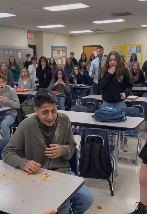
For one frozen second, the cafeteria at Westbridge High School in St. Louis, Missouri, became a stage built out of plastic trays, cheap fluorescent light, and the cruel silence of people deciding whether to laugh. The milk dripped from my sleeve onto my jeans. A piece of soggy bread stuck to the front of my cardigan. Somewhere behind Hailey, one of her friends kept filming, her phone lifted high, catching every second of my humiliation.
I stood there, seventeen years old, Syrian American, hair neatly pinned back the way my mother always said made me look “ready for serious things,” wearing my soft beige cardigan, faded jeans, and sneakers I had cleaned that morning because I had a student council meeting after lunch.
I had walked into school thinking the worst thing that could happen was another rumor.
I had been wrong.
Hailey Brent stood in front of me like she had just won something.
She was eighteen, white American, light-skinned, glossy-haired, dressed in a cream sweater, a plaid skirt, and brown boots that probably cost more than my family’s weekly groceries. Her father’s name was on the donor wall near the auditorium. Her mother chaired the Winter Giving Gala. Her older brother had graduated from Westbridge with three awards, two scholarships, and a rumor that his family had made certain problems disappear before college applications went out.
People listened to Hailey even when she lied.
Sometimes especially when she lied.
“Say it again, Noor,” she said, loud enough for nearby tables to hear. “Tell everyone why you were digging through fundraiser files.”
My hands shook, but I did not wipe the milk from my shirt.
Not yet.
Because if I moved too quickly, people would see only the mess.
And I needed them to see the reason behind it.
“I asked Ms. Raymond to check the fundraiser record,” I said.
Hailey laughed, sharp and pretty. “No. You accused people.”
“I asked for the record.”
“You acted like money was missing.”
“Because the trail didn’t match.”
The cafeteria noise changed.
Before that, students had been whispering, snickering, reacting to the thrown drink. Now the word money moved through the room like smoke.
Money always made people look twice.
Three days earlier, I had not been trying to start anything.
I was part of the Global Arts Night committee, a public school event meant to raise money for student projects: translation headsets for parent-teacher conferences, art supplies for the newcomer program, bus passes for after-school tutoring, and a small emergency fund for students whose families could not afford club fees.
It was not glamorous.
That was why I cared about it.
My family had come to St. Louis when I was six, after leaving Syria with two suitcases, documents in a plastic folder, and my mother’s wedding bracelet sewn into the lining of her coat. My parents worked hard enough to make exhaustion feel normal. My father drove medical supply deliveries. My mother altered dresses from our apartment and remembered every customer’s measurements like they were poetry.
We did not waste money.
We did not treat small amounts as small.
So when I helped student council organize the fundraiser deposits, I noticed the numbers did not line up.
The bake sale table reported $1,240.
The ticket booth reported $3,680.
The online donations showed $5,900.
The donor-matching pledge from Brent Family Charitable Partners was supposed to add another $5,000 once the student-raised total passed $10,000.
But the deposit sheet showed $9,870.
Exactly $130 short of triggering the donor match.
That would have been suspicious enough.
Then I checked the booth receipt photos.
One receipt had been replaced.
The original ticket booth cash count from Saturday night showed $3,810, not $3,680.
The missing $130 was not random.
It was the exact amount needed to keep the fundraiser below the threshold, delay the donor match, and let the Brent family present the “saved” amount at the Winter Giving Gala in front of cameras.
I did not accuse anyone at first.
I took screenshots. I checked dates. I asked Samiyah, who had worked the ticket table with me, whether she remembered the final count. She did. I asked Diego, who had photographed the deposit envelope, whether he still had the picture. He did.
Then I brought it to Ms. Raymond, the activities coordinator.
I said, “Can you please check the original fundraising record before the final report goes out?”
That was all.
One adult.
One record.
One chance to fix it quietly before students who needed the money lost out.
By lunch, the rumor had already become something else.
Noor Khalil accused Hailey’s family of stealing.
Noor is jealous of donor kids.
Noor wants attention.
Noor hates the gala because her family can’t afford tickets.
By fourth period, someone had taped a fake “audit notice” to my locker.
By lunch, Hailey was waiting.
She did not approach me alone. Girls like Hailey never did cruelty alone when an audience could make it useful. She came with Madison and Claire, both already filming, both wearing expressions that said they were witnesses only if the story favored them.
I tried to walk past.
Hailey stepped into my space.
“Apologize,” she said.
I looked at her. “For what?”
“For spreading lies about my family.”
“I didn’t spread anything.”
“You told Ms. Raymond we changed the fundraiser money.”
“I told Ms. Raymond the numbers didn’t match.”
“Same thing.”
“No,” I said. “It isn’t.”
That was when she grabbed the strawberry milk from Madison’s tray and threw it.
The carton hit my chest first, then burst open down my cardigan. Something from the tray followed—soft bread, mashed fruit, sauce. The cafeteria gasped, then went silent.
Hailey smiled.
She thought the public scene would do what rumors had not.
Make me too embarrassed to keep going.
Make everyone remember the food on my clothes instead of the fundraiser record.
Make teachers deal with “girl drama” instead of a money trail.
But she miscalculated one thing.
My mother had raised me to stay calm around spilled things.
Tea on silk. Ink on lace. Blood on a hem. Strawberry milk on a cardigan.
A stain was not the end.
A stain was evidence of contact.
I looked down at myself once.
Then I looked back at Hailey.
“Can someone please call Ms. Raymond?” I said.
Hailey’s smile twitched.
“Noor,” she warned.
I turned toward Mr. Harris, the teacher on cafeteria duty. “Please. Ask Ms. Raymond to bring the fundraiser proof file.”
The cafeteria shifted again.
Hailey’s face changed.
That was the first time the crowd saw it.
Not guilt exactly.
Panic.
Mr. Harris frowned. “What proof file?”
“The event folder,” I said. “Deposit sheets, booth receipts, email approvals, donor-match terms. I already asked her to check it.”
Hailey stepped closer. “Stop talking.”
I did not step back.
“You threw food at me because you don’t want that file opened.”
The cafeteria erupted.
Madison lowered her phone a little. Claire whispered something I could not hear.
Hailey’s eyes flashed. “You’re insane.”
“No,” I said. “I’m wet.”
Someone near the back snorted, and that tiny laugh cracked the spell.
Hailey heard it too.
Her control slipped.
“You think people will believe you over my family?” she hissed.
I wiped strawberry milk from my chin with the back of my hand.
“I think records don’t care who your family is.”
That was when Principal Carver entered the cafeteria.
He came in with Ms. Raymond beside him, carrying a blue binder and a school laptop. Behind them walked Mrs. Liddell from the front office, holding a sealed envelope.
Principal Carver was a careful man. He wore careful ties, chose careful words, and smiled carefully when donors visited. Usually, he looked like someone trying to keep the ceiling from falling by pretending it was not cracking.
But that day his expression was different.
He looked angry.
Not loud angry.
Worse.
Quiet angry.
“What happened here?” he asked.
Hailey pointed at me immediately. “She has been harassing me about my family’s donation, and she started yelling.”
Mr. Harris said, “Hailey threw milk and food at Noor.”
Hailey spun toward him. “She provoked me!”
Ms. Raymond looked at my cardigan, then at the floor, then at Hailey.
“Provoked you into assaulting another student with food?”
Hailey flushed. “It wasn’t assault. It was just milk.”
“It is still an attack,” Ms. Raymond said.
For a moment, Hailey looked startled that an adult had named it correctly.
Principal Carver turned to me. “Noor, are you hurt?”
“My skin is cold,” I said. “My cheek is fine. My clothes are not.”
A few students laughed quietly.
Principal Carver did not.
“Do you want to go to the nurse?”
“After the file is checked.”
Hailey snapped, “This is ridiculous.”
Principal Carver looked at her. “It stopped being ridiculous when you threw something at another student.”
Hailey’s mouth closed.
Ms. Raymond set the laptop on the cafeteria staff table. “Noor asked me this morning to preserve the fundraiser file. I did. I also contacted the district activity funds office.”
The words district activity funds changed the room.
Hailey went still.
“You contacted the district?” she whispered.
“Yes,” Ms. Raymond said. “Because Noor was right. The numbers did not match.”
The cafeteria buzzed.
Principal Carver raised a hand. “Quiet.”
Ms. Raymond opened the laptop. The cafeteria projector, normally used for announcements and basketball schedules, was still connected from morning assembly. The screen above the lunch line flickered to life.
Hailey stared at it like it was a loaded weapon.
Ms. Raymond opened the proof file.
GLOBAL ARTS NIGHT FUNDRAISER — ORIGINAL DOCUMENTS
Folder one: ticket booth photos.
Folder two: cash count sheets.
Folder three: donor match agreement.
Folder four: email approvals.
Folder five: revision history.
My stomach twisted.
Even though I knew what was there, seeing it on the giant screen made everything feel dangerous. Truth was safer inside a folder. On a public screen, truth became a blade.
Ms. Raymond opened the original ticket booth receipt photo.
The screen showed the yellow cash-count sheet from Saturday night. Samiyah’s handwriting listed the total.
$3,810.
Then Ms. Raymond opened the final report submitted Monday morning.
Ticket booth total:
$3,680.
Difference:
$130.
Whispers moved through the room.
Hailey laughed, but it came out dry. “That could be a simple correction.”
Ms. Raymond nodded. “It could be.”
Then she opened the donor match agreement.
Brent Family Charitable Partners agrees to match student-raised funds with a $5,000 contribution if student total reaches $10,000 before final event reporting deadline.
Ms. Raymond opened the calculator sheet.
Student-raised total using original ticket booth amount:
$10,000.
Student-raised total using revised ticket booth amount:
$9,870.
The cafeteria became dead silent.
There was the shape of it.
Not a missing fortune.
Not a dramatic theft of thousands.
Just $130.
A small enough number for adults to dismiss.
A large enough number to block $5,000 from reaching students who needed it.
Principal Carver’s jaw tightened.
Hailey crossed her arms. “My family was going to donate anyway.”
“Then why change the total?” I asked.
Her eyes snapped to mine.
Ms. Raymond clicked the revision history.
The screen showed a spreadsheet log.
Final_Report_Draft.xlsx
Original upload: Saturday 8:42 p.m. — Raymond, L.
Edited: Sunday 9:13 a.m. — hbrent.studentleadership
Cell changed: TicketBooth_Total
Original value: 3810
New value: 3680
Comment added: cash recount correction
A sound went through the cafeteria.
Not a gasp.
A judgment.
Hailey shook her head. “Someone used my login.”
Principal Carver asked, “Were you in the activities office Sunday morning?”
“No.”
Ms. Raymond looked down at another document. “The building access log says your student leadership badge opened the east office hall at 9:07 a.m.”
Hailey’s face drained.
“My badge could have been borrowed.”
Mrs. Liddell stepped forward with the sealed envelope.
“We reviewed the security stills,” she said.
Hailey looked at the envelope.
And for the first time, I saw real fear in her eyes.
Not embarrassment.
Fear.
Mrs. Liddell removed a printed still image and placed it under the document camera.
The projector showed Hailey in the east office hall at 9:08 a.m., wearing the same brown boots she had on now, holding a folder and looking directly toward the activities office door.
No one spoke.
Principal Carver looked at Hailey. “Why were you there?”
She opened her mouth.
Closed it.
Opened it again.
Nothing came.
Then, from the back of the cafeteria, a man’s voice cut through.
“I believe this has gone far enough.”
Everyone turned.
Graham Brent stood near the entrance in a charcoal coat, his silver hair combed back, his donor smile already arranged. He was Hailey’s father, owner of Brent Development Group, a company whose name was on local playground renovations, church sponsorship banners, and half the new luxury apartments pushing families out of neighborhoods my classmates still lived in.
Behind him stood Mrs. Brent, PTA gala chair, wearing a pearl necklace and the expression of a woman watching a stain spread across white carpet.
Hailey’s face crumpled with relief.
“Dad.”
Graham Brent walked toward the front like the cafeteria belonged to him.
“I received a call that my daughter was being publicly accused,” he said. “This should be handled privately.”
Principal Carver stiffened. “Mr. Brent, a student was attacked in this cafeteria.”
Graham glanced at my stained cardigan.
“I see a regrettable lunchroom incident,” he said. “Not a public trial.”
A regrettable lunchroom incident.
That was what he called it.
Not humiliation.
Not intimidation.
Not an attempt to stop a record from being checked.
My fingers curled into fists.
Ms. Raymond’s voice was cold. “We are reviewing fundraiser records.”
“With minors present?” Graham said. “With phones recording? Are you trying to damage reputations?”
I looked at him.
“Whose reputation?” I asked.
His eyes moved to me slowly, like I had interrupted a meeting I was not invited to attend.
“You must be Noor.”
“I am.”
“I understand you are very passionate.”
The word passionate landed exactly where he aimed it.
Not careful.
Not accurate.
Emotional.
Uncontrolled.
Easy to dismiss.
“My daughter has done more for this school than most students could imagine,” he continued. “If there is a clerical error, we will correct it.”
“Then answer the question,” Ms. Raymond said.
Graham turned to her, surprised.
She pointed to the screen.
“Why did Hailey change the ticket booth total by exactly $130?”
Graham smiled thinly. “I will not allow my daughter to be interrogated in a cafeteria.”
Principal Carver looked uncertain.
And in that hesitation, I felt the whole room tilt.
This was the moment where money usually won.
Not by proving innocence.
By making accountability feel impolite.
Hailey saw it too. Her shoulders relaxed a little.
Then Samiyah stood up.
She was small, usually quiet, and had worn a green hijab that day pinned with a tiny gold moon.
“I counted the ticket booth money,” she said.
Every head turned.
Samiyah’s voice trembled, but she kept going. “Noor didn’t make up the $3,810. I wrote it down. Diego took the picture. We all signed the envelope.”
Diego rose next.
“I have the original photo on my phone,” he said. “With metadata.”
Hailey’s relief vanished.
Graham’s smile hardened. “Students should be careful making accusations they do not understand.”
Diego lifted his phone. “I understand timestamps.”
Ms. Raymond looked at him. “Can you send it to me?”
He did.
Thirty seconds later, the image appeared on the screen.
Same receipt.
Same amount.
But now, beside the file details, the metadata showed:
Created: Saturday 8:31 p.m.
Location: Westbridge High cafeteria
Device: Diego Ramirez
Ms. Raymond opened the revised document log again.
Hailey’s edit:
Sunday 9:13 a.m.
A full night later.
Principal Carver turned to Hailey.
“You altered the amount after the original record was photographed.”
Hailey whispered, “I had to.”
The cafeteria stopped breathing.
Graham snapped, “Hailey.”
But the words had already slipped out.
Ms. Raymond stepped forward. “Why did you have to?”
Hailey’s mouth trembled.
Her eyes moved to her father.
Then to her mother.
Then to the screen.
Then to me.
And suddenly I understood.
She had not acted alone, but she had been the one sent to make the edit. The perfect daughter. The student leader. The one adults trusted with the office badge. The one who could make a number disappear and call it a correction.
Hailey started crying.
“My dad said the match couldn’t trigger before the gala,” she said.
Mrs. Brent covered her mouth.
Graham’s face turned to stone.
Hailey kept going, voice cracking. “He said the family announcement needed to happen at the gala. He said if the school already qualified on its own, then the donation wouldn’t look generous enough.”
The cafeteria erupted.
Graham moved toward her. “Stop talking.”
Hailey flinched.
That flinch changed the room.
For the first time, she looked less like a villain and more like a girl who had been trained to protect a family brand until she did not know where her own choices began.
But it did not erase what she had done.
It did not erase the milk on my cardigan.
It did not erase the public lie.
Ms. Raymond asked the question that made the whole scandal crack open.
“Hailey, where is the $130?”
Hailey froze.
Everyone did.
Because until then, people had focused on the lowered total, the blocked match, the donor image.
But if the report was reduced by $130, where had that money gone?
Hailey shook her head. “I didn’t take it.”
“Then where is it?”
“I don’t know.”
“You changed the number.”
“I changed the report,” she said. “Not the cash.”
Principal Carver looked at Ms. Raymond. “Check the deposit.”
She opened the bank deposit confirmation.
The amount deposited from the fundraiser cash envelope was not $9,870.
It was $10,000.
The exact full amount.
A stunned silence spread through the cafeteria.
The money had not been stolen.
The money was in the account.
The report had been falsified to pretend the school had not reached the match threshold.
That meant the Brent family could delay the match, announce it dramatically later, and appear to “rescue” the fundraiser with generosity that had already been earned by students.
Graham Brent looked trapped now.
But Ms. Raymond was not finished.
She opened the email approvals folder.
There, on the screen, was an email from Graham Brent to the private donor coordinator.
Subject: Gala Timing
Do not confirm match trigger yet. Student total should remain below threshold in preliminary report. We will announce completion at gala for press visibility.
The room exploded so loudly Principal Carver had to shout for order.
Graham’s face went red. “That email is taken out of context.”
Ms. Raymond clicked the attachment below it.
A second document opened.
Press Release Draft.
BRENT FAMILY CHARITABLE PARTNERS RESCUES STUDENT FUNDRAISER WITH SURPRISE $5,000 MATCH
Rescues.
The word sat on the screen like a confession.
Noor Khalil had not been trying to embarrass a donor family.
I had been trying to stop them from turning student labor into their own staged rescue story.
Hailey stared at the screen, crying silently now.
Then she looked at me.
For the first time all day, her expression had no performance in it.
“I’m sorry,” she whispered.
I did not answer.
Not because I wanted to be cruel.
Because sorry was not a sponge.
It could not soak the milk from my cardigan, erase the video from phones, or give back the dignity she had tried to take from me.
Principal Carver turned to Graham Brent. “Mr. Brent, you and your wife need to leave campus.”
Graham laughed once. “You are making a serious mistake.”
“No,” Principal Carver said, and his voice finally stopped shaking. “The mistake was letting donors think they owned student records.”
That sentence traveled through the cafeteria like a match catching.
Students began clapping.
One table.
Then another.
Then the whole cafeteria.
I did not clap.
I stood there wet, cold, shaking, and more tired than victorious.
But when Samiyah came to my side and wrapped her clean jacket around my shoulders, I almost broke.
“You okay?” she whispered.
“No,” I said.
She nodded. “Me neither.”
That made me laugh, and then I cried, and for once nobody made my tears the story.
The district investigation started that afternoon.
The videos spread before the final bell.
By morning, everyone in St. Louis seemed to know about the food-throwing attack, the altered fundraiser file, and the donor email that used the word rescue like students were props in a charity advertisement.
The Brent family announced that their original $5,000 match would be paid immediately. The district refused to let them present it at the gala. Then, after pressure from parents, alumni, and local reporters, Brent Family Charitable Partners was removed as the event’s headline sponsor.
But the twist nobody saw coming happened two weeks later.
Ms. Raymond called me into the library after school.
I expected another statement.
Instead, she sat me down beside Principal Carver, Samiyah, Diego, and a woman from the district finance office.
On the table was a thick folder.
The woman opened it.
“Noor,” she said, “your request to preserve the fundraiser proof file led us to review other donation-linked student activity reports from the past four years.”
My stomach tightened.
“Was it more than our event?” I asked.
She nodded.
The folder contained a pattern.
Not one fundraiser.
Seven.
Seven events where student-raised totals were reported just below donor-match thresholds.
Seven public announcements where donor families appeared to save the day.
Seven times students did the work, and wealthy families took the glory.
Some money had eventually arrived. Some had not. Some funds had been delayed so long that projects were canceled before donations came through.
One canceled project made my throat close.
Newcomer Language Lab — postponed due to insufficient funds.
That was the project meant to buy translation headsets for families like mine.
Families who came to school meetings with children translating serious adult words.
Families who smiled politely while missing half the conversation.
Families who were later blamed for “not being involved.”
I stared at the line until the words blurred.
Ms. Raymond touched the folder. “Because the proof file was preserved, the district is restoring all delayed funds.”
“How much?” Diego asked.
The finance officer looked at us.
“Forty-eight thousand dollars.”
Samiyah gasped.
Principal Carver bowed his head.
I could not speak.
Forty-eight thousand dollars.
Not stolen in one dramatic bag of cash.
Not hidden in some movie-villain vault.
Just delayed, redirected, staged, and polished until everyone forgot students had earned it first.
A week later, Westbridge held an assembly.
Not a gala.
No donor spotlight.
No staged rescue.
Just students, staff, families, cafeteria workers, custodians, translators, and the people who had actually carried boxes, sold tickets, made posters, counted cash, and cleaned up afterward.
Principal Carver stood at the podium.
“We failed,” he said. “We allowed influence to pressure our records. We allowed student labor to be repackaged as donor generosity. We allowed a student who asked for verification to be publicly humiliated before we acted. That ends now.”
Then he invited Ms. Raymond to announce the restored projects.
Translation headsets.
Art supplies.
Bus passes.
Emergency club-fee support.
And a new student finance transparency board with three student auditors.
Samiyah.
Diego.
And me.
When my name was called, the auditorium stood up.
I did not know what to do with applause.
It felt too loud.
Too warm.
Too much like being seen.
My mother cried in the third row. My father held her hand. My little brother waved both arms like I had won the Olympics.
I walked onstage in a clean cardigan, the stained one folded at home in a plastic bag because my mother said, “We do not throw away evidence.”
Ms. Raymond handed me a small framed copy of the new policy.
Student fundraising records must remain accessible for verification by student representatives, staff sponsors, and district activity funds review.
At the bottom, in smaller print, it said:
Created after the Westbridge Global Arts Night review, initiated by student request.
Not my name.
Not Hailey’s.
Not the Brents’.
The request.
That mattered to me.
Because it meant the rule was bigger than one person.
After the assembly, Hailey found me near the side hallway.
She looked different without her friends around her. Smaller somehow. Her hair was tied back. Her sweater was plain. No boots clicking. No camera girls. No audience.
“I’m transferring,” she said.
I nodded.
“My dad is furious,” she added.
I said nothing.
She swallowed. “I know that doesn’t matter.”
“It matters,” I said. “Just not more than what you did.”
She flinched, but she accepted it.
“I shouldn’t have thrown the milk.”
“No,” I said. “You shouldn’t have changed the report. You shouldn’t have lied. You shouldn’t have tried to make me look crazy for checking a record.”
Her eyes filled.
“I know.”
For a moment, I saw the girl behind the donor name. Not innocent. Not excused. But young, scared, and shaped by a house where reputation mattered more than truth.
I did not hug her.
I did not forgive her out loud.
But I said, “You still get to decide what kind of person you become after this.”
She cried then.
Quietly.
Without performance.
And maybe that was the first honest thing I ever saw her do.
Spring came slowly to St. Louis that year.
The translation headsets arrived in April. I helped unpack them in the same cafeteria where Hailey had thrown food at me. My father picked one up carefully, placed it over his ears, and listened as the principal’s welcome message played in Arabic.
My mother covered her mouth.
For years, I had translated school meetings for them, making adult decisions with a child’s vocabulary, softening bad news, guessing at words I did not know.
Now my mother could hear for herself.
She looked at me and said in Arabic, “This is what you protected.”
That was when I finally cried for real.
Not because of the milk.
Not because of the slap of laughter that had followed.
Because the proof file had become something living.
A headset.
A bus pass.
A paintbrush.
A student staying after school because the fee was covered.
A parent understanding the teacher without needing their child to carry every word.
On the last day of senior year, I walked past the donor wall outside the auditorium.
The Brent plaque was gone.
In its place was a new display titled:
STUDENT WORK BUILT THIS.
Underneath were photos from Global Arts Night: Samiyah counting tickets, Diego carrying chairs, Ms. Raymond taping signs, cafeteria workers serving food, my mother hemming donated costumes, my father fixing a broken display stand, me holding the blue proof binder with strawberry milk still drying on my sleeve.
I stared at that photo for a long time.
The girl in it looked embarrassed, furious, and shaking.
But she was still standing.
That was the part I loved.
People remember the attack because it was loud.
But I remember what happened after.
I asked for the record.
The record opened.
And the truth did what truth always does when someone protects it long enough.
It made the powerful answer one question they could not dodge.
Where did the money go?
And when the answer appeared, the whole school finally understood why Hailey Brent had thrown first and explained later.
She thought humiliation would bury the trail.
Instead, it marked the exact spot where everyone started digging.
THE END
