The moment Harper Lawson smiled at me across the activity room, I knew she had already chosen the ending.
Not the truth. Not the fairest explanation. Not even the version that would hurt the least.
She had chosen a public ending, the kind with phones raised, whispers sharpened, and my name dragged through a hallway before I could say three complete sentences.
The Pasadena High activity space looked harmless that afternoon. Paper flowers hung from string lights above folding tables. The air smelled like glue sticks, poster paint, and the citrus cleaner the custodians used after lunch. A banner over the stage read SPRING SERVICE FAIR in blue letters, and every club had been given a display area to show what they had contributed to the community project.
Art club had spent three weeks making paper-flower name tags for donors, volunteers, and students who had helped assemble care baskets for the senior center. I knew that because I had stayed after school every day, cutting petals until my fingers cramped and gluing tiny paper labels onto green wire stems.
Student council had handled registration, microphones, and refreshments.
Both jobs mattered.
That was why the mistake hit me so hard when I saw the display board.
Every paper-flower name tag had been moved under a printed sign that said: CREATED BY STUDENT COUNCIL.
For a second, I thought someone had mixed up the table cards by accident. Then I looked closer. The original art club credit line had not just been misplaced. It had been covered by a clean white strip printed in the same font as the rest of the display.
My stomach tightened.
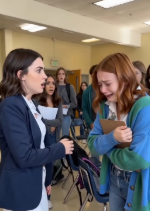
My name is Kaitlyn Reed. I was seventeen, born in Missouri, and still new enough in Pasadena that people called me “the quiet one” like it was my actual name. I was wearing a blue-green cardigan over a white shirt, a jacket tied around my waist, jeans, and brown boots scuffed from walking home. Standing near Harper Lawson, I looked like an extra in a show she produced.
Harper was eighteen, born in New York, always polished, always bright under a camera lens. She ran the school news channel like it was a national broadcast. That day, she wore white dress pants and a sleeveless top, her hair smooth enough to reflect the overhead lights.
She was beside the display board, directing two younger students where to stand for a video segment.
“Move closer to the flowers,” she told them. “We want the credit wall in the background.”
Credit wall.
The words made my face hot.
I stepped forward with the clipboard I had been carrying since setup. “Harper?”
She turned. “Yes?”
“I think there’s a mistake on the board.”
Her expression did not change, but something behind her eyes went still.
“What mistake?”
“The paper-flower name tags were made by art club,” I said. “The sign says student council created them.”
A few students nearby glanced over. Harper noticed them before she answered me.
“Oh,” she said lightly. “That was updated.”
“Updated by who?”
Her smile widened, but it was not friendly. “By people who know how the fair is supposed to be presented.”
I looked at the white strip covering the old credit line. “Can we just check? I’m not trying to make a scene. I’m asking for one comparison, one timestamp, one official check. The original layout file should show who changed it.”
Harper tilted her head, as if I had said something adorable and embarrassing. “Kaitlyn, this is a school event, not a criminal investigation.”
“I know. But art club students worked on these. Some of them are here with their parents.”
The younger students near the camera traded looks. Harper saw that too. Her mouth tightened for less than a second, then smoothed itself back into a smile.
“You’re confused,” she said.
“I’m not.”
“That’s okay. You’re new. Things get reassigned.”
“Credit doesn’t get reassigned after the work is done.”
The room seemed louder suddenly, every conversation folding toward us. I could feel attention gathering like static.
Harper took one step closer. “Do you understand what you’re doing right now?”
“Yes,” I said, though my voice shook. “I’m asking for verification.”
She laughed softly.
That laugh hurt more than if she had shouted.
“Verification,” she repeated, turning slightly so the nearby students could hear. “Kaitlyn thinks there’s a conspiracy about paper flowers.”
Heat crawled up my neck. “That’s not what I said.”
“No, you just implied student council stole something.”
“I said the sign is wrong.”
“And I said it was updated.”
“Then who approved the update?”
Her eyes flicked past me, toward the hallway doors. I followed her gaze and saw Principal Marlow speaking with a parent volunteer. Harper looked back at me quickly.
“Drop it,” she whispered.
That whisper was the first real thing she had said.
I should have been scared enough to stop. Maybe a smarter person would have waited until the room emptied, or sent an email, or asked Mrs. Aguilar, the art teacher, to handle it.
But I thought of Maya Torres, who had stayed late cutting names with me even though she had a chemistry exam the next day. I thought of Jonah Lee burning his thumb with the hot glue gun and laughing because “at least the seniors will get fancy flowers.” I thought of the freshman who had asked if her grandmother would see her name on the display.
So I lifted the clipboard and pointed to the printed schedule. “The official check-in photos were taken at 2:10. The board was still correct then. If the credit line changed after that, there should be a timestamp.”
For one heartbeat, Harper’s face opened.
Not with anger.
With fear.
Then it closed again, harder than before.
“You really want attention this badly?” she said loudly.
The words carried. Heads turned. Someone lowered a tray of cupcakes onto a table without looking away.
“I don’t want attention,” I said.
“Then why are you standing here accusing me in front of everyone?”
“I’m not accusing you.”
“You just did.”
“No, I asked—”
The slap came so fast I did not understand it until the sound had already crossed the room.
A sharp crack.
My head turned. My cheek burned. The clipboard hit the floor, papers sliding across the polished linoleum like startled birds.
For a moment, nobody moved.
Harper stood inches from me, breathing hard, her hand still half-raised.
I touched my cheek.
The room had gone silent except for the hum of the projector and one phone camera making tiny clicking sounds from somewhere near the refreshment table.
Harper blinked, and I saw the panic return. It flashed across her face like lightning behind a curtain.
Then she did what Harper always did.
She performed.
“Oh my God,” she said, stepping back. “Kaitlyn, why would you push me like that?”
I stared at her. “What?”
“She grabbed my arm,” Harper said, louder now, turning to the crowd. “You all saw her. She came at me.”
A murmur moved through the students.
“I didn’t touch you,” I said.
Harper’s voice shook perfectly. “I was trying to calm her down, and she got aggressive.”
“She slapped her,” someone whispered.
“No, I saw Kaitlyn step forward,” another student muttered.
I could feel the room dividing around me, not because anyone knew the truth, but because Harper had given them a script before I even found my voice.
Principal Marlow hurried over. He was a tall man with tired eyes and a tie patterned with tiny yellow pencils. “What happened?”
Harper pressed a hand to her chest. “I’m sorry, Mr. Marlow. I was trying to keep the event moving, and Kaitlyn started accusing student council of stealing. She got in my face.”
“That’s not true,” I said.
My cheek throbbed. My eyes burned, but I refused to cry.
Principal Marlow looked from Harper to me to the display board. “Kaitlyn, did you accuse anyone?”
“I asked for the original file and a timestamp.”
Harper let out a broken laugh. “See? She’s still doing it.”
I bent to pick up my papers, mostly because I needed something to do with my hands. On the floor, between the scattered schedules, one photo had slipped free from the packet.
It showed the art club table during setup, with the paper flowers laid out and the original sign clearly visible.
CREATED BY ART CLUB.
I reached for it, but Harper’s white pant leg moved into my line of sight.
She stepped on the corner of the photo.
Not hard enough to tear it.
Just enough to stop me from taking it.
My heart began pounding in a different rhythm.
She knew.
This was not a misunderstanding. It had never been a misunderstanding.
“Move your foot,” I said quietly.
Harper looked down at me. Her smile came back, small and cold. “You should be careful, Kaitlyn. People are already worried about you.”
A shadow fell across us.
Mrs. Aguilar had arrived.
She was a small woman with silver hair, paint under her fingernails, and a calmness that made even loud students lower their voices. She looked at my cheek first. Then Harper’s foot. Then the photo beneath it.
“Harper,” she said, “step back.”
Harper froze.
Mrs. Aguilar did not raise her voice. She did not need to.
“Now.”
Harper stepped back.
I picked up the photo and handed it to Mrs. Aguilar. My fingers trembled so badly the paper fluttered.
Mrs. Aguilar studied it. Her face did not change, but the softness in her eyes disappeared.
“Mr. Marlow,” she said, “we need to pause the presentation.”
Harper’s laugh was too quick. “For a photo? Seriously?”
“For a student being hit,” Mrs. Aguilar said. “And for a credit change that appears to have happened after staff approval.”
The room shifted again.
Harper noticed. She always noticed.
“That photo could be from earlier,” she said. “Before the final arrangement.”
“That is exactly why Kaitlyn asked for a timestamp,” Mrs. Aguilar replied.
Principal Marlow took the photo and looked at it. “Everyone, please return to your stations.”
Nobody did.
He cleared his throat. “Now.”
The crowd slowly broke apart, but whispers remained, alive and hungry.
I wanted to disappear into the supply closet and breathe in the smell of construction paper until the world stopped spinning. Instead, Mrs. Aguilar placed a hand lightly on my shoulder.
“Come with me,” she said.
We went to the media office, a narrow room behind the stage where the school news team stored tripods, cables, microphones, and the editing computer Harper guarded like a throne. Principal Marlow followed us. Harper came too, insisting she had “nothing to hide” in a voice that made it clear she had everything to hide.
Inside, the air was cooler. Posters from old school broadcasts lined the walls. On one shelf sat a row of labeled memory cards.
Harper stood near the desk, arms folded. “This is ridiculous.”
Mrs. Aguilar opened her folder and removed several printed photos.
My breath caught.
I had seen one photo. She had a stack.
“These were sent to me by art club students during setup,” she said. “Parents wanted pictures before the room filled.”
She laid them on the desk one by one.
2:03 p.m. The flowers on the art club table.
2:10 p.m. The approved board with CREATED BY ART CLUB.
2:27 p.m. Harper standing beside the board, holding a roll of white adhesive paper.
2:31 p.m. The credit line covered.
Harper’s face went pale, then pink. “That doesn’t prove I changed anything.”
Mrs. Aguilar looked at her for a long moment. “No. It proves you were present during the change.”
Harper grabbed onto that. “Exactly.”
“But not why,” Principal Marlow said.
Harper’s mouth shut.
I looked at the photos again. Something bothered me. In the 2:27 picture, Harper was not alone. Behind her, half-hidden near the media cart, was a student in a gray hoodie.
The student’s face was turned away, but the sleeve had a small embroidered moon on it.
I knew that hoodie.
Maya Torres.
My best friend in art club.
“Maya was there?” I whispered.
Mrs. Aguilar looked at me sharply. “You recognize her?”
“I think so.”
Harper heard the uncertainty and pounced. “Great. Now Kaitlyn is dragging other people into her drama.”
I did not answer. I was staring at the photo.
Maya had been nervous all week. She had missed lunch twice and kept checking her phone during club. When I asked if she was okay, she said her cousin was visiting and her house was chaotic.
But in the picture, she was not just passing by.
She was holding a folder.
A black folder with a silver corner clip.
The same kind Harper used for broadcast scripts.
Principal Marlow noticed where I was looking. “Mrs. Aguilar, can you call Maya Torres?”
Mrs. Aguilar’s expression tightened. “Yes.”
Harper’s confidence flickered.
Just flickered.
But it was enough.
Ten minutes later, Maya appeared at the media office door looking like she had been pulled out of a storm. Her curls were tied back unevenly, and her hands were clenched around her phone.
When she saw me, her eyes filled with guilt.
“Kaitlyn,” she said.
My chest ached. “Maya, what happened?”
Harper cut in. “Don’t answer that. They’re trying to blame you.”
Maya flinched.
Principal Marlow turned to Harper. “Let her speak.”
Maya stared at the floor. “I didn’t change the sign.”
“Then why were you there?” Mrs. Aguilar asked gently.
Maya swallowed. “Harper told me to bring the folder from the news desk.”
“What folder?” Principal Marlow said.
Maya looked at Harper.
Harper’s face had gone perfectly blank.
“The donor interview folder,” Maya said. “She said the student council sponsor needed it.”
“I never said that,” Harper snapped.
Maya’s eyes flashed. Fear cracked into anger. “Yes, you did.”
The room fell still.
Maya turned to Principal Marlow. “She told me if I helped her, she’d make sure my scholarship video got featured on the school channel. My application deadline is next week. She knew that.”
Harper laughed, but it sounded brittle. “That’s insane.”
Maya opened her phone. “I have the messages.”
For the first time, Harper looked truly cornered.
Principal Marlow held out his hand. “May I see?”
Maya handed him the phone.
He read silently. With each second, his jaw tightened.
Mrs. Aguilar asked, “What do the messages say?”
Principal Marlow looked at Harper. “They say, ‘Bring the black folder. Don’t ask Kaitlyn. She notices everything.’”
My skin went cold.
Maya wiped her eyes with the back of her hand. “I’m sorry. I thought it was just some student council thing. Then I saw her covering the credit line, and I told her that was wrong. She said the art club credit would mess up the broadcast angle because student council needed a clean win after the fundraiser problem.”
“The fundraiser problem?” I asked.
Harper whispered, “Maya.”
But Maya was done protecting her.
“The donor baskets,” Maya said. “The senior center baskets. Student council ordered half the supplies late. Art club used its own materials to finish the decorations, and Harper didn’t want that in the final report because she’s applying for the district leadership award.”
Principal Marlow looked at Harper. “Is that true?”
“No,” Harper said immediately. “They’re lying because they’re jealous.”
Mrs. Aguilar’s voice sharpened. “Jealous of what, Harper?”
“My platform,” Harper said, too fast. “My work. My reputation. Everyone knows Kaitlyn has been trying to make art club look more important than student council.”
I almost laughed. Not because it was funny, but because it was so absurd. I had spent most of the year trying not to be noticed.
Then the media office door opened again.
A freshman named Eli Chen stood there, clutching a camera bag. He was one of Harper’s news volunteers, a quiet kid who always wore oversized headphones around his neck.
“Sorry,” he said. “I heard you needed timestamps.”
Harper turned so quickly I thought she might fall.
“Eli,” she said carefully, “this is a staff matter.”
Eli did not look at her. He looked at Principal Marlow.
“I didn’t mean to record anything bad,” he said. “I was testing the hallway camera for the livestream. It was pointed at the activity room doors, but the reflection caught the display board in the glass trophy case.”
My heart stopped.
Harper’s lips parted.
Eli reached into his camera bag and took out a memory card. “I copied the test footage because Harper asked me to delete it.”
No one spoke.
Principal Marlow took the memory card slowly. “When did she ask you to delete it?”
“Right after Kaitlyn got slapped.”
Harper’s voice rose. “That is not true!”
Eli finally looked at her. “You said, ‘If anyone sees the reflection, we all lose.’”
The sentence landed like a chair dropped in an empty gym.
If anyone sees the reflection, we all lose.
Not I lose.
We all lose.
Principal Marlow inserted the memory card into the computer. The screen filled with shaky test footage from the hallway camera. Students walked in and out. The trophy case glass reflected the activity room at an angle, dim but visible.
There was the board.
There was Harper.
There was Maya bringing the folder.
There was Harper peeling the white strip and smoothing it over the art club credit line.
Then the video showed something we did not expect.
A woman in a navy blazer stepped into the reflection.
She was not a student.
She was Mrs. Bell, the student council sponsor.
She handed Harper an envelope.
Harper shook her head at something. Mrs. Bell leaned closer and pointed toward the board.
Maya stood frozen beside them.
Then Mrs. Bell walked away.
The room became so quiet I could hear the computer fan.
Principal Marlow rewound the clip.
Played it again.
Mrs. Bell. The envelope. The gesture.
Harper’s expression changed completely.
All the arrogance drained out of her, leaving something younger, smaller, and terrified.
She sat down in the nearest chair.
“I didn’t want to,” she whispered.
Mrs. Aguilar stared at her. “What?”
Harper covered her mouth.
Principal Marlow paused the footage. “Harper, start talking.”
For a moment, I thought she would lie again. I thought she would build another performance out of tears and blame.
Instead, she looked at me.
And for the first time all day, she looked like she actually saw me.
“I’m sorry,” she said.
The apology was so unexpected I did not know where to put it.
“I didn’t plan to hit you,” she said. “I panicked.”
“You slapped me because I asked for a check,” I said.
Her eyes filled. “I know.”
“That’s not panic. That’s a choice.”
She nodded, and tears slipped down her face. “I know.”
Principal Marlow’s voice was low. “Why did Mrs. Bell tell you to change the board?”
Harper looked at the frozen image on the screen. “Because the district leadership award requires a documented service project led by student council. If the report showed art club created the donor tags and corrected the basket presentation, student council’s project looked incomplete.”
Mrs. Aguilar’s face hardened. “So she told you to erase student work.”
“She said it was temporary,” Harper whispered. “Just for the broadcast and the district photos. She said art club would still be thanked later.”
Maya made a hurt sound. “You knew that was wrong.”
“I did,” Harper said. “But Mrs. Bell told me if student council lost the award, the school channel funding would get cut, and my recommendation letter would disappear.”
Principal Marlow leaned back as if the words had struck him.
“Recommendation letter?” he asked.
Harper nodded. “For Columbia’s summer journalism program. She said she had contacts. She said I needed to prove I could protect the school’s image.”
Protect the school’s image.
The phrase made me feel sick.
Mrs. Aguilar turned to Principal Marlow. “Where is Mrs. Bell now?”
“At the district guest table,” he said.
The adults exchanged a look.
Then Principal Marlow stood. “Everyone stays here.”
He left.
The next fifteen minutes felt longer than the whole afternoon. Harper cried quietly into her hands. Maya stood near me but did not try to touch my arm. Eli sat on the floor with his camera bag hugged to his chest.
I kept staring at the paused screen.
Harper had changed the sign. Mrs. Bell had pushed her. Maya had been used. Eli had evidence. But something still did not fit.
The envelope.
Why would Mrs. Bell hand Harper an envelope in the middle of an activity fair?
I stepped closer to the computer.
“Can you zoom in?” I asked Eli.
He blinked. “Maybe.”
Harper lifted her head. “Why?”
“The envelope,” I said.
Her face tightened. “It was nothing.”
But it was not nothing. I knew because her fear changed shape again.
Eli scrubbed through the footage and enlarged the reflection. The image blurred, then sharpened slightly. The envelope had writing on it.
Not a name.
A number.
2,400.
Mrs. Aguilar leaned closer. “What is that?”
Harper shut her eyes.
Maya whispered, “Harper?”
Harper’s voice broke. “It was cash.”
The room seemed to tilt.
Mrs. Aguilar’s hand went to the back of the chair.
“Cash for what?” she asked.
Harper looked down. “For the supplies.”
“What supplies?”
“The ones student council said were donated.”
The twist unfolded slowly, piece by piece, each part worse than the last.
Student council had reported that a local craft store donated materials for the senior center baskets. The donation made the project look larger and more impressive for the district award. But the supplies had not been donated. Art club had used its own leftover materials, parent contributions, and small cash purchases to finish the paper flowers and labels.
Mrs. Bell had submitted reimbursement forms anyway.
For supplies never bought.
For a donation that never happened.
The credit line was not only about pride.
It was a cover.
If art club was credited, someone might ask why student council had claimed the full supply budget. Someone might compare photos, receipts, and donor lists. Someone might notice that the “donated” materials matched art club’s own inventory.
Harper had not just wanted applause.
She had been protecting an adult’s lie.
And when I asked for one official check, I had stepped directly onto the fault line.
Principal Marlow returned with Mrs. Bell beside him. She was composed, elegant, and smiling in the way adults smile when they believe students are too emotional to be dangerous.
“This has gotten completely out of hand,” she said as she entered. “Harper, sweetheart, you should have come to me before letting this spiral.”
Harper flinched at sweetheart.
Principal Marlow shut the door. “Mrs. Bell, did you instruct Harper to cover the art club credit line?”
“Of course not.”
He pointed to the screen.
Her smile weakened, but only slightly. “That appears to be taken out of context.”
“The footage shows you handing Harper an envelope.”
Mrs. Bell laughed. “Event materials.”
“Cash,” Harper said.
Mrs. Bell turned slowly.
Harper stood, shaking. “It was cash. You told me to hold it until after the district guests left.”
Mrs. Bell’s eyes sharpened. “Harper, be very careful.”
“I should have been careful before,” Harper said. “Before I listened to you.”
For a second, I admired her. I did not forgive her. Not yet. Maybe not for a long time. But standing up to Mrs. Bell took something real.
Mrs. Bell looked at Principal Marlow. “These are teenagers. They misunderstand everything. Kaitlyn has been disruptive from the beginning, Maya is emotional, and Harper is clearly overwhelmed.”
There it was.
The adult version of the same script.
Make the girls look unstable. Make the truth look messy. Make the room tired enough to move on.
But Mrs. Aguilar stepped forward.
“No,” she said. “Not this time.”
She opened her own folder and removed another set of papers.
Receipts.
Inventory sheets.
Photos.
Email printouts.
Mrs. Bell’s face changed.
Mrs. Aguilar placed them on the desk with the care of someone setting down a blade.
“I started checking last week,” she said. “When our art club inventory numbers did not match the district project report.”
Mrs. Bell went white.
“You knew?” I whispered.
Mrs. Aguilar looked at me, and her expression softened. “I suspected. I did not know who was involved. I asked students to photograph setup today because I wanted clean documentation.”
My breath caught.
The evidence package had not appeared by accident.
Mrs. Aguilar had been quietly building it the whole time.
“But Kaitlyn noticed the final piece first,” she continued. “And when she asked for one check, the truth finally showed itself.”
Mrs. Bell’s composure cracked. “You encouraged a student to cause a scene?”
“No,” Mrs. Aguilar said. “You caused a scene when you used students to cover your paperwork.”
Principal Marlow picked up the receipts. “This goes to the district office immediately.”
Mrs. Bell’s eyes darted toward the door.
“Please don’t make this dramatic,” she said. “We can discuss this professionally.”
Harper let out a broken laugh. “That’s what you told me before I hit her.”
The words silenced everyone.
Harper turned to me. Her face crumpled. “I am so sorry, Kaitlyn. I know saying that doesn’t fix it. I know everyone saw. I know I tried to make them blame you. I was scared and selfish, and I hurt you.”
The apology did not erase the sting on my cheek. It did not erase the whispers or the way my body had gone cold when the room turned against me.
But it mattered that she said it where everyone could hear.
Principal Marlow opened the media office door. “We are going back to the activity room.”
Mrs. Bell stiffened. “Why?”
“Because the false credit was public,” he said. “The correction will be public too.”
The walk back felt unreal.
The activity room had not recovered. Students pretended to arrange flyers and stack cups, but every face turned when we entered. Parents noticed. Teachers noticed. The district guests at the front table noticed.
Principal Marlow stepped onto the small stage and took the microphone.
“May I have everyone’s attention?”
The room quieted quickly.
My hands went numb.
Mrs. Aguilar stood beside me. Maya stood on my other side. Harper stood a few feet away, pale but steady. Mrs. Bell remained near the stage stairs like a person waiting for a sentence.
Principal Marlow looked at the crowd.
“Earlier today, a student raised a concern about the credit line on the paper-flower name tag display. That concern was valid.”
Whispers rippled.
“The paper-flower name tags were created by the art club. The credit line was improperly changed after staff approval. Kaitlyn Reed was correct to ask for verification.”
My name sounded strange through the speakers.
Correct.
Not dramatic. Not aggressive. Not confused.
Correct.
Principal Marlow continued. “There was also a physical incident. It is being addressed. No student should be humiliated or harmed for asking for an official check.”
Harper took a step forward.
Principal Marlow looked at her, surprised.
She held out her hand for the microphone.
For a moment, I thought he would refuse. Then he gave it to her.
Harper faced the room.
The queen of the school news channel looked smaller without a script.
“I changed the credit line,” she said.
The room inhaled.
“Kaitlyn asked for verification, and I tried to make her look like the problem because I was afraid of what the check would show. Then I slapped her. She did not push me. She did not attack me. I lied.”
A few students gasped. Someone whispered, “Oh my God.”
Harper’s voice trembled, but she kept going.
“I’m sorry to Kaitlyn. I’m sorry to art club. I’m sorry to Maya and Eli. I’m sorry to everyone who trusted me to tell the truth on the school channel when I was willing to hide it for myself.”
She lowered the microphone.
For once, nobody clapped. They were too stunned for applause.
Then Maya reached for my hand.
I let her take it.
Mrs. Aguilar replaced the display sign herself. She peeled away the white strip and restored the original credit line beneath it. The paper had torn a little at the corner, but the words were still readable.
CREATED BY ART CLUB.
Something inside me loosened.
Not everything. But something.
The district investigation began that afternoon. Mrs. Bell was escorted out before the fair ended. Later, we learned she had submitted three false reimbursement claims that year, each one small enough to seem harmless alone but large enough together to matter. The $2,400 envelope was meant to be moved before anyone reviewed the records.
Harper was suspended from the school news channel and removed from the district award application. She had to attend a disciplinary hearing, write formal apologies, and complete restorative service with the clubs she had harmed. Some people said she got off easy. Some said Mrs. Bell had manipulated her. I thought both things could be true.
Maya apologized to me under the jacaranda trees outside the school after sunset.
“I should have told you,” she said.
“You were scared.”
“So were you.”
I looked at the purple petals scattered across the sidewalk. “Yeah.”
“But you still asked.”
I touched my cheek. It barely hurt anymore.
“I almost wish I hadn’t.”
Maya shook her head. “No. You don’t.”
She was right.
Two weeks later, the school news channel aired a special segment. Not hosted by Harper. Hosted by Eli, whose hands shook on camera for the first thirty seconds until he found his voice.
The segment was called THE CREDIT LINE.
It showed the art club students making flowers, parents donating supplies, seniors receiving baskets, and teachers explaining why documentation mattered. It did not show the slap. It did not turn my humiliation into content. Mrs. Aguilar had insisted on that.
At the end, Eli interviewed me in the courtyard.
He asked, “What made you keep asking for a check?”
I looked toward the art room window, where paper flowers now lined the sill.
“I guess I knew a small wrong thing doesn’t stay small just because people tell you to ignore it,” I said. “And I knew the truth should not depend on who is loudest.”
When the segment aired, something unexpected happened.
Students started bringing small mistakes forward. A missing name on a science poster. A misquoted volunteer hour total. A club budget typo. At first, teachers looked exhausted. Then they started calling it “the Kaitlyn check,” which embarrassed me so badly I begged them to stop.
They did not stop.
Harper returned to school after suspension, quieter than before. For several days, people watched her like she might explode. She did not. She kept her head down. She cleaned storage shelves for art club. She sorted paper by color. She wrote apology letters by hand.
One afternoon, she found me alone in the activity room, taking down the last of the fair decorations.
“I’m not asking you to forgive me,” she said.
I folded a string of paper leaves. “Good.”
She nodded, accepting that.
“I’m transferring out of student council,” she said. “And I’m not applying for the district award.”
I looked at her. “Okay.”
“I also sent Columbia a letter explaining what happened before Mrs. Bell’s recommendation could go anywhere.”
That surprised me. “Why?”
Her eyes were tired. “Because if they still want me someday, it should be after they know who I was when truth cost me something.”
For the first time, I saw the girl beneath the polish. Not innocent. Not fully changed. But trying.
“That sounds like a start,” I said.
Harper’s eyes filled, but she smiled a little. “Mrs. Aguilar said the same thing.”
I almost smiled back.
Almost.
At the end of the year, art club received a district recognition for community contribution. Not because of scandal. Because the seniors from the care center wrote letters about the baskets, the flowers, and the students whose names they had learned from the tiny labels.
Maya won her scholarship.
Eli became the official producer of the news channel.
Mrs. Aguilar framed the torn credit sign and hung it in the art room with a small caption underneath:
CHECK THE SOURCE.
On the last day of school, I stood in front of it for a long time.
I thought about the girl I had been at the start of the year, the quiet one from Missouri who thought staying unnoticed was the safest way to survive a new place. I thought about the moment my papers hit the floor and everyone waited to see which version of me they were allowed to believe.
Then I thought about the reflection in the trophy case.
That was the twist nobody expected.
Harper’s own camera system, the one she used to shape stories and polish reputations, had captured the truth she tried to erase. But the deeper twist was not the footage. It was Mrs. Aguilar, quietly trusting students to document their own work before anyone knew they would need protection. It was Maya finding courage after fear. It was Eli saving what he had been told to delete. It was Harper, finally choosing truth after making every wrong choice first.
And maybe it was me too.
Because I had spent so long thinking my quietness made me weak.
But quiet was not the same as powerless.
Sometimes quiet was where the record waited.
Sometimes quiet was where courage gathered itself before speaking.
That summer, I received a small envelope in the mail from the senior center. Inside was a paper flower, one of ours, carefully preserved. On the back of the tag, someone had written in shaky blue ink:
Thank you for making sure the right names stayed attached to the right kindness.
I sat on my bed and cried then.
Not because I was hurt.
Because, for once, the story had ended where it should have begun.
With the truth.
THE END
