The first thing I noticed was not the missing money.
It was Whitney Cross watching my hands.
She stood behind the counter of the student store with one elbow resting beside the cash box, smiling at everyone who walked in like the place belonged to her family. In a way, people acted like it did. Her father’s company had paid for the new athletic field scoreboard, half the stadium lights, and the shiny donor plaque outside the gym that everyone passed on the way to assemblies. At Desert Vista Preparatory in Phoenix, Arizona, that meant Whitney did not just enter rooms. She arrived inside a reputation already built for her.
I was the opposite.
My name is Camila Ortiz. I was seventeen, Mexican American, and usually known as the girl teachers trusted with forms, receipts, and quiet jobs nobody wanted. That afternoon, I wore the white source-matched school outfit required for winter fundraiser volunteers: white button-up shirt, white sweater vest with the school crest, white sneakers, and a plain ID badge clipped carefully to my collar. Next to Whitney in her perfect polo shirt and glasses, I looked like I had been printed from the budget version of the student catalog.
The student store was crowded because it was the final hour of the winter-coat fundraiser. Students came in carrying folded coats, envelopes of cash, and prepaid slips. The walls were lined with school hoodies, notebooks, water bottles, and spirit pins. A cardboard sign taped to the counter read: ONE COAT = ONE WARM NIGHT FOR SOMEONE ELSE.
I liked that sign.
That was why the numbers bothered me so much.
I had been assigned to compare the sales log with the cash box before everything went to the faculty sponsor, Mr. Peña. The process was simple. Count the cash. Match the prepaid codes. Check the sales log. Seal the envelope. Sign with a timestamp.
But the cash box did not match the sales log.
Not by five dollars. Not by ten.
By three hundred and eighty.
I counted twice.
Then a third time.
My throat went dry.
“Whitney,” I said carefully.
She did not turn right away. She finished laughing at something one of the basketball players said, then looked at me with bright, patient eyes.
“Yes, Camila?”
“The winter-coat fundraiser cash box doesn’t match the sales log.”
Her smile stayed in place.
The basketball player stopped smiling.
“It probably does,” Whitney said. “You’re just tired.”
“I counted three times.”
“Then count better.”
A few students near the snack shelf looked over. I felt their attention before I saw their faces.
I lowered my voice. “I’m not accusing anyone. I’m asking for a recount.”
Whitney’s fingers tapped once against the counter. “We already counted.”
“I didn’t sign off yet.”
“You don’t need to. I’ll handle it.”
My hand tightened around the logbook. “The instructions say two volunteers and one sponsor have to verify before the cash envelope is sealed.”
Her expression cooled by one degree.
Most people would not have noticed. I did.
“I know the instructions,” she said.
“Then we should follow them.”
The student store suddenly seemed too small. The air smelled like cinnamon gum, dust, and the plastic wrap from new merchandise. Behind me, someone whispered, “Is there money missing?”
Whitney heard it.
Her eyes flicked past me, then came back sharper.
“There is no money missing,” she said loudly. “Camila is confused.”
My face warmed. “I’m not confused.”
Whitney laughed softly, like she felt sorry for me. “You always do this.”
I blinked. “Do what?”
“Turn simple things into problems so people have to notice how responsible you are.”
The words landed in the room like spilled ink.
“That’s not true.”
“Isn’t it?” she asked, tilting her head. “You asked to be put on cash duty. You asked for the logbook. You asked for the access code list. Now suddenly there’s a problem only you can solve?”
I stared at her.
I had not asked for any of that. Mr. Peña assigned me because I had worked office aide last semester and knew how to file receipts.
But Whitney was not talking to me anymore.
She was talking to the room.
“I asked for one comparison,” I said, forcing each word to stay steady. “One timestamp. One official check.”
Her smile changed.
It became smaller. Meaner.
Like she had already decided I was easy to crush.
“Careful, Camila,” she said quietly.
Something in my stomach dropped.
“Careful about what?”
Whitney stepped around the counter. She was taller than me, not by much, but enough that when she came close, I had to lift my chin.
“You’re making people think I stole from a coat fundraiser.”
“I didn’t say that.”
“You implied it.”
“I said the cash box doesn’t match.”
“And who had the cash box?”
I froze.
Whitney’s voice rose. “Who has been sitting with it for the last twenty minutes?”
A boy near the door muttered, “Camila.”
My fingers went cold around the logbook.
“That’s because Mr. Peña asked me to check it.”
Whitney’s eyes widened with perfect disbelief. “Wow.”
“Whitney, stop.”
“No, I want everyone to understand what’s happening.” She turned toward the students. “Camila found a mismatch after being alone with the cash box, and now she’s trying to make it look like a student council problem.”
“I was never alone with it,” I said.
“Yes, you were.”
“No, the store cameras—”
The slap cut the sentence out of my mouth.
It was sharp, sudden, and loud enough to silence the store.
My head turned. The logbook slipped from my hands and hit the floor. A prepaid slip slid out between my shoes.
For one second, all I could hear was the buzzing refrigerator behind the counter.
Then someone gasped.
A phone came up.
Then another.
Whitney stood in front of me, breathing hard, her palm still lifted near her chest.
The burn on my cheek spread fast.
I touched my face, stunned.
She looked at the phones first.
Not at me.
The panic in her eyes flashed so quickly that if I had blinked, I would have missed it.
Then she became Whitney Cross again.
Perfect posture. Hurt expression. Controlled voice.
“Camila,” she said, loud enough for every recording phone to catch, “why would you grab me?”
I stared at her. “What?”
“You grabbed my wrist.” Her voice trembled. “I told you to calm down, and you grabbed me.”
“No, I didn’t.”
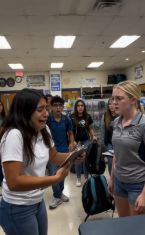
Students murmured. Someone said, “I didn’t see that.” Someone else said, “She was really close to her.”
Whitney pressed a hand to her chest. “I was scared.”
Scared.
That word did something powerful in a crowd. It gave people permission to stop thinking.
I bent down to pick up the logbook, but Whitney stepped closer, blocking me.
“You need to apologize,” she said.
My cheek pulsed. My eyes stung.
I wanted to scream.
Instead, I said, “I want Mr. Peña.”
Her face tightened again.
Only for a second.
But again, I saw it.
The fear.
The student store door opened, and Mr. Peña walked in with two empty deposit bags in his hand. He was a history teacher and the fundraiser sponsor, a calm man with round glasses and sleeves always rolled up like he had just finished building something.
He stopped when he saw the phones.
“What happened?”
Whitney answered first.
“She accused me of stealing, then got aggressive.”
“That’s not true,” I said.
“She had the cash box,” Whitney continued. “Then she claimed money was missing.”
Mr. Peña looked at me. “Camila?”
My voice came out smaller than I wanted. “The cash box doesn’t match the sales log. I asked for a recount and an official check.”
Mr. Peña’s expression sharpened. “How much is the difference?”
“Three hundred and eighty dollars.”
The room shifted.
Whitney laughed, but it sounded wrong. “That’s impossible.”
Mr. Peña set the deposit bags on the counter. “Everyone who is not a fundraiser volunteer, please leave the store.”
Nobody moved.
“Now,” he said.
Students began shuffling out, but many kept their phones pointed through the glass windows from the hallway.
Whitney noticed.
Her perfect story had already started cracking, and the cracks had an audience.
Mr. Peña picked up the logbook from the floor and looked at the last page. Then he looked at the cash box.
“Who opened the box after 2:30?” he asked.
Whitney crossed her arms. “Camila had it.”
“I asked who opened it.”
I swallowed. “I used code 4417 at 3:05 to count. It was already short.”
Mr. Peña looked at Whitney. “Your code?”
“My code is 1028,” she said.
“Did you use it today?”
“Of course. Earlier.”
“What time?”
“I don’t remember exactly.”
Mr. Peña pulled out his phone. “The student store register logs every cash box access.”
Whitney’s face changed.
Not much.
But enough.
“Mr. Peña,” she said quickly, “I don’t think we need to turn this into some big investigation. The hallway is already full of people recording.”
“That is exactly why we need the official record,” he said.
My lungs finally took in air.
He opened the store laptop and logged into the fundraiser system. The screen reflected in his glasses as he clicked through the cash box access panel.
Whitney stood very still.
I stared at her hands.
They were trembling.
Mr. Peña read from the screen. “Cash box opened at 1:12 by my sponsor code. 1:47 by Whitney Cross. 2:18 by Whitney Cross. 2:54 by guest override.”
He stopped.
“Guest override?” I asked.
Whitney whispered, “That happens sometimes.”
Mr. Peña did not look away from the screen. “No, it does not.”
The hallway outside grew quiet.
Even the students filming seemed to understand something had changed.
Mr. Peña clicked again. “Guest override entered with temporary code 7783.”
Whitney’s eyes lowered.
“Who had that code?” I asked.
Mr. Peña looked at me, then at Whitney.
“The temporary code was assigned to the athletic department sponsor account,” he said.
A murmur rose outside the glass.
Whitney’s father’s company sponsored the athletic field.
But it was not proof. Not yet.
Whitney grabbed onto that. “A sponsor account doesn’t mean me.”
“No,” Mr. Peña said. “It means we check further.”
Then the door opened again.
Coach Reynolds stepped in.
He was a broad-shouldered man with a whistle still around his neck and a sunburn across his nose. He coached track and handled athletic department equipment. Everyone knew he was close with the Cross family because their sponsorship paid for new turf and training gear.
“What’s going on?” he asked.
Whitney’s shoulders loosened with relief.
“Coach,” she said, rushing toward him. “They’re making this look like I stole money.”
Coach Reynolds looked at Mr. Peña with immediate irritation. “Is this necessary in front of students?”
Mr. Peña’s voice remained calm. “Yes.”
Coach Reynolds frowned. “A donor’s daughter is being humiliated because of a counting mistake?”
I felt the room tilt against me again.
Mr. Peña did not move. “A student was hit, a cash discrepancy was reported, and an unauthorized code was used. We are following procedure.”
Coach Reynolds glanced at me. His eyes landed on my cheek, then moved away.
“She looks fine,” he said.
The words hit almost harder than the slap.
Mr. Peña’s jaw tightened. “That is not your call.”
Whitney suddenly looked nervous again.
Coach Reynolds stepped closer to the counter. “Look, I’m sure this can be settled quietly. The Cross family has done a lot for this school.”
There it was.
The sentence everyone understood even when adults pretended they did not.
The Cross family had done a lot.
So do not embarrass them.
So do not ask too many questions.
So do not make a missing $380 bigger than a football scoreboard.
I looked at the cash box. Then at the logbook. Then at all the students outside the glass, their phones raised.
For the first time, I was glad they were recording.
“Mr. Peña,” I said, “can you check the sales codes too?”
Whitney’s head snapped toward me.
“Sales codes?” Coach Reynolds repeated.
I kept my eyes on Mr. Peña. “Every winter coat sale has a code. Cash, prepaid, donated, sponsor match. If the cash is short, maybe some entries were changed.”
Mr. Peña clicked into another page.
Whitney stepped forward. “She doesn’t know what she’s talking about.”
I did not look at her. “Then the logs will show that.”
Mr. Peña began reading.
At first, everything looked normal.
Cash sale. Cash sale. Prepaid. Cash sale.
Then the entries changed.
At 2:55, six cash sales had been edited to sponsor match.
Six coats.
Three hundred and eighty dollars.
The exact difference.
Mr. Peña looked up slowly.
Coach Reynolds stopped breathing for half a second.
Whitney whispered, “That’s not possible.”
But she was not looking at Mr. Peña.
She was looking at Coach Reynolds.
And he was looking at the door.
That was when I understood.
Whitney had not acted alone.
Mr. Peña clicked the edit history. “Changes made under temporary code 7783.”
The hallway exploded in whispers.
Coach Reynolds raised his voice. “Enough. You’re reading confidential system information in front of students.”
“No student names are being disclosed,” Mr. Peña said. “Only access records.”
“This is reckless.”
“What is reckless,” Mr. Peña said, “is altering a charity fundraiser log.”
Whitney’s face crumpled. “I didn’t take the money.”
The sentence came out before anyone accused her directly.
Coach Reynolds turned on her. “Whitney.”
She flinched.
Everyone saw it.
Mr. Peña said quietly, “Then who did?”
Whitney looked like she might collapse.
Her eyes found mine.
For the first time since I had known her, she did not look polished. She looked eighteen. Terrified. Trapped inside the reputation adults had built around her and the lies she had learned to survive inside.
“I was supposed to fix it,” she whispered.
Coach Reynolds said, “Stop talking.”
But she did not.
“My dad promised matching money for the fundraiser,” Whitney said, tears filling her eyes. “He wanted the announcement at halftime tomorrow. Six sponsor-matched coats. Big photo. Big thank-you post.”
Mr. Peña’s expression darkened. “But the sponsor match had not been paid.”
Whitney shook her head. “No. He said it would be handled later.”
“Then why was cash removed?”
She covered her mouth.
Coach Reynolds moved toward the door. “This conversation is over.”
Mr. Peña stepped in front of him. “No, it is not.”
Outside the glass, students were still recording.
Coach Reynolds knew it.
That was why his voice dropped.
“Think carefully,” he said to Mr. Peña. “Before you damage relationships the school depends on.”
Mr. Peña looked at him for a long moment. “I am thinking carefully.”
Then he turned the laptop so the screen faced the hallway.
A dozen phones caught the log.
Whitney made a broken sound.
Coach Reynolds went red. “Are you insane?”
“No,” Mr. Peña said. “I am making sure the record cannot disappear.”
The room fell silent again.
That was the moment Whitney’s perfect story fully cracked.
But the twist was not finished.
Because at the back of the student store, near the shelf of school mugs, a freshman named Lucas Park raised his hand.
He was one of the quiet store volunteers, short, nervous, always wearing a lanyard heavy with keys he was not allowed to use. I had forgotten he was even there.
“Mr. Peña?” Lucas said.
Everyone turned.
“I have the code sheet.”
Whitney went still.
Coach Reynolds whispered something under his breath.
Lucas reached into his backpack and pulled out a folded paper inside a plastic sleeve.
“I wasn’t supposed to,” he said, voice shaking. “But after the fall snack sale, the numbers were weird too, so I started keeping copies of code assignments. Just in case.”
Mr. Peña took the sleeve.
The code sheet had signatures beside each temporary code.
7783 was assigned that morning.
Not to Whitney.
Not to her father.
To Coach Reynolds.
The silence was total.
Coach Reynolds forced a laugh. “That’s an internal athletic department code. It doesn’t mean I used it.”
Lucas swallowed. “There’s more.”
He pulled out his phone, tapped twice, and held it toward Mr. Peña.
A video began playing.
The camera angle was low, like Lucas had been pretending to film the merchandise shelf. In the background, Coach Reynolds stood beside Whitney near the register.
His voice was muffled but clear enough.
“Change the six entries to sponsor match. I’ll pull the cash and replace it before deposit. Your dad’s transfer is late, but the announcement has to happen tomorrow.”
Whitney’s voice shook on the recording. “What if someone checks?”
Coach Reynolds answered, “No one checks if you act offended first.”
A chill moved through me.
No one checks if you act offended first.
That was the whole plan.
Not just the missing cash.
The public outrage. The accusation. The slap. The performance.
Whitney had not invented it on the spot.
She had been coached.
Coach Reynolds lunged for the phone.
Lucas stumbled back.
Mr. Peña stepped between them. “Do not touch him.”
The hallway erupted.
Someone shouted, “He tried to grab the phone!”
Another student yelled, “I got that!”
Phones rose higher.
Coach Reynolds stopped, realizing every movement was being captured.
His face changed then.
All the authority drained out, leaving only calculation.
“This is being taken out of context,” he said.
But nobody believed him.
Not anymore.
Principal Han arrived three minutes later with campus security. By then, the student store had become the center of the entire school. Students crowded the hallway. Teachers tried to move them along and failed. The story was already traveling through group chats, short videos, and whispered summaries.
Principal Han was a small woman with a severe bun and a voice that could freeze a gym. She looked at my cheek, at Whitney’s tears, at Coach Reynolds, at Mr. Peña’s laptop, and at Lucas’s phone.
Then she said, “Office. All of you.”
In the conference room, the truth came out in pieces.
Coach Reynolds had been helping coordinate athletic sponsor announcements. Whitney’s father had promised a sponsor-match donation for six coats, but the payment was delayed because his company’s accounting department had not approved it yet. Coach Reynolds wanted the announcement ready before the big rivalry game, where cameras and donors would be present. So he used his temporary code to change six real cash purchases into sponsor-match entries, removed the cash, and planned to put it back after the sponsor transfer arrived.
He called it “bridging.”
Mr. Peña called it theft from a charity fundraiser.
Whitney admitted she knew the entries had been changed. She admitted she tried to stop me from asking for verification because Coach Reynolds told her the problem would embarrass her father and cost the school future donations.
Then she looked at me and admitted the worst part.
“When you asked for the timestamp,” she said, voice shaking, “I heard Coach’s voice in my head. Act offended first. Make them defend themselves. I slapped you because I panicked and because I thought if everyone focused on that, no one would check the codes.”
Her apology came next.
It was ugly and real.
Not graceful. Not polished.
“I’m sorry,” she said, crying so hard she could barely speak. “I’m sorry I hurt you. I’m sorry I lied about you grabbing me. I’m sorry I tried to make everyone think you were unstable when you were the only person doing the right thing.”
I sat across from her with an ice pack wrapped in a paper towel against my cheek.
I wanted to hate her completely.
Part of me did.
But another part of me saw the way Coach Reynolds glared at her from the end of the table, furious not because she had done wrong, but because she had failed to protect him.
That scared me more than Whitney’s slap.
Because Whitney was a student who made a terrible choice.
Coach Reynolds was an adult who taught her how.
Principal Han sent Coach Reynolds out with security. He was placed on administrative leave that afternoon. The district opened an investigation. The fundraiser deposit was frozen until the records could be audited. Whitney’s father was called.
I expected him to arrive angry.
He did.
But not at me.
Mr. Cross entered the office in a gray suit, face pale beneath his tan. Whitney stood up like she expected him to defend her no matter what.
He looked at the evidence first.
The system logs.
The code sheet.
Lucas’s recording.
Then he looked at Whitney.
“Did you hit her?” he asked.
Whitney broke. “Yes.”
His face crumpled with disappointment so deep the room seemed to feel it.
Then he turned to me.
“I am sorry,” he said. “My company’s delayed payment should never have become a student’s burden. And my name should never have been used to silence you.”
I did not know what to say.
So I only nodded.
By the next morning, the story was everywhere in school. Some clips had spread online, though Principal Han asked students not to share footage of the slap. To my surprise, most listened. The clip that traveled instead was Mr. Peña turning the laptop toward the glass, showing the system logs before anyone could bury them.
Students started calling him “Mr. Receipts.”
He hated it.
Secretly, I think he liked it a little.
Whitney was suspended, removed from fundraiser leadership, and required to face a restorative discipline panel before returning to any student role. Coach Reynolds resigned before the investigation finished, but the district still reported the matter. The missing cash was recovered from an athletic office lockbox, sealed inside an envelope marked FIELD ANNOUNCEMENT.
That label became the detail nobody could stop talking about.
Not because it was dramatic.
Because it was so ordinary.
A plain envelope. A neat handwriting. A false purpose.
That was how wrongdoing survived, I learned.
Not always in dark rooms or shocking plans.
Sometimes it survived in labeled folders, polite smiles, sponsor plaques, and adults saying, “Let’s handle this quietly.”
The winter-coat fundraiser almost collapsed after that. Parents were angry. Students were embarrassed. Some people wanted the whole thing canceled.
Then something unexpected happened.
Students began bringing coats anyway.
More than before.
A junior who had recorded part of the confrontation posted a message in the school forum: Don’t let them make this about scandal. The coats were always for people who needed them.
By Friday, the donation bins overflowed.
By Monday, the fundraiser had doubled its goal.
The official count was read aloud during morning announcements by Mr. Peña, whose voice cracked halfway through.
“Two hundred and twelve coats,” he said. “Verified, logged, and delivered.”
The entire school applauded.
I did not expect to cry, but I did.
Not loudly. Just enough that Maya Alvarez, my lab partner, slid me a tissue without looking at me.
A week later, Whitney asked to speak with me.
I almost said no.
Principal Han told me I did not have to accept. Mr. Peña told me the same thing. My mother, who had wanted to march into school the day of the slap and personally rearrange several futures, told me forgiveness was not a homework assignment.
But I went.
We met in the library conference room with Mr. Peña present. Whitney looked different without her usual armor. No perfect ponytail. No polished smile. Just a plain sweatshirt, red eyes, and hands folded tightly on the table.
“I wrote something,” she said.
“If it’s for your discipline panel, you don’t have to read it to me.”
“It’s not,” she said. “It’s for you.”
I waited.
She unfolded a paper.
“I thought being trusted meant being protected from consequences,” she read. “I thought if people liked my family, liked my image, liked the story I told, then truth could be adjusted around that. When Camila asked for a check, I treated her like an enemy because she reminded me that records don’t care who your father is.”
Her voice broke.
She kept reading.
“I am responsible for hitting her. I am responsible for lying about her. Coach Reynolds pressured me, but he did not move my hand or speak my lie for me. I did that. I am sorry.”
The room was quiet.
I looked at the girl across from me.
There was no happy ending that made the slap disappear. No twist that turned it into something harmless. No apology that changed the fact that, for a few terrifying minutes, the room had almost believed her version of me.
But there was this.
The truth spoken clearly.
The blame placed where it belonged.
A beginning.
“Thank you for saying it,” I said.
Whitney nodded, crying silently.
“I don’t forgive you yet,” I added.
“I know.”
“But I hope you become someone who never does that again.”
She covered her mouth and nodded harder.
Months later, when winter had softened into the warm edge of spring, the school changed its fundraiser policy. No student could be alone with cash. Every code edit required two approvals. Sponsor matches had to be paid before being announced. And every club budget meeting began with what students jokingly called the Camila Check.
One comparison.
One timestamp.
One official check.
I hated the name at first.
Then I stopped hating it.
Because the check was never really about me.
It was about making sure quiet students did not have to become loud just to be believed.
At the final assembly of the year, Principal Han announced a new student integrity award. I tried to shrink into my seat when she said my name.
It did not work.
The applause rose around me, warm and overwhelming. Mr. Peña stood in the aisle clapping. Lucas waved both hands like a maniac. Even Whitney, seated near the back with the other seniors, stood up.
I walked onto the stage with my heart pounding.
Principal Han handed me a certificate and said into the microphone, “Camila Ortiz reminded this school that asking for verification is not disrespect. Sometimes it is the bravest form of respect there is.”
I looked out at the students.
The store windows were visible from the auditorium doors, shining in the afternoon light.
I thought about the moment Whitney slapped me. The way the room froze. The way phones rose. The way her story almost swallowed mine.
Then I thought about Lucas keeping copies because something had felt wrong before. Mr. Peña turning the laptop around so the record could not vanish. The students choosing not to let the fundraiser die. My mother holding my face in both hands that night and whispering, “Mija, your voice did not shake as much as you think it did.”
That was the part I remembered most.
Not the slap.
Not the humiliation.
The fact that my voice had survived it.
After the assembly, I found a folded note tucked into my certificate folder.
It was from Lucas.
It said: Thanks for asking the question I was too scared to ask.
I smiled all the way home.
That evening, my mother and I drove past the athletic field. The Cross company plaque was still there, but below it the school had added a smaller sign for all community donors, not just the biggest ones. At the bottom, in plain black letters, was a sentence chosen by the student council after three rounds of voting.
EVERY RECORD PROTECTS SOMEONE.
I watched the words blur through the car window as the Phoenix sunset turned the sky gold and pink.
For most of my life, I had thought being plain meant being forgettable. I thought girls like Whitney shaped the story because they were brighter, richer, louder, and easier for people to believe.
But I understood now.
A perfect story could crack.
A quiet record could speak.
And sometimes, when enough students started recording, the truth did not just survive.
It became impossible to erase.
THE END
