The worst part was not that Sutton Hale slapped me in front of half the hallway.
The worst part was that everyone already had their phones out before her hand ever touched my face.
That was how I knew it had been planned.
Brooklyn Heights Preparatory liked to pretend it was different from other schools because the walls were old brick, the scholarship plaques were polished every Friday, and the school newspaper had once won a statewide journalism award. Adults loved saying we were “a community of integrity.” They said it at assemblies, on donor nights, in glossy brochures mailed to families who could afford tuition without checking their bank accounts.
But that morning, standing outside Room 214 with my sweater sleeve twisted in one hand and a folder pressed against my ribs, I learned how quickly integrity disappeared when a rich girl decided the truth was inconvenient.
My name is Naomi Reed. I was seventeen, Jewish American, senior editor of the school newspaper’s ethics column, and the kind of person people trusted with documents but not drama. I had neatly styled brown hair because my grandmother always said, “If the world wants to underestimate you, don’t give it messy evidence.” I liked clean margins, verified quotes, and the quiet satisfaction of knowing a story was right before it went to print.
Sutton Hale hated that about me.
Sutton was eighteen, polished in a way that looked effortless only if you did not understand money. Cream blazer over a fitted blouse. Gold chain at her throat. Hair so smooth it seemed allergic to humidity. Her family name was printed on the auditorium donor wall, the debate lounge, and three scholarship brochures. Her mother sat on the parent advisory board. Her father owned a media consulting firm and treated school events like campaign stops.
Sutton had never needed to be right.
She only needed to sound confident.
The rumor reached me during first period.
Mara Klein slid into the seat beside me in AP Government, pale and shaking, and whispered, “People are saying you forged my interview.”
I looked up from my notes.
“What?”
Her hands were clenched around her phone. “Sutton’s group chat. They’re saying you changed my quotes for the school newspaper article to make her family look bad.”
My stomach dropped.
The article.
For two weeks, the newspaper staff had been investigating the “Student Voice Initiative,” a donor-funded mentorship program Sutton had promoted as her senior leadership project. It was supposed to pair younger students with upperclassmen mentors and publish anonymous reflections about school culture.
At least, that was the public version.
The real issue was that several anonymous reflections had been edited before publication. Not grammar edits. Not clarity edits. Meaning edits.
A freshman’s complaint about favoritism in club funding had been softened into a vague note about “communication challenges.”
A sophomore’s comment about scholarship students feeling excluded had been cut entirely.
And Mara’s interview, the one Sutton was now accusing me of forging, had originally included a specific claim: that Sutton pressured student writers to remove criticism of donor families before the mentorship program’s showcase.
I had not published it yet.
I had done what student journalists were supposed to do.
I paused publication. I saved the original audio. I exported the transcript. I emailed Ms. Bell, our newspaper advisor, asking for teacher verification before anything went live.
That was the school-newspaper ethics issue Sutton wanted buried.
Not because I had lied.
Because I had proof that she had.
By lunch, the rumor had grown teeth.
Naomi forged quotes.
Naomi is jealous of Sutton.
Naomi targeted donor families.
Naomi tried to ruin the showcase because her article got cut.
Every hallway whisper reached me with a new detail attached, each one more ridiculous than the last. I wanted to laugh, but fear sat too hard in my chest.
Because lies did not need to make sense.
They only needed to arrive first.
I found Ms. Bell outside the faculty workroom before fifth period, balancing a stack of essays and a mug that said DEADLINES ARE REAL.
“Ms. Bell,” I said, “I need you to verify the original record today.”
She looked at my face and immediately lowered her voice. “What happened?”
“Sutton is saying I forged Mara’s quotes.”
Ms. Bell’s expression changed.
Not surprise.
Concern.
“Do you have the original file?”
“Yes. Audio, transcript, timestamp, and the revision history.”
“Good. Bring everything to the newspaper room after school. I’ll compare it against the saved draft.”
I swallowed. “I don’t think this can wait.”
Before she could answer, someone called her from the stairwell. A teacher needed coverage. The faculty meeting had been moved. The school showcase committee was looking for her.
Ms. Bell looked torn.
“Naomi, keep the folder with you. Do not argue in the hallway. If Sutton approaches you, walk away and find an adult.”
I almost smiled.
Adults always said that as if hallways politely let you leave.
Two minutes later, Sutton stepped into my space outside Room 214 with three friends behind her and at least six phones already recording.
“Naomi,” she said, sweet as poison, “we need to talk.”
The hallway slowed.
Lockers slammed softer. Conversations dipped. People smelled conflict the way sharks smell blood.
I tightened my grip on the folder.
“No, we don’t.”
Sutton’s eyebrows lifted. “That’s interesting. You were brave enough to invent quotes about me, but now you don’t want to explain?”
“I didn’t invent anything.”
Mara stood several feet behind Sutton, looking miserable. Two girls from the newspaper staff hovered near the stairs, unsure whether moving closer would help or make them targets too.
Sutton tilted her head toward the phones.
“She accused my family of controlling the school newspaper,” she said loudly. “Then she tried to attach Mara’s name to it.”
I looked at Mara.
Her eyes filled with tears.
“That is not true,” Mara whispered.
Sutton turned so sharply Mara flinched.
“What did you say?”
Mara’s mouth closed.
There it was. The whole problem in one tiny movement.
Fear.
Not confusion. Not evidence. Fear.
I said, “Stop using her.”
The hallway went silent.
Sutton’s face flickered.
Then she smiled.
“Using her? Naomi, you’re the one who put words in her mouth.”
“I have the original audio.”
A murmur moved through the crowd.
Sutton’s eyes dropped to my folder.
“Then show it.”
“I’m showing Ms. Bell.”
“Convenient.”
“I asked for teacher verification this morning.”
“You asked after you got caught.”
My cheeks burned.
“No. I asked before you started lying.”
Someone whispered, “Oh.”
Sutton heard it.
Her expression hardened.
She took one step closer.
“You think because you write for the newspaper, you get to ruin people?”
“I think if people edit student quotes to protect donors, that matters.”
Her friends shifted behind her.
One of them, Brielle, lowered her phone slightly.
Sutton noticed.
That was when she stopped performing hurt and let anger show.
“You don’t know anything about donors,” Sutton said. “You don’t know what keeps this school running.”
“I know students shouldn’t be erased because their truth embarrasses rich parents.”
For half a second, Sutton looked genuinely shocked.
Maybe no one had ever said it to her plainly before.
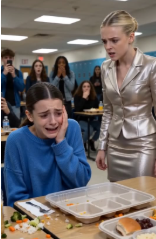
Then her hand moved.
The slap cracked across my face, sharp and humiliating.
My head turned. My eyes watered instantly. The hallway gasped like one giant creature.
For half a second, I froze.
Not because I had nothing to say.
Because I finally understood how far she would go.
She wanted the video.
She wanted my stunned face, my red cheek, my silence. She wanted people to watch the slap and forget the transcript. She wanted the evidence to look like revenge instead of protection.
One of her friends whispered, “Sutton, stop.”
Sutton was breathing fast now. “You don’t get to lie about me.”
I slowly turned back.
My cheek burned. My hands shook.
But my voice came out steady.
“Pull up the original record.”
The hallway changed.
It was only one sentence.
But it cut through everything.
Sutton blinked. “What?”
I looked past her to the phones, the crowd, the teachers’ closed doors.
“Pull up the original record. Right now. Ms. Bell has the archived draft. The interview audio has a timestamp. Mara can verify her voice. The revision history will show who changed what.”
The crowd murmured again, louder this time.
Sutton’s eyes flashed toward her friends.
“Stop filming,” she whispered.
No one stopped fast enough.
A classroom door opened behind us.
Mr. Levin, the history teacher, stepped into the hallway with the expression of a man who had spent twenty years catching lies before they became official. He had a trimmed gray beard, wire glasses, and a voice that could quiet a room without rising above normal volume.
“What happened?”
Everyone spoke at once.
“She slapped her—”
“Naomi forged—”
“Sutton said—”
“Everyone was filming—”
Mr. Levin raised one hand.
Silence fell.
He looked at my cheek. Then at Sutton’s hand. Then at the folder.
“Naomi,” he said, “what original record?”
I held out the folder.
Sutton stepped forward. “Mr. Levin, she’s been spreading false accusations about my family.”
He did not take his eyes off me.
“What original record?” he repeated.
“The Mara Klein interview,” I said. “The one for the Student Voice Initiative article. Sutton is accusing me of forging quotes. I have the audio, transcript, saved draft, and revision history. Ms. Bell was going to verify it after school.”
Mr. Levin accepted the folder.
Sutton’s confidence slipped.
“Mr. Levin, this is a newspaper issue. Ms. Bell should handle it.”
“She will,” he said. “But a student was just struck in the hallway, so now I am handling this part.”
He turned toward the nearest student. “Go get Ms. Bell. Now.”
Brielle moved before anyone else could.
Mr. Levin looked at the crowd.
“Phones down.”
No one moved.
His voice cooled.
“Phones down, or every device still recording goes to the office.”
Phones lowered one by one.
Sutton stared at the floor, jaw tight.
I could feel my heartbeat in my cheek.
Ms. Bell arrived less than a minute later, breathless and angry in the controlled way good teachers get when they are trying not to scare students.
She saw my face.
“Oh, Naomi.”
“I’m okay,” I lied.
Her eyes shifted to Sutton.
Sutton immediately changed tone.
“Ms. Bell, I was defending myself. Naomi has been spreading a fabricated interview.”
Ms. Bell’s expression turned unreadable.
“That is a serious claim.”
“It’s true.”
“Then you won’t object to verification.”
Sutton’s lips parted.
No answer came.
Mr. Levin said, “Newspaper room. Now. Principal’s office after.”
That was the first time Sutton looked afraid.
The newspaper room was at the end of the second-floor hall, tucked behind the library, with old award plaques, mismatched chairs, and a whiteboard covered in deadlines. It had always felt safe to me. Ink cartridges, stale coffee, student drafts, the hum of the archive computer.
That day, it felt like a courtroom.
Ms. Bell sat at the archive desktop. Mr. Levin stood beside the door. Mara sat with her hands folded so tightly her knuckles had gone pale. Sutton leaned against the far table, surrounded by friends who no longer seemed sure where to stand.
The principal, Dr. Kessler, had not arrived yet.
That mattered later.
Ms. Bell logged into the newspaper archive and opened the article file.
“Naomi,” she said, “explain the verification chain.”
I took a breath.
“Mara’s interview was recorded Tuesday at 3:42 p.m. in this room. I transcribed it that night. The draft was uploaded Wednesday morning. I flagged three quotes for advisor review because they involved donor influence. Thursday, the quotes appeared changed in the shared draft, but I did not make those edits. I exported the revision history and emailed you before publication.”
Ms. Bell nodded.
She clicked the revision history.
Names and timestamps appeared on the screen.
My edits. Mara interview transcript upload. Ms. Bell comments. Layout adjustment.
Then, Thursday, 8:16 p.m.
Three quote changes.
User: S. HALE.
The room went silent.
Sutton laughed once.
“That’s impossible.”
Ms. Bell looked at her. “Did you access the newspaper draft?”
“No. I don’t even have access.”
Mr. Levin said, “Apparently you did.”
“I didn’t.”
Ms. Bell clicked the user details.
The login belonged to a temporary editorial access account created for showcase committee review.
Authorized by: DR. A. KESSLER.
Principal Kessler.
The room seemed to shrink.
Sutton stopped breathing.
Mara whispered, “Why would the principal give her access?”
Nobody answered.
Ms. Bell’s face had gone pale, but she kept clicking.
She opened the original transcript.
Mara’s quote appeared exactly as I remembered it.
“Sutton told us not to include complaints about donor families because the showcase was supposed to make the program look successful.”
Ms. Bell opened the revised draft.
The quote had been changed to:
“Sutton encouraged us to keep the article positive because the showcase represented everyone’s hard work.”
Mara put a hand over her mouth.
“That is not what I said.”
Ms. Bell clicked the audio file.
Mara’s voice filled the room, shaky but clear.
“Sutton told us not to include complaints about donor families because the showcase was supposed to make the program look successful.”
No one moved.
The verification was complete.
I had not forged anything.
Sutton had changed the record.
The slap had happened because I was too close to proving it.
Ms. Bell did not even finish playing the audio before Sutton turned toward her friends and hissed, “Delete the hallway video.”
Brielle stared at her.
“What?”
“Delete it.”
Mr. Levin stepped forward. “Nobody deletes anything.”
Sutton’s eyes filled with panic. “You don’t understand.”
Ms. Bell turned from the computer.
“Then explain it.”
Sutton shook her head.
“No. I want my mother.”
The door opened.
Principal Kessler walked in.
He was tall, silver-haired, always perfectly dressed, the kind of administrator who spoke in polished phrases and smiled at donors before students. Behind him stood Mrs. Hale, Sutton’s mother, in a navy coat with pearl earrings and the calm face of someone used to entering rooms already on her side.
Dr. Kessler looked at the room.
At me.
At Sutton.
At the archive computer.
Then he said, “Nobody leaves.”
For one strange second, relief almost touched me.
Then I saw Ms. Bell’s face.
She was not relieved.
She was furious.
Mrs. Hale moved to Sutton immediately. “What happened?”
Sutton’s voice broke. “Mom—”
Dr. Kessler cut in. “There has been a misunderstanding regarding newspaper access.”
Mr. Levin said, “A student was assaulted in the hallway.”
Dr. Kessler’s expression tightened.
“We will address that.”
“After the records?” Ms. Bell asked.
He looked at her sharply.
“What records?”
She turned the monitor toward him.
The revision history showed Sutton’s edits.
The access authorization showed his name.
Mrs. Hale’s eyes flicked over the screen.
Too fast.
Like she already knew what she was looking at.
I saw it.
Ms. Bell saw it too.
Dr. Kessler sighed. “The showcase committee was granted temporary review access to ensure factual accuracy. That is standard.”
“No,” Ms. Bell said. “It is not.”
His voice cooled. “Ms. Bell.”
She stood.
“You gave a student connected to the article subject editing access to an unpublished newspaper draft. Without notifying the advisor. Without notifying the editors. Then quotes critical of donor influence were altered.”
Mrs. Hale smiled faintly.
“Teenagers use dramatic language. My daughter probably clarified the tone.”
Mara stood up so suddenly her chair scraped the floor.
“She changed my words.”
Mrs. Hale looked at her with practiced sympathy.
“Sweetheart, sometimes young writers misunderstand the weight of what they say.”
Mara’s face crumpled.
That sentence did something to me.
It pushed past fear.
Past pain.
Past the sting on my cheek.
“She understood exactly what she said,” I replied. “That’s why Sutton changed it.”
Mrs. Hale looked at me for the first time.
Really looked.
And dismissed me in the same breath.
“You must be Naomi.”
I held her gaze.
“Yes.”
“My daughter tells me you have been under pressure with college applications. Stress can make students interpret things personally.”
There it was again.
The old trick.
Make the evidence about the girl holding it.
Dr. Kessler stepped between us.
“This discussion is over. The article will be paused. The hallway incident will be reviewed. Everyone go home.”
“No,” Ms. Bell said.
The word stunned the room.
Dr. Kessler turned slowly. “Excuse me?”
“No,” she repeated. “The article will not disappear. The evidence will not disappear. And Naomi is not leaving until her parents have been contacted and an incident report is filed.”
Mrs. Hale’s smile vanished.
“Careful,” she said softly. “You are turning a student disagreement into something very damaging for this school.”
Mr. Levin answered before Ms. Bell could.
“No. Sutton did that when she hit Naomi. Someone else did it when they gave her access to alter student journalism.”
Sutton started crying then.
Not the pretty hallway kind.
Real tears.
“I didn’t want to change it,” she whispered.
Her mother snapped, “Sutton.”
But the words had already escaped.
The room froze.
Ms. Bell softened her voice. “Sutton, who told you to change Mara’s quote?”
Sutton shook her head, crying harder.
Mrs. Hale gripped her shoulder. “Do not answer that.”
Mr. Levin looked at Dr. Kessler.
“Why not?”
Nobody spoke.
Then Brielle, still standing near the door, raised her phone with shaking hands.
“I didn’t delete the video,” she said.
Sutton stared at her.
Brielle’s voice trembled. “But it’s not just the slap.”
She tapped the screen.
A video began playing.
The angle was from behind Sutton’s group before the hallway confrontation. Sutton stood near the stairwell, facing her mother and Dr. Kessler. Their voices were low, but the phone had caught enough.
Mrs. Hale said, “If Naomi brings up the draft, make it about fabrication.”
Sutton whispered, “What if Ms. Bell checks the history?”
Dr. Kessler’s voice answered, calm and unmistakable.
“She won’t have time before the showcase. Once the donor presentation is over, the story is dead.”
My blood went cold.
The video continued.
Mrs. Hale said, “You are not letting one scholarship student and one nervous girl derail three years of work.”
Scholarship student.
Me.
Sutton’s face collapsed.
Dr. Kessler whispered, “Control the hallway conversation. Make her defend herself.”
Then the video stopped.
No one breathed.
The real liar had not been only Sutton.
The real liar had been standing in the principal’s office all along.
Dr. Kessler’s face turned gray.
Mrs. Hale lunged toward Brielle’s phone.
Mr. Levin stepped in front of her.
“Don’t.”
She stopped.
Her mask finally cracked.
“You recorded a private conversation?”
Brielle’s eyes filled with tears. “You were planning to ruin Naomi.”
Mrs. Hale looked around the room and seemed to realize, perhaps for the first time, that none of the students were on her side anymore.
Dr. Kessler tried one last time.
“This is being taken out of context.”
Ms. Bell laughed once.
There was no humor in it.
“You authorized access. A student altered quotes. Another student was assaulted. A parent and principal were recorded planning to discredit the editor before verification. What context saves that?”
He had no answer.
The next hour moved like a storm through glass.
My parents arrived, my mother pale with anger and my father frighteningly quiet. The district superintendent was called. The student newspaper archive was locked and copied. Brielle’s video was preserved. Mara gave a statement, crying through most of it but refusing to take back a single word.
Sutton sat in the corner, no longer polished, no longer untouchable.
When my mother saw my cheek, she touched my face with two fingers.
“Who did this?”
Sutton stood shakily.
“I did,” she said.
My mother turned to her.
Sutton looked like she wanted the floor to open.
“I’m sorry,” she whispered.
My mother did not answer.
That silence was worse than shouting.
By the end of the day, Dr. Kessler was placed on administrative leave. Mrs. Hale resigned from the showcase committee before the board could remove her. Sutton was suspended pending disciplinary review. The donor presentation was canceled. The school newspaper was ordered to publish a special issue on student press ethics with district oversight.
Ms. Bell asked me whether I still wanted the article to run.
I thought of Mara’s shaking hands.
Of Sutton’s slap.
Of every phone filming my humiliation.
Of Dr. Kessler saying the story would be dead after the showcase.
“Yes,” I said. “But Mara approves every quote before publication.”
Mara looked at me and cried again.
This time, not from fear.
The article ran two weeks later.
Its headline was simple:
WHEN STUDENT VOICES ARE EDITED, WHO GETS HEARD?
We published the original quotes, the verification process, and an editorial note explaining that the paper’s archive had been tampered with by someone given improper access. We did not include the hallway slap video. We did not need to. The story was not about my cheek.
It was about the record.
The response was bigger than anyone expected.
Parents wrote letters. Alumni offered legal support for student journalism protections. A local paper covered the district investigation. The school board created a new policy: administrators and donors could not access unpublished student newspaper drafts, and any requested correction had to go through the advisor and editor-in-chief with a documented reason.
At the final newspaper meeting of the year, Ms. Bell brought cupcakes.
Nobody touched them at first because we were all pretending not to be emotional.
Then Mara raised a plastic cup of lemonade.
“To original records,” she said.
June from layout added, “And to not letting rich people use track changes.”
Everyone laughed.
Even me.
Sutton returned to school near the end of the semester.
People stared, of course.
People always stare after they help build a crown and then watch it crack.
She found me in the courtyard after dismissal, where the wind carried the smell of rain and food carts from the street.
“I’m not asking you to forgive me,” she said.
“Good.”
She nodded, accepting it.
“I gave the district my messages with my mom and Dr. Kessler.”
I studied her face.
“Why?”
She swallowed. “Because Brielle’s video wasn’t everything. And because I kept hearing what you said.”
“What did I say?”
“That Mara understood exactly what she said.”
Her eyes dropped.
“I realized I never treated anyone else’s words like they belonged to them. Not Mara’s. Not yours. Maybe not even mine.”
I did not know what to say to that.
Sutton looked at me with red eyes and no performance left.
“My mother told me the school runs on families like ours. Dr. Kessler told me student journalism was only acceptable when it protected the school. I believed them because believing them made me important.”
“And the slap?”
She flinched.
“That was me,” she whispered. “No excuse.”
For a long moment, we stood under the gray Brooklyn sky.
“I don’t forgive you yet,” I said.
“I know.”
“But telling the truth now matters.”
She nodded.
“It should have mattered before.”
“Yes,” I said. “It should have.”
Graduation came on a bright June afternoon in the auditorium her family had helped renovate. The donor plaque outside the doors had been temporarily covered while the board reviewed naming policies. Nobody said it out loud, but everyone noticed.
When my name was called for the Student Journalism Integrity Award, my legs felt unsteady.
I walked across the stage while my parents stood in the audience, my mother crying openly, my father clapping like he wanted the sound to reach every adult who had underestimated me.
Ms. Bell handed me the certificate and whispered, “You protected the record.”
After the ceremony, Mara hugged me so tightly I nearly dropped my flowers.
“I got into the summer writing program,” she said.
“I know. You texted me seventeen times.”
“I’m telling you again because now it feels real.”
Across the lobby, Sutton stood with Brielle. Their friendship looked different now, quieter, less shiny, maybe more honest. Sutton caught my eye and gave a small nod.
I nodded back.
Not forgiveness.
Not friendship.
But recognition.
That evening, I sat at my desk at home and opened a blank document for my college essay. For weeks, I had tried to write about ambition, identity, journalism, Brooklyn, my grandmother’s rules, my parents’ sacrifices, and the way truth can feel heavy in your hands when everyone wants you to put it down.
Nothing had worked.
Then I touched my cheek, where the sting had long faded, and finally began.
Everyone filmed the moment I was humiliated, but the video was never the proof that mattered.
I paused.
Then I kept writing.
The proof that mattered was the original record, the teacher who checked it, the student who refused to let fear rewrite her own words, and the moment a room full of people learned that the truth does not become revenge just because powerful people dislike being exposed.
Outside my window, Brooklyn glowed with evening traffic and apartment lights.
My phone buzzed.
A message from Mara:
Editor-in-chief next year. You ready?
I smiled.
Then I typed back:
Keep the archive locked.
For the first time in weeks, I laughed without feeling the old burn of humiliation.
Sutton had wanted everyone staring at the slap.
Instead, they remembered the verification.
And that made all the difference.
THE END
