The field-trip bus looked completely normal right before my life turned into a public scene.
That was the part I kept thinking about afterward.
Nothing about it warned me.
Not the yellow paint shining under the gray Portland morning. Not the rain misting against the windows. Not the rows of students climbing aboard with backpacks, coffee cups, headphones, and half-finished breakfast sandwiches. Not even the teacher standing by the door with a clipboard, calling names like this was any ordinary school trip.
It should have been ordinary.
A senior media-and-history field trip to the Oregon Historical Society. Two buses. Eighty students. Four teachers. One approved seating chart printed the day before and emailed to every chaperone because Mr. Alvarez believed chaos could be defeated with spreadsheets.
I was Grace Miller, seventeen years old, born in Kansas, still new enough to Portland that the rain felt personal. I wore jeans, an old T-shirt under an unbuttoned flannel shirt, and sneakers with frayed laces I kept meaning to replace. Beside Madison Vale, I looked plain in a way people noticed only when they wanted to ignore me.
Madison looked like a student brochure had come to life.
She was eighteen, born in California, captain of the student media team, and the kind of girl who could walk into a room and make people straighten their backs without knowing why. She wore a cropped jacket, clean sneakers, tiny gold hoops, and a smile that always seemed ready for a camera. Teachers called her ambitious. Students called her untouchable. I called her dangerous, but only in my head, because saying it out loud would have sounded dramatic.
And Madison loved making other people sound dramatic.
“Grace,” she said as I reached the bus door. “You’re in the wrong line.”
I stopped with one foot on the first step.
The bus smelled like vinyl seats, damp jackets, and cinnamon from someone’s pastry. Behind Madison, students shoved bags under seats and shouted over each other. The driver adjusted the mirror. Mr. Alvarez checked names at the curb.
I looked down at the paper in my hand.
“No,” I said. “I’m Bus One. Row four. Window.”
Madison’s smile did not change.
“That was yesterday’s version.”
My stomach tightened.
Yesterday’s version was not supposed to change.
Mr. Alvarez had said that three times in class. The seating chart had been approved for safety and supervision because one of the new students, Daniel Cho, had anxiety about sitting in the very back after being harassed on a previous trip at his old school. His counselor had requested a middle-row seat near a chaperone. Mr. Alvarez had approved it. The assistant principal had signed off.
Daniel was supposed to sit in row five.
Not the back.
I glanced past Madison and saw him near the aisle, gripping his backpack straps, his face carefully blank. A boy from the soccer team was waving him toward the last row.
“Back here, new kid.”
Daniel hesitated.
My chest tightened.
“Where is the new chart?” I asked.
Madison turned slightly so the students behind her could hear. “On the bus app.”
“There is no bus app.”
A few people laughed.
Madison lifted her eyebrows. “There’s a shared field-trip roster. Try keeping up.”
I felt the first spark of fear then, small but bright.
Madison was not annoyed. She was prepared.
I had seen the original seating chart. I had helped Mr. Alvarez staple copies because he asked for volunteers during study hall. I remembered Daniel’s name beside row five, aisle seat. I remembered Madison’s media team scattered across different rows so they would not take over the bus camera equipment. I remembered Madison complaining that she needed the back row for “team filming angles,” and Mr. Alvarez saying no.
Now Daniel was being pushed exactly where she wanted him.
And somehow Madison was acting like I was the one confused.
“Grace,” Madison said, softer now, sweeter. “Please don’t start something before we even leave.”
That sentence did exactly what she wanted.
Heads turned.
People loved the idea that a quiet person was secretly difficult. It made them feel smart, like they had discovered a hidden flaw.
I stepped fully onto the bus.
“I’m not starting anything,” I said. “I’m asking to see the teacher-approved seating chart.”
Madison’s friend Harper, who always carried the media team’s second camera, snorted from row three. “She thinks she’s a hall monitor.”
Someone else whispered, “Why does she care so much?”
Because I had been the new student once.
Because in Kansas, after my mom moved us twice in one year, I learned what it felt like to be assigned the worst seat because nobody thought you mattered enough to argue for.
Because Daniel had spent two weeks eating lunch in the library and pretending he preferred it.
Because rules only protected people when someone noticed they were being broken.
I turned toward Mr. Alvarez, still outside by the bus door.
“Mr. Alvarez?”
Madison moved before he heard me.
She stepped closer, blocking the aisle with her body and the bright shine of her jacket.
“Grace,” she said, smile dropping. “Sit down.”
“No.”
The bus went quieter.
Not silent.
Just quieter in that way crowds become when they sense a story forming.
Madison’s eyes sharpened. “You are embarrassing yourself.”
“I want the printed chart checked.”
“Why? Because Daniel got moved?”
Daniel’s head lifted.
There it was.
She had admitted she knew.
A few students looked from her to Daniel.
Madison realized her mistake instantly. Her jaw tightened, but she recovered fast.
“He asked to move,” she said.
Daniel’s voice came out small. “I didn’t.”
The bus fell still.
Madison turned toward him.
Just one look.
Daniel lowered his eyes.
That look made something inside me go cold.
She had done this before. Maybe not with seating charts. Maybe not with field trips. But she knew how to make people retreat.
I raised my voice enough for Mr. Alvarez to finally look up.
“Can we check the approved chart?”
He frowned and stepped onto the bus. “What’s going on?”
Madison turned immediately into performance mode.
“Grace is confused about seating,” she said lightly. “I tried to explain that the roster updated this morning.”
Mr. Alvarez’s eyebrows pulled together. “Updated by whom?”
Madison blinked. “I assumed you.”
“I did not update it.”
That should have ended everything.
It did not.
Because Madison was already reaching into the paper bag on the seat beside Harper.
At first, I thought she was grabbing her phone.
Instead, she pulled out a plastic container from the breakfast table the school boosters had set up before departure. It was filled with scrambled eggs, salsa, and diced potatoes from the cafeteria’s travel breakfast.
“Madison,” Harper whispered.
Madison ignored her.
She looked at me with a smile so cold it barely looked human.
“Maybe you need something else to focus on.”
Then she threw the food at me.
It hit my shirt, my flannel, my jeans.
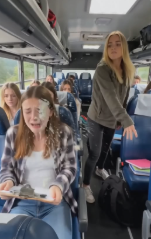
Warm eggs slid down the front of me. Salsa splattered across my sleeve and neck. Potatoes bounced onto the bus floor. For one second, I could not breathe, not because it hurt, but because my brain refused to accept that someone had really done that in front of everyone.
The bus went sharp and silent.
Like every locker, every phone, every laugh in the world had stopped at once.
Then the phones came up.
“Yo, she threw it!”
“Madison, what the heck?”
“Grace, are you okay?”
“Oh my God, film it.”
My face burned hotter than the food.
I looked down at my shirt, stained and dripping, and something inside me wanted to shrink so badly I could almost feel my body trying to disappear. I could smell salsa. I could hear whispers. I could see Daniel staring at me with wide, horrified eyes.
Madison had not just thrown food.
She had made me the scene.
The messy girl. The unstable girl. The one everyone would remember covered in breakfast instead of the one asking about a seating chart.
Mr. Alvarez’s voice cut through the bus.
“Everyone off. Now.”
No one moved.
He turned toward Madison. “You too.”
Madison’s expression shifted. Not regret. Irritation.
“She was escalating,” she said.
“She asked a question,” Mr. Alvarez replied.
“She was accusing me.”
“I heard what happened.”
“You heard her harassing me.”
I wiped salsa from my wrist with a shaking hand. “The chart was changed.”
Madison pointed at me. “See? She won’t stop.”
Mr. Alvarez took a slow breath. “Grace, come with me. Madison, stay where you are.”
But I did not move.
Because behind Madison, I saw Harper’s laptop sitting open on the seat.
The media team used it to organize trip footage. The screen glowed with a spreadsheet window. I could see rows, names, bus numbers, seat assignments.
And in the top corner, a small word pulsed like a tiny warning light.
Saving…
The record was still open.
My heart kicked hard.
Madison had forgotten.
She had changed the seating chart through the shared trip document, then left the file open on Harper’s laptop.
“Mr. Alvarez,” I said slowly, “look at the laptop.”
Madison’s face changed.
It happened fast, but I saw it.
The color under her makeup thinned. Her eyes snapped toward the open screen. Her right hand twitched as if she wanted to slam the laptop shut.
Harper saw it too.
She moved first.
Not toward the laptop.
Away from it.
“Don’t touch that,” Mr. Alvarez said.
Madison froze.
The bus driver stood up from his seat. “Should I call the office?”
“Yes,” Mr. Alvarez said. “Now.”
Students whispered so loudly it became a rushing sound.
Madison tried to laugh. “This is insane. It’s just a seating chart.”
“Then there should be no problem checking it,” I said.
Her eyes locked onto mine.
For the first time since I had known her, Madison Vale looked genuinely afraid.
Not because of the food.
Because of the record.
The next twenty minutes felt like being trapped inside a rumor while it was still being born.
We were moved into the school lobby because the trip was paused. I stood near the attendance office with a borrowed sweatshirt from Ms. Reed, the art teacher, who kept emergency clothes for paint accidents. My stained flannel was folded in a plastic bag at my feet. Every time someone looked at me, I felt the food hit me again.
Madison stood across the hall with her arms folded, surrounded by her media team, but they were not standing as close to her as usual.
Daniel sat on a bench near the trophy case, twisting the zipper pull on his backpack.
I wanted to say something to him.
I did not know what.
Sorry you became part of this?
Sorry I made it worse?
Sorry standing up for you got eggs thrown at me?
Before I could decide, Principal Warren came down the hall with the assistant principal, Ms. Kim. Mr. Alvarez walked beside them carrying Harper’s laptop like evidence in a crime show. Harper followed behind, pale and silent.
Principal Warren was a calm woman with silver glasses and a voice that made students lower theirs without being asked.
She looked at my borrowed sweatshirt, then at Madison.
“What happened on Bus One?” she asked.
Madison answered first.
“Grace had a breakdown over seating and blocked the aisle. I reacted badly, and I’m sorry for throwing food, but she was trying to ruin the trip.”
I almost laughed.
Not because it was funny.
Because it was so clean.
She had turned my question into a breakdown, her decision into a reaction, and the changed chart into my attempt to ruin something.
Principal Warren looked at me. “Grace?”
My throat felt tight, but I forced the words out.
“A teacher-approved seating chart was changed to move Daniel Cho into the back row. I asked to check the original. Madison threw food at me before Mr. Alvarez could verify it.”
Madison rolled her eyes. “She’s obsessed with making me the villain.”
Ms. Kim turned to Daniel. “Daniel, did you request a seat change?”
Daniel stared at the floor.
The hall held its breath.
Then he shook his head.
“No.”
Madison’s mouth tightened.
Ms. Kim’s voice softened. “Were you told to sit in the back?”
Daniel nodded.
“By whom?”
He did not answer.
Madison crossed her arms tighter. “This is ridiculous. Nobody forced him.”
Principal Warren looked at the laptop. “The document history will tell us enough.”
Madison’s face hardened.
“You can’t just go through Harper’s laptop.”
Harper finally spoke.
“It’s school equipment.”
Madison turned toward her. “Harper.”
Harper flinched, then looked away.
That tiny moment said more than a confession.
Principal Warren opened the laptop on the front desk. The office secretary leaned away to give her space. Mr. Alvarez logged into the school document system from his account. Ms. Kim stood close, watching.
I could not see the screen at first.
I heard the clicks.
One.
Two.
Three.
Then Principal Warren said, “Interesting.”
Madison’s foot tapped once.
Mr. Alvarez leaned closer. “There. That’s the original.”
Ms. Kim read aloud. “Daniel Cho, Bus One, row five, aisle. Approved by Mr. Alvarez yesterday at 3:18 p.m.”
Principal Warren clicked again.
“And the change?”
Another pause.
The hall became so silent I heard rain tapping against the front doors.
Ms. Kim’s voice changed.
“Edited this morning at 7:12 a.m. Daniel Cho moved to row twelve, middle seat. Media team equipment moved to rows five and six.”
Madison lifted her chin. “That could have been anyone with access.”
Principal Warren looked at her. “The edit was made under your student media captain account.”
Madison laughed once. “My account stays logged in on the media laptop. Anyone could have used it.”
That was when Harper made a sound.
Not a word.
Just a small, broken breath.
Madison looked at her again, warning in her eyes.
Principal Warren noticed.
“Harper,” she said. “Do you know who made the change?”
Harper’s eyes filled with tears.
Madison said, “Don’t.”
One word.
Too sharp.
Too late.
Harper whispered, “Madison did.”
The hallway erupted.
Madison spun toward her. “Are you serious?”
Harper backed up. “You told me it was fine. You said Mr. Alvarez wouldn’t care as long as the media team got better shots.”
“I never said that.”
“Yes, you did.”
“You changed it.”
“You made me unlock the laptop!”
“I did not.”
Their voices overlapped, rising, cracking, turning ugly.
Principal Warren raised one hand. “Enough.”
But the truth had already slipped out.
And once it came out, it started pulling everything behind it.
Mr. Alvarez clicked again. “There are access codes attached to the bus roster.”
Madison went still.
I looked at him. “Codes?”
He nodded without taking his eyes off the screen. “Every field-trip document has a revision code. It tracks not only the account, but the device, time, and approval path.”
Madison whispered, “No, it doesn’t.”
Mr. Alvarez looked at her.
“Yes,” he said. “It does.”
For the first time, I understood the title of the disaster I was living through.
Madison had forgotten the record was still open.
But worse for her, she had never known the codes existed.
Principal Warren printed the revision report. The office printer hummed, slow and mechanical, while every student in the hallway pretended not to listen.
The first page showed the original seating chart.
The second page showed the altered chart.
The third page showed the code trail.
Madison Vale — Student Media Captain Account.
Device: Media Laptop 02.
Location: Room 214.
Time: 7:12 a.m.
Change: Daniel Cho reassigned from Bus One, Row 5 to Bus One, Row 12.
Change: Media equipment group reassigned from split seating to Rows 5 and 6.
Status: Unapproved.
Unapproved.
That word mattered.
It meant the seating chart had not updated officially. It had been altered inside the working record but never approved by the teacher. Madison had counted on confusion, not authorization. She had expected the bus to leave before anyone checked.
Principal Warren placed the paper on the desk.
“Madison,” she said, “why did you change the seating chart?”
Madison stared at the report.
Her face was pale now, but her voice came out flat.
“I didn’t.”
Even then.
Even with the codes.
Even with Harper crying.
Even with Daniel sitting there like a person finally realizing he had not imagined being targeted.
Madison chose denial.
Principal Warren sighed. “We will continue this in my office.”
But the twist was not finished.
Because Daniel stood up.
His hands were shaking.
“I have something,” he said.
Everyone turned.
Madison’s expression flashed with annoyance. “Daniel, don’t make this worse.”
He looked at her, and for a second I thought he would sit back down.
Then he reached into his backpack and pulled out his phone.
“My old school told me to record when people gave me instructions that didn’t match what teachers said,” he whispered. “Because last year, people kept saying I misunderstood.”
My chest ached.
He tapped the screen and held the phone out to Principal Warren.
A video played.
It was shaky and partly blocked by Daniel’s backpack, but Madison’s voice was clear.
“Back row,” she said in the recording. “Don’t make it a big thing. Mr. Alvarez approved it because media needs front-middle access.”
Daniel’s voice replied softly, “He told me row five.”
Madison laughed.
“Then he changed his mind. You’re new, Daniel. Don’t start the year by being difficult.”
The recording ended.
No one spoke.
Madison’s lips parted.
This time, nothing came out.
Principal Warren took the phone gently. “May I send this to my district email as evidence?”
Daniel nodded.
Ms. Kim said, “Daniel, thank you.”
He sat down like his legs could no longer hold him.
I looked at Madison.
Her perfect posture had cracked. Her eyes moved from the printed codes to Harper to Daniel to me, as if she were searching for the weakest point in the room and finding none.
Then she did something unexpected.
She started crying.
Not the controlled kind.
Not the glossy, camera-ready tears she used when teachers questioned her deadlines.
These were angry, humiliated tears.
“You don’t understand,” she said. “The media team needed those seats. We had one chance to film the trip properly. The district contest deadline is next week. If we lose because the new kid had some special seating issue—”
Mr. Alvarez’s face darkened. “Stop.”
Madison wiped her face. “I didn’t mean it like that.”
“Yes,” Principal Warren said quietly. “You did.”
Madison looked at me with sudden fury.
“This is your fault.”
I stared at her. “You threw food at me.”
“You made everyone look.”
“You changed the chart.”
“You could have just sat down.”
There it was.
The heart of it.
The sentence people like Madison always believed.
You could have just let me.
Let me move him.
Let me lie.
Let me use the system.
Let me make someone else smaller so I could get what I wanted.
I stepped closer, not enough to threaten, just enough to stop feeling like the stained girl hiding in a borrowed sweatshirt.
“No,” I said. “I couldn’t.”
Madison looked away first.
The field trip was canceled.
By lunch, everyone knew why.
By final period, five different versions were moving through the school.
In one version, Madison threw an entire tray at me. In another, Daniel had secretly been recording her for weeks. In another, I had planned everything because I hated the media team. By dismissal, someone had edited the bus video with dramatic music and posted it before the school forced them to delete it.
But the official truth was harder to erase.
Madison was removed as media captain pending investigation. Harper gave a written statement. Daniel’s seating accommodation was reviewed and protected. The district checked every field-trip roster from the semester.
That was when they found the older changes.
Madison had done it before.
Not always to Daniel. Not always with seating charts.
She had rearranged interview credits on a school documentary so a quieter sophomore’s footage appeared under her name. She had changed volunteer media passes so her friends got access to events before other students. She had moved names down lists, swapped credit lines, and blamed “tech issues” whenever anyone asked.
The codes showed all of it.
Weeks of tiny edits.
Months of quiet advantage.
A whole pattern hiding behind the glow of Madison Vale’s perfect student profile.
Two days later, Principal Warren called an assembly.
I hated assemblies. I hated the feeling of hundreds of eyes. I hated walking into the auditorium and hearing whispers flatten as people recognized me.
Grace Miller. The girl Madison threw food at.
Grace Miller. The girl who caught the codes.
Grace Miller. The girl who did not sit down.
I sat beside Daniel near the aisle. He kept his backpack on his lap like armor.
“You okay?” I whispered.
He nodded, then shook his head, then gave up and shrugged.
“Same,” I said.
That almost made him smile.
Principal Warren walked to the microphone.
She did not mention Madison by name at first. She spoke about student rights, approved records, safety instructions, and the responsibility of leadership. Then she said something that made the room go completely still.
“Being popular does not make a student more credible. Being quiet does not make a student less credible. From now on, every student involved in an official activity will receive a digital confirmation of approved records and changes.”
A murmur moved through the rows.
Then she looked down at her notes.
“We also owe appreciation to two students who spoke up when a record was changed improperly.”
My heart lurched.
Please don’t say my name.
Please don’t say my name.
“Grace Miller and Daniel Cho.”
The auditorium turned toward us.
My skin went hot.
Then someone clapped.
It was Leila from art club, who barely knew me but had lent me paint markers once.
Then Mr. Alvarez clapped.
Then Daniel’s row.
Then half the auditorium.
I wanted to disappear.
But not from shame this time.
From the overwhelming shock of being seen correctly.
Daniel whispered, “This is weird.”
I whispered back, “Extremely.”
He laughed once, under his breath.
It was the first real laugh I had heard from him.
Madison did not return to school for a week.
When she did, she was no longer untouchable.
People still watched her, but differently now. Not with admiration. With caution. Her jacket looked the same, her sneakers looked the same, her hair still fell perfectly, but the invisible shield around her was gone.
She found me after school by the media room.
I was there because Mr. Alvarez had asked if I wanted to help rebuild the student media credit system. At first, I thought he was joking. Then I realized he genuinely believed I could help.
Madison stood in the hallway, holding a cardboard box filled with camera straps, old press badges, and a framed photo of last year’s media team.
“I have to return everything,” she said.
I looked at the box. “Okay.”
She swallowed. “I’m not here to fight.”
“Good.”
For a long moment, she stared at the floor.
“I keep thinking about the food,” she said.
“So do I.”
She flinched.
“I thought if everyone looked at you, they’d stop looking at the chart,” she said. “That sounds awful when I say it out loud.”
“It was awful before you said it out loud.”
Madison nodded slowly.
“I know.”
I expected excuses. Contest pressure. College applications. Her parents. The media team. Anything.
Instead, she said, “I was scared of being ordinary.”
That surprised me.
She looked up, eyes red but steady.
“Everyone expected me to be impressive. Captain, winner, editor, leader. I thought if I didn’t control everything, people would realize I wasn’t special.”
I did not know what to say.
Madison gave a small, bitter laugh. “And then I made sure everyone realized something worse.”
I shifted my backpack on my shoulder.
“Daniel was scared too,” I said. “He didn’t use that as a reason to hurt people.”
Madison closed her eyes.
When she opened them, she looked smaller.
“You’re right.”
She reached into the box and pulled out a small black flash drive.
“This has the raw footage from the documentary contest. Some of the shots are Daniel’s. Some are yours from the prep day. I labeled them correctly.” She held it out. “Mr. Alvarez already has a copy. I just wanted you to know.”
I did not take it.
“Give it to Daniel.”
She nodded. “Okay.”
Then she hesitated.
“Grace?”
I looked at her.
“I’m sorry.”
The hallway hummed with distant lockers and after-school announcements.
I wanted the apology to fix something.
It did not.
But it landed somewhere.
Not deep enough to erase the humiliation. Not wide enough to cover what she had done. But somewhere real.
“I hope you mean that after people stop watching,” I said.
Madison’s face tightened with pain.
Then she nodded.
“Me too.”
Spring moved on.
The media team changed. Mr. Alvarez created a rule that every credit line needed two approvals. Daniel joined as a sound editor, which surprised everyone except me. He liked being behind the camera. He said microphones were better than crowds because they only picked up what was actually there.
I helped build a record-check system with dropdown menus, timestamps, and automatic copies sent to students. It was boring in the way important things often are. No drama. No applause. Just small protections built into places where people used to take advantage.
The documentary contest came anyway.
Without Madison as captain, everyone assumed the team would lose.
They did not.
They submitted a short film called “The Seat We Save,” about access, fairness, and the quiet ways schools tell students where they belong. Daniel edited the sound. Harper handled interviews. I helped verify releases and credits.
The final scene showed an empty bus seat in the middle row while student voices described moments they almost stayed silent.
No one mentioned Madison.
They did not need to.
The film won second place in the district.
Daniel held the certificate like it might vanish.
Harper cried.
Mr. Alvarez pretended the dust was bothering his eyes.
And me?
I stood at the back of the room, watching everyone pass the certificate around, and thought about that first morning on the bus. The salsa on my sleeve. The phones. The silence after the food hit me.
Madison had wanted one messy moment to define me.
But it had not.
The record had stayed open.
The truth had stayed alive.
And somehow, in the middle of the worst embarrassment of my senior year, I had learned something I wished every quiet student could know.
You do not have to be loud to be strong.
You do not have to be popular to be right.
And sometimes the smallest question—Can we check the chart?—is enough to break open an entire lie.
On the last day of school, Daniel found me by the buses.
The same bus lane. The same gray Portland sky. The same smell of rain on pavement.
He handed me a folded piece of paper.
“What’s this?” I asked.
“A copy,” he said.
I opened it.
It was the original seating chart from that day, printed cleanly, with Daniel Cho in row five and Grace Miller in row four. At the bottom, he had written one sentence.
Thanks for noticing before I disappeared into the back.
My throat tightened.
I looked at him. “You wouldn’t have disappeared.”
He smiled a little.
“I know that now.”
Behind us, the buses opened their doors.
Students climbed on, loud and careless, dragging bags and laughing at videos and arguing about seats. It looked completely normal.
But I knew better now.
Normal could hide unfairness.
Normal could hide courage too.
I folded the paper carefully and slipped it into my backpack.
This time, when I stepped onto the bus, nobody blocked the aisle.
Nobody told me I was confused.
Nobody asked me to sit down and let the wrong thing happen.
I took my seat by the window, watched rain bead on the glass, and smiled as Daniel sat safely in the middle row.
The bus pulled away from the curb.
And for once, the record was right before the story even began.
THE END
