I knew something was wrong before Tinsley Morgan slapped me.
I knew it from the way the hallway outside the college essay workshop had gone too quiet.
At Westbridge High in Ann Arbor, Michigan, quiet was never just quiet. Quiet had a texture. It pressed against lockers, curled around bulletin boards, and made students lower their phones just enough to pretend they were not recording. It was the kind of quiet that happened before a fight, before an announcement, before someone powerful decided a weaker person needed to be made an example.
And that afternoon, the quiet was waiting for me.
My name is Iris Lind. I was seventeen, Swedish American, and the kind of student teachers called dependable when they needed something done but rarely remembered when awards were handed out. I had realistic teen features, expressive eyes that gave away too much when I was nervous, and a habit of standing too straight when I felt small.
My family was not rich. That mattered at Westbridge more than people admitted. It mattered in the shoes students wore without thinking, the college counselors their parents paid for, the clubs they joined because their families already knew which ones looked good on applications. My mother worked long shifts at a dental office. My father repaired old houses and came home with paint under his nails. We were not poor in a dramatic way. We just counted things. Gas. Groceries. Printing costs. Field-trip fees. Application deadlines.
So I brought my own supplies. I reused binders until the rings bent. I volunteered for behind-the-scenes jobs because someone had to set up chairs, label folders, sort forms, and help classmates who were too embarrassed to ask the adults.
That was how I ended up in the hallway outside the college essay workshop holding a history fair folder that did not belong to me.
The folder was navy blue, thick, and slightly bent at the corner. A white label on the front read: MICHIGAN HISTORY FAIR — FINAL STUDENT SUBMISSIONS.
Inside were consent forms, exhibit descriptions, interview transcripts, source notes, and a flash drive taped to the back pocket.
It was supposed to be locked in the counseling office.
It was not supposed to be on the floor beside the scholarship resource table.
And one page was missing.
That was the small school problem I thought I was fixing.
One missing page.
One student’s permission form.
One detail that could disqualify an entire project or, worse, expose a private family story during a public presentation.
I had been asked to help at the college essay workshop because Ms. Anika Patel, our counselor, trusted me to organize sign-in sheets and pass out prompt packets. The workshop was held after school in the media center, but students had spilled into the hallway because there were too many of us. Seniors leaned against lockers with laptops open. Juniors hovered near the snack table pretending they were not anxious. Posters about deadlines covered the walls.
COMMON APP ESSAY SUPPORT.
FAFSA NIGHT.
HISTORY FAIR FINALISTS — FRIDAY.
That last poster was crooked.
I noticed because I noticed everything.
I had just finished stacking essay packets when I saw the navy folder lying halfway under the scholarship table. At first I assumed someone had dropped it. Then I picked it up and saw the front label.
My stomach tightened.
History fair mattered that year. Westbridge had three teams headed to the regional showcase, and one of them belonged to a quiet sophomore named Maya Chen. Her exhibit was about immigrant-owned laundries in Michigan and included an interview with her grandmother about being harassed in the 1980s. It was powerful. It was personal. It was also sensitive, because Maya’s grandmother had only agreed to let the school use certain parts of the interview.
Her consent form had strict limits.
No raw audio shared publicly.
No family address.
No unedited transcript outside the judging packet.
I knew this because Maya had asked me to check the formatting the week before. She was brilliant but nervous, and English was not her grandmother’s first language. Maya kept asking, “Does this sound respectful?” like she was afraid the school would turn her family’s pain into decoration.
I told her it did.
Now, as I flipped through the folder, I realized her restricted consent sheet was gone.
In its place was a different form.
A general release.
It gave permission for public use of all audio, transcripts, images, and family details.
My fingers went cold.
Someone had swapped it.
“Are you okay?”
I looked up.
Noah Bell, one of the AV students, stood near the media center door carrying a tripod bag. He had curly hair, round glasses, and the permanently cautious expression of someone who had learned that recording school events often meant capturing things adults later wished did not exist.
“This folder was out here,” I said quietly.
His eyes dropped to the label. “That should not be out here.”
“I know.”
He stepped closer. “Is something missing?”
I hesitated.
The hallway was crowded. Too many people. Too many ears.
Then I saw Maya at the far end of the hall, sitting on the floor beside a power outlet with her laptop balanced on her knees. She was wearing a blue hoodie and typing quickly, unaware that a piece of paper could change everything.
“Yes,” I said. “A restricted consent form.”
Noah’s face changed. “For history fair?”
I nodded.
He glanced toward the trophy case, where the history fair finalists’ display photos were already printed and mounted. One of the photos showed Tinsley Morgan in a pastel dress, pearl-detailed cardigan, and soft cream heels, standing beside her clique like they had been born under better lighting.
Tinsley was eighteen, rich, and treated school rules like velvet ropes that parted when she approached. She was not the best student in every room, but she was the student adults described with phrases like “very involved” and “leadership potential.” Her mother chaired the parent gala. Her father’s firm sponsored the college readiness program. Her clique held positions on student council, yearbook, peer mentoring, and the history fair presentation team.
Tinsley did not need to shout to control a room.
She only needed to look disappointed.
The direct reason everything started was specific, though at first I barely understood how ugly it was. I had refused to let the altered consent form stay in the folder. I had refused to pretend a student’s family story could be used however Tinsley’s clique wanted. I had refused to hand the folder back without correcting the record.
That refusal made the hidden problem visible.
And Tinsley Morgan could not survive visible problems.
“I need Ms. Patel,” I said.
Noah lowered his voice. “She’s in the media center with the college rep.”
“I’ll wait.”
“No, Iris.” He glanced behind me. “You need to move now.”
I turned.
Tinsley Morgan was walking toward us.
People parted without meaning to. That was the thing about her. She made space appear. She wore an expensive pastel dress under a pearl-detailed cardigan, polished and soft and impossible to ignore. Her hair was curled just enough to look effortless. A tiny gold bracelet circled her wrist. Beside her, my denim skirt and practical cardigan suddenly felt like proof of a different life.
Her friends followed close behind.
Brianna Hale, who always had lip gloss and a sharp comment.
Celeste Wynn, who smiled only when someone else got embarrassed.
Margot Price, who had a scholarship consultant and still called herself self-made.
Tinsley’s gaze locked on the folder in my hands.
“There it is,” she said.
Not “thank you for finding it.”
Not “is everything okay?”
There it is.
Like the folder had escaped her.
I held it tighter. “This was in the hallway.”
Tinsley stopped in front of me. Her perfume smelled expensive and sweet, like flowers arranged by someone who never had to clean the vase.
“I know,” she said. “I left it for Madison to pick up.”
“There’s a missing consent form.”
Her expression did not move. “No, there isn’t.”
“Yes, there is. Maya Chen’s restricted form is gone. This general release was inserted instead.”
The hallway changed.
Not dramatically. Just enough.
A few students stopped pretending not to listen. Phones tilted. Someone near the lockers whispered, “Maya?”
Tinsley’s smile thinned.
“Iris,” she said softly, “you are confused.”
I hated how familiar that sentence felt.
Confused.
Not concerned. Not careful. Confused.
A word used to take the ground out from under someone without raising your voice.
“I checked the packet last week,” I said. “Maya’s grandmother did not agree to public release.”
Tinsley looked past me toward Noah. “Did she drag you into this too?”
Noah said nothing, but his grip tightened on the tripod bag.
“I’m not dragging anyone,” I said. “I’m taking this to Ms. Patel.”
Tinsley’s eyes sharpened.
“You are not taking anything.”
I heard the warning before I understood it.
My pulse began to pound.
“The folder belongs to the school,” I said. “And the form inside it is wrong.”
Brianna laughed. “She thinks she’s a lawyer.”
Celeste lifted her phone halfway.
Margot murmured, “This is so embarrassing.”
I felt heat rise in my face, but I kept my posture straight.
That was what my mother always told me. When people try to make you feel small, stand like your bones remember their worth.
“I’m not trying to embarrass anyone,” I said. “I’m protecting Maya’s project and her grandmother’s privacy.”
Tinsley’s smile disappeared.
There she was.
Not the polished girl from posters. Not the donor daughter. Not the perfect history fair finalist.
The person underneath.
“You don’t even know what you’re talking about,” she said. “That release was updated.”
“By whom?”
“By the team.”
“Maya is the team lead.”
“She agreed.”
“Then she can confirm it.”
Tinsley stepped closer.
“Iris,” she said, voice low enough that only the closest students could hear, “you are always inserting yourself into things that do not involve you.”
My throat tightened.
Because part of me feared she was right.
I was not Maya. I was not a teacher. I was not a finalist. I was the girl who stapled packets, fixed printer jams, labeled folders, and stayed late cleaning up after events other people got credit for.
But that was why I had seen it.
People like Tinsley never noticed the hands that kept their stage standing.
“I was asked to help with workshop materials,” I said. “The folder was misplaced. The record is wrong.”
“You mean you were snooping.”
“No.”
“You mean you wanted to catch someone because you’re jealous.”
“No.”
“Because girls like you hate girls like me.”
The hallway inhaled.
There it was again.
A sentence designed to turn a fact into a personality flaw.
I looked down at the folder.
The flash drive inside shifted slightly, tapping against the plastic pocket.
I remembered Maya’s grandmother’s voice from the interview clip, soft and deliberate, saying, “Some stories are not secrets. But they are not for everyone to take.”
My hands stopped shaking.
“I’m going to Ms. Patel,” I said.
I took one step.
Tinsley slapped me.
Her hand struck my cheek so hard the folder flew from my arms.
For one second, nobody moved.
The sound seemed to stay in the hallway, hanging between the lockers and the college posters. My face turned with the force of it. My vision flashed white. The side of my cheek burned, then throbbed, and my hands lifted halfway like my body still did not understand what had happened.
The navy folder hit the floor.
Papers slid out across the tiles.
The school item I had been protecting scattered like it suddenly weighed a hundred pounds.
A transcript page landed near Tinsley’s shoe. A judging rubric skidded under the scholarship table. The flash drive bounced once, then stopped beside Noah’s tripod bag.
Phones froze halfway up.
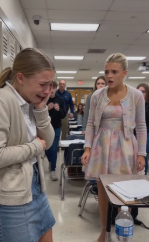
Someone whispered, “She slapped her.”
Another voice said, “Oh my God, Iris.”
My eyes stung, but I did not cry.
Tinsley leaned close, breathing hard.
“Now maybe you’ll stop making things up.”
Then the hallway exploded.
Ms. Patel pushed through the crowd first.
“What happened?”
Her voice cut through the whispers like scissors. She saw my cheek. She saw the papers on the floor. She saw Tinsley standing over them.
Her face changed.
Behind her came Mr. Danvers, the assistant principal, and a college admissions representative who looked like she deeply regretted accepting the school’s invitation.
Tinsley stepped back and immediately shifted into a different version of herself.
The victim version.
“Iris grabbed confidential history fair materials,” she said, voice trembling. “She was trying to sabotage our project. I panicked.”
I stared at her.
She had already built the bridge from her violence to my blame.
“I did not grab anything,” I said. My voice sounded strange to me, too calm and too thin. “The folder was left in the hallway. Maya’s restricted consent form is missing.”
Tinsley laughed weakly, as if she could not believe how cruel I was being.
“She is obsessed with this. She keeps acting like my team stole something.”
Ms. Patel bent to gather the papers, but I knelt too.
My cheek screamed when I moved.
“Don’t touch anything,” Noah said suddenly.
Everyone looked at him.
His voice shook, but he kept going. “I mean, maybe take a photo first. The folder was on the floor. The papers scattered. If something is missing or added, the placement matters.”
Tinsley snapped, “Noah, seriously?”
Ms. Patel held up a hand. “He is right.”
She took out her phone and photographed the papers where they had fallen.
Tinsley’s jaw tightened.
Mr. Danvers turned toward the crowd. “Everyone who is not directly involved needs to move into the media center now.”
No one moved fast enough.
“Now,” he repeated.
Students shuffled, whispering. Some lowered their phones. Others kept recording from their sides. Tinsley’s friends backed away, but not far enough to stop watching.
Ms. Patel picked up the general release form and read it.
Her brows drew together.
“This is not the form Maya submitted.”
Tinsley said quickly, “Maya updated it.”
“When?”
“This week.”
“With me?”
Tinsley hesitated.
Ms. Patel’s eyes sharpened. “I am the history fair documentation advisor. Any update to a consent form must go through me.”
Tinsley’s mouth opened.
No words came.
Mr. Danvers looked at me. “Iris, how did you know it was wrong?”
I swallowed.
“I helped Maya format her transcript last week. Her grandmother only allowed limited use. The project could include selected quotes, not raw audio or personal details.”
Ms. Patel nodded slowly. “That matches what I remember.”
Tinsley’s voice went sharp. “She should not have been looking at our packet at all.”
“I was helping Maya.”
“You were helping yourself.”
“Tinsley,” Ms. Patel said.
But Tinsley was no longer listening.
She had expected the slap to end the question. To turn me into a messy, humiliated girl defending myself while everyone forgot the form. But the form was on the floor now, visible to everyone. The proof had literally fallen open.
And the adults were checking it.
That was when Principal Adler arrived.
He was not the kind of principal students feared because he yelled. He feared yelling, actually. He spoke softly and let silence do the heavy lifting. He had a narrow face, kind eyes, and a terrifying ability to remember exact dates.
He looked at my cheek first.
Then at Tinsley.
Then at the papers.
“Office,” he said.
No one argued.
We ended up in the conference room beside the main office: me, Tinsley, Ms. Patel, Mr. Danvers, Noah, Maya, and eventually our parents. Maya had been pulled from the media center and looked terrified when she entered. She kept glancing at me like she was trying to apologize for something she had not done.
My mother arrived in her dental office scrubs, hair pulled back, eyes wide with worry. She touched my face gently and whispered, “Who did this?”
I looked toward Tinsley.
My mother’s expression went cold.
Tinsley’s mother arrived in a camel coat with a designer bag and the sharp impatience of someone whose schedule had been insulted. She asked for “context” before she asked if I was okay.
That told me almost everything.
Principal Adler placed the papers on the table.
“We have two issues,” he said. “A student was struck in public, and a history fair consent document appears to have been altered.”
Mrs. Morgan folded her hands. “My daughter says Iris was interfering with confidential materials.”
Principal Adler looked at me. “Iris found the folder unattended in a public hallway.”
“It should not have been unattended,” Ms. Patel said quietly. “It was my responsibility to secure it after the history fair prep session.”
Tinsley looked relieved.
For one second.
Then Ms. Patel continued.
“But I did not replace Maya’s restricted consent form. And I did not authorize anyone else to replace it.”
Maya’s voice came out small. “I did not replace it either.”
Everyone turned to her.
She sat straighter, though her hands trembled in her lap.
“My grandmother did not want the full interview shared,” she said. “She was very clear. She told me some parts were for judges only, not for the showcase video.”
Tinsley’s eyes flicked toward her.
Maya looked down immediately.
I saw it.
So did Principal Adler.
“Maya,” he said gently, “did anyone pressure you to change the release?”
Maya’s mouth pressed shut.
Tinsley’s mother said, “This is turning into an accusation without evidence.”
Principal Adler nodded. “Then we will review the evidence.”
He turned to Noah. “You mentioned placement in the hallway. Did you see anything else?”
Noah adjusted his glasses. “Not exactly. But I was setting up the camera for the essay workshop livestream test earlier. The hallway camera angle might have captured who had the folder.”
Tinsley went still.
Mrs. Morgan frowned. “Hallway camera?”
Mr. Danvers said, “The school has hallway security cameras.”
“No,” Tinsley said too quickly. “That camera is broken.”
The room froze.
Principal Adler slowly turned toward her.
“How do you know that?”
Tinsley blinked.
“I mean, everyone knows. People say that.”
Noah shook his head. “It was broken last month. AV fixed it for the workshop overflow monitor.”
Tinsley’s face changed before anyone pressed play.
Not fear exactly.
Recognition.
Like she had built her lie on an old map and only just realized the road had changed.
Principal Adler opened his laptop and called up the hallway footage.
The first clip showed the empty hallway at 2:11 p.m.
Then Brianna entered carrying the navy folder.
She looked around.
Celeste held the scholarship table sign aside.
Margot pulled a paper from the folder.
Then Tinsley stepped into frame.
She held a white form.
Maya gasped.
My mother whispered, “There.”
On the screen, Tinsley removed one page from the folder and replaced it with another. Then she handed the original page to Brianna, who folded it and slid it into her own notebook.
Mrs. Morgan’s face went pale.
Tinsley stared at the screen.
No one spoke.
The clip ended.
Principal Adler said, “Tinsley?”
Tinsley’s mouth trembled. “It was not like that.”
Mrs. Morgan grabbed her daughter’s wrist under the table. “Do not say another word until—”
But Tinsley pulled away.
“No, Mom. You don’t understand.”
Mrs. Morgan’s eyes flashed. “Tinsley.”
“You said it was just paperwork,” Tinsley whispered.
The words landed like glass breaking.
Principal Adler leaned back slightly.
Ms. Patel’s face drained of color.
I looked from Tinsley to her mother.
“What does that mean?” Principal Adler asked.
Tinsley’s eyes filled.
Her polished mask cracked down the middle.
“She said the project would lose sponsorship points if Maya’s grandmother limited the media release,” Tinsley said. “She said the showcase video needed emotional material. She said colleges like impact stories, not half-protected interviews. She told me to get a broader release or fix the packet.”
Maya’s face crumpled.
My stomach turned.
Mrs. Morgan stood. “That is not true.”
Tinsley looked at her mother with something like betrayal.
“You gave Brianna the blank form.”
“I did no such thing.”
“You told me not to let some nervous sophomore ruin the regional showcase.”
“Tinsley Morgan, stop.”
But Tinsley had started, and maybe for the first time in her life, stopping would not save her.
“You said if the judges heard the full audio, our team would win. You said Maya should be grateful anyone cared about her family’s little story.”
Maya made a small sound.
I wanted to reach for her hand, but she was too far away.
Principal Adler’s voice was low. “Mrs. Morgan, did you supply a replacement consent form to students?”
Mrs. Morgan’s face hardened.
“My comments have been twisted.”
“That is not an answer.”
“I support this school. I have spent years supporting this school.”
“And did that support include directing students to alter another student’s consent documentation?”
Silence.
Then Mr. Danvers spoke.
“We need Brianna’s notebook.”
Tinsley closed her eyes.
Mrs. Morgan sat down slowly.
The notebook was found twenty minutes later in Brianna’s locker. Inside, folded between college essay notes and a glossy admissions brochure, was Maya’s original restricted consent form.
Signed by Maya.
Signed by Maya’s grandmother.
Signed by Ms. Patel.
Stamped by the school office.
The final proof was not loud.
It was a piece of paper.
But it changed the air in the building.
The history fair project had not just been manipulated for a trophy. A student’s family privacy had been treated like raw material. A grandmother’s trust had been nearly turned into public content without permission. The polished students who claimed leadership had tried to steal dignity from someone quieter.
And when I caught it, Tinsley slapped me to make the room look at my humiliation instead of her responsibility.
By the end of the day, everyone knew something had happened.
By morning, everyone knew more.
The school sent a message to families announcing an investigation into history fair documentation and student conduct. It did not name Tinsley, but Westbridge did not need names. Rumors moved faster than official language.
Tinsley was suspended.
Brianna, Celeste, and Margot were removed from the regional history fair team.
Mrs. Morgan resigned from the parent sponsorship committee after the district opened a review.
But the part that mattered most was Maya.
For two days, she did not come to school.
When she returned, she walked with her shoulders curved inward, like the hallway itself was too bright. I found her in the library sitting behind a shelf of old yearbooks.
“I’m sorry,” she said before I could speak.
I sat across from her. “Why are you sorry?”
“Because you got slapped because of my project.”
“No,” I said. “I got slapped because Tinsley did not want the truth checked.”
Maya looked down at her hands.
“My grandmother cried when I told her,” she whispered. “Not because of the contest. Because she thought she had been foolish to trust the school.”
That hurt more than my cheek.
“What will you do?” I asked.
Maya took a shaky breath.
“At first I wanted to withdraw.”
I nodded. “That makes sense.”
“But my grandmother said no.” Maya’s mouth trembled into something almost like a smile. “She said, ‘They wanted to take my voice. So now I will choose how to use it.’”
My eyes stung.
Maya opened her laptop and turned it toward me.
The revised project title appeared on the screen:
CONSENT IS HISTORY TOO: WHO GETS TO TELL IMMIGRANT STORIES?
I stared at it.
“That is incredible,” I said.
“I want to include what happened,” Maya said. “Not names. Not gossip. But the idea that preserving history without consent is another kind of harm.”
I nodded slowly.
“That will make people uncomfortable.”
Maya looked at me, and for the first time, I saw something stronger than fear in her face.
“Good.”
The regional history fair happened on a rainy Friday in a university auditorium.
Maya stood beside her exhibit board wearing a navy blazer and her grandmother’s jade necklace. Her grandmother sat in the front row, small and elegant, hands folded over her purse. Ms. Patel stood near the back, looking nervous enough to faint.
I came as a volunteer.
Not because anyone asked me to.
Because I wanted Maya to look into the crowd and see someone who knew the truth.
Her presentation began softly. She spoke about laundries, labor, immigration, and memory. She played selected audio clips, each one introduced with the exact permission attached to it. She explained why some parts of the interview were not included.
Then she said, “A complete archive is not always an ethical archive. Sometimes what is withheld is also part of the truth.”
The judges leaned forward.
Maya’s grandmother closed her eyes.
I thought of the folder hitting the floor. The slap. The flash drive bouncing beside Noah’s tripod bag. Tinsley’s face before the clip played.
And I realized something.
Tinsley had thought proof was a weapon.
Maya had turned proof into protection.
Maya won first place.
The applause was not polite. It was thunder.
When her name was called, she froze for half a second. Then her grandmother stood, clapping with both hands, tears running down her face.
I cried too.
I tried not to, but I did.
Afterward, Maya hugged me so hard I almost dropped the program.
“You protected it,” she whispered.
“No,” I said. “You did.”
She shook her head. “You noticed.”
That word stayed with me.
Noticed.
For most of my life, I thought noticing was a small thing. A behind-the-scenes thing. A thing done by students who did not get applause.
But sometimes noticing was the beginning of justice.
Two weeks later, Tinsley returned to school for a restorative meeting.
I almost refused to attend.
My mother said I did not owe anyone my peace.
My father said silence could be dignity too.
They were both right.
But I kept thinking about the hallway. About how Tinsley had slapped me in front of everyone, but the apology, if it came, would probably happen behind closed doors. That felt wrong.
So I agreed on one condition.
Maya did not have to be there unless she wanted to.
She did not.
The meeting happened in the same conference room.
Tinsley sat across from me without pearls, without pastel, without her clique. She wore a plain sweater and looked younger than eighteen. Her mother was not there. A district representative sat beside Principal Adler. Ms. Patel sat near the window.
Tinsley could barely look at me.
“I am sorry,” she said.
I waited.
She swallowed.
“I slapped you because you found what I was trying to hide. I told myself you were trying to ruin me, but you were protecting Maya. And I knew that. I knew it before I hit you.”
The room was silent.
Her hands twisted in her lap.
“My mother made it sound normal. Like influence was just how school worked. Like rules were flexible if the goal was important enough. But I chose to do it. I chose to replace the form. I chose to lie. I chose to hit you.”
I felt my cheek burn again, memory more than pain.
“Why?” I asked.
Tinsley’s eyes filled.
“Because I was terrified of not winning.”
It sounded too small for what she had done.
Maybe the truth often did.
She continued, voice cracking. “My whole life, everyone told me I was exceptional. But every time I did something good, there was someone behind me arranging it. My mom, her committees, her friends, her donations. I started thinking if I didn’t keep winning, people would realize I was just… packaged.”
For the first time, I saw the cage inside her privilege.
It did not excuse anything.
But it explained the panic.
“You hurt Maya,” I said. “You hurt her grandmother. You hurt me.”
“I know.”
“You made the hallway look at me like I was crazy.”
Tears slipped down her face. “I know.”
“You do not get to fix that with one apology.”
“I know.”
I looked at her for a long moment.
Then I said, “Tell the school the truth.”
Tinsley went pale.
Principal Adler looked at me carefully.
I continued. “Not every detail. Not Maya’s private information. But enough. You humiliated me publicly. You can correct the lie publicly.”
Tinsley nodded.
The next Monday, she stood in the auditorium.
The whole senior class was there, along with the history fair teams and workshop volunteers. Principal Adler introduced the assembly as a statement on academic integrity and student privacy. Everyone knew it was more than that.
Tinsley walked to the microphone with a printed page shaking in her hands.
She looked out at the crowd.
For once, the room did not part for her.
It waited.
“My name is Tinsley Morgan,” she began. “I altered a history fair consent document that did not belong to me. I did it to benefit my team and protect my status. When Iris Lind found the problem, I lied about her. Then I slapped her in public to stop people from listening to what she had found.”
The auditorium was so quiet I could hear someone’s bracelet shift in the row behind me.
Tinsley’s voice broke, but she kept reading.
“Iris was not causing trouble. She was protecting another student’s dignity and privacy. Maya Chen’s project deserved honesty. Her family deserved respect. I am sorry to everyone I harmed.”
She looked up, found me in the crowd, and lowered the paper.
“I am especially sorry to Iris. She told the truth when I tried to make the truth look embarrassing.”
For a few seconds, nobody clapped.
Then Maya stood.
She did not clap loudly. Just once, then again.
I stood too.
Then Noah.
Then Ms. Patel.
Then the auditorium filled with applause—not for the scandal, not for Tinsley, but for the truth finally standing where the lie had stood.
After that, Westbridge changed in small ways that mattered.
Consent forms moved to a digital system with locked approvals. Student project privacy rules were rewritten and taught before competitions. Parent sponsors lost access to student documentation. Behind-the-scenes volunteers were listed by name in event credits. The scholarship table got a locked drop box. The history fair display added a new sentence to every project board:
Stories belong first to the people who lived them.
Near graduation, Ms. Patel asked me to stop by the counseling office.
I thought she needed help labeling folders again.
Instead, she handed me an envelope.
Inside was a certificate from the district recognizing student integrity in academic documentation. There was also a recommendation letter.
I read the first line and froze.
Iris Lind is the kind of student who notices what others overlook, and because she notices, others are protected.
My eyes blurred.
Ms. Patel smiled softly.
“I should have noticed sooner,” she said.
I shook my head. “You trusted me when it mattered.”
“No,” she said. “You made it impossible not to.”
On the last day of school, I walked past the hallway where it had happened.
The college essay posters were gone. The scholarship table had been moved. The floor had been polished so thoroughly there was no trace of scattered papers or the folder that had hit the tile like a warning bell.
But I remembered.
I remembered the slap.
I remembered the silence.
I remembered Maya’s missing form.
And I remembered Tinsley’s face when the principal turned the screen toward her side of the room.
She had thought the final clip would destroy me.
Instead, it revealed what the school had been hiding.
Not just a swapped document.
Not just a rich girl’s lie.
But a system that had grown too comfortable letting polished students take credit, take space, take stories, and call it leadership.
That system did not end in one day.
Systems rarely do.
But something cracked.
And through that crack, students like Maya could be heard.
Students like Daniel from the workshop, who finally asked for help on his essay instead of pretending he understood everything.
Students like Noah, who stopped apologizing before he spoke.
Students like me, who learned that being behind the scenes did not mean being invisible.
A week after graduation, Maya mailed me a copy of her final history fair program. On the inside cover, she had written one sentence in blue ink.
Thank you for protecting the part of the story that was not yours to take.
I kept it in the drawer with my college letters, beside my practical supplies, my old notebooks, and the folder copies my father always told me to save.
Because proof matters.
Records matter.
But people matter more.
Tinsley Morgan slapped me because she believed humiliation could bury responsibility.
She was wrong.
The slap made everyone look.
The record made everyone listen.
And the truth did what it always does when someone finally protects it.
It found its way into the light.
THE END
