That day should have been about school spirit and student work.
Instead, it became a public trial, and somehow my face was in the center of it.
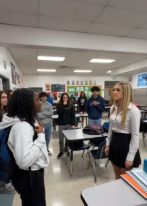
The student media room in Los Angeles was packed so tightly that the air felt warm from everyone pretending not to breathe. Posters from old school campaigns covered the walls. Tripods leaned near the editing stations. The big screen at the front still showed the paused frame of an interview video that had already spread through half the school before lunch.
In the frozen image, Victoria Langley looked nervous.
That was the problem.
Or at least, that was what everyone had been told.
The clip made it seem like she had lied during an interview for the school spirit fundraiser. It showed her smiling in front of a camera while saying, “We made sure every student group got equal credit,” followed by a jump cut to a reporter asking about missing names from the art club volunteer list.
Then Victoria appeared to freeze.
Then the clip ended.
Five seconds. That was all it took for the rumor to become a verdict.
By the time I reached the media room, people had already decided what the video meant, who had released it, and who deserved to be punished.
Me.
My name was Nora Osei. I was seventeen, Ghanaian American, and dressed in the kind of contemporary school clothes nobody remembered after seeing them once: a fitted gray sweater, dark jeans, simple sneakers, my hair pulled back because I had spent the afternoon helping carry equipment, label files, and organize footage nobody else wanted to sort.
I had helped after school. I had done the unglamorous work. I had stayed late cleaning memory cards and checking interview folders while the people who smiled on camera got thanked in announcements.
And still, the second something went wrong, I was disposable.
Victoria Langley stood near the front table, surrounded by students who looked ready to protect her before they even knew the truth. She was eighteen, privileged, polished, and connected to nearly every important adult committee at school. Her mother helped plan donor events. Her father knew the principal by first name. Victoria herself floated between student council, media club, and spirit committee like every organization was just another room in her house.
She wore a crisp white blouse under a soft blue jacket, tailored pants, and shoes so clean they looked untouched by the same floors the rest of us walked on.
Her eyes were red.
But not messy.
Victoria even cried beautifully.
I hated that I noticed.
“Nora,” she said, and the room went silent.
Every head turned toward me.
The paused video glowed behind her.
My stomach sank.
“I didn’t edit that clip,” I said before she could start.
Victoria’s mouth trembled. “No one said you did.”
A boy near the camera rack muttered, “Everyone knows she did.”
My fingers curled.
I looked toward Mr. Reynolds, the media teacher, but he was near the doorway trying to calm two arguing students. Ms. Harper, the assistant principal, had just arrived and was asking someone to pull up the raw footage.
That was all I had wanted from the beginning.
Verify it.
Check the original.
Do not punish anybody based on a cut clip.
But Victoria did not want verification.
She wanted a moment.
And she knew exactly how to make the room give her one.
“You were the last person in the editing folder,” she said, louder now.
“I was organizing files.”
“You had access.”
“So did half the media team.”
“You were upset about the volunteer credit list.”
“I was upset because the art club names were missing.”
Victoria’s eyes flashed.
For a second, the wounded expression disappeared, and I saw something sharper underneath.
Then she turned toward the room.
“See?” she said. “She had a reason.”
That was when I understood.
This was not about the video alone.
It was about control.
The fundraiser highlight package was supposed to premiere at the spirit assembly the next morning. It would show Victoria’s committee leading the school through a week of donation drives, club booths, pep rally preparation, and volunteer projects. But the art club had painted the massive backdrop, designed half the posters, and stayed late three nights in a row.
Their names were missing from the credit list.
I had found that mistake while sorting caption notes.
When I asked why the art club was not credited, Victoria said, “We’ll fix it later.”
Later meant never.
So I pulled the interview folder and started checking who had said what on camera. That was when I found the edited clip.
The raw file was supposed to show Victoria explaining that several groups were accidentally left out of an early draft and would be added before the final premiere.
But the clip circulating now cut out that answer.
It made her look like she had lied.
And somehow, she wanted everyone to believe I had done it.
“I told you,” I said carefully, “the school needs to verify the raw footage before blaming anyone.”
Victoria stepped closer.
Her friends moved with her.
Someone lifted a phone.
I saw the screen out of the corner of my eye, already recording.
Victoria’s voice shook. “You don’t get to humiliate me and then hide behind procedure.”
“I’m not hiding.”
“You always do this,” she said. “You act helpful, then you make people look bad when they don’t do things your way.”
“That’s not true.”
“You think because you stayed late, you own the project.”
“No,” I said. “I think if a record exists, we should check it.”
The word record changed her face.
Only for a heartbeat.
But I saw it.
Fear.
Then anger rushed in to cover it.
Before I could step back, Victoria slapped me.
The sound cracked through the media room.
My head turned with the force of it. Heat bloomed across my cheek, sharp and humiliating. A few students gasped. Someone whispered my name. Phones rose higher, catching the aftermath instead of the truth.
For one terrible second, I felt myself shrinking.
My face burned while teachers tried to understand what had just happened. Mr. Reynolds finally pushed through the crowd, saying, “Phones down. Everybody put your phones down.”
But nobody really did.
Not completely.
Because when a girl gets slapped in front of everyone, people tell themselves they are documenting evidence. Sometimes they are just collecting entertainment.
Victoria stood in front of me, breathing fast, her hand shaking at her side.
“She tried to ruin me,” she said.
I forced myself to stay standing.
Not because I felt brave.
Because the original proof was still somewhere in that room.
The raw camera footage. The project file. The edit history. The timestamp.
I pressed my tongue to the inside of my cheek and tasted blood.
Then I said, “Open the raw file.”
Victoria’s face changed again.
This time, other people saw it.
Ms. Harper’s voice cut through the room. “Everyone step back.”
The circle around us widened.
Mr. Reynolds looked at Victoria, then at me, then at the frozen clip on the screen.
“Nora,” he said, quietly, “which folder?”
“Spirit Fundraiser Interviews. Camera B. Thursday after school.”
Victoria said quickly, “That folder was already corrupted.”
I looked at her. “How would you know?”
The room went still.
Mr. Reynolds turned toward the editing station. “We’re checking it now.”
Victoria’s friend Allison stepped forward. “Mr. Reynolds, this is unfair. Victoria is clearly the victim here.”
Ms. Harper looked at her. “A student was just struck in front of staff. No one is clearly anything until we review the evidence.”
That sentence made something loosen in my chest.
Not enough to stop my hands from shaking.
But enough to breathe.
Mr. Reynolds connected the main editing station to the big screen. The video file library appeared. Folder names filled the display.
Spirit Week Raw.
Fundraiser Interviews.
Assembly Cut.
Volunteer Credits.
He clicked Fundraiser Interviews.
A list of files opened.
Camera A.
Camera B.
Camera C.
Audio Backup.
My eyes went straight to Camera B.
Mr. Reynolds opened it.
The raw footage played.
Victoria appeared on screen, standing in front of the fundraiser banner. She smiled into the camera while a student interviewer asked, “How did the committee make sure every group was recognized?”
Victoria answered, “We made sure every student group got equal credit.”
Then, in the raw footage, the interviewer continued, “There was a concern that art club volunteers were missing from the first caption draft. Can you explain that?”
Victoria did not freeze.
She did not look guilty.
She smiled, a little embarrassed, and said, “Yes, that was an early draft mistake. Nora caught it while organizing the files, and we’re updating the final credits before the assembly. The art club did amazing work.”
The room changed.
Every whisper turned in a different direction.
Allison’s mouth opened.
The students near the camera rack looked at me, then at Victoria.
The raw footage had done what no argument could.
It proved the viral clip had been cut out of context.
It proved I had not been attacking Victoria.
It proved I had been trying to protect the truth, including the part that made Victoria look better than the rumor did.
Mr. Reynolds paused the video.
Ms. Harper looked at Victoria. “You knew this raw answer existed?”
Victoria swallowed. “I didn’t watch the whole file.”
I said, “You just said the folder was corrupted.”
She looked at me.
This time, there was no performance left in her eyes.
Only panic.
Mr. Reynolds opened the edited clip file next.
The one that had spread.
He pulled up the project properties, then the revision history.
The screen loaded slowly.
Nobody moved.
The student media room, which had been loud enough to feel like a storm minutes ago, became so quiet I could hear the hard drive humming.
A list of timestamps appeared.
4:18 p.m. — Project created.
User: nora.osei.media.
Victoria’s eyes flicked toward the crowd.
A few students gasped.
My stomach dropped, even though I knew I had created a project file while organizing clips.
Mr. Reynolds scrolled.
4:21 p.m. — Raw footage imported.
User: nora.osei.media.
4:29 p.m. — Clip marked for credit correction.
User: nora.osei.media.
That was me.
That was the moment I flagged the section where Victoria mentioned the art club.
Mr. Reynolds kept scrolling.
5:03 p.m. — Project duplicated.
User: vlangley.student.
Victoria stopped breathing.
Her name appeared on screen.
Not hidden. Not implied. Not whispered.
There.
Plain.
Unforgiving.
Mr. Reynolds clicked the duplicated project.
5:07 p.m. — Segment removed: “Nora caught it while organizing the files…”
5:08 p.m. — Segment removed: “The art club did amazing work.”
5:10 p.m. — Export file: langley_interview_short.mp4.
User: vlangley.student.
The room stepped back from her.
Physically.
It was not dramatic. No one screamed. No one rushed away.
But the students closest to Victoria shifted, creating space around her like the truth had heat.
Ms. Harper folded her hands. “Victoria, explain this timestamp.”
Victoria stared at her own name on the screen.
Her lips parted.
No answer came.
For the first time since I had known her, Victoria Langley had no story ready.
Allison whispered, “Victoria?”
That seemed to break something.
Victoria turned toward her friend, eyes wet and furious. “Don’t look at me like that.”
“You said Nora did it.”
“I thought—”
“You said you had proof.”
Victoria looked around the room.
At the phones.
At the teachers.
At me.
Then she said the sentence that made everything worse.
“I had to make people care.”
Mr. Reynolds went still. “Care about what?”
Victoria’s face crumpled, but her voice sharpened, defensive even as she started to fall apart.
“About what Nora found,” she said. “About the credit list. About the committee. About how everyone was going to blame me if the art club complained after the assembly.”
I blinked.
That was not what I expected.
“You made yourself look like a liar,” I said slowly, “so people would blame me?”
Victoria’s eyes flashed. “No. I made the clip look suspicious so it would spread. Then I was going to reveal you had access, and everyone would think you were trying to sabotage me because you were mad about the art club.”
My throat went cold.
“That makes no sense.”
“It would have worked,” she snapped.
And the terrible thing was, part of me knew she was right.
It almost had.
She continued, words spilling faster now. “The volunteer credits were already locked for the assembly. My mother said changing them would make the committee look disorganized. The donors were coming. The principal was going to announce our leadership awards. If the art club names got added late, people would ask why they were missing in the first place.”
“So you cut the video.”
“I needed a distraction.”
“You needed a scapegoat,” Ms. Harper said.
Victoria flinched.
Mr. Reynolds opened another panel on the project file.
“Who sent the clip out?”
Victoria went silent again.
The answer loaded before she could invent one.
5:14 p.m. — Shared to Student Spirit Preview Thread.
User: vlangley.student.
Message attached:
Does this look weird to anyone? I think Nora cut this wrong.
A sound moved through the room.
Not shock anymore.
Disgust.
Allison stepped away from Victoria completely.
I felt my knees go weak, but I stayed standing.
I had thought the worst part was being slapped.
It wasn’t.
The worst part was realizing how carefully she had arranged the crowd before I even walked in.
She did not hit me because she lost control.
She hit me because control was slipping.
And violence was the fastest way to make everyone stare at my face instead of the screen.
The disciplinary meeting happened the same afternoon.
My cheek was swollen. My mother was called. Victoria’s parents were called. The principal, Dr. Albright, came down from his office with the expression of a man who had just realized the school’s perfect spirit campaign had become evidence.
Victoria sat across from me in the conference room, no longer surrounded by friends.
Her mother arrived first, elegant and furious.
“This is being exaggerated,” Mrs. Langley said before she even sat down.
My mother’s eyes narrowed.
My mother did not raise her voice often. She worked as a nurse, and years of emergencies had taught her to become calm when other people became loud.
But that calm had edges.
“My daughter was slapped,” she said. “Start there.”
Mrs. Langley looked at me briefly, then away. “Teenagers have emotional conflicts.”
“My daughter was slapped,” my mother repeated. “Start there.”
The room went quiet.
Dr. Albright cleared his throat. “We are reviewing both the physical incident and the manipulation of school media files.”
Mrs. Langley’s expression shifted. “Manipulation is a strong word.”
Mr. Reynolds turned the laptop toward her and played the revision history.
No one spoke while Victoria’s name appeared again and again.
Mrs. Langley’s face tightened, but not with surprise.
With recognition.
That was when I noticed Victoria looking at her mother.
Not seeking comfort.
Seeking permission.
The twist was not finished.
Ms. Harper said, “Victoria, did anyone instruct you to keep the art club credits off the final assembly list?”
Victoria shook her head quickly. “No.”
Too quickly.
My mother noticed.
“So why did you?” she asked.
Victoria looked down.
Mrs. Langley answered instead. “Student committees make editing decisions all the time. Not every volunteer can be named.”
I leaned forward.
“The football boosters were named,” I said. “The donor committee was named. The student council setup team was named. The art club painted the entire backdrop.”
Mrs. Langley smiled thinly. “And I’m sure their contribution was appreciated.”
My mother said, “Appreciated is not credited.”
The words landed.
Victoria’s eyes filled again.
Then Dr. Albright opened the final assembly credit file.
The list appeared on the conference screen.
Student Council.
Spirit Committee.
Boosters.
Langley Family Community Fund.
Rhodes Printing.
Westview Football Support Crew.
No art club.
No design team.
No after-school volunteers.
I saw my own notes in the side panel, flagged in yellow.
ADD ART CLUB NAMES BEFORE FINAL EXPORT.
Underneath, a reply from Victoria.
Resolved.
But it had not been resolved.
Mr. Reynolds clicked the comment history.
My note had been marked resolved at 5:01 p.m.
By Victoria.
Then, at 5:03, she duplicated the interview project.
Dr. Albright said softly, “Victoria, this looks like you removed the warning note and then created the edited clip.”
Mrs. Langley straightened. “My daughter may have made an error under pressure, but this does not require a public overreaction.”
My mother laughed once.
It was not a happy sound.
“Your daughter created a public accusation.”
Mrs. Langley ignored her and turned to Dr. Albright. “Be careful. The Langley Fund supports several student programs.”
The room froze.
There it was.
The sentence everyone heard even when powerful people were careful not to say it.
Punish us, and money disappears.
Victoria whispered, “Mom.”
Mrs. Langley shot her a look.
And suddenly, I understood something I had missed.
Victoria was privileged. Victoria had lied. Victoria had hurt me.
But Victoria had also been trained.
Not in editing. Not in student leadership.
In protection.
Protect the image.
Protect the name.
Protect the fund.
If someone finds the truth, make them look unstable.
If credit is missing, call it strategy.
If a student gets hurt, call it conflict.
My anger did not disappear.
It deepened.
Because now it had roots.
Dr. Albright closed the laptop.
“Mrs. Langley,” he said, “your family’s donations do not affect student conduct policy.”
Mrs. Langley’s face hardened. “They affect opportunity.”
Ms. Harper replied, “So does honesty.”
For the first time all day, I almost smiled.
Victoria was suspended pending review. The assembly was postponed. The media project was locked. The art club was called in to verify the credit list themselves.
By the next morning, the school had split into versions of the story.
Some people said Victoria was evil.
Some said I had trapped her.
Some said the whole thing was “just an editing mistake” and everyone was too sensitive.
But the raw footage had spread too.
Not the manipulated clip.
The full one.
Mr. Reynolds released it with a statement explaining that incomplete media can misrepresent the truth. He did not name Victoria. He did not name me. But everyone knew.
The raw footage showed what had been cut.
And what had been cut was the truth.
Three days later, I found an envelope taped to my locker.
Inside was a printed copy of the final assembly credit page.
The art club names were there.
So were the design volunteers.
So was my name, under media verification support.
At the bottom, someone had written:
You were not disposable.
I stared at it until the hallway blurred.
I never found out who wrote it.
Maybe Mr. Reynolds.
Maybe an art club student.
Maybe someone who had watched me get slapped and finally felt ashamed.
It did not matter.
I folded the paper carefully and kept it in my backpack.
The assembly happened two weeks later.
This time, the spirit video opened with a short message from Mr. Reynolds about context, editing, and responsibility. Then the screen showed the full fundraiser highlights.
The art club backdrop filled the stage behind the speakers, bright and gorgeous, painted with wildcats, city lights, and hundreds of tiny stars. Every student group was named. Every volunteer team appeared.
When the art club names rolled across the screen, the auditorium applauded.
I looked toward the row where they sat.
Some of them were crying.
Then Dr. Albright stepped to the microphone.
“School spirit,” he said, “does not mean protecting an image. It means protecting one another’s work.”
The applause came slowly at first.
Then louder.
Beside me, my mother squeezed my hand.
“You okay?” she whispered.
I nodded.
I was not completely okay.
But I was closer.
After the assembly, Victoria found me near the media room.
She looked different without her usual group around her. Smaller, but not harmless. I had learned that someone could be sorry and still have caused real damage.
Her suspension was over, but she had been removed from the spirit committee and media leadership. Her family fund had temporarily paused donations, then quietly resumed after public pressure made withdrawal look worse than accountability.
That part still made me angry.
Money always found a way to save face.
Victoria stood a few feet away.
“I owe you an apology,” she said.
“You owe the art club one too.”
“I gave it.”
“And Mr. Reynolds.”
“I know.”
“And everyone who believed you.”
Her mouth trembled. “I know.”
I waited.
She looked at the floor, then back at me.
“I slapped you because I wanted people watching your pain instead of my file,” she said. “I cut the video because I thought controlling the first story mattered more than telling the true one. And I let my mother convince me that credit was something powerful people could distribute however they wanted.”
I said nothing.
She swallowed.
“I’m sorry, Nora.”
I wanted forgiveness to arrive like sunlight.
It did not.
What arrived was quieter.
A little space inside me where hatred no longer had to work so hard.
“I don’t forgive you yet,” I said.
Victoria nodded, tears gathering.
“But I hope you stop becoming the kind of person who thinks a name on a fund matters more than a name in the credits.”
She cried then.
Not beautifully.
Not for a crowd.
Just cried.
And for once, nobody filmed it.
Months later, the student media room changed.
Not physically. The posters still curled at the edges. The tripods still leaned dangerously near the wall. The chairs still squeaked. But now, above the editing station, there was a printed rule in bold letters:
NEVER PUNISH FROM A CUT CLIP. CHECK THE RAW RECORD.
Mr. Reynolds said it was inspired by “recent events.”
Everyone knew what that meant.
I kept working there after school.
People asked why.
Honestly, I asked myself the same thing.
Maybe because I refused to let the room where I was humiliated become a place I avoided forever. Maybe because I liked the quiet truth of raw footage. The way it held everything: awkward pauses, half sentences, corrections, kindness, mistakes. The parts people cut away when they wanted a cleaner lie.
One afternoon, I was labeling camera cards when a freshman came in holding a flash drive.
“I think someone edited my interview weird,” she said nervously. “I don’t want to make a big deal.”
I looked at her.
Then I looked at the sign above the editing station.
“You’re not making a big deal,” I said. “You’re asking us to check the record.”
Her shoulders relaxed.
And that was the happy ending I had not expected.
Not Victoria destroyed.
Not me suddenly popular.
Not the whole school magically fair.
The real victory was that the next quiet student did not have to get slapped before someone believed the record mattered.
The raw footage was checked.
The credits were corrected.
The room learned to pause before choosing a villain.
And the next time a name appeared on screen, everyone understood it was not just a detail.
It was accountability.
Because a lie can travel fast through a school.
A rumor can lift phones before anyone lifts a hand to help.
A polished girl with connections can make a crowd turn on someone who only asked for proof.
But truth has its own kind of patience.
It waits in the uncut file.
It waits in the comment history.
It waits in the timestamp beside the name of the person who thought nobody would look closely enough.
And when that name appears on screen, the whole room finally knows where to turn.
THE END
