I knew something was wrong the moment the photographer told me to smile.
Not because he was rude. He wasn’t. He was a cheerful man in a black shirt with a camera strap around his neck and a practiced voice that made nervous people obey without thinking.
“Big smiles, everyone,” he called, backing toward the glowing sign that read FUTURE VOICES PODCAST STUDIO LAUNCH. “This is history for Harding Academy.”
History.
That word was everywhere that evening.
It was printed on the program. It was written in gold marker on the welcome board. It was said by parents in pearl earrings and expensive jackets while they sipped sparkling water under the bright studio lights.
But as I stood near the ribbon, holding my note cards so tightly they bent in my hands, I felt less like history and more like a mistake waiting to happen.
My name was Priya Dawson. I was seventeen, Nepalese American, scholarship student, media club editor, unpaid hallway poster maker, late-night audio cleaner, and, somehow, the person chosen to switch on the first microphone at the elite podcast studio launch in Nashville.
The studio had taken eight months to build.
The official story was that it had been funded by donors, designed by the student committee, and inspired by the school’s mission to “amplify young voices.”
The real story was that half the equipment had arrived broken, the editing software had crashed three times, and the launch film—the one every donor was about to watch—had almost disappeared forever the night before.
I knew that because I had been there at 11:47 p.m., sitting on the studio floor in my wrinkled dress rehearsal clothes, rebuilding the full film edit while the janitor vacuumed around me.
Nobody was supposed to know that part.
At least, that was what Audrey Winthrop believed.
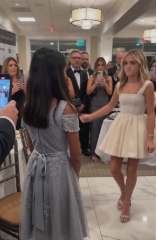
Audrey stood across the room near the donor wall, surrounded by girls who laughed before she finished speaking. She wore a cream satin dress that looked simple in the way expensive things pretend to be simple, and her hair fell over one shoulder in perfect waves. Her father’s name was on one of the plaques outside the studio. Her mother had chaired the launch committee. Her family had not built the room, but they had bought enough of it that everyone moved around them carefully.
Especially adults.
That was the thing about Audrey. She didn’t need to shout most of the time. She had inherited a quieter kind of power. Teachers softened around her. Parents smiled too long. Students made room.
When her eyes found mine, her smile disappeared.
She looked me up and down, from my navy dress to the small gold earrings my mother had lent me that morning. The earrings were shaped like tiny suns. “Wear them,” Mom had said while twisting my hair into a neat low bun. “When you feel small, remember you are not.”
At the time, I had laughed.
In that room, under those lights, I touched one earring with my shaking fingers and tried to believe her.
Audrey leaned toward one of her friends, but she made sure I could hear her.
“I still don’t understand why she’s doing the microphone.”
Her friend, Madison, glanced at me, then quickly away.
Audrey continued, softer but sharper. “My family made this possible. Every inch of credit should go where it belongs.”
I pretended to check my note cards.
The words blurred.
WELCOME. THANK YOU. FUTURE VOICES. FIRST MICROPHONE.
I had practiced the line twenty times in my bedroom. I had practiced it in the bathroom mirror. I had practiced it while my little brother, Rohan, sat on my bed eating cereal and pretending to be a bored audience.
“Say it like you belong there,” he had told me.
“I don’t know how people sound when they belong there.”
“Louder,” he said, crunching cereal. “Rich people always talk like the room already agreed with them.”
That memory almost made me smile.
Almost.
Then Mrs. Bell, the event organizer, stepped onto the small stage.
“Good evening, everyone,” she said into a handheld microphone. “Thank you for joining us for this very special launch of Harding Academy’s new podcast studio.”
Applause filled the room.
The studio lights reflected off the glass wall behind her. Inside the recording booth, three black microphones waited on adjustable arms like sleeping birds. The mixing board glowed blue. Through the glass, the chairs looked untouched, holy almost, like the room was waiting for voices brave enough to enter.
I wanted to be brave.
I really did.
But courage felt different when every person in the room had a phone.
Mrs. Bell talked about donors, innovation, student leadership, and the importance of storytelling. She thanked the Winthrop family first. Audrey lifted her chin like she was accepting applause personally.
Then Mrs. Bell looked down at her program.
“And now, to switch on the first microphone, we would like to invite the student whose dedication helped bring this launch together…”
My stomach tightened.
Audrey’s head snapped toward Mrs. Bell.
“…Priya Dawson.”
For one second, there was applause.
Not thunderous. Not wild. But real enough.
I took one step forward.
That was when Audrey moved.
She crossed in front of me so fast that my shoulder brushed hers. At first, I thought she had mistaken the cue. I thought she was going to make some polished joke, take the spotlight, and force Mrs. Bell to correct her gently.
But Audrey wasn’t smiling anymore.
Her face was pale with fury.
“Are you serious?” she said, not to me exactly, but loud enough that the front row turned.
“Audrey,” Mrs. Bell said carefully. “Please take your seat.”
Audrey ignored her.
She stepped closer until I could smell her perfume, something floral and expensive. Her eyes were bright, but not with tears. With panic.
“You don’t get to stand there,” she whispered.
My voice came out smaller than I wanted. “I was asked to.”
“You were asked because you lied.”
The room shifted.
That was the first terrible sound of public humiliation: not a gasp, not a shout, but movement. Chairs creaking. Shoes turning. Attention gathering like storm clouds.
“I didn’t lie,” I said.
Audrey’s lips curled. “You think nobody knows? You think nobody saw you backstage last night?”
My heart thudded.
Backstage last night.
She knew I had been there. Of course she knew. Her mother had given instructions to half the staff. The Winthrops knew everything that happened in rooms they paid for.
“I was fixing the edit,” I said.
Audrey laughed once, cold and sharp. “Fixing it? You mean touching files you had no right to touch?”
Mrs. Bell stepped down from the stage. “Audrey, enough.”
But Audrey was past listening.
Behind her, Madison lifted her phone halfway, then looked around as if checking whether other people were recording too. They were. I saw screens rising in the crowd like small, glowing verdicts.
I wanted to run.
Instead, I stood there with my bent note cards and my mother’s tiny sun earrings and the whole room waiting to see what a scholarship girl did when a Winthrop accused her.
“Audrey,” I said quietly, “please don’t do this.”
That was the wrong thing to say.
Her face changed.
For a split second, I saw fear under the anger. Real fear. The kind people show only when something is slipping out of their control.
Then she slapped me.
The sound cracked across the studio.
My head turned with the force of it. My note cards fell. Someone gasped. Someone said my name. My cheek burned so hot my eyes watered instantly, and the world narrowed to the floor, the fallen cards, and one tiny gold earring that had come loose and landed near my shoe.
For a few seconds, I could not move.
Not because the slap was unbearable, but because something inside me folded inward.
I heard phones lift before I fully understood what had happened.
I heard Audrey breathing hard.
I heard Mrs. Bell say, “Security.”
I heard a donor whisper, “Oh my God.”
My dress was ruined too, though I didn’t notice at first. Audrey had knocked into the refreshment table when she moved, and a glass of red punch had spilled down the front of my navy dress. It looked dramatic on camera. It looked like proof that I was messy, unstable, exactly what some people already believed I was.
Audrey saw it and smiled.
A tiny smile.
That smile hurt worse than the slap.
“Look at her,” she said, turning to the room. “This is who you picked to represent the studio?”
My eyes burned. I wanted my mother. I wanted the floor to open. I wanted every camera to vanish.
But then, from somewhere behind the stage curtain, a door opened.
A young man from the technical staff stepped out.
His name was Eli. He was a college intern from Vanderbilt who had helped wire the studio. He wore a headset around his neck and carried a silver laptop against his chest like it contained something fragile.
His face was grim.
“Mrs. Bell,” he said.
The room was still buzzing, but his voice cut through it.
Mrs. Bell turned. “Eli, not now.”
“It has to be now.”
Audrey went still.
I noticed because I was looking at the floor, trying not to cry, and her shoes stopped shifting.
Eli walked to the stage.
Mrs. Bell stared at him. “What is going on?”
He opened the laptop and connected it to the screen behind the podium. The projector flickered. The gold launch logo vanished, replaced by a file folder.
There were three files inside.
LAUNCH_FILM_FINAL.mp4
LAUNCH_AUDIO_BACKUP.wav
BACKSTAGE_ACCESS_LOG.csv
A murmur rolled through the room.
Audrey’s mother, Catherine Winthrop, stood near the donor wall. She had the same perfect posture as her daughter, the same smooth blond hair, the same expression that suggested every room was slightly disappointing. Until that moment, she had watched with tense annoyance, like Audrey had made a social mistake that could still be repaired.
When she saw the file names, her face drained.
Audrey whispered, “Don’t.”
No one heard it except me.
But I heard it clearly.
And suddenly I understood.
She had not slapped me because she hated me.
She had slapped me because she was terrified.
Eli clicked the first file.
The launch film appeared on the screen. It began with glossy shots of the empty studio, students painting the walls, donors touring the space, microphones being installed. It was beautiful. Better than I remembered. The music swelled softly underneath.
Then the video froze.
The time code appeared in the corner.
11:38 p.m.
Eli paused it.
“This was the last usable version before the system crash,” he said. “At 11:38 last night, the main editing project was corrupted.”
Mrs. Bell looked confused. “We know there was a crash.”
“No,” Eli said. “You were told there was a crash.”
Audrey’s mother moved forward. “This is not appropriate for a donor event.”
Eli looked at her, and something in his face hardened.
“With respect, Mrs. Winthrop, the donor event became inappropriate when a student was assaulted in front of everyone.”
The room went silent.
My cheek throbbed.
Audrey’s hands clenched.
Eli clicked the second file.
Audio filled the studio.
At first, it was just static and muffled movement. Then voices.
Catherine Winthrop’s voice came through the speakers, low and controlled.
“The student introduction needs to change.”
Another voice answered. Mr. Crane, the media director. “The program is already printed.”
“I don’t care about the program. Audrey should switch on the microphone.”
“She didn’t work on the recovery.”
“She doesn’t need to have worked on it. Her family funded the studio.”
A pause.
Then Audrey’s voice, tight with frustration.
“Priya saved the edit, didn’t she?”
My heart stopped.
Eli let the recording play.
Mr. Crane sighed. “Yes. Without her backup, we wouldn’t have a film for tomorrow.”
Audrey said, “Then delete the backup.”
A collective gasp went through the room.
On the screen, the audio waveform moved calmly, indifferent to the damage it was doing.
Catherine’s voice followed, colder than her daughter’s.
“No. Don’t delete anything. That creates risk. We only need the credit reassigned.”
“Mom,” Audrey said, “if Priya gets up there, everyone will know.”
“They will know what we tell them.”
Eli paused the audio.
No one spoke.
The room had become a courtroom without a judge.
Audrey stared at the screen like it had betrayed her. Her friends stood farther away now. Madison slowly lowered her phone.
Mrs. Bell looked sick.
I could barely breathe.
All night, I had thought I had saved a film. I had thought the worst thing Audrey could do was steal credit for a project.
But this was bigger than credit.
This was adults deciding that my work could be taken because I was easier to erase.
Catherine Winthrop lifted her chin. “This recording was not authorized.”
Eli turned to her. “It came from the backup microphone in Studio B. The same emergency audio system your donation funded.”
A strange laugh almost escaped me.
The microphone had been built to preserve important sound in case of failure.
It had preserved the truth instead.
Catherine’s eyes flashed. “You are a technician, not an investigator.”
“No,” Eli said. “But I am a mandated reporter for student safety during school-sponsored events, and the file has already been sent to the head of school.”
Audrey looked at her mother.
For the first time that evening, she looked seventeen.
Not royal. Not untouchable.
Just scared.
And for a dangerous second, I almost felt sorry for her.
Then my cheek pulsed again, and I remembered her smile.
Mrs. Bell stepped forward. Her voice shook, but she spoke clearly.
“Security, please escort Audrey Winthrop outside.”
Audrey’s mouth opened. “What?”
Catherine spun around. “Absolutely not.”
But two security staff members were already walking toward them.
Mrs. Bell’s face tightened. “Audrey struck another student. She cannot remain at this event.”
“You will regret this,” Catherine said.
Mrs. Bell met her eyes. “I already regret not protecting Priya sooner.”
That broke something in me.
Not loudly. Not dramatically.
Just a small crack in the wall I had built inside my chest.
Audrey looked at me as security approached.
Her expression twisted between rage and pleading. “Priya, tell them you’re fine.”
The room turned toward me.
There it was again.
The expectation.
Be fine. Be graceful. Be grateful. Make everyone comfortable. Let the powerful leave with dignity after they take yours.
My mother’s earring still lay near my shoe.
I bent down, picked it up, and closed it in my palm.
Then I looked at Audrey.
“I’m not fine,” I said.
My voice was soft, but the microphone on the podium caught it, and the speakers carried it through the studio.
“I am embarrassed. I am hurt. I am angry. And I am done pretending people can humiliate me and call it a misunderstanding.”
Audrey flinched.
The room stayed silent.
Security escorted her out.
Catherine followed, not because anyone forced her, but because staying would have meant facing the entire room without the shield of control.
As they reached the door, Audrey turned back once.
Not at her friends.
Not at the donors.
At me.
And in her eyes, I saw something I would not understand until later.
Not hatred.
Warning.
The event should have ended there.
Any normal event would have.
But Harding Academy was not normal. Donors had flown in. Local press was waiting. Parents were already whispering about statements, liability, consequences. Adults gathered in tense circles, using calm voices to hide panic.
Mrs. Bell came to me with trembling hands.
“Priya, I am so sorry.”
I nodded, because I didn’t know what else to do.
“Would you like to call your parents?”
“They’re here,” I said.
I hadn’t seen them in the crowd, but then I did.
My mother stood near the back, one hand covering her mouth. My father was beside her, his face frozen in a way I had never seen before. He was a gentle man, a pharmacist who apologized when other people bumped into him. But in that moment, he looked like he was holding back a storm.
My mother reached me first.
She didn’t ask if I was okay.
She knew better.
She took my face carefully in both hands, looked at my cheek, then pulled me into her arms.
“My sun,” she whispered in Nepali, her voice breaking. “My brave sun.”
That was when I cried.
Not loudly. Just enough that the room blurred.
My father took off his suit jacket and draped it around my shoulders to cover the punch stain. His hands shook.
“Who touched my daughter?” he asked.
No one answered.
They didn’t have to.
The answer had just been escorted outside.
The head of school, Dr. Harlan, arrived ten minutes later. He had missed the slap itself but not the fallout. Someone had already sent him the recording. Someone had already sent him the videos. Someone had already sent him everything.
That was the thing about phones.
They could turn humiliation into a cage.
But sometimes, they made silence impossible.
Dr. Harlan asked to speak with us privately in the green room behind the stage. My parents, Mrs. Bell, Eli, and I followed him. The room smelled like coffee and new carpet. A tray of untouched sandwiches sat on a table, their plastic wrap fogged from the lights.
Dr. Harlan looked older than he had that morning.
“Priya,” he said, “what happened to you tonight was unacceptable.”
I waited for the but.
Adults loved buts.
But it was complicated.
But Audrey was under pressure.
But the Winthrops were important.
But we needed to think of the school.
He didn’t say but.
He said, “Audrey will be suspended pending a disciplinary hearing. Mrs. Winthrop will be removed from the launch committee immediately. Mr. Crane has been placed on leave while we review his involvement.”
My father’s voice was quiet. “And my daughter?”
Dr. Harlan looked at me. “Priya will decide what she wants to do next. No one will pressure her to continue tonight.”
I stared at the floor.
My cheek hurt. My eyes felt swollen. My dress was sticky under my father’s jacket. Every part of me wanted to go home, wash my face, crawl into bed, and never hear the word microphone again.
But through the wall, I could hear the crowd.
They were still there.
Waiting.
Not for Audrey.
For the story.
And I suddenly knew that if I left, Audrey’s slap would become the last image of me from that night.
The girl who got hit.
The girl who cried.
The girl who almost had a moment.
I thought of Rohan telling me to speak louder. I thought of my mother’s earrings. I thought of myself on the floor the night before, saving the film while no one watched.
Then I looked at Eli.
“The microphone still works?” I asked.
He blinked. “Yes.”
“Then I want to turn it on.”
My mother inhaled sharply. “Priya—”
“I want to,” I said. “Not for them. For me.”
My father studied me for a long moment.
Then he nodded.
When we returned to the studio, the room changed.
People tried not to stare at my cheek, which was probably red. They tried not to stare at my dress, hidden under my father’s too-large jacket. They tried not to look guilty, though many of them had watched silently when Audrey stepped toward me.
Mrs. Bell returned to the podium.
“Thank you for your patience,” she said. “Tonight has not gone as planned. But perhaps that is exactly why this studio matters. Because voices are not only important when they are polished. They are important when they tell the truth.”
She turned to me.
“Priya Dawson.”
This time, the applause was different.
It started slowly.
Then grew.
My legs trembled as I walked into the recording booth.
The glass door clicked shut behind me, soft and final.
Inside, the noise became muted. The microphone waited in front of me. Black metal. Silver mesh. A small red light beneath it, dark for now.
Through the glass, I saw my parents. I saw Eli. I saw Mrs. Bell. I saw donors, students, teachers, and phones.
I sat down.
My hands hovered over the switch.
Then I pressed it.
The red light came on.
For a moment, I heard only my own breathing in the headphones.
Then my voice.
“Welcome to Future Voices,” I said.
It shook at first.
So I started again.
“Welcome to Future Voices. My name is Priya Dawson. And tonight, I learned that a microphone does not make a voice powerful. It only makes it harder to ignore.”
No one moved.
So I kept going.
“I was chosen to switch on this microphone because I worked on the launch film and helped recover it after a crash. That work mattered even before anyone knew my name. It mattered when I was alone. It mattered when no one was clapping. And it matters now.”
My throat tightened.
“I hope this studio becomes a place where students tell the truth before someone powerful edits it out.”
The room erupted.
This time, I didn’t shrink from it.
The applause came through the glass as a dull roar, but I felt it in my chest.
For the first time all evening, I smiled.
A real one.
I thought that was the ending.
I thought Audrey had been exposed, the truth had come out, and the girl who was slapped had gotten her voice back.
But the truth had one more file.
And that file would change everything.
Three days later, I was called back to Dr. Harlan’s office.
My parents came with me. So did Mrs. Bell. Eli was already there, sitting stiffly in a chair with his laptop bag on his knees.
Audrey was there too.
I stopped in the doorway.
She looked different without her audience. Her hair was tied back. Her face was pale. There were no friends around her, no mother standing behind her, no invisible crown.
Only a girl twisting a tissue in her hands until it tore.
My father immediately stepped in front of me.
Dr. Harlan raised a hand. “Mr. Dawson, Audrey requested this meeting. Priya does not have to stay.”
I looked at Audrey.
She would not meet my eyes.
“I’ll stay,” I said.
My mother touched my arm, but she didn’t stop me.
Audrey swallowed.
“I’m sorry,” she said.
The words came out flat, like she had practiced them badly.
My father’s jaw tightened.
Audrey looked up then, and tears filled her eyes. “No. I mean—I know that sounded fake. I don’t know how to say it right. I’m sorry I hit you. I’m sorry I tried to take credit. I’m sorry I made you feel like you didn’t belong there.”
I said nothing.
She looked at Eli.
“Show her.”
Eli opened his laptop.
Dr. Harlan’s face was grave.
“There is another recording,” he said. “It was recovered from the backstage audio backup. We believe Priya deserves to hear it before the disciplinary hearing.”
Eli clicked play.
At first, there was silence.
Then Catherine Winthrop’s voice.
“You will do exactly what I told you.”
Audrey’s voice answered, shaking. “Mom, please. I can’t do this.”
“You can, and you will.”
“She fixed the edit. Everyone knows she did.”
“No. Everyone knows what I allow them to know.”
Audrey began crying on the recording. Not dramatic crying. Quiet, frightened crying.
Catherine’s voice hardened.
“Do you want your brother’s treatment paid for or not?”
The room froze.
I looked at Audrey.
Her face crumpled.
Catherine continued through the speakers.
“Your father’s accounts are locked until the audit clears. If the board pulls our pledge, the hospital arrangement collapses. Do you understand me? This family cannot afford embarrassment right now.”
Audrey whispered, “Priya didn’t do anything.”
“Priya is a scholarship student. She will survive disappointment. You will survive guilt. Your brother may not survive losing care.”
Eli stopped the recording.
No one breathed.
Audrey covered her mouth.
And suddenly every strange detail rearranged itself in my mind.
The panic in her eyes.
The warning look at the door.
The way she had said, Tell them you’re fine.
Not only because she wanted escape.
Because she was trapped too.
I didn’t forgive her in that moment.
That would be too simple.
What she did to me was still real. My humiliation was real. The slap was real. Her choice was real, even if it had been squeezed out of her by someone crueler.
But my anger shifted shape.
It widened.
It found the adult in the room behind the child.
Audrey wiped her face. “My brother’s name is Henry. He’s nine. He has a rare immune condition. My mom uses him to make everyone do things. Me, my dad, the school, everyone. I thought if I ruined your moment, the launch would stay focused on our family and the pledge would hold.”
Her voice broke.
“I know that doesn’t excuse it.”
“No,” I said.
She nodded like she deserved that.
“It doesn’t.”
For a long moment, there was only the hum of the office lights.
Then I asked, “Why show me?”
Audrey looked at me, and this time there was no royalty in her face.
Only shame.
“Because my mother is going to blame you next.”
My stomach dropped.
Dr. Harlan folded his hands. “Catherine Winthrop’s attorney sent a letter this morning claiming Priya manipulated the audio files to defame the Winthrop family.”
My mother stood. “What?”
Eli said quickly, “She can’t prove that, because it isn’t true. But she’s going to try.”
Audrey reached into her bag and pulled out a flash drive.
It was shaped like a tiny gold microphone.
“I have the original,” she said. “Not just the backup audio. Emails. Messages. The pledge documents. The audit warnings. Everything.”
Dr. Harlan stared at her. “Audrey, where did you get this?”
“My dad gave it to me before he left town,” she said. “He said if Mom crossed a line with another student, I should give it to someone who still had a conscience.”
Another twist of silence.
Audrey held the flash drive out.
Not to Dr. Harlan.
To me.
“I don’t deserve to ask you for help,” she said. “So I’m not asking. I’m just giving you the thing that proves you didn’t lie.”
I stared at the little gold microphone in her palm.
A microphone again.
A voice again.
A truth waiting to be turned on.
I took it.
The disciplinary hearing happened the following week.
By then, the story had spread beyond Harding Academy. Local news called it “The Podcast Studio Scandal.” Online strangers argued over short clips without knowing anything about me. Some called me brave. Some called me dramatic. Some said Audrey deserved everything. Some said I had ruined a family.
I stopped reading after the second day.
At the hearing, Catherine Winthrop arrived in a white suit with two attorneys and the expression of a woman who had never entered a room she couldn’t purchase.
Audrey came too, sitting on the opposite side from her mother.
That alone caused whispers.
I sat between my parents.
My hands were cold, but I wasn’t shaking.
Catherine’s attorney spoke first. He used words like “fabricated,” “misleading,” “emotional,” and “unverified.”
Then Eli presented the metadata.
Backups. Time stamps. Device signatures. Access logs.
Mrs. Bell presented the program notes showing my assigned role.
Mr. Crane, pale and defeated, admitted Catherine pressured him to reassign credit.
Then Audrey stood.
Her mother’s head turned sharply.
“Audrey,” Catherine said.
Audrey flinched.
Then she looked at me.
And kept standing.
“My mother told me to stop Priya from being recognized,” Audrey said. “I chose to do it in the worst way possible. I am responsible for that. But Priya did not fake anything. She did not manipulate files. She saved the launch film. And my family tried to steal that from her.”
Catherine’s face hardened into something terrifyingly calm.
“You ungrateful child,” she whispered.
Audrey heard it.
Everyone heard it.
But Audrey did not sit down.
Then came the final file.
The gold microphone flash drive.
The emails were worse than the audio. They showed Catherine had promised additional funding only if the launch coverage centered Audrey and the Winthrop name. They showed she had pressured staff. They showed she had known the edit was saved by me and demanded the recognition be “redirected.”
And at the very bottom of the folder was a document no one expected.
A donor transfer agreement.
Not to Harding Academy.
To a private foundation in Henry Winthrop’s name.
Signed by Catherine.
Using funds pledged publicly to the school.
Dr. Harlan went white.
Catherine’s attorney stopped speaking.
Audrey stared at the document as if seeing it for the first time.
“My brother’s foundation?” she whispered.
Eli enlarged the page.
The account listed under the foundation was not a hospital account.
It was controlled by Catherine Winthrop.
The room tilted.
Audrey sat down hard.
“No,” she said. “No, that money was for Henry.”
Her mother did not look at her.
That was the real twist.
Catherine had not been protecting her sick son.
She had been using him.
Using Audrey’s fear. Using the school’s gratitude. Using donors’ sympathy. Using my invisibility.
All of us had been pieces on her board.
Even her own children.
Audrey began to cry, and this time no one looked away because it was embarrassing. We looked away because it was private.
The hearing ended with Catherine Winthrop removed permanently from all school committees. Her family’s pledge was frozen pending legal review. Mr. Crane resigned. Audrey received a suspension and a restorative discipline plan that required public accountability, counseling, and service work with the media club.
But the biggest surprise came from the donors.
One by one, they reissued their gifts directly to the school, separate from the Winthrop name.
Then an anonymous donor doubled the studio fund.
Two weeks later, Dr. Harlan called me into the studio.
The plaque outside had been replaced.
It no longer said WINTHROP FAMILY PODCAST SUITE.
It said FUTURE VOICES STUDIO.
Underneath, in smaller letters:
FOR EVERY STUDENT WHO WAS EVER TOLD THEIR STORY DID NOT BELONG.
I stared at it until the words blurred.
Mrs. Bell stood beside me. “There’s one more thing.”
Inside the studio, the first official episode was ready to record.
I thought she wanted me to host it.
Instead, I found two chairs.
Audrey was sitting in one of them.
She stood when I entered.
“I can leave,” she said quickly. “I told them I would only do it if you agreed.”
I looked at the microphones.
Then at her.
“What’s the episode?”
Audrey swallowed. “Truth and credit.”
A bitter laugh escaped me. “That’s subtle.”
“I know.”
For the first time, she almost smiled.
Then it vanished.
“I don’t expect us to be friends,” she said. “I don’t expect you to forgive me. But I want to say what I did without hiding behind my mother.”
I sat across from her.
The glass reflected both of us back at ourselves: two girls in one room, one harmed, one guilty, both used by a world that taught power to speak first.
I put on the headphones.
Audrey did the same.
Eli gave us a thumbs-up from the control booth.
The red light came on.
For a moment, neither of us spoke.
Then I leaned toward the microphone.
“My name is Priya Dawson,” I said. “And this is Future Voices.”
Audrey closed her eyes, took a breath, and said, “My name is Audrey Winthrop. And I need to tell the truth.”
The episode changed everything.
Not overnight. Real change never happens as fast as people want it to. Some students still whispered. Some parents still avoided my family. Some people praised me in public and ignored me in hallways.
But more students joined the media club.
Scholarship students started applying for committee roles.
The school created a rule that student work had to be credited by documented contribution, not donor preference.
Audrey returned after suspension quieter than before. She lost friends, but not all of them. Madison apologized to me for recording instead of helping. I accepted the apology, but I did not pretend it fixed everything.
Audrey and I were never best friends.
That would have made the story too neat.
But months later, when the studio won a statewide student journalism award, she stood in the back of the auditorium and clapped until I saw tears in her eyes.
After the ceremony, she handed me a small box.
Inside was a pair of gold earrings shaped like tiny microphones.
“I know you already have the suns,” she said awkwardly. “These just made me think of you.”
I looked at them.
Then at her.
“Thank you,” I said.
She nodded.
“Priya?”
“Yeah?”
“I’m sorry.”
This time, the words did not sound practiced.
“I know,” I said.
And I did.
That night, I went home and placed the microphone earrings beside my mother’s tiny suns.
Rohan leaned in my doorway, grinning.
“So,” he said, “are you famous now?”
“No.”
“Infamous?”
“Go away.”
He laughed. “You did sound rich on the podcast, though.”
I threw a pillow at him.
Later, my mother came in and sat beside me.
She picked up one sun earring and one microphone earring, holding them in her palm together.
“You see?” she said softly. “First you remembered you were light. Then you remembered you were voice.”
I leaned against her shoulder.
For a long time, we sat there without speaking.
The next morning, the first episode of Future Voices passed one million views.
But that was not the happy ending.
The happy ending was not the applause, or the plaque, or the donors, or even Catherine Winthrop finally facing consequences.
The happy ending came two months later, during an ordinary Wednesday lunch period.
A freshman girl I barely knew approached me near the library. She wore a faded hoodie and held a notebook against her chest like armor.
“Priya?” she asked.
“Yeah?”
She looked around, nervous. “I have a story. Something happened in my science group, and everyone keeps saying I should just let it go.”
My chest tightened.
Not again, I thought.
But then she looked toward the podcast studio.
“Do you think,” she asked, “I could record it?”
I smiled.
Not because the world had become fair.
Because it had become harder to silence.
“Yes,” I said, opening the studio door. “Let’s turn on the microphone.”
THE END
