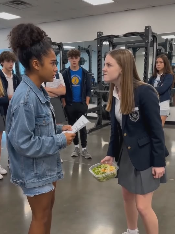
The boxed salad struck my shoulder, burst against my cheek, and scattered cold lettuce across the weight-room floor before I fully understood that Blair Wellington had thrown it.
For one stunned second, nobody moved.
The plastic container spun beneath a rack of silver dumbbells. Tomato slices clung to my denim overshirt. Dressing ran down the side of my face and soaked into the collar of my T-shirt. Around me, twenty-four students stood frozen among exercise mats, resistance bands, and machines that suddenly seemed far too heavy and dangerous for a room filled with anger.
Then the phones came out.
Not one person asked whether I was hurt.
Not one person asked why Blair had attacked me.
They recorded.
“Look what she made me do!” Blair shouted.
Her voice cracked at exactly the right moment.
Blair was good at that. She could make fury sound like fear and cruelty sound like self-defense. Standing nearly five inches taller than me in her polished navy blazer, school-approved cream skirt, and spotless sneakers, she looked less like someone who had just thrown food and more like the victim in an advertisement about bullying.
She pointed at me with a trembling hand.
“She stole my private fitness report!”
A murmur moved through the room.
I wiped dressing from my eyelashes, forcing myself not to cry.
“I didn’t steal anything.”
“You showed people my data,” Blair said. “You humiliated me.”
“I reported a privacy problem.”
“That is not what happened.”
Her friends gathered behind her instantly.
Sabrina Cole, who laughed whenever Blair laughed, folded her arms. Nolan Pierce, captain of the boys’ tennis team and Blair’s campaign partner for student council, stepped between us as though I were the threat.
“You should apologize, Jolie,” he said.
“For getting food thrown at me?”
“For sharing something private.”
The accusation spread faster than truth ever could.
“She posted Blair’s scores.”
“She took screenshots.”
“She was jealous because Blair did better.”
“I heard she changed the numbers.”
Every sentence grew more confident than the one before it.
My name is Jolie Jenkins. I was seventeen, five feet three inches tall, Filipina American, and accustomed to being overlooked until someone needed a problem fixed. I was the person teachers trusted to organize equipment lists, repair slideshow formatting, and notice when two numbers in a spreadsheet did not match.
That morning, I had noticed something small.
At least, it had looked small.
Our class was completing a non-ranked fitness check. Mr. Ortega, our physical education teacher, had repeated the rules three times: no grades, no public comparisons, no leaderboard, and no student access to anyone else’s results.
The check existed only to help students set personal goals.
Each student wore a numbered wristband. Mr. Ortega entered results into a school tablet protected by his staff login. Students later received private summaries through the district wellness portal.
That was how it was supposed to work.
But when I walked to the hydration station, I saw a printed sheet beneath Blair’s open binder.
It listed names.
Beside each name were weight-room measurements, endurance times, flexibility scores, and private notes.
My name was highlighted in yellow.
Below it, someone had typed:
LOW PERFORMANCE. POSSIBLE MEDICAL LIMITATION. EXCLUDE FROM STUDENT FITNESS AMBASSADOR ROLE.
I was not applying for the ambassador role.
I had already been chosen.
The role came with a small scholarship sponsored by a local health foundation, and the announcement was supposed to happen that afternoon.
Blair had also applied.
At first, I thought the paper was a teacher’s draft that had been placed in the wrong binder. Then I noticed the header.
STUDENT FITNESS AMBASSADOR COMPARISON RANKING.
There was never supposed to be a ranking.
I took one photograph of the header without touching the paper.
Then Blair came around the corner.
The look on her face told me the document was not an accident.
She snatched the binder closed.
“What are you doing?”
“That sheet has private data.”
“It’s mine.”
“It has twenty students’ names on it.”
“It’s for student council.”
“No, it isn’t.”
Her expression changed. The panic disappeared so quickly that I almost wondered whether I had imagined it.
Then she smiled.
“You have always wanted people to think you’re the smartest person in the room.”
“I’m going to tell Mr. Ortega.”
“Tell him what?” she asked. “That you went through my private binder and photographed my health information?”
“I photographed the document title.”
“You photographed my property.”
“It contains my name.”
“Delete it.”
“No.”
Her smile vanished again.
She moved close enough for me to smell expensive perfume and mint gum.
“You don’t understand who this will hurt.”
“That depends on who created it.”
For several seconds, Blair said nothing.
Behind us, weights clanged and students laughed, unaware that the entire afternoon was about to split open.
Then Blair raised her voice.
“Give me my phone back!”
I stared at her.
“What?”
The nearest students turned.
Blair pointed at the phone in my hand.
“She took my phone!”
It was so absurd that I almost laughed. The case was covered with small blue stars and a photograph of my younger brother tucked beneath the clear plastic.
Before I could respond, Blair grabbed my wrist.
I pulled away.
The boxed salad was sitting on a nearby bench, brought in for the wellness committee’s afternoon meeting. Blair seized it, tore off the cardboard sleeve, and threw it at my face.
That was the moment everyone began recording.
Not the binder.
Not the accusation she invented.
Only my reaction.
“Back away from each other!”
Mr. Ortega’s voice cut through the room.
Students moved aside as he hurried toward us. He was a broad-shouldered man in his early forties who rarely raised his voice, which made his anger more frightening when he did.
He looked at the salad on the floor, then at Blair, then at me.
“What happened?”
“She accessed my fitness results,” Blair said before I could speak. “She photographed them and threatened to post them because she lost the ambassador position.”
I stared at her.
“I didn’t lose it.”
Blair’s eyes flickered.
Only for a fraction of a second.
But Mr. Ortega noticed.
“What position?” he asked.
Blair swallowed.
“The student fitness ambassador position.”
“That decision has not been announced.”
The room went quiet.
Blair recovered quickly.
“Nolan told me.”
Everyone turned toward Nolan.
His face reddened.
“I only heard a rumor.”
Mr. Ortega’s expression hardened.
“No student has been informed of the selection.”
“I saw a list,” Blair said. “Maybe Jolie did too.”
“I saw a ranking sheet in her binder,” I said. “It contained everyone’s private results.”
“That is a lie!” Blair shouted.
“Lower your voice,” Mr. Ortega said.
“She’s accusing me of stealing medical information!”
“I said fitness data.”
“It’s the same thing!”
“No,” he replied sharply. “It is not. And the difference matters.”
Principal Helen Mercer arrived less than two minutes later, followed by Assistant Principal Darnell and the school nurse. By then, students had already sent videos across three group chats.
In every clip, Blair looked frightened and I looked angry.
Nobody had recorded the beginning.
Principal Mercer ordered the room cleared, but students lingered in the hallway, whispering through the closing doors.
I sat on a wooden bench while the nurse wiped dressing from my cheek.
Blair remained near the squat racks with Sabrina and Nolan beside her.
“I want my parents called,” Blair said.
“They are being contacted,” Principal Mercer replied.
“My father is on the district advisory board.”
“I am aware.”
“He will want to know why a student was allowed to steal my personal records.”
Principal Mercer looked at me.
“Jolie, do you have the photograph?”
I unlocked my phone and handed it to her.
It showed only the top portion of the page.
STUDENT FITNESS AMBASSADOR COMPARISON RANKING.
Underneath were four column headings:
NAME.
PERFORMANCE LEVEL.
HEALTH CONCERNS.
RECOMMENDATION.
Blair stepped forward.
“That proves she took a photo.”
“It also proves the document existed,” Mr. Ortega said.
“She could have created it herself.”
Principal Mercer enlarged the image.
A small district logo appeared in the corner. Beneath it was a file code.
Mr. Ortega’s face changed.
He reached for the phone but stopped himself.
“Principal Mercer, may I see that code?”
She held the screen toward him.
His jaw tightened.
“That document was generated from the wellness portal.”
Blair shook her head.
“That’s impossible.”
“Yes,” he said quietly. “It should be.”
“What does that mean?” I asked.
Mr. Ortega looked troubled rather than relieved.
“It means whoever created that sheet had access to protected student information.”
Blair crossed her arms.
“Then Jolie must have hacked it.”
A few minutes later, Blair’s father stormed into the room.
Grant Wellington was the sort of man who never seemed to walk anywhere. He arrived. Tall, silver-haired, and dressed in a charcoal suit, he carried an atmosphere of authority around him like a second jacket.
He barely glanced at me.
“Where is my daughter’s phone?”
“She has it,” Principal Mercer said.
“Then what was stolen?”
“Nothing has been established yet.”
Blair rushed to him.
“Dad, she accessed my private report and threatened me.”
Grant looked at the stain on my shirt.
“And the food?”
“She came at me.”
“That is not true,” I said.
Grant finally looked at me.
His eyes were calm, dismissive, and strangely familiar.
“You’re the Jenkins girl.”
I felt a chill.
“What does that mean?”
“Your mother handles records for the district office, correct?”
My mother, Celeste Jenkins, worked as an administrative systems coordinator. She trained staff members to use the district’s attendance, counseling, and wellness databases.
“She works there,” I said.
Grant nodded as if a final piece had fallen into place.
“So you had access through your mother.”
“No.”
“My mother would never give me her login.”
“Children often know more about their parents’ passwords than parents realize.”
Mr. Ortega stepped between us.
“Mr. Wellington, do not accuse a student without evidence.”
Grant smiled without warmth.
“I am asking reasonable questions.”
“No,” Mr. Ortega replied. “You are creating an explanation that protects your daughter.”
Principal Mercer turned to the school’s technology specialist, Mrs. Kwan, who had entered carrying a laptop.
“Can you determine who generated the document?”
Mrs. Kwan sat at a folding table and typed quickly.
“The file code will help.”
Blair leaned against her father.
“She probably deleted the evidence.”
Mrs. Kwan did not look up.
“The portal keeps activity logs.”
For the first time, Grant Wellington appeared uneasy.
It vanished almost immediately.
“Logs can be misunderstood.”
“They record usernames, devices, times, and actions,” Mrs. Kwan said.
“Machines make mistakes.”
“People make mistakes. Machines record them.”
The silence that followed felt heavier than the weight plates around us.
Mrs. Kwan entered the file code.
A yellow warning box appeared on her screen.
She frowned.
“What is it?” Principal Mercer asked.
“The report was generated using a PE staff account at 11:43 this morning.”
Every face turned toward Mr. Ortega.
His skin went pale.
“That is impossible.”
Blair covered her mouth.
“Mr. Ortega did it?”
“No,” he said.
“You said your account created it,” Grant replied.
“I was supervising the track assessment at 11:43.”
“You could have used the tablet.”
“The tablet was locked in my office.”
Mrs. Kwan continued typing.
“The system shows two successful logins under your username today.”
Mr. Ortega moved closer.
“From which devices?”
“One from the school tablet at 8:02 a.m.”
“That was me.”
“The second was from a desktop terminal in the athletic administrative office at 11:39.”
Mr. Ortega’s expression tightened.
“I have not entered that office today.”
Grant sighed as though disappointed.
“Then perhaps your password was not secure.”
Mr. Ortega ignored him.
“Can you show what the second login accessed?”
Mrs. Kwan hesitated.
“I can show administrative actions, but student privacy rules restrict the display of individual health records in front of unauthorized people.”
Blair lifted her chin.
“Exactly. Jolie had no right to see mine.”
Mr. Ortega turned to her.
“No one has shown your individual record.”
“She photographed the ranking.”
“A ranking that should not exist.”
“She made it!”
Mrs. Kwan’s fingers stopped moving.
“No,” she said.
Everyone looked at her.
“The document creation history identifies the portal template used. Jolie could not have made this outside the system.”
Blair’s father stepped forward.
“Who could?”
“Someone using Mr. Ortega’s account.”
Principal Mercer’s voice sharpened.
“Can you confirm whether the document was printed?”
Mrs. Kwan checked.
“Yes. At 11:51 a.m., using the printer in the athletic administrative office.”
“That office remains locked,” Mr. Ortega said.
“Who has access?” I asked.
Mr. Ortega counted silently.
“Principal Mercer. Assistant Principal Darnell. Coach Ellis. The athletic secretary. Me.”
“And student aides,” Blair said quickly.
Mr. Ortega looked at her.
“No student aides are permitted inside without supervision.”
“But they have keys.”
“No.”
Nolan shifted his weight.
It was a tiny movement, but I noticed.
He was staring at the floor.
“Nolan?” I said.
His head snapped up.
“What?”
“You said you heard a rumor about the ambassador position. Who told you?”
Blair answered for him.
“Everyone knew.”
“No one knew,” Mr. Ortega said.
Nolan rubbed the back of his neck.
“I don’t remember.”
“You told Blair she got it?” Principal Mercer asked.
“I thought she did.”
“Based on what?”
He looked at Blair.
She stared back at him with an expression so cold that it seemed to silence him.
Grant stepped between them.
“This is becoming an interrogation of children. My daughter was assaulted through a serious privacy violation, and everyone here seems determined to reverse the blame.”
I looked at the salad dripping from my shirt.
“Your daughter threw food at me.”
“After being provoked.”
“She grabbed me first.”
“Do you have proof?”
The question cut deeper than it should have.
Because he knew I did not.
I looked toward the ceiling camera.
“The room camera would show it.”
Mr. Ortega followed my gaze.
“It should.”
Principal Mercer turned to Mrs. Kwan.
“Retrieve the footage.”
Mrs. Kwan opened the security system.
The camera feed existed.
The recording did not.
Between 11:35 a.m. and 12:12 p.m., the weight-room camera showed a gray screen.
Grant Wellington’s mouth curved slightly.
I almost missed it.
“The camera malfunctioned?” Principal Mercer asked.
Mrs. Kwan shook her head.
“It was manually placed into privacy mode.”
A cold sensation moved down my spine.
“Who can do that?” I asked.
“Administrative staff,” she said. “And PE personnel during health screenings.”
Blair looked at Mr. Ortega.
“So he disabled the camera.”
Mr. Ortega closed his eyes briefly.
“No.”
“When is privacy mode allowed?” Principal Mercer asked.
“When students are completing measurements that could reveal private information,” Mr. Ortega replied. “But we did not perform those activities in this room today.”
Mrs. Kwan clicked into another log.
“The privacy setting was activated at 11:34 under Mr. Ortega’s account.”
Grant folded his arms.
“This appears increasingly clear.”
Mr. Ortega’s face was rigid.
“Check the device.”
“The same administrative-office desktop,” Mrs. Kwan said.
The room seemed to tilt.
Someone had used Mr. Ortega’s username to access protected student data, create a ranking, print it, and disable the camera before Blair confronted me.
That was not panic.
It was preparation.
I looked at Blair.
She had stopped pretending to be frightened.
Her expression was blank now.
Controlled.
“Why was your binder in the weight room?” I asked.
She shrugged.
“I brought it.”
“From where?”
“Class.”
“You came from chemistry.”
“So?”
“You didn’t have that binder during chemistry.”
Sabrina frowned.
“How would you know?”
“Our classes are across the hall. I saw Blair leave. She was carrying only her purse.”
Blair’s mouth tightened.
“You’re obsessed with me.”
“No. I notice things.”
“You manufacture things.”
I remembered the file beneath her binder, the yellow highlight over my name, and the note recommending my removal.
“Why was my ambassador selection mentioned in the report?”
“I don’t know.”
“You knew about it before the announcement.”
“Nolan told me.”
Nolan looked at her sharply.
Blair’s eyes warned him again.
Principal Mercer saw it this time.
“Nolan, come with Assistant Principal Darnell.”
Grant objected immediately.
“My daughter’s friends will not be questioned without their parents.”
“Nolan’s parents have been contacted,” Principal Mercer said. “Mr. Darnell will wait for their permission.”
She turned to Blair.
“You and your father will remain here.”
Grant stepped closer to her.
“We are leaving.”
“No,” Principal Mercer said.
“You cannot detain us.”
“I can suspend Blair from school grounds pending a safety investigation. Leaving now will be documented as refusal to cooperate.”
Grant stared at her.
For a moment, I thought he would force his way out.
Then his phone rang.
He checked the screen.
The color drained from his face.
He declined the call.
A second later, it rang again.
The caller ID was visible from where I stood.
CELESTE JENKINS—DISTRICT SYSTEMS.
My mother.
Grant turned the phone facedown.
I felt my heartbeat in my throat.
“Why is my mother calling you?”
“She works for the district.”
“She called you directly.”
“She has my number through the advisory board.”
“Then answer.”
His eyes moved to mine.
For the first time, the dismissive confidence disappeared.
Before he could respond, my mother entered the weight room.
She was still wearing her district identification badge. Her black hair had begun slipping from its bun, and she carried a sealed evidence envelope beneath one arm.
She looked at me first.
The moment she saw the dressing on my clothes, her expression broke.
“Jolie.”
“I’m okay.”
She crossed the room and held my face gently between her hands.
“Did anyone hurt you?”
“Blair threw food at me.”
My mother looked over my shoulder.
Blair stepped closer to her father.
Grant did not move.
Celeste straightened.
“I received an automated security alert twenty minutes ago,” she said. “A restricted wellness report was generated through an account that had been flagged for unusual duplicate access.”
Grant regained his composure.
“You have no authority to discuss student data in public.”
“I am not discussing student data.”
“What is in the envelope?” Principal Mercer asked.
“A privacy verification generated by the district system.”
Mr. Ortega looked almost afraid to hope.
“What does it verify?”
“The legitimate device assigned to your PE account.”
She placed the envelope on the table and broke the seal.
Inside was a signed district report.
“My account was used from the athletic office,” Mr. Ortega said. “I was nowhere near it.”
“I know,” my mother replied.
She pointed to the first page.
“Every staff login carries a rotating device certificate. Mr. Ortega’s school tablet has the correct certificate. The athletic-office desktop did not.”
“So someone copied his password,” Mrs. Kwan said.
“Not exactly.”
My mother looked toward Grant Wellington.
“They used a stored password recovery token.”
Grant’s expression remained still, but his hand curled into a fist.
Principal Mercer noticed.
“Who had access to that token?”
“The athletic administrative office was upgraded last month. Mr. Wellington volunteered his technology company to install new network security hardware at no cost.”
Every eye turned toward him.
He laughed once.
It sounded forced.
“My company donated equipment. We did not access staff credentials.”
“The recovery token was created during the installation window,” my mother said. “It was never authorized by the district.”
“That proves nothing.”
“It identifies the external administrator account that created it.”
“And whose account was that?” Principal Mercer asked.
My mother’s voice became very quiet.
“GWellington Consulting.”
Blair stared at her father.
“Dad?”
Grant shook his head.
“An installer may have used my corporate account.”
My mother removed another page.
“The account accessed Mr. Ortega’s password recovery system twice. Once three weeks ago and once this morning.”
Grant’s lawyer-like calm began to fracture.
“You cannot connect that activity to me personally.”
“We can,” my mother said.
“How?”
“The desktop required a physical security key.”
The room fell silent.
Grant slowly touched the pocket of his suit jacket.
My mother noticed.
“So did I,” she said.
Principal Mercer held out her hand.
“Mr. Wellington, please place the contents of that pocket on the table.”
He did not move.
Blair whispered, “Dad, what is she talking about?”
Grant’s eyes remained on my mother.
“You should be careful, Celeste.”
My mother’s shoulders stiffened.
“I spent fourteen years being careful around men who believed warnings were more powerful than evidence.”
Something passed between them.
Not recognition.
History.
I looked from my mother to Grant.
“How do you know him?”
Neither answered.
The school resource officer entered the room, summoned quietly by Assistant Principal Darnell. Grant saw him and stepped backward.
“This has been exaggerated beyond reason.”
Principal Mercer spoke evenly.
“Place the contents of your pocket on the table.”
Grant removed a slim black security key.
Blair looked as though she had been struck.
“You said you were coming from work.”
“I was.”
“That key is for your company,” my mother said. “But its encrypted identifier matches the one used on the athletic-office desktop.”
Grant’s confidence finally collapsed.
“You had no right to trace that.”
“You had no right to access children’s private information.”
He turned toward the door.
The resource officer blocked him.
Then Blair did something nobody expected.
She laughed.
It was not a happy sound.
It was thin, broken, and exhausted.
“Of course,” she said.
Her father looked at her.
“Blair, say nothing.”
“You said it couldn’t be traced.”
“Do not speak.”
“You promised me.”
The room went utterly still.
Grant’s face hardened.
“I said be quiet.”
Blair looked at him, and for the first time all day, she truly appeared eighteen.
Not polished.
Not untouchable.
Just terrified.
“You told me the ranking would look official,” she said. “You said everyone would believe Jolie accessed it because her mother worked for the district.”
My breath stopped.
Grant moved toward her.
“Blair.”
The officer raised a hand.
“Stay where you are.”
Blair’s voice rose.
“You said the camera would be off. You said Mr. Ortega would take the blame if anything went wrong.”
“Stop talking.”
“You told me to make her react!”
Her words struck the room harder than the salad had struck me.
Principal Mercer stared at her.
“Your father planned the confrontation?”
Tears gathered in Blair’s eyes.
“He said I needed witnesses. He said if Jolie looked angry on video, people would assume she had threatened me before the recording started.”
Mr. Ortega’s face filled with disbelief.
“Why?”
Blair looked at me.
The hatred I expected was not there.
Only shame.
“Because the foundation chose her.”
The answer seemed too small for everything that had happened.
Principal Mercer frowned.
“A student scholarship?”
Grant snapped, “You do not understand what was at stake.”
My mother looked at him.
“I think I do.”
Grant’s face turned toward her.
“Don’t.”
She removed the final paper from the envelope.
“The fitness ambassador scholarship was not the real target.”
I stared at her.
“What do you mean?”
“The foundation planned to announce a larger district partnership next month. The selected ambassador’s parent would be invited onto the community wellness oversight committee.”
Grant closed his eyes.
My mother continued.
“That committee would receive authority to audit every district wellness technology contract.”
Mrs. Kwan inhaled sharply.
“Including Wellington Consulting.”
Principal Mercer’s expression changed as the full picture emerged.
“You believed Celeste would discover the unauthorized access tokens.”
“She already had,” Grant said bitterly.
My mother nodded.
“Three days ago.”
“So you tried to discredit Jolie,” Mr. Ortega said. “If she were accused of stealing student health data, her mother would be removed from the audit for conflict of interest.”
Grant’s silence was an answer.
I looked at Blair.
“Did you know all of that?”
She wiped her face.
“No. He told me you cheated to get the scholarship. He said your mother manipulated the selection and that exposing you would protect our family.”
“Blair,” Grant warned again.
She spun toward him.
“You told me Mom would lose the house if your contracts were canceled.”
His face did not change.
“You involved yourself willingly.”
“You are my father!”
“And you wanted to win.”
The cruelty in his voice shocked even Blair.
Her mouth fell open.
Grant looked around the room with contempt.
“Do not pretend she is innocent. She knew the document was false. She carried it into this room. She lied. She provoked the confrontation.”
Blair began to cry.
This time, nobody mistook it for acting.
Grant turned toward me.
“And you. Do you think this makes you a hero? Your mother has built her career destroying people who make one mistake.”
My mother went pale.
“You did not make one mistake.”
“You have wanted revenge for years.”
My skin prickled.
“Revenge for what?”
Grant smiled at my mother.
“Tell her.”
“Do not use Jolie to hurt me.”
“She deserves to know why you recognized my name before today.”
My mother’s eyes filled with dread.
I remembered Grant looking at me and saying, You’re the Jenkins girl.
“Mom?”
She lowered her head.
“Grant and I attended college together.”
“That’s all?” I asked.
“No.”
Grant laughed softly.
“That is not all.”
My mother gripped the edge of the table.
“Before I met your father, Grant and I worked on a student technology project. We created an early system for storing school health records securely.”
Grant spoke over her.
“She created nothing. She documented my work.”
My mother faced him.
“I discovered you were selling access to anonymized records without permission.”
“They were research samples.”
“They belonged to children.”
“I was twenty-two.”
“You knew it was wrong.”
“You reported me and destroyed my scholarship.”
“You forged my approval.”
His smile vanished.
The argument sounded old, rehearsed in private for years.
Principal Mercer interrupted.
“What does this have to do with Jolie?”
Grant looked directly at me.
“Ask your mother why she changed universities.”
My mother whispered, “Enough.”
“Ask why she left Spokane for nearly a year.”
My stomach twisted.
“Mom, what is he saying?”
She stared at me, struggling to speak.
Then Blair stepped away from her father.
“Whatever it is, it doesn’t change what he did today.”
Grant turned on her.
“You ungrateful child.”
Blair flinched.
I had spent years seeing her as someone protected by power.
In that instant, I saw the cost of living beneath it.
My mother finally spoke.
“Grant believed Jolie might be his daughter.”
Nobody moved.
The words seemed to erase all sound from the room.
I felt as though the floor had disappeared beneath me.
“What?”
“He was wrong,” my mother said immediately. “A legal test was done when you were an infant. Your father, Daniel Jenkins, is your biological father. Grant had no claim to you.”
Grant’s eyes glittered.
“She refused to let me see the original report.”
“Because you were harassing me.”
“You disappeared.”
“I was protecting my family.”
I could barely breathe.
Grant had not targeted a random student.
He had targeted me.
Not simply because of the audit or scholarship.
Because for seventeen years, some part of him had wondered whether I belonged to him.
“Is that why my name was highlighted?” I asked.
Blair looked horrified.
“I didn’t highlight it.”
Grant said nothing.
My mother understood before I did.
“The document was not only meant to remove Jolie from the scholarship.”
She turned to Mrs. Kwan.
“Check which records were opened before the report was created.”
Mrs. Kwan typed.
Her eyes widened.
“The account accessed Jolie’s wellness profile, emergency contacts, blood type, and genetic screening exemption form.”
My mother went still.
“Genetic screening?”
Mr. Ortega looked confused.
“Our wellness portal does not contain genetic test results.”
“No,” my mother said. “But it records whether a family declined participation in optional district health studies.”
Grant’s plan became clear in the silence.
He had not merely intended to ruin my reputation.
He wanted to create a reason for the school to demand medical clarification. If I were accused of falsifying fitness data or concealing a condition, he expected the investigation to open records that could answer the question he had carried for seventeen years.
“You used the school to search for proof that I was your daughter,” I said.
His face twisted.
“I wanted certainty.”
“You already had certainty,” my mother replied. “You refused to accept it.”
Grant looked at me with an expression that frightened me more than anger.
“You have my eyes.”
“No,” I said.
My voice shook, but I forced the words out.
“I have my father’s eyes.”
Grant stared at me.
Then my mother reached into the envelope once more.
“There is something else.”
She placed a sealed laboratory report on the table.
Grant’s breath caught.
“When the district alert showed Jolie’s records had been targeted, I understood what you were trying to find,” she said. “I called Daniel. He gave me permission to access the certified copy of the original paternity test stored with our family attorney.”
Grant stepped forward.
“That report was manipulated.”
“No.”
“You controlled the sample.”
“No,” my mother repeated. “But your father did.”
Grant froze.
My mother’s voice softened, though there was no kindness in it.
“Your father arranged the test because he wanted the harassment to end. He provided your comparison sample from a medical record.”
Grant looked confused.
“What are you saying?”
“The test proved you were not Jolie’s father. But it revealed something else your father begged the laboratory not to include in the family copy.”
The room seemed to contract around us.
Grant’s voice dropped.
“What?”
“You were not biologically related to the Wellington family.”
Blair stared at him.
Grant shook his head slowly.
“No.”
“Your father had discovered that you were switched with another infant at the hospital,” my mother said. “He feared losing you, so he buried the result.”
“No.”
“He loved you as his son.”
“You’re lying.”
“The court-certified report is here.”
Grant reached for it, but his hands trembled so badly that the pages slipped.
For years, he had obsessed over whether I was his child.
All that time, the secret hidden inside the test had been about him.
He unfolded the report.
His eyes raced across the lines.
Then he sank onto the bench.
The man who had entered the room believing he could control everyone suddenly looked smaller than any of us.
Blair stood a few feet away, crying silently.
“Dad?”
He did not respond.
The school resource officer eventually escorted Grant Wellington from the building. He was not handcuffed in front of us, but investigators were waiting outside. The district suspended all contracts with his company that evening. A state inquiry later uncovered unauthorized access tools installed in four schools and evidence that he had used confidential information to pressure administrators into renewing contracts.
Blair received a ten-day suspension and was removed from student council.
She also faced a disciplinary hearing for the attack and privacy scheme.
But she did something nobody expected.
She told the truth.
All of it.
She handed over messages from her father, admitted that she had carried the false ranking sheet, and acknowledged that she invented the phone accusation. She also submitted a written statement clearing Mr. Ortega and me.
The statement did not erase what she had done.
But it prevented Grant from blaming others.
Three weeks later, Blair asked to speak with me in the school counseling office.
She wore plain jeans and a gray sweater. Without her blazer, perfect hair, and loyal crowd, she seemed almost unfamiliar.
“I’m not asking you to forgive me,” she said.
“Good.”
She nodded.
“I was jealous before my father ever got involved. When I heard you might be selected, I told him it was unfair. I wanted him to fix it.”
“And he did.”
“Yes.”
She looked down at her hands.
“When he gave me the paper, I knew it was wrong. I kept telling myself I was only exposing favoritism. Then you saw it, and I panicked.”
“You threw food at me.”
“I know.”
“You grabbed me and lied.”
“I know.”
“You let everyone think I had stolen private records.”
Her eyes filled.
“I know.”
I wanted to hate her.
Part of me did.
But another part remembered the way Grant had spoken to her when she stopped protecting him.
You involved yourself willingly.
And you wanted to win.
He had not seen her as a daughter in that moment. He had seen her as a failed accomplice.
“What happens to you now?” I asked.
“My mother and I are moving to Tacoma. She filed for divorce.”
I had never met Blair’s mother. Blair rarely mentioned her.
“My dad keeps asking me to change my statement,” she continued. “His lawyer says I misunderstood him.”
“Did you?”
“No.”
The answer came without hesitation.
She took a folded page from her pocket.
“This is an apology. A real one. You don’t have to read it.”
I accepted it but did not open it.
“Why did you tell the truth?”
She looked toward the office window, where rain traced silver lines across the glass.
“Because when he said you might be his daughter, I realized something.”
“What?”
“If you had been, he would have destroyed you anyway.”
The words stayed with me.
I eventually read her apology.
I did not forgive her immediately.
Forgiveness was not a door that opened because someone knocked once. It was a long hallway, and I was not certain we would ever reach the other end.
But I stopped wishing for her life to collapse.
That was enough.
The health foundation delayed the ambassador announcement until the investigation concluded. When it finally happened, the entire school gathered in the gym.
I stood beside my parents beneath a banner that read WELLNESS BELONGS TO EVERYONE.
My father, Daniel, squeezed my shoulder.
He had spent seventeen years being my dad without ever asking biology for permission. He taught me to ride a bicycle, stayed awake beside me during fevers, packed sliced mango into my lunch, and attended every robotics presentation even when he understood none of the terminology.
“I’m sorry you learned about the test that way,” he said.
I leaned into him.
“It didn’t change anything.”
His eyes shone.
“I know. But I needed to hear you say it.”
My mother stood on my other side.
She looked exhausted but peaceful, as if a door she had held shut for years had finally been sealed properly.
Principal Mercer approached the microphone.
“The student selected as Spokane Ridge High School’s first fitness ambassador demonstrated more than physical effort,” she said. “She demonstrated integrity, courage, and respect for the privacy of others, even when protecting those values came at a personal cost.”
My name echoed through the gym.
The applause began slowly.
Then it grew.
Mr. Ortega clapped from the front row. Mrs. Kwan stood beside him. Even Nolan and Sabrina, both under disciplinary probation, rose from their seats.
At the far side of the gym, near the exit, Blair stood with her mother.
She did not clap dramatically or try to draw attention.
She simply met my eyes and nodded.
I nodded back.
After the ceremony, the foundation director handed me a certificate and explained that the scholarship had been increased. The district also invited my mother to lead a new student-data protection initiative independent of vendor control.
But the best moment came later.
I returned to the weight room alone.
The floor had been cleaned weeks earlier. The broken salad container was gone. The camera had been restored with a new privacy system requiring two staff approvals. Everything looked ordinary again.
Mr. Ortega entered carrying two bottles of water.
“You all right?” he asked.
“I think so.”
He handed me one.
“For what it’s worth, I believed you before the log appeared.”
I looked at him.
“You didn’t say that.”
“I was trying to follow procedure.”
“Procedure feels a lot like silence when everyone is blaming you.”
He absorbed the criticism without defending himself.
“You’re right.”
That surprised me.
Most adults apologized by explaining why they had not really failed.
Mr. Ortega sat on the bench.
“I should have stopped the accusations immediately. Evidence mattered, but so did protecting you while we found it.”
I sat beside him.
“Thank you.”
He looked toward the restored camera.
“Machines can confirm what happened. They cannot decide who deserves dignity while the truth is still uncertain.”
For months, I had believed the most important thing in that room was the privacy confirmation that proved I had not stolen anyone’s data.
It was important.
The login records mattered.
The camera settings mattered.
The security key mattered.
But Mr. Ortega was right.
Evidence had exposed the lie.
Character determined what everyone did after it.
Blair’s father had possessed information and used it as a weapon.
My mother possessed information and used it to protect people.
Blair had joined a lie, then chose to stop it.
Mr. Ortega had followed procedure, then admitted that procedure had not been enough.
And I had learned that keeping receipts was not the same as living without fear.
Courage was not knowing proof would save you.
Courage was telling the truth before you knew whether anyone would believe it.
As I left the weight room, my phone vibrated.
It was a message from an unknown Tacoma number.
I opened it.
Blair had sent a photograph of a school bulletin board.
Pinned in the center was a handwritten poster:
STUDENT PRIVACY IS NOT SOCIAL CURRENCY.
Below it, she had written:
I joined the new student ethics committee. They made me start by telling everyone why I needed to be there.
A second message appeared.
I still don’t expect forgiveness. I just wanted you to know I’m trying to become someone who would have stood beside you that day.
I stared at the screen for a long time.
Then I typed:
Start by standing beside the next person.
Her reply came almost immediately.
I will.
Outside, my parents waited beneath the school awning as rain softened the parking lot into silver. My father held an umbrella that was too small for all three of us. My mother laughed when the wind turned it inside out.
I ran toward them.
For the first time since the salad struck my face, I did not feel watched.
I did not feel ranked.
I did not feel like a highlighted name on someone else’s secret document.
I was Jolie Jenkins.
Daughter of Celeste and Daniel Jenkins.
Student fitness ambassador.
The girl who noticed one small thing and refused to let it disappear.
Behind us, through the weight-room windows, the new privacy indicator glowed steadily above the restored camera.
This time, the light did not feel like surveillance.
It felt like a promise.
No hidden login would decide who I was.
No powerful family would rewrite my story.
And no lie, no matter how carefully designed, would ever be stronger than the people brave enough to open the original record.
THE END
