The pumpkin soup hit me before I saw Kenzie Whitmore lift the bowl.
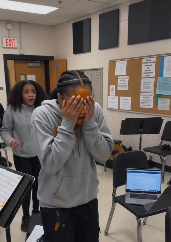
One moment, I was standing beside the mixing console in the choir recording room, trying to explain why the senior showcase track had been altered. The next, warm orange liquid covered my cheek, soaked through my gray school T-shirt, and dripped from the ends of my braids onto the polished floor.
A piece of bread slid down my shoulder.
Someone gasped.
Someone else laughed before realizing no one was supposed to laugh.
Then nearly every phone in the room rose toward me.
Kenzie stood three feet away, still holding the empty paper bowl. Her straight auburn hair remained perfectly arranged over her shoulders. Not a drop had touched her cream cardigan, pleated skirt, or white sneakers.
She looked furious, but not surprised.
That was the first thing I understood.
She had planned the humiliation.
“Stop lying about me,” she shouted.
Her voice filled the recording room, bouncing from the acoustic panels and suspended microphones. Students from advanced choir crowded near the door. Members of the school media club stood beside the equipment table. Two parent volunteers had come to hear the final senior-showcase mix.
Everyone had seen what Kenzie did.
Yet the second she accused me, their attention shifted from the soup on my face to the laptop in front of me.
Kenzie pointed at it.
“She tried to sabotage my solo.”
I wiped soup from my eyelashes.
“That is not your solo.”
Her mouth tightened.
“It has my name on the program.”
“Because someone changed the program.”
“There she goes again,” Kenzie said, turning toward the crowd. “She cannot accept that the choir director chose me.”
“I was chosen to sing the opening verse.”
“You were chosen as a backup.”
“That is not what the original project says.”
A murmur passed through the room.
Kenzie’s confidence flickered.
Only for a second.
Then she dropped the empty bowl on the floor.
“You edited that project yourself.”
“No.”
“You had access.”
“I recorded the sessions.”
“Exactly.”
“I did the work Mr. Daniels assigned me.”
Kenzie spread her hands as if my answer proved her accusation.
“Everyone heard that, right? She controlled the files.”
I could feel the soup cooling against my skin. I wanted to run to the restroom, lock the door, and disappear until graduation.
Instead, I looked at the laptop.
The original audio project was still open.
That mattered more than my embarrassment.
My name is Asha Freeman. I was seventeen years old, Trinidadian American, and a senior at Jackson Central High School in Mississippi. My mother worked early mornings at a hospital cafeteria, and my father repaired air-conditioning systems across three counties. We were not poor enough for people to call us tragic or wealthy enough for anyone to treat us as important.
I had learned to finish whatever other people abandoned.
If chairs needed stacking after rehearsal, I stacked them.
If microphones needed labeling, I labeled them.
If twenty-seven vocal tracks needed cleaning before the district showcase, I stayed after school until every breath, click, and background cough was organized.
Kenzie Whitmore lived in a different world.
Her father owned three dental practices. Her mother chaired the school arts foundation. Adults remembered her birthday, rearranged rehearsals around her schedule, and called her “our shining star” before she had sung a single note.
Kenzie had a beautiful voice.
That was what made everything harder.
She did not need to steal my part.
But she believed visible things belonged to her.
The senior showcase recording had begun two weeks earlier. Our choir was performing an original arrangement called “Home Beyond the River,” composed by our director, Mr. Julian Daniels.
The opening required a low, clear solo before the full choir entered.
During auditions, Mr. Daniels selected me.
Kenzie received the final solo, which was longer and technically more difficult. We were both featured.
At least, that was the arrangement we recorded.
But when the promotional video appeared on the school website three days later, my voice was missing.
Kenzie sang the opening verse.
The video credits listed her as the only featured vocalist.
At first, I assumed the media club had exported the wrong version.
I emailed Mr. Daniels.
He did not respond.
I emailed Ms. Whitmore, Kenzie’s mother, because the arts foundation had funded the recording project.
She replied within six minutes.
Asha,
The final artistic decisions were made by the appropriate adults. Senior projects sometimes change during editing. Please celebrate the success of the entire choir rather than focusing on individual recognition.
Best,
Eleanor Whitmore
Jackson Central Arts Foundation
I read the message three times.
Then I checked the shared project folder.
The session file had been renamed.
The version containing my solo was gone.
In its place was a new file titled:
HOME_BEYOND_THE_RIVER_FINAL_KW.
KW.
Kenzie Whitmore.
I clicked on the file history.
Access denied.
That was when I stopped believing it was an ordinary mistake.
The following afternoon, I stayed late in the recording room and opened the local backup drive. Mr. Daniels required every recording session to save automatically to two locations: the school server and a physical drive inside the studio computer.
The server copy could be renamed.
The local backup preserved the original creation history.
I found the project.
The first vocal track was still labeled ASHA_OPENING_MAIN.
My voice was there.
So was something else.
At the end of the session, after most students had left, a microphone remained active.
It had recorded a conversation.
I heard Kenzie’s voice first.
“My mother said the sponsor video needs one face.”
Then another voice answered.
“We can replace Asha’s opening without anyone noticing.”
I recognized the second speaker.
But before I could listen further, the recording-room door opened.
Kenzie walked in carrying pumpkin soup from the arts foundation luncheon.
Behind her came her mother, Mr. Daniels, the principal, several choir students, and the school media adviser.
Kenzie saw the waveform on the screen.
She saw the original track label.
Then she threw the soup.
Now I stood dripping in front of everyone while she claimed I had sabotaged her.
Mr. Daniels finally stepped forward.
“That is enough.”
He was a thin man in his late forties with tired eyes and a habit of pressing two fingers against his temple whenever rehearsals became chaotic.
He looked at Kenzie.
“Throwing food at another student is unacceptable.”
“She accused me in front of everyone,” Kenzie replied.
“That does not justify what you did.”
Eleanor Whitmore moved to her daughter’s side.
She wore a tailored blue dress and pearl earrings, though it was only Wednesday afternoon.
“Kenzie reacted under extreme provocation,” she said.
I stared at her.
“Extreme provocation?”
“You entered a restricted project file and accused my daughter of theft.”
“The project contains my voice.”
“It belongs to the school.”
“My performance belongs to me.”
Mrs. Whitmore gave me the patient smile adults use when they want to make a child feel unreasonable.
“Asha, creative projects evolve.”
“Not by erasing people.”
Principal Marcus Hale raised one hand.
“Everyone needs to calm down.”
I looked at the soup on my clothes.
“Why does everyone always say that after someone else attacks me?”
The room became quiet.
Principal Hale lowered his hand.
The media adviser, Ms. Patel, handed me a roll of paper towels.
“Go clean up,” she said gently. “We will preserve the computer exactly as it is.”
Mrs. Whitmore stepped toward the laptop.
“There is no reason to preserve anything. This is a student editing dispute.”
Ms. Patel moved between her and the equipment.
“There may be unauthorized access to a school project.”
“I fund this studio.”
“You do not own its records.”
Mrs. Whitmore’s face hardened.
Until then, she had spoken to Ms. Patel as though addressing an employee. Now she seemed to realize the media adviser would not obey her.
Kenzie reached for the laptop lid.
I placed my hand over it first.
“Do not touch it.”
She glared at me.
“You think one file makes you important?”
“No. I think it proves what happened.”
“It proves you were obsessed with getting attention.”
I looked at her empty bowl.
“You threw soup at me because you were scared of a file.”
Her cheeks turned red.
Mr. Daniels stepped between us.
“Asha, please clean yourself up. Kenzie, remain here.”
“No,” I said.
Everyone looked at me.
I had never openly refused Mr. Daniels before.
My voice trembled, but I continued.
“The last time I left this room, my track disappeared. I’m not leaving the computer alone again.”
Ms. Patel nodded.
“She can stay.”
Mrs. Whitmore exhaled sharply.
“This is absurd.”
Principal Hale looked toward the students gathered by the door.
“Everyone not directly involved must leave.”
Nobody moved.
“I said leave.”
The students slowly filed into the hallway, but not before sending the videos they had already recorded.
Within minutes, the soup attack would be all over school.
Most people would see only the moment I stood covered in orange liquid.
They would not see the missing voice.
They would not hear the hidden conversation.
They would decide whether I deserved it before knowing what “it” was.
Ms. Patel connected an external evidence drive to the studio computer.
“First, we make a protected copy of the project,” she said.
Mrs. Whitmore folded her arms.
“Under whose authority?”
“School media policy.”
“I am chair of the arts foundation.”
“And I am the faculty member responsible for this equipment.”
Principal Hale nodded.
“Proceed.”
Kenzie looked at her mother.
For the first time, uncertainty passed between them.
Ms. Patel opened the project-information window.
The screen displayed the original creation date, recording devices, track names, user history, and export records.
I leaned closer.
The project had been created under my student production account.
That was expected. Mr. Daniels had assigned me to organize the session.
The original opening track was recorded at 3:42 p.m.
The file containing Kenzie’s replacement vocal had been added three days later at 7:18 p.m.
The studio was supposed to be locked at that hour.
“Who entered the school that evening?” Principal Hale asked.
Mrs. Whitmore answered immediately.
“The foundation held a planning meeting.”
“In this room?”
“In the arts wing.”
Mr. Daniels stared at the timestamp.
“I left at six.”
Kenzie’s voice became smaller.
“I recorded a correction.”
“With whom?” I asked.
She looked at her mother.
Mrs. Whitmore replied, “Mr. Daniels approved it.”
All eyes moved toward him.
He looked genuinely confused.
“I did not.”
“You told me the opening needed a stronger tone,” Mrs. Whitmore said.
“I said the opening needed a cleaner mix.”
“You suggested Kenzie could provide another take.”
“No. I said every featured singer might need pickups.”
Kenzie stared at him.
“You told me to record it.”
“I never scheduled a session with you.”
The confidence drained from her face.
Mrs. Whitmore stepped closer to him.
“Be careful, Julian.”
The use of his first name changed the room.
Mr. Daniels went still.
Principal Hale noticed.
“What exactly are you warning him about?”
“I am reminding him that casual comments can be interpreted in different ways.”
Mr. Daniels looked from Mrs. Whitmore to Kenzie.
Then he turned toward the computer.
“Check which user imported the replacement vocal.”
Ms. Patel opened the event log.
A username appeared.
JDANIELS_ADMIN.
Mr. Daniels gripped the back of a chair.
“That is my account.”
Kenzie let out a breath.
“See?”
“But I did not log in.”
Mrs. Whitmore spoke calmly.
“Then someone must know your password.”
He looked at her.
“You helped purchase the studio system.”
“I write checks. I do not manage passwords.”
Ms. Patel enlarged the access details.
“The login came from the studio computer.”
“Then Mr. Daniels did it,” Kenzie said.
“No,” I replied.
She turned on me.
“You cannot keep changing your accusation every time the evidence proves you wrong.”
“I’m not changing anything.”
“Asha,” Principal Hale said, “what do you know?”
I pointed to the project timeline.
“The replacement vocal was added at 7:18. But the original mix was not edited until 7:31.”
“So?” Kenzie asked.
“The active microphone recorded the room between those times.”
Her face tightened again.
Mrs. Whitmore looked at the waveform.
“What active microphone?”
“The overhead room microphone.”
“Why would it be recording?”
“It was armed during rehearsal and never disabled.”
Ms. Patel nodded.
“That happens when the session remains open.”
Mrs. Whitmore recovered quickly.
“A microphone left running without consent cannot be used.”
Principal Hale looked at her.
“That is a legal question for the district, not a decision for you.”
“It recorded a private foundation meeting.”
“It recorded activity inside a school studio connected to the editing of student work.”
Kenzie moved behind her mother.
“The audio could be fake.”
I looked directly at her.
“You know it isn’t.”
Ms. Patel duplicated the original project to the protected drive.
Then she isolated the room-microphone track.
“Before we play anything,” Principal Hale said, “we need district authorization.”
Mrs. Whitmore gave a satisfied nod.
“Exactly.”
“We also need the student privacy officer,” he continued.
Her satisfaction vanished.
Principal Hale called the district office.
While we waited, the school nurse arrived and examined my face. The soup had not been hot enough to burn me, but my skin was red and irritated.
She gave me a clean choir sweatshirt.
I changed in the storage room while Ms. Patel guarded the computer.
When I returned, Kenzie sat with her arms folded. Her mother whispered urgently into her ear.
Mr. Daniels stood alone near the vocal booth.
He looked older than he had an hour earlier.
I approached him.
“Did you know they changed the track?”
He did not answer immediately.
“I knew the promotional committee requested a version centered on Kenzie.”
“Did you agree?”
“I told them the choir arrangement was already complete.”
“But?”
He looked toward Mrs. Whitmore.
“The foundation threatened to withdraw funding for the spring trip.”
My chest tightened.
“So you let them erase me?”
“I did not know they had replaced your voice.”
“You saw the video.”
“Yes.”
“And you said nothing.”
His eyes filled with shame.
“I planned to correct it after the district showcase.”
“After everyone already believed Kenzie sang my part?”
“I was trying to protect the choir.”
“No. You were protecting the funding.”
He flinched.
I had admired Mr. Daniels since freshman year. He was the first teacher who told me my lower register was not something to hide. He had encouraged me to learn audio production when I said my family could not afford private vocal lessons.
His silence hurt more than Kenzie’s cruelty.
“You should have protected your student,” I said.
“I know.”
The answer was quiet.
It did not repair anything.
But at least he did not excuse himself.
Twenty minutes later, Dr. Renee Brooks, the district student-privacy officer, arrived with a technology investigator named Calvin Reed.
Dr. Brooks listened as each person explained what had happened.
Kenzie described herself as the victim of a jealous classmate.
Mrs. Whitmore called the hidden audio “an illegally obtained private conversation.”
Mr. Daniels admitted that he had failed to challenge the altered promotional video.
Then it was my turn.
I explained the original audition, the recording session, the missing track, the renamed project, and the active microphone.
Dr. Brooks did not interrupt.
When I finished, she asked one question.
“Did you send the audio to anyone?”
“No.”
“Did you post any portion of it?”
“No.”
“Did you alter it?”
“No.”
She looked at Mr. Reed.
“Preserve the complete system image.”
Mrs. Whitmore stepped forward.
“You are not seriously treating a student project as forensic evidence.”
Mr. Reed connected a device to the computer.
“Someone accessed a staff account and altered an official school production containing student performances. That requires investigation.”
He examined the system history.
The project log showed Mr. Daniels’s username, but the operating-system record showed something different.
At 7:12 p.m., an external drive had been connected.
At 7:16, a password-reset utility had been opened.
At 7:18, Kenzie’s new vocal was imported.
At 7:31, my original track was muted and moved into a hidden folder.
At 7:46, the revised project was exported.
At 7:49, someone attempted to delete the local backup.
The deletion failed because the studio drive had automatic recovery protection.
Mr. Reed turned toward Mrs. Whitmore.
“Do you recognize the external drive identifier?”
“No.”
“Do you own a silver Whitmore Foundation drive issued to board members?”
She hesitated.
“Several exist.”
“Where is yours?”
“At home.”
Kenzie looked at her.
“Mom.”
Mrs. Whitmore did not turn.
“What?”
“You gave it to me that night.”
The room fell silent.
Mrs. Whitmore’s expression remained composed, but her voice sharpened.
“You are confused.”
“No, I’m not.”
“Kenzie, stop.”
“You said Mr. Daniels had approved the recording.”
“He had.”
Mr. Daniels shook his head.
“No.”
Kenzie looked between them.
“You said the drive had the new project template.”
Mrs. Whitmore stepped closer to her daughter.
“This is not the time to reconstruct casual conversations.”
“You told me to bring it into the studio.”
“Kenzie.”
“You said someone would meet me here.”
The person standing behind her shifted.
It was so slight that most people did not notice.
I did.
Behind Kenzie stood Lucas Bell, the student media club president.
Lucas had entered quietly with Dr. Brooks because he managed livestream equipment during the foundation luncheon. He was eighteen, soft-spoken, and trusted by nearly every teacher in the arts wing.
He was also my closest friend.
We had spent three years recording school concerts together. He knew my passwords, my habits, and the exact location of every studio backup.
When Kenzie said someone had met her in the studio, Lucas lowered his eyes.
My stomach turned cold.
“Lucas?”
His head lifted.
“What?”
“You were here that night.”
“No.”
My voice sounded distant to me.
“The media log.”
He stared at the computer.
“You signed out a camera for the foundation meeting.”
“That doesn’t mean I entered the studio.”
“You knew the room microphone would stay active.”
“Asha, I didn’t—”
“You knew how to hide a track inside the project.”
Kenzie slowly turned around.
Her face changed when she saw him.
“You said no one would find it.”
Lucas went pale.
Mrs. Whitmore closed her eyes.
The truth moved through the room before anyone spoke.
Principal Hale looked at Lucas.
“Did you assist in altering the recording?”
Lucas opened his mouth, but nothing came out.
Mr. Reed checked the operating-system logs again.
“The external drive was inserted,” he said. “But another user was already signed into the studio’s local media profile.”
He turned the screen.
LBELL_MEDIA.
I felt as though someone had pressed all the air from my lungs.
Kenzie had lied to me.
Mrs. Whitmore had tried to erase me.
Mr. Daniels had chosen funding over courage.
But Lucas had stood beside me every day while I searched for the missing file.
He had helped me inspect folders he already knew were empty.
He had watched me question my own memory.
“Why?” I whispered.
Lucas’s eyes filled.
“Asha—”
“Why?”
Mrs. Whitmore interrupted.
“He is a student. He should not answer without his parents.”
Lucas looked at her.
Something in his expression changed.
Fear became anger.
“You said you would protect me.”
Mrs. Whitmore’s voice dropped.
“Do not be dramatic.”
“You said the foundation internship would become permanent.”
“I said we would consider recommending you.”
“You told me to use Mr. Daniels’s account.”
“Be quiet.”
“You said muting one track wasn’t stealing.”
“Lucas,” she warned.
He laughed bitterly.
“That is exactly what you said.”
Kenzie stared at her mother.
“You told him the same thing you told me.”
Mrs. Whitmore’s control finally cracked.
“I was trying to rescue this showcase from mediocrity.”
I stepped toward her.
“My voice was mediocre?”
“This is not about your voice.”
“Then what was it about?”
She looked at me, and for the first time, she stopped pretending to be kind.
“You did not fit the image.”
The words landed harder than the soup.
Dr. Brooks’s expression hardened.
“What image?”
Mrs. Whitmore seemed to realize too late what she had admitted.
She tried to recover.
“The campaign required consistency.”
“What kind of consistency?” I asked.
“The foundation had already built promotional materials around Kenzie.”
“Before auditions?”
She said nothing.
Mr. Daniels looked sick.
“The solo decision was never supposed to matter,” he said.
Mrs. Whitmore turned on him.
“The foundation raised sixty thousand dollars for your program.”
“And that entitled you to choose the singers?”
“It entitled me to prevent a careless decision from weakening our largest campaign.”
I felt my hands shaking.
“A careless decision?”
Mrs. Whitmore looked at my borrowed sweatshirt, my worn sneakers, and the faint orange stain still visible near my hairline.
“You are talented, Asha. But sponsors respond to polish, familiarity, and a family capable of representing the institution.”
Kenzie stared at her mother.
“You told me I earned it.”
“You did.”
“No. You decided before auditions.”
“I created an opportunity for you.”
“You made me steal someone else’s.”
Mrs. Whitmore’s face softened.
“Kenzie, everything I did was for your future.”
“No,” Kenzie said. “You did it because you wanted people to see me winning.”
Mr. Reed restored the room-microphone track.
Dr. Brooks authorized him to review the relevant portion privately through headphones. After several minutes, he removed them.
“The recording confirms that Mrs. Whitmore directed Kenzie and Lucas to replace Asha’s vocal,” he said. “It also records discussion of deleting the original file.”
Mrs. Whitmore lifted her chin.
“A recording can be taken out of context.”
“There is more,” Mr. Reed said.
He looked at Lucas.
“You entered the studio again the following morning.”
Lucas nodded weakly.
“Why?”
“Mrs. Whitmore texted me that the local backup might still exist.”
I closed my eyes.
He had returned to finish erasing me.
“Did you delete it?” Dr. Brooks asked.
“I tried.”
“Why did you stop?”
Lucas looked at me.
“Because I heard the original project.”
I opened my eyes.
“What does that mean?”
He swallowed.
“The hidden room microphone had captured more than the conversation with Mrs. Whitmore.”
Mr. Reed returned to the project.
Lucas pointed toward a later section of the waveform.
“Play the final four minutes.”
The room microphone had continued recording after Mrs. Whitmore, Kenzie, and Lucas left.
At first, there was silence.
Then the studio door opened again.
Two voices entered.
One belonged to Mr. Daniels.
The other belonged to Principal Hale.
Principal Hale’s recorded voice sounded tense.
“Eleanor cannot keep controlling student decisions.”
Mr. Daniels replied, “Then stop accepting her money.”
“The district will cut the program.”
“She replaced Asha’s voice.”
“I know.”
My heart sank.
Principal Hale had known.
On the recording, Mr. Daniels asked, “What are you going to do?”
Principal Hale answered, “Nothing until after the board vote. If Whitmore withdraws support, the district loses the new auditorium.”
The recording room became completely silent.
Principal Hale’s face lost all color.
Dr. Brooks stared at him.
“You knew a student’s work had been altered?”
He looked at me.
“Asha, I intended to restore your credit.”
“After the board vote,” I said.
He lowered his eyes.
The person behind Kenzie had not been the only betrayal.
The entire system had known enough to stop it.
Lucas had helped alter the file.
Mr. Daniels had remained silent to protect the choir trip.
Principal Hale had remained silent to protect an auditorium.
Each person had told themselves my erasure was temporary, manageable, or necessary.
I was the only one expected to carry the cost.
Dr. Brooks ordered the room closed and the equipment secured.
Principal Hale was placed on administrative leave that evening. Mrs. Whitmore was removed from the arts foundation pending a district investigation. The board froze all foundation spending and ordered an independent review of donor influence over student programs.
Mr. Daniels resigned as showcase director but remained a classroom teacher while the district reviewed his conduct.
Lucas was suspended from the media club and referred to a student disciplinary panel.
Kenzie received a separate suspension for throwing the soup, participating in the unauthorized recording session, and lying during the initial investigation.
By the next morning, the video of the attack had spread throughout school.
But this time, it did not end with me covered in soup.
Someone had recorded Mrs. Whitmore saying I did not fit the image.
That clip spread too.
Students who had laughed began deleting their posts.
People I barely knew sent apologies.
Most of them sounded less sorry for believing the lie than embarrassed that they had chosen the losing side.
I ignored nearly all of them.
The district postponed the senior showcase.
For a week, I considered quitting choir.
Every time I entered the arts wing, I remembered Mrs. Whitmore looking at me as if talent were not enough because my family did not photograph well beside donors.
Then my father sat beside me at the kitchen table.
He had just returned from repairing an air-conditioning system at a retirement home. His work shirt smelled faintly of dust and machine oil.
“You know what your grandmother used to say in Trinidad?” he asked.
“What?”
“A person who closes a window cannot stop the sunrise.”
I looked at him.
“That sounds like something Grandma would say.”
“She usually said it while opening every curtain at five in the morning.”
I laughed despite myself.
He became serious.
“They tried to close one window, Asha.”
“They almost succeeded.”
“But they didn’t.”
My mother placed a bowl of callaloo beside me.
“You do not have to return to prove anything,” she said. “But do not stay away because they taught you to feel ashamed.”
That was the difference.
Leaving because I chose peace would be freedom.
Leaving because Mrs. Whitmore convinced me I did not belong would be surrender.
I returned the following Monday.
The recording room smelled faintly of cleaning solution. The soup stain was gone. New access rules had been posted beside the door.
Ms. Patel was appointed interim showcase director.
She handed me a drive.
“This contains the untouched original session.”
I held it carefully.
“What happens now?”
“That depends on you.”
The district wanted to release a corrected promotional recording featuring my original opening and Kenzie’s original closing solo.
I stared at her.
“They still want Kenzie on it?”
“She earned her closing solo during the audition.”
I thought about that.
Kenzie had participated in the scheme.
She had lied and attacked me.
But her original solo had been honestly earned.
Erasing her would make me part of the same system I hated.
“Keep her closing solo,” I said.
Ms. Patel studied my face.
“You are certain?”
“Yes. But use the original recording. No replacement tracks. No altered credits.”
“Agreed.”
Kenzie returned after her suspension ended.
She found me alone in the choir room.
Her clothes were simpler than usual. Her hair was tied back, and she carried no expensive bag.
“I heard you kept my solo,” she said.
“You earned that one.”
She looked down.
“My mother says you are trying to make yourself look generous.”
“I don’t care what your mother says.”
“I don’t either.”
That surprised me.
Kenzie sat several chairs away.
“She has been telling everyone the district turned me against her.”
“Did it?”
“No. Hearing her say I earned something she had already arranged did.”
She rubbed her palms together.
“I thought she believed in me.”
“She believed you should be visible.”
“That isn’t the same thing.”
“No.”
Her eyes filled with tears.
“I hated you because you made it look easy.”
I almost laughed.
“Easy?”
“You came to rehearsal, sang one time, and Mr. Daniels chose you. I had private lessons, vocal coaches, summer programs—everything. Then you opened your mouth, and the room went quiet.”
“So you helped erase me.”
“Yes.”
The honesty was painful, but it was cleaner than another excuse.
“I am sorry,” she said. “Not because I got caught. I am sorry because when my mother said you didn’t fit the image, part of me already knew that was why she wanted me in front.”
I did not forgive her that day.
But I believed her apology.
Lucas’s apology came later.
He wrote me a twelve-page letter.
I read only the first page.
He explained that the foundation internship would have helped him afford film school. He said Mrs. Whitmore had promised recommendations, equipment access, and paid summer work. He claimed he believed my track would remain on the full album even if it disappeared from the promotional video.
Those explanations might have been true.
They did not change the fact that he sat beside me while I searched for evidence of something he had done.
I folded the letter and placed it in a drawer.
Some friendships ended not because the love had been fake, but because trust could no longer survive what the other person had chosen.
The corrected showcase premiered one month later.
The auditorium renovation was canceled after the Whitmore Foundation withdrew its funding. Instead, the district held the performance in the old school gym.
The bleachers squeaked.
The curtains were borrowed.
One spotlight flickered during sound check.
It was perfect.
Parents filled every row. Students stood along the walls. My mother wore a bright yellow dress, and my father kept testing his phone camera as if the performance might begin without warning.
Before we sang, Dr. Brooks walked onto the stage.
She announced new district rules separating private donors from artistic decisions, requiring student access histories for all digital projects, and creating an appeal process for altered student work.
Then Ms. Patel introduced the song.
She did not mention the scandal.
She did not call me brave.
She simply read the credits exactly as they should have appeared from the beginning.
“Opening solo, Asha Freeman. Closing solo, Kenzie Whitmore. Audio production, Jackson Central Advanced Choir under faculty supervision.”
The lights dimmed.
The first note began.
My voice entered alone.
Low.
Clear.
Unhidden.
I had sung the opening many times in rehearsal, but that night it sounded different. Every breath carried the memory of the missing file, the soup on my face, and the adults who had decided I could be erased temporarily for a more convenient future.
Then the choir joined me.
Dozens of voices rose behind mine—not replacing it, not burying it, but building around it.
Near the final verse, Kenzie stepped forward.
Her closing solo was beautiful.
She did not look toward the donors’ section.
There was no donors’ section anymore.
She looked at me.
For one second, our eyes met.
Then we finished the song together.
The audience stood.
My father shouted my name so loudly that people laughed.
My mother cried without trying to hide it.
Afterward, Ms. Patel found me near the equipment table.
“There is someone who wants to meet you.”
A woman in a dark green suit waited beside the stage. She introduced herself as Dr. Camille Foster, director of a university sound-arts program.
“I heard the restored project,” she said.
My heart jumped.
“The performance?”
“The entire project.”
I looked at Ms. Patel.
Dr. Foster smiled.
“Your track organization, microphone placement, and vocal editing were unusually advanced for a high school student.”
“I only cleaned the session.”
“You also protected the original structure well enough for investigators to reconstruct every change.”
“That was automatic backup.”
“You configured the backup.”
I had forgotten.
At the beginning of the semester, the studio kept losing files whenever the server disconnected. I had created the automatic local recovery system using instructions from an audio-engineering forum.
The system that saved my voice had been built by me.
Dr. Foster handed me an envelope.
“Our summer program has one remaining scholarship. I would like you to apply.”
I stared at her.
“Because of what happened?”
“Because of what you made.”
For months, people had reduced the story to the soup attack.
Then they reduced it to Mrs. Whitmore’s prejudice.
Then to the principal’s silence.
But Dr. Foster had listened past all of that.
She heard my work.
I received the scholarship two weeks before graduation.
Kenzie moved in with her aunt after her mother was charged with unauthorized computer access and attempting to destroy school records. The criminal case continued, but Kenzie testified honestly and completed restorative-service hours with a nonprofit youth arts program.
Mr. Daniels apologized publicly to the choir.
He did not ask us to excuse him.
He admitted that he had mistaken protecting a program for protecting the students inside it.
Principal Hale resigned.
Lucas lost his internship and media-club position. Months later, he sent one final message.
You were right to stop answering me. I kept thinking my reasons made the betrayal smaller. They didn’t.
I did not reply.
But I stopped hating him.
Graduation arrived beneath a hot Mississippi sky.
As I crossed the stage, the announcer read my name, followed by the university sound-arts scholarship.
My parents rose from their seats.
Kenzie applauded from three rows behind me.
For once, no one had to be pushed aside for another person to be visible.
Later that evening, I returned to the empty recording room one final time.
The mixing console glowed softly in the dark. The microphone that captured the secret conversation hung above the room, perfectly still.
I opened the original project.
The untouched waveform filled the screen.
ASHA_OPENING_MAIN.
Created by: ASHA FREEMAN.
Every later edit remained visible in the history, but none could change who created the original.
I exported one final copy and named it:
HOME_BEYOND_THE_RIVER—TRUTHFUL_MASTER.
Then I removed my headphones and listened through the studio speakers.
My younger voice filled the room.
It did not sound humiliated.
It did not sound frightened.
It sounded like someone already becoming the person she had needed when everyone else stayed silent.
Kenzie thought throwing food in my face would make the crowd remember only my embarrassment.
Her mother thought money could decide whose voice belonged at the front.
Lucas thought one hidden track could be deleted without destroying a friendship.
Mr. Daniels and Principal Hale thought they could restore the truth later, after it became convenient.
They were all wrong.
The truth had been saved before any of them tried to erase it.
Not by luck.
Not by a powerful adult.
By the girl they believed nobody would protect.
I shut down the computer and walked toward the door.
Above the mixing console, the backup indicator blinked once, confirming that the original project remained stored in three secure locations.
I smiled.
Then I turned off the light.
My voice continued playing in the darkness until the final note faded naturally—exactly where I had placed it.
THE END
