The slap sounded louder than it should have.
Maybe that was because the after-school math prep room had gone completely silent a second before Brielle Beaumont’s hand struck my face.
Or maybe it was because thirty people were watching.
My head snapped to the side. The metal leg of a chair scraped across the tile. Someone gasped near the whiteboard, and three students lifted their phones higher.
For one humiliating second, I saw my own reflection in the dark computer monitor beside me.
My cheek was already turning red.
Brielle stood inches away, breathing hard, one hand still raised as though she had surprised herself.
But her eyes did not look surprised.
They looked desperate.
“You need to stop,” she said.
I touched my cheek.
My fingers were shaking, but I refused to let her see me cry.
“Stop asking who changed a shared school password?”
“You know this isn’t about a password.”
“That’s the first honest thing you’ve said.”
A murmur moved through the room.
Brielle’s face changed.
She had expected people to laugh at me.
That was how she controlled rooms. She made someone else look ridiculous before anyone had time to decide what was true.
At Franklin Heights Academy in Cincinnati, Brielle Beaumont was the kind of student teachers described as “exceptional” even when she had not done anything exceptional in front of them.
She was student council vice president, co-captain of the academic team, and the official student ambassador for the district exam-preparation initiative.
Her mother served on the district education foundation.
Her father owned Beaumont Learning Systems, the company that had donated tablets and online practice software to three local schools.
Brielle had learned early that authority did not always come from being right.
Sometimes it came from being introduced first.
I was Nora Callahan, seventeen, a junior who spent most afternoons organizing tutoring worksheets because the volunteer coordinator never remembered where anything belonged.
I wore thrift-store jeans, a faded maroon sweater, and sneakers with one shoelace shorter than the other. I was not popular enough for people to assume I was right, and I was not dramatic enough for them to enjoy watching me be wrong.
That afternoon, I had walked into the prep room expecting a boring hour of sorting algebra packets.
Instead, I discovered that the shared Google Drive folder used by dozens of students had been locked.
The folder was called Franklin Free Math Prep.
It contained teacher-created review guides, recorded tutoring sessions, practice exams, answer explanations, and accommodations for students who could not afford private tutoring.
District exams began in six days.
The folder had worked that morning.
By 3:12 p.m., the shared password had changed.
Students who had paid to join Brielle’s private “advanced review circle” still had access.
Everyone else did not.
At first, I assumed it was a mistake.
Then I saw Brielle watching me try to log in.
She laughed before I said anything.
“Maybe the folder finally learned who actually studies,” she told her friends.
I looked at the password error.
“Did you change it?”
“Why would I have access to change it?”
“You’re listed as an editor.”
“So are other people.”
“Not anymore.”
That made her glance toward the teacher’s computer.
Only for a second.
But I noticed.
I always noticed the glance people made before they lied.
My mother said it was an exhausting habit. My late grandfather called it useful.
He had worked as an accountant and taught me that the smallest change in a record often mattered more than the largest speech in a room.
Dates.
Permissions.
Version histories.
Names removed and added.
“Numbers don’t betray people,” he used to say. “People betray numbers.”
The folder had originally been created by three math teachers and shared with the entire junior class.
But when I opened the access panel from an older direct link saved in my browser, I saw that the permissions had changed.
Most student accounts had been downgraded from viewer access to restricted.
The change had occurred at 2:48 p.m.
Brielle had entered the room at 2:46.
I took a screenshot.
Then I asked Mr. Jennings, the teacher supervising the prep session, to open the sharing history.
He barely looked up from grading.
“Nora, passwords get reset all the time.”
“Not six days before district exams.”
“Use the printed packets today.”
“Some students need the recorded explanations.”
“We’ll handle it tomorrow.”
Brielle laughed from the table behind me.
“She acts like she runs the district.”
Her friends smiled.
I turned toward her.
“Reopen the folder.”
Her smile remained, but she pressed her thumb against the side of her phone.
“I told you, I didn’t change anything.”
“Then you won’t mind if Mr. Jennings checks the audit history.”
That was when she stood.
The room gradually noticed us.
“Why are you obsessed with me?” she asked.
“I’m not.”
“You follow everything I do.”
“I checked a school folder.”
“You always do this. You find one tiny detail and act like everyone is corrupt.”
“I said the password changed.”
“You’re accusing me.”
“I’m asking for the original sharing history.”
She stepped closer.
Behind her, students began recording.
Brielle lowered her voice.
“You should be careful.”
“About what?”
“People are already tired of you making problems.”
“What people?”
“Everyone.”
I looked around.
Most students avoided my eyes.
That was the power of a person like Brielle. She could invent a crowd and make others afraid to be the first person who refused to join it.
I picked up the printed screenshot.
“The change happened two minutes after you entered the room.”
“That proves nothing.”
“It proves someone changed access from a school account while you were sitting beside the teacher computer.”
“You’re embarrassing yourself.”
“Then let the record prove it.”
Her expression cracked.
I saw the fear underneath.
Then she slapped me.
Now Mr. Jennings finally stood.
“Brielle!”
She backed away, pressing both hands to her chest.
“She grabbed me.”
“I did not touch you,” I said.
“She cornered me.”
“You walked over here.”
“She was threatening me over a folder!”
Mr. Jennings looked between us.
The entire room seemed to wait for him to decide whose version mattered.
My cheek burned.
My eyes filled despite every effort to stop them.
I knew how the video would look if I cried.
Brielle standing straight.
Me shaking.
The teacher asking questions.
Someone would cut away the first thirty seconds and upload only the part that made me look unstable.
So I pointed at the computer.
“Open the original version.”
Mr. Jennings frowned.
“Nora, sit down.”
“Please check the Google Drive sharing history.”
“Right now, I need to address the physical incident.”
“The incident happened because she does not want you to check it.”
Brielle laughed, but the sound was thin.
“This is unbelievable.”
Then her best friend, Tessa Monroe, spoke from the back of the room.
“Wait.”
Everyone turned.
Tessa held her phone in both hands.
Her face had gone pale.
“I have the earlier screenshot.”
Brielle froze.
Tessa looked at her.
“You told me to screenshot the access list before lunch.”
Brielle’s voice dropped.
“Don’t.”
Tessa took one step forward.
“You said the teachers might accidentally delete something.”
“Tessa.”
“But the screenshot shows who had editor access.”
The room became so quiet that I could hear the ventilation fan above us.
Mr. Jennings held out his hand.
“Show me.”
Tessa hesitated.
Brielle stared at her as though friendship were a contract she could enforce with eye contact.
“Tessa, my mother will handle this.”
The sentence changed everything.
Tessa looked at me.
Then she handed Mr. Jennings the phone.
The screenshot had been taken at 11:06 that morning.
It showed the folder’s access panel before the password changed.
Editors included Mr. Jennings, two other math teachers, the district curriculum account, and Brielle Beaumont.
At 2:48 p.m., all teacher accounts except Mr. Jennings had been removed.
Brielle’s remained.
Mr. Jennings looked at her.
“You told Nora you didn’t have access.”
“I forgot.”
“You forgot you were an editor on the district preparation folder?”
“My account is on a lot of school documents.”
I stepped closer to the computer.
“Open the activity dashboard.”
Brielle turned to Mr. Jennings.
“You cannot let her go through private district information.”
“It isn’t private,” I said. “It’s the access history for a student resource folder.”
“My family donated the software hosting these materials.”
“Google hosts the folder.”
“You know what I mean.”
“No,” I said. “I think that’s the problem.”
Mr. Jennings sat at the teacher computer.
His hands moved slowly across the keyboard.
He logged into the folder as an owner.
The sharing panel opened.
At first, nothing unusual appeared.
Brielle exhaled.
“There. Can we stop this now?”
“Open the activity,” I said.
Mr. Jennings clicked the information icon.
The latest action showed that seventeen minutes earlier, viewer access had been restored to all students.
Brielle smiled.
“It was probably a glitch.”
“Scroll down.”
He did.
At 2:48 p.m., access had been restricted.
The account responsible was listed only as District Curriculum Administrator.
Brielle’s smile returned.
“That isn’t me.”
I almost believed I had been wrong.
Then Tessa looked at her phone again.
“My screenshot has something else.”
She enlarged the image.
Beside Brielle’s name was a small gray line of text.
Access granted by District Curriculum Administrator.
Mr. Jennings leaned closer.
“When were you added as an editor?”
Brielle said nothing.
I pointed toward the audit history.
“Open the details for the administrator account.”
Mr. Jennings clicked.
A login location appeared.
Cincinnati, Ohio.
The device was a district-issued Chromebook.
The device identification number ended in 4419.
Mr. Jennings looked toward the charging cart in the corner.
Each Chromebook had a numbered label.
Brielle’s assigned device was 4419.
Students began whispering.
Brielle stepped backward.
“That could be anyone using my laptop.”
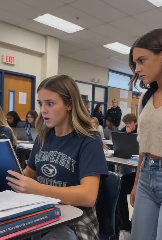
“Your laptop requires your fingerprint,” Tessa said softly.
Brielle glared at her.
“You don’t know what you’re talking about.”
“I watched you set it up.”
“You borrowed it last week.”
“Not today.”
Brielle’s breathing changed.
Mr. Jennings opened the device session record.
The administrator account had logged in at 2:47 p.m.
The folder permissions changed one minute later.
Then something stranger appeared.
At 2:51 p.m., a new folder had been created inside Brielle’s private Drive.
Its name was Premium Exam Review.
It contained copies of the same free materials removed from student access.
A payment spreadsheet was attached.
Twenty-three students had paid forty dollars each.
The room erupted.
“You were selling the school’s study materials?” someone demanded.
“My mother organized an optional tutoring program,” Brielle said.
“You locked us out so people would pay you,” another student shouted.
“That’s not what happened.”
Tessa’s voice trembled.
“You told me the money was for snacks and tutor gifts.”
Brielle turned on her.
“It was.”
“The spreadsheet says Beaumont Learning Services.”
“That’s my father’s company.”
“We know,” I said.
Mr. Jennings opened the payment records.
Several names belonged to students in the room.
One boy near the window looked furious.
“You told me the free folder had been discontinued.”
Brielle raised her hands.
“My parents told me the materials belonged to our platform because the company paid for development.”
“Teachers created those lessons,” Mr. Jennings said.
“My father’s software helped distribute them.”
“That does not give him ownership.”
Brielle looked toward the door.
It opened before she could move.
Principal Elaine Carver entered with a security officer and Assistant Superintendent Rebecca Lin.
Apparently, one of the students had already messaged the front office.
Principal Carver took in the room quickly.
The phones.
My red cheek.
Brielle’s shaking hands.
The access history displayed on the projector.
“What happened?” she asked.
Brielle began crying.
This time, the tears looked real.
“Nora attacked me over a technology problem.”
The room reacted immediately.
Several students protested at once.
“She slapped Nora!”
“We recorded it!”
“Nora never touched her!”
Brielle looked around as though the room had betrayed her.
Principal Carver’s expression hardened.
“Everyone lower your voices.”
Assistant Superintendent Lin approached the computer.
“What am I looking at?”
Mr. Jennings explained.
He showed her the screenshots, the device identification, and the copied study materials.
Ms. Lin read without speaking.
Then she looked at Brielle.
“Did you access the district curriculum administrator account?”
“No.”
“The session came from your assigned Chromebook.”
“Someone must have used it.”
“The session was authenticated by fingerprint.”
“My fingerprint data could have malfunctioned.”
Ms. Lin stared at her.
“Fingerprint authentication does not identify another student as you.”
Brielle looked toward Principal Carver.
“You know my mother.”
Principal Carver’s jaw tightened.
“Yes.”
“She can explain everything.”
“I’m sure she will have the opportunity.”
Brielle’s face fell.
The security officer asked her to step into the hallway.
She refused.
“You cannot remove me like I’m some criminal.”
“You assaulted another student,” Principal Carver said. “And there is evidence your device accessed a restricted district account.”
“My family has supported this school for years.”
“That does not place you above school policy.”
Brielle looked directly at me.
“This is your fault.”
My cheek still burned.
“No,” I said. “The history was there before I opened it.”
She was escorted from the room.
I should have felt relieved.
Instead, I noticed Assistant Superintendent Lin staring at the administrator account details.
Her expression had changed.
“What is it?” I asked.
She closed the panel.
“Nothing students need to worry about.”
The words reminded me of every adult who had ever decided that silence was protection.
“You recognized the account,” I said.
Ms. Lin looked at me.
“Nora, you have been through enough today.”
“That isn’t an answer.”
Principal Carver stepped closer.
“The district will investigate.”
“Will students get access to the folder tonight?”
“Yes.”
“Will the original activity log be preserved?”
Ms. Lin’s gaze sharpened.
“Why are you asking?”
“Because the administrator account did not belong to Brielle.”
The room quieted again.
Mr. Jennings looked confused.
“The login came from her device.”
“The device used the account,” I said. “That doesn’t mean Brielle created it.”
Tessa slowly raised her phone.
“I have another screenshot.”
Brielle had apparently asked her to document more than one thing.
Tessa opened a message thread from the previous week.
Brielle had sent her a photograph of the Chromebook screen.
At the top of the image, the administrator account was already logged in.
Below it was a message from Brielle:
MOM SAYS THIS ACCOUNT LETS US FIX THE SHARING SETTINGS WITHOUT WAITING FOR THE TEACHERS.
Principal Carver read the message.
“Her mother gave her district administrator credentials?”
Ms. Lin said nothing.
I studied her face.
“You knew.”
Principal Carver turned toward her.
“Rebecca?”
Assistant Superintendent Lin glanced at the students still recording.
“Phones need to be put away.”
Nobody moved.
“Now.”
Tessa held hers tighter.
Mr. Jennings stepped between Ms. Lin and the students.
“With respect, this matter concerns their exam access and potentially stolen teacher materials.”
“It also concerns protected district systems.”
“Protected from whom?” I asked. “The people whose work was copied?”
Ms. Lin closed her eyes briefly.
Then she told us the truth.
Brielle’s mother, Corinne Beaumont, was not merely a foundation board member.
She had been contracted by the district to oversee the transition to a new digital learning platform.
As part of the work, she had temporary access to curriculum folders, student-account permissions, and usage analytics.
That access should have expired three months earlier.
It had not.
Corinne had continued using the account.
Worse, the district had known.
“Why?” Principal Carver asked.
Ms. Lin lowered her voice.
“Because Beaumont Learning Systems threatened to withdraw funding if we revoked platform access before contract renewal.”
A student laughed bitterly.
“So they owned the district?”
“No,” Ms. Lin replied.
“They owned the account,” I said. “That was enough.”
Principal Carver turned toward Ms. Lin.
“How much access did Corinne have?”
“More than she should have.”
“That is not a number.”
“Student data, curriculum documents, assessment schedules, and analytics.”
The last phrase caught my attention.
“Assessment schedules?”
Ms. Lin did not answer.
Mr. Jennings did.
“District exams.”
A cold silence spread through the room.
Six days before district exams, the daughter of a technology contractor had used an administrator account to restrict study materials and sell access.
But if that account could view assessment schedules, then the locked folder might not be the worst thing hidden inside it.
“Can the account access exam drafts?” I asked.
“No,” Ms. Lin said immediately.
Too immediately.
Principal Carver looked at her.
“Rebecca.”
“Only metadata.”
“What kind of metadata?”
“File names, upload dates, permissions.”
“Can it open attached documents?”
“Not under standard settings.”
“Were standard settings used?”
Ms. Lin did not respond.
The principal called the district legal office.
The math prep room was cleared.
Students were sent home, though none of us truly left the story behind. Videos had already spread across school accounts. By evening, local parents were asking why a private company had access to district curriculum systems.
My mother picked me up from school.
She was a nurse who worked long shifts and had little patience for people who confused money with intelligence.
When she saw the mark on my face, she gripped the steering wheel so tightly her knuckles whitened.
“She hit you?”
“In front of everyone.”
“And the school waited until after that to check the record?”
“Yes.”
My mother stared through the windshield.
“I am trying to choose a response that will not require bail money.”
Despite everything, I smiled.
At home, she photographed my cheek and called an attorney.
I sat at the kitchen table, refreshing the school folder.
Access had been restored.
But several files were missing.
The recorded tutoring sessions were there.
The worksheets were there.
The district-exam strategy guides were not.
I checked the trash.
Empty.
Then I remembered the earlier direct link saved in my browser.
The folder ID still existed, even though its title had changed.
Someone had moved the files into an archive labeled Legacy Materials.
I opened the activity panel.
At 5:16 p.m., while district officials were supposedly preserving evidence, the archive had been transferred to another owner.
The new owner was Beaumont Learning Systems.
I took screenshots.
Then I called Principal Carver.
She answered on the second ring.
“How did you get this number?”
“It was on the student handbook.”
“What happened?”
“The files are being moved.”
She went silent.
“Send me everything.”
I did.
Twenty minutes later, the folder disappeared completely.
But the screenshots remained.
The next morning, the district announced that all exams would proceed as scheduled.
Corinne Beaumont released a statement claiming her daughter had made an “immature mistake” while trying to organize optional tutoring resources.
She denied selling public school property.
She also claimed that no confidential exam information had been accessed.
By lunch, most students believed the scandal was over.
Brielle was suspended.
The paid folder was removed.
The slap video had been viewed thousands of times.
The district promised a review.
But Tessa found me in the library.
She sat across from me and placed her phone on the table.
“I need to show you something.”
She looked exhausted.
“Why did Brielle ask you to take all those screenshots?”
“She said her mother wanted proof that the teachers were disorganized.”
“Why would that matter?”
“The district was considering whether to replace teacher-managed folders with the Beaumont platform.”
“So they wanted the free system to fail.”
Tessa nodded.
“Brielle changed passwords and permissions before. Small things. Broken links. Missing worksheets. Then her mother used the failures in presentations.”
My stomach turned.
The locked math folder had not been a single act of greed.
It was part of a campaign.
Make the free teacher system look unreliable.
Convince the district to adopt the private platform.
Charge the schools for access to materials teachers had created themselves.
Tessa opened another image.
It was a photograph of a document on Corinne’s desk.
The page listed schools, platform fees, and projected profits.
At the bottom was a section titled Assessment Integration.
Beside Franklin Heights Academy was a handwritten note:
EARLY EXAM ALIGNMENT CONFIRMED THROUGH E.C.
“Who is E.C.?” I asked.
“I don’t know.”
Principal Elaine Carver.
The initials struck me immediately.
But I did not want to believe it.
Principal Carver had defended me.
She had ordered Brielle removed.
She had challenged the district official.
Still, my grandfather’s voice echoed in my memory.
Numbers don’t betray people. People betray numbers.
Initials were not proof.
We needed the original file.
Tessa said Brielle kept copies of her mother’s documents in a private shared folder.
“Can you access it?”
“Brielle removed me yesterday.”
“Did you save the folder link?”
“Yes.”
A removed user could not open a folder, but the sharing-request page sometimes displayed the current owner.
We opened it.
The owner was not Corinne Beaumont.
It was Elaine Carver.
My chest tightened.
We took the information to Mr. Jennings.
He contacted the district’s independent technology auditor rather than Assistant Superintendent Lin.
By afternoon, state investigators had arrived.
They discovered that Principal Carver and Corinne Beaumont had been partners long before the technology contract.
Carver provided internal curriculum schedules.
Corinne used the data to align her company’s paid materials with likely exam content.
The platform did not contain direct copies of test questions.
That would have been too obvious.
Instead, it gave paying students practice sets built around the exact concepts, question structures, and difficulty sequence scheduled for district exams.
Students using the free folder studied everything.
Students paying Beaumont Learning Systems studied what was most likely to appear.
The advantage was subtle enough to look like better tutoring.
It had operated for nearly two years.
But the most shocking discovery was not Principal Carver’s involvement.
It was who had exposed her.
Assistant Superintendent Lin called me into the district office three days later.
My mother came with me.
Tessa and Mr. Jennings were also present.
On the conference-room table sat a printed email.
It had been sent anonymously to the state education department four months earlier.
The email warned that Beaumont Learning Systems had unauthorized access to district curriculum accounts.
Attached were screenshots, account logs, and the phrase:
WATCH WHAT HAPPENS TO THE FREE MATH FOLDER BEFORE EXAMS.
The anonymous sender had predicted the exact incident.
“Why didn’t the state investigate then?” my mother asked.
“They requested additional evidence,” Ms. Lin said. “The sender stopped responding.”
“Who sent it?” I asked.
The door opened.
Brielle entered with her attorney.
She looked smaller without her usual group around her.
A faint bruise of exhaustion rested beneath her eyes.
Ms. Lin pushed the email toward her.
“Brielle sent it.”
I stared at her.
“That makes no sense.”
Brielle sat across from me.
“My mother had been using me for months.”
Her voice was barely above a whisper.
“She told me changing permissions was part of testing the new platform. She said the free folders needed to fail sometimes so the district would understand why professional software was necessary.”
“You still locked students out,” I said.
“Yes.”
“You sold access.”
“She told me to call it an advanced tutoring group.”
“You slapped me.”
Tears filled her eyes.
“Yes.”
“Then why report your own family?”
“Because I found the exam-alignment files.”
The room remained silent.
Brielle explained that she had discovered her mother and Principal Carver were using upcoming exam structures to design paid study materials.
At first, she believed the advantage was only strategic.
Then she learned that scholarship committees used district exam scores.
Students paying Beaumont were not only receiving better preparation.
They were gaining an artificial advantage in class placements, awards, and academic rankings.
Brielle sent the anonymous email.
But she lost courage when the state asked to interview her.
“Then why keep helping your mother?” I asked.
“Because she found the email draft on my computer.”
Brielle wiped her face.
“She said my father would be charged too. She said the company would collapse, employees would lose jobs, and everyone would blame me.”
“That does not explain why you attacked Nora,” my mother said coldly.
Brielle looked at me.
“When Nora found the permission change, I thought the investigation had already started. I thought she knew I was the anonymous source.”
“You were afraid I would expose you for telling the truth?”
“I was afraid you would expose everything before I was ready.”
“So you tried to destroy my credibility.”
“Yes.”
The honesty hurt more than another excuse would have.
She had wanted the truth revealed.
But only in a way that protected her.
When I came too close, she sacrificed me.
“I cannot forgive that,” I said.
“I know.”
“You made me look unstable.”
“I know.”
“You nearly let students lose access before exams.”
“I know.”
“And you stood there while your friends laughed.”
Brielle lowered her eyes.
“I was a coward.”
Her attorney placed a hand on her shoulder, but she moved away from it.
“I thought exposing my mother would make me brave,” she continued. “But bravery is not sending one anonymous email. It is telling the truth when people know your name.”
She agreed to testify.
Principal Carver was removed from the school that afternoon.
Corinne Beaumont was charged with unauthorized system access, fraud, misuse of student data, and conspiracy to manipulate public education contracts.
The district canceled its agreement with Beaumont Learning Systems.
All upcoming exams were replaced.
Previous exam scores connected to scholarship decisions were reviewed by an independent panel.
Students who had been unfairly denied placements received new evaluations.
The free study folder was restored under teacher ownership.
Every access change became visible in a public audit log.
No private company could alter permissions.
No administrator could transfer ownership without approval from three independent staff members.
Mr. Jennings asked me to help design the transparency rules.
I told him I would do it only if student representatives could review them too.
He agreed.
Tessa joined the committee.
So did two students who had paid for Brielle’s review circle and one student who had been locked out completely.
Brielle was not allowed back at school immediately.
She completed the semester through remote classes while the disciplinary board reviewed the assault.
She later pleaded guilty in juvenile court to a reduced charge and received community service, counseling, and a formal no-contact order that remained in place until I chose to modify it.
I did not modify it for six months.
By then, the district had opened a new academic resource center in a converted library wing.
The room contained computers, tutoring stations, printed materials, and free access to every review course.
A plaque near the entrance read:
EDUCATIONAL RESOURCES CREATED WITH PUBLIC FUNDS BELONG TO THE STUDENTS THEY WERE MEANT TO SERVE.
On the opening day, Mr. Jennings handed me a small framed screenshot.
It was the original access list Tessa had saved.
Brielle’s name appeared as an editor.
Beneath it, he had added another line:
THE TRUTH SURVIVED BECAUSE SOMEONE KEPT THE EARLIER VERSION.
Tessa stood beside me.
“I almost deleted that screenshot,” she said.
“Why?”
“Brielle told me it was useless.”
I looked at the frame.
“People call records useless when they are afraid of what the records remember.”
That afternoon, I saw Brielle outside the center.
She stood near the glass doors with her hands in the pockets of a plain coat.
No expensive school jacket.
No crowd.
No camera pointed toward her.
She had completed nearly two hundred hours of community service helping digitize free tutoring materials for rural districts.
She waited until I approached.
“I heard they named you student transparency representative,” she said.
“I heard you testified again.”
“My mother’s trial starts next month.”
“Are you scared?”
“Yes.”
It was the simplest answer she had ever given me.
She looked through the glass at the students using the center.
“I used to think access was something valuable because not everyone had it.”
“And now?”
“Now I think that was the ugliest thing I learned from my family.”
I studied her face.
The girl who had slapped me was still part of her.
So was the girl who had sent the anonymous warning.
Neither erased the other.
“I’m not ready to be your friend,” I said.
“I didn’t expect you to be.”
“But I changed the no-contact order.”
Her eyes widened.
“That doesn’t mean everything is fixed.”
“I know.”
“It means you can attend committee meetings as a community-service representative.”
She let out a breath that sounded almost like a laugh.
“You’re putting me on a committee?”
“You will not control passwords.”
“Fair.”
“You will not remove anyone’s access.”
“Also fair.”
“You will organize file names and compare permission logs.”
Her expression softened.
“The boring work?”
“The most important work is usually boring until someone ignores it.”
She nodded.
“I’ll be there.”
District exam results were released two months later.
For the first time, every student had prepared from the same materials.
Scores did not collapse, as Beaumont Learning Systems had predicted.
They improved.
Not because everyone suddenly became better at math.
Because the students who had once been excluded finally had the same chance to learn.
At the end-of-year assembly, Assistant Superintendent Lin invited me to speak.
I walked onto the stage beneath bright auditorium lights.
A year earlier, I would have hated every second of standing in front of so many people.
Now I looked at the rows of students and remembered the math prep room.
The slap.
The phones.
The whispers.
The moment everyone expected me to become the embarrassing part of Brielle’s story.
I told them about access logs.
I told them about version history.
I told them that digital files were not invisible just because someone expected students to stop asking questions.
Then I looked toward the back row.
Tessa sat beside Mr. Jennings.
Brielle sat several seats away, wearing a visitor badge and holding a folder of audit reports.
“When someone changes the story,” I said, “look for the earlier version. When someone tells you a detail is too small to matter, ask who benefits if you ignore it. And when power closes a door, remember that history often records who changed the lock.”
The auditorium remained quiet for one heartbeat.
Then the applause began.
My mother stood first.
Mr. Jennings followed.
Then Tessa.
Eventually, almost everyone rose.
Brielle did not stand immediately.
She looked down at her hands.
Then she rose too.
Not as the center of attention.
Not as the victim.
Not as the person who controlled the room.
Just as someone learning to live without hiding the record.
Later, in the resource center, I opened the Franklin Free Math Prep folder.
At the top of the page, beneath the title, a new line had been added:
OWNED BY FRANKLIN HEIGHTS TEACHERS. ACCESSIBLE TO EVERY STUDENT. FULL HISTORY PRESERVED.
I clicked the sharing icon.
No secret administrator accounts appeared.
No private company owned the materials.
No student had been removed.
The access list was long, ordinary, and exactly the same for everyone.
That was the happy ending nobody would have considered dramatic before all of this happened.
The folder opened.
THE END
