The first sound I heard after Vivienne Kensington slapped me was not a gasp.
It was the soft tearing of fabric.
My dress had already been damaged when she stepped on the hem, but the force of the slap made me twist sideways, and the narrow seam I had sewn by hand split beneath my arm.
For one terrible second, I stood in the center of the ballroom with one palm pressed against my cheek and the other clutching the side of my dress closed.
Crystal chandeliers burned above me.
A string quartet continued playing near the marble staircase because none of the musicians knew whether they were supposed to stop.
Around us, Connecticut’s wealthiest donors stared over champagne glasses and polished silver place settings.
Some looked shocked.
Others looked entertained.
Vivienne Kensington looked satisfied.
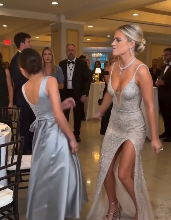
She wore a pale gold gown designed specifically for that evening, with hand-sewn crystals across the bodice and a skirt that moved like liquid beneath the ballroom lights. Her blond hair had been pinned into a flawless knot. Diamonds shone at her ears.
Beside her, I must have looked exactly like what people had assumed when I entered.
A scholarship invitation.
A girl who had altered a secondhand dress in her bedroom.
Someone allowed into the room, but not meant to stand at the center of it.
Vivienne lowered her hand slowly.
“You should have stayed in your place,” she said.
Her voice was quiet enough to sound controlled and loud enough for the honor table to hear.
I tasted blood where my tooth had caught the inside of my lip.
“My name was on the program.”
“Because you manipulated someone into putting it there.”
“I was selected.”
“You were tolerated.”
The words moved through the ballroom like smoke.
Nobody rushed forward.
That was the strange thing about public cruelty among powerful people. Everyone recognized it, but most waited to see which side would become safer.
My name is Elena Park. I was eighteen years old, Korean American, raised by my grandmother in the small apartment above her alterations shop in Bridgeport.
The dress I wore that night had cost twenty-eight dollars at a thrift store.
It had once been dark green, with oversized sleeves and a damaged zipper. I replaced the zipper, narrowed the waist, shortened the sleeves, and stitched tiny black beads along the neckline using leftovers from a customer’s discarded evening jacket.
I had spent eleven nights altering it after finishing homework and helping my grandmother close the shop.
I was proud of that dress.
Vivienne knew it.
Before she slapped me, she had lifted a glass of red cranberry punch from a passing tray and tipped it down the front of my skirt.
She pretended it had been an accident.
Then, while I stared at the spreading stain, she stepped onto my hem and whispered that I had stolen her place in the ceremony.
When I tried to walk away, she slapped me.
She believed the room would remember the damaged dress more clearly than the reason I was standing there.
She was almost right.
“Elena!”
A woman hurried from the side entrance carrying a staff tablet.
Her name was Mara Ellis, the operations manager for Bellweather Equestrian Foundation, the organization hosting the gala. She had spent the past hour coordinating caterers, security staff, auction displays, and the presentation schedule.
She stopped when she saw my face.
“What happened?”
Vivienne answered before I could.
“She became aggressive after being informed there was an error in the program.”
Mara looked at the red liquid covering my dress.
“An error?”
Vivienne’s mother, Caroline Kensington, rose from the honor table.
She was chair of the Bellweather Foundation board and the kind of woman who could turn an insult into a sentence that sounded charitable.
“There has been an unfortunate misunderstanding,” she said. “Elena appears to believe she was chosen to open the ceremony.”
“I was chosen,” I replied.
Caroline smiled at me.
Not warmly.
Patiently.
As though I were a child insisting on an imaginary title.
“The opening presentation is traditionally performed by the junior patron representative.”
“That title does not exist.”
The smile disappeared.
Several donors exchanged glances.
Vivienne stepped closer to her mother.
“It should have been me.”
Mara tightened her grip on the tablet.
“The program was approved yesterday. Elena’s name is listed as the opening presenter.”
Caroline turned toward her.
“Then the program contains an unauthorized change.”
“I entered the final version from the board-approved file.”
“Who submitted that file?”
“Mr. Whitaker.”
A murmur rose near the honor table.
Thomas Whitaker was the foundation’s principal donor. His family had owned Bellweather Farm for almost a century before placing most of the property into a charitable trust.
He had not yet entered the ballroom.
Caroline lifted her chin.
“Mr. Whitaker would not personally select a student presenter.”
Mara looked at me.
“He did.”
Vivienne laughed.
It was a small sound, but there was panic beneath it.
“That is ridiculous.”
I held my torn dress closed.
“Why?”
“Because he doesn’t know you.”
“Yes, he does.”
Vivienne stared at me.
I had not meant to reveal that yet.
The ceremony was supposed to explain everything.
My presence at the gala was not the result of pity, a school nomination, or a diversity invitation, as several guests had whispered.
I had been asked to open the evening because Bellweather Farm would not have survived the previous winter without me.
Not financially.
Not operationally.
Literally.
But Caroline Kensington had spent months making sure no one knew that.
She stepped away from the honor table.
“Mara, close the program file and remove Elena from the presentation list. We will address the matter privately.”
“No,” I said.
Caroline turned.
“Excuse me?”
“I’m not leaving before the file is opened.”
Vivienne glanced at the tablet.
“What file?”
“The official care ledger.”
Her face changed.
The color did not vanish completely, but something shifted behind her eyes.
Fear.
That was when I knew she understood exactly what I meant.
Bellweather Farm housed thirty-two horses, including retired racehorses, therapy animals, and competition horses donated by wealthy families. The foundation claimed to fund rehabilitation, youth riding programs, and veterinary support for neglected animals.
Its annual gala raised millions.
Most guests knew the horses through photographs projected behind auction tables.
I knew them by the sounds they made before dawn.
I knew which stall doors stuck during cold weather.
I knew that Maple refused medicine unless it was hidden inside mashed banana.
I knew Samson’s left hind leg stiffened whenever the temperature dropped.
I knew that Luna stopped eating three days before her infection became visible.
For nearly a year, I had worked weekends at Bellweather as part of a school agricultural-science placement.
At least, that was what the paperwork said.
In reality, I often arrived before the paid staff and left after the final feeding because the foundation had quietly reduced stable hours to save money before the gala season.
My official duties were basic.
Clean water containers.
Prepare feed.
Brush horses.
Record observations.
But by December, I was doing far more.
The stable supervisor, Mr. Alvarez, had warned the board that the heating system in the rehabilitation barn was failing. He sent repair requests in October, November, and December.
Each request disappeared.
Then, during the coldest week of January, the pipes froze.
Water stopped flowing to one wing of the barn.
Two staff members called out sick.
The emergency generator failed.
And twelve horses were left inside a building where the temperature dropped hour after hour.
I was the one who found them.
I was the one who called Mr. Alvarez.
I was the one who began carrying heated water from the main barn in five-gallon containers because the emergency maintenance number went unanswered.
For three nights, my grandmother drove me to Bellweather after closing the shop.
Mr. Alvarez and I slept in the tack room between feeding checks.
We wrapped the oldest horses in extra blankets, monitored their temperatures, and recorded every treatment in the stable’s digital care ledger.
When Luna developed respiratory distress, I recognized the warning signs from a veterinary science class and insisted we call the emergency vet immediately.
That decision saved her life.
The ledger documented all of it.
My name appeared on more than one hundred entries.
But the version prepared for the gala removed me.
In the public report, Vivienne Kensington was listed as the leader of the “Winter Rescue Initiative.”
Vivienne had visited the stable once during the crisis.
She arrived with a photographer.
She posed beside Luna for eleven minutes and left before feeding time.
I discovered the altered report two days before the gala when Mara asked me to verify a photograph.
The caption described Vivienne as “the young volunteer whose leadership protected Bellweather’s most vulnerable horses during the winter emergency.”
I told Mara it was false.
Mara checked the staff tablet.
The original ledger did not match the donor report.
She notified Thomas Whitaker.
He ordered that I be invited to open the ceremony and present the real rescue record.
Caroline Kensington tried to stop it.
Now her daughter had damaged my dress and slapped me in front of the very people who were supposed to see the truth.
Mara unlocked the tablet.
Caroline moved toward her.
“This is neither the time nor the place.”
Mara stepped back.
“It is exactly the time. The opening presentation begins in twelve minutes.”
“There will be no presentation.”
“That decision belongs to Mr. Whitaker.”
Caroline’s eyes hardened.
“I chair this board.”
“And he controls the trust.”
For the first time, the balance in the room shifted.
The guests nearest the honor table stopped watching me and began watching Caroline.
Vivienne sensed it too.
She pointed at the tablet.
“That ledger was edited.”
“Yes,” I said. “The donor copy was.”
“You did it.”
“I don’t have administrator access.”
“You had access to the stable system.”
“To enter care notes.”
“You could have added your name later.”
Mara opened the ledger history.
“Every entry has a timestamp, device identifier, staff confirmation, and location record.”
Vivienne’s mouth tightened.
Caroline remained calm.
“Digital records can be misunderstood.”
A man seated beside the empty chair reserved for Thomas Whitaker rose.
He was in his sixties, with a narrow face and a black tuxedo that looked uncomfortable on him. I recognized him as Dr. Samuel Levin, the veterinarian who had treated Luna during the winter emergency.
He looked at Mara.
“Open the January seventeenth records.”
Caroline turned toward him.
“Samuel, this is a board matter.”
“No,” he replied. “Animal-care records are a medical matter.”
Mara selected the date.
The first entry appeared on the ballroom display because the tablet was already connected to the presentation screen.
JANUARY 17 — 4:46 A.M.
REHABILITATION BARN TEMPERATURE: 34°F AND FALLING.
WATER LINE FROZEN.
HORSES MOVED TO INTERIOR STALLS.
RECORDED BY: ELENA PARK.
CONFIRMED BY: MIGUEL ALVAREZ.
The ballroom became still.
Mara scrolled.
5:12 A.M.
MAPLE — WARM WATER ADMINISTERED. REDUCED APPETITE. EXTRA BLANKET ADDED.
RECORDED BY: ELENA PARK.
5:34 A.M.
SAMSON — STIFFNESS LEFT HIND LEG. WALKED IN INDOOR AISLE FOR CIRCULATION. VETERINARY ADVICE REQUESTED.
RECORDED BY: ELENA PARK.
6:03 A.M.
LUNA — COUGHING, NASAL DISCHARGE, ELEVATED RESPIRATORY RATE. EMERGENCY VETERINARIAN CONTACTED.
RECORDED BY: ELENA PARK.
Dr. Levin looked around the room.
“I received that call at 6:06.”
Vivienne crossed her arms.
“That does not prove she ran anything.”
Mara opened the next file.
It was a voice note attached to the ledger.
My own exhausted voice filled the ballroom.
“Luna’s breathing is worsening. Mr. Alvarez is moving Maple and Samson. I’m staying with Luna until Dr. Levin arrives.”
Behind my voice came the sound of hooves striking straw and wind pressing against the barn doors.
The recording ended.
Several guests looked at me differently.
Not with pity.
With attention.
Caroline stepped toward the screen.
“This was supposed to be an evening of celebration, not a public examination of operational difficulties.”
Dr. Levin stared at her.
“Operational difficulties?”
“No horse died.”
“Because Elena recognized the emergency.”
“And because our professional staff responded.”
“After she called them.”
Vivienne shook her head.
“This still doesn’t explain why she should open the gala.”
I turned toward her.
“The gala theme is ‘The Hands That Saved Bellweather.’”
“That refers to donors.”
“No,” Dr. Levin said. “It should refer to the people who actually saved it.”
The doors at the rear of the ballroom opened.
Thomas Whitaker entered.
He moved slowly with a cane, accompanied by his attorney and a young assistant carrying a folder.
Conversations stopped one by one.
Thomas had not attended a Bellweather gala in three years. Illness had kept him away from public events, and Caroline had gradually become the visible authority of the foundation.
But the room still belonged to him in a way no title could replace.
His gaze traveled from the stained front of my dress to the torn seam beneath my arm.
Then he looked at Vivienne.
“What happened?”
Caroline hurried toward him.
“Thomas, there has been an unfortunate confrontation.”
“I did not ask for a summary.”
He pointed at my dress.
“What happened to her?”
Nobody answered.
A phone video had captured the entire incident.
One of the catering assistants, a young man named Devon, stepped forward and held out his phone.
“I recorded it, sir.”
Caroline looked furious.
“You should not be filming guests.”
“I started recording because Miss Kensington poured punch on Elena.”
“I dropped a glass,” Vivienne snapped.
Devon played the video.
On the ballroom screen, everyone watched Vivienne tilt the glass deliberately over my skirt.
They watched her step on the hem.
They heard her whisper, “You will never stand in front of my family’s donors.”
Then they watched her slap me.
The video ended.
Thomas looked at Vivienne.
“Did Elena touch you?”
Vivienne said nothing.
“Did she threaten you?”
“No.”
“Then why did you strike her?”
Vivienne looked at her mother.
Caroline stepped in front of her.
“My daughter believed Elena had manipulated the ceremony.”
Thomas turned toward Caroline.
“Why would she believe that?”
Caroline’s face remained composed.
“Because the program was changed at the last minute.”
“By me.”
The words landed softly.
Their effect was immediate.
Vivienne’s mouth opened.
Caroline blinked.
Thomas continued.
“I selected Elena after reviewing the original care ledger.”
Caroline lowered her voice.
“You should have consulted the board.”
“I consulted the evidence.”
“This foundation has traditions.”
“It has obligations.”
“You cannot allow a temporary worker to become the public face of Bellweather.”
I felt every person in the room turn toward me again.
Thomas’s expression hardened.
“She was not temporary when she kept the rehabilitation barn functioning.”
“She was a student intern.”
“She performed work this board failed to provide.”
Caroline’s voice sharpened.
“That is an exaggeration.”
“Then open the financial file.”
The room went silent.
Mara looked at the assistant carrying the folder.
Caroline’s confidence finally faltered.
“What financial file?”
Thomas tapped his cane once against the floor.
“The one comparing stable operations with gala expenditures.”
Vivienne looked at her mother.
Caroline did not look back.
Thomas’s assistant connected a second device to the ballroom screen.
A spreadsheet appeared.
During the six months before the winter emergency, Bellweather had reduced stable staffing by thirty-two percent.
Veterinary supply orders had been delayed.
Heating-system repairs had been rejected three times.
At the same time, gala spending had increased dramatically.
Imported flowers.
Custom lighting.
Designer table linens.
A promotional film.
A private wardrobe consultant.
Then one line appeared near the bottom.
JUNIOR PATRON IMAGE DEVELOPMENT — $48,700.
Vivienne’s face went white.
“What is that?”
Thomas looked at Caroline.
“I was hoping you would explain.”
Caroline straightened.
“That category covers youth outreach.”
The assistant opened the attached invoices.
Gown fittings.
Professional photography.
Social-media management.
A public-speaking coach.
A private riding videographer.
All listed under Vivienne Kensington’s name.
A donor at the second table stood.
“You used foundation money to promote your daughter?”
Caroline’s expression became icy.
“I invested in the foundation’s future leadership.”
“With money intended for animal care?” Dr. Levin asked.
“Visibility attracts donations.”
“Luna nearly died while you paid for photographs.”
“That is an inflammatory distortion.”
Thomas’s attorney opened another file.
“It may also be financial misconduct.”
A wave of whispers moved through the ballroom.
Vivienne stared at the invoices.
“Mom, you told me Dad paid for those things.”
Caroline spoke without turning.
“Not now.”
“You said the foundation wanted me as an ambassador.”
“It did.”
“No. You did.”
Caroline looked at her daughter.
“I built every opportunity you have.”
Vivienne’s voice cracked.
“You told me everyone chose me.”
“They would have, eventually.”
The cruelty of the answer seemed to surprise even Caroline.
Vivienne stepped backward.
All evening, I had believed she attacked me because she could not stand losing a moment of attention.
That was true.
But the person standing behind her had spent years teaching her that attention was proof of worth.
Thomas addressed the room.
“The gala will pause for thirty minutes.”
Caroline stared at him.
“You cannot do this publicly.”
“You made it public when you placed your daughter at the center of a false rescue narrative.”
“I protected Bellweather’s reputation.”
“You protected your own.”
Security staff approached the honor table.
Thomas’s attorney informed Caroline that her authority as board chair had been suspended pending an independent audit.
Vivienne looked at me.
The anger had left her face.
What remained was fear and humiliation.
The same emotions she had tried to force onto me.
“I didn’t know about the money,” she said.
I held the torn side of my dress.
“You knew the rescue story was false.”
She swallowed.
“Yes.”
“You knew I had done the work.”
“I knew you were there.”
“You posed beside Luna after the danger was over.”
“My mother said the photographs would help donations.”
“And when my name appeared on the program?”
“She told me you were trying to take everything.”
I looked around the ballroom.
“What exactly did I take?”
Vivienne had no answer.
I had not taken her gown.
Her family name.
Her money.
Her place at the honor table.
I had only refused to surrender the truth.
Thomas approached me.
Up close, he looked more tired than powerful.
“I am sorry,” he said.
I did not know whether he meant the slap, the stolen credit, or the conditions in the barn.
“Did you know the repair requests were being denied?” I asked.
His eyes lowered.
“Not until last week.”
“You should have known.”
“Yes.”
The answer surprised me.
Powerful people rarely admitted failure without adding an explanation that made it sound unavoidable.
Thomas did not.
“I trusted the board reports,” he said. “That was negligence.”
Mr. Alvarez entered the ballroom from the service corridor. He was still wearing his dark stable jacket because he had come directly from evening feeding.
When he saw my dress, his expression darkened.
“What happened?”
I almost laughed.
The question had been asked so many times, but no answer seemed large enough.
“Vivienne slapped me.”
He looked toward her.
Then at Caroline.
“I told you the ledger would come back.”
Caroline’s face tightened.
Thomas turned to him.
“What does that mean?”
Mr. Alvarez removed a thick folder from his jacket.
“I kept printed copies.”
He placed them on the honor table.
Every repair request.
Every staffing warning.
Every veterinary supply delay.
Each one bore Caroline’s electronic approval or rejection.
But the final page was different.
It was an internal memo recommending that Mr. Alvarez be dismissed after the gala for “failing to maintain donor confidence.”
The memo also recommended ending the student placement program.
That meant removing me.
Caroline had not only rewritten the winter rescue.
She planned to eliminate the two people who could contradict it.
Thomas read the memo in silence.
Then he looked at Caroline.
“You intended to fire him?”
“He resisted necessary organizational changes.”
“He kept the horses alive.”
“He constantly challenged the board.”
“Because the board was endangering animals.”
Caroline’s composure finally shattered.
“You have no idea what it takes to keep wealthy people interested! They do not donate for water pipes and night staff. They donate for beauty, prestige, stories, faces they recognize.”
She pointed toward me.
“They do not write six-figure checks because an unknown girl carried buckets through a barn.”
The room became painfully still.
Thomas turned toward the donors.
“Is she right?”
Nobody answered.
He waited.
A woman in a silver shawl stood.
“I donated for the rehabilitation program.”
Another guest rose.
“I donated because your report said emergency care was fully funded.”
A third donor spoke.
“I would rather pay for heating than another promotional film.”
More voices followed.
Caroline looked around the ballroom as the certainty beneath her collapsed.
She had spent years claiming donors required a polished lie.
Now the donors were rejecting the lie in front of her.
Thomas faced me.
“The ceremony was meant to begin with the Bellweather Cup.”
On a pedestal near the stage stood a silver trophy engraved with the names of past patrons.
Vivienne’s name had already been printed on several unofficial programs as the person expected to raise it.
Thomas extended his hand toward me.
“Will you still open the ceremony?”
I looked down at my dress.
The cranberry stain had darkened across the skirt.
The side seam was split.
One sleeve hung slightly lower than the other.
Caroline had wanted the room to believe that appearance decided who belonged at the front.
Vivienne had counted on shame finishing what the punch and slap began.
I thought of my grandmother, who could repair nearly anything with thread, patience, and enough light.
Then I saw her near the ballroom entrance.
She had arrived after receiving Mara’s call.
Mrs. Sun-hee Park stood barely five feet tall in a black suit she had made twenty years earlier. A measuring tape hung from her handbag because she carried one everywhere.
She looked at me.
Then she looked at the damaged seam.
“Ten minutes,” she said.
A small laugh escaped me.
My grandmother led me into the staff dressing room while the gala paused.
She examined the stain and tear without asking whether I wanted to leave.
She knew me better than that.
“The stain will remain,” she said.
“I know.”
“I can close the seam.”
“Do it.”
She removed a sewing kit from her handbag.
As she worked, I watched her hands.
Those hands had altered wedding gowns, school uniforms, funeral dresses, and clothing for families who could pay only a little.
“People laughed at the dress,” I said.
“They laughed before they saw the stitching.”
“Some of them still will.”
She tied off the thread.
“Then they can laugh from their seats while you stand on the stage.”
When we returned, the cranberry stain remained visible.
My cheek was still red.
But the dress held.
The ballroom lights dimmed.
Thomas walked to the microphone.
He did not hide what happened.
He announced Caroline’s suspension, the audit, and the creation of an emergency animal-care fund using money redirected from promotional expenses.
He also announced that the board would no longer allow donor families to approve awards, volunteer recognition, or youth leadership positions involving their own relatives.
Then he called my name.
I walked to the stage in clean flats and a stained thrifted dress.
No one whispered this time.
Mara brought the Bellweather Cup forward.
It was heavier than I expected.
I placed both hands beneath it.
Behind me, the screen displayed photographs from the winter emergency.
Not the staged photograph of Vivienne beside Luna.
Real photographs.
Frozen pipes.
Buckets lined along the aisle.
Mr. Alvarez sleeping in a folding chair.
Me kneeling beside Luna with my hand beneath her jaw.
The final image showed Luna standing in morning light three weeks after her recovery.
I raised the cup.
The applause began near the stable staff’s table.
Then the donors joined.
Soon the entire ballroom was standing.
I did not mistake applause for justice.
Justice would require repaired barns, paid staff, transparent records, and consequences that lasted after the chandeliers were turned off.
But for that moment, the truth was no longer hidden in a tablet.
It was visible.
After the gala, Caroline Kensington was formally removed from the board. The audit found that she had redirected more than two hundred thousand dollars from animal-care budgets into image campaigns, private events, and expenses connected to Vivienne.
Some of the spending violated foundation rules.
The rest violated donor agreements.
The case went to state regulators.
Bellweather recovered part of the money and canceled the following year’s luxury gala.
Instead, it held an open farm day with public financial reports posted beside each program.
The rehabilitation barn received a new heating system before autumn.
Mr. Alvarez became director of equine care.
Every stable worker received increased hours and emergency training.
My student placement became a paid position.
Thomas also created the Elena Park Animal-Care Scholarship.
I asked him to change the name.
“It should not belong to one person,” I said.
The final name became the Bellweather Night Staff Scholarship, honoring everyone who performed invisible work after donors went home.
Vivienne disappeared from school for two weeks.
When she returned, she had withdrawn from the junior patron program.
Most students expected her to act as though nothing had happened.
Instead, she found me outside the library.
She wore jeans, a plain sweater, and no makeup.
The confidence that once entered rooms before her was gone.
“I owe you an apology,” she said.
“You owe me more than words.”
“I know.”
She handed me an envelope.
Inside was a check for the full cost of repairing the dress.
I gave it back.
“The dress cost twenty-eight dollars.”
“For the damage.”
“My grandmother repaired it.”
“Then for the cleaning.”
“The stain is staying.”
She looked confused.
“Why?”
“Because I wore it when the truth came out.”
Vivienne lowered her eyes.
“I was horrible to you.”
“Yes.”
“I believed my mother when she said you were trying to humiliate me.”
“You poured a drink on me before I said anything.”
“I know.”
“And you slapped me.”
Her eyes filled with tears.
“I know.”
I waited.
She took a breath.
“I knew the ledger was false. I told myself it didn’t matter because I had helped with fundraisers and visited the stable. But when your name appeared on the program, I panicked. I thought everyone would realize I had never done the thing they praised me for.”
“So you tried to make me look small.”
“Yes.”
The answer was quiet and honest.
“Why are you telling me this?”
“Because my mother still says she only did what every successful family does. She says we lost because we were unlucky.”
Vivienne looked toward the library windows.
“I don’t want to become someone who believes cruelty is bad only when it fails.”
I did not forgive her that day.
The slap still existed.
The public humiliation still existed.
Her apology did not remove the memory of standing beneath the chandeliers while strangers decided whether my pain was entertaining.
But Vivienne testified during the foundation investigation.
She admitted that her mother instructed staff to rewrite volunteer reports and confirmed that she knew the winter rescue story was false.
She sold several designer gowns and donated the money to the emergency care fund.
At first, people called it another performance.
Maybe part of it was.
People rarely change for one pure reason.
But she also began working at a small animal shelter where no photographers waited.
Months later, Mr. Alvarez told me she had asked to volunteer at Bellweather.
He refused.
“Not yet,” he said.
She accepted the answer.
That mattered more to me than a dramatic speech.
By spring, Luna was healthy enough to join the foundation’s therapy program.
On the morning she returned to the outdoor ring, I stood beside the fence in jeans and work boots.
No chandeliers.
No donors.
No cameras.
My grandmother watched from a bench, wearing a sun hat and complaining that the wind was too cold.
Luna walked slowly across the ring with a young girl on her back.
The child had spent months recovering from surgery and had been afraid to sit upright without support.
She held the saddle with both hands.
Luna took one careful step after another.
When they completed the circle, the girl smiled.
It was not a polished society smile.
It was wide, surprised, and completely real.
Thomas Whitaker stood several yards away.
He leaned on his cane and watched quietly.
“I spent years thinking the gala was the heart of Bellweather,” he said.
I looked at Luna.
“It was never the heart.”
“No.”
“The barn was.”
He nodded.
“And the people inside it.”
At graduation, I wore the altered green dress again beneath my gown.
The cranberry stain had faded but remained visible if the light struck it correctly.
My grandmother had reinforced every seam.
When my name was called, she stood and shouted louder than anyone in the auditorium.
I received a scholarship to study veterinary science and nonprofit management.
I wanted to understand both sides of what happened at Bellweather.
Saving an animal required medical knowledge.
Protecting a program required knowing where money went, who controlled it, and which quiet warnings were being ignored.
Before leaving Connecticut for college, I visited the Bellweather office one final time.
Mara handed me the old staff tablet.
“We replaced the system,” she said. “This one is being archived.”
The original winter ledger remained on it.
I opened January seventeenth.
My entries appeared exactly as they had that night in the ballroom.
Time.
Temperature.
Treatment.
Confirmation.
No speech could have explained the truth more clearly.
The record did not care what my dress cost.
It did not care which family sat at the honor table.
It did not care whose name looked better on a program card.
It recorded who showed up.
Vivienne believed ruining my dress would make me disappear.
Caroline believed a donor report could become more real than the people who carried water through a freezing barn.
They both counted on the same thing.
That appearance would matter more than evidence.
But the file opened.
The ledger remained.
And once the room saw who had done the work, no amount of money could force the truth back into hiding.
I closed the tablet and returned it to Mara.
Outside, Luna called from the rehabilitation field.
I walked toward the sound in clean work boots, with hay already clinging to my jeans.
No one mistook me for a society patron.
No one needed to.
I knew why the ceremony had happened.
I knew why the horses had survived.
And I knew that the strongest thing I had worn that night was never the dress.
It was the truth stitched beneath it.
THE END
