Charlotte Vale’s hand struck my face beside the pool lockers, but the sound that truly frightened her came from the photograph sliding across the wet tile.
It landed faceup between us.
For one second, nobody looked at me.
Everyone looked at the image.
The photograph showed lane four of the Westbridge High School swimming pool at 7:14 that morning. The floating lane divider had been moved almost three feet toward lane five, narrowing the space where our fastest swimmer would later make her final turn during the P.E. time trial.
More importantly, the picture showed who had moved it.
Charlotte’s older brother, Adrian Vale, stood waist-deep in the pool with both hands wrapped around the lane rope.
Behind him, reflected in the glass office window, was Coach Everett Sloan.
Neither of them was supposed to be there.
Charlotte stared at the photograph as if it had spoken her name.
Then she reached for it.
I stepped on the corner first.
“Don’t,” I said.
My voice shook, but I did not move my foot.
The pool locker area smelled of chlorine, damp towels, deodorant, and the sharp metallic scent of the old lockers. Water dripped from the ends of students’ hair. Girls in P.E. uniforms crowded near the benches, some holding phones, others pretending not to stare.
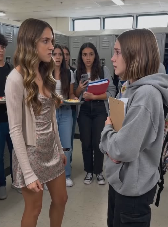
Charlotte stood in front of me wearing a silk floral dress, a pale cardigan, and jeweled sandals that did not belong anywhere near a pool deck.
She was not enrolled in P.E. that period.
She had come specifically to find me.
My name was Jade Harris. I was seventeen, and that morning I had arrived at school in an oversized gray hoodie, black cargo pants, and a canvas backpack covered in handmade pins.
The pins were small things I designed at home: stars, mushrooms, cartoon frogs, tiny protest signs, and one that read CHECK THE ORIGINAL.
Charlotte had laughed at that pin when she first saw it.
Now she was staring at it.
“You took that picture illegally,” she said.
I touched my burning cheek.
“You slapped me in front of thirty witnesses.”
“You were following my brother.”
“I was completing a pool-safety check.”
“You are not a safety officer.”
“I’m the student equipment assistant.”
“That means you count kickboards.”
“It means Coach Sloan assigned me to photograph the lane setup before first period.”
Coach Sloan’s name changed the room.
Several students glanced toward the pool doors.
Charlotte noticed.
She raised her voice.
“Jade has been obsessed with my family for months. She followed Adrian into the aquatic center and edited a photograph to make him look guilty.”
“I didn’t edit anything.”
“She wants everyone to believe my brother cheated.”
“I never said Adrian cheated.”
That was true.
I had not needed to say it.
Everyone at Westbridge knew why Adrian Vale mattered.
He had graduated the previous spring as the most celebrated swimmer in school history. His records still hung on a blue-and-gold banner above the pool. He had earned a university scholarship, appeared in district advertisements, and returned twice a week to help Coach Sloan train elite swimmers.
His younger sister, Charlotte, ruled school social life with the confidence of someone protected by money, beauty, and a family name carved into the aquatic center’s donor wall.
The Vales had funded new starting blocks, timing equipment, and team uniforms.
Their father sat on the school foundation board.
Their mother organized the annual athletics gala.
Charlotte had never needed to ask whether adults would believe her.
She had grown up inside the answer.
I bent down and picked up the photograph.
Charlotte lunged.
Her jeweled sandal slipped on the wet floor.
She caught herself against a locker, then grabbed the strap of my backpack.
“Give it to me.”
“No.”
“It belongs to my family.”
“It was taken on school property.”
“You don’t understand what you’re doing.”
“That’s what people say when they don’t want a record checked.”
Her expression sharpened.
Then the locker-room door opened.
Ms. Priya Nair, our P.E. teacher, stepped inside with Vice Principal Marcus Reed behind her.
“What is happening?” Ms. Nair demanded.
The girls around us began talking at once.
“Charlotte slapped Jade.”
“Jade took pictures of Adrian.”
“The lane was moved.”
“Charlotte tried to grab the evidence.”
Vice Principal Reed lifted both hands.
“Quiet.”
The room obeyed reluctantly.
He looked at Charlotte first.
That told me everything.
“Why are you here during a class period?” he asked her.
Charlotte’s eyes filled instantly.
“I came because Jade has been spreading lies about my brother.”
“I showed one photograph to Ms. Nair,” I said.
Charlotte pointed at me.
“She has been harassing us.”
Vice Principal Reed turned toward me.
“Jade, did you photograph Adrian Vale without permission?”
“I photographed the pool lanes because I was asked to document their positions before the time trials.”
“By whom?”
“Coach Sloan.”
The vice principal frowned.
“Coach Sloan says he never gave you that instruction.”
The words hit harder than the slap.
Ms. Nair looked at him.
“He told me Jade was helping with equipment documentation.”
“General equipment,” Reed replied. “Not photographing individuals.”
I opened my backpack.
Inside was a laminated checklist signed by Coach Sloan.
The third line read:
Photograph lane alignment before 7:30 a.m.
I handed it to Ms. Nair.
She studied the signature.
“Everett signed this.”
Vice Principal Reed took the form.
His expression remained calm, but his thumb covered the signature.
“Forms can be misunderstood.”
“It is one sentence,” I said.
Charlotte gave a small laugh.
“There she goes again.”
“What does that mean?” Ms. Nair asked.
“She turns every little thing into a conspiracy.”
I looked at Charlotte.
“You crossed the campus during class, entered a locker area where you were not assigned, accused me in front of everyone, and slapped me because of one little photograph.”
Charlotte’s face tightened.
Vice Principal Reed stepped between us.
“This conversation will continue in the administration office.”
“The lane needs to be checked first,” I said.
“The swimming period has ended.”
“The lane divider was moved before Maya Chen’s time trial.”
Several students reacted.
Maya Chen was a sophomore and the strongest current swimmer at Westbridge. That morning she had collided with another student during her final lap.
The collision injured her shoulder and cost her a qualifying time for the district development team.
Until I showed Ms. Nair the photograph, everyone called it an accident.
Charlotte looked toward the door again.
“She turned too wide,” she said.
I had never told Charlotte how Maya was injured.
The locker room went silent.
Ms. Nair’s eyes narrowed.
“How do you know where she turned?”
Charlotte’s lips parted.
“I heard people talking.”
“No one mentioned the turn,” I said. “The students were told only that Maya had a collision.”
Charlotte looked at Vice Principal Reed.
“My father is going to hear about how I’m being treated.”
Reed’s voice softened.
“Charlotte, let us handle this privately.”
“Privately?” I repeated.
He looked at me.
“That is enough.”
“No, it isn’t. Maya is at urgent care, the lane was moved, and the person who moved it is standing in my photograph.”
“Adrian assists with pool maintenance.”
“He is not a school employee.”
“He is a trusted volunteer.”
“He moved the divider into another lane.”
Reed held out his hand.
“Give me the photograph.”
I did not.
His expression changed.
“Jade.”
“I want it copied first.”
“You are refusing a direct instruction.”
“I’m protecting the original evidence.”
Charlotte laughed again, but she sounded nervous.
“This is exactly what I mean. She thinks everyone is trying to steal from her.”
I reached into my backpack and pulled out a clear plastic folder.
Inside were six printed photographs.
“I made copies before class.”
Charlotte stopped laughing.
I had also uploaded the original files to my personal drive and emailed them to myself.
My father used to say that one copy was a hope, two copies were a plan, and three copies were a warning.
He had been a newspaper photographer before a spinal injury forced him to stop working full-time.
He taught me to preserve originals, photograph context, and never crop away the details that might matter later.
“People lie inside the frame,” he told me once. “Truth often waits in the reflection.”
That was why I had noticed Coach Sloan in the office window.
Vice Principal Reed looked at the folder.
“How many people have seen these?”
“Ms. Nair and me.”
“And everyone here,” Charlotte said bitterly.
Most students had seen only the photograph on the floor.
They had not seen the other five.
Those images showed Adrian moving lane four, Coach Sloan checking his watch, and a person in a dark jacket entering the timing room.
The last image showed the lane rope after it had been secured in the wrong position.
The time stamp was 7:19 a.m.
Maya’s time trial began at 8:06.
No one corrected the lane.
Ms. Nair took the photographs.
Her face grew more serious with each one.
“Marcus, we need to close the pool.”
Vice Principal Reed lowered his voice.
“Let’s not overreact.”
“A student was injured.”
“Which may have nothing to do with the lane position.”
“The lane was altered.”
“We do not know why.”
“We know it created a hazard.”
Reed glanced at the students filming.
“Everyone put your phones away.”
Nobody moved.
Charlotte stepped toward the door.
“I’m leaving.”
Ms. Nair blocked her.
“You assaulted Jade.”
“She provoked me.”
“That does not excuse hitting her.”
Charlotte looked at Vice Principal Reed.
“Are you going to let her speak to me like that?”
For the first time, Reed did not answer immediately.
The locker-room door opened again.
Coach Sloan entered.
He was tall, athletic, and usually carried himself with the relaxed confidence of a man whose trophies had protected him from difficult questions for years.
That morning, his face looked gray.
“I heard there was a disturbance,” he said.
Ms. Nair held up the checklist.
“Did you assign Jade to photograph lane alignment?”
Coach Sloan looked at me.
His eyes gave me the same warning Charlotte’s had.
Then he smiled.
“I asked her to document general readiness.”
“The form specifically says lane alignment.”
“That may have been copied from an old checklist.”
“You signed it yesterday.”
“I sign many forms.”
“Did Adrian move lane four this morning?”
Coach Sloan looked at the photographs.
His jaw tightened.
“Adrian was adjusting tension.”
“Why?”
“The divider was loose.”
“Why was it moved into lane five?”
“It may look that way because of perspective.”
I removed my phone.
“The images contain location data, time stamps, and a continuous sequence.”
Vice Principal Reed moved quickly.
“Jade, put the phone away.”
“Why?”
“Because recording students and volunteers without consent may violate policy.”
“I photographed a safety assignment.”
“You are not authorized to distribute those images.”
“I haven’t distributed them.”
Charlotte’s breathing became louder.
Coach Sloan looked at her.
Then at Reed.
A message passed silently among them.
Ms. Nair saw it too.
She walked toward the pool doors.
“I’m measuring the lanes.”
Coach Sloan stepped into her path.
“The pool is being used.”
“Not anymore.”
“You do not have authority to cancel team training.”
“I have authority to stop a P.E. activity when student safety is in question.”
“This is not your program.”
“It is my student who got hurt.”
They stared at each other.
Then an alarm sounded from the timing room.
A short electronic beep.
Coach Sloan spun toward the pool.
“What was that?”
Nobody answered.
He pushed through the door.
We followed.
The aquatic center opened before us in a wash of blue light and chemical air. Sunlight poured through high windows, shaking across the water. The lanes looked normal from a distance.
But lane four was visibly narrow near the far wall.
Ms. Nair walked the deck with a measuring tape.
At the starting end, lane four measured the regulation width.
At the final-turn end, it was thirty-four inches narrower.
A collision there was not just possible.
It was predictable.
Charlotte stood behind her brother’s record board, arms folded around herself.
Coach Sloan began talking rapidly.
“The anchor may have slipped.”
“The anchor is locked,” Ms. Nair said.
“It could have shifted during use.”
“The photograph shows Adrian moving it before students entered.”
“He was correcting another problem.”
“What problem?”
Coach Sloan did not answer.
A red light continued flashing above the timing-room door.
Vice Principal Reed tried the handle.
Locked.
“Who is inside?” he called.
No response.
Coach Sloan reached for a key card.
Before he could use it, the door opened.
A girl stepped out.
She was wearing a Westbridge swim jacket and holding a small external hard drive.
Her name was Maya Chen.
Her injured arm rested in a sling.
Everyone stared.
“You’re supposed to be at urgent care,” Ms. Nair said.
“I was,” Maya replied. “My mother brought me back.”
A woman entered behind her.
Mrs. Chen was an emergency-room physician, and anger had sharpened every line of her face.
“My daughter received a message telling her not to describe how the collision happened,” she said.
Coach Sloan went still.
Maya held up her phone.
“The message came from Coach Sloan.”
“It was a reminder not to discuss an active school incident publicly,” he said.
“You wrote that I could lose my district recommendation if I created drama.”
Students began murmuring again.
Mrs. Chen looked at Vice Principal Reed.
“I would like that threat documented.”
“It was not a threat,” Sloan said.
Maya raised the hard drive.
“I also copied the timing-room files.”
“You had no permission to enter that room,” Coach Sloan snapped.
“The door was open when I came back.”
His eyes moved toward Charlotte.
Charlotte looked away.
Maya continued.
“The timing system recorded lane-width calibration this morning.”
Ms. Nair frowned.
“The system measures lane width?”
“It does when the automated touch panels are tested. The setup program stores the distance between panels and lane ropes.”
Coach Sloan stepped forward.
“Give me that drive.”
Mrs. Chen moved between them.
“Do not approach my daughter.”
Vice Principal Reed took out his phone.
“We need district security.”
“No,” Coach Sloan said.
The word came out almost as a shout.
Everyone turned.
He lowered his voice.
“There is no need to escalate until we understand the data.”
Maya looked at me.
“Jade’s photograph is not the only proof.”
She connected the drive to the pool’s display computer.
A calibration chart appeared on the scoreboard.
Lane four had been measured at 7:22 a.m.
The width narrowed near the final-turn wall.
The user account that approved the calibration was not Adrian’s.
It belonged to Vice Principal Marcus Reed.
The entire aquatic center went silent.
Reed stared at the screen.
“That account was used without my knowledge.”
Coach Sloan looked at him.
“You told me the access log had been cleared.”
Every phone in the room rose.
Reed’s face hardened.
“You need to stop talking.”
The sentence came too late.
Ms. Nair stepped away from both men.
“What exactly did you clear?”
“No one cleared anything,” Reed said.
Coach Sloan laughed once, without humor.
“You are not putting this on me.”
Charlotte suddenly began crying.
Not the clean, controlled tears she used when teachers challenged her.
These were frightened, uneven sobs.
“Dad said nobody would be hurt,” she whispered.
Everyone looked at her.
Vice Principal Reed’s face emptied.
Charlotte covered her mouth.
Coach Sloan closed his eyes.
I stared at Reed.
“You are Charlotte’s father?”
The rumor that followed was immediate and confused.
Everyone knew Charlotte’s father was Theodore Vale, the wealthy foundation member whose name appeared on the donor wall.
Reed looked toward the exits as if he were calculating whether he could leave.
Charlotte shook her head violently.
“No. I didn’t mean—”
But Coach Sloan had already given up protecting the secret.
“Theodore raised her,” he said. “Marcus is her biological father.”
Charlotte looked as though she might collapse.
Vice Principal Reed stepped toward her.
“Not here.”
“You promised Adrian would only win by a second,” she cried. “You said moving the lane would slow Maya down, not make her crash.”
Mrs. Chen made a sound of disbelief.
Maya’s face went white.
Adrian Vale was not competing in the school time trial. He had already graduated.
Then I remembered the district development team.
Maya was applying for one of two assistant-training positions offered to promising young swimmers. The role included travel funding, university exposure, and access to elite coaching.
The other candidate was Adrian.
Although he had graduated, he remained eligible through the district’s youth-athletics partnership.
Maya’s qualifying time could have displaced him.
“You narrowed her lane to slow her down,” I said.
Coach Sloan answered before anyone else could.
“Adrian’s university scholarship was under review.”
“Why?” Ms. Nair asked.
“His record times had been questioned.”
The banners above us suddenly looked different.
Maya stared at Adrian’s name.
“His records were false?”
Coach Sloan rubbed a hand across his face.
“For years, the timing system had calibration inconsistencies.”
“Inconsistencies you controlled,” Mrs. Chen said.
No one answered.
The truth unfolded piece by piece.
Seven years earlier, when Adrian was still a middle-school swimmer, Coach Sloan discovered that the old timing system could be adjusted manually. A fraction of a second could be removed from a recorded swim without changing the visible video clock.
The first manipulation was small.
Adrian missed a regional qualifying time by twelve hundredths of a second.
Theodore Vale had just pledged money for a pool renovation.
Coach Sloan changed the result.
That single false time became the foundation of everything that followed.
More records were adjusted.
Adrian attracted sponsors.
The Vale family donated more money.
Coach Sloan received promotions and awards.
Vice Principal Reed, who managed athletics compliance at the time, approved the results.
When Maya emerged as the fastest swimmer Westbridge had produced in years, she threatened more than Adrian’s assistant-training position.
Her genuine times made his records look impossible.
A formal comparison could expose the old calibration fraud.
“So you moved her lane,” I said.
Coach Sloan looked at the water.
“It was supposed to slow her turn.”
“It could have broken her neck,” Mrs. Chen replied.
Reed finally regained his voice.
“No one intended an injury.”
“That does not make this less criminal,” Ms. Nair said.
Charlotte sank onto the bottom bleacher.
She looked at me through tears.
“My mother told me to make you look unstable.”
“Which mother?” someone whispered.
Charlotte flinched.
Reed’s biological connection to her was not the only secret.
Theodore Vale had known for years that Charlotte was not his biological daughter. He kept the truth hidden to protect the family’s public image and because he genuinely considered Charlotte his child.
But Reed used the secret to pressure the Vales.
He convinced Theodore that if Adrian lost his scholarship and the timing fraud became public, Charlotte’s parentage would also be exposed.
Theodore agreed to help bury the old records.
Charlotte had learned pieces of the truth only days earlier.
She believed protecting Adrian also protected her mother from humiliation and her family from collapse.
That morning, she had been told to watch anyone near the pool.
When she saw me show Ms. Nair the photographs, fear took over.
She turned the evidence check into a personality attack.
Then she slapped me.
“I thought if everyone hated you, they wouldn’t look at the picture,” she whispered.
My cheek still hurt.
“You were willing to destroy me to protect a lie.”
“I know.”
“You let people believe Maya caused her own injury.”
Charlotte lowered her head.
“I know.”
District security arrived with police officers less than ten minutes later.
Coach Sloan and Vice Principal Reed were separated for questioning.
Theodore Vale arrived soon afterward.
He walked into the aquatic center with his lawyer and stopped beneath the donor wall carrying his family’s name.
Charlotte stood when she saw him.
For one terrible second, she looked like a little girl waiting to learn whether she still belonged to her own home.
Theodore crossed the deck.
She could not look at him.
“I’m sorry,” she said. “I ruined everything.”
Theodore removed his jacket and wrapped it around her shoulders.
“No,” he replied. “The adults did that.”
She began sobbing.
He held her.
The gesture did not erase what she had done to me, but it revealed something I had not expected.
Theodore had participated in hiding athletic fraud.
He had protected Adrian’s false records.
But he had not stopped loving Charlotte when the truth about her father became public.
His worst choices had come from protecting the image of his family.
His best choice was refusing to confuse that image with the child standing in front of him.
The investigation lasted four months.
Coach Sloan was charged with falsifying athletic records, reckless endangerment, evidence tampering, and conspiracy.
Vice Principal Reed was removed from his position and later charged for unauthorized system access, obstruction, and participating in the setup that injured Maya.
Theodore Vale admitted financing efforts to suppress the old timing discrepancies. He resigned from the foundation board, paid restitution, and cooperated with investigators.
Adrian surrendered his school records and withdrew from the district assistant-training position.
He released a public statement claiming he had not known his earliest times were manipulated.
Investigators eventually confirmed that he learned the truth only during his senior year.
After discovering it, however, he chose silence.
That silence cost him his scholarship.
Maya’s shoulder healed without surgery.
Her original time trial was voided, and she received a new supervised trial at an independent aquatic center.
She qualified by nearly two full seconds.
The district offered her the development position.
She accepted only after they agreed to independent timing audits for every athlete.
Ms. Nair became interim director of aquatic safety.
The old donor wall was removed.
In its place, the school installed a public inspection board displaying pool measurements, maintenance schedules, calibration certificates, and incident reports.
Every lane position was photographed before student use.
Every original file was automatically backed up.
No coach could alter timing records alone.
I helped design the evidence procedure.
My father pretended not to cry when I showed him the final policy.
He sat at our kitchen table, studying the document through his reading glasses.
“Three backups?” he asked.
“Local server, district archive, and independent cloud storage.”
He nodded solemnly.
“That is almost enough.”
“Almost?”
“You should print one.”
I laughed.
Then he reached across the table and touched the fading mark on my cheek.
“I’m sorry you had to be brave because adults were not.”
That sentence stayed with me.
People often praised students for courage after adults had left them no safer choice.
Charlotte was suspended for assaulting me and interfering with an investigation.
The school board considered expulsion.
I attended the hearing because they asked whether I wanted to speak.
Charlotte sat across the room in a plain navy dress, without jewelry, friends, or the confident smile she had worn near the lockers.
Her mother sat beside Theodore.
Reed was not there.
When it was my turn, I stood.
“I do not think Charlotte should escape consequences,” I said. “She hit me. She tried to take evidence. She lied about me because she thought people would believe her family before they believed a record.”
Charlotte stared at the table.
“But I also think the adults around her taught her that truth was dangerous and reputation was survival. That explains what she did. It does not excuse it.”
The board gave her a long-term suspension, mandatory counseling, and community service rather than permanent expulsion.
She was also prohibited from holding student leadership positions for the rest of the year.
Many students said the punishment was too light.
Others said it was too harsh.
I decided it was not my job to make everyone agree.
My job was to keep the truth from being rewritten.
The rumors about me changed slowly.
At first, I became “the girl Charlotte slapped.”
Then I became “the girl who exposed the swim scandal.”
Neither description felt like me.
I was still Jade.
I still wore the same gray hoodie.
I still carried a backpack covered in handmade pins.
I still avoided crowded lunch tables and forgot to answer messages for hours.
Public attention did not transform me into someone fearless.
It only made me more aware of how fear behaved.
Fear raised its voice.
Fear called details meaningless.
Fear demanded privacy only after acting in public.
Fear reached for the evidence.
Three months after the hearing, Charlotte returned to school.
Students watched her walk through the hallway alone.
Some whispered loudly enough for her to hear.
Others recorded her.
I understood the instinct.
She had once enjoyed standing inside a crowd while I was humiliated.
But watching the same machine turn against her did not feel satisfying.
Near the end of the day, I found her outside the aquatic center.
She was staring through the locked glass doors.
“You’re not allowed inside without supervision,” I said.
She turned.
“I know.”
Her eyes moved toward the pin on my backpack.
CHECK THE ORIGINAL.
“I used to hate that pin.”
“I noticed.”
“I thought you wore it because you wanted people to think you were smarter than them.”
“I wear it because people forget.”
She nodded.
For a moment, neither of us spoke.
Then she held out an envelope.
Inside was a printed photograph.
It showed the pool locker area seconds before she slapped me.
Someone had taken it from the far end of the room.
I stood near the lockers, holding the evidence folder.
Charlotte was approaching me.
Behind her, reflected in a mirror, Vice Principal Reed was visible through the open doorway.
He had been watching.
The time stamp showed he arrived before the slap.
“He told me to confront you,” Charlotte said.
My stomach tightened.
“He said he would step in once you became upset. He wanted you suspended for causing a disturbance.”
“But he waited.”
“He wanted everyone filming first.”
The setup had been even more deliberate than I understood.
The shove toward public humiliation had not begun with Charlotte.
Reed had positioned her like another piece of equipment.
“Why didn’t you show this during the investigation?” I asked.
“I found it yesterday. One of the girls sent it to me because she thought I should know.”
“Have you given it to the police?”
“Yes.”
“Why give me a copy?”
“Because it is your record too.”
I looked at her.
She did not ask me to forgive her.
That mattered.
“I’m helping Maya with the calibration archive,” I said.
Charlotte blinked.
“Why are you telling me?”
“The school needs volunteers to scan old athletics photographs.”
“You want me to volunteer?”
“I want you to learn what evidence looks like when it belongs to everyone.”
She looked through the aquatic-center doors again.
“Will Maya be there?”
“Yes.”
“She hates me.”
“She has a reason.”
“And you?”
“I don’t hate you.”
Charlotte’s eyes filled.
“That feels worse.”
“It should.”
She nodded slowly.
“I’ll come.”
Her first volunteer session was uncomfortable.
Maya barely spoke to her.
I assigned Charlotte a box containing old swim-team photographs and meet sheets.
She scanned every page, labeled every file, and entered every visible date.
The work was slow and unglamorous.
No one photographed her doing it.
No adults praised her.
She kept returning.
Several weeks later, she found an image from seven years earlier.
The photograph showed Adrian after the first meet where his time had been altered.
In the background, the old electronic scoreboard displayed his actual finish time before Coach Sloan changed the official result.
That single photograph allowed investigators to identify the exact beginning of the fraud.
Charlotte stared at it for a long time.
Then she carried it to Maya.
“I found something,” she said.
Maya studied the image.
“You should send it to the auditors.”
“I already made three copies.”
Maya looked at me.
I shrugged.
“She’s learning.”
The next spring, Westbridge reopened the aquatic center after a complete safety renovation.
The pool itself remained, but nearly everything surrounding it had changed.
New lane anchors had been installed.
The timing system required independent verification.
A glass-walled records room stood beside the deck so no one could hide inside it unseen.
The district removed Adrian’s false records.
Maya set two new legitimate ones during the first official meet.
This time, every lane was measured in front of coaches, students, parents, and an outside official.
I photographed the setup.
At 7:14 a.m., exactly one year after I had taken the image that started everything, I stood near lane four with my camera.
Charlotte approached wearing a volunteer badge and simple pool shoes.
She handed me the morning checklist.
“All lanes measured,” she said.
“Photographs uploaded?”
“To three locations.”
“Originals preserved?”
“Yes.”
“Any secret administrator accounts?”
“None.”
I examined the form.
Her handwriting was neat.
At the bottom, beneath her signature, she had added one sentence:
A RECORD SHOULD NEVER DEPEND ON THE REPUTATION OF THE PERSON WHO NEEDS IT.
I looked at her.
“That is almost good enough for a pin.”
“Almost?”
“It needs fewer words.”
She laughed quietly.
It was the first time I had heard her laugh without using it against someone.
Maya climbed onto starting block four.
The crowd settled.
My father sat in the front row with his camera resting in his lap.
Ms. Nair raised the starting signal.
Before the whistle, Maya looked toward me.
Then she looked at Charlotte.
Charlotte stepped away from the cameras and checked the lane one last time.
The whistle sounded.
Maya entered the water cleanly.
She cut through lane four with powerful, even strokes. At the final wall—the place where the divider had once narrowed—she turned without hesitation.
No collision.
No hidden adjustment.
No false time.
When she touched the finish panel, the scoreboard displayed a new school record.
The number remained unchanged.
The crowd erupted.
Maya surfaced, laughing.
Charlotte covered her mouth as tears filled her eyes.
I lifted my camera and captured the moment.
Not because it was perfect.
Because it was true.
Later, the school displayed two photographs outside the aquatic center.
The first showed the altered lane on the morning Maya was injured.
The second showed her breaking the record one year later.
Between them hung a small plaque:
THE TRUTH WAS NOT SAVED BY THE LOUDEST PERSON IN THE ROOM. IT WAS SAVED BY THE EVIDENCE SOMEONE REFUSED TO SURRENDER.
Students stopped to read it on their way to class.
Some knew the whole story.
Others knew only pieces.
But everyone could see the original photographs.
Nothing had been cropped.
Nothing had been hidden behind a family name.
And whenever someone asked why Charlotte Vale appeared in the second image, standing quietly beside the lane she had once helped conceal, I told them the truth.
Accountability did not erase what happened.
It made sure the ending was not written by the same lie.
THE END
