Part 2: The Inbox She Could Not Control
Tinsley’s fingers closed around the edge of the folder, but Mr. Caldwell caught her wrist before she could pull it from my hand.
“Enough,” he said.
His voice was not loud, but it cut through the journalism classroom harder than a shout.
The room smelled like printer ink, old coffee, and the dusty heat from the computers lining the back wall. Everyone had been sitting in clusters for source-check session, pretending this was just another deadline day for the student newspaper. But after Tinsley slapped me, no one pretended anything.
My cheek burned.
Her bracelet had scratched the skin under my eye.
I kept my grip on the folder because if I let go, I was scared she would win by movement alone.
Tinsley jerked her arm back. “She’s twisting everything.”
Mr. Caldwell looked at me. “Jada, what is in the folder?”
My throat felt too dry to work.
“The article draft,” I said. “The source-check sheet. And the email.”
The word email made Tinsley’s face twitch.
Her friend Brooke stood from the second row. “This is insane. Tinsley already said the source approved the quote.”
“No,” I said.
My voice came out thin, but it came out.
“She said that. The source didn’t.”
Mr. Caldwell held out his hand. I gave him the folder, and every sound in the classroom got sharper: a phone buzzing on silent against a desk, somebody’s sneaker shifting under a chair, Tinsley breathing too fast through her nose.
He opened the first page.
The student article had Tinsley’s name at the top, polished and bold: LOCAL COUNCIL CANDIDATE PROMISES STUDENT SAFETY REFORMS.
Underneath, one quote had been highlighted in yellow.
“Boise High students are exaggerating the safety issue for attention.”
The quote was attributed to Councilwoman Elise Grant.
Mr. Caldwell’s eyes moved to the email behind it.
His face changed before he read it aloud.
Tinsley said, “That email is out of context.”
Mr. Caldwell looked up slowly.
“Tinsley,” he said, “the email is from Councilwoman Grant herself.”
Then he read the line that cracked the room open.
“I never gave this quote, and I would like to know why a student journalist attributed it to me.”
A sound moved through the classroom like air leaving a tire.
Brooke sat down.
Tinsley’s lips parted, but nothing came out.
I pressed my hand against my stinging cheek and watched the lie finally become visible.
Then Mr. Caldwell turned to the second printed email.
“And this one,” he said quietly, “was sent to Jada before contest submission.”
Tinsley’s eyes went wide.
Because now everyone knew the part she had slapped me to hide.
I had found the fake quote before it could damage the school, the newspaper, and the person Tinsley tried to blame.
Part 3: The Draft With My Name In It
Mr. Caldwell did not ask anyone to leave.
That made it worse for Tinsley.
He laid the pages on his desk one by one like evidence in a hearing. The article draft. The source-check sheet. The email from Councilwoman Grant. The timestamp showing I had flagged the quote yesterday afternoon, before the final contest packet had been locked.
Tinsley stared at the papers like she could still make them obey her.
“This is harassment,” she said. “Jada has been jealous of me since I got editor feature placement.”
A few students looked at me.
That old fear rose in my chest, the kind that knew how quickly a room could turn if someone rich enough, pretty enough, loud enough gave it permission.
But then a voice from the back said, “No, she hasn’t.”
It was Leo Mercer, one of the sports reporters, still wearing his baseball hoodie with ink stains on the cuff.
He stood awkwardly, chair scraping behind him.
“Jada asked me to check two stats last week because she didn’t want my recap to get rejected,” he said. “She’s always checking stuff for people.”
Tinsley whipped around. “Leo, seriously?”
He swallowed. “Yeah. Seriously.”
Mr. Caldwell looked at Tinsley. “Who entered this article into the contest portal?”
“I did,” she snapped. “Because it was my article.”
“And who attached the source verification document?”
Tinsley hesitated.
That hesitation was so small most people might have missed it.
I did not.
Mr. Caldwell clicked on the classroom computer, pulled up the student newspaper shared drive, and opened the contest submission folder on the projector. The screen glowed against the whiteboard.
My stomach tightened.
There were files listed by title, date, and uploader.
Tinsley’s article was there.
Beside it was a verification file.
Mr. Caldwell opened it.
The class went still.
At the bottom, under “Student Source Checker,” was a typed name.
Jada Miller.
I stood so fast my chair hit the desk behind me.
“I didn’t write that.”
Tinsley folded her arms. “You were the source checker assigned to it.”
“No,” I said. “I was assigned to the freshman lunch story. Not yours.”
Mr. Caldwell clicked the file details.
The document had been created from Tinsley’s account.
Then modified.
The final modification was under my login.
My stomach dropped.
I had not touched that file.
But there it was.
My name.
My account.
My supposed approval.
Tinsley smiled for the first time since the email had been opened.
“See?” she whispered. “She’s lying.”
The room tilted.
Then a quiet girl near the copy machine lifted her hand.
It was Nora Ellis, the yearbook assistant.
“I saw someone using Jada’s computer after practice yesterday,” she said.
Tinsley’s smile disappeared.
Mr. Caldwell turned. “Who?”
Nora looked at Tinsley and whispered, “Brooke.”
Part 4: Brooke Finally Broke First
Brooke stood like her chair had burned her.
“That’s not true.”
But her face had already betrayed her.
Nora’s hands twisted around the strap of her camera bag. “I came in to pick up yearbook batteries. Jada’s computer was open. Brooke was sitting there.”
Brooke’s voice rose. “Because Tinsley asked me to print something!”
The second she said it, she covered her mouth.
Tinsley closed her eyes.
The whole classroom understood before Brooke did.
Mr. Caldwell spoke carefully. “Brooke, what did Tinsley ask you to print?”
Brooke shook her head. “No. I don’t want to be involved.”
“You became involved when you used another student’s account.”
“I didn’t know!” Brooke’s eyes filled with tears. “She told me Jada forgot to upload the verification and that the contest deadline would close. She said Jada gave permission.”
I stared at her.
“You believed that?”
Brooke looked at me, and guilt folded her face into something younger.
“She said you were too scared to do it yourself because you knew the quote was controversial.”
Tinsley slammed her hand on the desk. “Stop talking.”
Brooke flinched.
And suddenly I saw it: Brooke was not just Tinsley’s friend. She was one of the people Tinsley pushed around when no adults were watching. She had helped her, yes. But she was also afraid of her.
Mr. Caldwell went to the classroom phone and called Principal Whitaker.
No one spoke while we waited.
The slap mark on my cheek pulsed with every heartbeat.
Tinsley pulled out her phone and started typing.
Mr. Caldwell turned back. “Put it away.”
“I’m calling my mother.”
“You can do that from the office.”
“My mother is on the school media board.”
“I’m aware.”
Tinsley smiled bitterly. “Then you should also be aware that she decides which students get nominated for the state journalism fellowship.”
The sentence landed like a threat.
Not just against Mr. Caldwell.
Against me.
Against anyone who spoke.
Leo muttered, “Wow.”
Tinsley looked at him. “You think this is funny?”
“No,” he said. “I think you just said the quiet part out loud.”
Principal Whitaker entered a minute later with Assistant Principal Reeves behind her. She took one look at my cheek, one look at the pages on Mr. Caldwell’s desk, and the whole room seemed to hold its breath.
“What happened?” she asked.
Mr. Caldwell handed her the folder.
Tinsley stepped forward. “Jada accused me of something she approved herself.”
Principal Whitaker read the first email.
Then the second.
Then she looked at the projector where my name sat under a file I had not made.
“Jada,” she said gently, “were you logged into that computer yesterday?”
“Yes. Before track practice.”
“Did you log out?”
I swallowed.
“I thought I did.”
Tinsley’s face brightened with cruel relief.
Then Assistant Principal Reeves walked to the computer, clicked another tab, and said, “The hallway camera outside this room was repaired Monday.”
Tinsley went completely still.
Reeves looked at her.
“So we do not have to guess who came back in.”
Part 5: The Hallway Camera Caught More Than Brooke
They did not play the footage immediately.
That almost broke me.
We had to wait while Principal Whitaker sent the class to the library under supervision, but nobody moved quickly. Students gathered their notebooks with slow, nervous hands, staring at me, at Tinsley, at Brooke, at the folder that had become too dangerous to touch.
Tinsley tried to walk out with them.
Principal Whitaker stopped her.
“You’re staying.”
Brooke stayed too.
So did I.
The room felt bigger after everyone left, but not safer. Empty desks looked like witnesses that had refused to take sides. The projector fan buzzed. Outside the window, the football field shimmered in the afternoon sun, bright and careless.
Assistant Principal Reeves logged into the security system.
Tinsley’s mother arrived before the footage loaded.
Marianne Monroe swept into the room in a pale blazer, her hair perfectly smooth, her sunglasses still perched on top of her head like she had come from somewhere more important.
“Tinsley, honey,” she said, touching her daughter’s shoulder. “Are you all right?”
I almost laughed.
My cheek was swelling.
Tinsley had tears in her eyes now.
Tears for her mother.
Not for what she had done.
Marianne Monroe looked at me and said, “Is this the girl?”
This.
Not Jada.
Not student.
This.
Principal Whitaker’s mouth tightened. “Mrs. Monroe, please sit down.”
“I would rather stand. I understand there is an accusation being thrown around without context.”
Mr. Caldwell said, “There is an email from the quoted source denying the quote.”
Marianne’s eyes flickered.
Only once.
But I saw it.
She knew.
My skin went cold.
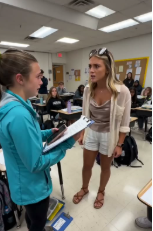
Assistant Principal Reeves pressed play.
The hallway footage appeared on the screen.
There I was at 3:41 p.m., leaving the journalism classroom in my windbreaker and neon hair tie, backpack over one shoulder, moving quickly because track practice had already started.
At 3:47 p.m., Brooke entered.
She looked around before opening the door.
Tinsley followed two seconds later.
The room became soundless.
In the footage, Tinsley held the door while Brooke went inside.
At 3:53 p.m., Marianne Monroe appeared in the hallway.
My heart slammed against my ribs.
She was not supposed to be there.
She looked directly toward the camera, then away.
She entered the journalism classroom.
Tinsley whispered, “Mom…”
Marianne’s hand dropped from her daughter’s shoulder.
Assistant Principal Reeves paused the footage.
Principal Whitaker turned slowly.
“Mrs. Monroe,” she said, “why were you in the journalism classroom after school yesterday?”
Marianne did not answer right away.
Then the computer notification chimed.
A new email appeared on Mr. Caldwell’s screen.
From Councilwoman Elise Grant.
Subject: Urgent: Regarding Student Article And Monroe Campaign Contact.
Mr. Caldwell opened it.
The first line made Marianne Monroe close her eyes.
“The fabricated quote matches language sent to my office by Marianne Monroe’s campaign consultant last week.”
Part 6: The Fake Quote Was Never Just Tinsley’s
Tinsley backed away from her mother like the floor had split between them.
“What does that mean?”
Marianne turned sharply. “Do not speak.”
But the command came too late.
Everyone in that room had heard the fear in Tinsley’s question.
Principal Whitaker took the laptop from Mr. Caldwell and read the rest of the email silently. Her face shifted from concern to something much colder.
“Mrs. Monroe,” she said, “Councilwoman Grant states that your campaign consultant proposed a quote attacking student safety complaints, and that her office rejected it in writing.”
Marianne lifted her chin. “That is political correspondence. It has nothing to do with a student class.”
“It became student journalism the moment that rejected language appeared as a quote in your daughter’s article.”
I stared at Tinsley.
For the first time all day, she looked truly lost.
Not trapped.
Lost.
“You said it was real,” she whispered to her mother.
Marianne’s eyes sharpened. “Tinsley.”
“You told me Councilwoman Grant agreed privately. You said the email trail would be too complicated for anyone to check.”
Her voice was cracking now, and the crack let something ugly into the air.
Mr. Caldwell looked sick.
The article was not just a student trying to win a contest.
It was a planted attack on students who had spoken up about broken locks, dark parking lots, and the walk from the bus stop after evening clubs.
Students like me.
Students who did not get picked up in new cars at the front entrance.
My hand curled around the edge of a desk.
“So you were going to make it look like we lied about being unsafe?” I asked.
Tinsley looked at me, and for once there was no smile.
“I didn’t think of it like that.”
“That is because you didn’t have to walk home in the dark.”
The words came out before I could polish them.
No one corrected me.
Marianne exhaled sharply. “This is becoming emotional.”
Principal Whitaker looked at her. “A student was physically assaulted after discovering a fabricated quote connected to your campaign.”
Marianne’s face hardened. “Be careful with that word.”
“Which word?” Mr. Caldwell asked. “Fabricated or assaulted?”
The room froze.
Tinsley began crying again, but this time her tears seemed different. She looked at her mother, at the footage, at the email, at me.
“I didn’t know she was going to send it to the contest,” she said.
Brooke’s head snapped up. “Tinsley.”
“I didn’t! I only thought we were fixing the draft.”
“You slapped me,” I said.
Her face collapsed.
“I know.”
The apology did not come.
Not yet.
Assistant Principal Reeves checked the email header.
“This came with attachments,” he said.
He opened one.
It was a forwarded message from Grant’s office.
At the bottom was a line from Marianne Monroe’s consultant.
If the student paper runs this before the district safety forum, Monroe can cite youth voices publicly.
Principal Whitaker leaned back slowly.
Marianne reached for her phone.
Reeves stepped in front of her.
Then Mr. Caldwell opened the final attachment.
It was a document titled:
Preferred Student Narratives.
Underneath were three names.
Tinsley Monroe.
Brooke Hayes.
Jada Miller.
Beside my name, one note had been written.
Useful as fall person if questioned.
Part 7: I Refused To Be Their Fall Person
For a moment, I was outside my own body.
I saw myself standing there in the journalism classroom: cobalt windbreaker, black leggings, old shoes, red cheek, hands clenched so tightly my nails hurt my palms. I saw Tinsley crying beside her mother. I saw Brooke covering her face. I saw Mr. Caldwell gripping the back of a chair like he needed it to stay upright.
Useful as fall person if questioned.
Not student.
Not journalist.
Not girl.
A tool.
A place to put blame.
Something they assumed would hold still.
Marianne Monroe spoke first.
“That document was not approved by me.”
Principal Whitaker’s voice was flat. “It came from your campaign consultant.”
“Then direct questions to him.”
“And why were you in this classroom yesterday?”
Marianne’s silence came back.
This time, it was heavier.
Tinsley turned toward her mother. “You said if Jada complained, people would believe she was trying to sabotage me.”
Marianne’s expression flashed with anger. “Tinsley, stop.”
But Tinsley had started sliding, and truth was the only thing left to grab.
“You said she had the right background for it.”
The right background.
I knew what that meant without anyone translating it.
Principal Whitaker’s face went pale with fury.
Mr. Caldwell said my name softly. “Jada…”
But I did not want comfort yet.
I wanted the room to hear me while I was still shaking.
I stepped closer to Marianne Monroe.
Not too close.
Just close enough that she had to look at me.
“You thought I would be easy to blame because my shoes are old, because my mom works nights, because I don’t have anyone on the school media board.”
Marianne’s mouth tightened.
I kept going.
“You thought I would apologize for being in the room where your lie fell apart.”
Tinsley whispered, “Jada…”
I turned to her.
“No. You don’t get to say my name like we’re both victims of the same thing. You hit me because you thought the room would follow your version.”
Her tears slipped down her cheeks.
“And your mother,” I said, looking back at Marianne, “walked into a classroom to help put my name on a lie.”
Principal Whitaker straightened.
“Mrs. Monroe, this matter is now beyond school discipline. We will be contacting the district, the contest committee, and Councilwoman Grant’s office.”
Marianne’s voice dropped. “You will destroy a child’s future over a misunderstanding?”
The room went still.
Then Mr. Caldwell answered.
“No. We are protecting several children’s futures from an adult’s strategy.”
For the first time, Marianne had no reply.
Outside the classroom, the bell rang, releasing hundreds of students into the hall. Their voices surged beyond the door.
Assistant Principal Reeves stepped into the hallway, then came back with a strange look on his face.
“Principal Whitaker,” he said, “the source-check session livestream was still active on the newspaper training page.”
My blood ran cold.
Mr. Caldwell whispered, “What?”
Reeves looked at me.
Then at Marianne.
“Students have been watching for the last twelve minutes.”
Part 8: The Article They Could Never Publish
By the time the livestream was shut off, the story had already escaped the room.
Not as gossip.
As evidence.
Students had screen-recorded the email from Councilwoman Grant, the hallway footage, the campaign document, and Marianne Monroe standing beside her daughter while the words useful as fall person if questioned glowed on the projector behind them.
No one had to exaggerate.
The truth was ugly enough.
Principal Whitaker moved fast after that. The contest submission was withdrawn before judging. The district opened an investigation into outside influence in student media. Marianne Monroe resigned from the school media board that evening, though her statement called it “a step back to avoid distraction.”
Nobody believed that.
Tinsley was suspended from the newspaper and removed from the contest team. Brooke received discipline too, but she also gave a full statement confirming that she had used my computer under Tinsley’s direction.
The slap became the smallest part of the story.
That surprised me.
For hours, I thought my cheek would be what everyone remembered.
But the school remembered the email.
The fake quote.
The adult campaign plan.
The way a student article had almost been turned into a weapon.
Two days later, Mr. Caldwell asked me to come to the journalism classroom before school.
I almost said no.
My stomach twisted when I saw the door. The bruise on my cheek had faded yellow at the edges, but my body remembered the sound of Tinsley’s palm, the folder shaking in my hand, the entire room deciding whether I was worth believing.
Inside, the desks had been rearranged in a circle.
The newspaper staff was waiting.
Leo stood when I entered. Nora raised one hand in a tiny wave. Brooke sat with red eyes and no makeup, staring at her notebook.
Tinsley was not there.
Mr. Caldwell looked nervous.
“We owe you more than an apology,” he said.
I looked at him. “Yes.”
He nodded once, accepting it.
Then he handed me a printed page.
At the top was the next issue’s lead editorial.
Not by Tinsley.
Not by the board.
By the full staff.
Its headline read:
WHEN SOURCE-CHECKING SAVED OUR PAPER FROM BECOMING SOMEONE ELSE’S LIE
My throat tightened.
Mr. Caldwell said, “We want to publish it with your permission. It does not name you unless you choose to be named.”
I read the first paragraph.
It did not make me sound dramatic.
It did not make me sound lucky.
It said a student source-checker protected the paper by refusing to approve a quote the source denied giving.
I looked around the circle.
Brooke stood slowly.
“I’m sorry,” she said. “Not because I got caught. Because you were standing there telling the truth, and I still let her make you stand alone.”
The room was quiet.
This time, quiet did not feel like danger.
It felt like people finally listening.
I looked at the editorial again, then picked up a pen.
“Use my name,” I said.
Mr. Caldwell’s eyes softened. “Are you sure?”
I signed the permission line.
“I’m tired of being the unnamed student when something bad happens.”
The issue came out Friday.
By lunch, copies were gone from every rack.
Councilwoman Grant publicly thanked the school newspaper for correcting the record. The contest committee created a new source-verification award. And when the district safety forum happened the following week, students packed the auditorium with real quotes, real stories, and real evidence.
I sat in the front row wearing the same old running shoes.
This time, nobody looked at them like proof I belonged lower.
At the end of the forum, Mr. Caldwell handed me a press badge for the school paper.
Not assistant.
Not backup.
Investigations editor.
I clipped it to my cobalt windbreaker, right over my heart.
The folder Tinsley tried to grab was still in my backpack, bent at the corners but intact.
I kept it there for one reason.
To remind myself that the truth does not always enter the room loudly.
Sometimes it comes in shaking, wearing old shoes, holding a folder everyone wants dropped.
And sometimes, that is enough to change the whole story.
