Part 2: The Fingerprint On The Deleted File
The room went so quiet I could hear the projector fan trembling.
On the screen, the first image was not glamorous or dramatic. It was just a frozen frame from the journalism room security camera: Victoria Beaumont leaning over my desk at 7:12 that morning, one hand gripping the edge of my laptop, the other sliding a silver flash drive into the side port.
Someone behind me whispered, “That’s her.”
Victoria’s face changed before her body did. Her mouth stayed open like she was about to laugh, but her eyes hardened into something panicked and bright.
“That is edited,” she said.
Mr. Callahan, our journalism adviser, did not look at her. He stood beside the projector with his jaw tight, one finger still on the laptop trackpad.
“This came from the school hallway archive,” he said. “The file has not been processed by a student.”
Victoria turned toward Principal Whitmore. “You are seriously letting him do this in front of everyone?”
Principal Whitmore’s hand hovered near his tie. He was the kind of man who liked calm hallways, shiny donor plaques, and problems that solved themselves before parents arrived. For one second, I thought he would shut it down.
Then the audio waveform appeared under the video.
Mr. Callahan clicked once.
Victoria’s voice filled the room.
“Delete the part where Eliza says the prom contract was rigged. Make it sound like she was confused.”
A gasp rolled through the students packed at the door.
My cheek still burned from where Victoria had slapped me, but somehow that pain became smaller. The sound of her own voice did what my words could not.
Victoria took one step back. Her expensive necklace flashed against her white dress as she shook her head.
“That was a joke.”
Eliza Moreau, the student whose interview I had protected, stood near the copy machine with her hands clasped so tightly her knuckles were pale. She was usually soft-spoken, almost invisible. But now her eyes lifted.
“No,” Eliza said. “You told me my parents would lose their hotel shifts if I kept talking.”
The room shifted again.
Victoria snapped, “Don’t drag your parents into this.”
“You already did,” Eliza answered.
That was when Principal Whitmore finally moved. He closed the journalism room door, not to protect me, but because too many students were filming.
“Phones down,” he ordered.
No one obeyed fast enough.
Victoria pointed at me. “She set this up. She’s been obsessed with making me look bad since she lost the prom feature.”
I wanted to defend myself. I wanted to tell everyone I had not lost anything. I had refused to publish a polished lie about a hotel contract that favored Victoria’s family while student workers were being underpaid for setup shifts.
But Mr. Callahan clicked again.
The second file opened.
It was the raw transcript log. Every edit attempt had a timestamp. Every access had a user ID. My name appeared once, at 6:48 a.m., when I uploaded Eliza’s interview.
Victoria’s name appeared nine times.
Then another name appeared below hers.
Margaret Beaumont.
The room did not gasp this time. It froze.
Victoria’s mother was chair of the school fundraising board. Her family hotel was hosting prom. Her name was on the new media lab plaque outside the door.
Principal Whitmore leaned toward the screen as if the letters might rearrange themselves.
Mr. Callahan’s voice dropped. “Why was Mrs. Beaumont accessing a student transcript?”
Victoria whispered, “Don’t.”
It was the first time she sounded afraid.
The projector flickered. The frozen screen glowed across all our faces.
Then a message notification popped up on the administrator’s laptop, mirrored for everyone to see.
From: Margaret Beaumont.
Subject: Shut That Room Down Now.
Part 3: The Call From The Hotel Lobby
Principal Whitmore lunged for the laptop, but the damage was already done.
Students at the back erupted into whispers. Someone said, “Her mom knows.” Someone else said, “They’re watching this live.”
Victoria’s confidence cracked in small, ugly pieces. She grabbed her phone, looked at the screen, and turned away from everyone like she could hide inside her own hair.
Principal Whitmore shut the projector lid.
The room plunged into ordinary fluorescent light, which somehow made everything worse. Without the evidence glowing on the wall, all that remained was Victoria’s red face, Eliza’s trembling shoulders, and my stinging cheek.
“Everyone out,” Principal Whitmore said.
Nobody moved.
Mr. Callahan stepped between him and the students. “No. Zara stays. Eliza stays. Victoria stays. And I want a union representative present before you ask either student one question.”
Principal Whitmore glared at him. “This is a school matter.”
“This is a retaliation matter,” Mr. Callahan said. “And a student was struck.”
Victoria laughed once, sharp and empty. “Oh, please. She’s fine.”
That broke something in me.
I touched my cheek, then looked straight at her. “You hit me because I would not erase Eliza.”
Eliza covered her mouth.
Victoria’s eyes flicked toward the closed door, toward the students outside, toward the laptop. She was calculating again. Searching for the angle that would save her.
Then my phone buzzed in my pocket.
Unknown number.
I ignored it.
It buzzed again.
Mr. Callahan noticed. “Answer it on speaker.”
Principal Whitmore frowned. “Absolutely not.”
But I had already tapped the screen.
A man’s voice came through, low and hurried, with noise behind him. Glasses clinking. A lobby bell. The soft chaos of a hotel at midday.
“Is this Zara Ali from the student paper?”
I swallowed. “Yes.”
“My name is Martin Keller. I work night accounts at the Beaumont Grand.”
Victoria went still.
The name meant something to her.
Martin continued, “Eliza gave you the wrong story because she only knew half of it. The prom contract is not just overpriced. It was changed after student council approved it.”
Principal Whitmore said, “Who is this?”
The man ignored him.
“I sent your adviser a file last night, but I think it bounced. There are two contracts. One signed by the student committee. One submitted to the district.”
Victoria whispered, “Hang up.”
Her voice was so thin that everyone heard the fear beneath it.
Martin said, “And there is a cleaning roster attached to the second one. Student volunteers are listed as unpaid event staff.”
Eliza’s eyes filled.
“I knew it,” she said.
Victoria spun toward her. “You don’t know anything.”
The man on the phone exhaled shakily. “Mrs. Beaumont told us not to worry because ‘teenagers love volunteer hours.’ But the hours were billed to the district.”
The silence after that sentence felt enormous.
Principal Whitmore finally found his voice. “Mr. Keller, you need to send all documentation directly to my office.”
“No,” Martin said. “I tried that in November.”
Principal Whitmore’s face drained.
Mr. Callahan looked at him slowly.
Martin added, “That is why I called the student journalist.”
My hand tightened around the phone.
Victoria stared at the screen like it was a weapon pointed at her.
Then Martin said the sentence that made Principal Whitmore reach for the nearest chair.
“I also have the voicemail where your office told me to delete the older contract.”
Part 4: The Voicemail Nobody Expected To Survive
Mr. Callahan did not shout. That was what made him terrifying.
“Play it.”
Principal Whitmore raised both hands. “No one is playing anything in this room.”
But the students outside had gone quiet again. They knew the shape of scandal even if they did not know the details.
Martin hesitated. “I do not want to lose my job.”
Eliza stepped forward before I could speak.
“My mum cleans banquet rooms there,” she said. “She already lost hours after I talked to Zara.”
Her voice shook, but she did not step back.
“My dad works kitchen prep. They told him prom week was fully staffed, then hired student volunteers through the school. If you have proof, please don’t disappear.”
The phone speaker crackled.
Then came another voice.
Not Martin’s.
Principal Whitmore’s.
“Mr. Keller, the Beaumont Grand has been a generous partner to Saint Bartholomew’s Academy. We do not need old drafts confusing students who do not understand business arrangements.”
The recording hissed.
Martin’s voice followed, younger in the voicemail, nervous. “But the district payment schedule does not match the committee approval.”
Principal Whitmore’s recorded voice cooled.
“Then correct your files.”
The room seemed to tilt.
Victoria sat down hard in the nearest chair.
Mr. Callahan looked at Principal Whitmore, and his expression was no longer anger. It was grief.
“You knew,” he said.
Principal Whitmore’s lips moved without sound.
Victoria suddenly stood. “This is not my fault.”
Everyone turned.
“My mother handles the hotel. Whitmore handles the school. I only wanted the article fixed before people started attacking my family.”
Eliza stared at her. “Your family attacked mine first.”
Victoria’s face twisted. “You think you’re the only one with parents?”
The sentence came out too raw, too personal, and for a second I saw something behind the polished outfit and bright necklace. Not regret. Not kindness. Something like terror wearing perfume.
Then the door opened.
Mrs. Beaumont entered without knocking.
She was elegant in a dark coat, hair pinned perfectly, phone in one hand. Two school board members followed her, both looking as if they had been dragged into a fire.
“Victoria,” she said.
Not “Are you all right?” Not “What happened?” Just her daughter’s name, delivered like a warning.
Victoria’s shoulders folded inward.
Mrs. Beaumont’s eyes swept over Eliza, Mr. Callahan, Principal Whitmore, then me. They stopped on the mark across my cheek.
For a moment, I wondered if she would apologize.
She smiled instead.
“This is unfortunate,” she said. “But children often misunderstand adult agreements.”
Mr. Callahan turned the laptop toward her. “Then explain your login on a student transcript.”
Mrs. Beaumont removed her gloves finger by finger.
“My daughter asked me for help correcting defamatory material.”
“It was an interview,” I said.
“It was a liability,” she replied.
Eliza’s mother appeared at the doorway then, still wearing her Beaumont Grand cleaning uniform under her winter coat. Her name tag read: Clara.
She looked at Eliza, then at Mrs. Beaumont.
“My daughter told the truth,” Clara said.
Mrs. Beaumont barely glanced at her. “You should be careful, Clara. You have two children and a rent reference from our office.”
Eliza made a small broken sound.
That was when Victoria whispered, “Mum, stop.”
Mrs. Beaumont’s head turned slowly.
Victoria looked smaller than she had all day.
But before she could say another word, Clara reached into her coat pocket and pulled out a folded sheet of paper.
Her hand trembled, but her voice did not.
“I was careful. That is why I kept the original cleaning roster.”
Part 5: The Mother Who Kept The Roster
The folded paper looked almost harmless.
It had been creased and unfolded so many times that the corners had softened. Clara held it like a fragile thing, but everyone in that room understood it could cut deeper than any accusation.
Mrs. Beaumont reached for it.
Clara pulled it back.
“No,” she said. “Not this time.”
Victoria stared at Clara as if seeing her for the first time. Not as someone who moved quietly through hotel corridors. Not as someone whose name could be forgotten after a room was cleaned. As a witness.
Mr. Callahan took the roster carefully and placed it under the document camera.
The projector came alive again.
Names filled the wall.
Student volunteers.
Hours.
Ballroom setup.
Chair covers.
Stage assembly.
Midnight cleanup.
Beside the student names was a billing column marked TEMP STAFF ALLOCATION.
My stomach turned.
“They charged for us,” someone outside the room whispered.
A boy pushed through the doorway. Daniel Reeves, student council treasurer, pale and furious. “I signed off on volunteer decoration hours. Not labor replacement.”
Principal Whitmore said, “Daniel, leave.”
Daniel did not. “My signature is on the approval packet. I want to see the second contract.”
Mrs. Beaumont’s smile disappeared.
“Young man,” she said, “you are entering legal territory you do not understand.”
Daniel’s voice cracked, but he held his ground. “Then I’ll bring my father. He’s a solicitor.”
For the first time, a board member spoke. “Margaret, we need to pause.”
Mrs. Beaumont turned on him. “Do not perform morality for teenagers.”
Victoria flinched.
That flinch told me more than her slap had.
Mrs. Beaumont did not merely control rooms. She controlled people. Even her own daughter.
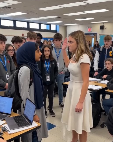
Eliza’s mother looked at Victoria, and something in her face softened for half a second. Not forgiveness. Recognition.
Then my phone buzzed again.
This time it was Martin.
A new message came through with three attachments.
Mr. Callahan opened the first: Contract A.
The approved prom agreement.
Then Contract B.
The submitted district version.
Then the third attachment.
A scan of an email chain.
At the top was Margaret Beaumont writing to Principal Whitmore:
“Use student media to present this as a community partnership. Remove any language about labor. Victoria can influence the paper if needed.”
I felt the room turn toward her.
Victoria’s lips parted. Her eyes filled, not beautifully, not softly, but like someone whose last hiding place had been torn open.
Mrs. Beaumont said, “Victoria, say nothing.”
But Victoria was already looking at me.
Something terrible and human passed across her face.
“I didn’t know about the billing,” she said.
Eliza laughed once, bitter and hurt. “But you knew enough to threaten me.”
Victoria looked down.
“Yes.”
The word landed heavily.
Mrs. Beaumont snapped, “Victoria.”
Victoria looked at her mother, and all the fear in her suddenly burned into anger.
“You told me it was just reputation,” she said. “You told me they were trying to ruin us.”
Mrs. Beaumont’s voice turned icy. “And you believed me because you enjoy being important.”
Victoria went white.
That sentence hit harder than any slap.
For the first time, I saw Victoria not as the girl who had humiliated me, but as a weapon someone else had sharpened and pointed.
Then the school intercom chimed.
A secretary’s nervous voice filled the room.
“Principal Whitmore, district representatives are in reception. They are asking for Mrs. Beaumont, Mr. Callahan, and Zara Ali.”
Mrs. Beaumont stared at me.
And somehow, I knew the next move would be crueler than the slap.
Part 6: The Lie In The Boardroom
The district representatives did not put us in Principal Whitmore’s office.
They took us to the boardroom.
That mattered.
The boardroom had glass walls, polished wood, framed scholarship photos, and a long table where adults usually made decisions before students ever heard about them. Outside, clusters of students gathered in the corridor. Teachers pretended to move them along, but nobody truly left.
Victoria sat across from me, her hands clenched in her lap.
Mrs. Beaumont sat beside her like a queen beside a damaged crown.
Principal Whitmore kept wiping his forehead with a handkerchief.
Eliza and her mother sat near Mr. Callahan. Daniel Reeves stood behind them with his arms crossed, refusing a chair.
A woman from the district introduced herself as Helen Ward. Her voice was calm, but her eyes missed nothing.
“We have received documentation suggesting contract irregularities, unauthorized access to student journalism materials, and retaliation against students.”
Mrs. Beaumont leaned forward. “You have received gossip.”
Helen Ward opened a folder. “We have received timestamps.”
The boardroom went still.
Mrs. Beaumont changed strategies with the smoothness of someone used to buying exits.
“My daughter made a teenage mistake. She was upset by defamatory content aimed at our family. She should not have touched a student’s laptop. But this has become a mob.”
Victoria stared at the table.
Helen Ward looked at me. “Did Victoria Beaumont strike you?”
My mouth went dry. Every eye turned.
“Yes.”
Victoria’s voice came almost immediately. “I did.”
Mrs. Beaumont’s head snapped toward her.
Victoria swallowed. “I slapped her.”
For one fragile second, I thought she was choosing the truth.
Then she added, “After she threatened to publish private family information about me.”
The boardroom shifted.
My breath caught.
“That’s not true,” Eliza said.
Mrs. Beaumont placed one hand over Victoria’s, the gesture tender enough to fool anyone who had not seen the command in it.
Helen Ward looked at me. “Did you threaten her?”
“No,” I said. “I told her the interview would not be altered unless Eliza requested changes for accuracy.”
Mrs. Beaumont sighed. “Students are clever. They know exactly how to make cruelty sound ethical.”
My cheek burned again, but this time from rage.
Mr. Callahan leaned forward. “I supervised the article. Zara followed procedure.”
Principal Whitmore suddenly spoke. “There were concerns about her judgment.”
Everyone looked at him.
He would not meet my eyes.
“She has been unusually fixated on this story,” he said. “I advised caution.”
My chest tightened.
There it was. The second slap. Cleaner. Quieter. Delivered by an adult in a suit.
Helen Ward wrote something down. “Do you have documentation of that concern?”
Principal Whitmore hesitated.
Mrs. Beaumont smiled faintly.
Then Victoria looked at him.
“Don’t,” she whispered.
Principal Whitmore opened his folder anyway.
“I have a complaint,” he said, “submitted this morning by Victoria Beaumont.”
He slid a printed page across the table.
I read the first line upside down and felt ice move through my ribs.
It claimed I had harassed Victoria for weeks, fabricated sources, and planned to embarrass her family because I was jealous of her prom committee position.
At the bottom was a signature.
My signature.
But I had never written it.
Eliza whispered, “Zara?”
I looked at the page, then at Victoria.
Her face had gone gray.
Mrs. Beaumont’s hand tightened around her daughter’s wrist.
Helen Ward picked up the document.
“This is serious,” she said.
And then Victoria did something nobody expected.
She pulled her hand away from her mother and stood.
“That signature is fake.”
Part 7: The Daughter Who Broke The Machine
Mrs. Beaumont did not move at first.
The whole boardroom seemed to hold its breath around Victoria.
Principal Whitmore stared at her as if she had stepped off a ledge.
Victoria’s voice shook, but she kept standing.
“That complaint was not written by Zara,” she said. “It was written in my name, but I did not submit it.”
Mrs. Beaumont’s face hardened into something almost unrecognizable.
“Sit down.”
Victoria looked at her mother. “No.”
One word. Barely loud enough.
But it changed the air.
Helen Ward folded her hands. “Victoria, are you saying this document was fabricated?”
Victoria pressed her fingers against the edge of the table. Her bright necklace trembled with her breathing.
“I’m saying my mother told me there would be a complaint if Zara did not back down. I thought she meant a real complaint. I thought she had evidence.” She looked at me then, and her eyes were wet. “I didn’t know they forged her signature.”
Mrs. Beaumont gave a soft laugh. “My daughter is emotional.”
Victoria turned on her. “You always say that when I stop obeying.”
No one spoke.
Even Mrs. Beaumont blinked.
Victoria reached into her bag and pulled out her phone. Her hands were shaking so badly she almost dropped it.
“I recorded you this morning,” she said.
Mrs. Beaumont’s expression changed by a fraction. Tiny. But enough.
Victoria tapped the screen.
Her mother’s voice filled the boardroom.
“If Zara refuses, we make her the problem. Whitmore will place the complaint. By the time anyone checks, the article will be dead.”
Then Principal Whitmore’s voice.
“I do not like the signature issue.”
Mrs. Beaumont again.
“You like the new science wing funding.”
The recording ended.
Daniel Reeves whispered something under his breath.
Helen Ward slowly removed the forged complaint from the folder and placed it in a clear evidence sleeve.
Principal Whitmore stood. “This has been taken out of context.”
“No,” Helen Ward said. “Sit down.”
He sat.
Victoria looked as if the recording had cost her more than courage. It had cost her the version of herself she had been trained to perform.
Mrs. Beaumont’s voice turned soft. “Victoria, think carefully. Everything you enjoy, everything you have, came from this family.”
Victoria closed her eyes.
When she opened them, she looked exhausted. And younger than eighteen.
“Then I don’t want it like this.”
Mrs. Beaumont smiled sadly, as if Victoria were an ungrateful child.
“You will regret humiliating me.”
Victoria nodded once. “Probably.”
Then she turned to me.
“I hit you,” she said. “I tried to scare Eliza. I helped bury the interview because I liked being powerful. I am not innocent.”
Her voice broke.
“But Zara did not lie.”
The words struck me harder than I expected.
Not because they healed what she had done.
Because they put the truth back where it belonged.
Helen Ward stood. “Effective immediately, Principal Whitmore is placed on administrative leave pending investigation. Mrs. Beaumont, you will have no further contact with student witnesses. The prom contract is suspended.”
The corridor outside erupted.
But Mrs. Beaumont was not finished.
She stood slowly, buttoning her coat.
“You think a school board can frighten me?”
No one answered.
She looked at me last.
“Little reporters should learn what powerful families do when cornered.”
Before she reached the door, Clara spoke.
“You are not cornered by a reporter.”
Mrs. Beaumont paused.
Clara stood, still in her cleaning uniform, holding up her old phone.
“You are cornered by every worker you thought was invisible.”
The door opened behind her.
Three hotel employees stepped into view.
Then five more.
Then Martin Keller.
And in his hands was a sealed envelope with the Beaumont Grand crest.
“Margaret,” he said, “your husband signed a confession before he died.”
Part 8: The Confession Hidden Beneath The Ballroom
Mrs. Beaumont stopped breathing.
At least, that was how it looked.
All the polish drained from her face, leaving behind a woman who had built her life on locked rooms and quiet threats, only to watch the walls turn transparent.
Victoria stared at Martin. “My father?”
Martin did not look proud. He looked tired.
“He found the second payroll system last spring,” Martin said. “He wanted to report it. He was ill by then, and your mother convinced him to wait until after the hospital fundraiser.”
Mrs. Beaumont’s voice came out flat. “Do not say another word.”
Martin placed the envelope on the table.
Helen Ward opened it with careful hands.
Inside was a signed statement, a copied ledger, and a small key card labeled SUBLEVEL ARCHIVE.
The confession was not dramatic in language. It was worse. Plain. Precise. Dates. Payments. Names.
The Beaumont Grand had billed public events for staff who were never paid. Student volunteers, immigrant cleaners, kitchen apprentices, temporary crews whose hours vanished under “community partnership adjustments.”
At the bottom, Victoria’s father had written one final line.
“If Margaret buries this, give it to the students. Adults have failed them enough.”
Victoria covered her mouth.
Her tears came silently, with no performance left in them.
Mrs. Beaumont reached for the page, but Helen Ward moved it away.
“You have no authority over this evidence,” she said.
For the first time all day, Mrs. Beaumont had nothing ready.
No smile.
No threat.
No beautiful sentence.
Only silence.
The investigation moved faster after that, because truth has a different speed once powerful people can no longer slow it down. The district suspended the contract. The hotel workers filed claims together. The school paper published the full story with redactions to protect families, and Eliza’s interview became the center, not because she was perfect on camera, but because her voice trembled and kept going anyway.
Mr. Callahan refused to let me write the final article alone.
“You are part of the story now,” he said.
So Daniel handled the contract timeline. Eliza wrote a personal essay. Martin verified the hotel records. Clara approved every word about the workers.
And Victoria?
She did not disappear.
That was the surprising part.
She resigned from prom committee. She gave a public statement admitting what she had done to me and Eliza. She did not ask for forgiveness. She did not cry in a way that asked people to comfort her.
She stood in the auditorium, hands shaking around the microphone, and said, “I confused attention with worth, and I hurt people because power made me feel safe.”
Some students rolled their eyes.
Some respected it.
I did neither.
I listened.
Two weeks later, prom was moved from the Beaumont Grand to an old municipal hall overlooking the river in Lisbon, part of a student exchange trip that had nearly been canceled until the city education office offered the venue free of charge. No chandeliers. No luxury staircase. No family crest on napkins.
Just paper lanterns, borrowed speakers, and a long table of food brought by parents, teachers, and workers who had once been treated like background.
Eliza’s mother danced first.
That made everyone cheer.
Victoria arrived late in a simple blue dress. No necklace. No crowd. She walked up to me near the doorway, where I was checking the final photo captions for the paper.
For a second, we were back in the journalism room.
My cheek no longer hurt, but I remembered.
She did too.
“I found something,” Victoria said.
She handed me a small black recorder.
I did not take it immediately.
“What is that?”
“My father’s last interview,” she said. “He recorded it for me. I never listened because my mother told me grief makes people imagine heroes.”
Her voice cracked.
“I listened today. He mentioned your article. Not you by name. He said, ‘There is a student who refuses to make silence look elegant.’”
I stared at the recorder.
Victoria held it out farther.
“I think it belongs in the archive.”
I took it.
Not as a gift.
As evidence.
As memory.
As proof that people can be late to the truth and still choose it before the door closes.
The article won a national student journalism prize that summer, but that was not the ending I carried with me.
The ending was quieter.
It was Eliza laughing beside her mother under paper lanterns.
It was Martin getting rehired by a worker-owned hotel cooperative formed after the scandal.
It was Mr. Callahan taping our front page to the journalism room wall, exactly where Victoria had once tried to erase us.
And it was Victoria Beaumont standing alone at the edge of the dance floor, not forgiven by everyone, not rescued from consequences, but finally free from being her mother’s sharpest weapon.
When she looked over, I nodded once.
She nodded back.
Then I opened my notebook and wrote the headline we had earned together:
THE RECORD SURVIVED BECAUSE THE PEOPLE INSIDE IT REFUSED TO VANISH.
