Part 2: The Clip Whitney Begged Them Not To Play
The principal’s finger hovered over the spacebar, and Whitney Vale’s face lost all its expensive confidence at once.
She looked at the screen, then at the students clustered near the paint-splattered tables, then at me, as if she could still command the room to believe her by choosing where to glare.
My cheek throbbed where her palm had landed.
I could feel the heat of it spreading under my skin, but I refused to touch my face. I refused to give her the image she wanted: me hurt, me small, me proving her story for her.
The art room smelled like acrylic paint, wet cardboard, and the sharp metal scent of panic.
Ms. Calder, the art teacher, stood between Whitney and me with both hands raised. “No one moves,” she said.
Whitney laughed, but it came out thin. “This is insane. She grabbed the project sheet and started accusing people.”
“I did not accuse anyone,” I said.
My voice shook. I hated that it shook.
Whitney’s eyes flickered with satisfaction.
“She’s been weird all morning,” Whitney said quickly. “She kept staring at the mural plan like she wanted to change it. I told her not everything has to be about her.”
A few students looked away.
That was the worst part.
Not the slap.
Not even the sting.
It was the way people made themselves smaller around a lie because disagreeing with Whitney cost too much.
The principal pressed play.
The video opened on the mural wall from earlier that morning. Someone had recorded the planning board while people were still unpacking paint. At first, nothing looked important: brushes in jars, name cards taped beside sections, the anti-bullying slogan sketched in pencil across the top.
Then Whitney appeared in the corner of the frame.
She was laughing with two girls from her clique. One of them blocked the doorway while the other held a clipboard.
On the board, every student’s name was matched to a mural section.
Except one name had been rubbed almost completely away.
Noah Ellis.
The student who had designed the center image.
The student everyone called quiet because they had never bothered to learn how loud his art was.
Whitney leaned toward the board with an eraser in her hand.
Someone whispered, “Oh my God.”
In the clip, Whitney erased the rest of Noah’s name.
Then she wrote her own beside the central design.
The room changed temperature.
The principal paused the video.
No one breathed.
Whitney’s lips parted. “That doesn’t prove anything.”
Ms. Calder stared at her. “You erased Noah’s name.”
Whitney snapped, “It was a draft.”
“No,” I said, and this time my voice did not shake. “That was the final assignment sheet.”
Whitney turned on me. “You don’t know that.”
I bent down and picked up the paper that had fallen when she slapped me.
The corner was creased. A line of blue paint had smeared across the bottom.
But the title at the top was still clear.
Final Mural Credits And Score Sheet.
I placed it on the table.
“The one I was protecting,” I said. “The one you said I stole.”
Whitney’s mouth tightened.
Behind her, one of her friends whispered, “Whitney, stop.”
But Whitney was already trapped, and trapped people sometimes scratch harder.
She lifted her chin. “Maybe Hana changed it.”
Ms. Calder’s face went still.
That was when Noah stepped out from behind the storage shelves.
He had been there the whole time, half-hidden by rolls of brown paper, his paint-stained hoodie sleeves pulled over his hands.
He looked at the score sheet on the table.
Then he looked at Whitney.
“She didn’t change it,” he said. “I took the photo.”
Part 3: The Boy Whose Name She Stole
Noah did not look brave when he said it.
He looked terrified.
His shoulders were hunched, his eyes fixed somewhere near the floor, and his fingers kept twisting the cuff of his sleeve like he was trying to disappear inside it.
But he had spoken.
And that alone made Whitney’s face harden.
“You took a photo of me?” she said, loud enough to turn fear into accusation.
Noah flinched.
I stepped forward before I could stop myself. “He took a photo of the board.”
Whitney swung toward me. “Of course you’re defending him. You two planned this.”
The principal raised his voice. “Enough.”
The word cracked through the room.
Whitney went silent, but her eyes stayed sharp.
Ms. Calder moved closer to Noah. “Noah, do you have the photo?”
He nodded and pulled out his phone with shaking hands.
His screen was cracked across one corner. He tapped twice, then handed it to Ms. Calder.
She looked at it.
Her face softened first.
Then it tightened with anger.
She turned the phone toward the principal.
The photo showed the mural board before anything had been erased.
Noah Ellis was listed for the center panel.
My name was listed beside “materials and final credit verification.”
Whitney Vale was listed under “background lettering.”
Not the center.
Not the main design.
Not the leadership score.
Just background lettering.
Whitney saw it and laughed again, too sharp and too quick.
“That’s old.”
Noah swallowed. “It was taken at 8:11.”
The principal checked the timestamp.
His jaw clenched.
Ms. Calder placed Noah’s phone on the desk carefully, like it had become evidence too heavy to hold.
“Whitney,” she said, “why was Noah’s name erased?”
Whitney’s nostrils flared. “Because he wasn’t going to present. Everyone knows he freezes when he has to talk.”
Noah’s face went red.
The room went so quiet that the drip of paint water from a brush into a plastic cup sounded huge.
I felt something hot rise in my chest.
“That doesn’t mean you get to steal his work.”
Whitney leaned toward me. “You really think you’re some hero because you carry clipboards and tape labels?”
I looked at Noah.
His eyes were wet, but he was still standing there.
“No,” I said. “I think names matter.”
The principal asked for the score sheet.
I handed it over.
He read the top section, then the scoring column. His brows drew together.
“What is this award category?” he asked.
Ms. Calder looked over his shoulder. “The district mural showcase. The winning design gets featured at City Hall.”
A wave of murmurs moved through the students.
I had known the mural mattered.
I had not known it mattered that much.
Whitney did.
That was why she had needed the score sheet hidden.
That was why she had slapped me before I could say what I had found.
The principal turned another page.
Then his eyes stopped.
“There’s a signature here,” he said.
Ms. Calder frowned. “What signature?”
He laid the sheet flat on the table.
At the bottom of the scoring approval box, beneath Whitney’s name, was a teacher signature.
Ms. Calder’s signature.
Except Ms. Calder was staring at it like she had never seen it before.
“That is not mine,” she said.
Whitney’s face drained.
The principal looked at her.
The room seemed to shrink around the table.
Ms. Calder reached for the paper, but her hand stopped before touching it.
“That is a forged signature.”
Whitney whispered, “I didn’t do that.”
And from the back of the room, one of her own friends said, “Whitney, you told me to copy it.”
Part 4: The Friend Who Finally Chose The Truth
Her name was Elise Warren, and until that moment, I had only known her as the girl who stood slightly behind Whitney in every photo.
She had perfect curls, glossy nails, and the frightened look of someone who had spent years laughing half a second after the popular girl laughed.
Now she was crying so hard her eyeliner had started to run.
Whitney turned toward her slowly.
“Elise,” she said, almost gently.
That one word sounded like a warning.
Elise shook her head. “No. I can’t.”
Whitney took a step closer. Ms. Calder immediately stepped between them.
“Elise,” the principal said, “what are you saying?”
Elise wiped her cheeks with the back of her hand. “Whitney said Noah wasn’t going to speak at the showcase anyway. She said the mural would look better if someone confident presented it. She said if we changed the score sheet before Ms. Calder uploaded it, no one would care.”
Noah stared at her.
His face had gone blank in a way that hurt more than crying.
Elise looked at him and broke harder. “I’m sorry.”
Noah did not answer.
He should not have had to.
Whitney folded her arms. “She’s lying because she’s scared.”
Elise laughed through her tears. “Of you.”
The words hit hard.
Whitney’s eyes flashed.
Elise pulled her phone out. “I have the messages.”
Whitney moved so fast Ms. Calder had to catch her arm.
“Don’t touch her,” the principal snapped.
Every phone in the room lifted higher.
Whitney saw them and froze.
She had used an audience as a weapon. Now the audience had turned into witnesses.
Elise opened a group chat.
The name at the top made my stomach twist.
Mural Fix.
Fix.
As if Noah’s name had been a stain.
As if my checking the credit sheet had been damage.
As if fairness was something to clean up before adults noticed.
The principal took photos of the messages from Elise’s phone.
Whitney had written:
Noah can’t handle the showcase. I’ll present the center panel.
Then:
Hana checks everything. Keep her away from the score sheet.
And finally:
If she finds it, say she’s jealous because nobody asked her to design anything.
My hands curled into fists.
I could still hear Whitney’s voice before the slap, sweet and cruel: “Why are you so obsessed with things that aren’t yours?”
But the thing had not been mine.
That was the point.
I had been protecting someone else’s.
The principal scrolled further.
His expression changed.
“What is this?” he asked.
Elise looked at the screen and covered her mouth.
Whitney looked away.
The message was from Whitney.
Delete the original photos after lunch. If Noah complains, remind people he has “issues.”
Noah’s eyes dropped.
The word sat there like poison.
Issues.
The way people turned someone’s quietness into weakness.
The way they turned anxiety into a punchline.
The way they made a student easier to steal from by pretending he was too fragile to own anything.
Ms. Calder’s voice broke. “Whitney, do you understand what you did?”
Whitney’s face hardened again. “I protected the project.”
“No,” I said.
She looked at me.
I stepped closer to the table, my cheek still burning, my hands still trembling.
“You protected your applause.”
The room went completely silent.
Then the principal’s radio crackled.
The front office was calling him.
He answered, eyes still on Whitney.
A woman’s voice came through.
“Mr. Lowell, Whitney Vale’s mother is here. She says she needs to speak to you immediately before any student statements are taken.”
Whitney’s lips curved just slightly.
There it was.
Not relief.
Expectation.
She still believed the rescue was coming.
Part 5: The Mother Who Knew The Right People
Mrs. Vale entered the art room wearing a camel coat, pearl earrings, and a smile that looked polished enough to cut glass.
She did not rush to Whitney.
She did not ask who had been hurt.
She scanned the room like a lawyer studying a weak witness.
Then her eyes landed on my face.
The red mark was still visible.
Her smile faded only a little.
“Principal Lowell,” she said, “I was told there has been an incident.”
The principal stood by the desk with the score sheet, Noah’s photo, Elise’s messages, and the paused video all visible behind him.
“There has.”
Mrs. Vale glanced at the evidence, then at Whitney. “My daughter tells me she was provoked.”
Whitney’s chin lifted.
My stomach tightened.
There it was again: the story before the facts.
Ms. Calder crossed her arms. “Your daughter struck Hana in front of half the room.”
Mrs. Vale looked at me again, and this time her gaze lingered on my old sweater, my paint-smudged jeans, my worn sleeves.
It was not a glance.
It was a measurement.
“I’m sure emotions ran high,” she said. “Group projects can be difficult, especially when students misunderstand their roles.”
Noah’s fingers gripped his phone.
I stepped toward him without thinking.
Mrs. Vale noticed.
“Ah,” she said softly. “So this is about the boy.”
Noah flinched.
The principal’s voice sharpened. “This is about erased credit, a forged signature, intimidation, and physical assault.”
Mrs. Vale’s expression cooled.
“Careful, Mr. Lowell.”
The air changed.
Even Whitney looked at her mother.
Mrs. Vale set her handbag on a clean corner of the table, far from the paint, as if the room itself might stain her.
“The Vale Foundation funds three district art grants,” she said. “Including the showcase this mural was intended for. I would hate for a student misunderstanding to damage a partnership that benefits so many children.”
Ms. Calder’s face went pale with anger.
Noah stared at the floor.
Elise whispered, “Oh my God.”
Whitney did not speak.
She looked almost relieved.
That hurt in a different way.
She had not invented this behavior.
She had inherited it.
Mrs. Vale turned to me. “Hana, isn’t it?”
I did not answer.
She smiled anyway.
“You seem like a responsible girl. Responsible girls understand when something has gone too far.”
I could feel every student watching me.
Mrs. Vale lowered her voice, but not enough.
“I’m sure the school can find you a leadership credit somewhere else. Perhaps a recommendation. Perhaps a supply stipend. Something useful.”
My cheeks burned again, but this time not from the slap.
She thought she had found the price.
Old clothes.
Own supplies.
Behind-the-scenes work.
She saw all of that and decided I could be bought cheaply.
I looked at Noah.
He was still holding himself like he expected the floor to open under him.
Then I looked at Whitney.
Her face was unreadable now.
Not smug.
Not sorry.
Waiting.
Waiting to see whether her mother could erase this too.
I turned back to Mrs. Vale.
“You can’t give me a stipend for someone else’s name.”
The words came out calm.
The room held them.
Mrs. Vale’s smile vanished.
The principal placed his hand on the score sheet. “This investigation will proceed.”
Mrs. Vale leaned forward. “Then I suggest you remember who signs the grant renewals.”
Before the principal could answer, the classroom projector flickered.
Everyone turned.
Noah had moved to the teacher station.
His hands shook over the keyboard, but his eyes were different now.
Focused.
He connected his phone to the projector.
Whitney whispered, “Noah, don’t.”
Mrs. Vale’s head snapped toward him.
Noah clicked a file.
“This is the original time-lapse,” he said.
His voice was quiet.
But the whole room heard.
“I set it up to record the mural progress.”
Whitney went white.
Noah looked at the screen.
“It recorded more than the mural.”
Part 6: The Time-Lapse That Caught Everything
At first, the time-lapse looked harmless.
Students moved in quick little bursts around the art room, setting down brushes, rolling butcher paper, taping sketches to the wall. Paint jars appeared and disappeared like magic. Chairs slid across the floor in jerky motions.
Then the room emptied for the morning announcement.
Almost emptied.
Whitney and Elise remained.
The time-lapse sped everything up, but the truth was still clear.
Whitney crossed to the planning board.
Elise stood near the door, watching the hallway.
Whitney erased Noah’s name.
She wrote her own.
Then she took the score sheet from Ms. Calder’s desk.
Mrs. Vale moved closer to the screen.
Her face had gone very still.
The video continued.
Whitney sat at the teacher’s desk and practiced Ms. Calder’s signature on scrap paper.
Once.
Twice.
The third time, she copied it onto the sheet.
Elise covered her face and began sobbing.
Whitney stared at the screen like she was watching a stranger commit the act.
The time-lapse jumped forward.
I appeared in the frame.
I picked up the score sheet.
I looked at the board.
I looked back at the sheet.
Then I took a photo with my phone and placed the paper under a stack of unused mural templates, away from the paint water.
Protecting it.
Not stealing it.
Protecting it.
My chest tightened.
I had known what I did.
But seeing it from above, seeing my own careful hands, made the lie finally separate from me.
The video kept moving.
Whitney came back in with two friends.
She searched the desk.
She searched the supply table.
Then she saw me return.
The time-lapse did not capture sound, but it captured bodies.
Whitney stepping close.
Me holding up both hands.
Whitney pointing at the paper.
Me shaking my head.
Whitney slapping me.
The slap happened so fast on the time-lapse that it looked like a flicker.
But everyone in the room felt it.
The principal stopped the video.
No one spoke.
Not even Mrs. Vale.
Then the final seconds resumed by accident.
The time-lapse showed something no one expected.
Mrs. Vale herself entering the art room early that morning before students arrived.
She was with Whitney.
The two of them stood at the mural board.
Mrs. Vale pointed to Noah’s name.
Then she pointed to the center panel.
Whitney shook her head once, like she was nervous.
Mrs. Vale took the marker and tapped Whitney’s name on the side list.
Then she drew a small circle around the center panel.
The message was silent, but unmistakable.
Take it.
The video ended.
The projector screen went blue.
Whitney slowly turned toward her mother.
“You said no one would check the room camera,” she whispered.
Mrs. Vale’s lips tightened. “Whitney.”
“You said the time-lapse was probably only pointed at the wall.”
“Stop talking.”
But Whitney did not stop.
Her voice cracked. “You told me if Noah presented, people would feel sorry for him and he’d win.”
Noah looked up.
Mrs. Vale’s expression became ice.
“I told you to think strategically.”
Whitney laughed once, broken and bitter. “You told me to take his place.”
The room went silent in a new way.
Not just shocked.
Witnessing.
The principal looked at Mrs. Vale.
“Did you instruct your daughter to alter the score sheet?”
Mrs. Vale picked up her handbag.
“I will not answer questions in a room full of minors.”
But the answer was already standing on every face.
Whitney stared at her mother as if she had finally seen the outline of the cage she had mistaken for a crown.
Then Ms. Calder said quietly, “Noah, may I save a copy of that video?”
Noah nodded.
Whitney’s mother reached for Whitney’s arm.
“We’re leaving.”
Whitney pulled away.
It was small.
Just one step back.
But it was the first honest thing I had seen her do all day.
Part 7: The Hearing Where Whitney Chose Herself
The disciplinary hearing happened three days later in the library conference room.
The mural had been covered with a white sheet.
Every time I passed it, I felt like something alive was waiting underneath, holding its breath.
I almost did not go to the hearing.
My parents said I did not have to.
Ms. Calder said my written statement was enough.
Noah texted me one sentence that morning.
I’m going, but I don’t want to go alone.
So I went.
The library conference room had windows facing the courtyard, but the blinds were half-closed. A district official sat at the head of the table. Principal Lowell was there. Ms. Calder. Noah and his father. Elise and her mother. Whitney and both her parents.
Mrs. Vale looked furious behind her calm.
Mr. Vale looked like a man trying to decide whether the scandal or his daughter embarrassed him more.
Whitney looked different.
No satin skirt.
No corset top.
No armor.
Just a navy sweater, her hair tied back, and dark circles under her eyes.
When I entered, she looked at my cheek.
The mark had faded.
But she looked at it like she could still see her hand there.
The district official began with the evidence.
The photo.
The score sheet.
The group messages.
The time-lapse.
Mrs. Vale interrupted twice.
The second time, the official said, “Mrs. Vale, if you threaten district funding again, that will be added to the report.”
Her mouth closed.
Noah read his statement first.
His voice shook so badly on the first line that his father reached under the table and held his wrist.
Noah kept going.
He talked about designing the mural after his younger sister had stopped going to school for two weeks because girls in her class had mocked her speech therapy.
He talked about wanting the center image to show a hand repainting a crossed-out name.
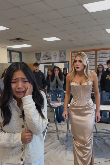
At that, Whitney lowered her head.
Noah swallowed.
“I didn’t design it to win,” he said. “I designed it because I know what it feels like when people act like your place can be given away.”
No one moved.
Then it was my turn.
I read my statement from one folded page.
I said I had checked the score sheet because that was my assigned job.
I said I had protected the paper because I saw Noah’s name erased.
I said Whitney hit me before I could explain.
Then I looked up.
“I don’t want revenge,” I said. “I want the mural to tell the truth.”
Whitney’s shoulders shook.
Mrs. Vale whispered sharply, “Control yourself.”
Whitney lifted her head.
Something changed in her face.
The old fear was still there, but something stronger stood behind it.
The district official asked Whitney if she wanted to make a statement.
Mrs. Vale immediately said, “No, she does not.”
Whitney said, “Yes, I do.”
Her mother froze.
Whitney stood.
Her paper trembled in her hand.
“I erased Noah’s name,” she said. “I copied Ms. Calder’s signature. I told people Hana was jealous. I slapped her because she had proof.”
Mrs. Vale hissed, “Whitney.”
Whitney looked at her mother.
“And my mother told me to do it.”
The room seemed to stop breathing.
Mrs. Vale stood. “This is outrageous.”
Whitney’s voice rose.
“You told me if I didn’t learn to take credit, I’d spend my life watching less deserving people get ahead.”
Noah’s father muttered something under his breath.
Whitney turned to Noah.
“You were not less deserving. You were better.”
Noah stared at her, stunned.
Then Whitney looked at me.
“And Hana was the only person in that room who acted like your name mattered before everyone else had proof.”
My throat tightened.
Whitney placed her statement on the table.
“I should be removed from the showcase. I should lose the leadership credit. And the mural should go under Noah’s name, with Hana listed for verification, because that’s what the record said before I ruined it.”
Mrs. Vale grabbed her handbag.
“Whitney, we are done.”
Whitney did not move.
“No,” she said, so quietly it hurt. “I’m done being your proof that winning matters more than people.”
Part 8: The Name Painted Where Everyone Could See
The mural was unveiled on a gray Friday afternoon when the courtyard smelled like rain and wet concrete.
No one expected a crowd.
But people came anyway.
Students who had filmed the slap.
Teachers who had pretended not to notice Whitney’s clique for years.
Parents.
District officials.
Even the local arts council sent two representatives because the story had reached them without anyone meaning for it to become public.
The white sheet hung over the mural like a held breath.
Noah stood beside me with paint under his fingernails.
He had repainted the center panel himself.
Ms. Calder had asked if he wanted help.
He said no.
Then, after a pause, he asked me to hold the ladder.
That was how we worked for two afternoons after school: him painting, me handing up brushes, neither of us saying much.
Sometimes silence is awkward.
Sometimes it is trust.
Whitney was there too, standing near the back of the courtyard.
Alone.
Her mother was not with her.
I heard later that the Vale Foundation had paused its district grants, expecting the school to beg.
The school did not.
That was the first surprise.
The second came when the arts council announced a new independent student mural fund to replace the money.
The third surprise was Whitney.
When Principal Lowell asked Noah to speak, Noah froze.
His fingers gripped the edge of his note card.
The crowd waited.
I saw his breathing change.
I took one small step closer, not enough to rescue him, just enough to remind him he was not alone.
Then Whitney raised her hand from the back.
Everyone turned.
She looked pale, but steady.
“I can read his first line,” she said, “if he wants. Only the first line.”
Noah stared at her.
For a long second, no one knew what to do.
Then he looked down at the note card and nodded.
Whitney walked forward.
She did not take the card from him.
She stood beside him and read the first sentence softly.
“This mural is for everyone whose name was crossed out before they got to speak.”
Then she stepped back.
Noah continued.
His voice was quiet.
But it held.
By the end, even the students near the fountain had gone silent.
Ms. Calder pulled the sheet down.
The mural appeared all at once.
At the center was a giant painted hand restoring a name over layers of crossed-out words. Around it were dozens of smaller hands holding brushes, each one different, each one unfinished in a way that made the whole wall feel alive.
At the bottom, in clear black letters, were the credits.
Center Design: Noah Ellis.
Verification And Records: Hana Miller.
Collaborating Artists: Art Room Mural Team.
And below that, smaller but impossible to miss, Noah had painted one final sentence.
No one owns the truth just because they speak louder.
My eyes blurred.
I looked at him.
“You added that?”
He nodded. “It needed to be there.”
The arts council representative stepped forward with an envelope.
The mural had been selected for City Hall after all.
Not because of Whitney.
Not because of her mother’s foundation.
Because the council had reviewed the original design, the time-lapse, and the final wall.
Noah’s sister came to the unveiling.
She was nine, with purple glasses and a shy smile.
When she saw the center image, she reached for Noah’s hand and whispered something I could not hear.
Whatever it was, Noah started crying.
Whitney stood several feet away, watching.
Then she came over to me.
Not close.
Never too close.
“I’m transferring,” she said.
I did not know what to say.
She looked at the mural. “Not because I’m running. Because I think I need to learn who I am when nobody is impressed by my last name.”
That sounded rehearsed, then not rehearsed at all.
She handed me a small envelope.
“I wrote an apology. A real one. You don’t have to read it.”
I took it.
Not because everything was fixed.
Because some truths deserve to be received even when forgiveness is still far away.
Whitney turned to Noah.
“I’m sorry,” she said.
Noah looked at her for a long moment.
Then he nodded once.
That was all.
It was enough for that day.
Weeks later, the mural hung in City Hall, and the school started requiring digital backups for every student project credit sheet. Ms. Calder made “verification” an official leadership role. Students laughed at the word at first.
Then they started asking for it.
The proof everyone missed had not just saved Noah’s name.
It had changed what the school thought counted as courage.
On the last day before summer, I opened Whitney’s apology.
Inside was one sentence written at the bottom in shaky blue ink.
You protected a name because you knew what it meant to be unseen.
I folded the letter carefully and placed it behind the photo of the mural.
Then I looked at the painted words, at Noah’s name, at mine, at the wall that had almost become a lie.
Whitney had slapped me to erase the truth, but all she did was leave a mark bright enough for everyone to follow.
