Part 2: The Barcode That Would Not Disappear
The slap left the room silent enough to hear the refrigerator unit humming behind the chemical cabinets.
My cheek burned, but the worst part was not the pain. It was the way everyone stared at me like they were waiting to see whether I would fall apart and prove Isabelle Monroe right.
She stood in front of me with her hand still half-raised, breathing fast through her nose. Her perfect cream cardigan had not shifted. Her silver bracelet still sat neatly at her wrist. She looked like someone who had done something terrible and expected the world to rearrange itself around her.
“See?” she said, her voice shaking just enough to sound emotional instead of guilty. “She’s been acting unstable all morning.”
I pressed my palm to my cheek.
Do not cry.
Not here.
Not while they are recording.
Mr. Calder, the chemistry technician, lowered the inventory tablet slowly. His eyes had gone from angry to still, and that stillness made Isabelle blink.
“Isabelle,” he said, “step away from Elara.”
Elara.
My name sounded strange in his mouth, like it had crossed a line from rumor to record.
Isabelle laughed once. “You’re seriously defending her?”
“I am asking you to step away.”
Behind me, someone whispered, “The scan code worked?”
That was when Isabelle’s face changed.
Only for a second.
But I saw it.
The fear.
Mr. Calder turned the tablet so the screen faced the nearest teacher, Ms. Varga. “The cabinet log says this bottle was scanned out at 8:11 this morning.”
Isabelle folded her arms. “So?”
“The rumor was that Elara removed it yesterday after club hours.”
I swallowed hard.
Ms. Varga looked at the screen, then at the bottle sealed inside the evidence tray. “Who scanned it out?”
Mr. Calder did not answer immediately.
He tapped once.
The scanner beeped.
A student near the doorway muttered, “No way.”
Mr. Calder looked directly at Isabelle.
“The scan is attached to your student access card.”
Isabelle shook her head before he finished. “That’s impossible.”
But the tablet did not care what was impossible.
It showed her name.
It showed the time.
It showed the cabinet number.
And beneath it, there was one more line Isabelle had missed completely.
Manual Override Approved By Faculty Sponsor.
Ms. Varga’s face went pale.
Because everyone knew who Isabelle’s faculty sponsor was.
The person standing in the doorway with a second file pressed against his chest.
Dr. Henrik Vale.
The teacher who had recommended Isabelle for every science prize that year.
The adult she thought would protect her.
Part 3: The Teacher With The Second File
Dr. Vale did not rush into the room.
He stepped in carefully, almost sadly, as if the floor beneath him had become glass.
Isabelle turned toward him with relief so sharp it looked like panic wearing a prettier mask.
“Dr. Vale,” she said. “Tell them. Tell them I didn’t do this.”
He looked at her for a long moment.
Then he said, “I wish I could.”
The words hit her harder than any shout could have.
Her mouth opened.
Nothing came out.
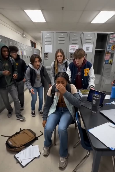
The students behind the storage shelves shifted closer, phones still raised, but nobody laughed now. The whole room had changed shape. Ten minutes earlier, I had been the strange girl who supposedly messed with the chemical cabinet. Now every person was watching the rich, polished senior and the award-winning teacher standing beside a record they could not explain away.
Dr. Vale handed the file to Ms. Varga.
“I found this in the preparation office printer queue,” he said. “It was scheduled to print after lunch.”
Ms. Varga opened the file.
Her eyebrows drew together.
“What is it?” Mr. Calder asked.
“A disciplinary statement,” she said slowly.
My stomach dropped.
Dr. Vale’s voice was low. “It names Elara as responsible for unauthorized cabinet access and recommends removing her from the regional science showcase.”
The air went cold around me.
I had known Isabelle wanted me embarrassed.
I had not known she wanted me erased.
Ms. Varga flipped the page. “This was written before the cabinet was even reported.”
A whisper moved through the room.
Before.
That word changed everything.
Isabelle took one step backward. “I didn’t write that.”
Dr. Vale looked at her. “No. You dictated it.”
Her face went white.
He opened his own phone and placed it on the table. “You left me a voice message at 7:52 this morning. You said the cabinet problem needed to look official before Elara started talking.”
Lydia Hart, Isabelle’s closest friend, made a small choking sound near the sink.
Isabelle snapped, “Why would you save that?”
Dr. Vale’s eyes sharpened with something that looked almost like guilt. “Because this morning was not the first time you asked me to bend a record.”
The room went silent all over again.
My cheek still burned.
But now Isabelle was the one trapped under everyone’s gaze.
Ms. Varga turned another page.
Then her hand stopped.
“Elara,” she said carefully, “were you supposed to present the catalyst stability project at the showcase?”
I nodded.
She looked at the file in her hand.
“So was Isabelle.”
Dr. Vale closed his eyes.
And I finally understood.
This was never about a cabinet. It was about a prize she could not win fairly.
Part 4: The Prize Hidden Behind The Rumor
Isabelle’s expression twisted so fast it almost frightened me.
“That showcase was mine,” she said.
Not should have been.
Not might have been.
Mine.
The word exposed more than she meant it to.
Ms. Varga’s face hardened. “The selection committee had not announced the final presenter.”
“They were going to choose her,” Isabelle said, pointing at me like I was something dirty on the floor. “Everyone knew it.”
I felt every eye swing back to me.
My fingers tightened around the strap of my backpack. The handmade keychain my little brother had given me pressed into my palm, its plastic edge biting my skin.
I wanted to say I had worked for it. I wanted to say I spent nights testing sample reactions while Isabelle posted photos from sponsor dinners. I wanted to say the project was mine because I had built it from failed trials, burned gloves, and notes written in the margins of borrowed textbooks.
But my throat locked.
Dr. Vale spoke instead.
“Elara’s results were independently verified last week,” he said. “Your data set had inconsistencies.”
Isabelle stared at him as if he had betrayed her in a language she had never learned.
“You told me my poster was stronger.”
“I told you your poster was polished,” he said. “That is not the same as correct.”
A few students reacted before they could stop themselves.
A gasp.
A whisper.
A quiet “wow” from someone behind the reagent shelves.
Isabelle heard all of it.
Her eyes shone, not with tears, but fury.
“You let people like her walk in and take everything,” she said.
Ms. Varga snapped, “Enough.”
But Isabelle was already breaking open.
“She doesn’t even belong in advanced chemistry. She only got noticed because everyone wants a perfect little underdog story.”
Something inside me went very still.
Not calm.
Not peaceful.
Still, like a match before it strikes.
I took my hand away from my cheek.
“I got noticed,” I said, “because my experiment worked.”
Isabelle laughed, but her voice cracked. “You copied the method.”
“No,” I said. “You did.”
The room froze.
I reached into my canvas backpack and pulled out my notebook.
The blue cover was bent at the corners. The elastic band had snapped two weeks ago, so I kept it closed with a hair tie. It looked cheap compared to Isabelle’s leather portfolio.
But inside were dates.
Sketches.
Failed formulas.
Temperature adjustments.
Every mistake that had taught me the final answer.
I opened to the page with the missing diagram.
“The photo of my catalyst setup that appeared in your draft poster,” I said, “came from this notebook.”
Isabelle’s eyes flicked to the page.
Then to Lydia.
That tiny glance was enough.
Lydia stepped backward.
Dr. Vale noticed.
So did Ms. Varga.
“Lydia,” Ms. Varga said, “what did you do?”
Part 5: The Friend Who Stole The Picture
Lydia Hart looked like she might faint.
Her phone slipped lower in her hand. For once, she was not recording anyone. She was the one being watched.
“I didn’t know,” she whispered.
Isabelle whipped toward her. “Don’t.”
But Lydia had already started crying.
“I didn’t know she was going to set Elara up.”
Every word loosened another bolt in the room.
Ms. Varga stepped closer. “What did you know?”
Lydia wiped her face with her sleeve, leaving a dark streak of mascara across her skin. “Isabelle said Elara was hiding notes because she didn’t want the team to improve before the showcase. She said it was unfair. She asked me to get a picture.”
My stomach turned.
The week before, my notebook had gone missing for half a day. I found it under a stack of lab aprons, and Isabelle had smiled when I picked it up.
I had told myself I was being paranoid.
I hated how often cruel people depended on that.
Lydia looked at me. “I’m sorry.”
The apology landed strangely.
Too small for what it had broken.
Dr. Vale opened Isabelle’s draft poster on the preparation-room computer. Mr. Calder connected it to the classroom screen because Ms. Varga told him to, and within seconds the stolen diagram appeared large enough for the whole room to see.
My handwriting was cropped out.
But not all of it.
At the bottom corner, barely visible, was the loop of my letter E.
Elara.
The room noticed before anyone said a word.
Someone whispered, “That’s hers.”
Isabelle’s hands clenched at her sides. “Everyone uses similar setups.”
Mr. Calder zoomed in.
There, beside the diagram, was a small label Isabelle had forgotten to remove.
Trial 19B.
My trial number.
My failed trial number.
Dr. Vale turned to Isabelle. “You used a failed setup in your poster.”
Isabelle’s eyes darted.
“And then,” he continued, “you realized Elara’s final method would expose that your version could not produce the same results.”
Ms. Varga looked at the sealed bottle in the evidence tray.
“So the cabinet rumor was meant to discredit her before the showcase review.”
Isabelle said nothing.
Her silence was an answer.
Then the door opened again.
Principal Marceau entered with a woman in a dark blazer and a city visitor badge clipped to her lapel.
I recognized her immediately from the email I had been too scared to show anyone that morning.
Dr. Celeste Armand.
Regional Science Showcase Committee.
She looked around the storage area, took in my red cheek, Isabelle’s pale face, the projected stolen diagram, and the sealed chemical bottle.
Then she said, “I think we need to discuss the scholarship recommendation Isabelle Monroe submitted yesterday.”
Part 6: The Scholarship Letter That Changed Everything
Isabelle made a sound like the floor had dropped beneath her.
Her mother was not there.
Her friends were useless.
Her sponsor had turned into a witness.
And now the committee itself was standing in the doorway with another piece of the truth in her hand.
Dr. Armand placed a folder on the front lab table. “The regional showcase includes a scholarship review. Applicants may submit supporting statements from teachers, but student-written claims must be accurate.”
Principal Marceau looked at Isabelle. “What claim?”
Dr. Armand opened the folder. “Isabelle wrote that she originated the catalyst stability method currently under review.”
My chest tightened.
I had expected theft.
I had not expected her to try to carry my work all the way into a scholarship file.
“That’s not true,” I said.
My voice shook.
This time, nobody laughed.
Dr. Armand turned to me gently. “Elara, do you have original lab records?”
I lifted my battered notebook.
“And digital backups?”
I nodded. “Photos. Timestamped. My brother told me to back up everything because my laptop keeps crashing.”
A tiny, ridiculous memory flashed through me: my brother sitting at the kitchen table, eating cereal from a mug, saying, “Cloud folder, El. Rich kids lose things differently.”
I had rolled my eyes at him.
Now I wanted to hug him until he complained.
Dr. Armand nodded to Mr. Calder. “We’ll need copies.”
Isabelle suddenly spoke. “This is insane. You’re all acting like I’m some criminal.”
“No,” Ms. Varga said. “We are acting like records matter.”
Isabelle’s eyes snapped to her. “Records can be misunderstood.”
“Then explain them.”
She looked from the scan code to the voice message, from Lydia’s confession to my notebook, from Dr. Vale to the scholarship file.
For once, there was nowhere pretty to stand.
Her voice dropped. “You don’t understand what my family expects.”
The room shifted.
Not sympathy exactly.
Recognition.
Pressure had a smell. A shape. A way of making people mean and calling it ambition.
“My sister won the regional prize,” Isabelle said. “My brother got the fellowship. My father tells everyone I’m next.”
Dr. Vale’s face softened for half a second. “Isabelle—”
“No.” She backed away from him. “You helped. Don’t pretend you didn’t. You told me which teachers mattered. You told me how committees think. You told me not to look average.”
Dr. Vale flinched.
That was when Principal Marceau looked at him differently.
“Dr. Vale,” she said, “how long have you been privately advising Isabelle on applications connected to school competitions?”
He did not answer fast enough.
Dr. Armand closed the scholarship folder.
The next silence belonged to him.
And somehow, unbelievably, the room found a deeper secret beneath Isabelle’s lie.
The teacher who exposed her had also helped build the system that protected her.
Part 7: The Adult Who Could Not Hide Anymore
Dr. Vale sat down like his legs had finally failed him.
The chemistry room looked different with him seated. Smaller. Less certain. He had always seemed like the kind of teacher who knew where every answer belonged. Now he looked like a man surrounded by answers he had avoided too long.
“I never altered results,” he said.
Principal Marceau’s voice was quiet. “That is not what I asked.”
He rubbed both hands over his face. “I advised several students. Informally.”
“Which students?”
He looked at Isabelle.
She looked away.
My stomach sank.
Because I knew.
Not the names, maybe. Not the details. But I knew the shape of it. The quiet invitations after class. The polished students whose posters always seemed to match what judges wanted. The rest of us told to work hard and wait our turn.
Dr. Armand opened a tablet. “The committee has noticed a pattern. Three showcase finalists from this school in four years had recommendation drafts edited from the same staff account before submission.”
Principal Marceau went still.
“Dr. Vale?”
His voice dropped to almost nothing. “I thought I was helping them compete.”
Ms. Varga said, “You were helping some of them compete.”
That sentence hit harder than yelling.
Isabelle began crying again, but this time there was no performance in it. She looked ruined in a way that made me feel neither happy nor sorry. Just tired.
“I thought everyone had someone,” she whispered.
I looked at my stained hoodie folded over a chair. The red mark had dried into the fabric. My cheek still throbbed when I moved my jaw.
“No,” I said. “Some of us just had the work.”
Nobody spoke.
Dr. Vale lowered his head.
Dr. Armand turned to me. “Elara, the committee will pause all scholarship decisions linked to this project until an academic review is complete.”
Pause.
The word scared me.
“So I lose it too?” I asked before I could stop myself.
Dr. Armand’s expression softened. “No. You get reviewed properly. With your records. With your data. With independent evaluators.”
Properly.
It was such a simple word.
It almost made me cry.
Principal Marceau instructed everyone to leave their phones with the office if they had recorded the slap or the storage-room discussion. The videos were already spreading, but at least the school was trying to stop my humiliation from becoming entertainment.
As students filed out, Isabelle stayed behind.
She stood across from me, no friends around her now.
“I hated you,” she said.
I looked at her.
She swallowed. “Because you made it look possible without all the things I had.”
I did not know what to say to that.
Then she did something I never expected.
She removed the silver bracelet from her wrist and placed it on the lab table.
“My father gave me this after my sister won,” she said. “He said I’d get a better one when I did.”
Her voice broke.
“I don’t want to win like this.”
The bracelet sat between us, bright and useless.
Then she picked up a pen and wrote one sentence on a blank incident form.
I lied about Elara Novak because I was afraid her work was better than mine.
Part 8: The Formula They Could Not Take
The review took eleven days.
Eleven days of whispers in corridors.
Eleven days of students going quiet when I entered classrooms.
Eleven days of seeing my own slapped face frozen in screenshots before teachers forced people to delete them.
But something else happened too.
Quietly at first.
Then everywhere.
People started checking records.
A Year Ten student asked why his robotics score sheet had been “misplaced” after a judge praised his design. A girl from biology requested the timestamp on her missing specimen photos. Two students from the maths club found old competition drafts with staff edits they had never been offered.
The chemical cabinet scan code had opened more than Isabelle’s lie.
It opened the school’s locked habit of pretending unfairness was just excellence with better shoes.
Dr. Vale was suspended from advising competitions. Principal Marceau announced a new rule: all scholarship and showcase submissions would go through blind review, with student records uploaded directly to the committee.
Isabelle disappeared for three days.
When she returned, she wore no silver bracelet, no perfect cardigan, no hard little smile. She kept her head down and sat alone in the back of chemistry.
I did not speak to her.
Forgiveness was not a performance either.
On the twelfth day, Dr. Armand called me into the auditorium.
Not the office.
The auditorium.
My mother was there in her work coat, still holding her bus pass. My little brother sat beside her, swinging his feet and trying to look serious. Ms. Varga stood near the stage. Mr. Calder held the inventory tablet like it had become a sacred object.
And Isabelle was there too.
So was Dr. Vale, seated apart from everyone, pale and silent.
Dr. Armand stepped to the microphone. “The independent review has concluded.”
My hands went numb.
She looked directly at me.
“Elara Novak’s catalyst stability project is original, properly documented, and scientifically valid.”
My mother covered her mouth.
My brother whispered, “I told you to back it up.”
A laugh broke out near the front row, small and relieved.
Dr. Armand continued. “The committee has selected Elara as the regional showcase presenter.”
The room clapped.
Not wildly.
Not like a movie.
But steadily, seriously, like people understood that applause could be a kind of repair.
I looked down at my hands.
They were shaking.
Then Dr. Armand said, “There is one more matter.”
The applause faded.
My stomach tightened all over again.
“The scan code that identified the false cabinet access was part of a pilot inventory system designed by a student assistant last semester. That assistant flagged a weakness in manual override approvals and recommended a second verification step.”
She smiled slightly.
“Elara Novak wrote that recommendation.”
I blinked.
I had forgotten.
It had been a boring form after a boring training session. I wrote it because the old system annoyed me. Because rules should work even when no one important was watching.
Dr. Armand turned a page.
“The city science board has accepted that recommendation. Starting next term, every school lab in the district will use the revised verification process.”
My mother started crying then.
Not quietly.
My brother leaned into her side.
Across the room, Isabelle looked at me. Her face was wet, but she did not look away.
After the meeting, she approached slowly.
“I submitted the written confession to the scholarship board,” she said. “And I withdrew my application.”
I nodded.
She seemed to expect nothing else.
Then she added, “My father read it.”
My breath caught.
“What happened?”
She looked down at her empty wrist. “He said I embarrassed the family.”
I did not answer.
“But my grandmother called me,” Isabelle said. “She said it was the first honest thing anyone in our house had done in years.”
That surprised me enough to look at her fully.
For the first time, Isabelle Monroe looked like someone standing at the beginning of a harder life, not the end of a perfect one.
“I’m sorry,” she said.
“I know.”
“I don’t deserve forgiveness.”
“No,” I said. “You don’t.”
She nodded, and somehow that made the apology feel real.
At the regional showcase, my project stood on a plain white table beneath bright lights. No stolen diagrams. No false cabinet reports. No polished lie standing between my work and the people judging it.
When the judges came by, I explained every failed trial first.
Trial 4, too unstable.
Trial 11, wrong temperature curve.
Trial 19B, the one Isabelle copied, useless after six minutes.
Then the final formula.
The one that held.
The one nobody could take because I knew exactly how I had built it.
I did not win first place.
I won something stranger.
A special award for research integrity and applied safety design, created that year because a scan code in a school storage room had exposed how easily truth could be buried when people trusted status more than systems.
The certificate had my name on it.
Correctly spelled.
Printed in black ink.
Verified by three signatures.
When I got home, I pinned it above my desk beside the handmade keychain from my brother and the first page of my battered notebook.
My cheek had healed by then.
But I kept one photo from that day.
Not the slap.
Not Isabelle crying.
Not Dr. Vale lowering his head.
The photo I kept was of the tablet screen showing the scan code record, plain and unpretty and impossible to intimidate.
Because before the whole school believed me, before the committee cleared me, before the rules changed for every lab in the district, one small code had done what nobody else was brave enough to do: it told the truth without flinching.
