Part 2: The Boy Vivian Wanted Everyone To Blame
The person in the doorway did not look like someone who had come to defend himself.
Lucas Meyer stood there with his school cap crushed between both hands, his shoulders pulled tight, his face pale under the dugout lights. Behind him, the charity game kept going in broken pieces: a whistle, a metal bat clanging somewhere, nervous parents pretending they were not staring.
Vivian Locke’s smile disappeared so fast it almost looked practiced.
“Lucas,” the counselor said carefully, holding up the equipment loan tag. “Did you move this bat?”
Lucas looked at me first.
Not Vivian.
Not the counselor.
Me.
His eyes dropped to the smear of sauce on my cardigan, then to the tag on the floor, then to the bat now visible behind the rival group’s water cooler like a secret that had finally gotten tired of hiding.
“No,” he whispered. “I’ve been trying to tell you that all afternoon.”
Vivian laughed once, sharp and thin. “Of course he says that now.”
But nobody laughed with her.
The counselor turned the tag over. A little barcode sticker curled at one corner. Under it, written in black marker, was the loan number, the borrower initials, and the checkout time.
V.L. — 2:14 PM.
Vivian’s necklace flashed as she stiffened.
A boy from the junior team murmured, “That’s her.”
Vivian spun toward him. “Shut up.”
That single word did more damage than anything else. Rich girls like Vivian were supposed to be graceful when accused. Sweet. Shocked. Above it all.
She sounded scared.
The counselor looked from the tag to Vivian. “Why was your loan tag on the missing bat?”
Vivian’s face changed again, softer now, almost wounded. “Because Hannah planted it.”
My stomach twisted.
I had expected her to deny it.
I had not expected her to throw me under the bus while the food she had thrown was still drying on my sleeve.
“I didn’t,” I said.
Vivian stepped closer, lowering her voice enough for the adults to call it calm and the students to call it poison. “You were the one carrying that camera all day. You were the one sneaking around the dugout. You were the one who wanted attention.”
Lucas flinched like he had heard those words before.
The counselor’s grip tightened around the tag. “Everyone stay here.”
That was when Vivian’s father arrived.
Mr. Locke came through the side gate in a navy coat, phone already in his hand, expression already annoyed. He did not ask why his daughter had thrown food at another student. He did not ask why a missing charity bat had appeared behind a cooler. He looked straight at me, at my stained cardigan, my old sneakers, my cheap fabric camera strap.
Then he said, “I assume there has been a misunderstanding.”
Vivian’s shoulders loosened.
The old order had walked in.
And everyone felt it.
Mr. Locke put one hand on Vivian’s back and smiled at the counselor like he owned the air between them. “My daughter has spent weeks helping organize this fundraiser. She would never risk the charity event over a baseball bat.”
Lucas finally lifted his head.
“It wasn’t just the bat,” he said.
The dugout went still.
Vivian’s father looked at him as if he had forgotten poor people could speak.
Lucas swallowed. “There were other things missing. Gloves. donation envelopes. Two camera batteries from the media table. Every time something disappeared, Vivian said I was nearby.”
Vivian’s eyes snapped wide. “That’s a lie.”
Lucas’s voice shook, but he kept going. “My brother’s team almost got disqualified last week because their borrowed catcher’s gear went missing. Then it came back after Vivian’s group won the practice slot.”
Mr. Locke laughed softly. “This is ridiculous.”
The counselor did not laugh.
He looked at me. “Hannah, you said you had evidence.”
My fingers closed around my camera strap.
Vivian noticed.
So did her father.
The camera hanging against my ribs suddenly felt heavier than any bat in the dugout. I had not meant to become the kind of person who exposed someone in public. I only took photos for the school newsletter because I liked catching moments nobody else kept: kids laughing after a bad swing, tired volunteers stacking chairs, parents clapping for students who never got trophies.
But sometimes a camera catches more than smiles.
I unzipped the small side pocket of my bag.
Vivian took one step forward.
Mr. Locke said, quietly, “Be careful what you accuse people of.”
I looked at Lucas. His cap trembled in his hands.
Then I handed the memory card case to the counselor.
“I’m not accusing,” I said. “I’m showing.”
Part 3: The Photo That Changed Every Face
The counselor did not open the files in the dugout.
That made Vivian brave again.
She folded her arms and tilted her chin, pretending the whole thing had become boring. Her friends gathered behind her like polished shields, whispering just loudly enough for me to hear words like jealous, fake, desperate.
Lucas stood alone.
I hated that most.
The counselor led us into the equipment office beside the field, a narrow room smelling of rubber gloves, grass stains, and old rain. A laptop sat open on a folding table. Two staff members came in. Then the assistant principal, Ms. Anders, arrived from the main pavilion with a clipboard clutched to her chest.
Mr. Locke followed without being invited.
“My daughter is a minor,” he said. “I will be present.”
“So are the students you are speaking over,” Ms. Anders replied.
It was the first time all day I saw Vivian blink in surprise.
The counselor inserted the memory card.
My hands turned cold.
I knew what was on it, but knowing and watching people see it were different things. Pictures looked harmless until they started telling the truth.
The first images were normal: players warming up, banners for the children’s hospital fundraiser, Vivian laughing near the donation table, Lucas carrying a crate of water bottles.
Then came the photo.
Vivian at the dugout bench.
Her blue dress bright against the dull green wall.
Her hand on the borrowed bat.
Not holding it by accident.
Not moving it out of the way.
Her fingers were wrapped around the handle, and beside her stood one of her friends with the rival group’s water cooler open.
Nobody spoke.
The counselor clicked forward.
Another photo.
Vivian sliding the bat behind the cooler while her friend blocked the view with a clipboard.
Lucas’s face crumpled.
Ms. Anders inhaled slowly.
Mr. Locke leaned toward the screen. “That is not clear enough to prove intent.”
The counselor clicked again.
This time, the image showed Vivian turning toward the camera.
Looking directly at me.
Her mouth was half open.
Her eyes were furious.
And behind her, the bat was already hidden.
A whisper moved through the room like wind through paper.
Vivian’s face drained of color.
“That photo was taken out of context,” she said.
Ms. Anders did not look away from the screen. “Then explain the context.”
Vivian’s lips parted.
Nothing came out.
Her father stepped in smoothly. “My daughter may have moved equipment for safety reasons. That does not justify a public smear campaign.”
I almost laughed, but it came out as a breath that hurt.
“Public smear campaign?” I said. “She threw food at me in front of everyone.”
Vivian’s eyes flashed. “Because you were stalking me with a camera.”
“I was taking photos for the school newsletter.”
“You were obsessed.”
“No,” Lucas said suddenly.
Everyone turned.
His voice was quiet, but something in it had changed. “She wasn’t obsessed. She was the only person who believed me.”
Vivian stared at him like his loyalty had been stolen from her.
Lucas took one step forward. “You told people I stole the catcher’s gear. You told Coach Brennan I took donation money. You said my family needed it.”
His throat tightened, but he forced the next words out.
“You made them look at me like I was already guilty.”
The office was too small for that sentence.
Even Mr. Locke seemed to feel it press against him.
Ms. Anders turned to Vivian. “Is that true?”
Vivian shook her head too quickly. “No. He’s making it dramatic.”
The counselor clicked through the next photos.
A donation envelope tucked under Vivian’s clipboard.
A pair of missing batting gloves inside her tote bag.
A sign-up sheet with Lucas’s name crossed out and rewritten beside a cleanup duty slot he had never accepted.
Each image was small.
Each image was ordinary.
Together, they became a door Vivian could not close.
Then Ms. Anders froze on one photograph.
It was blurry. I had almost deleted it.
Vivian stood beside the scoreboard table, her phone angled toward the equipment log binder. On the screen of her phone, enlarged by accident in the photo, was a message draft.
Only a few words were visible.
Lucas took it. Staff already suspects him.
The counselor leaned closer.
Mr. Locke’s voice sharpened. “That image is not admissible in any school review.”
Ms. Anders looked at him calmly.
“This is not a courtroom, Mr. Locke.”
Then she turned to Vivian.
“This is a school, and your daughter just gave us a pattern.”
Part 4: Vivian’s Father Made One Fatal Mistake
Vivian did not cry until she realized charm would not save her.
It started small. One glassy shine in each eye. One trembling breath. One hand reaching for her father’s sleeve.
“Dad,” she whispered.
Mr. Locke softened instantly. “I’m handling it.”
That was the problem.
He thought everything could be handled.
Money handled awkward questions. Donations handled angry staff. Polished emails handled parents who worked too many hours to fight back. Vivian had learned from him that truth was just something you delayed until people got tired.
Ms. Anders asked everyone to wait while she called the event coordinator and Coach Brennan.
Mr. Locke stepped into the hallway, phone pressed to his ear. But the equipment office door did not close all the way.
We heard him.
“Pull the sponsorship banner if they push this,” he said. “No, I don’t care how it looks. They don’t get to humiliate my daughter over a borrowed bat.”
Vivian closed her eyes.
For one second, she looked less like a queen losing a crown and more like a girl realizing the crown had always been wired to explode.
Ms. Anders looked toward the cracked door.
The counselor did too.
Lucas stared at the floor.
I felt a strange chill move through me. The fundraiser was not just school pride. It was supposed to help buy recovery equipment for the children’s rehabilitation ward. Everyone had baked, sold tickets, washed cars, begged local businesses for donations.
Mr. Locke was willing to threaten all of it.
For Vivian.
Or maybe not for Vivian.
Maybe for his name.
The assistant principal opened the door fully.
Mr. Locke turned, still holding his phone.
“End the call,” she said.
He gave her a smile without warmth. “You are making a mistake.”
“No,” she said. “You are.”
He ended the call, but his face hardened. “My family has supported this school for eight years.”
“And these students have carried the work of this event for eight weeks.”
Vivian suddenly snapped, “It was one bat!”
Lucas looked up.
I did too.
Vivian realized too late what she had admitted.
Ms. Anders said nothing.
Silence did the work.
Vivian’s hands flew up. “I mean, this is insane. Everyone acts like I destroyed someone’s life.”
Lucas laughed once, bitter and broken. “You nearly got me removed from the volunteer program.”
Vivian looked away.
The counselor asked, “Why Lucas?”
Vivian’s jaw clenched.
Her father answered for her. “She does not need to respond to accusations from—”
“Because he got the scholarship nomination,” Vivian said.
The room stopped breathing.
Mr. Locke slowly turned toward his daughter.
Vivian’s eyes were shining now, but her voice had gone flat. “He got nominated for the sports service scholarship. I was supposed to get it. I organized everything. I made the sponsor calls. I gave speeches. He just shows up and everyone acts like he’s humble and hardworking.”
Lucas looked stunned. “I didn’t even know I was nominated.”
Vivian gave him a look filled with pure resentment. “Exactly.”
That one word told the whole story.
She had not framed Lucas because she hated him.
She framed him because he had received something without begging for her permission first.
Ms. Anders wrote something on her clipboard.
Mr. Locke stepped toward Vivian. “Stop talking.”
Vivian turned on him. “Why? You said they would fix it.”
His face changed.
It was tiny, but I saw it.
So did Ms. Anders.
“What did your father say would be fixed?” she asked.
Vivian swallowed.
Mr. Locke’s voice dropped. “Vivian.”
But Vivian was already shaking. Not with guilt. With anger. With the panic of someone who had trusted the wrong adult to make consequences disappear.
“He said the nomination committee owed him,” she said. “He said if Lucas looked unreliable, they would choose me instead.”
Lucas went white.
The counselor sat down like his knees had weakened.
And I understood something terrible.
Vivian had thrown the food, hidden the bat, and framed Lucas. But the plan had been bigger than her.
Part 5: The Scholarship Was Never About Charity
By sunset, the baseball field looked like it belonged to another story.
The charity banners still fluttered along the fence. Children still chased foul balls near the grass. Parents still bought lemonade at the table where Vivian had smiled for photos that morning.
But behind the pavilion, everything had cracked open.
Coach Brennan arrived red-faced and breathing hard. The event coordinator came with three printed folders. Ms. Anders asked Lucas to sit, but he refused.
“I want to stand,” he said.
His voice sounded different now.
Still quiet.
But no longer small.
The coordinator opened the first folder. “The sports service scholarship nomination list was revised yesterday.”
Mr. Locke folded his arms. “That is confidential.”
The coordinator looked at him. “Not when a student may have been targeted.”
She placed the paper on the table.
Lucas Meyer’s name had been removed.
Vivian Locke’s had been added.
My heart thudded once.
Lucas stared at the page like it had slapped him.
“I didn’t know,” he whispered.
Coach Brennan looked sick. “Lucas, I submitted your name three weeks ago. You had the strongest volunteer hours and peer recommendations.”
Vivian’s face twisted. “He doesn’t even need it like that.”
Lucas turned toward her slowly.
“My mum cleans offices at night,” he said. “My dad drives deliveries before dawn. That scholarship was my chance to attend the summer academy.”
Vivian’s mouth tightened, but she said nothing.
Maybe she had not known.
Maybe she had known and decided it made him easier to break.
Ms. Anders asked the coordinator, “Who authorized the change?”
The woman hesitated.
That hesitation pointed before any finger could.
Mr. Locke smiled again, but now the smile looked thin enough to cut. “Be very careful.”
The coordinator’s eyes filled with tears. “Your office called the foundation. Your assistant said the school had concerns about Lucas’s conduct.”
Lucas gripped the back of a chair.
I wanted to reach for him, but I did not know if he would want anyone touching him in that moment.
The counselor asked, “Was there a written complaint?”
“Yes,” the coordinator said.
She opened the second folder.
There it was.
A formal conduct concern.
Lucas accused of mishandling equipment, accessing donation envelopes, disrupting volunteer organization, and intimidating other students.
At the bottom, the signature line carried Coach Brennan’s name.
Coach Brennan recoiled.
“I never signed that.”
Mr. Locke’s face went still.
Vivian looked at her father.
The air shifted.
Ms. Anders took the paper, then glanced at the signature. “Coach?”
“That’s not mine,” he said. “I swear on everything, that is not mine.”
The counselor reached for the third folder.
Inside was the scanned version sent to the foundation.
It included a digital timestamp.
And a sender email.
Not Coach Brennan’s.
Not the school office.
Locke Community Sports Initiative.
Mr. Locke’s foundation.
Vivian whispered, “Dad?”
For the first time all day, she sounded young.
He did not answer her.
He looked at Ms. Anders and said, “This conversation is over.”
“No,” Lucas said.
Everyone turned.
Lucas’s hands were shaking, but he stood straighter than anyone in the room.
“It is over when my name is put back.”
Mr. Locke stared at him.
Lucas continued, each word pulled from somewhere deep and bruised. “It is over when every person who heard I was a thief hears that I wasn’t. It is over when my parents stop getting pity looks from people who believed your lie.”
Vivian stared at the ground.
Then the office door opened.
A woman in a gray jacket stepped inside holding a tablet.
“I’m sorry to interrupt,” she said. “I’m from the hospital charity board.”
Her eyes moved to Mr. Locke.
“And we need to discuss why your foundation’s donation account has been receiving money meant for today’s event.”
Part 6: The Account Number Nobody Checked
Mr. Locke did not move.
That was how I knew the woman had hit something real.
Vivian looked confused. Ms. Anders looked sharply at the charity board representative. The counselor rose from his chair.
“What money?” he asked.
The woman introduced herself as Elena Moreau, finance chair for the children’s rehabilitation appeal. Her voice was calm, but her hands held the tablet too tightly.
“We noticed an irregularity this afternoon,” she said. “Several digital donations from the QR codes on the baseball field did not arrive in the hospital account.”
The coordinator frowned. “That’s impossible. We printed the codes from the final file.”
Elena tapped the tablet. “Some posters used the correct code. Some did not.”
My memory sparked.
The scoreboard table.
Vivian’s phone angled over the equipment log binder.
The photo.
I stepped closer. “There were two stacks of posters this morning.”
Everyone looked at me.
I swallowed. “One stack had a darker blue border. Vivian said those were the sponsor-approved versions.”
Vivian whispered, “I didn’t know.”
Mr. Locke’s head turned toward her slowly.
Elena looked at him. “The alternate QR code directed donors to a holding account connected to Locke Community Sports Initiative.”
“That is a temporary pass-through account,” Mr. Locke said smoothly. “Standard administrative structure.”
Elena’s expression did not change. “Then why was the payment description changed from children’s rehabilitation appeal to youth baseball development?”
The coordinator covered her mouth.
Coach Brennan muttered, “God.”
The sound from the field outside seemed suddenly distant, like we were underwater.
Mr. Locke adjusted his cuff. “This is being misunderstood.”
Elena held up the tablet. “Thirty-seven donations. More than nine thousand euros in equivalent converted pledges from international donors and local sponsors. All from posters placed near the dugout, concessions table, and raffle tent.”
Vivian shook her head. “No. I only replaced the posters Dad’s assistant gave me.”
The words fell out before she could stop them.
Mr. Locke’s eyes flashed.
Ms. Anders stepped between them without hesitation.
Vivian’s breath hitched.
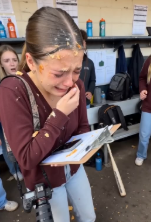
For the first time, I saw it clearly: Vivian was not just protected by her father. She was trapped in his protection. Every favor had a hook. Every rescue had a price. Every polished smile she wore came from a house where losing was treated like betrayal.
Elena asked, “Vivian, did you know the QR code was different?”
Vivian looked at her father.
He gave her a look I could not hear but understood anyway.
Do not ruin me.
Vivian’s lips trembled.
Then Lucas spoke.
“You blamed me for donation envelopes,” he said softly. “Because if money went missing, people would already have someone to suspect.”
Vivian closed her eyes.
That was answer enough.
But then she whispered, “I thought the money would go back.”
Mr. Locke snapped, “Vivian.”
She flinched.
The room went silent.
That flinch changed everything.
Ms. Anders’ voice was careful. “Vivian, did your father ask you to make Lucas look responsible for missing equipment and donation issues?”
Vivian’s face broke.
Not dramatically. Not beautifully. Just a small collapse around the mouth, like a child trying not to cry in front of someone who punished weakness.
“He said Lucas was perfect,” she whispered. “Perfect people are easy to ruin because everyone wants to believe they were fake.”
Lucas looked away.
I felt sick.
Elena lowered the tablet.
The counselor said, “We need to contact the police.”
Mr. Locke laughed, but there was no confidence left in it. “Over school gossip and a QR code error?”
Elena tapped the screen once more.
A recording began to play.
Mr. Locke’s own voice filled the room, crisp and irritated.
“Route the first wave through the initiative account. By the time they reconcile it, the girl will have made enough noise about Meyer that nobody will trust his family’s complaint.”
Vivian put both hands over her mouth.
Her father lunged for the tablet.
Coach Brennan stepped in front of Elena.
And outside, the game announcer’s microphone crackled to life.
“Attention, everyone,” a voice said across the field. “We need all event organizers at the pavilion immediately.”
Vivian stared at the open door.
The whole field was about to learn why the charity money had vanished.
Part 7: Vivian Finally Said The Name He Feared
The pavilion filled faster than anyone expected.
Parents came first, then students, then coaches still holding clipboards and half-finished raffle tickets. The charity banners snapped in the evening wind, bright and cheerful above faces that had gone tense with dread.
Mr. Locke tried to leave.
Elena blocked him with one sentence.
“The board has frozen the account.”
He stopped.
Vivian stood beside Ms. Anders, arms wrapped around herself. Her ice-blue dress looked almost gray now under the pavilion lights. I stood near Lucas, close enough to feel him shaking but not close enough to make him feel watched.
The head of school, Mr. Fournier, arrived with two security officers and a laptop. He looked older than he had that morning.
“I will keep this brief,” he said into the microphone.
A murmur rolled through the crowd.
Vivian’s friends stood near the fence, no longer surrounding her. Their distance looked louder than any insult.
Mr. Fournier explained that the charity board had found irregular donation routing. He explained that equipment concerns against Lucas Meyer were under review. He did not name Vivian at first.
But rumors move faster than announcements.
Someone shouted, “Was Lucas framed?”
Lucas went rigid.
His mother had arrived without anyone noticing.
She was still in her cleaning uniform, hair pulled back, a work badge clipped crookedly to her jacket. His father stood beside her in delivery trousers, hands rough and red from the cold. They looked at their son, then at the crowd, then at Mr. Locke.
Mrs. Meyer’s face changed.
Not into anger.
Into recognition.
Like she had spent her life seeing doors close and knew exactly who had pushed this one.
Lucas whispered, “Mum.”
She walked straight to him and touched his cheek.
“You should have told us it was this bad,” she said.
His eyes filled. “I didn’t want you to worry.”
She pulled him into her arms.
Vivian watched them.
Something in her expression shifted.
Not jealousy this time.
Hunger.
Not for attention. Not for applause.
For someone who would cross a crowd just to touch her face gently.
Mr. Locke stepped toward the microphone. “My family will not participate in this public defamation.”
Elena said, “Then answer publicly where the donations went.”
He ignored her and faced the crowd. “This is what happens when institutions punish success. My daughter has been targeted by envious students and careless staff.”
Vivian stared at him.
The old spell was trying to work.
His voice. His confidence. His certainty that if he said a thing strongly enough, weaker people would arrange themselves around it.
Then he said the wrong thing.
“Vivian made a mistake trusting the wrong classmates, but she acted under pressure from a manipulative boy and a girl with a camera.”
My breath caught.
Lucas’s mother tightened her arms around her son.
Vivian looked at me.
For one second, I thought she would let him do it.
Let him place the blame on us and carry her out of the wreckage.
Then she stepped to the microphone.
Mr. Locke turned. “Vivian, no.”
She did not look at him.
Her hands shook around the stand.
“I hid the bat,” she said.
The pavilion exploded into whispers.
Vivian’s voice cracked, but she kept going. “I helped replace the posters. I repeated things about Lucas that were not true. I threw food at Hannah because she had proof.”
My throat tightened.
Vivian looked at Lucas.
“I am sorry,” she said. “Not because I got caught. Because I knew people would believe it. And I used that.”
Lucas did not forgive her.
He only listened.
That felt more honest.
Then Vivian turned toward her father.
Her face was pale, but her voice steadied.
“But Gareth Locke planned the donation account.”
Her father went white.
She reached into her necklace, unclasped it, and pulled free the delicate pendant I had noticed earlier. It was not just jewelry.
It was a tiny storage drive.
“My mother gave me this before she left,” Vivian said. “She told me to record the truth when I was old enough to stop being afraid of him.”
Mr. Locke whispered, “You ungrateful little—”
Security stepped closer.
Vivian held out the pendant to Elena.
“Everything is on there.”
Part 8: The Pendant Opened More Than One Door
The pendant did not just expose the charity scheme.
It opened a history.
By Monday morning, the school had canceled classes for an assembly that nobody called mandatory but everyone attended. The police investigation had already begun. The foundation account was frozen. The hospital charity confirmed the rerouted donations would be recovered. Coach Brennan’s forged complaint was withdrawn, and Lucas’s scholarship nomination was restored before lunch.
But the shocking part came later.
Elena Moreau asked to meet with Lucas, his parents, me, Vivian, Ms. Anders, and the head of school in the library.
Vivian arrived without her father.
She wore a plain gray sweater and no necklace. Without her polished armor, she looked smaller, exhausted, and strangely real.
Lucas did not speak to her.
I did not blame him.
Elena placed a folder on the library table. “The files on Vivian’s pendant included more than recordings of Mr. Locke.”
Vivian stared at the folder like it might bite.
Elena continued, “There were documents from your mother, Clara Locke. She was investigating the foundation before she left.”
Vivian’s face tightened. “My father said she left because she was unstable.”
Elena’s eyes softened. “She left because she was afraid. And because she was trying to protect evidence.”
Vivian’s hand went to the empty place at her throat.
Elena opened the folder.
Inside were old transfer records, emails, donor lists, and one sealed letter addressed in careful handwriting.
For Vivian.
No one moved.
Vivian picked it up slowly. Her fingers trembled as she opened it.
She read silently at first.
Then her breath broke.
“My darling Vivian,” she whispered.
Her voice failed.
Ms. Anders gently asked, “Would you like privacy?”
Vivian shook her head, tears sliding down her face.
“She says she didn’t abandon me,” Vivian said. “She says she tried to get custody, but he used the foundation lawyers. She says the pendant was the only thing she could leave where he wouldn’t look.”
Mr. Fournier looked down.
Lucas’s mother covered her mouth.
Vivian pressed the letter to her chest like it was the first warm thing she had held in years.
Then Elena revealed the last page.
Clara Locke had created a protected education fund before disappearing from public life. Not for Vivian alone.
For students harmed by foundation misconduct.
Lucas’s name was not on it then, of course.
But the fund’s terms were clear: any student whose scholarship, reputation, or access had been damaged by the foundation’s interference could receive full support.
Lucas stared at the document.
His father whispered, “What does that mean?”
Elena smiled faintly.
“It means Lucas does not just have his nomination back,” she said. “It means his summer academy, equipment, travel, and university preparation can be covered.”
Lucas’s mother began to cry quietly.
Lucas looked overwhelmed, almost frightened by the size of relief.
Then Elena turned to me.
“Hannah, there is also a student media protection grant attached to the fund.”
I blinked. “For me?”
“For documenting misconduct during sponsored events.” Elena’s smile widened. “Your photographs protected more than a bat.”
I looked down at my stained cardigan, washed twice but still faintly marked.
For the first time, the stain did not feel humiliating.
It felt like proof I had stood close enough to the truth to get hit by the mess around it.
Vivian stood.
Lucas tensed.
She did not come closer.
“I know sorry doesn’t fix it,” she said to him. “I know you don’t owe me anything. But I’m going to tell everyone exactly what I did. Not just the adults. Everyone.”
Lucas looked at her for a long time.
Then he said, “Start with my little brother’s team.”
Vivian nodded, crying harder. “I will.”
She turned to me next.
“I hated you because you saw things,” she said. “I thought that made you dangerous.”
I shook my head. “No. What was dangerous was everyone pretending not to see.”
A week later, the charity game was replayed in a smaller park outside the city. No sponsor banners from the Locke foundation. No glossy speeches. Just students, parents, hospital volunteers, and a new donation code checked by four separate adults.
Lucas threw the first pitch.
His little brother caught it.
The crowd cheered so loudly that Lucas laughed into his glove, embarrassed and bright.
Vivian stood near the donation table, not in charge, not surrounded, just working. When Lucas’s mother handed her a stack of raffle tickets, Vivian accepted them with both hands and said thank you like she meant it.
Near the end of the day, Ms. Anders found me by the fence.
“Keep taking pictures,” she said.
I lifted my camera.
Across the field, Lucas was smiling with his family. Vivian was taping up a poster with shaking hands but steady eyes. Elena was checking the donation tablet. And above them all, the evening light spread gold over a field that had almost been ruined by lies.
I pressed the shutter.
This time, the photo did not catch the moment everything fell apart.
It caught the moment everyone finally chose to rebuild.
