Part 2: The Email She Could Not Unsend
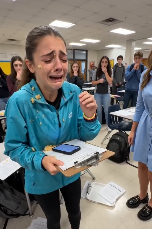
The food hit my windbreaker and slid down the cobalt fabric in a slow, humiliating smear.
For one second, the whole newspaper room stopped breathing.
Then chairs scraped. Someone gasped. Someone whispered my name like I was the one who had done something wrong. The smell of cold cafeteria pasta sauce filled the air, sharp and sour, mixing with printer ink, paper dust, and the burned-coffee smell from the editor’s desk.
Vivian Locke stood two feet away from me, her hand still frozen in the air.
Her ice-blue shirt dress looked untouched. Her necklace caught the fluorescent light. Her glossy loafers were planted like she owned the floor.
My folder was still in my hand.
That was why she looked scared.
“Jada,” Ms. Ellery, the newspaper advisor, said from across the room. “Are you hurt?”
I shook my head, even though my chest felt tight and my hands would not stop trembling.
Vivian laughed once, soft and poisonous. “She’s fine. She just loves making scenes.”
I looked down at the sauce on my jacket.
Then I looked up at her.
“No,” I said. “You made this one.”
Her smile twitched.
Ms. Ellery came between us. “Vivian, step back.”
Vivian’s eyes stayed on the folder. “She stole documents.”
“I printed emails,” I said. “From the club-fee thread you told me didn’t exist.”
The room shifted.
Students who had been whispering stopped. The copy editor lowered her red pen. Two juniors near the layout computer turned fully around.
Vivian’s voice sharpened. “That thread was internal.”
“No,” I said. “It included student newspaper questions because you submitted the article for final deadline.”
Ms. Ellery’s face changed. “What email thread?”
I opened the folder.
My fingers almost slipped because sauce had reached the edge of the paper, but the top page was still clean. At the top was the principal’s reply email, printed with the header, timestamp, and full chain.
Vivian lunged.
Not all the way.
Just enough.
The whole room saw it.
Ms. Ellery grabbed the folder before Vivian could reach it. “Do not touch this.”
Vivian’s face went pale under the makeup.
Ms. Ellery read the first page.
Her lips parted slightly.
The room was so quiet I heard the printer finish a job on the far side of the room, one page sliding into the tray like even the machine wanted proof.
Ms. Ellery read aloud, voice low but clear.
“Per our review, the activity fee collection method described in the draft article was not approved by administration. Students who paid mandatory club participation fees must be refunded.”
The room erupted.
“What?”
“Refunded?”
“Wait, mandatory fees?”
Vivian snapped, “That’s not what it means.”
Ms. Ellery looked at her. “It says exactly what it means.”
Vivian’s eyes darted toward the layout monitor.
That was when I remembered.
The final article was still open.
Her version.
The polished-school-image version.
The headline said:
STUDENT CLUBS THRIVE UNDER NEW VOLUNTARY SUPPORT PROGRAM.
Voluntary.
I walked to the computer before she could.
Vivian shouted, “Don’t touch my layout!”
But Ms. Ellery was already beside me.
The article claimed all club fees were optional donations. It quoted Vivian as student editor-in-chief. It praised the “community spirit” of students contributing to activities.
It did not mention that kids had been told they could not participate unless they paid.
It did not mention refunds.
It did not mention the principal’s email.
Ms. Ellery turned slowly toward Vivian.
“Why did you remove the correction?”
Vivian’s mouth opened.
Then the newspaper room door swung open.
Principal Harlan stepped in, holding his phone, his face grim.
“I received a message saying there was a disruption,” he said.
No one spoke.
He saw the sauce on my jacket.
Then he saw the email in Ms. Ellery’s hand.
And Vivian Locke stopped looking scared.
She looked cornered.
Part 3: The Draft That Lied For Her
Principal Harlan did not raise his voice.
That made the room feel worse.
He walked to the editor’s desk, looked at the open article, then looked at Vivian. His eyes lingered on the headline.
“Voluntary support program?” he asked.
Vivian swallowed. “That was the wording we had before the clarification.”
Ms. Ellery held up the printed email. “The clarification was sent yesterday.”
The word yesterday landed hard.
Because final deadline was today.
Because Vivian had had time.
Because the lie was not an accident.
Principal Harlan took the printed email and scanned it. “I replied to this thread at 4:37 p.m.”
I nodded. “That’s why I asked to delay publication.”
Vivian cut in. “She demanded we kill the whole article.”
“I asked you to correct it,” I said.
She turned on me. “You were trying to embarrass the clubs.”
“No. I was trying to stop students from being blamed for asking for their money back.”
A boy named Marcus stood near the sports desk, his camera strap hanging from his hand. “My little sister paid that fee.”
Vivian’s eyes flashed. “Nobody forced her.”
Marcus stared at her. “The debate club sponsor told them no payment, no tournament list.”
The room shifted again.
One truth made room for another.
A sophomore from yearbook said, “Art club did that too.”
A girl at the copy table whispered, “Robotics called it a materials requirement.”
Principal Harlan’s expression tightened with every sentence.
Vivian looked around like the room had betrayed her by becoming full of witnesses.
“This is not my fault,” she said. “I was reporting what club officers submitted.”
Ms. Ellery clicked into the article history.
The school newspaper platform opened its revision log.
Draft 1: Club Fee Investigation.
Draft 2: Principal Confirms Refund Review.
Draft 3: Mandatory Fees Violated Policy.
Then a later draft.
Draft 4: Student Clubs Thrive Under New Voluntary Support Program.
Edited by: V. Locke.
Time: 9:12 p.m.
Ms. Ellery went still.
“Vivian,” she said, “you changed the article after the principal replied.”
Vivian’s jaw tightened. “I improved the tone.”
“You erased the facts.”
“I protected the paper.”
I looked at her.
“No,” I said. “You protected your image.”
Her face snapped toward me.
There it was—the real wound.
Not the fees.
Not the article.
The image.
Vivian Locke, perfect editor-in-chief, perfect school ambassador, perfect girl in the perfect photo beside perfect headlines. She had built herself on being the one who made the school look clean.
But the record was dirty.
And I had brought it into the room.
Principal Harlan scrolled through the deleted text. His face darkened when he reached one paragraph.
“What is this?”
Ms. Ellery leaned over.
I knew before she read it.
It was the paragraph I wrote.
The one about students who had quietly dropped clubs because their families could not pay.
Vivian had deleted every word.
Principal Harlan clicked restore preview.
My paragraph appeared on the screen.
Then the line beneath it.
Editor note: remove hardship angle. Makes school look predatory.
Nobody spoke.
Vivian whispered, “That was private.”
I stared at the words.
Hardship angle.
As if students struggling to afford fees were a style problem.
Then the printer started again.
One page slid out.
Ms. Ellery picked it up.
Her hand shook.
It was an anonymous tip submission from the newspaper inbox.
Subject line:
Vivian told club officers to deny everything.
Part 4: The Club Officers Started Talking
Vivian moved toward the printer.
Principal Harlan stopped her with one look.
“Sit down,” he said.
She did not sit.
But she stopped.
Ms. Ellery read the anonymous tip twice, then opened the newspaper inbox on the main screen. The room watched as she clicked through the attached screenshots.
The first screenshot showed a group chat.
Vivian’s name at the top.
Her message was highlighted.
If anyone asks, fees were suggested donations. Do not use the word required.
A second screenshot.
Jada is digging. Keep answers vague until after publication.
A third.
Once the article runs, the story becomes school spirit, not complaints.
My stomach tightened.
She had not just removed the truth.
She had organized people around the lie.
Principal Harlan turned to the room. “Who is in that chat?”
Nobody moved.
Then Marcus raised his hand slightly. “My sister is.”
Vivian said, “This is insane.”
A senior from student council, Nora, stood near the back of the room with tears shining in her eyes.
“I am too,” she said.
Vivian whipped toward her. “Nora.”
Nora flinched, but kept going.
“She told us the principal’s email was being misread. She said if families found out about refunds before the paper published, the clubs would lose funding and everyone would blame us.”
Principal Harlan’s voice was careful. “Who collected the fees?”
Nora looked down. “Club officers collected them for some groups. Sponsors collected them for others.”
“Were students told payment was optional?”
Nora shook her head.
A quiet anger moved through the room.
Not loud.
Worse.
The kind that makes people stop needing permission to believe what they already saw.
Vivian’s eyes were wet now, but her voice stayed sharp. “I was trying to prevent panic.”
I laughed once, but it came out broken.
“By lying?”
“By controlling the message.”
“That’s the same thing when the message is false.”
She stepped toward me. Ms. Ellery moved between us again.
Principal Harlan opened his phone and made a call.
“Yes,” he said. “I need the activities office fee records brought to the newspaper room now. All club deposit sheets from this semester.”
Vivian went still.
So still the whole room noticed.
That was when I understood.
The article was only the surface.
The fee records were the thing she feared most.
Ten minutes later, Assistant Principal Greer arrived with a box of deposit folders. She looked confused until she saw my jacket and the article on the screen.
“What happened?”
Principal Harlan said, “We are verifying club fee collections.”
Vivian said quickly, “Those are not newspaper records.”
“No,” he said. “They are school records.”
He opened the first folder.
Debate Club.
Deposit sheet.
Cash envelopes.
Student names.
Fee amount: $45.
Required participation support.
Principal Harlan’s mouth tightened.
He opened another.
Art Club.
Robotics.
Drama.
Marching Auxiliary.
Each folder told the same story in different handwriting.
Then Assistant Principal Greer pulled out a blue folder from the bottom of the box.
“This one was separated,” she said.
Vivian’s face drained.
On the tab was written:
Newspaper Booster Features.
Part 5: The Feature Package Nobody Paid For
Principal Harlan opened the blue folder.
Inside were glossy mockups of newspaper pages, sponsor forms, club profiles, and photo placement notes. At first, it looked like normal journalism planning. Then Ms. Ellery pulled out a spreadsheet.
The columns made the room go cold.
Club Name.
Fee Collected.
Feature Priority.
Photo Size.
Quote Placement.
A line near the top showed Student Council.
Fee collected: $300.
Feature priority: front page sidebar.
Debate Club.
Fee collected: $225.
Feature priority: full quote.
Art Club.
Fee collected: $180.
Feature priority: photo strip.
Marcus leaned over the desk. “What is this?”
Vivian whispered, “It’s not what it looks like.”
Principal Harlan did not look at her. “It looks like clubs that collected more money were promised better coverage.”
Ms. Ellery looked sick. “Vivian, did you sell newspaper placement?”
“No,” she said. “It was a booster appreciation layout.”
“Were students told this?”
Vivian’s lips pressed shut.
Nora wiped her face. “She said if clubs contributed more, the paper could highlight their programs better.”
Marcus said, “That’s selling coverage.”
Vivian snapped, “You all loved the coverage when your clubs looked good.”
“That’s not consent,” I said, “if nobody knew the article was tied to money.”
She glared at me. “You think you’re so clean because you don’t understand how things actually get funded.”
“No,” I said. “I understand that students paid fees they weren’t supposed to pay, and your article tried to make it look voluntary.”
Assistant Principal Greer pulled another paper from the folder.
Her eyebrows drew together.
“This is a refund risk list.”
Principal Harlan looked up sharply. “A what?”
She placed it on the table.
The spreadsheet listed students who had paid club fees.
Some names were highlighted yellow.
Next to them were notes.
Likely to request refund.
Parent may complain.
Needs quiet handling.
My name was not on the list.
But Marcus’s sister was.
Nadia from debate.
Owen from robotics.
A freshman named Celia, whose family had asked for a payment extension.
Ms. Ellery’s voice shook. “Who made this?”
Vivian said nothing.
Principal Harlan checked the file metadata from the printed footer.
Created by: VLOCKE.
The room seemed to tilt.
“You made a list of students who might ask for their money back?” I asked.
Vivian’s face twisted. “I made a communication plan.”
“You made a pressure list.”
She looked at me with sudden fury. “You don’t know what pressure is.”
The words echoed strangely.
Then she broke.
“My mother said if the refund story ran, the booster board would blame me. She said I had one job—keep the paper positive until sponsorship renewals.”
Principal Harlan closed the folder slowly.
“Your mother?”
Vivian immediately looked like she wished she could swallow the sentence back.
Before anyone could ask more, her phone buzzed on the desk.
A message preview lit the screen.
MOM.
Did you stop the refund article? The principal can’t force this if the paper already published.
Part 6: Her Mother Entered Like A Sponsor
No one touched the phone.
No one needed to.
The message sat there long enough for the room to understand that Vivian had not invented the pressure alone.
Principal Harlan looked exhausted, but not surprised. That bothered me. It meant adults had known families like the Lockes could bend a room.
“Vivian,” he said quietly, “is your mother on the booster board?”
Vivian stared at the floor.
“Yes.”
Ms. Ellery closed her eyes.
The door opened before anyone knocked.
Mrs. Locke entered in a camel coat, pearl earrings, and the kind of expression adults wore when they expected their name to solve the problem before the problem spoke.
“Principal Harlan,” she said. “I was told there was an issue with student publication judgment.”
Her eyes passed over me.
Then over the sauce on my jacket.
She did not ask what happened.
Instead, she said, “This must be Jada.”
The way she said my name made it sound like evidence she had already decided to reject.
Vivian whispered, “Mom, don’t.”
Mrs. Locke ignored her.
Principal Harlan stood. “A student was assaulted, and evidence suggests the newspaper article was altered to conceal improper club fees.”
Mrs. Locke smiled politely. “Assaulted is a strong word.”
“She threw food at me,” I said.
Mrs. Locke looked at my jacket again. “Teenagers lose composure during stressful deadlines.”
Ms. Ellery’s voice turned cold. “Vivian tried to grab evidence from Jada’s folder.”
“Evidence?” Mrs. Locke repeated, amused. “This is a school newspaper, not a courtroom.”
Principal Harlan held up the refund email. “This is my reply instructing correction before publication.”
Mrs. Locke’s smile thinned.
“Your reply created unnecessary liability.”
The room went silent.
Principal Harlan stared at her. “The liability was collecting unauthorized fees.”
“The liability,” Mrs. Locke said, “is announcing refunds before the district has a messaging plan.”
Messaging plan.
I felt something inside me harden.
That was what they called the truth when it threatened them.
Mrs. Locke stepped toward Vivian. “Get your things. We are leaving.”
Principal Harlan blocked the path just slightly. “Vivian needs to remain while we preserve records.”
Mrs. Locke’s eyes sharpened. “You cannot hold my daughter because another student made a mess.”
Vivian suddenly said, “Jada didn’t make it.”
Her mother turned.
Vivian’s face was pale. “I did.”
For the first time, Mrs. Locke looked truly angry.
Not scared.
Angry that Vivian had spoken without permission.
“Vivian,” she said softly, “stop helping them misunderstand you.”
Vivian flinched.
The whole room saw it.
Then Assistant Principal Greer, who had been examining the blue folder, pulled out a stapled packet.
“Principal Harlan,” she said, voice tight, “there’s a booster email chain printed here.”
Mrs. Locke reached for it.
Ms. Ellery got there first.
She read the top email.
Then she looked at Mrs. Locke.
The subject line was clear:
Delay Refund Notice Until After Publication Window.
Part 7: The Email Chain Named The Adults
Mrs. Locke stopped smiling.
That was when the room truly changed.
Vivian had looked scared when her own edits appeared. She had looked trapped when her mother’s text lit up. But Mrs. Locke losing her smile made the adults stand differently.
Principal Harlan took the email chain from Ms. Ellery.
He read the first page.
Then the second.
By the third, his jaw was locked.
“This includes booster board members,” he said.
Assistant Principal Greer nodded grimly. “And two club sponsors.”
Ms. Ellery whispered, “They knew refunds were required.”
Mrs. Locke’s voice was smooth again, but thinner now. “They knew refunds might be discussed. That is different.”
Principal Harlan read aloud.
“Delay direct student communication until after positive coverage stabilizes parent perception.”
Marcus muttered, “That means lie first.”
Mrs. Locke looked at him. “Young man—”
“No,” Principal Harlan said. “He is correct.”
The room froze around those words.
Principal Harlan placed the email chain on the desk, then looked at me.
“Jada, I owe you an apology.”
My throat tightened.
I had not expected that.
“You brought this to the right place,” he said. “The delay was not your fault.”
I could not answer right away.
Because the whole day had been built to make me feel like I was too loud, too suspicious, too ordinary to question polished people.
And now the principal had said, in front of everyone, that I had been right to keep the folder.
Mrs. Locke’s face hardened. “This is becoming performative.”
Vivian let out a small, broken laugh. “That’s what you always say when people tell the truth where others can hear.”
Mrs. Locke turned slowly.
“Excuse me?”
Vivian’s hands shook, but she did not stop.
“You told me to change the angle. You told me Jada would look emotional if I forced a scene. You told me everyone would remember the stain, not the email.”
My chest went cold.
Ms. Ellery looked at Vivian. “Forced a scene?”
Vivian’s eyes filled.
“She told me if Jada wouldn’t drop the folder, I had to make the deadline room focus on Jada instead of the article.”
Mrs. Locke said, “That is not what I meant.”
Vivian wiped her cheek with the back of her hand.
Then she reached into her bag and pulled out a small recorder.
“I knew you’d say that.”
No one moved.
Vivian set it on the table.
Her voice was barely above a whisper.
“I recorded the call because I was scared you’d blame me if the article failed.”
Principal Harlan looked at Mrs. Locke.
Mrs. Locke’s face had gone gray.
Ms. Ellery pressed play.
Mrs. Locke’s voice filled the newspaper room, crisp and unmistakable.
“If the Miller girl refuses to cooperate, make her the disruption. Deadlines are emotional. Use that.”
Then Vivian’s recorded voice, smaller than I had ever heard it:
“What if she has the principal’s email?”
Mrs. Locke replied:
“Then make everyone look at her before they look at the proof.”
The room went absolutely still.
The sauce on my jacket had dried by then.
But suddenly, I felt the humiliation all over again.
Not as an accident.
As a plan.
Principal Harlan reached for his phone.
“This is going to the district tonight,” he said.
Part 8: The Article They Finally Printed
The final edition did not publish that night.
For the first time in years, the school newspaper missed a deadline.
Nobody celebrated that.
Ms. Ellery sat at the editor’s desk after everyone left, staring at the frozen layout like it had personally betrayed her. The room was quieter than I had ever heard it. No keyboard tapping. No printer humming. No Vivian giving orders in her polished voice.
Just the low buzz of lights and the faint smell of sauce still clinging to my jacket.
Principal Harlan sent me to the nurse, then called my mother.
By morning, the district had frozen club fee collections, suspended the booster board’s access to student activity funds, and ordered a full refund review.
Vivian was removed as editor-in-chief pending investigation.
Two club sponsors were placed on administrative leave.
Mrs. Locke resigned from the booster board before anyone could vote her out, but the email chain was already in district hands.
The hallway version spread fast.
Some people said Vivian had lost everything because of me.
Some said I had wanted attention.
Some said the refunds proved I was right.
I learned that people will still argue with evidence if the truth makes their favorite person look bad.
But the students who had paid fees stopped whispering.
They started bringing receipts.
By Friday, Ms. Ellery called a new newspaper meeting.
I almost did not go.
My windbreaker had been washed, but one faint stain remained near the zipper. I wore it anyway.
When I entered the room, everyone looked at me.
Vivian was there.
Not at the editor’s desk.
In a regular chair.
No delicate necklace. No camera-ready smile. Just tired eyes and a folder in her lap.
Ms. Ellery stood at the front. “We are printing a corrected issue. Fully sourced. No booster language. No image management.”
Then she looked at Vivian.
Vivian stood.
Her hands trembled as she opened her folder.
“I altered the article,” she said. “I removed the refund information after Principal Harlan confirmed it. I helped create a scene to discredit Jada. And I threw food at her because I wanted people looking at her instead of the email.”
Nobody rescued her from the silence.
That was good.
Some silences are deserved.
Vivian looked at me.
“I’m sorry,” she said. “Not because the recording exposed me. Because I used the thing that makes you strong—checking what people ignore—and tried to make it look like a flaw.”
I did not forgive her in that room.
Forgiveness would have made the moment too neat.
So I said, “Print the truth.”
She nodded.
And for once, she did.
The corrected article ran Monday morning.
The headline was simple:
School To Refund Unauthorized Club Fees After Student Record Review.
My name was not in the headline.
Vivian’s was not either.
The article listed the facts: the principal’s reply email, the revised policy, the refund process, the student impact, and the investigation into booster influence.
There was no polished-school-image ending.
There was a QR code where students could check refund eligibility.
By lunch, the line outside the activities office wrapped past the trophy case.
Marcus’s sister got her money back.
Nadia from debate got hers.
Celia, the freshman on the risk list, cried when Assistant Principal Greer handed her a refund form and apologized.
A month later, the newspaper room changed.
The editor’s desk no longer belonged to one person. Every major article required a source log. Corrections were printed on the front page, not hidden online. Booster board members were banned from reviewing student articles before publication.
Ms. Ellery asked me to join the paper officially.
I said yes, but not as editor.
As records manager.
Vivian stayed too, after suspension and review, but she was not allowed near final approval. She did copy edits, checked commas, and sat through every ethics training without complaint.
One afternoon, she placed a clean folder on my desk.
Inside was the original principal reply email, printed again, this time sealed in a plastic sleeve.
“I thought you should keep the copy that survived the deadline,” she said.
At the bottom, she had written one sentence in blue ink:
The story changed because you refused to drop the record.
I looked at the folder.
Then at the faint stain still visible on my windbreaker sleeve.
For the first time, it did not feel like humiliation.
It felt like proof.
And when the next deadline came, I walked into the newspaper room carrying a new folder, and nobody laughed when I asked to check the source.
